Free email delivery
Please sign up for email delivery in the subscription area to the right.
No salesman will call, at least not from us. Maybe from someone else.
We’d been roasting in the San Fernando Valley and smoke from the nearby 35,000-acre Sand Canyon fire darkened our sky, turning the sun into a small beet. Malibu, just to be different, was cool with fog so thick we could barely make out birds on the sand islands 100 yards away.
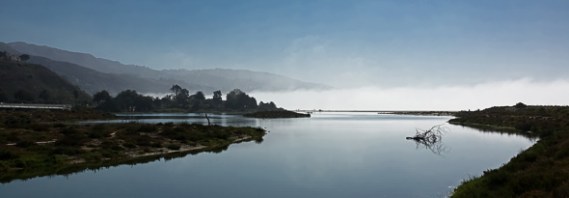
The fog in retreat (C. Bragg 7-24-16)
The fog suddenly lifted about 9:30, and the Ospreys went fishing. One of the lagoon’s numerous long, thin Jumping Mullet was snagged, and the bird retired to breakfast in a cypress tree. Fish head first, was the method. I hoped that the
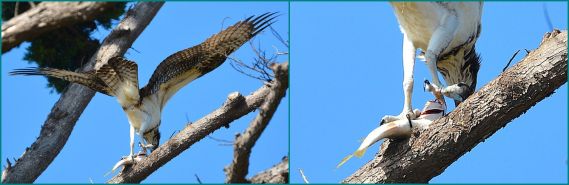
Osprey & fish, a closeup (G. Murayama 7-24-16)
occasional fish tail twitch was caused by the bird jerking the fish around with its long talons, and not that the fish still survived. One of their favorite resting places in in the large, deep-green coniferous araucaria* or Monkey-puzzle tree across the lagoon at Adamson House.

Osprey and fish (C. Bragg 7-24-16)
Least Terns usually show up shortly before and shortly after they have bred elsewhere, such as at the colonies at Venice Beach or Pt. Mugu Naval Air Station. One bird repeated plunged into the lagoon, occasionally emerging with tiny silvery fish slightly larger than its slender bill, which it took to another bird waiting on the sand flat near the lagoon.

Black-vented Shearwaters off San Diego
(Brad Weinert & Lynn Ferguson-Weinert 10-6-12)
A large raft of Black-vented Shearwaters rested well out on the ocean – scope views only. As they began to rise and drift away through the calm air and low seas, we could see their extensive white undersides. At 14” long (wingspan 34”) these are the smallest of the shearwaters who regularly visit California waters. Near-neighbors, 95% of them nest on three islands (Guadeloupe, San Benito and Nativitad) off central Baja’s western coast. All other west coast shearwaters are visitors from distant lands like New Zealand, Australia or southern South America.
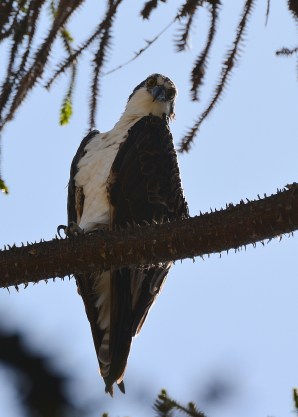
The medusa-like glare of the Osprey
(G. Murayama 7-24-16)
Except for the solitary Brant, which is after all merely a Goose, Mallard and Gadwall were the only duck species present, and most of those were ducklings trailing their mothers. Shorebirds came and went, with one flock of Black-bellied Plovers coasting past our head to land near the flock of Brown Pelicans and Western Gulls, joining the Willets and Whimbrels.
We gave away free gifts – some gifts you have to pay for, but not ours, because they’re free! – which some guests seemed to appreciate while others scratched their heads. Come next month and we may have more.

Do you think this is a sparrow?
(C. Bragg 7-24-16)
Birders often visit from afar. Malibu Lagoon is somewhat famous, you might know, among birders of the world, just as Surfrider Beach is famous among the surfing and beach party bingo crowd, and our SMBAS blog is read in over 100 countries. Joining us this month was Otto Mayer, down from Portland, Oregon and visiting his grandmother who thoughtfully brought him to the lagoon. I think the Least Terns were a lifer for him. He inquired as to whether any California Thrashers might be in the lagoon vicinity, but unfortunately they much prefer the chaparral of the nearby hills.

The usual suspects on the beach (C. Bragg 7-24-16)
By the time we left Adamson House and its endless parade of wedding guests and caterers, the day had warmed and sweat has soaked my shirt to render my checklist damp and the ink runny.
*Araucaria trees are a very interesting family of conifers, about which we’ll someday post a blog.

Killdeer and Semipalmated are close relatives of the Snowy Plover
(C. Bragg 7-24-16)
Welcome Back Snowy Plovers! We found nine roosting in the eastern enclosure, with three more foraging by the lagoon’s edge. Among them was GA:OY (left leg green band over aqua, right leg orange over yellow). My records show this bird was banded the summer of 2014 at Oceano Dunes near Pismo Beach. It’s appeared on four previous Sunday walks: 12/25/14, 1/25/15, 9/27/15 and 11/22/15. It’s also been reported on 10/6/15 by Bill Crowe and 12/ 5/15 and 1/19/16 by Grace Murayama. The birds first appeared on 7/4/16 when Snowy Plover aficionados Grace Murayama and Larry Loeher found six birds, including first-timer banded bird NR:NR.

At long last, the coots have returned! (C. Bragg 7-24-16)
Birds new for the season were: Western Grebe, Black-vented Shearwater, Turkey Vulture, American Coot, Snowy Plover, Semipalmated Plover, Spotted Sandpiper, Whimbrel, Ruddy Turnstone, Least Sandpiper, Least Tern, American Kestrel, American Robin, Spotted Towhee, Bullock’s Oriole.
As always, many thanks to our photographers: Chuck Bragg and Grace Murayama.
Our next four scheduled field trips: Lower Los Angeles River 7am, 27 Aug; Malibu Lagoon 8:30 & 10am, 28 Aug; Coastal Cleanup Day – Malibu Lagoon 9am, 17 Sep; Malibu Lagoon 8:30 & 10am, 25 Sep.

Common Yellowthroat singing (Chuck Bragg 2-28-16)
Our next program: Roadrunners with Mark Mendelsohn, Tuesday, 4 Oct, 7:30 pm; Chris Reed Park, 1133 7th St., NE corner of 7th and Wilshire Blvd. in Santa Monica.
NOTE: Our 10 a.m. Parent’s & Kids Birdwalk meets at the shaded viewpoint just south of the parking area. Watch for Willie the Weasel. He’ll be watching for you and your big floppy feet.
Links: Unusual birds at Malibu Lagoon
9/23/02 Aerial photo of Malibu Lagoon
Prior checklists:
2016: Jan-June 2015: Jan-May, July-Dec
2014: Jan-July, July-Dec 2013: Jan-June, July-Dec
2012: Jan-June, July-Dec 2011: Jan-June, July-Dec
2010: Jan-June, July-Dec 2009: Jan-June, July-Dec
The 10-year comparison summaries created during the project period, despite numerous complaints, remain available on our Lagoon Project Bird Census Page. Very briefly summarized, the results unexpectedly indicate that avian species diversification and numbers improved slightly during the period Jun’12-June’14. [Chuck Almdale]
| Malibu 2016 | 2/28 | 3/27 | 4/24 | 5/22 | 6/26 | 7/24 |
| Temperature | 57-70 | 55-65 | 60-67 | 61-66 | 68-72 | 68-76 |
| Tide Lo/Hi Ht. | L+1.38 | H+3.43 | H+3.63 | H+3.69 | L+0.32 | L+0.20 |
| Tide Time | 0654 | 1228 | 1143 | 1101 | 0831 | 0707 |
| Brant | 3 | 2 | 1 | 2 | 1 | |
| Gadwall | 20 | 14 | 4 | 8 | 18 | |
| American Wigeon | 16 | 10 | ||||
| Mallard | 22 | 16 | 18 | 4 | 30 | 25 |
| Northern Shoveler | 12 | 14 | ||||
| Green-winged Teal | 8 | |||||
| Lesser Scaup | 5 | |||||
| Surf Scoter | 17 | 16 | ||||
| Bufflehead | 2 | |||||
| Red-breasted Merganser | 3 | 2 | 1 | 1 | ||
| Ruddy Duck | 10 | |||||
| Red-throated Loon | 2 | |||||
| Pacific Loon | 1 | 2 | ||||
| Common Loon | 1 | 1 | ||||
| Pied-billed Grebe | 8 | 3 | 1 | 2 | ||
| Horned Grebe | 1 | |||||
| Eared Grebe | 5 | 2 | ||||
| Western Grebe | 1 | 1 | 1 | |||
| Black-vented Shearwater | 200 | |||||
| Brandt’s Cormorant | 4 | 2 | ||||
| Double-crested Cormorant | 19 | 6 | 23 | 7 | 35 | 18 |
| Brown Pelican | 43 | 28 | 77 | 14 | 94 | 39 |
| Great Blue Heron | 4 | 3 | 2 | 3 | 3 | |
| Great Egret | 1 | 5 | 2 | 1 | 7 | 4 |
| Snowy Egret | 7 | 7 | 4 | 2 | 6 | 8 |
| Blk-crwnd N-Heron | 2 | |||||
| Turkey Vulture | 2 | |||||
| Osprey | 3 | 1 | 1 | 2 | ||
| Cooper’s Hawk | 1 | 1 | 2 | |||
| Red-shouldered Hawk | 1 | |||||
| Red-tailed Hawk | 1 | |||||
| American Coot | 65 | 53 | 4 | 2 | ||
| Black-necked Stilt | 19 | |||||
| Blk-bellied Plover | 32 | 8 | 20 | 6 | 6 | 60 |
| Snowy Plover | 4 | 3 | 12 | |||
| Semipalmated Plover | 8 | 4 | ||||
| Killdeer | 4 | 3 | 2 | 6 | 8 | 6 |
| Spotted Sandpiper | 1 | 1 | 1 | 3 | ||
| Willet | 8 | 12 | 10 | 16 | 11 | 30 |
| Whimbrel | 4 | 21 | 2 | 16 | ||
| Marbled Godwit | 22 | 15 | 6 | |||
| Ruddy Turnstone | 5 | 1 | 5 | |||
| Surfbird | 1 | |||||
| Least Sandpiper | 13 | 7 | 15 | |||
| Western Sandpiper | 4 | 35 | 1 | 1 | 7 | |
| Long-billed Dowitcher | 2 | |||||
| Common Murre | 3 | |||||
| Bonaparte’s Gull | 1 | 3 | ||||
| Heermann’s Gull | 1 | 2 | 8 | 130 | 12 | |
| Mew Gull | 1 | |||||
| Ring-billed Gull | 90 | 15 | 1 | 26 | 1 | |
| Western Gull | 160 | 45 | 60 | 23 | 120 | 45 |
| California Gull | 650 | 130 | 15 | 3 | 3 | |
| Thayer’s Gull | 1 | |||||
| Glaucous-winged Gull | 4 | 1 | 1 | |||
| Least Tern | 2 | |||||
| Caspian Tern | 3 | 19 | 9 | 11 | 2 | |
| Forster’s Tern | 1 | |||||
| Royal Tern | 31 | 18 | 2 | 48 | 5 | 3 |
| Elegant Tern | 5 | 1800 | 10 | 110 | 10 | |
| Rock Pigeon | 6 | 6 | 6 | 1 | 23 | 4 |
| Mourning Dove | 2 | 2 | 1 | 2 | 2 | |
| Anna’s Hummingbird | 2 | 1 | 3 | |||
| Allen’s Hummingbird | 3 | 4 | 4 | 2 | 1 | 5 |
| Belted Kingfisher | 1 | |||||
| American Kestrel | 1 | |||||
| Nanday Parakeet | 8 | 2 | ||||
| Black Phoebe | 8 | 6 | 4 | 1 | 2 | 7 |
| Say’s Phoebe | 1 | |||||
| Cassin’s Kingbird | 1 | |||||
| Western Scrub-Jay | 1 | 2 | 1 | 1 | ||
| American Crow | 23 | 6 | 4 | 4 | 6 | 3 |
| Common Raven | 1 | 1 | ||||
| Violet-green Swallow | 1 | |||||
| Rough-winged Swallow | 10 | 10 | 6 | 6 | 4 | |
| Cliff Swallow | 1 | 6 | 4 | 7 | 15 | |
| Barn Swallow | 6 | 4 | 4 | 20 | 20 | |
| Oak Titmouse | 1 | 1 | ||||
| Bushtit | 4 | 5 | 4 | 2 | 15 | |
| House Wren | 1 | |||||
| Bewick’s Wren | 1 | 1 | ||||
| Ruby-crowned Kinglet | 1 | |||||
| Western Bluebird | 1 | |||||
| Hermit Thrush | 3 | 1 | ||||
| American Robin | 2 | 1 | 1 | |||
| Northern Mockingbird | 3 | 4 | 6 | 2 | 2 | 2 |
| European Starling | 90 | 1 | 2 | 2 | 10 | 40 |
| Common Yellowthroat | 5 | 5 | 1 | 1 | 4 | |
| Yellow-rumped Warbler | 9 | |||||
| Spotted Towhee | 1 | 1 | ||||
| California Towhee | 2 | 5 | 3 | |||
| Song Sparrow | 3 | 12 | 14 | 2 | 3 | 3 |
| White-crowned Sparrow | 5 | 5 | ||||
| Black-headed Grosbeak | 1 | |||||
| Red-winged Blackbird | 5 | 4 | 15 | 12 | ||
| Western Meadowlark | 2 | |||||
| Brewer’s Blackbird | 6 | 12 | ||||
| Great-tailed Grackle | 1 | 9 | 3 | 3 | 4 | 20 |
| Brown-headed Cowbird | 2 | |||||
| Hooded Oriole | 1 | |||||
| Bullock’s Oriole | 2 | 1 | ||||
| House Finch | 6 | 21 | 16 | 7 | 6 | 25 |
| Lesser Goldfinch | 1 | |||||
| House Sparrow | 3 | |||||
| Totals by Type | Feb | Mar | Apr | May | Jun | Jul |
| Waterfowl | 118 | 74 | 22 | 14 | 33 | 44 |
| Water Birds – Other | 146 | 100 | 106 | 22 | 129 | 262 |
| Herons, Egrets & Ibis | 12 | 15 | 6 | 5 | 18 | 15 |
| Quail & Raptors | 4 | 2 | 1 | 1 | 3 | 5 |
| Shorebirds | 86 | 113 | 76 | 28 | 26 | 158 |
| Gulls & Terns | 939 | 219 | 1903 | 127 | 382 | 74 |
| Doves | 8 | 8 | 7 | 3 | 23 | 6 |
| Other Non-Passerines | 13 | 7 | 5 | 2 | 4 | 5 |
| Passerines | 168 | 105 | 95 | 60 | 86 | 174 |
| Totals Birds | 1494 | 643 | 2221 | 262 | 704 | 743 |
| Total Species | Feb | Mar | Apr | May | Jun | Jul |
| Waterfowl | 11 | 7 | 2 | 4 | 3 | 3 |
| Water Birds – Other | 10 | 9 | 4 | 3 | 2 | 6 |
| Herons, Egrets & Ibis | 3 | 3 | 2 | 3 | 4 | 3 |
| Quail & Raptors | 2 | 2 | 1 | 1 | 2 | 3 |
| Shorebirds | 10 | 11 | 10 | 3 | 4 | 10 |
| Gulls & Terns | 9 | 8 | 8 | 7 | 9 | 6 |
| Doves | 2 | 2 | 2 | 2 | 1 | 2 |
| Other Non-Passerines | 3 | 3 | 2 | 1 | 2 | 1 |
| Passerines | 19 | 22 | 20 | 17 | 15 | 17 |
| Totals Species – 104 | 69 | 67 | 51 | 41 | 42 | 51 |
New View of Earth and Moon
As part of our unending series of moon updates,
here’s a wonderful item from NASA.

Not photoshopped, but the far side of the moon, illuminated by the sun, as it crosses between the DSCOVR spacecraft’s Earth EPIC camera and telescope, and the Earth – one million miles away. (NASA/NOAA)
A NASA camera aboard the Deep Space Climate Observatory (DSCOVR) satellite captured a unique view of the moon as it moved in front of the sunlit side of Earth last month. The series of test images shows the fully illuminated “dark side” of the moon that is never visible from Earth.
The images were captured by NASA’s Earth Polychromatic Imaging Camera (EPIC), a four megapixel CCD camera and telescope on the DSCOVR satellite orbiting 1 million miles from Earth. From its position between the sun and Earth, DSCOVR conducts its primary mission of real-time solar wind monitoring for the National Oceanic and Atmospheric Administration (NOAA).
EPIC maintains a constant view of the fully illuminated Earth as it rotates, providing scientific observations of ozone, vegetation, cloud height and aerosols in the atmosphere. Once EPIC begins regular observations next month, the camera will provide a series of Earth images allowing study of daily variations over the entire globe. About twice a year the camera will capture the moon and Earth together as the orbit of DSCOVR crosses the orbital plane of the moon.

Images taken between 3:50pm. and 8:45pm EDT, July 16, 2016, showing the moon moving over the Pacific Ocean near North America. The North Pole is in the upper left corner of the image, reflecting the orbital tilt of Earth from the vantage point of the spacecraft. (NASA/NOAA)
The far side of the moon was not seen until 1959 when the Soviet Luna 3 spacecraft returned the first images. Since then, several NASA missions have imaged the lunar far side in great detail. The same side of the moon always faces an earthbound observer because the moon is tidally locked* to Earth. That means its orbital period is the same as its rotation around its axis.
*Tidal Locking: Also called gravitational locking or captured rotation, this occurs when the gravitational gradient makes one hemisphere of a revolving astronomical body constantly face the partner body, an effect known as synchronous rotation. A tidally locked body takes just as long to rotate around its own axis as it does to revolve around its partner. For example, the same side of the Moon always faces the Earth. Usually, only the satellite is tidally locked to the larger body. However, if both the mass difference between the two bodies and the distance between them are relatively small, each may be tidally locked to the other, as is the case for Pluto and Charon. This effect is employed to stabilize some artificial satellites.
[posted by Chuck Almdale]
Sexual Dimorphism Reversal and Polyandry – Part III
Sometimes it’s the exception that proves the rule.
Part one of this series introduced the concepts of sexual monomorphism, sexual dimorphism, briefly discussed why female choosiness of mates appears, why it drives sexual selection, and can cause extremes of sexual dimorphism. The “rule” was introduced:
Greater equality in breeding duties means greater similarity in appearance. The lesser the similarity in appearance, the lesser the involvement in breeding duties by the male, who is the more colorful bird.
Part two furthered the discussion of sexual selection and sexual dimorphism, introduced the topics of polyandry, sexual dimorphism reversal, and sexual size dimorphism reversal. Two cases of monogamous sexual dimorphism reversal were described, followed by descriptions of double-clutching and of polyandry in conjunction with monomorphism and sexual size dimorphism reversal, likely forerunners of polyandry combined with sexual dimorphism reversal.
We now introduce those polyandrous species that display sexual dimorphism reversal, and we will begin to see that the above “rule” is not quite right.

Left: Greater Painted-Snipe (male left, female right) shows reversed sexual dimorphism (Anwar Khan)
Right: Sexually monomorphic South American Painted-Snipe
(Gastón Cassus at Cornell)
Painted-Snipe (family Rostratulidae): Ancestral lines of Painted-Snipe and Jacana diverged about 47 MYA, making them each others closest relatives. An interesting case is presented by the three currently recognized species of Painted-Snipe: South American (Nycticryphes semicollaris), Greater (Rostratula benghalensis) and Australian (R. australis). The two latter species are sometimes considered subspecies of R. benghalensis; females of both species are serially polyandrous and display sexual dimorphism reversal. This is our first example of association of serial polyandry with sexual dimorphism reversal. These two species are estimated to have diverged about 16.5 MYA ago. Their lineage split from the monomorphic and monogamous N. semicollaris of South America about 34 MYA. So in this tiny family of only three species, we see the clear association of sexual dimorphism reversal with polyandry, and either monomorphism or non-reversed sexual dimorphism with typical monogamy. 3
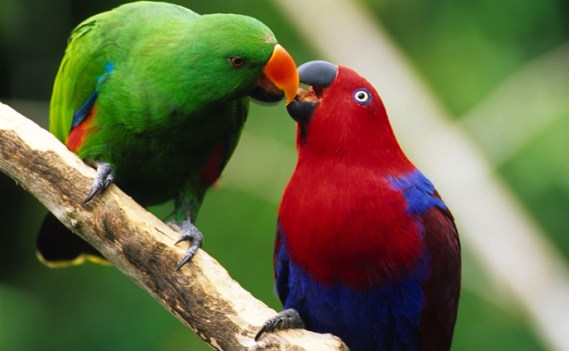
Eclectus Parrot pair, sexual dimorphism reversed; male left, female right
(Papagoi Keskus – Erispapagoi)
Eclectus Parrot (Eclectus roratus): Eclectus Parrots live in tropical eucalyptus-dominated Australasian rainforests, ranging from Indonesian Sumba and Halmahera Islands in the west, throughout New Guinea, eastward through the Solomon Islands, and in a small patch of rainforest in northeastern Australia. Both sexes are brightly plumaged: females are a colorful scarlet-and-blue; males are green, with ultraviolet pigments invisible to the human eye and less visible to hawks than to other Eclectus Parrots. They were long thought to be separate species due to this sexual dimorphism reversal. Their breeding behavior is complicated and habitat-driven.
Australasia has no woodpeckers; cavities are few and in high demand by cavity-nesting birds and marsupials. Eucalyptus wood is hard but brittle, and useful cavities appear primarily when high winds break large limbs from the trees, which leaves a hole or a large scar which a bird or marsupial might shape into a suitable cavity. The scarcity and high value of suitable nesting cavities caused this parrot to evolve a very rare polygynandrous breeding system, where both males and females mate have multiple simultaneous mates. The female defends her nest tree, which comprises her entire territory; her bright scarlet plumage warns other females that her tree is occupied and defended, and signals males of her presence. She does all incubation and nest defense, while her mates, as many as seven, keep her supplied with food. Her perpetual proximity to the nest protects her from predation from hawks. The male spends all his time foraging for fruits, nuts, etc.; his green plumage blends well with tree foliage, providing protection from hawk predation. His large territory can contain many nest trees, each with a female and her young. He mates with many females and supplies food to all of them. Thus each male has a dispersed collection of mates, all of whom they feed, and each female has multiple mates, all of whom feed her.
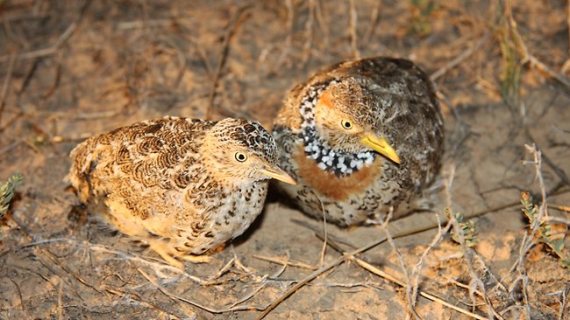
Plains-Wanderer, sexual dimorphism reversed, male left, female right
(David Baker-Gabb, Melbourne Herald Sun, November 16, 2012)
Plains-Wanderer (Pedionomus torquatus): The only species in the monotypic family Pedionomidae, the Plains-Wanderer is a classic example of serial polyandry associated with reversed sexual dimorphism, plus sexual size dimorphism reversal. These nocturnal residents of the eastern Australian grasslands are sedentary, traveling only when forced to by conditions such as overgrazing or fire, and the male does all the work of egg incubation, feeding, and protecting and raising of the young. The classification of Plains-Wanderer has changed significantly and frequently over the past few decades. Currently its closest affinities are to Seedsnipe, from whom they split 42 MYA. Their previous split was from the linage leading to Painted-Snipe and Jacana; that split occurred 51 MYA. This twig of the avian class abounds with sexual dimorphism reversals of size and plumage, as it consists of Plains-Wanderer, Seedsnipe (minor sexual size dimorphism reversal), Painted-Snipe and Jacana. 4
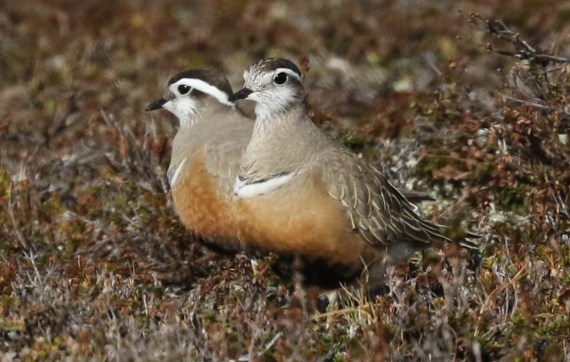
Eurasian Dotterel, female left, male right, sexual dimorphism reversed
(Killian Mullarney, Kaunispaa, Norway, May 27, 2016)
Eurasian Dotterel (Charadrius morinellus): This species of plover possesses a most peculiar breeding system. Their breeding range extends from northern Scotland, crosses Norway to far eastern Siberia, with a few additional mountainous locales in southern Europe and Siberia. They exhibit not just reversed sexual dimorphism and polyandry, but add a reversed lek*-system, followed by the female choosing of mates. In the lek the females compete, with success typically going to the most brightly colored; dominant females then choose their mate. After mating and laying her first clutch, the female may continue northwards and mate with another male. This may be repeated. With her last mate of the season her behavior can change, and she may share or completely take over nesting duties. Despite decades of study, it is difficult to identify any consistent mating behavior across this wide-ranging, far-northern species. Can it get more confusing? 5, 6
*Definition:
Lek: An aggregation of males gathered to engage in competitive displays to establish dominance. Females observe, then select their mate – usually the dominant male – then leave to nest and raise her chicks with no further help from the male.
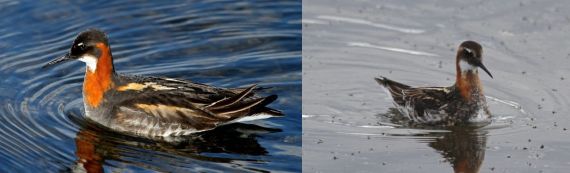
Red-necked Phalarope, sexual dimorphism reversed; female left, male right
(Joyce Waterman, Lake Myvatn, Iceland, May 27, 2014)
This brings us to the three species of Phalarope (family Scolopacidae, subfamily Phalaropodinae), a familiar example of serial polyandry associated with sexual dimorphism reversal. Females are much brighter plumaged than the males. When males are numerous, the female lays her eggs in the nest prepared by the male whom she has selected; she then moves on to another mate. The first male alone does the work of incubating the eggs and feeding, protecting and rearing the young. When males are few, females may become monogamous. One of Southern California’s earliest “fall” migrants, females begin to move through as early as early June.
The Red (Phalanopus fulicarius) and Red-necked (P. lobatus) Phalaropes are two “sister species” whose ancestral line diverged about 7 MYA. The more distantly related Wilson’s Phalarope (Steganopus tricolor), separated from them about 21 MYA. They diverged from the more-typical sandpipers about 28 MYA; the Terek Sandpiper (Xenus cinereus), is their closest relative.

Red Phalarope, sexual dimorphism reversed
female left (Joe Fuhrman – Vireo), male right (Garth McElroy – Vireo)
Both from National Audubon Society
Red and Red-necked Phalaropes are holarctic nesters, nesting in suitable areas surrounding the Arctic Ocean. Red Phalaropes winter along the southwestern coast of South America, and central and southern west coast of Africa. Red-necked Phalaropes winter along the central west coast of South America, the southern Arabian coast, and in Philippines and Indonesia archipelagos.
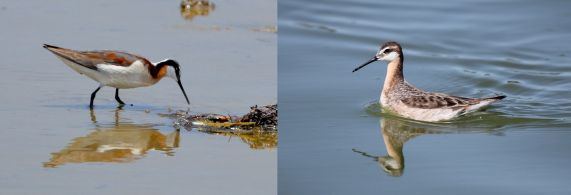
Wilson’s Phalarope, sexual dimorphism reversed
Female left (Grace Murayama, Malibu Lagoon, Ca., June 8, 2016)
Male right (Jason Crotty, Redwood City, Ca., May, 2012)
Perhaps reflecting their more distant relationship with the other two phalaropes, Wilson’s Phalaropes are entirely New World birds, nesting from southern Alaska across prairie states and provinces to eastern Ontario, and wintering across southern South America from Ecuador to southern Brazil and south to Tierra del Fuego.
In Southern California, the Wilson’s and Red-necked Phalaropes arrive with the spring (April-May) and fall (June-October) migrants. The Red Phalarope appears as a spring (April-May) migrant, but may also winter on California coasts during the September-February period. 7
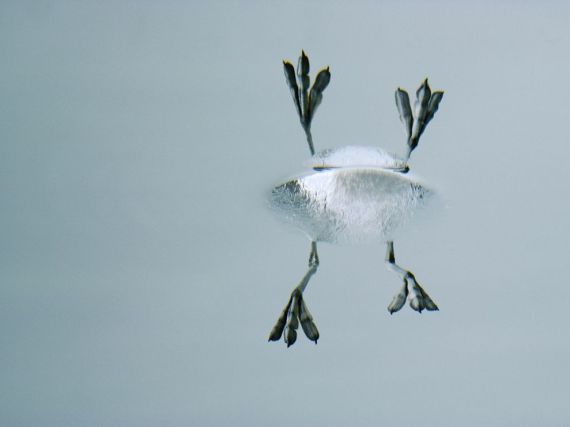
Lobed toes on diving phalarope, reflected
(Bates Littlehales at National Geographic Society)
Phalaropes differ from other sandpipers not just in their serial polyandry and sexual dimorphism reversal, but in having thick, duck-like downy plumage which enables them to float without becoming waterlogged. They can do their famous twirling feeding behavior because they have lobed toes (as do coots) and can paddle quite well. Twirling creates a vortex in the water, bringing small plankton to the surface where the phalarope can suck them up by capillary action between their thin upper and lower mandibles. All-in-all, they are unusual and special birds. 8
Summation
Polyandry, wherein the female mates with multiple males, either serially (Phalarope) or simultaneously (Jacana), is very uncommon in the avian world; it is primarily found in the Gruiformes (Storks and Allies) and Charadriiformes (Sandpipers and Allies). Only 0.4% of avian species, about 40 species, are polyandrous, with variation in both the degree of polyandry and the sexual dimorphism displayed. This variety seems to fall along the following progression.
1. The species is both sexually monomorphic and monogamous, but females double-clutch, leaving the first clutch for the male to raise and raising the second clutch herself. Examples: Mountain Plover, Sanderling, Temminck’s Stint.
2. The species exhibits sexual monomorphism, sexual size dimorphism reversal, polyandry when sufficient males are present, monogamous otherwise, and the degree of sexual role reversal likewise varies. Examples: Jacana, Spotted Sandpiper.
3. The species exhibits sexual dimorphism reversal with or without sexual size dimorphism reversal, polyandry when sufficient males are present, monogamous otherwise, degree of sexual role reversal likewise varies. Examples: Painted-Snipe, Plains-Wanderer, Eurasian Dotterel, the Phalaropes.
With the exception of Belted Kingfisher, discussed above, all species where the female is more brightly colored than the male are polyandrous. Conversely, the females of all polyandrous species are either larger, or more brightly colored, or both. The vast majority of birds are normally monogamous, and the greater their sexual dimorphism, the greater the difference in nesting duties. Monomorphic species share virtually all nesting duties, medium-range sexually dimorphic species share some duties and not others, and extreme sexually dimorphic species share few or no nesting duties.
So, for over 10,300 species, with one exception, the “rule” is:
Greater equality in nesting duties means greater similarity in appearance. Lesser similarity in appearance means lesser involvement in nesting duties by the more colorful bird.
We have eliminated the reference to the male although in nearly all sexually dimorphic species, it is the male who has the more brightly colored plumage. Polyandry is very rare, and instances of brighter-plumaged females is even more rare. Yet the clear linkage – in species such as Phalaropes – of sexual dimorphism reversal to both polyandry and sexual role reversal, demonstrates that they are the exceptions that prove this restated rule. [Chuck Almdale]
References (Web links are in the text)
Note: All lineage splitting dates are from Tree of Life website and are based on current data, which can easily change as studies continue: To find a species or family, open search bar (click little binoculars icon), enter desired text into search box at bottom, click “Next Hit.” Mouse navigates the screen: click-and-drag to move around, scroll-wheel to zoom in/out.
Photo Credits: In photo captions with links supplied.
Additional reading: The Many Types of Avian Mating Systems
1. Handbook of Birds of the World (HBW), Vol. 6. del Hoyo, J., Elliott, A. & Sargatal, J. eds. (2001) Lynx Edicions, Barcelona. Pgs 248-249.
2. HBW Vol. 3. (1996) Pgs. 277-280
3. HBW Vol. 3. (1996) Pgs. 292-300
4. HBW Vol. 3. (1996) Pgs. 534-538
5. HBW Vol. 3. (1996) Pg. 438
6. Killian Mullarney, personal communication
7. Birds of Southern California: Status and Distribution. Garrett, Kimball & Dunn, Jon. (1981) Los Angeles Audubon Society, Los Angeles. Pg. 50.
8. HBW Vol. 3. (1996) Pg. 446
Sexual Dimorphism Reversal and Polyandry – Part II
Sometimes it’s the exception that proves the rule.
Part one of this series introduced the concepts of sexual monomorphism and sexual dimorphism, with a brief discussion of why female choosiness of mates appears, why this drives sexual selection, and why it can cause extremes of sexual dimorphism. The “rule” was introduced:
Greater equality in breeding duties means greater similarity in appearance. The lesser the similarity in appearance, the lesser the involvement in breeding duties by the male, who is the more colorful bird.

British gentlemen “amicably” discussing sexual selection (Pinterest)
Details of all of the above are elements of the topic of sexual selection, and have been a touchy subject indeed since explained by Charles Darwin in The Descent of Man and Selection in Relation to Sex (1871). Many Victorian-era male scientists and educated elite welcomed Darwin’s Theory of Evolution, yet balked at the idea that females of any species, especially humans, could have any say in the matter of mate-selection, let alone actually driving the process of evolution by the mere fact of choosing her mate. The very idea struck at the core of male chauvinistic society. In this matter, as in all matters, males were firmly in charge and made all important decisions.

Humans display sexual dimorphism: female left (Beauty Dart Bathing Beauty); male right (a young Steve Reeves before he starred as Hercules)
In Western society, that prejudicial belief of the male’s importance began waning some decades ago, only to be replaced by a different prejudicial belief: However animal biology might influence animal behavior, humans are certainly not mere animals and human biology can not dictate human psychological behavior; human beings have “free will,” it is not nature that determines sexual pairing.
Of more than 10,300 species of birds, nearly all are either monomorphic or sexually dimorphic with the male more brightly colored. However, there are a very few exceptions, examples of sexual dimorphism reversal, in which the female possesses the more brightly colored plumage: the Plains-Wanderer and Eclectus Parrot of eastern Australia, two species of Painted-Snipes, Eurasian Dotterel, Belted Kingfisher, and all three species of Phalarope. Further, with one exception, sexual dimorphism reversal is linked to polyandry and sexual role reversal.
Two definitions:
Polyandry: females breed with multiple males, either the more common serial polyandry (after the first egg clutch is laid, she leaves the male to find a second mate, then perhaps a third and fourth), or less common simultaneous polyandry (she maintains relations and broods with multiple males at the same time). Some polyandrous species become temporarily monogamous when the numbers of males are reduced. About 40 bird species (0.4%) are polyandrous, primarily found in the Gruiformes (Storks and Allies) and Charadriiformes (Sandpipers and Allies).
Sexual role reversal: males perform duties usually performed by females in normal sexually dimorphic species; females may have no parental time investment when a particular paring is polyandrous.
First we’ll deal with the sole example of monogamy combined with sexual dimorphism reversal.

Belted Kingfisher, sexual dimorphism reversed
female left, male right; Malibu Lagoon, Ca.
(Jim Kenney, female March 10, 2010, male January 10, 2010)
Belted Kingfisher (Ceryle alcyon): It is still uncertain why males lack the female’s incomplete chestnut breast band, but there are two reasonable explanations. First, females migrate south for winter, but many or most males stay on-territory. When she returns in the spring, males are busily defending their territory and the female’s bright chestnut breast may keep him from driving her away. Second, when on-territory, females are more aggressive and territorial than males. If a higher testosterone level in the female drives this behavior, it may also affect the laying down of red pigmentation in the plumage. Females may be dominant over males in the early stage of nest-construction, when the male begins scraping at the surface of a sandy or earthen bank while she watches and calls to him. Together they then finish the three-to-fifteen-foot-long tunnel. 1

Temminck´s Stint, Varanger, Norway, June 2004
(Jari Peltomäki at Finnature)
A possible evolutionary precursor of serial polyandry is found in Temminck’s Stint, Little Stint, Mountain Plover, and Sanderling. In these species, the female lays a clutch that is incubated by the male, followed by a second clutch which she alone incubates. This two-clutch system can be envisioned as a step toward the sort of serial polyandry seen in the Spotted Sandpiper, but females of that species will only incubate a clutch alone if their mate has been killed.
There are a few cases where sexual size dimorphism reversal without plumage dimorphism reversal is linked to polyandry.
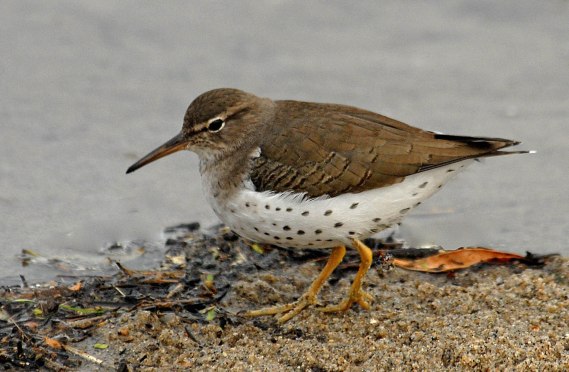
Spotted Sandpiper, still spotted, has normal plumage sexual monomorphism with reversed sexual size dimorphism
(Jim Kenney, Malibu Lagoon, Ca., November 23, 2006)
Spotted Sandpiper (Actitis macularia): They exhibit serial polyandry and reversed sexual size dimorphism, as females on average are 11% larger than males. Females are capable of laying up to five clutches of four eggs each, and compete among themselves for the males. An interesting note is that the female of the Common Sandpiper (Actitis hypoleucos) – the Spotted Sandpiper’s “sister-species” (their lineages split 16.6 million years ago [MYA]) – is also slightly larger than the male, yet is monogamous.

Northern Jacana, sexual plumage monomorphism, sexual size dimorphism reversal. Bottom female averages 82% heavier than the male.
(Cherie Pittillo in Yucatan Times)
Jacana (family Jacanidae): Scattered across the world’s tropics, all eight Jacana species exhibit reversed sexual size dimorphism, with the females larger than the males, but as with the Spotted Sandpiper, do not show any significant plumage dimorphism. The monogamous female Lesser Jacana is only slightly larger, but the other seven species exhibit either or both simultaneous and serial polyandry, depending on circumstances, and significant sexual size differences: females are on average 82% larger in six species, and 100% larger in the Pheasant-tailed Jacana of Southeast Asia. This is the greatest reversed sexual size dimorphism shown by any bird or mammal species in the world. 2
In Part III, we introduce those polyandrous species that display sexual dimorphism reversal.
Notated references are at the end of Part III.
[Chuck Almdale]
Sexual Dimorphism Reversal and Polyandry – Part I
Sometimes it’s the exception that proves the rule.
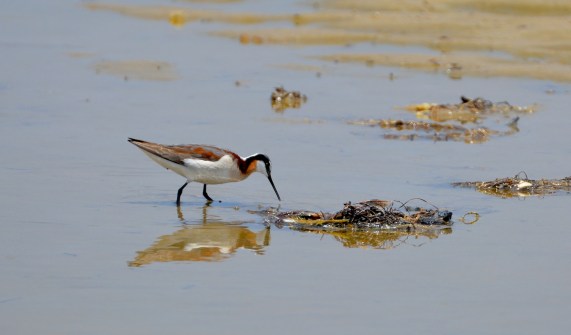
Female Wilson’s Phalarope, Malibu Lagoon, Ca.
(Grace Murayama, June 6, 2016)
Beginning birders soon notice that in many species, the male and female look different from each other. This divergence in appearance linked to sex appears in both birds and mammals. In mammals, for example, male lions have large manes that females totally lack, gorilla males are larger than females, male deer annually grow and shed their large antlers, and, of course, human males and females differ in body size and shape.

Irish Elk Group (Tabitha Paterson, TwilightBeasts)
Irish Elk size comparison (prehistoric-wildlife.com)
This distinct difference in features between genders is commonly called sexual dimorphism, or sometimes sexual bimorphism (two forms). The single-form alternative is sexual monomorphism (one form).
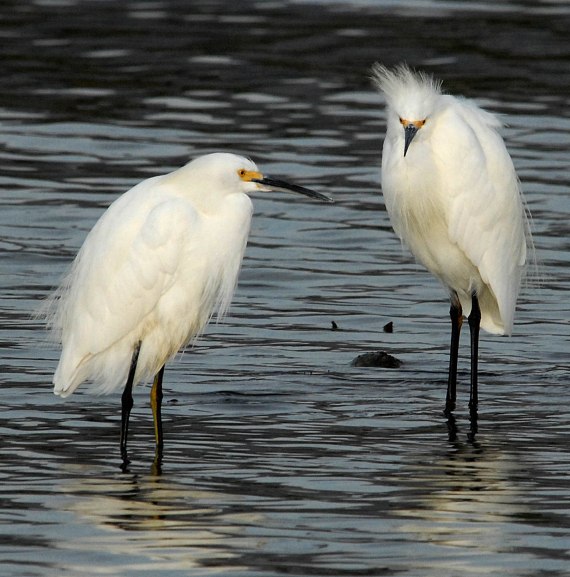
Sexual monomorphism in Snowy Egrets, Malibu Lagoon, Ca.
(Jim Kenney, November 2006)
Some examples of sexual monomorphism commonly seen in California are: geese, swans, loons, grebes, cormorants, pelicans, most herons and egrets, vultures, most sandpipers, gulls, terns, alcids, typical owls, swifts, corvids, chickadees, thrashers, some warblers, and most sparrows.
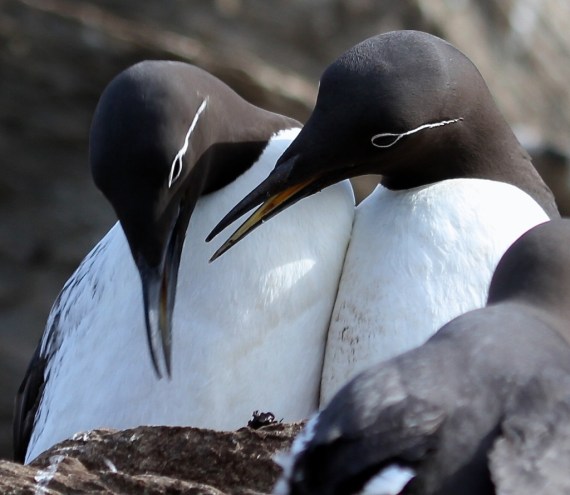
Common Murre (bridled variety), an alcid, exhibit sexual monomorphism.
Hornoya, Norway. (Joyce Waterman, May 30, 2016)
In California, readily seen examples of sexual dimorphism are: ducks, quail, grouse, phalaropes, hummingbirds, kingfisher, woodpeckers, gnatcatchers, most warblers, tanagers, blackbirds and orioles, finches, House Sparrow.

Hooded Mergansers exhibit sexual dimorphism; male front, female behind
(Jim Kenney, February 17, 2011)
Field guides generally show if a species is monomorphic or dimorphic. This is done with little male & female signs (♂♀), for dimorphism. If it says either “adult” or nothing, it’s monomorphic.
The reasons why a species is one or the other are complex. Dissertations and books have been- and still are being – written on the subject.
Four important factors to help understand sexual morphism:
Operational Sex Ratio (OSR): The ratio of the numbers of sexually receptive males to females.
Potential Reproductive Rate (PRR): The offspring production per unit of time each sex would achieve if unlimited mates were available.
Minimum Time Investment (MTI): The shortest amount of time either sex must contribute to produce a fertilized egg.
Parental Time Investment (PTI): The amount of time either sex contributes to parental duties.
For the purposes of this discussion, we’ll use the following definitions:
Breeding duties: All reproduction-related behaviors from courting, mating and egg-laying, through nest-building, incubation of eggs and feeding, protection and education of the young.
Nesting duties: Those activities listed above except mating and egg-laying.
Theoretically, the male and female can have the same MTI, and for many animals that is true. But in birds, because females must produce the large fertilized egg with a protective shell, white and yolk, while the males contributes only tiny sperm, the female’s MTI is always larger. Therefore, if either sex begins to make a larger parental time investment (PTI) than the other, as often happens in evolution, it is almost always the female. This greater (MTI+PTI) investment drives the evolution of the female’s greater choosiness in mate selection, picking – as best she can – the most fit male available. Female choosiness in turn causes males to compete in numerous ways for breeding opportunities. Such competition between males sets up the evolution of variations in ability to sing, gather food, build a nest, fight battles, and especially to display plumage.
[Article: Operational sex ratios & roles, dimorphism, monomorphism]

Allen’s Hummingbird shows extreme sexual dimorphism; female left, male right (Jim Kenney: female September 4, 2009, male January 9, 2007)
Thus it is the female selection of attractive, healthy, large or strong characteristics that shapes the male’s appearance and so produces sexual dimorphism. Because males cannot take on the female’s large initial time investment in egg-laying, males evolve in other ways: nest building, bringing food to the female, territory protection, and predator distraction. His overall parental time and energy investment in these activities may exceed the female’s combined egg production and parental time investment. Further, by performing such necessary duties, the female can concentrate on incubation, etc. Thus a sexual division of labor appears – different roles for females and males.
What does this division of labor have to do with monomorphism and dimorphism? In summary the “rule” which I alluded to at the beginning is:
Greater equality in breeding duties means greater similarity in appearance.
Eggs are always produced by females. In monomorphic species everything else is shared as equally as possible: site-selection, nest-building, incubation of eggs, territory defense, protection, feeding and education of the young. In sexually dimorphic species, duties of nesting and parenting diverge between sexes, with the manner and amount varying widely between species.
This brings up the second part of the “rule”:
The lesser the similarity in appearance, the lesser the involvement in breeding duties by the male, who is the more colorful bird.
When sexual dimorphism is extreme, the male may do nothing beyond inseminating the female. She then performs all the duties of nest-building, incubation of eggs and protection, feeding and education of the young, etc., with no assistance from the male. The avian families of Pheasants, Hummingbirds, Cotingas, Manakins, Birds-of-Paradise and Bowerbirds are filled with such species.
In Part II, we discuss the topics of double-clutching, sexual dimorphism reversal, sexual size dimorphism reversal and polyandry, with illustrative cases.
In Part III, we introduce those polyandrous species that display sexual dimorphism reversal.
[Chuck Almdale]



 SANTA MONICA BAY AUDUBON SOCIETY BLOG