Free email delivery
Please sign up for email delivery in the subscription area to the right.
No salesman will call, at least not from us. Maybe from someone else.
Sexual Dimorphism Reversal and Polyandry – Part II
Sometimes it’s the exception that proves the rule.
Part one of this series introduced the concepts of sexual monomorphism and sexual dimorphism, with a brief discussion of why female choosiness of mates appears, why this drives sexual selection, and why it can cause extremes of sexual dimorphism. The “rule” was introduced:
Greater equality in breeding duties means greater similarity in appearance. The lesser the similarity in appearance, the lesser the involvement in breeding duties by the male, who is the more colorful bird.

British gentlemen “amicably” discussing sexual selection (Pinterest)
Details of all of the above are elements of the topic of sexual selection, and have been a touchy subject indeed since explained by Charles Darwin in The Descent of Man and Selection in Relation to Sex (1871). Many Victorian-era male scientists and educated elite welcomed Darwin’s Theory of Evolution, yet balked at the idea that females of any species, especially humans, could have any say in the matter of mate-selection, let alone actually driving the process of evolution by the mere fact of choosing her mate. The very idea struck at the core of male chauvinistic society. In this matter, as in all matters, males were firmly in charge and made all important decisions.

Humans display sexual dimorphism: female left (Beauty Dart Bathing Beauty); male right (a young Steve Reeves before he starred as Hercules)
In Western society, that prejudicial belief of the male’s importance began waning some decades ago, only to be replaced by a different prejudicial belief: However animal biology might influence animal behavior, humans are certainly not mere animals and human biology can not dictate human psychological behavior; human beings have “free will,” it is not nature that determines sexual pairing.
Of more than 10,300 species of birds, nearly all are either monomorphic or sexually dimorphic with the male more brightly colored. However, there are a very few exceptions, examples of sexual dimorphism reversal, in which the female possesses the more brightly colored plumage: the Plains-Wanderer and Eclectus Parrot of eastern Australia, two species of Painted-Snipes, Eurasian Dotterel, Belted Kingfisher, and all three species of Phalarope. Further, with one exception, sexual dimorphism reversal is linked to polyandry and sexual role reversal.
Two definitions:
Polyandry: females breed with multiple males, either the more common serial polyandry (after the first egg clutch is laid, she leaves the male to find a second mate, then perhaps a third and fourth), or less common simultaneous polyandry (she maintains relations and broods with multiple males at the same time). Some polyandrous species become temporarily monogamous when the numbers of males are reduced. About 40 bird species (0.4%) are polyandrous, primarily found in the Gruiformes (Storks and Allies) and Charadriiformes (Sandpipers and Allies).
Sexual role reversal: males perform duties usually performed by females in normal sexually dimorphic species; females may have no parental time investment when a particular paring is polyandrous.
First we’ll deal with the sole example of monogamy combined with sexual dimorphism reversal.

Belted Kingfisher, sexual dimorphism reversed
female left, male right; Malibu Lagoon, Ca.
(Jim Kenney, female March 10, 2010, male January 10, 2010)
Belted Kingfisher (Ceryle alcyon): It is still uncertain why males lack the female’s incomplete chestnut breast band, but there are two reasonable explanations. First, females migrate south for winter, but many or most males stay on-territory. When she returns in the spring, males are busily defending their territory and the female’s bright chestnut breast may keep him from driving her away. Second, when on-territory, females are more aggressive and territorial than males. If a higher testosterone level in the female drives this behavior, it may also affect the laying down of red pigmentation in the plumage. Females may be dominant over males in the early stage of nest-construction, when the male begins scraping at the surface of a sandy or earthen bank while she watches and calls to him. Together they then finish the three-to-fifteen-foot-long tunnel. 1

Temminck´s Stint, Varanger, Norway, June 2004
(Jari Peltomäki at Finnature)
A possible evolutionary precursor of serial polyandry is found in Temminck’s Stint, Little Stint, Mountain Plover, and Sanderling. In these species, the female lays a clutch that is incubated by the male, followed by a second clutch which she alone incubates. This two-clutch system can be envisioned as a step toward the sort of serial polyandry seen in the Spotted Sandpiper, but females of that species will only incubate a clutch alone if their mate has been killed.
There are a few cases where sexual size dimorphism reversal without plumage dimorphism reversal is linked to polyandry.
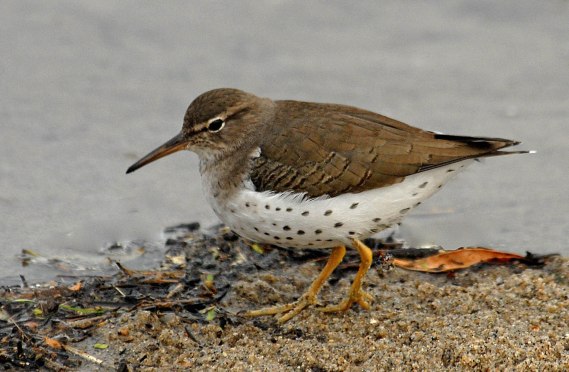
Spotted Sandpiper, still spotted, has normal plumage sexual monomorphism with reversed sexual size dimorphism
(Jim Kenney, Malibu Lagoon, Ca., November 23, 2006)
Spotted Sandpiper (Actitis macularia): They exhibit serial polyandry and reversed sexual size dimorphism, as females on average are 11% larger than males. Females are capable of laying up to five clutches of four eggs each, and compete among themselves for the males. An interesting note is that the female of the Common Sandpiper (Actitis hypoleucos) – the Spotted Sandpiper’s “sister-species” (their lineages split 16.6 million years ago [MYA]) – is also slightly larger than the male, yet is monogamous.

Northern Jacana, sexual plumage monomorphism, sexual size dimorphism reversal. Bottom female averages 82% heavier than the male.
(Cherie Pittillo in Yucatan Times)
Jacana (family Jacanidae): Scattered across the world’s tropics, all eight Jacana species exhibit reversed sexual size dimorphism, with the females larger than the males, but as with the Spotted Sandpiper, do not show any significant plumage dimorphism. The monogamous female Lesser Jacana is only slightly larger, but the other seven species exhibit either or both simultaneous and serial polyandry, depending on circumstances, and significant sexual size differences: females are on average 82% larger in six species, and 100% larger in the Pheasant-tailed Jacana of Southeast Asia. This is the greatest reversed sexual size dimorphism shown by any bird or mammal species in the world. 2
In Part III, we introduce those polyandrous species that display sexual dimorphism reversal.
Notated references are at the end of Part III.
[Chuck Almdale]
Sexual Dimorphism Reversal and Polyandry – Part I
Sometimes it’s the exception that proves the rule.
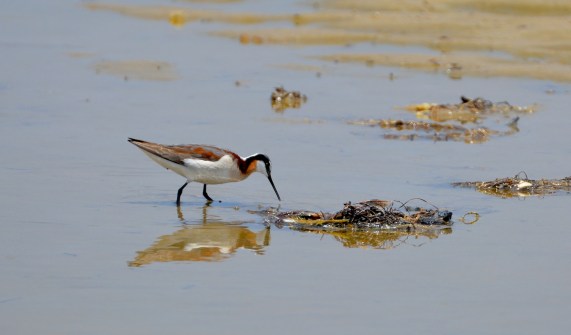
Female Wilson’s Phalarope, Malibu Lagoon, Ca.
(Grace Murayama, June 6, 2016)
Beginning birders soon notice that in many species, the male and female look different from each other. This divergence in appearance linked to sex appears in both birds and mammals. In mammals, for example, male lions have large manes that females totally lack, gorilla males are larger than females, male deer annually grow and shed their large antlers, and, of course, human males and females differ in body size and shape.

Irish Elk Group (Tabitha Paterson, TwilightBeasts)
Irish Elk size comparison (prehistoric-wildlife.com)
This distinct difference in features between genders is commonly called sexual dimorphism, or sometimes sexual bimorphism (two forms). The single-form alternative is sexual monomorphism (one form).
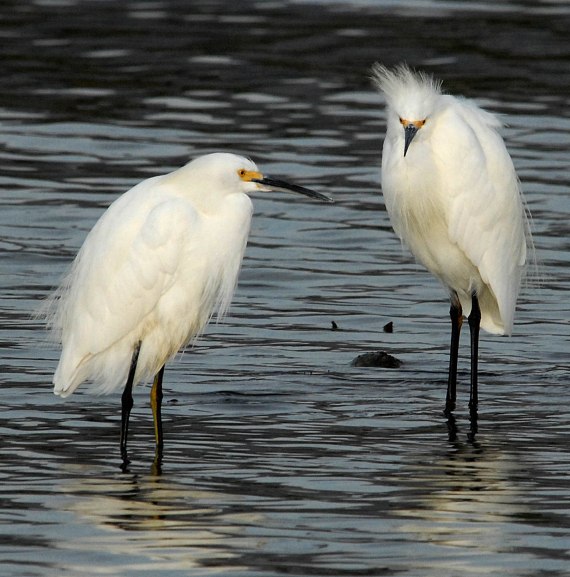
Sexual monomorphism in Snowy Egrets, Malibu Lagoon, Ca.
(Jim Kenney, November 2006)
Some examples of sexual monomorphism commonly seen in California are: geese, swans, loons, grebes, cormorants, pelicans, most herons and egrets, vultures, most sandpipers, gulls, terns, alcids, typical owls, swifts, corvids, chickadees, thrashers, some warblers, and most sparrows.
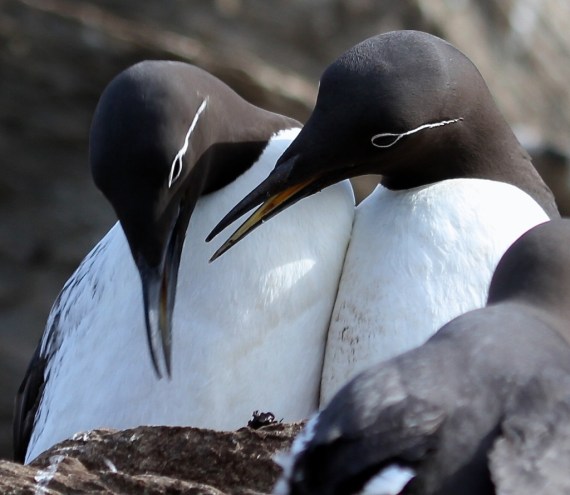
Common Murre (bridled variety), an alcid, exhibit sexual monomorphism.
Hornoya, Norway. (Joyce Waterman, May 30, 2016)
In California, readily seen examples of sexual dimorphism are: ducks, quail, grouse, phalaropes, hummingbirds, kingfisher, woodpeckers, gnatcatchers, most warblers, tanagers, blackbirds and orioles, finches, House Sparrow.

Hooded Mergansers exhibit sexual dimorphism; male front, female behind
(Jim Kenney, February 17, 2011)
Field guides generally show if a species is monomorphic or dimorphic. This is done with little male & female signs (♂♀), for dimorphism. If it says either “adult” or nothing, it’s monomorphic.
The reasons why a species is one or the other are complex. Dissertations and books have been- and still are being – written on the subject.
Four important factors to help understand sexual morphism:
Operational Sex Ratio (OSR): The ratio of the numbers of sexually receptive males to females.
Potential Reproductive Rate (PRR): The offspring production per unit of time each sex would achieve if unlimited mates were available.
Minimum Time Investment (MTI): The shortest amount of time either sex must contribute to produce a fertilized egg.
Parental Time Investment (PTI): The amount of time either sex contributes to parental duties.
For the purposes of this discussion, we’ll use the following definitions:
Breeding duties: All reproduction-related behaviors from courting, mating and egg-laying, through nest-building, incubation of eggs and feeding, protection and education of the young.
Nesting duties: Those activities listed above except mating and egg-laying.
Theoretically, the male and female can have the same MTI, and for many animals that is true. But in birds, because females must produce the large fertilized egg with a protective shell, white and yolk, while the males contributes only tiny sperm, the female’s MTI is always larger. Therefore, if either sex begins to make a larger parental time investment (PTI) than the other, as often happens in evolution, it is almost always the female. This greater (MTI+PTI) investment drives the evolution of the female’s greater choosiness in mate selection, picking – as best she can – the most fit male available. Female choosiness in turn causes males to compete in numerous ways for breeding opportunities. Such competition between males sets up the evolution of variations in ability to sing, gather food, build a nest, fight battles, and especially to display plumage.
[Article: Operational sex ratios & roles, dimorphism, monomorphism]

Allen’s Hummingbird shows extreme sexual dimorphism; female left, male right (Jim Kenney: female September 4, 2009, male January 9, 2007)
Thus it is the female selection of attractive, healthy, large or strong characteristics that shapes the male’s appearance and so produces sexual dimorphism. Because males cannot take on the female’s large initial time investment in egg-laying, males evolve in other ways: nest building, bringing food to the female, territory protection, and predator distraction. His overall parental time and energy investment in these activities may exceed the female’s combined egg production and parental time investment. Further, by performing such necessary duties, the female can concentrate on incubation, etc. Thus a sexual division of labor appears – different roles for females and males.
What does this division of labor have to do with monomorphism and dimorphism? In summary the “rule” which I alluded to at the beginning is:
Greater equality in breeding duties means greater similarity in appearance.
Eggs are always produced by females. In monomorphic species everything else is shared as equally as possible: site-selection, nest-building, incubation of eggs, territory defense, protection, feeding and education of the young. In sexually dimorphic species, duties of nesting and parenting diverge between sexes, with the manner and amount varying widely between species.
This brings up the second part of the “rule”:
The lesser the similarity in appearance, the lesser the involvement in breeding duties by the male, who is the more colorful bird.
When sexual dimorphism is extreme, the male may do nothing beyond inseminating the female. She then performs all the duties of nest-building, incubation of eggs and protection, feeding and education of the young, etc., with no assistance from the male. The avian families of Pheasants, Hummingbirds, Cotingas, Manakins, Birds-of-Paradise and Bowerbirds are filled with such species.
In Part II, we discuss the topics of double-clutching, sexual dimorphism reversal, sexual size dimorphism reversal and polyandry, with illustrative cases.
In Part III, we introduce those polyandrous species that display sexual dimorphism reversal.
[Chuck Almdale]
Full Buck Moon Update – July 19, 3:56 PM PDT
Here’s another update from SMBAS Blog on that large, disc-like, shining object which has frequently and mysteriously appeared in our nighttime sky this year (known to many as the moon).

Montage of moon in 16/5/03 eclipse (Sebastien Gauthier 5/14/14; NASA website)
July 19, 3:56 p.m. PDT — Full Buck Moon. This is the season when the new antlers of buck deer push out from their foreheads in coatings of velvety fur. It was also often called the Full Thunder Moon, thunderstorms being most frequent at this time. Sometimes this is also called the Full Hay Moon.
July Moon Names from other cultures Courtesy of Keith Cooley):
Chinese: Hungry Ghost Moon; Celtic: Moon of Claiming; English Medieval: Mead Moon
The annual Perseid meteor shower is next month on the 12th-13th, before the next full moon, so we’re mentioning it here. Up to 100 bright meteors per hour! Watch closely for UFO’s lurking among them.
Barroom bet question: How long is the average period of daylight at exactly the North or the South geographic pole? For purposes of this question, average = total hours of daylight / no. of 24-hour (midnight to midnight) periods with the sun above the horizon.
a. 8 hours
b. 11 hours, 58 minutes
c. 12 hours
d. 16 hours
e. 182.625 days
Tick, tock
Tick, tock
No peeking!
Tick, tock
Tick, tock
The answer is e, which is 1/2 year. At the North Pole the sun rises on March 21, never to set until Sept. 21. The converse happens at the South Pole. Thus the only period of daylight each year is 1/2 year long.
The Old Farmer’s Almanac has a page for each full moon. One tip for July: set your eggs on the 19th through 21st. Now you know, so you have no excuse.
The next significant full moon will occur on Aug. 18, 2:26 a.m. PDT. Keep an eye on this spot for additional late-breaking news on this unprecedented event.
This information comes to you courtesy of: http://www.space.com/31699-full-moon-names-2016-explained.html
written by Joe Rao. Joe Rao serves as an instructor and guest lecturer at New York’s Hayden Planetarium. He writes about astronomy for Natural History magazine, the Farmer’s Almanac and other publications, and he is also an on-camera meteorologist for News 12 Westchester, N.Y.
But that’s waaay too long to type in, and besides, you don’t need to go there because SMBAS has done the work for you!
[Chuck Almdale]
Summer starts at Malibu Lagoon: June 26, 2016
By the time we got home in the San Fernando Valley at noon, it was 102°F; at the lagoon it had been a lovely 72°F. That’s SoCal summertime; drive over the hill and the temperature jumps 30°. Boo! Hiss!

Western Sandpiper pals, back from the north (G. Murayama 6-15-16)
June is typically our slowest month at the lagoon. Today’s 42 species is about average, but total birds of 704 is higher than usual. And that doesn’t count the approximately 500 gulls and 200 Elegant Terns who lifted off the beach and flew west shortly after we arrived, but before we could count them.

Male Great-tailed Grackle, protesting loudly (R. Ehlers 6-26-16)
Low tide of +0.32 ft. was at 8:31am. Many rocks were exposed, but only a handful (that’s seven, for you non-polydactylists) of Willets were taking advantage. The lagoon outlet was closed, but the water level was high from runoff coming down the creek, one must suppose, with maybe another foot of rise before it would begin to

Harlequin Cabbage Bug on grass stalk (A. Douglas 6-26-16)
leak out. Surf was quite high, with waves cresting over than the heads of the men on boards, and PCH was packed on both sides by the parked cars of early-arriving surfers. One surfer, running barefoot down the path to the beach with board tucked underarm, replied to my query that he’d just driven down from Salt Lake City and couldn’t stop to talk. That’s surf! (Cue Chantays’ Pipeline.)

Forster’s Tern (R. Ehlers 6-26-16)
One unfortunate Double-crested Cormorant who landed on the snag in the water near our gathering spot, had a hook in its mouth with about 8 feet of fishing line and a small weight attached to it. It was reported to the local park ranger who said he’d pass it on to those who are equipped to come and aid such birds. I don’t know how they do it – throw a big net over it, perhaps.

One-year old Black-crowned Night-Heron (R. Ehlers 6-26-16)
In the nearby reeds we found a year-old Black-crowned Night Heron, in not-quite-adult plumage. Most of the adult Mallards were trailing ducklings of various sizes – sometimes one, sometimes a half-dozen.
We watched a tall Washingtonia Palm Tree for a while, as several people had spotted a Bullock’s Oriole flying in and out from what appeared, at a distance, to be a nest. It didn’t return. Usually it’s Hooded Orioles who nest in palms, which they’ve done in previous years. I’d like to have been able to confirm that the nest, if it was a nest, belonged to a Bullock’s.

Ring-billed Gull, 1 year old, with peculiar white wing patches (R. Ehlers 6-26-16)
An odd-looking gull showed up near trip’s end. Those observing it decided that it was a 1st-summer (one year old) Ring-billed Gull, but it had huge white patches in the wings, something I’ve never previously seen.
A quick anecdote: it’s often very difficult identifying a bird from someone’s verbal description. Two park rangers told us of a penguin-like black-and-white bird eating a Mallard duckling down by the lagoon. Penguin, eh? – sounds like an Alcid, unlikely but not impossible. But the field guide picture didn’t look quite right to them. One then said that another ranger had seen the same bird in Santa Barbara, and it was hanging out it’s wings to dry. Well…only cormorants do that. Again, the picture wasn’t quite right. Wait! One of them had a short video of it on their phone. Very dimly we could see an adult Black-crowned Night Heron gobbling down a baby duck. So it goes, as Kurt Vonnegut frequently said.

Red-breasted Merganser in ratty plumage
(G. Murayama 6-24-16)
Snowy Plovers: Although one recently arrived on Santa Monica Beach, we didn’t see any.
Birds new for the season were: Black-crowned Night-Heron, Cooper’s Hawk, Red-tailed Hawk, Glaucous-winged Gull, Forster’s Tern, Anna’s Hummingbird, Oak Titmouse, Bullock’s Oriole.
As always, many thanks to our photographers: Chuck Bragg, Adrian Douglas, Randy Ehler & Grace Murayama.
Our next four scheduled field trips: Malibu Lagoon 8:30 & 10am, 24 July; Lower Los Angeles River TBA; Malibu Lagoon 8:30 & 10am, 28 Aug.

Common Yellowthroat singing (Chuck Bragg 2-28-16)
Our next program: TBA, Tuesday, 4 Oct, 7:30 pm, at Chris Reed Park, 1133 7th St., NE corner of 7th and Wilshire Blvd. in Santa Monica.
NOTE: Our 10 a.m. Parent’s & Kids Birdwalk meets at the shaded viewing area. Watch for Willie the Weasel. He’ll be watching for you and your big floppy feet.
Links: Unusual birds at Malibu Lagoon
9/23/02 Aerial photo of Malibu Lagoon
Prior checklists:
2015: Jan-May, July-Dec 2014: Jan-July, July-Dec
2013: Jan-June, July-Dec 2012: Jan-June, July-Dec
2011: Jan-June, July-Dec 2010: Jan-June, July-Dec
2009: Jan-June, July-Dec
The 10-year comparison summaries created during the project period, despite numerous complaints, remain available on our Lagoon Project Bird Census Page. Very briefly summarized, the results unexpectedly indicate that avian species diversification and numbers improved slightly during the period Jun’12-June’14. [Chuck Almdale]
| Lagoon Birds 2016 | 1/24 | 2/28 | 3/27 | 4/24 | 5/22 | 6/26 |
| Temperature | 48-64 | 57-70 | 55-65 | 60-67 | 61-66 | 68-72 |
| Tide Lo/Hi Height | H+5.90 | L+1.38 | H+3.43 | H+3.63 | H+3.69 | L+0.32 |
| Tide Time | 0855 | 0654 | 1228 | 1143 | 1101 | 0831 |
| Brant | 3 | 2 | 1 | 2 | ||
| Gadwall | 3 | 20 | 14 | 4 | 8 | |
| American Wigeon | 10 | 16 | 10 | |||
| Mallard | 15 | 22 | 16 | 18 | 4 | 30 |
| Northern Shoveler | 16 | 12 | 14 | |||
| Northern Pintail | 4 | |||||
| Green-winged Teal | 8 | 8 | ||||
| Lesser Scaup | 5 | |||||
| Surf Scoter | 17 | 16 | ||||
| Bufflehead | 2 | 2 | ||||
| Red-brstd Merganser | 3 | 3 | 2 | 1 | 1 | |
| Ruddy Duck | 10 | |||||
| Red-throated Loon | 2 | |||||
| Pacific Loon | 1 | 2 | ||||
| Common Loon | 1 | 1 | ||||
| Pied-billed Grebe | 3 | 8 | 3 | 1 | ||
| Horned Grebe | 1 | 1 | ||||
| Eared Grebe | 2 | 5 | 2 | |||
| Western Grebe | 1 | 1 | ||||
| Blk-vented Shearwater | 1 | |||||
| Brandt’s Cormorant | 1 | 4 | 2 | |||
| Dble-crstd Cormorant | 24 | 19 | 6 | 23 | 7 | 35 |
| Pelagic Cormorant | 2 | |||||
| Brown Pelican | 30 | 43 | 28 | 77 | 14 | 94 |
| Great Blue Heron | 3 | 4 | 3 | 2 | 3 | |
| Great Egret | 2 | 1 | 5 | 2 | 1 | 7 |
| Snowy Egret | 21 | 7 | 7 | 4 | 2 | 6 |
| Blk-crwnd N-Heron | 2 | |||||
| Osprey | 1 | 3 | 1 | 1 | ||
| Cooper’s Hawk | 1 | 1 | 2 | |||
| Red-shouldered Hawk | 1 | |||||
| Red-tailed Hawk | 1 | |||||
| American Coot | 40 | 65 | 53 | 4 | ||
| Black-necked Stilt | 19 | |||||
| Blk-bellied Plover | 12 | 32 | 8 | 20 | 6 | 6 |
| Snowy Plover | 12 | 4 | 3 | |||
| Semipalmated Plover | 8 | |||||
| Killdeer | 2 | 4 | 3 | 2 | 6 | 8 |
| Spotted Sandpiper | 1 | 1 | 1 | |||
| Willet | 8 | 8 | 12 | 10 | 16 | 11 |
| Whimbrel | 3 | 4 | 21 | 2 | ||
| Marbled Godwit | 13 | 22 | 15 | 6 | ||
| Ruddy Turnstone | 5 | 1 | ||||
| Surfbird | 1 | |||||
| Least Sandpiper | 13 | 7 | ||||
| Western Sandpiper | 4 | 35 | 1 | 1 | ||
| Long-billed Dowitcher | 2 | |||||
| Common Murre | 3 | |||||
| Bonaparte’s Gull | 1 | 3 | ||||
| Heermann’s Gull | 4 | 1 | 2 | 8 | 130 | |
| Mew Gull | 1 | |||||
| Ring-billed Gull | 30 | 90 | 15 | 1 | 26 | 1 |
| Western Gull | 13 | 160 | 45 | 60 | 23 | 120 |
| California Gull | 400 | 650 | 130 | 15 | 3 | 3 |
| Thayer’s Gull | 1 | |||||
| Glaucous-wingd Gull | 4 | 1 | 1 | |||
| Caspian Tern | 3 | 19 | 9 | 11 | ||
| Forster’s Tern | 1 | |||||
| Royal Tern | 25 | 31 | 18 | 2 | 48 | 5 |
| Elegant Tern | 5 | 1800 | 10 | 110 | ||
| Rock Pigeon | 2 | 6 | 6 | 6 | 1 | 23 |
| Mourning Dove | 2 | 2 | 2 | 1 | 2 | |
| Anna’s Hummingbird | 1 | 2 | 1 | 3 | ||
| Allen’s Hummingbird | 3 | 3 | 4 | 4 | 2 | 1 |
| Belted Kingfisher | 1 | |||||
| Merlin | 1 | |||||
| Nanday Parakeet | 8 | 2 | ||||
| Black Phoebe | 3 | 8 | 6 | 4 | 1 | 2 |
| Say’s Phoebe | 1 | 1 | ||||
| Cassin’s Kingbird | 1 | |||||
| Western Scrub-Jay | 1 | 2 | 1 | |||
| American Crow | 6 | 23 | 6 | 4 | 4 | 6 |
| Common Raven | 1 | 1 | ||||
| Violet-green Swallow | 1 | |||||
| Rough-wingd Swallow | 10 | 10 | 6 | 6 | ||
| Cliff Swallow | 1 | 6 | 4 | 7 | ||
| Barn Swallow | 6 | 4 | 4 | 20 | ||
| Oak Titmouse | 1 | 1 | ||||
| Bushtit | 4 | 5 | 4 | 2 | ||
| House Wren | 1 | 1 | ||||
| Bewick’s Wren | 1 | 1 | ||||
| Ruby-crowned Kinglet | 1 | |||||
| Western Bluebird | 1 | |||||
| Hermit Thrush | 3 | 1 | ||||
| American Robin | 2 | 1 | ||||
| Northern Mockingbird | 1 | 3 | 4 | 6 | 2 | 2 |
| European Starling | 110 | 90 | 1 | 2 | 2 | 10 |
| Common Yellowthroat | 1 | 5 | 5 | 1 | 1 | |
| Yellw-rumpd Warbler | 9 | |||||
| Spotted Towhee | 1 | |||||
| California Towhee | 2 | 5 | 3 | |||
| Song Sparrow | 3 | 3 | 12 | 14 | 2 | 3 |
| Lincoln’s Sparrow | 1 | |||||
| White-crwnd Sparrow | 20 | 5 | 5 | |||
| Blck-heded Grosbeak | 1 | |||||
| Red-winged Blackbird | 5 | 4 | 15 | |||
| Western Meadowlark | 2 | |||||
| Brewer’s Blackbird | 6 | 12 | ||||
| Great-tailed Grackle | 2 | 1 | 9 | 3 | 3 | 4 |
| Brwn-headed Cowbird | 2 | |||||
| Hooded Oriole | 1 | |||||
| Bullock’s Oriole | 2 | |||||
| House Finch | 1 | 6 | 21 | 16 | 7 | 6 |
| Lesser Goldfinch | 1 | |||||
| House Sparrow | 3 | |||||
| Totals by Type | Jan | Feb | Mar | Apr | May | Jun |
| Waterfowl | 61 | 118 | 74 | 22 | 14 | 33 |
| Water Birds – Other | 104 | 146 | 100 | 106 | 22 | 129 |
| Herons, Egrets & Ibis | 26 | 12 | 15 | 6 | 5 | 18 |
| Quail & Raptors | 2 | 4 | 2 | 1 | 1 | 3 |
| Shorebirds | 50 | 86 | 113 | 76 | 28 | 26 |
| Gulls & Terns | 472 | 939 | 219 | 1903 | 127 | 382 |
| Doves | 4 | 8 | 8 | 7 | 3 | 23 |
| Other Non-Passerines | 4 | 13 | 7 | 5 | 2 | 4 |
| Passerines | 150 | 168 | 105 | 95 | 60 | 86 |
| Totals Birds | 873 | 1494 | 643 | 2221 | 262 | 704 |
| Total Species | Jan | Feb | Mar | Apr | May | Jun |
| Waterfowl | 8 | 11 | 7 | 2 | 4 | 3 |
| Water Birds – Other | 9 | 10 | 9 | 4 | 3 | 2 |
| Herons, Egrets & Ibis | 3 | 3 | 3 | 2 | 3 | 4 |
| Quail & Raptors | 2 | 2 | 2 | 1 | 1 | 2 |
| Shorebirds | 6 | 10 | 11 | 10 | 3 | 4 |
| Gulls & Terns | 5 | 9 | 8 | 8 | 7 | 9 |
| Doves | 2 | 2 | 2 | 2 | 2 | 1 |
| Other Non-Passerines | 2 | 3 | 3 | 2 | 1 | 2 |
| Passerines | 12 | 19 | 22 | 20 | 17 | 15 |
| Totals Species-105 | 49 | 69 | 67 | 51 | 41 | 42 |
Breeding Bird Atlas of Los Angeles County
 Many local birders put in a lot of time to bring this book to fruition, and we are eager, thrilled, and relieved to see that it is now on its way to the publishers.
List price: $49.95
20% discount if ordered by 7-15-16: -$9.99
Net: $39.96
Handling: Free if ordered by 15 July 2016
Sales tax @9% $3.60 (California shipping addresses only)
Shipping $8.00 to addresses in the contiguous United States
Total: $51.56 (California addresses)
From the posting on Los Angeles Audubon Society:
This 660-page hardcover compendium addresses 228 species found with evidence of breeding during the 1995–1999 Atlas survey period plus 18 additional historical, island-breeding, and post-Atlas breeding species. Our Atlas findings are based on over 28,000 records provided by over 300 volunteer observers contributing more than 10,000 hours of field effort. The authors have supplemented this information by consulting extensive ornithological and paleontological literature, extracting data from over 5600 egg-set records, and analyzing trend data from eight county BBS routes and eight county CBC circles in the attempt to provide as comprehensive a picture of Los Angeles County’s breeding avifauna as possible.
Link to description and order page.
Order your copy today. Really! I’ve ordered mine.
[Chuck Almdale]



 SANTA MONICA BAY AUDUBON SOCIETY BLOG