Free email delivery
Please sign up for email delivery in the subscription area to the right.
No salesman will call, at least not from us. Maybe from someone else.
Full Buck Moon Update – July 19, 3:56 PM PDT
Here’s another update from SMBAS Blog on that large, disc-like, shining object which has frequently and mysteriously appeared in our nighttime sky this year (known to many as the moon).

Montage of moon in 16/5/03 eclipse (Sebastien Gauthier 5/14/14; NASA website)
July 19, 3:56 p.m. PDT — Full Buck Moon. This is the season when the new antlers of buck deer push out from their foreheads in coatings of velvety fur. It was also often called the Full Thunder Moon, thunderstorms being most frequent at this time. Sometimes this is also called the Full Hay Moon.
July Moon Names from other cultures Courtesy of Keith Cooley):
Chinese: Hungry Ghost Moon; Celtic: Moon of Claiming; English Medieval: Mead Moon
The annual Perseid meteor shower is next month on the 12th-13th, before the next full moon, so we’re mentioning it here. Up to 100 bright meteors per hour! Watch closely for UFO’s lurking among them.
Barroom bet question: How long is the average period of daylight at exactly the North or the South geographic pole? For purposes of this question, average = total hours of daylight / no. of 24-hour (midnight to midnight) periods with the sun above the horizon.
a. 8 hours
b. 11 hours, 58 minutes
c. 12 hours
d. 16 hours
e. 182.625 days
Tick, tock
Tick, tock
No peeking!
Tick, tock
Tick, tock
The answer is e, which is 1/2 year. At the North Pole the sun rises on March 21, never to set until Sept. 21. The converse happens at the South Pole. Thus the only period of daylight each year is 1/2 year long.
The Old Farmer’s Almanac has a page for each full moon. One tip for July: set your eggs on the 19th through 21st. Now you know, so you have no excuse.
The next significant full moon will occur on Aug. 18, 2:26 a.m. PDT. Keep an eye on this spot for additional late-breaking news on this unprecedented event.
This information comes to you courtesy of: http://www.space.com/31699-full-moon-names-2016-explained.html
written by Joe Rao. Joe Rao serves as an instructor and guest lecturer at New York’s Hayden Planetarium. He writes about astronomy for Natural History magazine, the Farmer’s Almanac and other publications, and he is also an on-camera meteorologist for News 12 Westchester, N.Y.
But that’s waaay too long to type in, and besides, you don’t need to go there because SMBAS has done the work for you!
[Chuck Almdale]
Summer starts at Malibu Lagoon: June 26, 2016
By the time we got home in the San Fernando Valley at noon, it was 102°F; at the lagoon it had been a lovely 72°F. That’s SoCal summertime; drive over the hill and the temperature jumps 30°. Boo! Hiss!

Western Sandpiper pals, back from the north (G. Murayama 6-15-16)
June is typically our slowest month at the lagoon. Today’s 42 species is about average, but total birds of 704 is higher than usual. And that doesn’t count the approximately 500 gulls and 200 Elegant Terns who lifted off the beach and flew west shortly after we arrived, but before we could count them.

Male Great-tailed Grackle, protesting loudly (R. Ehlers 6-26-16)
Low tide of +0.32 ft. was at 8:31am. Many rocks were exposed, but only a handful (that’s seven, for you non-polydactylists) of Willets were taking advantage. The lagoon outlet was closed, but the water level was high from runoff coming down the creek, one must suppose, with maybe another foot of rise before it would begin to

Harlequin Cabbage Bug on grass stalk (A. Douglas 6-26-16)
leak out. Surf was quite high, with waves cresting over than the heads of the men on boards, and PCH was packed on both sides by the parked cars of early-arriving surfers. One surfer, running barefoot down the path to the beach with board tucked underarm, replied to my query that he’d just driven down from Salt Lake City and couldn’t stop to talk. That’s surf! (Cue Chantays’ Pipeline.)

Forster’s Tern (R. Ehlers 6-26-16)
One unfortunate Double-crested Cormorant who landed on the snag in the water near our gathering spot, had a hook in its mouth with about 8 feet of fishing line and a small weight attached to it. It was reported to the local park ranger who said he’d pass it on to those who are equipped to come and aid such birds. I don’t know how they do it – throw a big net over it, perhaps.

One-year old Black-crowned Night-Heron (R. Ehlers 6-26-16)
In the nearby reeds we found a year-old Black-crowned Night Heron, in not-quite-adult plumage. Most of the adult Mallards were trailing ducklings of various sizes – sometimes one, sometimes a half-dozen.
We watched a tall Washingtonia Palm Tree for a while, as several people had spotted a Bullock’s Oriole flying in and out from what appeared, at a distance, to be a nest. It didn’t return. Usually it’s Hooded Orioles who nest in palms, which they’ve done in previous years. I’d like to have been able to confirm that the nest, if it was a nest, belonged to a Bullock’s.

Ring-billed Gull, 1 year old, with peculiar white wing patches (R. Ehlers 6-26-16)
An odd-looking gull showed up near trip’s end. Those observing it decided that it was a 1st-summer (one year old) Ring-billed Gull, but it had huge white patches in the wings, something I’ve never previously seen.
A quick anecdote: it’s often very difficult identifying a bird from someone’s verbal description. Two park rangers told us of a penguin-like black-and-white bird eating a Mallard duckling down by the lagoon. Penguin, eh? – sounds like an Alcid, unlikely but not impossible. But the field guide picture didn’t look quite right to them. One then said that another ranger had seen the same bird in Santa Barbara, and it was hanging out it’s wings to dry. Well…only cormorants do that. Again, the picture wasn’t quite right. Wait! One of them had a short video of it on their phone. Very dimly we could see an adult Black-crowned Night Heron gobbling down a baby duck. So it goes, as Kurt Vonnegut frequently said.

Red-breasted Merganser in ratty plumage
(G. Murayama 6-24-16)
Snowy Plovers: Although one recently arrived on Santa Monica Beach, we didn’t see any.
Birds new for the season were: Black-crowned Night-Heron, Cooper’s Hawk, Red-tailed Hawk, Glaucous-winged Gull, Forster’s Tern, Anna’s Hummingbird, Oak Titmouse, Bullock’s Oriole.
As always, many thanks to our photographers: Chuck Bragg, Adrian Douglas, Randy Ehler & Grace Murayama.
Our next four scheduled field trips: Malibu Lagoon 8:30 & 10am, 24 July; Lower Los Angeles River TBA; Malibu Lagoon 8:30 & 10am, 28 Aug.

Common Yellowthroat singing (Chuck Bragg 2-28-16)
Our next program: TBA, Tuesday, 4 Oct, 7:30 pm, at Chris Reed Park, 1133 7th St., NE corner of 7th and Wilshire Blvd. in Santa Monica.
NOTE: Our 10 a.m. Parent’s & Kids Birdwalk meets at the shaded viewing area. Watch for Willie the Weasel. He’ll be watching for you and your big floppy feet.
Links: Unusual birds at Malibu Lagoon
9/23/02 Aerial photo of Malibu Lagoon
Prior checklists:
2015: Jan-May, July-Dec 2014: Jan-July, July-Dec
2013: Jan-June, July-Dec 2012: Jan-June, July-Dec
2011: Jan-June, July-Dec 2010: Jan-June, July-Dec
2009: Jan-June, July-Dec
The 10-year comparison summaries created during the project period, despite numerous complaints, remain available on our Lagoon Project Bird Census Page. Very briefly summarized, the results unexpectedly indicate that avian species diversification and numbers improved slightly during the period Jun’12-June’14. [Chuck Almdale]
| Lagoon Birds 2016 | 1/24 | 2/28 | 3/27 | 4/24 | 5/22 | 6/26 |
| Temperature | 48-64 | 57-70 | 55-65 | 60-67 | 61-66 | 68-72 |
| Tide Lo/Hi Height | H+5.90 | L+1.38 | H+3.43 | H+3.63 | H+3.69 | L+0.32 |
| Tide Time | 0855 | 0654 | 1228 | 1143 | 1101 | 0831 |
| Brant | 3 | 2 | 1 | 2 | ||
| Gadwall | 3 | 20 | 14 | 4 | 8 | |
| American Wigeon | 10 | 16 | 10 | |||
| Mallard | 15 | 22 | 16 | 18 | 4 | 30 |
| Northern Shoveler | 16 | 12 | 14 | |||
| Northern Pintail | 4 | |||||
| Green-winged Teal | 8 | 8 | ||||
| Lesser Scaup | 5 | |||||
| Surf Scoter | 17 | 16 | ||||
| Bufflehead | 2 | 2 | ||||
| Red-brstd Merganser | 3 | 3 | 2 | 1 | 1 | |
| Ruddy Duck | 10 | |||||
| Red-throated Loon | 2 | |||||
| Pacific Loon | 1 | 2 | ||||
| Common Loon | 1 | 1 | ||||
| Pied-billed Grebe | 3 | 8 | 3 | 1 | ||
| Horned Grebe | 1 | 1 | ||||
| Eared Grebe | 2 | 5 | 2 | |||
| Western Grebe | 1 | 1 | ||||
| Blk-vented Shearwater | 1 | |||||
| Brandt’s Cormorant | 1 | 4 | 2 | |||
| Dble-crstd Cormorant | 24 | 19 | 6 | 23 | 7 | 35 |
| Pelagic Cormorant | 2 | |||||
| Brown Pelican | 30 | 43 | 28 | 77 | 14 | 94 |
| Great Blue Heron | 3 | 4 | 3 | 2 | 3 | |
| Great Egret | 2 | 1 | 5 | 2 | 1 | 7 |
| Snowy Egret | 21 | 7 | 7 | 4 | 2 | 6 |
| Blk-crwnd N-Heron | 2 | |||||
| Osprey | 1 | 3 | 1 | 1 | ||
| Cooper’s Hawk | 1 | 1 | 2 | |||
| Red-shouldered Hawk | 1 | |||||
| Red-tailed Hawk | 1 | |||||
| American Coot | 40 | 65 | 53 | 4 | ||
| Black-necked Stilt | 19 | |||||
| Blk-bellied Plover | 12 | 32 | 8 | 20 | 6 | 6 |
| Snowy Plover | 12 | 4 | 3 | |||
| Semipalmated Plover | 8 | |||||
| Killdeer | 2 | 4 | 3 | 2 | 6 | 8 |
| Spotted Sandpiper | 1 | 1 | 1 | |||
| Willet | 8 | 8 | 12 | 10 | 16 | 11 |
| Whimbrel | 3 | 4 | 21 | 2 | ||
| Marbled Godwit | 13 | 22 | 15 | 6 | ||
| Ruddy Turnstone | 5 | 1 | ||||
| Surfbird | 1 | |||||
| Least Sandpiper | 13 | 7 | ||||
| Western Sandpiper | 4 | 35 | 1 | 1 | ||
| Long-billed Dowitcher | 2 | |||||
| Common Murre | 3 | |||||
| Bonaparte’s Gull | 1 | 3 | ||||
| Heermann’s Gull | 4 | 1 | 2 | 8 | 130 | |
| Mew Gull | 1 | |||||
| Ring-billed Gull | 30 | 90 | 15 | 1 | 26 | 1 |
| Western Gull | 13 | 160 | 45 | 60 | 23 | 120 |
| California Gull | 400 | 650 | 130 | 15 | 3 | 3 |
| Thayer’s Gull | 1 | |||||
| Glaucous-wingd Gull | 4 | 1 | 1 | |||
| Caspian Tern | 3 | 19 | 9 | 11 | ||
| Forster’s Tern | 1 | |||||
| Royal Tern | 25 | 31 | 18 | 2 | 48 | 5 |
| Elegant Tern | 5 | 1800 | 10 | 110 | ||
| Rock Pigeon | 2 | 6 | 6 | 6 | 1 | 23 |
| Mourning Dove | 2 | 2 | 2 | 1 | 2 | |
| Anna’s Hummingbird | 1 | 2 | 1 | 3 | ||
| Allen’s Hummingbird | 3 | 3 | 4 | 4 | 2 | 1 |
| Belted Kingfisher | 1 | |||||
| Merlin | 1 | |||||
| Nanday Parakeet | 8 | 2 | ||||
| Black Phoebe | 3 | 8 | 6 | 4 | 1 | 2 |
| Say’s Phoebe | 1 | 1 | ||||
| Cassin’s Kingbird | 1 | |||||
| Western Scrub-Jay | 1 | 2 | 1 | |||
| American Crow | 6 | 23 | 6 | 4 | 4 | 6 |
| Common Raven | 1 | 1 | ||||
| Violet-green Swallow | 1 | |||||
| Rough-wingd Swallow | 10 | 10 | 6 | 6 | ||
| Cliff Swallow | 1 | 6 | 4 | 7 | ||
| Barn Swallow | 6 | 4 | 4 | 20 | ||
| Oak Titmouse | 1 | 1 | ||||
| Bushtit | 4 | 5 | 4 | 2 | ||
| House Wren | 1 | 1 | ||||
| Bewick’s Wren | 1 | 1 | ||||
| Ruby-crowned Kinglet | 1 | |||||
| Western Bluebird | 1 | |||||
| Hermit Thrush | 3 | 1 | ||||
| American Robin | 2 | 1 | ||||
| Northern Mockingbird | 1 | 3 | 4 | 6 | 2 | 2 |
| European Starling | 110 | 90 | 1 | 2 | 2 | 10 |
| Common Yellowthroat | 1 | 5 | 5 | 1 | 1 | |
| Yellw-rumpd Warbler | 9 | |||||
| Spotted Towhee | 1 | |||||
| California Towhee | 2 | 5 | 3 | |||
| Song Sparrow | 3 | 3 | 12 | 14 | 2 | 3 |
| Lincoln’s Sparrow | 1 | |||||
| White-crwnd Sparrow | 20 | 5 | 5 | |||
| Blck-heded Grosbeak | 1 | |||||
| Red-winged Blackbird | 5 | 4 | 15 | |||
| Western Meadowlark | 2 | |||||
| Brewer’s Blackbird | 6 | 12 | ||||
| Great-tailed Grackle | 2 | 1 | 9 | 3 | 3 | 4 |
| Brwn-headed Cowbird | 2 | |||||
| Hooded Oriole | 1 | |||||
| Bullock’s Oriole | 2 | |||||
| House Finch | 1 | 6 | 21 | 16 | 7 | 6 |
| Lesser Goldfinch | 1 | |||||
| House Sparrow | 3 | |||||
| Totals by Type | Jan | Feb | Mar | Apr | May | Jun |
| Waterfowl | 61 | 118 | 74 | 22 | 14 | 33 |
| Water Birds – Other | 104 | 146 | 100 | 106 | 22 | 129 |
| Herons, Egrets & Ibis | 26 | 12 | 15 | 6 | 5 | 18 |
| Quail & Raptors | 2 | 4 | 2 | 1 | 1 | 3 |
| Shorebirds | 50 | 86 | 113 | 76 | 28 | 26 |
| Gulls & Terns | 472 | 939 | 219 | 1903 | 127 | 382 |
| Doves | 4 | 8 | 8 | 7 | 3 | 23 |
| Other Non-Passerines | 4 | 13 | 7 | 5 | 2 | 4 |
| Passerines | 150 | 168 | 105 | 95 | 60 | 86 |
| Totals Birds | 873 | 1494 | 643 | 2221 | 262 | 704 |
| Total Species | Jan | Feb | Mar | Apr | May | Jun |
| Waterfowl | 8 | 11 | 7 | 2 | 4 | 3 |
| Water Birds – Other | 9 | 10 | 9 | 4 | 3 | 2 |
| Herons, Egrets & Ibis | 3 | 3 | 3 | 2 | 3 | 4 |
| Quail & Raptors | 2 | 2 | 2 | 1 | 1 | 2 |
| Shorebirds | 6 | 10 | 11 | 10 | 3 | 4 |
| Gulls & Terns | 5 | 9 | 8 | 8 | 7 | 9 |
| Doves | 2 | 2 | 2 | 2 | 2 | 1 |
| Other Non-Passerines | 2 | 3 | 3 | 2 | 1 | 2 |
| Passerines | 12 | 19 | 22 | 20 | 17 | 15 |
| Totals Species-105 | 49 | 69 | 67 | 51 | 41 | 42 |
Breeding Bird Atlas of Los Angeles County
 Many local birders put in a lot of time to bring this book to fruition, and we are eager, thrilled, and relieved to see that it is now on its way to the publishers.
List price: $49.95
20% discount if ordered by 7-15-16: -$9.99
Net: $39.96
Handling: Free if ordered by 15 July 2016
Sales tax @9% $3.60 (California shipping addresses only)
Shipping $8.00 to addresses in the contiguous United States
Total: $51.56 (California addresses)
From the posting on Los Angeles Audubon Society:
This 660-page hardcover compendium addresses 228 species found with evidence of breeding during the 1995–1999 Atlas survey period plus 18 additional historical, island-breeding, and post-Atlas breeding species. Our Atlas findings are based on over 28,000 records provided by over 300 volunteer observers contributing more than 10,000 hours of field effort. The authors have supplemented this information by consulting extensive ornithological and paleontological literature, extracting data from over 5600 egg-set records, and analyzing trend data from eight county BBS routes and eight county CBC circles in the attempt to provide as comprehensive a picture of Los Angeles County’s breeding avifauna as possible.
Link to description and order page.
Order your copy today. Really! I’ve ordered mine.
[Chuck Almdale]
ICYMI: A Popular Local Invader
In Case You Missed It: From the New York Times
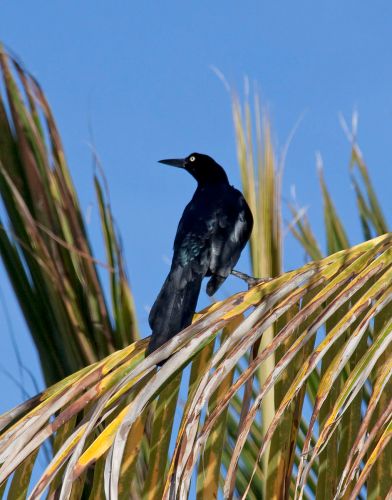
Photo Credit Tony Hisgett
THE GRACKLE’S SECRET TO SUCCESS-BY JAMES GORMAN
There’s an aura of power around invasive species. How is it that they can sweep in and take over from the locals? Are they more adaptable, tougher? What are their secrets?
The great-tailed grackle is a case in point. North America has its own similar species — the common and boat-tailed grackle. But the great-tailed bird, Quiscalus mexicanus, native to Central America, is one of the most invasive species in the United States.
The black birds with iridescent feathers were prized by the Aztec emperor Auitzotl, who, by some accounts, relocated some of them from Veracruz to near Mexico City about 500 years ago.
Over the past century or so the bird has spread north and its range is still expanding, particularly in the West, where it haunts cattle feed lots and big dairy farms. The birds are also quite happy in urban areas, like Santa Barbara, Calif., where Corina J. Logan captured and later released some grackle for recent experiments.
Great-tailed grackles first caught the attention of Dr. Logan, now at Cambridge University, in 2004 when she was doing undergraduate research in Costa Rica.
“They’ll actually walk right up and look you in the eye,” she said. “They look like they’re so smart.”
Years later, having earned her Ph.D. at Cambridge, she decided to look more closely at them because she was interested in behavioral flexibility. Grackles, for example, might look under rocks at the beach for something to eat, or switch to discarded sandwich wrappers in a city park.
There is another kind of behavioral change — innovation. That’s solving new problems either by adapting an existing kind of behavior or coming up with a new one. For instance, some crows and other birds have dropped stones in water to make the level rise so they can get a floating treat. Dr. Logan said that scientists have thought about flexibility and innovation as two sides of the same coin, and both are very characteristic of invasive species. But recently some researchers have wondered if they may be separate abilities.
Sign Up for the Science Times Newsletter
Every week, we’ll bring you stories that capture the wonders of the human body, nature and the cosmos.
Dr. Logan, then working at the SAGE Center for the Study of the Mind at U.C. Santa Barbara, wanted to see if the grackles were as innovative as they were flexible. They seemed like good candidates for the experiments because, although they are very adaptable, they have relatively small brains compared with birds like crows, which are part of the very smart and inventive corvid family.
So she challenged the birds she had trapped with some problems that required new behaviors to solve, using unfamiliar kinds of actions.
In one situation, she presented them with a stick that could be used to get food. The grackles don’t use tools in the wild, and they couldn’t figure out how to use one in an experiment, even after an experimenter showed them how.
In a second experiment, she offered them the chance to get a treat by pulling a string, either horizontally or vertically. None of the birds got the treat.
The great-tailed grackles did not show a capacity for innovation, despite their flexibility. So, Dr. Logan concluded in a report in Royal Society Open Science, innovation may not be so important for colonizing new environments. The grackles are doing pretty well without it. Perhaps, she said, scientists might reconsider how they think about what makes for a successful invasive species.
The birds in the test, all let go after the experiment, are listed by name in the scientific report: Tequila, Margarita, Cerveza and Michelada in one group, and Refresh, Horchata, Batido and Jugo in another.
“I was chatting with a restaurant owner where I was trapping the birds,” Dr. Logan said. He told her the grackles were bold in snatching items from tables that patrons had just vacated. He said, “They even drink the tequila”, Dr. Logan added.
Since it was a Mexican restaurant and Dr. Logan had already decided the birds ought to have Spanish names, she decided to name the birds after menu items — alcoholic drinks for the first group, nonalcoholic drinks for the second. She hopes to return to Santa Barbara for more research on grackles and already has plans for naming the next group.
“Appetizers,” she said.
HELP US IDENTIFY THE FLOWERS.
An intrepid group of 10 birders braved the beautiful mild June weather on Mt. Piños. It was hard getting beyond the parking lot, since we found dozens

Red Mariposa Lily, Calochortus venustus (Grace Murayama 6-11-16)

Long Leaf Paintbrush, Castilleja subinclusa?; one possibility among five species, plus additional hybrids (Read Howarth 6-11-16)
of gorgeous red mariposa lilies all over the area across the road, complemented by stands of orange paintbrush and many dandelion puffballs.

A native Dandelion puffball,
Agoseris sp. (Read Howarth 6-11-16)
There were more lilies than anyone (Mary) could remember. But there must be progress, and birding, so we tore ourselves away to climb Mt. Piños. Mary led the way to show us stops at our old reliable

Mylitta Crescent female, Phyciodes mylitta, breeds on thistles
(Grace Murayama 6-11-16)
places along the road. At the biggest trail head, we were stumped momentarily by a blue bird with an orange chest. It couldn’t be a western bluebird, since it had white wing bars and a sharply demarcated orange chest; further research proved it was a Lazuli Bunting!

Male Western Bluebird waits for a flyby fly (Read Howarth 6-11-16)
Some Western Bluebirds flew along to help us tell the difference. An American Robin and a Chipping Sparrow pecked at the trail, and a Band-tailed Pigeon sat guard on a tree, occasioning wishful thinking that it was a Clark’s Nutcracker (Someone saw one, but I didn’t).

California Fremontia, Fremontodendron californicum (Larry Loeher 6-11-16)
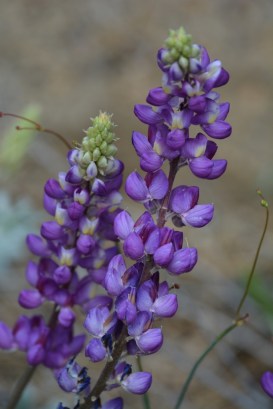
Purple Lupine, Lupinus sp.
(Grace Murayama 6-11-16)
All the way up the hill were lupines in full bloom; blue, purple and cream colored. Also bright yellow fremontia in almost full bloom; about 10 or so red snow plants poked up as we reached the top. At the top, the iris field was about a third in bloom. At the picnic area, there was much bird singing: bluebirds, sparrows galore, and some chipmunks.

Fox Sparrows have beautiful songs
(Read Howarth 6-11-16)
At the McGill campground, we were entertained by a Fox Sparrow in full voice, a pygmy nuthatch flew by and several Green-tailed Towhees also contributed their songs. Numerous Purple Finches were heard, and finally one was clearly spotted. A White-headed Woodpecker made an appearance, and so then it was OK to leave.
If you want to help refine our flower ID’s, this page on Calflora may help.
[Liz Galton]
Bird species seen
Red-tailed Hawk
Band-tailed Pigeon
White-headed Woodpecker
Western Wood-Pewee
Black Phoebe
Western Scrub-Jay
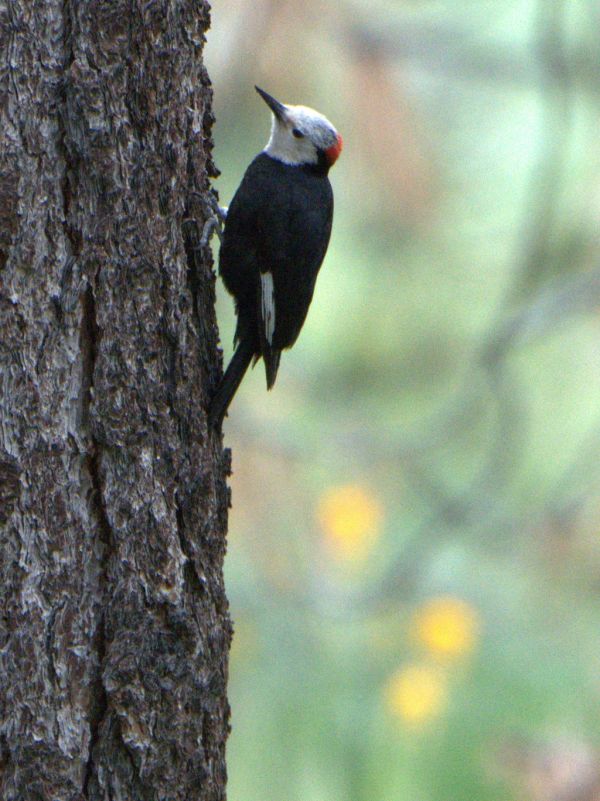
Male White-headed Woodpecker likes high altitudes (Read Howarth 6-11-16)
Steller’s Jay
Clark’s Nutcracker
Violet-green Swallow
Pygmy Nuthatch
Western Bluebird
American Robin
Green-tailed Towhee
Chipping Sparrow
Fox Sparrow
Dark-eyed Junco
Lazuli Bunting
Purple Finch
18 species

California Fremontia, Fremontodendron californicum (Larry Loeher 6-11-16)



 SANTA MONICA BAY AUDUBON SOCIETY BLOG