Free email delivery
Please sign up for email delivery in the subscription area to the right.
No salesman will call, at least not from us. Maybe from someone else.
Full Strawberry Moon Update – June 20, 4:02 AM PDT
Here’s another update from SMBAS Blog on that large, disc-like, shining object which has frequently and mysteriously appeared in our nighttime sky this year (known to many as the moon).
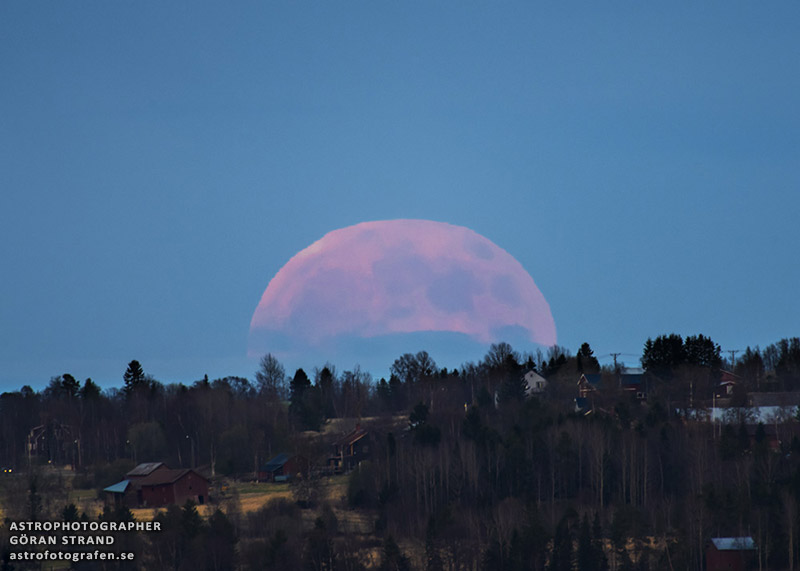
Full Strawberry Moon (Gören Strand 6/23/13 reproduced on apod.NASA.gov)
[Note: I found the above beautiful photo, by professional astrophotographer Göran Strand, on the NASA website. See many other of Göran’s astonishing photos at http://www.astrofotografen.se. On Friday the 13th, 2014, strangely enough, the moon rising over our Mt. Piños campsite was the same lovely rose-pink color.]
June 20, 4:02 a.m. PDT — Full Strawberry Moon. Known to every Algonquin tribe; strawberry picking peaks during this month. Europeans called it the Rose Moon or Honey Moon. [Top 10 Amazing Moon Facts]

Santa Monica’s Summer Solstice Sunset over the Santa Monica Mountains
(Bob Gurfield 6/21/14)
Long-time SMBAS member, prominent kayaker and alert reader, Bob Gurfield, reminded us of the fact that “Those of us who rise when the sun comes up should know that the latest (and earliest) sunrises do not occur on the solstices.”

Santa Monica’s Winter Solstice Sunset over the ocean (Bob Gurfield 12/21/13)
With use of information from Time and Date we constructed the following chart detailing sunrises & sunsets for three locales – Los Angeles, Anchorage and Bogota (Colombia). Note that the “earliest’ time (either sunrise or sunset) always precedes the solstice. The closer you are to the equator, the longer the period of this earliest-to-latest date spread. For example, around the summer solstice, Bogota, Colombia has 57 days between its earliest sunrise and latest sunset, Los Angeles has 16 days, Anchorage has only 3 days. Also note that the longest-to-shortest-day spread is very small near the equator; the difference for Bogota is only 32 minutes, 5 seconds. This is why in the tropics winter & summer are replaced by wet and dry seasons.
| Sunrises & | Los Angeles | Anchorage | Bogota |
| Sunsets | California | Alaska | Colombia |
| Latitude | 34° 3′ 8” N | 61° 13′ 5″ N | 4° 36′ 0″ N |
| Earliest Sunset | 12/04/13 – 1643 | 12/16/13 – 1540 | 11/09/13 – 1738 |
| Winter Solstice | 12/21/13 – 0911 | 12/21/13 – 0811 | 12/21/13 – 1211 |
| Latest Sunrise | 1/07/14 – 0659 | 12/25/13 – 1015 | 2/03/14 – 0612 |
| Earliest Sunrise | 6/12/14 – 0541 | 6/19/14 – 0420 | 5/22/14 – 0542 |
| Summer Solstice | 6/21/14 – 0351 | 6/21/14 – 0251 | 6/21/14 – 0551 |
| Latest Sunset | 6/28/14 – 2008 | 6/22/14 – 2342 | 7/18/14 – 1813 |
| Earliest Sunset | 12/04/14 – 1643 | 12/16/14 – 1540 | 11/10/14 – 1748 |
| Winter Solstice | 12/21/14 – 1503 | 12/21/14 – 1403 | 12/21/14 – 1803 |
| Latest Sunrise | 1/07/14 – 0659 | 12/26/14 – 1015 | 2/03/15 – 0612 |
| Longest Day | |||
| 6/21/2014 | 14h 25m 34s | 19h 21m 31s | 12h 23m 29s |
| Shortest Day | |||
| 12/21/2014 | 9h 53m 03s | 5h 27m 41s | 11h 51m 24s |
| Difference | 4h 32m 31s | 13h 53m 50s | 0h 32m 05s |
Nowhere do the latest sunrise and sunset or earliest sunrise and sunset occur on the solstices (except perhaps exactly at the North or South Pole). The reason for this is that the earth’s axis is not aligned with the minor axis of the earth’s orbit around the sun. Over time the earth’s ecliptic precesses a tiny bit each year so that every 134,000 years the orbit makes a complete rotation with respect to the positions of the stars. [This is not the same as the ‘precession of the equinoxes.’] http://en.wikipedia.org/wiki/Apsidal_precession
The Old Farmer’s Almanac has a page for each full moon. One tip: cut your hay on the 1st, 27th or 28th, and make haw while the sun shines.
The next significant full moon will occur on July 19, 3:56 PM PDT. Keep an eye on this spot for additional late-breaking news on this unprecedented event.
This information comes to you courtesy of: http://www.space.com/31699-full-moon-names-2016-explained.html
written by Joe Rao. Joe Rao serves as an instructor and guest lecturer at New York’s Hayden Planetarium. He writes about astronomy for Natural History magazine, the Farmer’s Almanac and other publications, and he is also an on-camera meteorologist for News 12 Westchester, N.Y.
But that’s waaay too long to type in, and besides, you don’t need to go there because SMBAS has done the work for you!
[Chuck Almdale]
Anacapa Island Nesting Season
Birds have it tough. About 90% die within their first year, with mortality heaviest on nestlings and unhatched birds. Many birds hide their nests in foliage or holes, but ground-nesting birds have a special challenge: their nest is right on the ground, where any bird soaring overhead or reptile or mammal wandering by can find it. Dense vegetation or grass may conceal small nests, enabling nesting success. Seabirds created other solutions.
To minimize nest predation, seabirds usually nest on small islands, where mammal and reptile predators are few or absent. Many take the addition step of nesting on small ledges of steep cliffs. Such birds may build no nest at all, laying their eggs directly on the bare rock. In such cases, the egg is sharply tapered at one end: if it moves, it rolls in a tight circle rather than off the ledge.
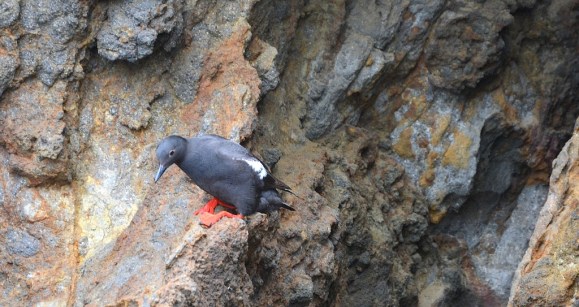
Pigeon Guillemot (G. Murayama 6-14-16)
Other seabirds, such as this Pigeon Guillemot, nest in rocky crevices, cavities or self-excavated burrows in dirt. Such sites can be defended by the adult. If the island is free of mammals and reptiles, some birds may nest openly on the ground. When they are large, as are Western Gulls, and can protect the nest from raptors, they have little to worry about. Still, when chicks are hatched, it helps if they are cryptically plumaged, as they are less likely to be spotted by predators if they wander from the adult’s protection.
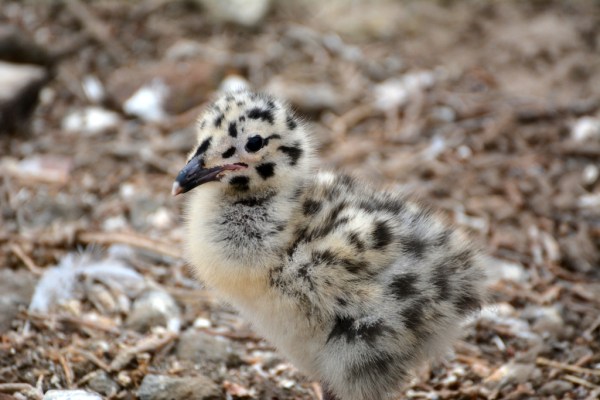
Western Gull cryptic chick (G. Murayama 6-14-16)
Western Gulls typically lay three eggs (one to five eggs is possible) in a nest built of grass or brush pieces. They nest in colonies; nests may be closely grouped, but not so close that adults in adjoining nests can peck one another. Unlike non-colonial birds which may maintain large territories, the gull’s territory consists only of how far they can peck without leaving their nest.
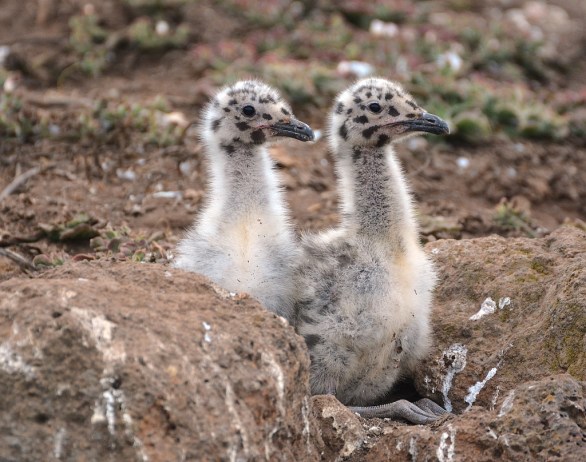
Chick pair (G. Murayama 6-14-16)
In about a month the eggs hatch, after which the chicks are fed a diet of invertebrates, small vertebrates, carrion, and eggs and chicks of other birds. While embryos can survive brief temperatures up to 114°F, adult birds may soak their belly feathers in water to cool heated eggs. Western Gulls are one of the many species that lay more eggs than they can be expected to successfully fledge; later-born chicks are “insurance” against loss of early chicks, and do not often survive.
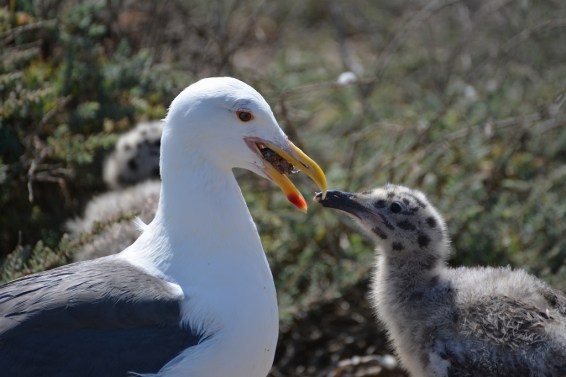
Up comes lunch (G. Murayama 6-14-16)
The hungry chicks peck at red spot on the adult’s lower mandible in order to trigger food regurgitation by the parent. Food is brought up from the internal carrying pouch, called the crop. This is not the stomach, and digestion within it is minimal. Chicks often grab more than them can swallow; the meal moves in and down as it is digested.
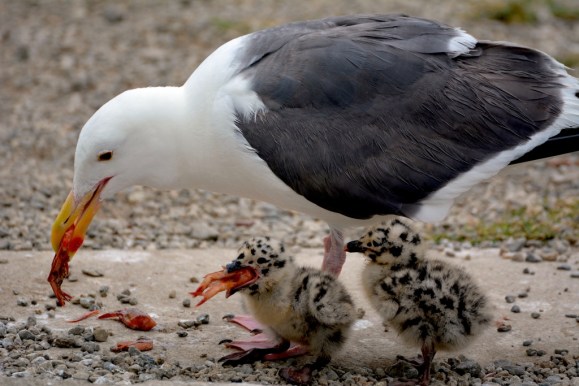
Western Gull feeding chicks (G. Murayama 6-14-16)
Chicks fledge in six to seven weeks, and may leave their home island in another three to four weeks, at which point they may begin appearing at mainland beaches like Surfrider Beach. Western Gulls reach adult plumage in their fourth spring, and begin breeding between ages four to eight. They can live to age sixteen. Along our coast they are frequently seen prying mussels off rocks, dropping them onto rocks from thirty to fifty feet up, then dropping to eat the exposed flesh from the broken shell. Other local gull species seem unable to learn this trick.

Island Tree Mallow gives the gulls something to admire (G. Murayama 6-14-16)
Western Gulls breed from NW Washington to central Baja California. Their winter range extends slightly, reaching the top of Vancouver Island and nearby Canadian mainland, and to the southern tip of Baja. They are extremely reliable at Malibu Lagoon, present on 99% of our visits.
Many thanks to Grace Murayama for her photos from Anacapa which inspired this message.
[Chuck Almdale]
From our South African connection
Many of our members will remember Laurel Serieys who, partly sponsored by SMBAS, completed her PhD at UCLA and often presented us with inside information on the felines of the Santa Monica Mountains. She then left for South Africa and is conducting similar research there. Below is an email she recently sent to Chuck And Lillian Almdale with a plea for assistance in her current project which is facing a competitive crowd-funding deadline. SMBAS does not fund outside our general area, but we thought a number of our members might be interested in contributing to this project. The link is toward the bottom of the text.
Hi Chuck and Lillian-
I hope you are well. How is the Audubon group going? Have you found any other good students at UCLA to support?
Things are well for me in Africa- I am loving it so much that I actually don’t want to leave! It’s really captivating me to work here, and it seems my life may be taking an unexpected detour.
To help fund my work here to wrap up the last leg of the fieldwork, I am running a crowd-funding campaign. There’s a couple caveats to this effort:
The project is part of a cluster of cat-related studies, and the project with the most donors (not the most money) gets a bonus of $1000 on June 10! We are in the lead, but barely! So I am calling on all potential supporters to donate, no matter how small, it will get us very far!
The project funding is all or none- we reach our goal within 2 weeks or we don’t get any of the cash. So every donation is crucial.
Would you mind circulating amongst the group and just let them know- any amount no matter how small could easily turn into $1000?
Thank you so much for your ongoing support!
Please let me know if you need more info- I’d be so grateful!
Much love to you guys!
Cheers
Laurel
The woman who brought Monsanto to its knees
Happy Birthday, Rachel Carson
“We are accustomed to look for the gross and immediate effects and to ignore all else. Unless this appears promptly and in such obvious form that it cannot be ignored, we deny the existence of hazard.”
This quote is not about Donald Trump’s climate change denials; it is from SILENT SPRING, published in 1962, challenging the notion made popular by the chemical industries of the postwar 50s that “better living through chemistry” was the answer for us all. Rachel Carson was the first scientist to call national attention to the danger caused by the indiscriminate use of pesticides by demonstrating their damage–from the insects they directly targeted all the way up the food chain to mammals, including people. The world almost lost bald eagles, falcons and many other species because of it. Carson declared, “A chemical war is never won, and all life is caught in its crossfire.” She was among the first to point out that to save a species, first its habitat must be saved. And she was alone in pointing it out with a literary style and poetry that caught the world’s attention.

Carson began her career as a biologist, writing for what would become US Fish and Wildlife Service. This after receiving her doctorate in biology from Johns Hopkins University at a time when women in science were accused of going to grad school, not to earn a doctorate but to marry one. For USFS, she wrote a scientific paper her boss said was unsuitable for a science publication– but would be perfect for a magazine. Atlantic Monthly was happy to oblige. She followed the article up with many more, and published three books of writings about the sea and its wildlife. Her biology work continued, and she became more and more convinced that pesticides were killers, but not just of “pests.”
SILENT SPRING first appeared in serialized form in the The New Yorker Magazine. It caused an immediate uproar in the agribusiness industry which closed ranks to mount a loud public campaign against Rachel Carson personally. When Houghton Mifflin released the book three months later, it hit the bestseller list. Carson’s science was less a target then she herself was. She was labeled hysterical by the chemical industry, which also criticized her for being childless. But President Kennedy took serious notice, and he went on to create the Environmental Protection Agency. Monsanto, maker of DDT, even sponsored a ride at Disneyland, “Adventure thru inner Space” to win over the public. But Carson prevailed, and years later DDT was banned, allowing affected species to begin on the years-long road to recovery.
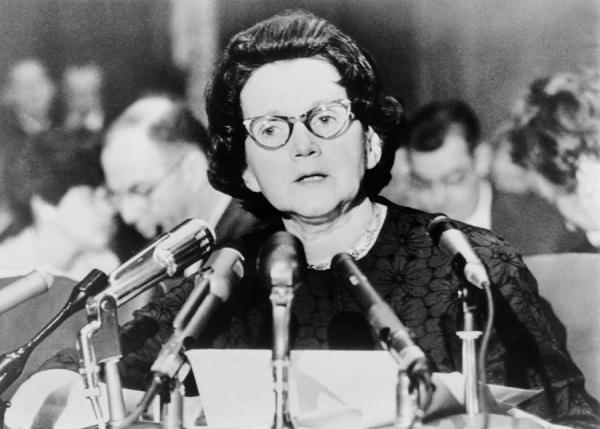
Carson’s efforts spearheaded the modern ecology movement, but she never lived to see it. Eighteen months after the publication of SILENT SPRING, she was dead of cancer at 56. Her legacy and her tireless fight continue to keep her relevant, and a quick look at the environment today reminds us that her struggle against unchecked pesticides by agribusiness needs to carry on. Representative Tom Coburn of Oklahoma even now blames her for the spread of malaria, although she never called for a ban on DDT, only for its careful use, and mosquitos have now proved resistant to DDT, something she warned against. Coburn recently blocked a congressional bill to honor her.
“But most of all I shall remember the Monarchs”
Carson wrote this to a friend at the end of her life. I believe she would’ve been horrified to learn that Monsanto is still killing the wildlife she loved, especially Monarch Butterflies. If you’d like to carry on the fight in her absence, there’s something easy you can do–sign this petition calling for the elimination of Monsanto’s indiscriminate use of the pesticide ROUND UP, believed by scientists and admitted by Monsanto to be responsible for the disappearance of milkweed (the only plant Monarch Butterflies can lay their eggs in), and therefore, a large contributor to the looming extinction of the species.
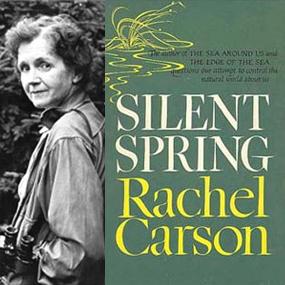
On this Memorial Day holiday weekend, you might be looking to grab a good beach read. Well, don’t grab SILENT SPRING. As ornithologist Connor Mark Jamison states, it can be “dense and technical.” Instead grab one of her earlier sea books, full of wonder and and razor-sharp prose. UNDER THE SEA WIND follows three marine inhabitants, including a Sanderling in a vivid, harrowing account. And if you find yourself on Santa Monica bay reading it—you may glance up to see a pelican, a cormorant or a peregrine falcon— which at one time were considered lost to DDT.
Carson is the hero in the survival of untold numbers of species devastated by pesticides.
She’s long been mine. Happy Birthday, Rachel
Field Trip Report Malibu Lagoon May 22, 2016
It may have been early in the month for our 4th Sunday, but for us it seemed quite late in the migration cycle. On a comfortable but gray Sunday we saw very few birds, especially in the wader category. One new arrival was a solitary Brant. Don’t let this rather low total (41 species) discourage you from visiting our favorite hot spot. Since that outing a number of interesting birds have shown up at the Lagoon, including a colorful female Wilson’s Phalarope, southward bound I’m told, spotted by Grace Murayama last week (June 8th). See you June 26th! [Lucian]
Brant (Branta bernicla) 1
Gadwall (Anas strepera) 8
Mallard (Anas platyrhynchos) 4
Red-breasted Merganser (Mergus serrator) 1
Pied-billed Grebe (Podilymbus podiceps) 1
Double-crested Cormorant (Phalacrocorax auritus) 7
Brown Pelican (Pelecanus occidentalis) 14
Great Blue Heron (Ardea herodias) 2
Great Egret (Ardea alba) 1
Snowy Egret (Egretta thula) 2
Osprey (Pandion haliaetus) 1
Black-bellied Plover (Pluvialis squatarola) 6
Killdeer (Charadrius vociferus) 6 ( Incl. 4 immature)
Willet (Tringa semipalmata) 16
Heermann’s Gull (Larus heermanni) 8
Ring-billed Gull (Larus delawarensis) 26
Western Gull (Larus occidentalis) 23
California Gull (Larus californicus) 3
Caspian Tern (Hydroprogne caspia) 9
Royal Tern (Thalasseus maximus) 48
Elegant Tern (Thalasseus elegans) 10
Rock Pigeon (Feral Pigeon) (Columba livia (Feral Pigeon)) 1
Mourning Dove (Zenaida macroura) 2
Allen’s Hummingbird (Selasphorus sasin) 2
Black Phoebe (Sayornis nigricans) 1
Western Scrub-Jay (Aphelocoma californica) 2
American Crow (Corvus brachyrhynchos) 4
Northern Rough-winged Swallow (Stelgidopteryx serripennis) 6
Barn Swallow (Hirundo rustica) 4
Cliff Swallow (Petrochelidon pyrrhonota) 4
Bushtit (Psaltriparus minimus) 2
Bewick’s Wren (Thryomanes bewickii) 1
Northern Mockingbird (Mimus polyglottos) 2
European Starling (Sturnus vulgaris) 2
Common Yellowthroat (Geothlypis trichas) 1
Song Sparrow (Melospiza melodia) 2
Red-winged Blackbird (Agelaius phoeniceus) 4
Brewer’s Blackbird (Euphagus cyanocephalus) 12
Great-tailed Grackle (Quiscalus mexicanus) 3
House Finch (Haemorhous mexicanus) 7
House Sparrow (Passer domesticus) 3
Species Total: 41



 SANTA MONICA BAY AUDUBON SOCIETY BLOG