Free email delivery
Please sign up for email delivery in the subscription area to the right.
No salesman will call, at least not from us. Maybe from someone else.
The Humble Hoopoe: Sunday Morning Bible Bird Study VI
This Week’s Lesson – The Humble Hoopoe
Link to entire 10-blog Birds in the Bible series on one page
The Hoopoe is another member of the list of twenty Unclean Birds whom we’re not supposed to eat. This list comes in numerous versions due to the problems of translating ancient and rare Hebrew words, but that’s a topic for a later lesson. For now, we’ll stay with the Hoopoe, a bird common in Eurasia and Africa, yet most uncommon in ways we shall see.
And these ye shall have in detestation among the fowls; they shall not be eaten, they are a detestable thing….the hoopoe… (הַדּוּכִיפַ֖ת – had·dū·ḵî·p̄aṯ “the hoopoe”)*
Lev 11:13-19 Holy Scriptures accor4ding to the Masoretic Text (HSMT)
Of all clean birds ye may eat, but these are they of which ye shall not eat….and the hoopoe… (וְהַדּוּכִיפַ֖ת – wə·had·dū·ḵî·p̄aṯ “and the hoople”)* Deut 14:11-18 HSMT

Eurasian Hoopoe pair – Upupa epops (Henry E. Hooper)
Slightly larger than an American Robin, a Hoopoe is 11-12″ long, including its slender and slightly decurved 2″ bill. It weighs only 1½ -3 ounces, the same as your quarter-pound hamburger after cooking. The head, neck, breast and belly colors varies from rufous to cinnamon to tawny; the wings and tail are black with irregular white bands; the bill, eyes and legs are black; the long crest feathers are tipped in black. It is an attractive, lively and inquisitive bird. Its name is unlikely to be forgotten or mistaken because for most people who know it, the name is echoic of its call, which varies from hoop-hoop to oo-poo-poo. [Video & call link]
The scientific name is Upupa epops (Latin name upupam + Greek name έποπα). Some other common names are: Arabic hud-hud, Dutch hoppe, French Huppe, Italian upupa, Maltese Daqquqa tat-toppu, Polish Dudek, Portuguese poupa, Spanish Abubilla, Turkish ibibik.
They are distantly related to the kingfishers. On their “birds of prey” branch of the Tree of Life, they split from Owls 75.9 million years ago (MYA), from Trogons 72.1 MYA, from Kingfishers & Bee-eaters 69.6 MYA, from Hornbills 55.3 MYA and from Woodhoopoes & Scimitarbills 35.2 MYA. [Don’t rely on the permanence of these dates. Research continues.]

Range of the Hoopoe: Orange-breeding, Light & Dark Green-resident all year; Blue-winter; Brown – Madagascar species (Wikipedia)
Their nesting begins as early as mid-April around the Mediterranean; in Northern Europe as late as early June. Nesting behavior of non-migratory resident birds cycles around the rainy seasons. Nest are in tree cavities, walls, cliffs, earth banks or termite mounds. The female incubates 4-6 (sometimes as many as 12) blue, gray, green, yellow or brown eggs for about 18 days. The male brings her food, but no water, as they are not known to drink. They don’t remove the eggshells or fecal sacs of their young, unlike most other cavity-nesting birds. The young – helpless with sparse down when hatched – fledge (leave the nest) in 3 to 4 weeks,

Feeding the young on the fly (Cowboy54 – From The Grapevine)
and may stay with their parents until nesting season returns. They feed on the ground and use trees for safety and night roosting. Their typical flight is slow, undulating and a bit haphazard, belying their impressive speed and maneuverability should a falcon take pursuit. Their long crests – normally held flat – may be raised in excitement or alarm. They can be found alone or in small bands which are probably family units, but they are not gregarious. Hoopoes can be tamed; one became accustomed to eating a boiled egg for breakfast.
Shorebirds and waders often have chunky bodies and long slender bills, but they usually stay close to water, when not actually in it. In the Hoopoe’s preferred dry, park-like habitat, only Lapwings remotely resemble them.

Northern Lapwing – Vanellus vanellus
(John Sheppard – Sulgrave, GB)
Until recently the Hoopoe was classified into ten subspecies, but one was split off as Madagascar Hoopoe Upupa marginata (a decision lacking universal scientific agreement), leaving the rest of the Hoopoes stuck with the less euphonious name, Eurasian Hoopoe.
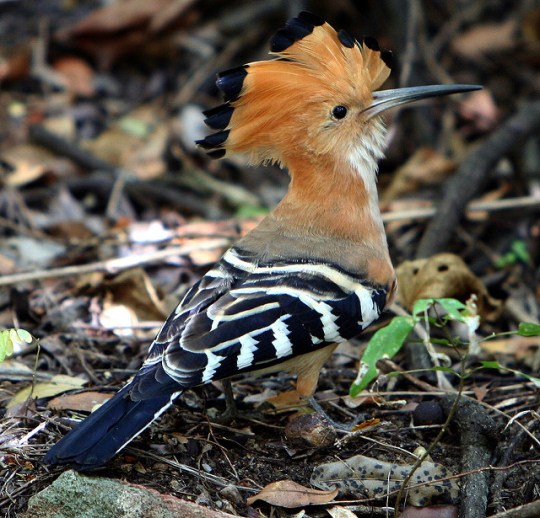
Madagascar Hoopoe -Upupa marginata
(Matthew Golding – Flickr photo)
Hoopoes have been admired for millennia and are well-represented in our art. Bartolo’s often reproduced painting, St. Francis Preaching to the Birds, depicts a pheasant, a quacking duck, several small birds in a tree and a Hoopoe in the foreground on the ground, all paying rapt attention to the words of this,

St. Francis Preaching to the Birds – find the Hoopoe, Taddio di Bartolo, 1362-1422 (Jean Louis Mazieres – Flickriver)
presumably their favorite saint. There are two stories of Francis involving preaching and birds. The first is that Francis and friends were walking through the Spoleto Valley of Italy when he spotted a flock of birds and ran over to them. “Beloved birds,” he greeted, expecting them to fly away. They stayed, and he preached while they silently listened. The second is that Francis, preaching to a crowd from a balcony in Alviano, had to contend with swallows building nests nearby and chattering noisily. Francis finally called to them, “My sisters, swallows, it’s my turn to speak now, because you’ve already said enough. Listen to the word of God. Stay still and be quiet until it’s over.” Reportedly the swallows fell silent until Francis finished. Francis seems to have loved everyone and everything. Would that today’s Italians felt as friendly towards their birds, rather than eating them all, large and small.
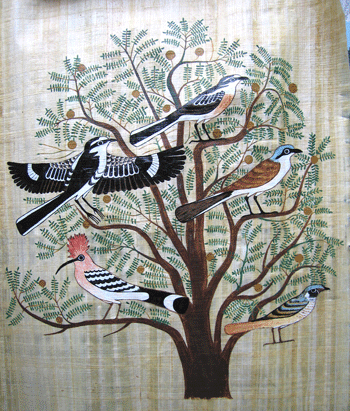
Bird tree with Hoopoe, Tomb of Khnun-Hotep, Middle Kingdom, Beni Hasan, Egypt (Timetrips.com)
Wall paintings in the Egyptian tomb of Khnum-hotep II, dated to 1950-1900 BCE, clearly shows a Hoopoe and many other birds.
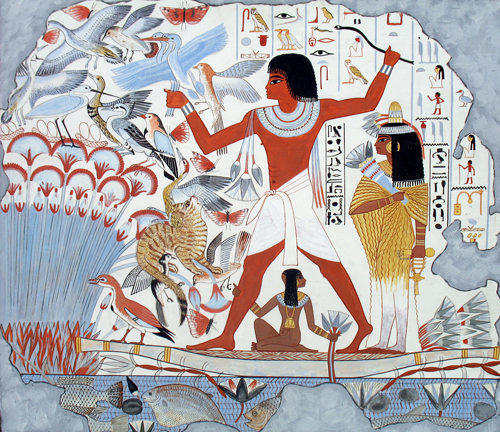
Neb-amun hunting birds in the marshes, Tomb of Khnun-hotep, Middle Kingdom, Beni Hasan, Egypt. No Hoopoes in the marshes. (Timetrips.com)
Many scientists say the Hoopoe is the sole species in their evolutionary family, Upupidae. Humans are similarly alone; our cousin Homo species are long extinct, probably at our hand. The Old World range of the Hoopoe virtually replicates ours at the end of the last ice age. They dislike large bodies of water and never made it to Australia, most of Japan or the New World, although they occasionally stray across the channel to England.

Hoopoe on Bamboo, Zhao Mengfu 1254-1332 (Wikipedia – Shangai Museum)
Ever since Homo erectus, our predecessor species, left Africa and wandered to the far reaches of Eurasia, our ancestors have found Hoopoes close at hand. Throughout our shared range we find them in savannas, open woodlands, forest clearings, cultivated ground and gardens, probing the ground with their long slender bills. As we adapted to life as herdsmen and farmers, Hoopoes remained nearby, gleaning our pastures and fields. The snails, spiders, centipedes, ant-lions, and lizards which they gleaned from our gardens and fields and ate within our easy eyesight, is what branded them an Unclean Bird. [Snails were definitely a no-no.] Divine taboos were not placed on tiny forest birds unnoticed by human eye, no matter how loathsome and lethal to humanity their choices in cuisine might be. Hoopoes gave us their lively beauty and ate our pests. Sometimes our landscape changes suited them; sometimes not. Mostly, we coexisted.
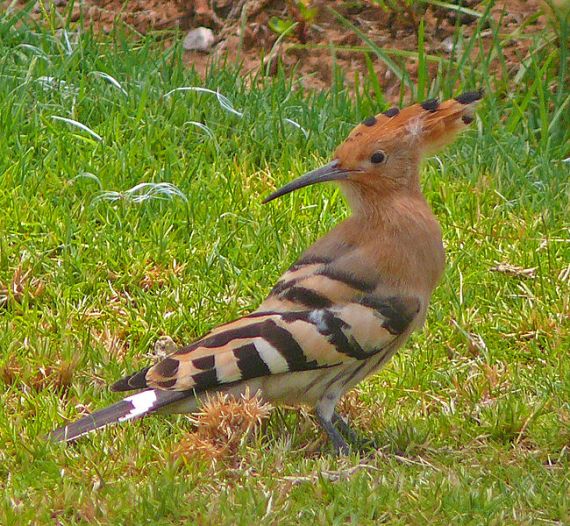
Israel’s National Bird in Ramat Gan (Zachi Evenor 5-22-10, on Wikipedia)
Hoopoes and Humanity: Fellow Passengers on Spaceship Earth
Hoopoes and humans are orphans; solitary species within our respective families. The large mammals preserved in La Brea pits were probably hunted into extinction by humans. Australian species vanished when Aborigines burned the landscape to suit their own needs. The aurochs, cave bears, elephants and rhinos of Europe are gone. Half of Hawaii’s bird species disappeared during the millennia between the arrivals of Polynesians and Euro-Americans. Humans are a dangerous species and the future of any creature that gets in our path is not promising. Our only successful adversaries are those who avoid confrontation and, like water, seek the low road, remaining obscure, like bacteria, rats and cockroaches. But through all the changes and depredations of human history, Hoopoes held their noble visibility, sharing our lands and lives, yet staying at arm’s length, neither dangerous nor useful to us.
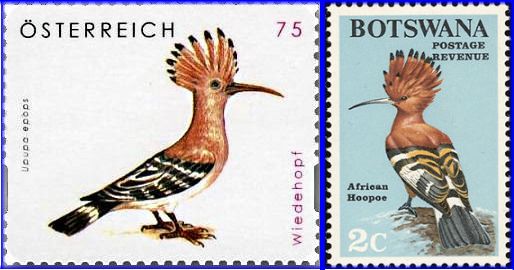
Humans typically exhibit an anthropocentric view of nature – “What does it do for me?” This attitude may muster economic forces to protect species or habitat, because, “Maybe we’ll find a cure for cancer!” We make much ado about the value of an individual’s life and freedom, yet rarely extend concern and courtesy to our fellow passengers on our earthly ark. Their lives have value for them as ours do for us, whatever one thinks of the other. If we understood that “dumb animals” participate as richly in their own lives as we do in ours, we might not act as we do towards them. What may we learn from them?

Explorer Speke, 1st European to see and map Lake Victoria, July 1858 (Central African Republic stamp)
Hoopoes are a good example of how the meek may yet inherit the earth. Better yet, perhaps they unintentionally do what Jesus, much later, told his disciples when he sent them out to preach:
“Behold, I send you out as sheep in the midst of wolves. Therefore be wise as serpents and harmless as doves. Matthew 10:16 New King James
Bible Factoid #6 – Catching Forty Winks
One way to do textual analysis and gain a glimpse into a writer’s mind is to find their favorite words and determine just how much they like them. All following citations are from the King James Version.
I will cause it to rain upon the earth forty days and forty nights… Genesis 7:4
…and Moses was in the mount forty days and forty nights…. Exodus 24:18
And forty sockets of silver he made under the twenty boards… Exodus 36:24
…the LORD thy God led thee these forty years in the wilderness… Deuteronomy 2:7
Being forty days tempted of the devil. And in those days he did eat nothing… Luke 4:2
To whom also he shewed himself…being seen of them forty days… Acts 1:3
As in modern parlance, “Forty? What’s up with that?”
What with all the armies and ages and apostles, numbers are very common in both Jewish and Christian scriptures. We even find an important Jewish scripture, fourth book in the Torah (Pentateuch) entitled “Numbers” in the Christian version. [The Jewish version is more appropriately titled “In the Wilderness.”] So let’s look at some numbers.
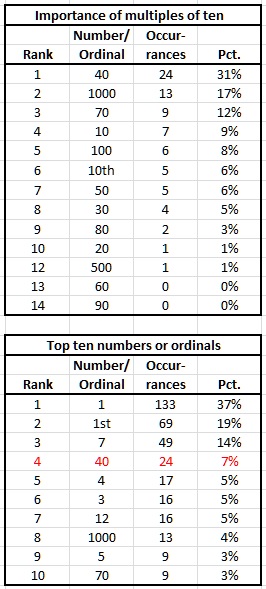
I combed through my bible concordance, counting citations for all numbers (one, two, etc.) and ordinals (first, second, etc.). It didn’t give all citations – just significant ones. I discovered that “forty” was by far the most common of multiples of ten between ten and one hundred (first chart). Among all numbers (second chart) it was fourth, surpassing 1000, 100 and even 10 itself.
BibleStudyTools, a great online site for biblical nit-picking, lists 145 occurrences for the word “forty.” Here “forty” rates only sixteenth, but this list includes all citations of the word, such as:
Those that were numbered of them, even of the tribe of Gad, were forty and five thousand six hundred and fifty.
Numbers 1:25
The verse above counts as one citation each for: forty, five, thousand, five thousand, six, hundred, six hundred, and fifty. These sorts of biblical citations are innumerable (pun intended). There are fourteen citations like this one, every one beginning with “forty and xxx thousand…” Although this exceeds the limits of randomness, I did not include citations such as these in my two charts.
Thirty-nine citations referred to counts of various sorts: “So all the cities which ye shall give to the Levites shall be forty and eight cities…” (Numbers 35:7) Seven citations referred to ages: “Then said the Jews, Forty and six years was this temple in building…” (John 2:20) I didn’t included these either.

Six citations referred to the flood, twenty to Moses on his various mountains, ten for Israelites wandering in the Sinai desert, four for Jesus meditating in the desert. Such clusters were counted as one citation each.
After subtracting 121 citations of low or no significance, twenty-four remained. I examined sixty different numbers; three had greater frequency than “forty.” Not unexpectedly, they were “one,” “first” and “seven” (second chart) “One” and “first” need no explanation of significance; “seven” is a magical number in many cultures and religions, and its high frequency was expected. For the same reason, I expected “three” to be higher than its 6th place rating. At the bottom, “sixty” and “ninety” were never used meaningfully (symbolically).
So, again…what’s up with forty?
The most common opinion is that forty symbolizes trial, testing or judgment.
And the rain was upon the earth forty days and forty nights. Genesis 7:12
And the children of Israel did eat manna forty years… Exodus 16.35
And [Moses] was there with the LORD forty days and forty nights… Exodus 34:28
…the LORD delivered them into the hand of the Philistines forty years. Judges 13:1
And Jonah…said, Yet forty days, and Nineveh shall be overthrown. Jonah 3:4
And [Jesus] was there in the wilderness forty days, tempted of Satan… Mark 1:13
There is also the legal limit on lashes, which can certainly be considered a “trial.”
Forty stripes he may give him, and not exceed… Deuteronomy 25:3
Another explanation is that forty symbolizes a “generation of man.”
And Esau was forty years old when he took to wife Judith… Genesis 26:34
And your children shall wander in the wilderness forty years, and bear your whoredoms, until your carcases be wasted in the wilderness. Numbers 14:33
And the land had rest forty years. And Othniel the son of Kenaz died. Judges 3:11
To whom also he shewed himself alive after his passion by many infallible proofs, being seen of them forty days, and speaking of the things pertaining to the kingdom of God. Acts 1:3

Versions Nos. 1 – 39
didn’t work so well
(Wikipedia)
One source claims:
According to saint Augustin, forty expresses the perfection ‘because the Law was given in ten commandments, then it is through the whole world that the Law has been preached, and the whole world is composed of four parts, Orient and Occident, South and North; therefore, by multiplying ten by four, we obtain forty.’
I didn’t know that St. Augustine had enough imagination to come up with that doozy.
But the two popular explanations don’t cover the many dozens of non-random appearances of “forty.” I have the suspicion that it was also used as we use “dozens,” “bazillion” or “many” – an indefinite large number that simply sounds good to our ears.
Those that were numbered of them, even of the tribe of Reuben, were forty and six thousand and five hundred. Numbers 1:21
About forty thousand prepared for war…to the plains of Jericho. Joshua 4:13
…and David slew the men of seven hundred chariots of the Syrians, and forty thousand horsemen… 2 Samuel 10:18
And Solomon had forty thousand stalls of horses for his chariots… 1 Kings 4:26
Then made he ten lavers of brass: one laver contained forty baths… 1 Kings 7:38
In the four corners of the court there were courts joined of forty cubits long and thirty broad… Ezekiel 46:22
The writers of the bible didn’t do that with “sixty” or “ninety.” That’s something to think about while you’re trying to catch forty winks.
Part I – What About That Dove? & The Flood of the Gilgamesh
Part II – Sandgrouse or Quail? & YHVH [יְהוָ֖ה] [Yahweh]
Part III – Junglefowl in Judea! & New Testament Koine Greek
Part IV – Birds that Sow, Reap and Store & Whence Jesus (Ἰησοῦς)
Part V – The Friendly Raven & The Bar-Abbas Mystery
Part VII – The Wise Hoopoe & On “On”
Part VIII –Don’t Eat That Bird! Part 1 & Of “Of”
Part IX – Don’t Eat that Bird! Part 2 & Seeing “Red”
Part X – Don’t Eat that Bird! The Last Bite & The Problems of Translation
[Chuck Almdale]
*The word “hoopoe” comes in two forms in the bible.
הַדּוּכִיפַ֖ת (had·dū·ḵî·p̄aṯ) “the hoopoe” 1 occurrence Lev 11:19
וְהַדּוּכִיפַ֖ת (wə·had·dū·ḵî·p̄aṯ) “and the hoopoe” 1 occurrence Deut 14:18
The root word דּוּכִיפַת (dū·ḵî·p̄aṯ) does not actually occur in the bible.
Additional Sources:
Tree of Life To navigate Tree Of Life, click binoculars icon in upper right corner, enter bird name and press “next hit” until you get to your bird.
BibleHub.com An invaluable tool. Almost a “one-stop-shopping” research site for the bible.
BibleStudyTools.com A very useful site.
1. Birds of Europe. Mullarney, K., Svensson, L., Zetterström, D., Grant, P.J. (1999) Princeton University Press, Princeton, N.J. – Pg 220.
2. Dictionary of Birds. Campbell, Bruce. (1974) Peerage Books, London. – Pgs 22-23, 347.
3. Handbook of Birds of the World (HBW), Vol. 6. del Hoyo, J., Elliott, A. & Sargatal, J. eds. (2009) Lynx Edicions, Barcelona. Hoopoes – Pgs 396-411.
4. Holy Scriptures: According to the Masoretic Text. (1955) The Jewish Publication Society of America. Philadelphia.
5. Nelson’s Comfort Print Bible Concordance. Youngblood, Robert F. (1995) Thomas Nelson Publishers, Nashville, TN
6. New English Bible with the Apocrypha, The, Oxford Study Edition. Sandmel, Samuel, Suggs, M. Jack, Tkacik, Arnold J.; eds. (1972) Oxford University Press, New York
Coastal Cleanup at Malibu Lagoon: 17 September, 2016

Trash buckets stand at attention (Photo: Kirsten Wahlquist 9-17-16)
Once again we volunteered to run the 2016
coastal cleanup at Malibu Lagoon!
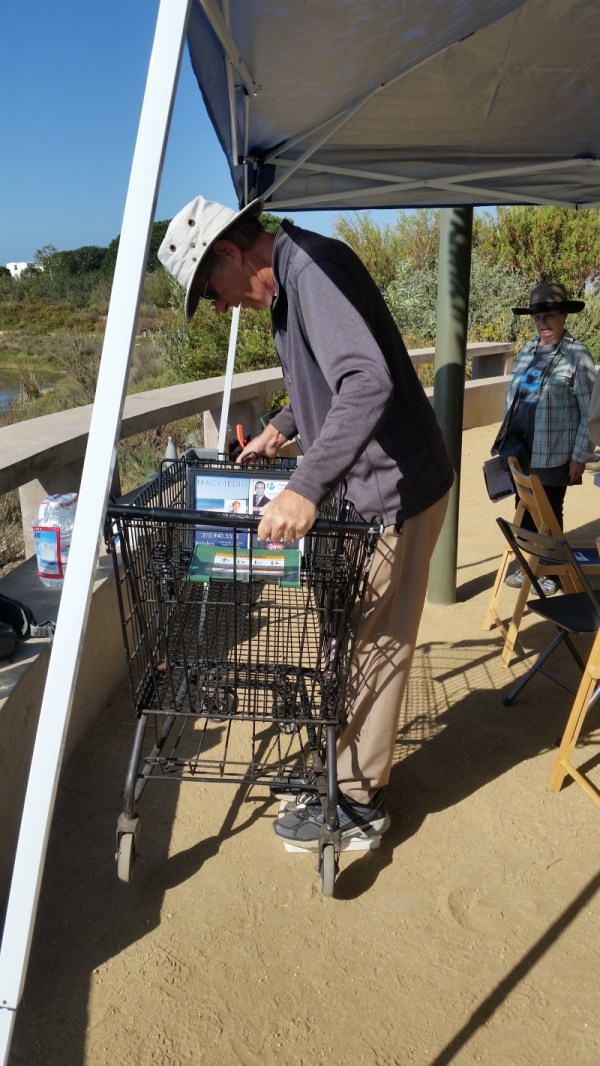
Photo: Kirsten Wahlquist 9-17-16
Special thanks to all the volunteers who took their trash to the dumpster after it was weighed. We also want to congratulate the growing number of people who brought their own cleanup supplies. There was only one mishap: the gloves we were supplied turned out to be dried and crystallized, breaking into little pieces when pulled apart. Next time when we get the supplies from Heal the Bay, we promise to immediately open the boxes of gloves and check them out. Fortunately, people could use trash bags and large pieces of paper to pick up items.

Photo: Kirsten Wahlquist 9-17-16
Unusual Items: One shopping cart, a mattress, one cinder block and the carcasses of dead birds were found. The most trash was around the river’s edge near the bridge. As usual there were always innumerable cigarette butts and other trash around the parking lot. We encouraged people to concentrate on tiny pieces of plastic with the visual aid of an Audubon photograph showing the contents found in the stomach of one albatross. People really responded to the request after seeing the picture.
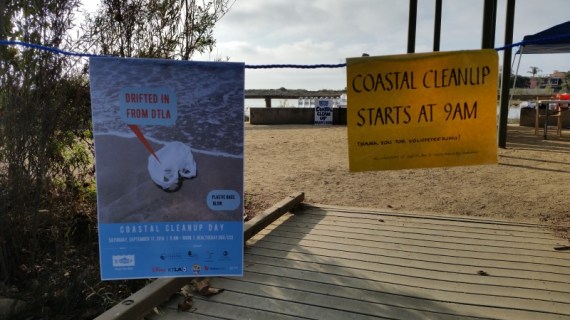
Photo: Kirsten Wahlquist 9-17-16
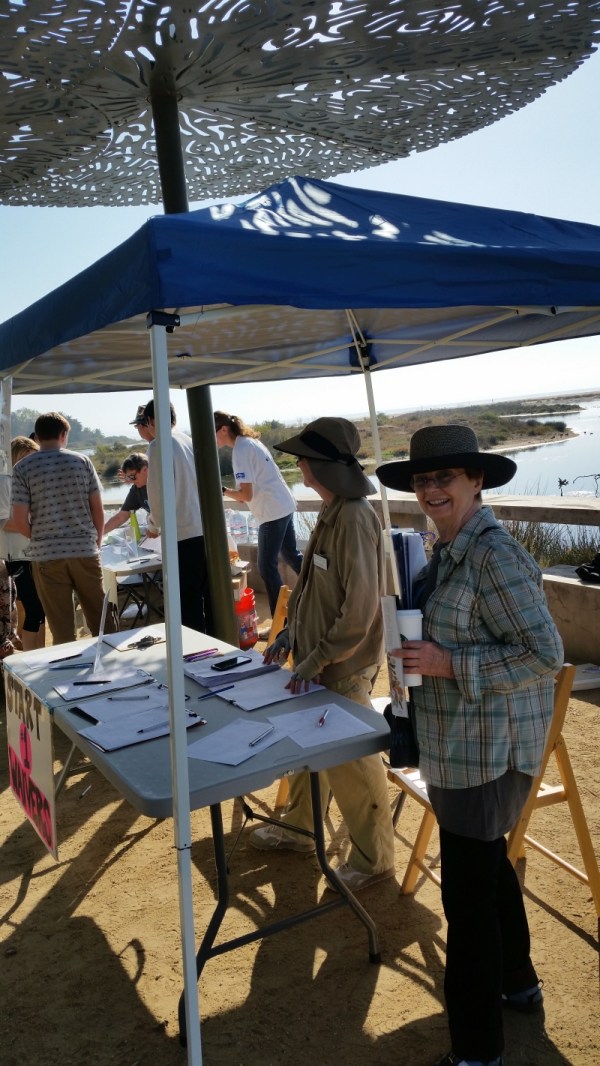
Photo: Kirsten Wahlquist 9-17-16
We had 220 volunteers, which is about the best number for this site. Many were individual people and families, but several organized groups showed up:
Pepperdine University
Aetna Insurance Company
Moorepark Junior College (Outdoors Club)
California Lutheran University (Oceans Outreach)
Alpha Phi Sorority of California State University at Northridge
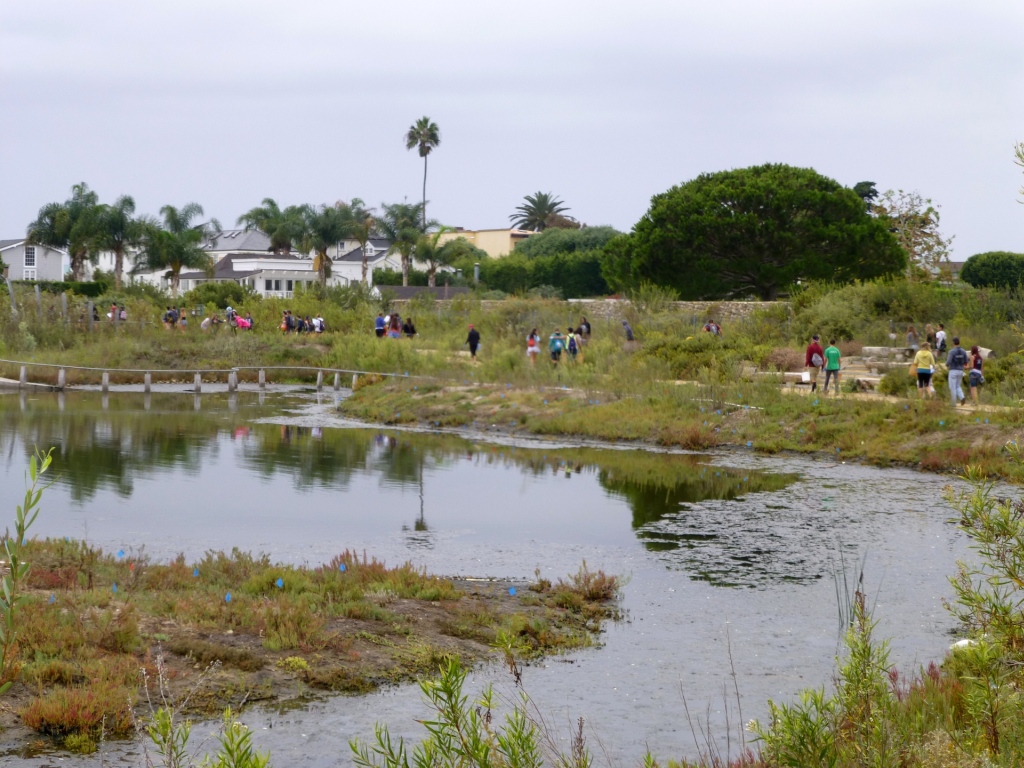
A line of trash-pickers heads towards the beach (L. Johnson 9/20/14)
Seven Santa Monica Bay Audubon Society volunteers ran the whole thing:
Captain Jean; Co-Captain Ellen; Weighmaster Chris; Masters of Waivers Lillian & Chuck B.; photographer Kirsten; and Trashmaster Chuck A., Scourge of the Brush.
Some statistics:
Total weight of trash = 334.5 lbs.
Total Bags = 105
Volunteers = 220
We still found many hundreds, if not thousands, of cigarette butts!
For Los Angeles County, Heal the Bay reports for 2016:
9,500 Volunteers
29,600 lbs. of debris
42.5 miles of coastline and river edge covered.
[Jean Garrett]
WHO WILL SAVE THE OCEANS?
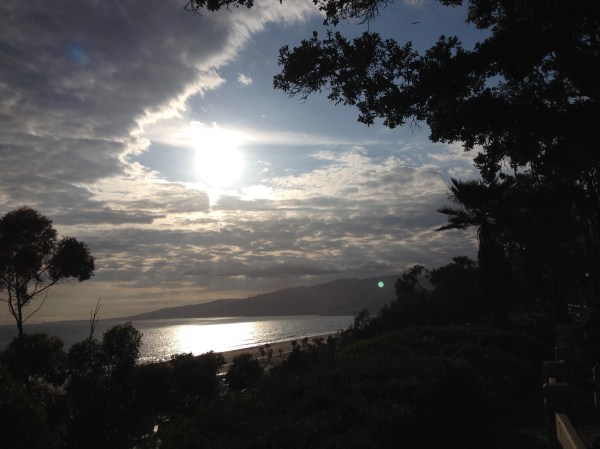 SANTA MONICA BAY Photo by Laurel Jones
The birds on Santa Monica Bay depend on a healthy ocean to survive. Who is working to make that happen and how can you become a meaningful part of the effort?
Meet Zack Gold—a Ph.D student at the LaKretz Center for California Conservation Science at UCLA; an avid surfer and scuba diver who grew up in Santa Monica and served as a lifeguard, as well, as helping to support the establishment of local Marine Protected Areas. In his own words:
During my undergraduate research at Stanford I became really interested in human impacts on marine ecosystems as well as using genetics techniques to study marine life. While there I was introduced to environmental DNA and became really interested in being able to use this tool to study how humans are impacting marine ecosystems and what management tools like MPAs are effective in restoring marine biodiversity and ecosystem health. So I came to UCLA under Professor Paul Barber to use eDNA techniques in the Santa Monica Bay and Channel Islands to study the the effects of MPA size and design on improving our local marine biodiversity, fish abundance, and ecosystem health. I am currently studying the biodiversity of marine protected areas in LA County using a new metagenomic tool called environmental DNA. In order to help my research, I am looking for helpful citizen science volunteers to help me collect seawater samples for this project.
This project is really exciting because it will allow us to compare the health of our marine ecosystems right in our backyard and give us insights into how the MPAs are working 5 years after they have been established.
If you want to learn more about the details of the research and project please check out my website here or follow this web address: http://www.zackgold.org/citizen-science.html
Now meet Emily Ryznar, another Ph.D student at the LaKretz Center for California Conservation Science at UCLA If you love tidepools (and who doesn’t?) then her project will be of interest to you. As she explains it:
I am attempting to quantify invertebrate diversity in CA kelp forests associated with crustose coralline algae (CCA), a very abundant algae in marine ecosystems that influences many marine invertebrates to live on or by it.
How you can help–identify invertebrates and other species growing on CCA in the field and from photographs using CPCe (Coral Point Count with Excel Extension), a specialized computer program used to quantify marine diversity from photos. Interested participants will be trained in common kelp forest species identification and use of the program. You may help as much or as little as you want, there is no hard time-commitment. Why is this important–CCA is very vulnerable to ocean acidification, which is predicted to increase in the future. CCA is required habitat for critically endangered invertebrates like abalone and coral. If CCA decreases due to ocean acidification, important invertebrates associated with CCA may also decline! CCA ecology is also relatively understudied in kelp forest ecosystems. You can reach Emily at EmilyRyznar@gmail.com
So many times we are hit with a wall of bad news about the environment and the oceans and are left feeling helpless to be able to make a difference. Now, you can. Contact Zack or Emily for further information as listed above.
It’s for the birds.
Full Harvest Moon Update – September 16, 12:05 PM PDT
Here’s another update from SMBAS Blog on that large, disc-like, shining object which has frequently and mysteriously appeared in our nighttime sky this year (spoken of in hushed whispers by the Illuminati as the moon).
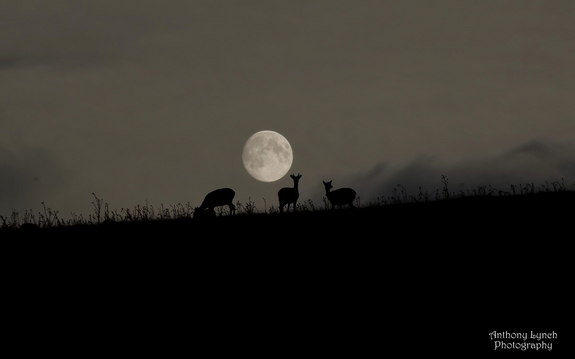
Irish harvest moon & deer (Anthony Lynch 9/19/13 from Space.com)
Sept. 16, 12:05 p.m. PDT — Full Harvest Moon. Traditionally, this designation goes to the full moon that occurs closest to the Autumnal (Fall) Equinox. This year’s version comes only five days early. At the peak of the harvest, farmers can work into the night by the light of this moon. Usually the moon rises an average of 50 minutes later each night, but for the few nights around the Harvest Moon, the moon seems to rise at nearly the same time each night: just 25 to 30 minutes later across the U.S., and only 10 to 20 minutes later for much of Canada and Europe. Corn, pumpkins, squash, beans and wild rice — the chief Indian staples — are now ready for gathering.
Full moon names from other cultures Courtesy of Keith Cooley):
Chinese: Chrysanthemum Moon; English Medieval: Barley Moon
Celtic: Singing Moon; Dakotah Sioux: Moon When The Calves Grow Hair
Interesting & useful factoids on moon averages:
Apparent width of the moon (full or otherwise): 1 /2 degree.
Time one full moon to next full moon: 29.5 days
Angle moon moves in 24 hours: 12.2 degrees
Time for moon to move it’s own width (1/2 degree): 59 minutes
Thus, on average, the moon takes just under an hour to move it’s own width. When trying to estimate the size of something, compare it to the moon, a known quantity.
MoonPhases.info – A handy site for slightly under a googolplex of moon facts.
The Old Farmer’s Almanac has a page for each full moon. A September tip: best days for fishing: 1-16th, 30th. Now you know, so you have no excuse.
The next significant full moon will occur on Oct. 15, 9:23 p.m. PDT. Keep an eye on this spot for additional late-breaking news on this unprecedented event.
The information on moon name comes to you courtesy of: http://www.space.com/31699-full-moon-names-2016-explained.html
written by Joe Rao. Joe Rao serves as an instructor and guest lecturer at New York’s Hayden Planetarium. He writes about astronomy for Natural History magazine, the Farmer’s Almanac and other publications, and he is also an on-camera meteorologist for News 12 Westchester, N.Y.
But that’s waaay too long to type in, and besides, you don’t need to go there because SMBAS has done the work for you!
[Chuck Almdale]
What a Fish Knows – Jonathan Balcombe

That’s a pufferfish looking at you.
BOOK REVIEW
What a Fish Knows: The Inner Lives of Our Underwater Cousins.
Jonathan Balcombe
Scientific American/Farrar, Straus and Giroux, New York, 2016, 304 pgs, $16-27.
We rarely recommend books, but this is a book that should interest everyone, whether you have pet fish, love catching fish, enjoy photographing fish, wonder what life would be like if you were a fish, contemplate your own fishy ancestors 500 million years ago, or simply like to see them on your plate and put them in your mouth.
Natural History Magazine’s Sept’16 issue featured an article by Dr. Jonathan Balcombe, drawn from this book. If this blog doesn’t convince you to buy the book, read the article. It will forever change your view of fish, and give you a new perspective the next time you see the Mullet jumping above the surface of Malibu Lagoon.
A few fishy facts:
- There are more than thirty thousand species of fish―more than all mammals, birds, reptiles, and amphibians combined.
- They can plan, hunt cooperatively, use tools, curry favor, deceive one another, and punish wrongdoers. Sound like anyone you know?
- Their courtship rituals are elaborate; they develop lifelong bonds with their neighbors.
- Their sexual arrangements vary widely: promiscuity, polygamy, monogamy, mating-for-life. Males may keep harems, defend a territory, spawn in groups, perform sneak copulations, be a “satellite male” or a “sexual pirate.” Males may become females or females become males as the opportunity arises. There are simultaneous hermaphrodites and sequential hermaphrodites. Some males parasitize the female, embedding themselves permanently into her flesh.
A few of the issues it addresses:
Can fish think? Can they recognize the humans looking back at them in their pools and aquariums? How do they learn to navigate their pools, rivers, reefs and oceans – and find their way home?
Dr. Balcombe relates a wonderful story:
During a dive off the southern tip of Japan, veteran diver and photographer Yoji Ookata was surprised to see, at a depth of about eighty feet, a six-foot-wide symmetrical circular pattern in the sand. The mural featured two concentric rings of ripples radiating outward from a center disk. Ookata returned some days later with a film crew, and the mystery of what might have created this exquisite curiosity was soon solved. The geometric “crop circles” were created by a small, quite ordinary-looking male puffer fish (Tetraodontidae). Swimming on his side, while fluttering a pectoral fin, the five-inch puffer spends hours making his masterpiece. He inspects it as he goes, decorating his mural with bits of small shells that he cracks in his mouth before sprinkling them into the central grooves.

Pufferfish in his sand ‘bower’ (Kimiaki Ito, National Geographic)
Link to Yoji Ookata YouTube series of still photos of the pufferfish ‘mandala.’
Link to Aysel Güler YouTube action video of pufferfish maintaining his mandala.
Mandalas found since show that no two are the same, they attract female puffers who lay their eggs in the inner circle, the furrows help prevent eggs from being carried away by currents, the crushed shells provide camouflage for the eggs, and the more elaborate the circle, the greater the mating success of the male. Birders familiar with Australia’s Bowerbirds will recognize the similarity of intent and result.
I thought I knew a lot about fish. Then I read What a Fish Knows. And now I know a lot about fish! Stunning in the way it reveals so many astonishing things about the fish who populate planet Earth in their trillions, this book is sure to “deepen” your appreciation for our fin-bearing co-voyagers, the bright strangers whose world we share.
— Carl Safina, author of Beyond Words: What Animals Think and Feel; named one of Audubon’s 100 Most Influential Conservationists of the 20th Century
Balcombe offers a picture of these underwater creatures as complex and sentient beings. Not only do they have acute senses of sight, hearing, and smell, but they also have the capacity to feel pleasure as well as pain….Balcombe never met a fish pun he didn’t like….This is a lively and surprising work that makes a strong argument for sport and food fishing reform.
— Lisa Peet, Library Journal
We rarely consider how individual fishes think, feel, and behave, but their lives are often as rich and complex as our own. Here’s your chance to discover the details.
[Chuck Almdale]



