Free email delivery
Please sign up for email delivery in the subscription area to the right.
No salesman will call, at least not from us. Maybe from someone else.
Malibu Lagoon Trip Report: 25 October, 2015

View to southeast across sand islands and inundated beach (J. Waterman 10/25/15)
Continuing large waves at high tides have washed away about 80% of the beach. The virtual fence for the Snowy Plover enclosure is gone, save one lonely pole, and the plovers have moved as well. I fully expect that one good rain – say, 2 inches – will fill Malibu Creek and blow out the beach between lagoon and ocean. [For our non-SoCal readers, 2” of rain is a lot for this neck of the woods. It may be the total rainfall we had last year.]
Despite that, excitement abounded at the lagoon today. The siren call of high surf stacked the sea with surfers. And birds galore! 78 species tied an all-time record for our Sunday walks.
| Date | 10/25/15 | 9/26/10 | 9/26/04 | 10/27/13 | 4/28/91 |
| Species | 78 | 78 | 76 | 75 | 75 |
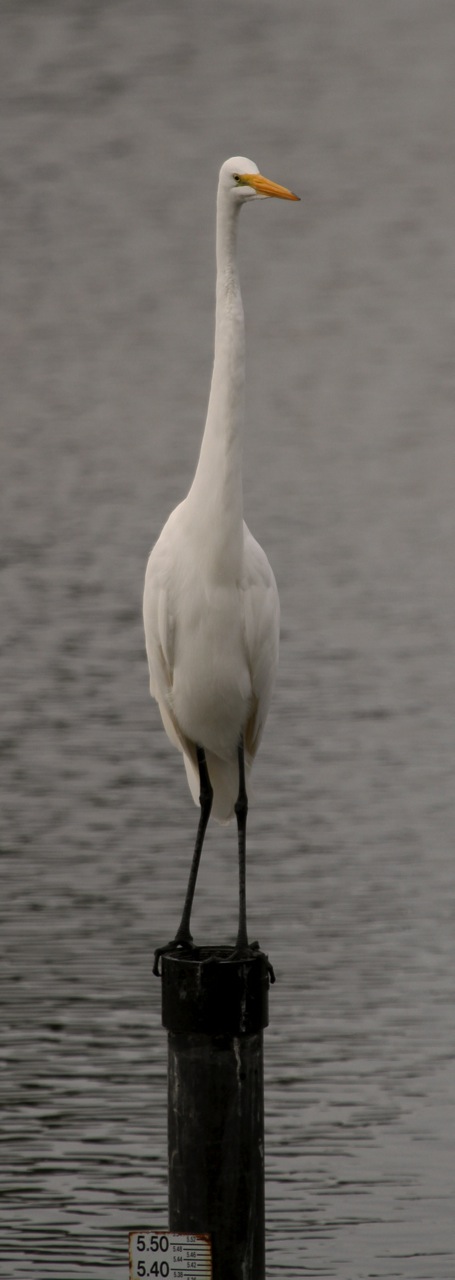
Great Egret pole extension
(J. Waterman 10/25/15)
Not only did we have a lot of species, we had a lot we seldom see. Our handy presbyopia-challenging checklist includes the 140 most common species – just about everything seen on more than 1% of trips, so anything we write in is uncommon at the lagoon. We had nine write-in birds: Eurasian Collared-Dove, Nuttall’s Woodpecker, Northern Flicker, Warbling Vireo, Blue-gray Gnatcatcher, Hermit Thrush, and Black-throated Gray Warbler. Admittedly, none of these birds are uncommon in SoCal; it’s just that they don’t often show up at the lagoon, primarily due to lack of habitat such as large woodpecker-friendly trees.
Hmm….that’s only seven species. The other two – Red-breasted Sapsucker and Palm Warbler – are totally new birds for the lagoon birdwalk. Sapsuckers like to suck sap (hence the name, although they really lick it and eat insects attracted to the ooze) and lagoon area trees aren’t quite right for that sort of thing, but Palm Warbler is one of those eastern warblers that show up west of the Rocky Mountains from time to time. They’re probably one of the most commonly appearing of the uncommon eastern warblers, and are reported in SoCal every year, although I personally haven’t seen one for a couple of years.

Palm Warbler – visiting from east of the Rockies (R. Ehler 10/25/15)
They’re best identified by their behavior: they like to walk on the ground, wagging their tail as they tootle along. They always have a yellow vent and usually have thin dark streaks on the pale breast, pale line over the eye and a faint chestnut cap. Chris Lord, returning from the beach, spotted it and reported it to the group. The following day, local ornithologist Dan Cooper found two Palm Warblers at the lagoon, confirmed by several later birders.

Hermit Thrust (R. Ehler 10/25/15)
The Red-breasted Sapsucker probably didn’t stay long: it was spotted briefly in some small trees near the colony back fence; it then took off, heading east.

Black-throated Gray Warbler: yellow lores but no black throat (R. Ehler 10/25/15)
It took longer than usual for us to reach the beach – not a problem as waves were washing across the sand into the lagoon. Only a few steps away from the squabbling trio of Killdeer at our meeting spot, we spotted the first (Black-throated Gray Warbler) of what turned out to be six species of warbler near the parking lot. A Townsend’s popped up, then some Yellow-rumped, a Common Yellowthroat, several Orange-crowned, a Warbling Vireo, Spotted & California Towhees, Song, White-crowned & Savannah Sparrows, House Finches, Lesser Goldfinches, and finally some Blue-gray Gnatcatchers and Bushtits as we walked away.
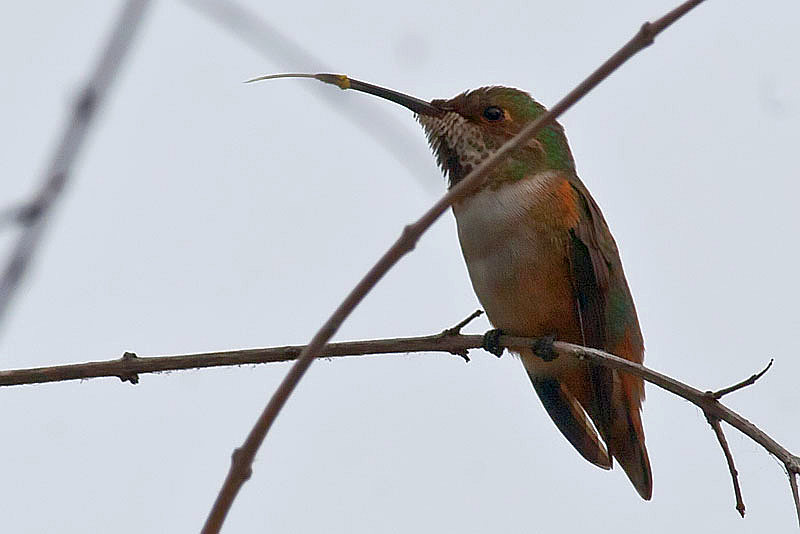
Allen’s Hummingbird and his fabulous tongue (Kirsten Wahlquist 10/25/15)
Afterward, Joyce Waterman sent me some photos of what she thought might be a Yellow Warbler. I couldn’t confirm or deny – thinking it might be Orange-crowned or Nashville – so we sent them on to Kimball Garrett at the Natural History Museum, who termed it a “textbook example” of Yellow Warbler. [What do I know?] See photo below.

Yellow Warbler (J. Waterman 10/25/15)

The elusive Marsh Wren
(J. Waterman 10/25/15)
Joyce also took about a million photos of one of the two – possibly four – Marsh Wrens that began to appear last month. Marsh Wren is one of those “easy to hear, hard to see” birds, and it’s even harder to photograph. We did manage to get everyone “onto” the bird this trip, as it skulked through the mini-patches of reeds.
We did not see the swans. Perhaps they’ve left, perhaps they were somewhere up the creek. Most of last month’s melee of mullet managed to escape the lagoon, or were snoozing on the bottom. They certainly weren’t churning up the lagoon edge as they had last month.
By the time we reached the beach the tide had retreated. We checked out the shorebirds and gulls and trudged onward down the beach, where Kirsten Wahlquist and Lu Plauzoles had an adventure. They relate:

Eared Grebe tangled in fishing line, attacked by gull (Kirsten Wahlquist 10/25/15)
Lu: [We got] a very close-up view of an Eared Grebe. It was incapacitated and being attacked by a Western Gull at the edge of the beach near the

The famous jail-break-for-grebes tool, pocket model
(Lu Plauzoles 10/25/15)
pier. Luckily I had my jail-break-for-grebes tool (pocket model), and as a surfer held the recalcitrant bird, we took 3 feet of tangled monofilament fishing line from his lobed feet and left wing. The bird quickly swam back out to sea.
Kirsten: Lu was the one that actually freed the grebe – I just watched from 75 yards away! I didn’t get a photo of the rescue itself, but I did get one of the gull going after the grebe.
Kudos to Lu and the Surfer-with-no-name, and best wishes to the freed grebe. To the gull? Better luck elsewhere.
As always, many thanks to the photographers: Randy Ehler, Joyce Waterman, joined this month by Kirsten Wahlquist and Lu Plauzoles. Also many thanks to Randy Ehler and his birding phone-app on which he keeps a separate count from mine, and to Chris Lord for always sharing his first-man-on-the-beach sightings with me. My records would be the poorer without them.
Birds new for the season were: Northern Shoveler, Horned & Western Grebe, Pelagic Cormorant, Red-breasted Sapsucker, Nuttall’s Woodpecker, Northern Flicker, Merlin, Nanday Parakeet, Western Scrub-Jay, Bewick’s Wren, Ruby-crowned Kinglet, Hermit Thrush, Palm, Black-throated Gray- &Townsend’s Warblers, Spotted Towhee, Brown-headed Cowbird and House Sparrow.
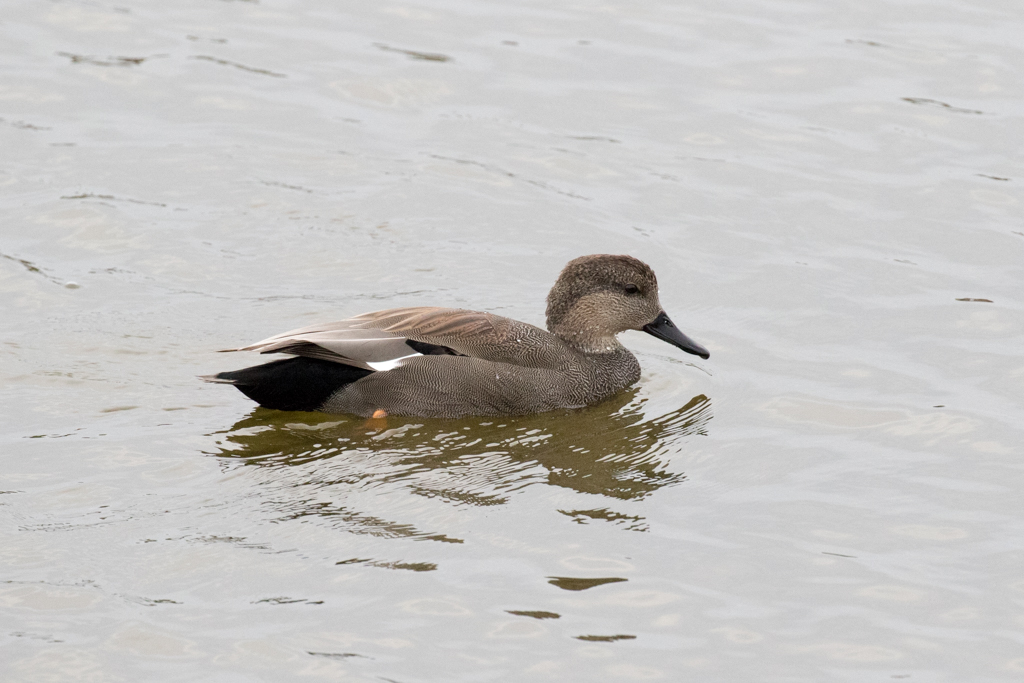
The elegant Gadwall male (R. Ehler 10/25/15)
Our next three scheduled field trips: Ballona Creek Area, 14 Nov. 8:30am; Malibu Lagoon, 22 November, 8:30 & 10am; Carrizo Plains, 12 Dec. 9am (sign up required).
Our next program: Unusual Mortality Event Affecting California Sea Lions with Jeff Hill on Tuesday, 3 November, 7:30 pm, at [note location change] Chris Reed Park, 1133 7th St., NE corner of 7th and Wilshire Blvd. in Santa Monica
NOTE: Our 10 a.m. Parent’s & Kids Birdwalk meets at the shaded viewing area. Watch for Willie the Weasel. He’ll be watching for you and your big floppy feet.
Links: Unusual birds at Malibu Lagoon
9/23/02 Aerial photo of Malibu Lagoon
Prior checklists:
2015: Jan-May
2014: Jan-July, July-Dec 2013: Jan-June, July-Dec
2012: Jan-June, July-Dec 2011: Jan-June, July-Dec
2010: Jan-June, July-Dec 2009: Jan-June, July-Dec
The 10-year comparison summaries created during the project period, despite numerous complaints, remain available on our Lagoon Project Bird Census Page. Very briefly summarized, the results unexpectedly indicate that avian species diversification and numbers improved slightly during the period Jun’12-June’14. [Chuck Almdale]
| Malibu Census 2015 | 4/26 | 5/24 | 7/26 | 8/23 | 9/27 | 10/24 |
| Temperature | 66-76 | 59-70 | 70-82 | 70-77 | 68-77 | 64-75 |
| Tide Lo/Hi Height | L+0.58 | L+0.54 | L+2.37 | L+2.80 | H+5.94 | H+5.93 |
| Tide Time | 1139 | 0927 | 1143 | 0944 | 0918 | 0810 |
| Brant | 3 | 7 | 1 | |||
| Canada Goose | 30 | |||||
| Mute Swan | 2 | 2 | ||||
| Gadwall | 10 | 22 | 5 | 8 | 54 | 15 |
| Mallard | 8 | 8 | 55 | 35 | 34 | 30 |
| Northern Shoveler | 6 | |||||
| Green-winged Teal | 4 | 10 | ||||
| Red-brstd Merganser | 1 | 1 | ||||
| Ruddy Duck | 4 | 5 | 68 | |||
| Pacific Loon | 1 | |||||
| Pied-billed Grebe | 1 | 3 | 2 | 3 | ||
| Horned Grebe | 1 | 2 | ||||
| Eared Grebe | 1 | 8 | 10 | |||
| Western Grebe | 2 | 1 | 3 | |||
| Brandt’s Cormorant | 1 | 2 | 1 | |||
| Dble-crstd Cormorant | 16 | 55 | 34 | 43 | 36 | 29 |
| Pelagic Cormorant | 1 | 4 | 2 | 1 | ||
| Brown Pelican | 1490 | 70 | 17 | 3 | 6 | 42 |
| Great Blue Heron | 2 | 2 | 4 | 8 | 4 | 4 |
| Great Egret | 5 | 5 | 4 | 6 | 3 | 5 |
| Snowy Egret | 12 | 4 | 6 | 22 | 18 | 12 |
| Blk-crwnd N-Heron | 2 | 3 | 3 | 3 | ||
| Osprey | 1 | |||||
| Cooper’s Hawk | 1 | |||||
| Red-tailed Hawk | 1 | |||||
| American Coot | 1 | 1 | 4 | 75 | 55 | |
| Blk-bellied Plover | 1 | 27 | 75 | 84 | 62 | |
| Snowy Plover | 16 | 21 | 32 | |||
| Semipalmated Plover | 9 | 1 | 5 | 2 | ||
| Killdeer | 2 | 6 | 4 | 6 | 10 | 15 |
| Spotted Sandpiper | 1 | 1 | 3 | 10 | ||
| Willet | 1 | 1 | 6 | 8 | 15 | 35 |
| Whimbrel | 12 | 1 | 13 | 10 | 4 | 2 |
| Marbled Godwit | 2 | 8 | 8 | |||
| Ruddy Turnstone | 3 | 12 | 15 | 18 | ||
| Black Turnstone | 1 | |||||
| Sanderling | 2 | 23 | ||||
| Dunlin | 1 | |||||
| Least Sandpiper | 15 | 8 | 3 | 6 | ||
| Western Sandpiper | 45 | 1 | 14 | 15 | 1 | |
| Short-billd Dowitcher | 6 | |||||
| Long-billed Dowitcher | 1 | 4 | ||||
| Wilson’s Phalarope | 1 | |||||
| Bonaparte’s Gull | 6 | 1 | 1 | 1 | ||
| Heermann’s Gull | 350 | 45 | 14 | 11 | 25 | 11 |
| Ring-billed Gull | 30 | 8 | 2 | |||
| Western Gull | 110 | 135 | 40 | 40 | 110 | 90 |
| California Gull | 600 | 6 | 2 | 1 | 8 | 4 |
| Glaucous-wingd Gull | 1 | 1 | ||||
| Caspian Tern | 10 | 11 | 1 | 6 | 1 | |
| Common Tern | 1 | |||||
| Forster’s Tern | 2 | 2 | ||||
| Royal Tern | 4 | 2 | 3 | 9 | 15 | 2 |
| Elegant Tern | 3100 | 85 | 45 | 12 | 6 | 4 |
| Black Skimmer | 1 | |||||
| Rock Pigeon | 8 | 9 | 4 | 6 | 12 | 10 |
| Eur. Collared-Dove | 1 | 1 | ||||
| Mourning Dove | 2 | 2 | 7 | 7 | 4 | 2 |
| Vaux’s Swift | 45 | |||||
| Anna’s Hummingbird | 2 | 2 | 1 | 3 | 4 | 2 |
| Allen’s Hummingbird | 4 | 6 | 3 | 10 | 5 | 8 |
| Belted Kingfisher | 1 | 1 | 1 | |||
| Red-brstd Sapsucker | 1 | |||||
| Nuttall’s Woodpecker | 1 | |||||
| Northern Flicker | 1 | |||||
| Merlin | 1 | |||||
| Nanday Parakeet | 6 | |||||
| Black Phoebe | 2 | 2 | 4 | 6 | 20 | 10 |
| Say’s Phoebe | 4 | 3 | ||||
| Warbling Vireo | 6 | 1 | ||||
| Western Scrub-Jay | 1 | |||||
| American Crow | 6 | 5 | 4 | 4 | 20 | 10 |
| Rough-wingd Swallow | 4 | 6 | 3 | 8 | ||
| Tree Swallow | 10 | 10 | ||||
| Barn Swallow | 6 | 12 | 12 | 12 | ||
| Cliff Swallow | 2 | 10 | 12 | 3 | ||
| Oak Titmouse | 1 | |||||
| Bushtit | 2 | 2 | 20 | 4 | ||
| House Wren | 1 | 4 | 1 | |||
| Marsh Wren | 1 | 2 | ||||
| Bewick’s Wren | 1 | |||||
| Blue-gray Gnatcatcher | 3 | 4 | ||||
| Ruby-crowned Kinglet | 4 | |||||
| Hermit Thrush | 1 | |||||
| American Robin | 1 | |||||
| Northern Mockingbird | 6 | 3 | 4 | 4 | 4 | 6 |
| European Starling | 10 | 3 | 25 | 25 | 35 | 10 |
| Cedar Waxwing | 40 | |||||
| Ornge-crwnd Warbler | 2 | 4 | ||||
| Nashville Warbler | 3 | |||||
| Common Yellowthroat | 5 | 5 | 8 | 8 | ||
| Yellow Warbler | 1 | 1 | ||||
| Palm Warbler | 1 | |||||
| Yellow-rumpd Warbler | 3 | 35 | ||||
| Blk-throated G. Warbler | 3 | |||||
| Townsend’s Warbler | 1 | |||||
| Spotted Towhee | 1 | 2 | ||||
| California Towhee | 2 | 2 | 4 | 6 | 2 | 3 |
| Savannah Sparrow | 2 | 3 | ||||
| Song Sparrow | 6 | 9 | 5 | 8 | 3 | 3 |
| White-crwnd Sparrow | 2 | 25 | ||||
| Red-winged Blackbird | 2 | 40 | 15 | 15 | ||
| Western Meadowlark | 4 | 4 | ||||
| Brewer’s Blackbird | 2 | |||||
| Great-tailed Grackle | 4 | 3 | 3 | 5 | 12 | 10 |
| Brwn-headed Cowbird | 4 | 2 | ||||
| Hooded Oriole | 3 | |||||
| House Finch | 12 | 20 | 2 | 12 | 25 | 9 |
| Lesser Goldfinch | 3 | 3 | ||||
| House Sparrow | 1 | |||||
| Totals by Type | Apr | May | Jul | Aug | Sep | Oct |
| Waterfowl | 55 | 37 | 62 | 46 | 99 | 129 |
| Water Birds – Other | 1511 | 134 | 57 | 54 | 126 | 145 |
| Herons, Egrets & Ibis | 19 | 11 | 16 | 39 | 28 | 24 |
| Quail & Raptors | 1 | 1 | 0 | 0 | 1 | 1 |
| Shorebirds | 89 | 8 | 71 | 170 | 215 | 161 |
| Gulls & Terns | 4213 | 294 | 105 | 80 | 169 | 114 |
| Doves | 10 | 11 | 11 | 13 | 17 | 13 |
| Other Non-Passerines | 7 | 8 | 4 | 13 | 55 | 20 |
| Passerines | 104 | 86 | 85 | 149 | 213 | 191 |
| Totals Birds | 6009 | 590 | 411 | 564 | 923 | 798 |
| Total Species | Apr | May | Jul | Aug | Sep | Oct |
| Waterfowl | 5 | 3 | 4 | 4 | 5 | 5 |
| Water Birds – Other | 6 | 8 | 5 | 5 | 5 | 8 |
| Herons, Egrets & Ibis | 3 | 3 | 4 | 4 | 4 | 4 |
| Quail & Raptors | 1 | 1 | 0 | 0 | 1 | 1 |
| Shorebirds | 10 | 3 | 8 | 14 | 13 | 10 |
| Gulls & Terns | 10 | 9 | 6 | 7 | 9 | 7 |
| Doves | 2 | 2 | 2 | 2 | 3 | 3 |
| Other Non-Passerines | 3 | 2 | 2 | 2 | 4 | 7 |
| Passerines | 13 | 17 | 13 | 15 | 26 | 33 |
| Totals Species – 110 | 53 | 48 | 44 | 53 | 70 | 78 |
(Un-) Common Terns at Malibu Lagoon

It’s easy to see that the dark “carpal bar” is on the upperwing secondary coverts, between the shoulder and “wrist” (Joyce Waterman 10/11/15)
On the West Coast, Common Terns are not at all common, but recently at Malibu Lagoon, up to 14 birds were reported (Irwin Woldman), resting on the sand with the usual mélange of terns and gulls.
Worldwide, Sterna hirundo is one of the most widespread and commonly seen species of tern. In North America they breed in a roughly rectangular range from Great Slave Lake in Northwest Territories, south to west central Montana, across Canada between the Great Lakes and James Bay on the southern Hudson Bay, and eastward to central Labrador and the Maritime Provinces. When breeding season ends they migrate southward in a broad swath across the Great Plains and Mississippi Valley, down the east coast, and winter along both coasts from Texas to Patagonia, excepting most of the coast of Chile.
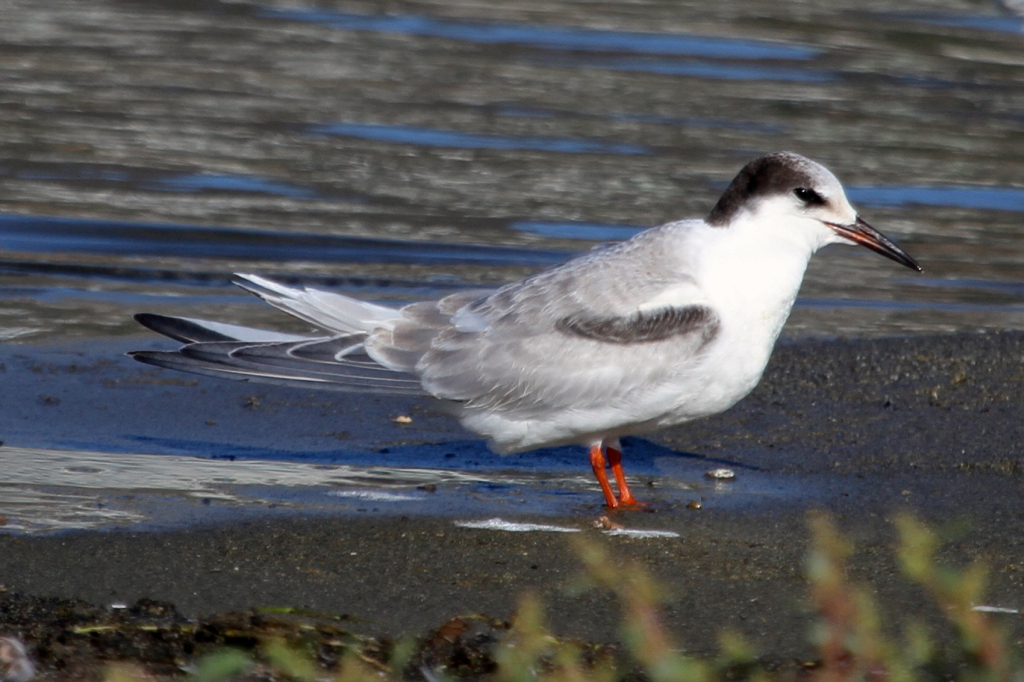
Carpal bar on the folded wing is horizontal (Joyce Waterman 10/11/15)
In Eurasia, they breed from the British Isles and Madeira and eastward in a broad swath to eastern Siberia. They winter around the coast of Africa from Senegal to South Africa to Ethiopia, the Indian Ocean coast from Iran to Australia, and throughout Indonesia and the tropical islands of the west Pacific.
A few southbound migrants wander westward from the western Canadian provinces, over the mountains and down to the Pacific coast, and continue southward, occasionally appearing at accommodating places like Malibu Lagoon.
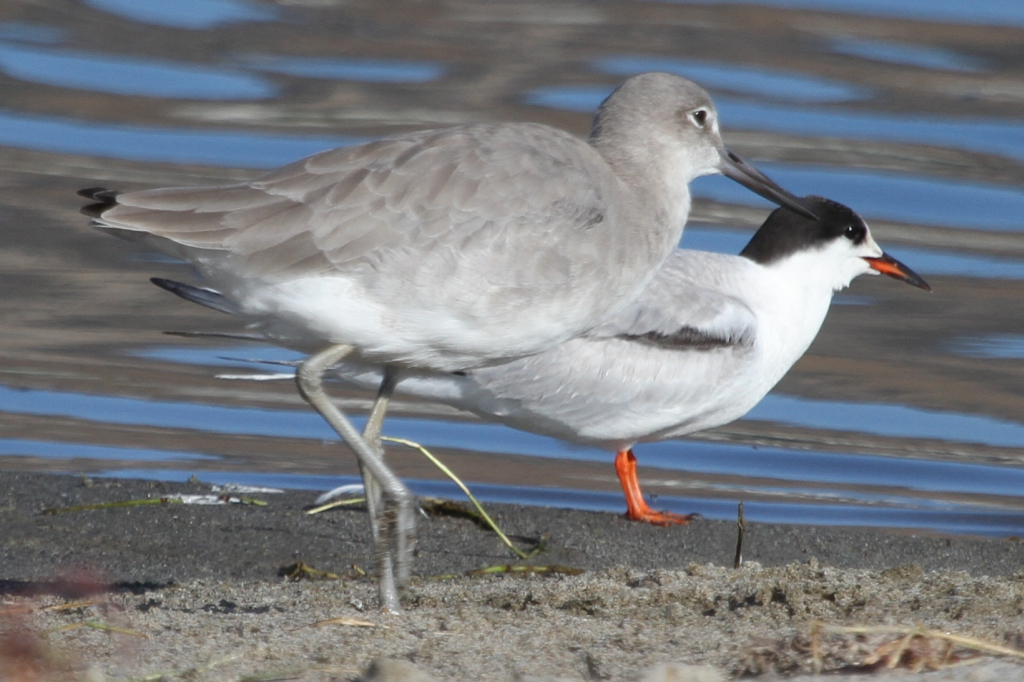
At 15″, the Willet is only 1/2″ longer than the Common Tern
(Joyce Waterman 10/11/15)
Unlike our Least Terns, they are not threatened. World population is 250,000 – 500,000 pairs. About 35,000 pairs nest in North America, 140,000 pairs in Europe, and the rest in the former USSR and adjoining nations.
Swedish scientist Linnaeus (Carl von Linné) described them in 1758, naming them Sterna hirundo. The genus Sterna derives from the Old English word for tern, stearn or stern. Species hirundo is Latin for the swallow, referring to the Common Tern’s buoyant, swallow-like flight and appearance with pointed wings and elongated outer tail feathers.
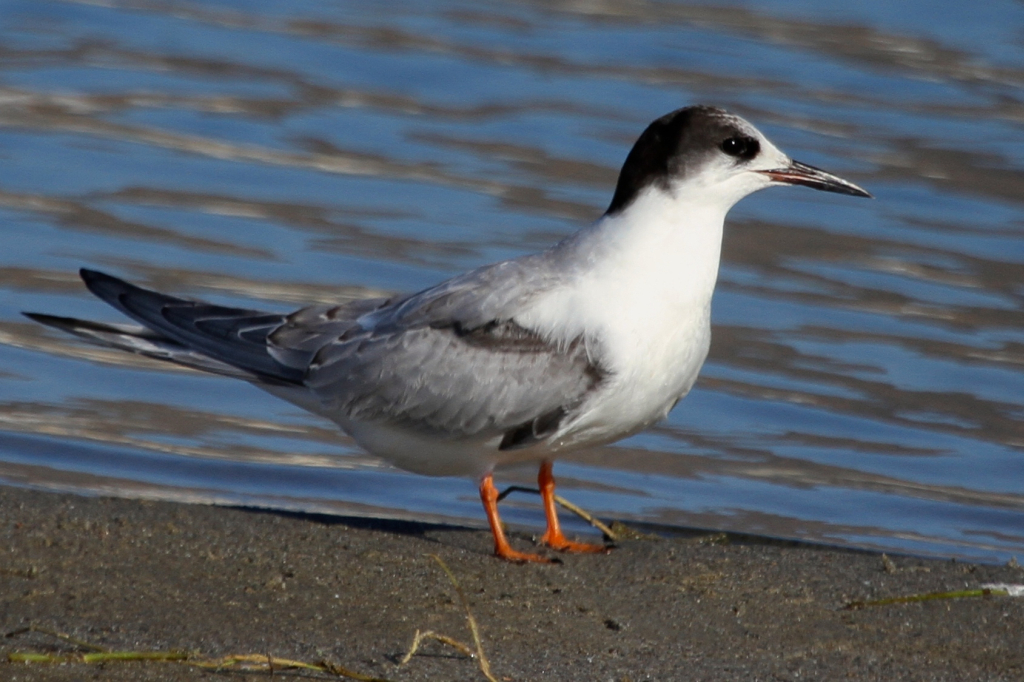
Black colors can appear on other parts of the wing (Joyce Waterman 10/11/15)
They eat mostly small fish, occasionally taking crustaceans, insects and parts of fish left by others. Opportunistic feeders, they readily switch to other prey when their preferred prey fails, perhaps one reason why they are so successful.
They breed primarily in colonies which can number into the many thousands, and lay eggs from April into June, depending primarily upon latitude. Nests are simple and average only 16″ apart. Normally three eggs are laid, but in poor food years they will lay two or sometimes
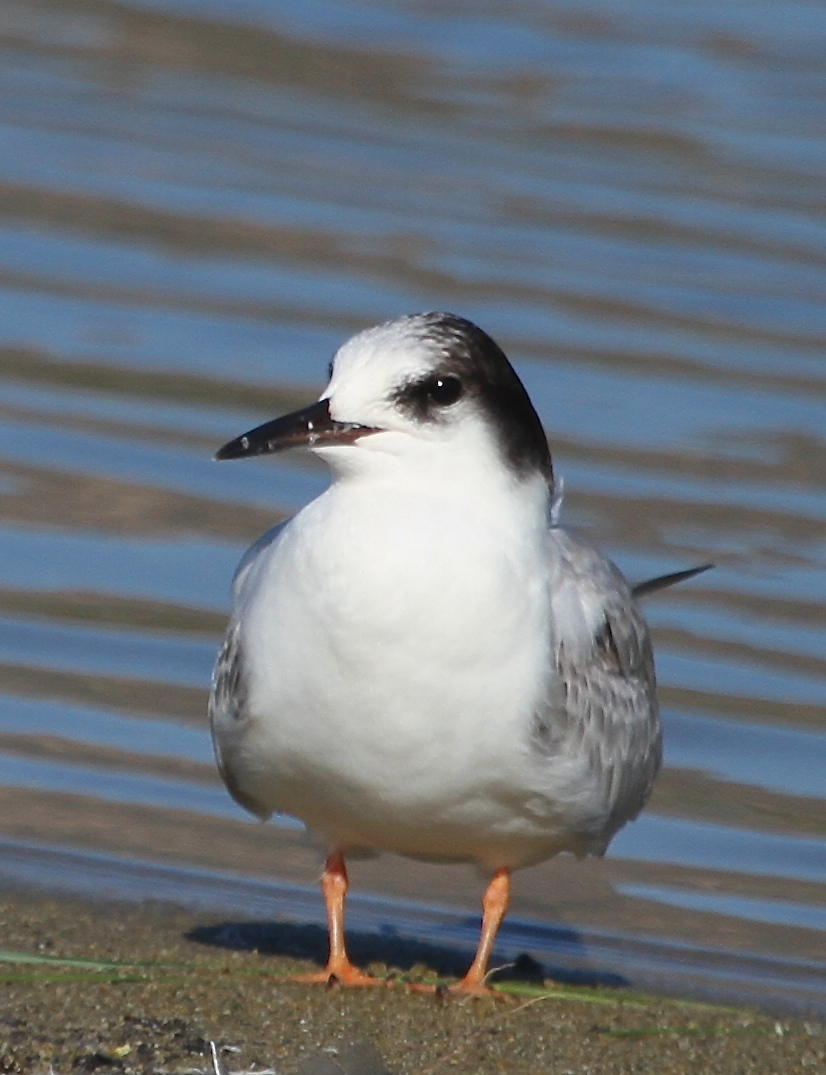
The amount of red on the bill is variable
(Joyce Waterman 10/11/15)
only one. Incubation takes three to four weeks; chicks are altricial. By day six the chick recognizes the parents’ landing call; they fledge at 24-28 days. Adult breeding plumage appears by their third spring. Mortality of adults is 7-17% per year; they return to their birth area to breed, and can live up to 25 years.
SoCal birders can confuse them with their close – and, locally, far more common – relative, the Forster’s Tern. They both average 14.5″ long; wingspan for both species is 28.3″ – 32.7″. Plumage of both is a mixture of white, gray and black feathers. Eyes are dark, legs range pale pink to orange to red. Juvenile and 1st-year birds have dark bills, which in breeding become red with black tips. Adults of both species in breeding plumage have a complete black cap, from bill to bottom of nape, passing just below the eye. So far, very similar.
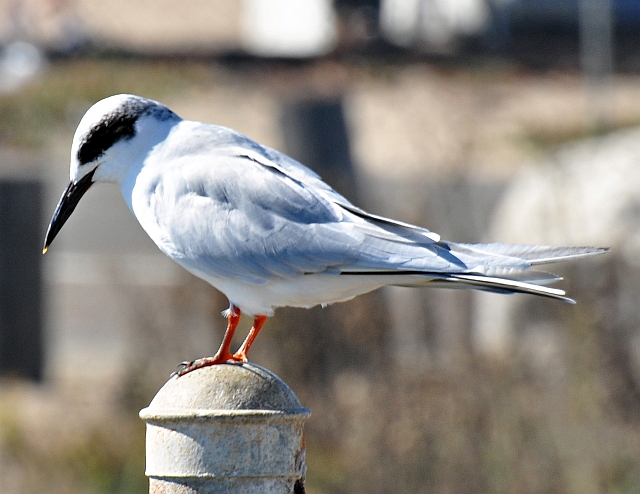
Forster’s Tern – note pale gray, not black, at nape
(Rob Hargraves, Bolsa Chica 10/8/11)
In non-breeding plumage, the best points to look at are the black areas on the head, and the presence or absence of a dark horizontal bar (“carpal bar”) on the folded wing. Both species have black around the eye: in the Common the black extents eye-to-eye around the nape; in the Forster’s the nape is a much paler gray. First-year Common Tern has a black carpal bar; first-year Forster’s might show slightly darker in this area, but it will be thinner and not as dark. Fortunately for SoCal birders, most Common Terns appearing on our shores are first-year birds. Unless, of course, we’re just not noticing non-breeding adults secreted among the Forster’s.

Black extents eye-to-eye around the back (nape) of the head (J. Waterman 10/11/15)
Many thanks to SMBAS member and frequent photographic contributor, Joyce Waterman, for taking these photos at Malibu Lagoon, and to Rob Hargraves whose photo of a Forster’s Tern, taken on our 2011 trip to Bolsa Chica, provided a nice comparison. [Chuck Almdale]
Origins of bird names: The Dictionary of American Bird Names; Choate, Ernest A.; 1985; Harvard Common Press, Boston, MA.
Other data:
Handbook of Birds of the World; 1996; Lynx Edicions, Barcalona, Spain
Birds of North America: Dunn, Aldefer, Lehman; National Geographic Society, Washington, DC
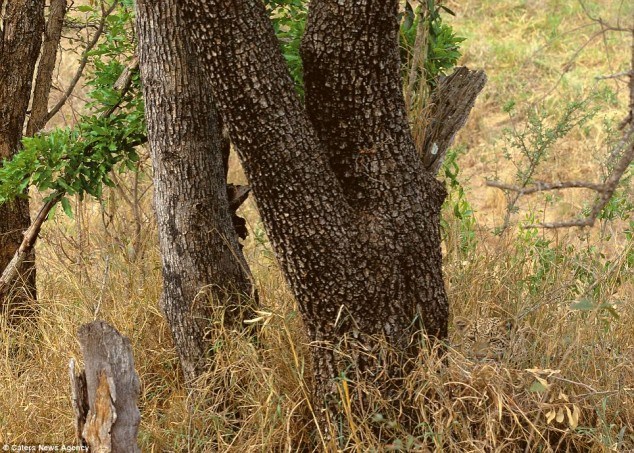
Find the hidden animals
A large part of enjoying nature is seeing what is actually there. Sometimes you find something already looking back at you. See if you can spot the leopard in the photo below.
At 22 words.com there’s a bunch more of these, using photos by Art Wolfe. Check it out and have fun. [Chuck Almdale]
Water-conserving rain barrels, nearly free!
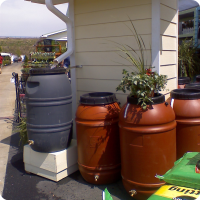
Typical Rain Barrels Int’l products
If you’re trying to save water for your garden or lawn, this is a great deal that comes up every once in a while. You buy rain barrels at a reduced rate, you install them at your house. Often a local official comes to check that you have installed them. In some towns such as Santa Monica, you must annually confirm your continued use of the barrels.
The really good part is that a week or two after you have installed the barrels, you get reimbursed the cost up to $100/barrel, 4 barrels maximum, for your expense! I installed three barrels three years ago and I haven’t used municipal water since then for my numerous potted plants. It also provides enough water for my compost box most years.
You will probably have to do a little modification on some of your roof /gutter downspouts, but I bet you’ll be surprised how much fog drip you will also collect in the non-rainy season.
The barrels cost $94-139 if bought from their website, the same price range as nearly every other rain barrel outlet. But you can pre-order and pre-pay $85 each for them and pick them up at one of their “events.” This must be done no later than the Wednesday prior to the event you’d like to attend. If they have extra barrels on hand, they bring them to the event. The event gives you all the information you need to start saving water.
Here is the link to their events:
Rain Barrels Int’l: http://www.rainbarrelsintl.com/events.asp
Their next event in the Santa Monica area is Sat., 11/7/15, 12-1:30 PM, at the Tree People HQ, 12601 Mulholland Dr., on the valley side (north) of Mulholland at Franklin Canyon Drive. If you want to get some rain barrels at this event, you must prepay no later than Weds. 11/04. Directions!
[NOTE from Chuck Almdale] We picked up 4 terra-cotta colored 58-gallon rain barrels on 10/24/15 at the Tree People “event.” They distributed the barrels, gave out some informative fliers and off we went. There was no slide-show presentation.
Rain Barrels Int’l describes their barrels as follows:
All of the barrels we use are recycled food grade barrels we purchase before they are disposed of into landfills. It is a WIN – WIN situation all the way around. Please help our environment by not only saving water, but by keeping these barrels out of landfills.
Specifications
- Dimensions vary slightly – approximately 40″ tall with 23″ diameter
- 55 + gallon capacity (some barrels slightly larger)
- Brass ¾” spigot for garden hose attachment
- Screen on top to prevent mosquitoes from accessing water
- Side brass overflow where a hose can be attached
- Made from recycled plastic food grade barrels
- Barrels retail in stores for $94.00 to $139.00
Thank you to Grace M. for the alert
[Lu Plauzoles & Chuck Almdale]
Red-hot Egrets: Bolsa Chica report, 10 October, 2015
Mad Dogs, crazy people and birders go out in triple digit sun, as we did at Bolsa Chica. We wore big hats and watched birds (particularly cormorants, herons and egrets) do gular fluttering and others panting. Hot! Our group started with good intentions, but by the end were down to less than half – all oblivious birders – who were trying to find one more bird!
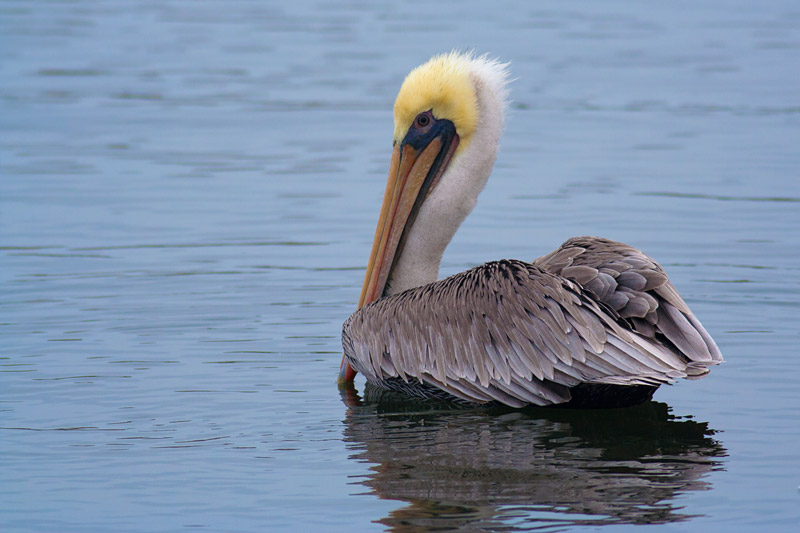
Brown Pelican in winter (basic) plumage (Kirsten Wahlquist 10/11/14)
Bolsa Chica** is an Ecological Reserve in Orange County, separated from the beach by Pacific Coast Highway. Our first exciting bird (not that the kamikaze diving pelicans and terns were not exciting) was a Ridgway’s Rail which emerged from under the bridge,

A new species for California – Ridgway’s Rail!!! (formerly known as Clapper Rail)
(Kirsten Wahlquist 10/11/14)
wandered through the pickle weed and went south. We saw lots of Dowitchers bringing up the old question “Short-billed or Long-billed?” (we concluded both), Willets, Sparrows mostly variations of Savannah: Belding’s, Large-Billed and Common, and assorted other shorebirds, including impressive Long-Billed Curlews.

Belding’s Savannah Sparrow is always found near pickleweed
(Kirsten Wahlquist 10/11/14)

Savannah Sparrow – the usual form (R. Hargraves 10/8/11)
One of our favorites, the Reddish Heron, was represented by one adult and one immature (sort of a pastel version of its parent) – neither was “dancing”; they too were enervated by the heat and did not move much. We saw a Great Blue Heron do a Yoga pose – its wings

Great Blue Heron, sunning, cooling, or perhaps downloading from ‘Twitcher’
(C. Almdale 10/10/15)
akimbo – sort of a fountain – very weird – as we said – Hot! Our best bird (well, mine) was a gorgeous Peregrine Falcon who cruised in over our heads and parked on a dead tree in full view of us and vice versa. It kept looking us over as if to see if we were edible.
***More on Bolsa Chica: It could mean “little pocket” or “small purse,” but also “small bag.” On the other hand, Chica is often “girl” or “young woman”, while bolsa can be “bag,” “pocket,” “sack,” “purse,” etc., so it could mean “bag girl“, “pocket girl,” “sack girl.” Isn’t this fun? However, bolsa may also refer to a “market,” while chica is a diminutive adjective, so it could mean “small market.” Then again, it could mean “market girl,” or “young woman of the market.” As markets were usually “street markets”, maybe it means “young woman of the street” who may or may not be marketing something. What could she be marketing? Hmmm….Best to leave it there.**** 99° by the time we got back to the cars. [Editor]
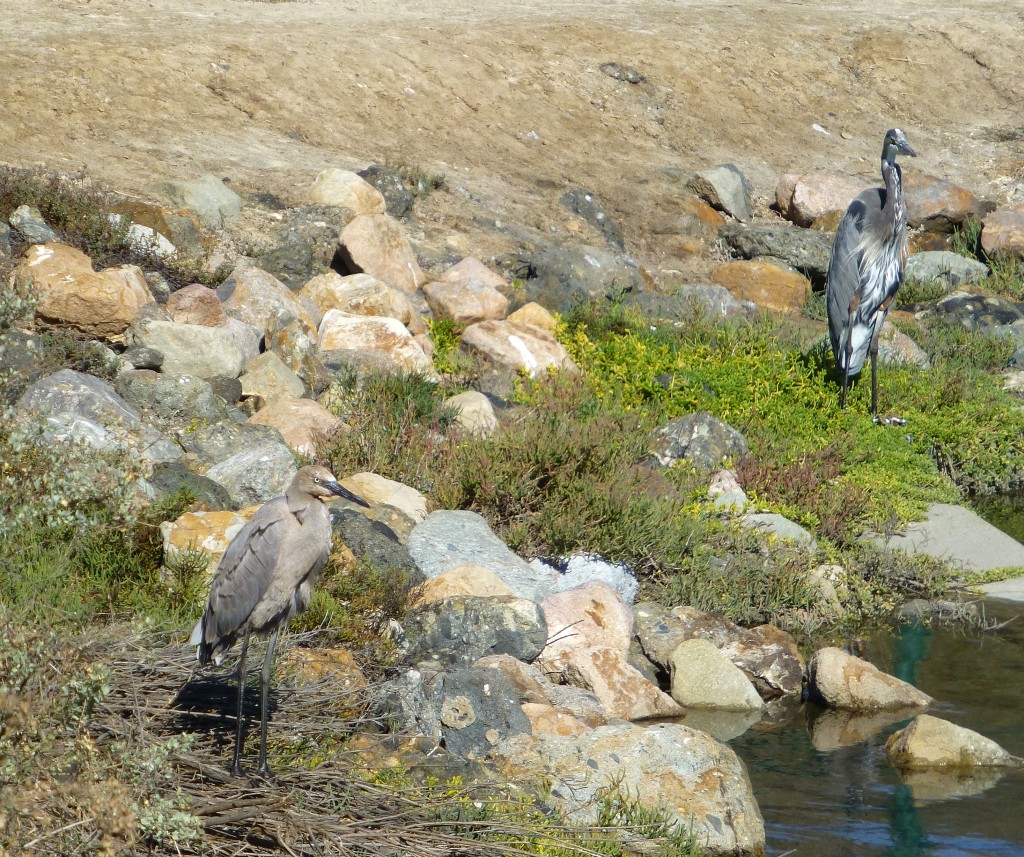
Juvenile Reddish Egret (L) & Great Blue Heron (R) (C. Almdale 10/10/15)
| Bolsa Chica Reserve | 10/10 | 10/11 | 10/12 | 10/6 |
| Trip List | 2015 | 2014 | 2013 | 2012 |
| Brant | X | X | ||
| American Wigeon | X | X | X | |
| Mallard | X | X | ||
| Blue-winged Teal | X | X | ||
| Cinnamon Teal | X | X | ||
| Northern Shoveler | X | X | ||
| Northern Pintail | X | X | ||
| Green-winged Teal | X | X | ||
| Redhead | X | |||
| Lesser Scaup | X | X | ||
| Ruddy Duck | X | X | X | X |
| Pied-billed Grebe | X | X | X | X |
| Eared Grebe | X | X | X | X |
| Western Grebe | X | X | ||
| Brandt’s Cormorant | X | |||
| Double-crested Cormorant | X | X | X | |
| American White Pelican | X | X | X | X |
| Brown Pelican | X | X | X | X |
| Great Blue Heron | X | X | X | X |
| Great Egret | X | X | X | X |
| Snowy Egret | X | X | X | X |
| Reddish Egret | X | X | X | X |
| Green Heron | X | |||
| Black-crowned Night Heron | X | X | X | |
| White-faced Ibis | X | |||
| Turkey Vulture | X | X | X | X |
| Osprey | X | X | X | X |
| White-tailed Kite | X | X | ||
| Northern Harrier | X | X | X | X |
| Red-tailed Hawk | X | X | ||
| Ridgway’s Rail | X | X | ||
| American Coot | X | X | X | X |
| Black-necked Stilt | X | |||
| American Avocet | X | |||
| Black-bellied Plover | X | X | X | X |
| Semipalmated Plover | X | X | ||
| Killdeer | X | X | X | |
| Greater Yellowlegs | X | X | ||
| Willet | X | X | X | X |
| Lesser Yellowlegs | X | |||
| Whimbrel | X | X | X | |
| Long-billed Curlew | X | X | X | X |
| Marbled Godwit | X | X | X | X |
| Ruddy Turnstone | X | X | X | |
| Red Knot | X | X | ||
| Sanderling | X | X | ||
| Western Sandpiper | X | X | X | X |
| Least Sandpiper | X | X | X | X |
| Dunlin | X | X | ||
| Short-billed Dowitcher | X | X | X | X |
| Long-billed Dowitcher | X | |||
| Ring-billed Gull | X | X | X | |
| Western Gull | X | X | X | X |
| California Gull | X | X | ||
| Black Tern | X | |||
| Forster’s Tern | X | X | X | X |
| Royal Tern | X | |||
| Elegant Tern | X | X | X | X |
| Rock Pigeon | X | X | X | X |
| Mourning Dove | X | X | X | |
| Anna’s Hummingbird | X | |||
| Allen’s Hummingbird | X | X | ||
| Belted Kingfisher | X | X | X | X |
| Nuttall’s Woodpecker | X | |||
| Downy Woodpecker | X | |||
| American Kestrel | X | X | X | |
| Peregrine Falcon | X | X | ||
| Black Phoebe | X | X | X | X |
| Say’s Phoebe | X | X | X | X |
| Loggerhead Shrike | X | |||
| American Crow | X | X | X | |
| Bushtit | X | |||
| House Wren | X | X | X | |
| European Starling | X | X | X | |
| American Pipit | X | |||
| Common Yellowthroat | X | X | X | X |
| Yellow-rumped Warbler | X | X | ||
| California Towhee | X | X | ||
| Savannah (Belding’s) Sparrow | X | X | X | |
| Savannah (Large-billed) Sparrow | X | |||
| Savannah Sparrow | X | X | X | X |
| Song Sparrow | X | X | ||
| White-Crowned Sparrow | X | X | X | X |
| House Finch | X | X | X | X |
| Pine Siskin | X | |||
| Total Species – 83 | 60 | 44 | 50 | 69 |



 SANTA MONICA BAY AUDUBON SOCIETY BLOG