Free email delivery
Please sign up for email delivery in the subscription area to the right.
No salesman will call, at least not from us. Maybe from someone else.
SMBAS field class in bird identification
Santa Monica Bay Audubon Society field class in bird ID
SMBAS will offer a short field course in bird identification in the spring of 2016. The course is intended to help new or novice birders improve their birding skills while learning how to identify some of the species commonly found in the Los Angeles basin.
The course will consist of 6 Saturday morning sessions, each of which will be held in a local park or natural area. Sessions will begin in mid-February, 2016.
Enrollment is limited to 8. A donation of $60 per SMBAS member or $90 per non-member will be requested.
For more information, send an e-mail to SMBAS [AT] verizon.net and put “Bird Class” in the subject line, or call 310-617-8904 and leave a message that includes your name and phone number.
Avian Tree of Life
This is a really cool online depiction of 9,993 species of birds.

The Avian Tree of life – OneZoom.org
Using your mouse and scroll wheel, or the on-screen buttons, you can move around the avian tree of life, zoom in, zoom out and see where each and every one of the 9,993 species are located, and how closely they are related to all the other species. You’ll be surprised at how the birds are now grouped. Your field guide is not adequate preparation for this. Plus there are many other viewing options such as an animated time line.
As you scroll in, the time of separation of a species or species group from their closest relatives is displayed.

Scroll in farther and links appear for each species to their entries on five information websites: Wikipedia, Discover Life, Encyclopedia of Life, Map of Life, and ARKive. Conservation status and population stability is displayed.
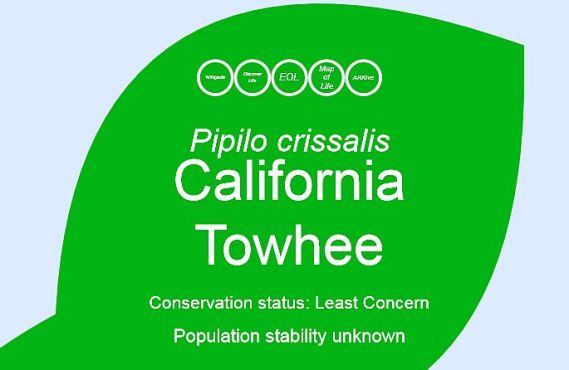
California Towhee closeup from Tree of Life
This is only one division of the entire tetrapod tree, comprising 22,821 species, located at: OneZoom Tree of Life Explorer. In addition to birds, this tree includes: 5,713 amphibians, 5,024 mammals, 1,835 lizards & snakes, 233 turtles & allies, and 23 crocodilians.
Additionally, if you can believe it, there’s yet another tree for 31,128 species in the plant tree of life: 593 gymnosperms, 43 waterlilies & allies, the monotypic Amborella, 36 star anises & allies, 30 chloranthus, 3 hornworts, 53 monocots, 53 pepper family, 960 poppies & allies, 10,009 gooseberries, roses & allies, and it just keeps going for another 11,324 species.
I’m not making this up. Someone spent a lot of time making this aspect of evolutionary science fun and easy.
Links to the three Trees of Life have been added to the right margin under “Other Blogs.”
Many thanks to birder Richard Carlson of Tuscon & Lake Tahoe for alerting me to this. [Chuck Almdale]
A Chilly Sepulveda Basin Trip: 12 December, 2015
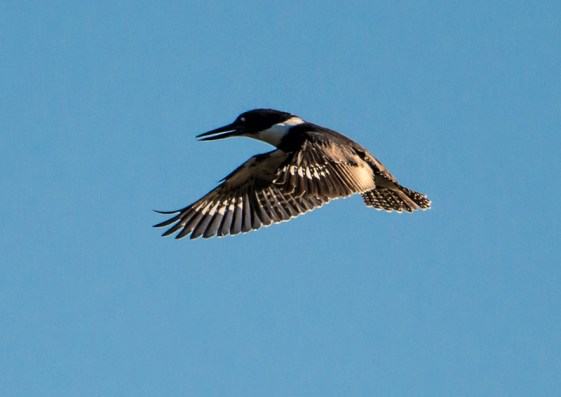
Both male & female Belted Kingfishers were present (Ray Juncosa 12/12/15)
Some newcomers showed up for this hastily organized field trip, which replaced the Carrizo Plain trip canceled late yesterday: Austin – fairly new to birding but quickly catching on – is a chapter member, and Wayne, who is not a member, but is a blog reader, and who escapes the Halifax, Nova Scotia winters for five months every year by staying in L.A. and looking at birds.
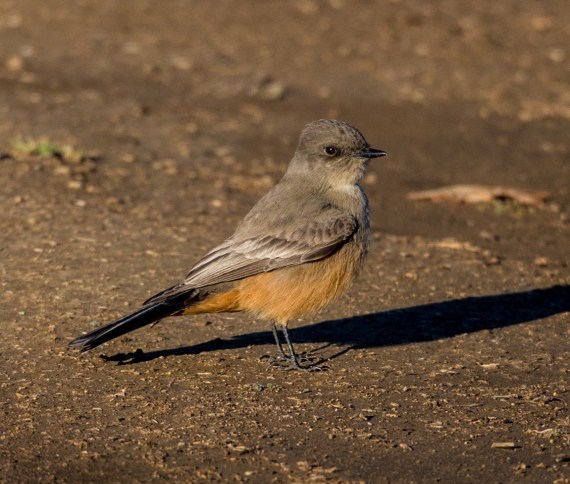
Say’s Phoebe busily flycatching by the fence (Ray Juncosa 12/12/15)
While waiting for potential late arrivals, we checked the lawn & trees near the parking lot, turning up a variety of Sparrows – Chipping, Lark, Savannah, and White-crowned. Near the south fence bordering the nature reserve we happened on a large flock of Western Meadowlarks, most of them out in the field, who flushed and re-lit farther away. A Merlin then flew by in the distance. On our way to the reserve entrance we found

California Towhee (Ray Juncosa 12/12/15)
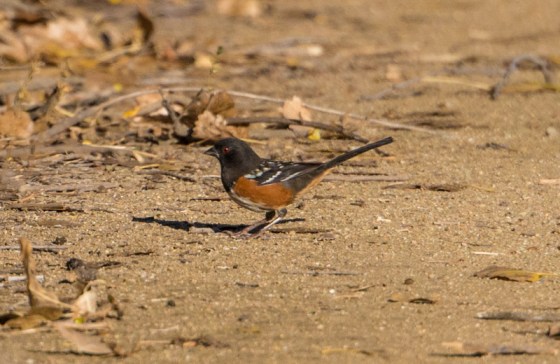
Spotted Towhee (Ray Juncosa 12/12/15)
California & Spotted Towhees, Black & Say’s Phoebes, a Song Sparrow, the first of many Ruby-crowned Kinglets, American Goldfinches, House Finches and some of the ever-present wintering Yellow-rumped Warblers hopping through the foliage and shagging flies from the canopy.
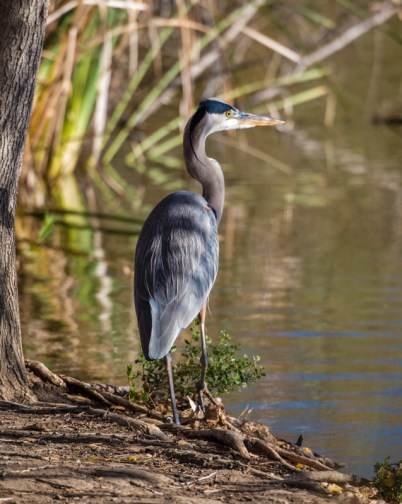
This Great Blue Heron almost picked our pockets
(Ray Juncosa 12/12/15)
We made it all of 20 ft. into the reserve before hitting a low wall of sparrows – more of the same as earlier – who worked the pathway before us, joined by a California Thrasher. I haven’t read of any problems in the thrasher population, but I don’t see nearly as many Cal Thrashers as I did decades ago. Anna’s and Allen’s hummers shot in to perch on twig ends above us. A Downy Woodpecker popped in and out of a Cottonwood tree.
The pond was populated by the usual suspects: various ducks, grebes, coots, pelicans, cormorants and egrets (see the list below for their exact names). The Black-crowned Night-Herons hid among the reeds, occasionally flying across the pond. An
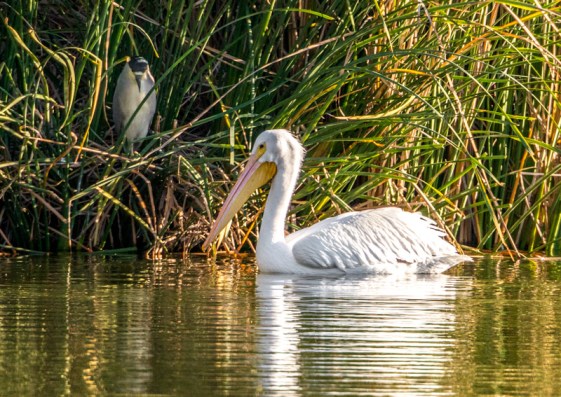
American White Pelican & Black-crowned Night-Heron (Ray Juncosa 12/12/15)
Osprey flew past in the distance, and a small group of Turkey Vultures roused themselves on this chilly morning from the leafy dark of the island floor. It turned out, oddly enough, to be a very good day for both Turkey Vultures and California Towhees.

This juvenile Red-tailed Hawk is likely the same bird pictured below, sitting in the tree.
(Ray Juncosa 12/12/15)
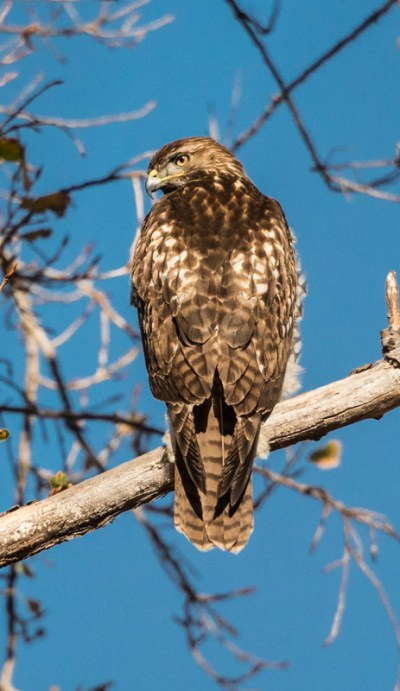
A Red-tailed Hawk’s mottled back (Ray Juncosa 12/12/15)
As said, it was rather chilly, with temperatures in the low 50’s (F) – my apologies to those of you currently suffering in cold climes, who would gladly snap off a frozen arm to be here now. Gloves felt good. I’ve read that in Norway this time of year the locals make great sport of catching scoters – called scoter-fanger, I believe – swimming through the ice-strewn fjord, wearing only swim fins, breath-holding for extraordinary lengths of time, rising under an unsuspecting scoter as it paddles past icy gray rock walls, catching the bird’s feet with their teeth and yanking them underwater. But we don’t do that here. The closest we come is downing an iced cola and hot dog drowned in chili sauce while reclining at the movies.
We spotted a very dark Red-tailed Hawk sitting in a tree, and later saw one soaring: dark brown head and belly with dark reddish brown chest. It was nearly a dead ringer of a bird photo’d two years ago at the same location. Unfortunately we did not see the immature Bald Eagle reported a few days ago.

This adult Dark Red-tail Hawk from two years ago was a dead ringer for one we saw today. (T. Hinnebusch 11/9/13)
We encountered many more kinglets, gnatcatchers, sparrows and finches south of Burbank Blvd. on our way to the Los Angeles River, along with a lovely Black-throated Gray Warbler. The vegetation, mostly willows and cottonwoods, is beginning to recover from the
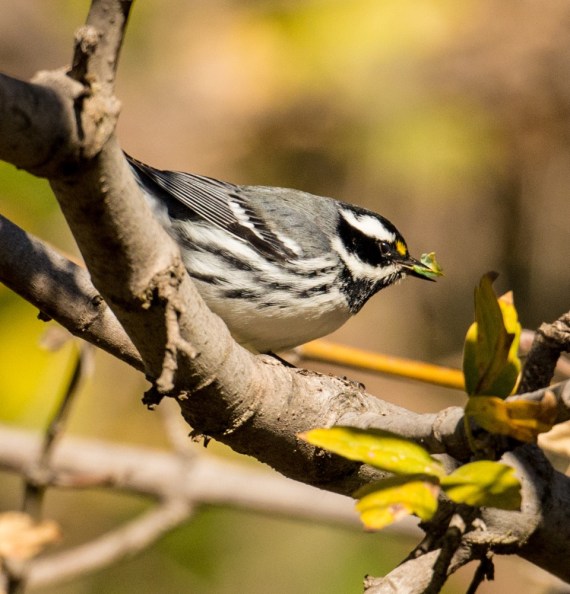
Black-throated Gray Warbler seizes a vermiform (Ray Juncosa 12/12/15)
havoc wreaked several years ago by the U.S. Army Corps of Engineers when they decided to remove most of the trees, failing to notify anyone of their intentions. (“We don’t have to,” they said, in a remarkable impersonation of Lily Tomlin’s telephone operator character, “we’re the Army Corp of Engineers.”)
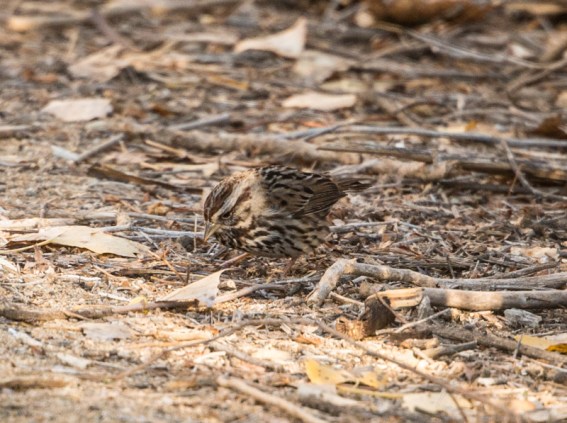
Song Sparrow (Ray Juncosa 12/12/15)
More ducks, mostly American Wigeons, the ubiquitous Mallards, and a few Bufflehead. A pair of Greater Yellowlegs worked one stream edge, some Spotted Sandpipers the other, a few American Pipits the stony stream-islands between. A flock of Least Sandpipers then flew in and began eagerly foraging at the water’s edge. We searched the reeds and grasses for Orange Bishops, but saw none.
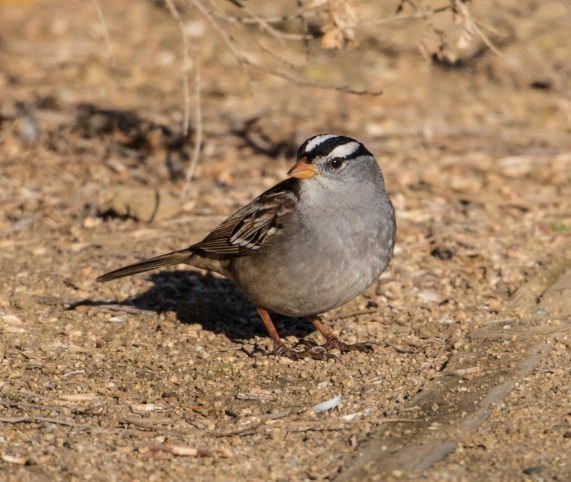
White-crowned Sparrows were common (Ray Juncosa 12/12/15)
On the way back to our cars we saw a few more Red-tailed Hawks and many Turkey Vultures soaring on the thermals. By the time we finished, it was nearly warm enough to support human life.
Many thanks to Ray Juncosa for his photographs. [Chuck Almdale]
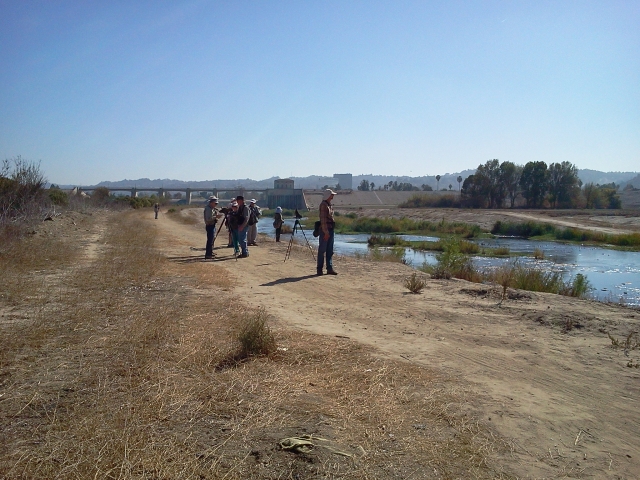
Los Angeles River looking southeast towards Sepulveda flood control dam (L. Johnson 11/9/13)
| Trip Lists Sepulveda Basin – Ponds & L.A. River areas | |||
| Name | Scientific Name | 11/9/13 | 12/12/15 |
| Canada Goose | Branta canadensis | 7 | 45 |
| Wood Duck | Aix sponsa | 2 | |
| Gadwall | Anas strepera | 2 | 8 |
| American Wigeon | Anas americana | 8 | 60 |
| Mallard | Anas platyrhynchos | 50 | 50 |
| Ring-necked Duck | Aythya collaris | 1 | |
| Bufflehead | Bucephala albeola | 4 | |
| Pied-billed Grebe | Podilymbus podiceps | 20 | 18 |
| Eared Grebe | Podiceps nigricollis | 6 | |
| Western Grebe | Aechmophorus occidentalis | 1 | |
| Double-crested Cormorant | Phalacrocorax auritus | 30 | 35 |
| American White Pelican | Pelecanus erythrorhynchos | 12 | 28 |
| Great Blue Heron | Ardea herodias | 4 | 3 |
| Great Egret | Ardea alba | 4 | 3 |
| Snowy Egret | Egretta thula | 2 | 2 |
| Green Heron | Butorides virescens | 3 | |
| Black-crowned Night-Heron | Nycticorax nycticorax | 5 | 5 |
| White-faced Ibis | Plegadis chihi | 2 | |
| Turkey Vulture | Cathartes aura | 8 | 12 |
| Osprey | Pandion haliaetus | 2 | 1 |
| Cooper’s Hawk | Accipiter cooperii | 1 | |
| Red-tailed Hawk | Buteo jamaicensis | 2 | 4 |
| American Coot | Fulica americana | 10 | 35 |
| Killdeer | Charadrius vociferus | 3 | |
| Spotted Sandpiper | Actitis macularius | 2 | 2 |
| Greater Yellowlegs | Tringa melanoleuca | 2 | |
| Least Sandpiper | Calidris minutilla | 15 | 40 |
| Western Gull | Larus occidentalis | 4 | |
| California Gull | Larus californicus | 10 | 4 |
| Rock Pigeon | Columba livia | 15 | 10 |
| Mourning Dove | Zenaida macroura | 8 | 30 |
| Anna’s Hummingbird | Calypte anna | 3 | 2 |
| Allen’s Hummingbird | Selasphorus sasin | 10 | 3 |
| Belted Kingfisher | Megaceryle alcyon | 1 | 2 |
| Nuttall’s Woodpecker | Picoides nuttallii | 2 | |
| Downy Woodpecker | Picoides pubescens | 1 | |
| Northern Flicker | Colaptes auratus | 4 | 1 |
| Merlin | Falco columbarius | 1 | 1 |
| Yellow-chevroned Parakeet | Brotogeris chiriri | 8 | |
| Black Phoebe | Sayornis nigricans | 20 | 18 |
| Say’s Phoebe | Sayornis saya | 4 | 2 |
| Cassin’s Kingbird | Tyrannus vociferans | 3 | |
| Western Scrub-Jay | Aphelocoma californica | 2 | |
| American Crow | Corvus brachyrhynchos | 10 | |
| Northern Rough-winged Swallow | Stelgidopteryx serripennis | 24 | |
| Barn Swallow | Hirundo rustica | 6 | |
| Bushtit | Psaltriparus minimus | 8 | |
| Bewick’s Wren | Thryomanes bewickii | 1 | |
| Blue-gray Gnatcatcher | Polioptila caerulea | 2 | 10 |
| Ruby-crowned Kinglet | Regulus calendula | 6 | 15 |
| American Robin | Turdus migratorius | 1 | |
| California Thrasher | Toxostoma redivivum | 1 | 1 |
| Northern Mockingbird | Mimus polyglottos | 5 | |
| American Pipit | Anthus rubescens | 12 | 4 |
| Common Yellowthroat | Geothlypis trichas | 6 | 4 |
| Yellow-rumped Warbler | Setophaga coronata | 40 | 35 |
| Chipping Sparrow | Spizella passerina | 10 | |
| Lark Sparrow | Chondestes grammacus | 5 | 6 |
| Dark-eyed Junco | Junco hyemalis | 8 | |
| White-crowned Sparrow | Zonotrichia leucophrys | 30 | 50 |
| Savannah Sparrow | Passerculus sandwichensis | 10 | 2 |
| Song Sparrow | Melospiza melodia | 10 | 5 |
| California Towhee | Melozone crissalis | 8 | 15 |
| Spotted Towhee | Pipilo maculatus | 2 | 2 |
| Red-winged Blackbird | Agelaius phoeniceus | 4 | |
| Western Meadowlark | Sturnella neglecta | 15 | 40 |
| House Finch | Haemorhous mexicanus | 30 | 15 |
| Lesser Goldfinch | Spinus psaltria | 4 | |
| American Goldfinch | Spinus tristis | 30 | 25 |
| House Sparrow | Passer domesticus | 6 | |
| TOTAL SPECIES – 70 | 61 | 50 | |
Great Bird Movie, limited release
Our friends in surrounding Audubon chapters have shared this with us.

The Messenger, a carefully-crafted documentary about the decline of songbirds in the world will be playing for one week at the Laemmle ROYAL Theater 11523 Santa Monica Blvd. 90025 starting December 11th but only through the 17th.
A look at the trailers at http://www.songbirdsos.com/videos/will certainly persuade you that this is the best piece of movie-making about birds to have been released since Winged Migration. Stunning visuals, solid scientific content, and reasoned advocacy make for a landmark film. There will be a panel discussion immediately following the evening showing on the 11th.
Weird-looking Animals
All real. For 34 more animals, go to The Dodo: Strange-looking animals you had no idea existed.
I’ve seen six of these, and knew of another eleven. What about you?
For example:

Orange Tortoise Spider (from Imgur)

Narrow-headed Softshell Turtle (from Imgur)

Glass Frog (from Imgur)

Coconut Crab (from Imgur)
I’ve seen what coconut crabs do to coconuts, and long wondered just how big these things must be to crack coconuts with their claws. Now I know. As the old song says: “Don’t sleep under the coconut tree with anything else but me, anything else but me, anything else but me, no no no…”
(Chuck Almdale)



 SANTA MONICA BAY AUDUBON SOCIETY BLOG