Free email delivery
Please sign up for email delivery in the subscription area to the right.
No salesman will call, at least not from us. Maybe from someone else.
ICYMI: In case you missed it: SHOREBIRDS

ASSOCIATED PRESS: September 30, 2015
CALIFORNIA SHOREBIRDS STARVING
Malnourished seabirds have been appearing across the state in alarming numbers, some shrunken to little more than feather and bone. Many of the thin-billed species are being brought into the International Bird Rescue Center, which says it is taking in the birds at the highest rates in 18 years. The murres’ presence is significant to scientists because they are considered a marker species. That means their movements and numbers signal changes in the ocean’s food supply.
Malibu Lagoon Trip Report: 27 September, 2015

Sanderlings are often misidentified as their roostmates Snowy Plover (R. Ehler 9/27/15)
The big surprise of the day was the really high tide, caused by the blood-red superharvestmoon lunar eclipse. About 2/3rds of the beach was gone; even at high tide rocks showed where we simply don’t see rocks because they are usually covered by sand. A cliff of sand dropped straight into the sea where beach used to be. A footpath now led over the low vegetated hill, and sand was lost to the sea nearly to the Snowy Plover virtual fence.
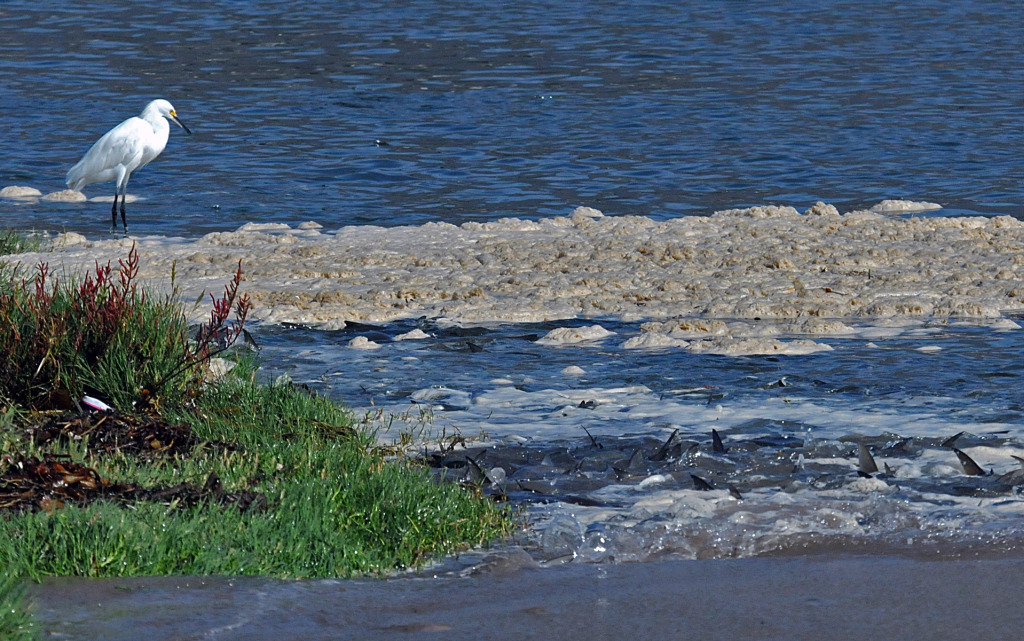
Snowy Egret eyes the mullet, many of whom are larger than the bird
(Jim Kenney 9/28/15)
From a distance we saw waves washing over the beach and into the lagoon, so we dawdled, giving the tide time to subside. High tide at 9:18am was very high at +5.94 ft., but by 10am we were able to pass.
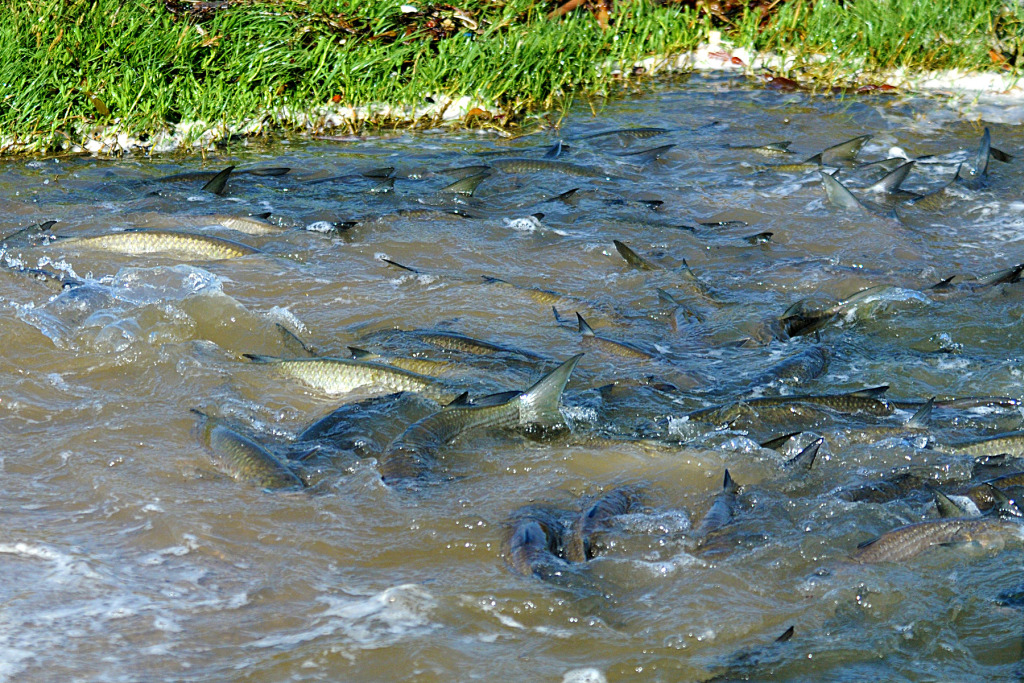
Mullet at lagoon’s edge (Jim Kenney 9/28/15)
An additional surprise was the number of fish in the lagoon. Along the lagoon shoreline, especially at the southern edge nearest the ocean, thousands of fish roiled and thrashed. A local Malibuite confidently averred they were “Sea Bass,” an identification I immediately

Kelp Bass – an actual “Sea Bass” (Aquafind.com)
distrusted for sounding too much like the common misnomer “whitefish,” – there must be hundreds of species called “whitefish” because their flesh is white and humans will eat it. Fish are notoriously renamed in order to suit marketers. When was the last (or first) time you saw “Patagonian Toothfish” (a cod, family Gadidae) on the menu? How about Chilean Sea Bass? Same species – case closed.
I later learned that “Sea Bass” is truly a family, Serranidae, which does not include cod, but does include groupers as well as Kelp Bass (Paralabrax clathratus), SoCal’s most common Sea Bass. But they all looked wrong for our fish. Mark Abramson, Senior Watershed Advisor of Santa Monica Bay Restoration Foundation, advised me that they were Striped Mullet (family Mugilidae, Mugil cephalus).
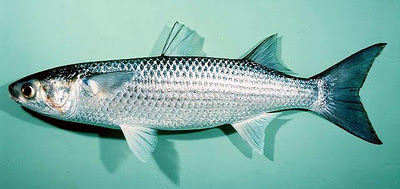
Striped Mullet – definitely not a “Sea Bass” (Smartfarming)
This of course is the same entertaining fish who have been leaping about in the lagoon for many months. Consensus is that the very high supermoon-caused tide and surf washed them over the beach into the lagoon. Fortunately they are able to live in fresh to brackish water as well as salt; I hope they survive to return to the sea when the lagoon entrance reopens.
We witnessed an unfortunate incident in association with all these fish: a young Double-crested Cormorant (not black but brown with beige belly, breast and throat) was struggling mightily to swallow a fish, an event not unusual in and of itself. One alert birder said she saw a fishhook and we realized that there was certainly a 3-prong fishhook and what appeared to be blood near the fish’s head. It might have been a lure, or fish blood, or cormorant blood. At any rate, the cormorant’s difficulty had more to do with this hook than with the fish. We shouted at the bird, hoping to startle it into dropping the fish & hook. This did not work; neither did it startle when I threw a stone at it, as it was about 4 times farther than my poor arm can throw. Sorry…there’s no end to this story beyond the fact that the cormorant, still hooked, swam away.
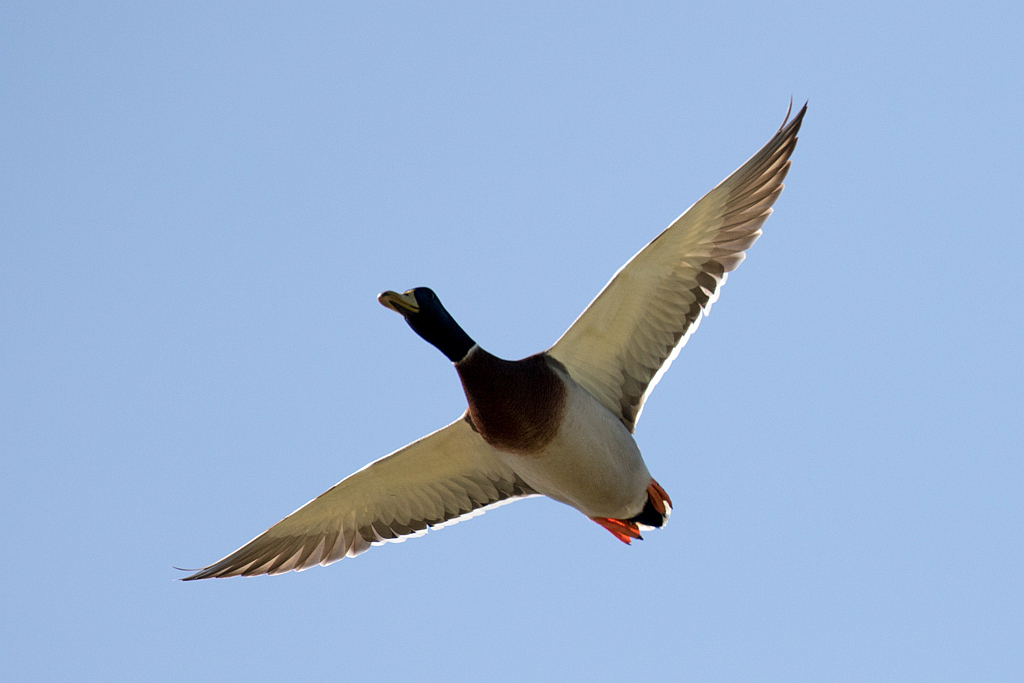
Male Mallard cruises in (R. Ehler 9/27/15)
It’s obviously migration time, with warblers and unusual species appearing all across the county, and the lagoon was no exception. Some new ducks, a Cooper’s Hawk, a nice mix of shorebirds, gulls and terns (including the uncommon Common Tern), Vaux’s Swift, many Anna’s and Allen’s Hummingbirds, 4 Say’s Phoebe,

Say’s Phoebe – here for the winter (R. Ehler 9/27/15)
6 Warbling Vireo!, two wrens, five warbler species including 3 Nashville, Savannah Sparrow and Western Meadowlark. The meadowlarks are hard to find as they prefer the vegetated areas on the sand islands. See the lists below for complete numbers.
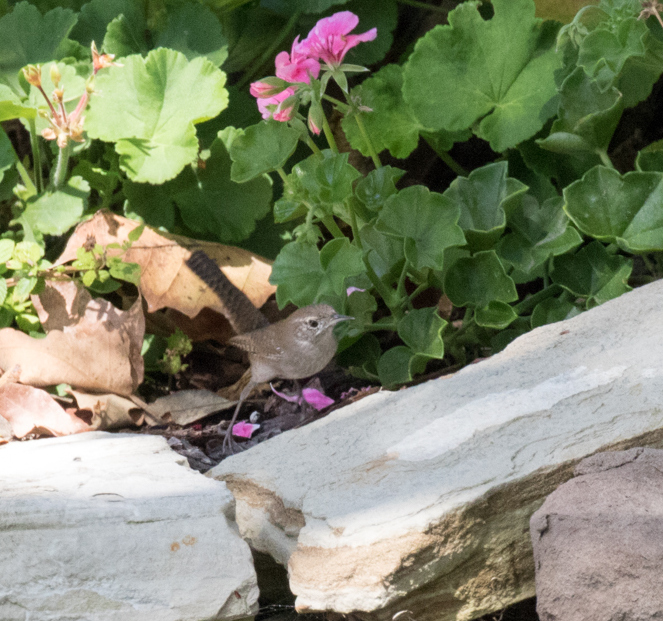
House (not a Marsh) Wren (R. Ehler 9/27/15)
The Marsh Wren was an unexpected but welcome sight, hopping through the small reed patches below the meeting pavilion. Our last sighting of this species, its 35th appearance at the lagoon, was on 1/22/12, almost 4 years ago. The reed beds they require were wiped out by the June’12 – May’13 lagoon reconfiguration, but they recently reappeared, albeit still quite small. I will not be shocked to see Sora appear sometime in 2016 – likely a short visit rather than a winter-long or full-year residency – but it may be an additional year or two before Virginia Rail show up.
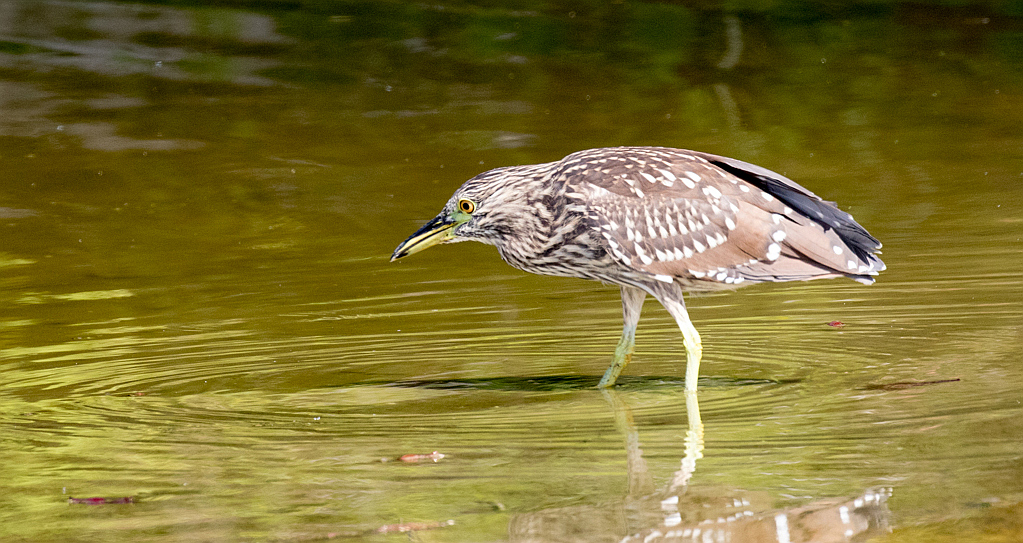
Juvenile Black-crowned Night-Heron stalking (R. Ehler 9/27/15)
Romeo & Juliet, our newly-resident pair of Mute Swans, are still here, gracefully gliding o’er the languid lagoon. The Snowy Plovers continue to increase in number – 32 this month, with ringed bird GA:OY (left Green over Aqua: right Orange over Yellow) putting in an appearance. GA:OY was ringed at Oceano Dunes (near Pismo Beach on the central coast) in Summer 2014. First spotted – and photographed – at the lagoon by Bill Crowe on 10/3/14, it was also seen 12/28/14 and 1/25/15 at the lagoon’s winter roosting colony.
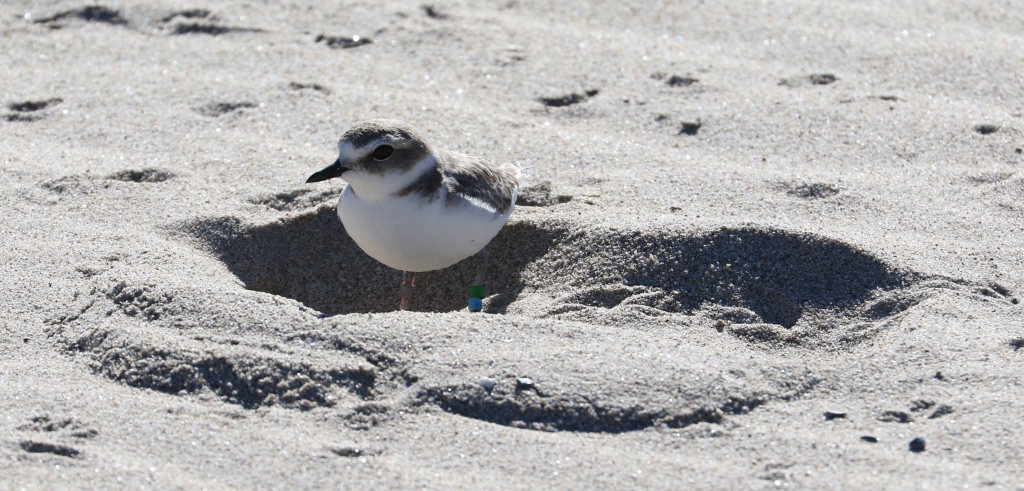
Dwarfed by a footprint – Snowy Plover GA:OY (R. Ehler 1/25/15)
Yielding to the urge to create a chart, I compared this Sept. to earlier years. It proved to be slightly above average.
| Ave of Prior | Variance | Range for prior | ||
| Sept 2015 | 12 Septs | from Ave. | 12 Years | |
| Species | 69 | 63 | +6% | 49 – 78 |
| Numbers | 922 | 869 | +9% | 556 – 1237 |
Birds new for the season are: Green-winged Teal, Ruddy Duck, Eared Grebe, Cooper’s Hawk, Marbled Godwit, Long-billed Dowitcher, Boneparte’s Gull, Common & Forster’s Terns, Vaux’s Swift, Belted Kingfisher, Say’s Phoebe, Warbling Vireo, Oak Titmouse, Marsh Wren, Blue-gray Gnatcatcher, Orange-crowned, Nashville, Yellow and Yellow-rumped Warblers, Savannah and White-crowned Sparrows, Western Meadowlark and Lesser Goldfinch.
Our next three scheduled field trips: Bolsa Chica, 10 October, 8:30am; Malibu Lagoon, 25 October, 8:30 & 10am: Ballona Creek Area, 14 Nov. 8:30am.
Our next program: The Sex Life of Spiders with Martina Ramirez on Tuesday, 6 October, 7:30 pm, at [note change] Chris Reed Park, 1133 7th St., NE corner of 7th and Wilshire Blvd. in Santa Monica.
NOTE: Our 10 a.m. Parent’s & Kids Birdwalk meets at the shaded viewing area. Watch for Willie the Weasel. He’ll be watching for you and your big floppy feet.
Links: Unusual birds at Malibu Lagoon
9/23/02 Aerial photo of Malibu Lagoon
Prior checklists:
2015: Jan-May
2014: Jan-July, July-Dec 2013: Jan-June, July-Dec
2012: Jan-June, July-Dec 2011: Jan-June, July-Dec
2010: Jan-June, July-Dec 2009: Jan-June, July-Dec
The 10-year comparison summaries created during the project period, despite numerous complaints, remain available on our Lagoon Project Bird Census Page. Very briefly summarized, the results unexpectedly indicate that avian species diversification and numbers improved slightly during the period Jun’12-June’14. [Chuck Almdale]
| Malibu Census 2015 | 3/22 | 4/26 | 5/24 | 7/26 | 8/23 | 9/27 |
| Temperature | 60-70 | 66-76 | 59-70 | 70-82 | 70-77 | 68-77 |
| Tide Lo/Hi Height | H+4.78 | L+0.58 | L+0.54 | L+2.37 | L+2.80 | H+5.94 |
| Tide Time | 1138 | 1139 | 0927 | 1143 | 0944 | 0918 |
| Brant | 3 | 7 | 1 | |||
| Canada Goose | 1 | 30 | ||||
| Mute Swan | 2 | 2 | ||||
| Gadwall | 1 | 10 | 22 | 5 | 8 | 54 |
| Mallard | 12 | 8 | 8 | 55 | 35 | 34 |
| Northern Shoveler | 2 | |||||
| Green-winged Teal | 4 | |||||
| Bufflehead | 2 | |||||
| Red-brstd Merganser | 2 | 1 | 1 | |||
| Ruddy Duck | 30 | 4 | 5 | |||
| Red-throated Loon | 3 | |||||
| Pacific Loon | 1 | |||||
| Common Loon | 5 | |||||
| Pied-billed Grebe | 2 | 1 | 3 | 2 | ||
| Horned Grebe | 1 | 1 | ||||
| Eared Grebe | 1 | 8 | ||||
| Western Grebe | 12 | 2 | 1 | |||
| Brandt’s Cormorant | 4 | 1 | 2 | 1 | ||
| Dble-crstd Cormorant | 45 | 16 | 55 | 34 | 43 | 36 |
| Pelagic Cormorant | 1 | 4 | 2 | |||
| Brown Pelican | 27 | 1490 | 70 | 17 | 3 | 6 |
| Great Blue Heron | 1 | 2 | 2 | 4 | 8 | 4 |
| Great Egret | 10 | 5 | 5 | 4 | 6 | 3 |
| Snowy Egret | 12 | 12 | 4 | 6 | 22 | 18 |
| Cattle Egret | 1 | |||||
| Blk-crwnd N-Heron | 2 | 3 | 3 | |||
| Osprey | 1 | |||||
| Cooper’s Hawk | 1 | |||||
| Red-tailed Hawk | 1 | |||||
| American Coot | 45 | 1 | 1 | 4 | 75 | |
| Blk-bellied Plover | 6 | 1 | 27 | 75 | 84 | |
| Snowy Plover | 16 | 21 | 32 | |||
| Semipalmated Plover | 9 | 1 | 5 | 2 | ||
| Killdeer | 3 | 2 | 6 | 4 | 6 | 10 |
| Spotted Sandpiper | 2 | 1 | 1 | 3 | ||
| Willet | 3 | 1 | 1 | 6 | 8 | 15 |
| Whimbrel | 10 | 12 | 1 | 13 | 10 | 4 |
| Marbled Godwit | 8 | 2 | 8 | |||
| Ruddy Turnstone | 1 | 3 | 12 | 15 | ||
| Black Turnstone | 1 | |||||
| Surfbird | 4 | |||||
| Sanderling | 2 | 23 | ||||
| Dunlin | 1 | |||||
| Least Sandpiper | 15 | 8 | 3 | |||
| Western Sandpiper | 45 | 1 | 14 | 15 | ||
| Short-billd Dowitcher | 6 | |||||
| Long-billed Dowitcher | 1 | |||||
| Wilson’s Phalarope | 1 | |||||
| Boneparte’s Gull | 12 | 6 | 1 | 1 | ||
| Heermann’s Gull | 6 | 350 | 45 | 14 | 11 | 25 |
| Ring-billed Gull | 3 | 30 | 8 | |||
| Western Gull | 3 | 110 | 135 | 40 | 40 | 110 |
| California Gull | 40 | 600 | 6 | 2 | 1 | 8 |
| Glaucous-wingd Gull | 1 | 1 | ||||
| Caspian Tern | 10 | 11 | 1 | 6 | 1 | |
| Common Tern | 1 | |||||
| Forster’s Tern | 2 | 2 | ||||
| Royal Tern | 15 | 4 | 2 | 3 | 9 | 15 |
| Elegant Tern | 28 | 3100 | 85 | 45 | 12 | 6 |
| Black Skimmer | 1 | |||||
| Rock Pigeon | 23 | 8 | 9 | 4 | 6 | 12 |
| Mourning Dove | 2 | 2 | 2 | 7 | 7 | 4 |
| Vaux’s Swift | 45 | |||||
| Anna’s Hummingbird | 1 | 2 | 2 | 1 | 3 | 4 |
| Allen’s Hummingbird | 6 | 4 | 6 | 3 | 10 | 5 |
| Belted Kingfisher | 1 | 1 | ||||
| American Kestrel | 1 | |||||
| Black Phoebe | 2 | 2 | 2 | 4 | 6 | 20 |
| Say’s Phoebe | 4 | |||||
| Warbling Vireo | 6 | |||||
| American Crow | 5 | 6 | 5 | 4 | 4 | 20 |
| Rough-winged Swallow | 4 | 4 | 6 | 3 | 8 | |
| Tree Swallow | 10 | 10 | ||||
| Barn Swallow | 2 | 6 | 12 | 12 | 12 | |
| Cliff Swallow | 2 | 10 | 12 | 3 | ||
| Oak Titmouse | 1 | |||||
| Bushtit | 14 | 2 | 2 | 20 | ||
| House Wren | 1 | 4 | ||||
| Marsh Wren | 1 | |||||
| Blue-gray Gnatcatcher | 3 | |||||
| American Robin | 1 | 1 | ||||
| Northern Mockingbird | 3 | 6 | 3 | 4 | 4 | 4 |
| European Starling | 4 | 10 | 3 | 25 | 25 | 35 |
| Cedar Waxwing | 40 | |||||
| Ornge-crwnd Warbler | 2 | |||||
| Nashville Warbler | 3 | |||||
| Common Yellowthroat | 2 | 5 | 5 | 8 | ||
| Yellow Warbler | 1 | |||||
| Yellow-rumpd Warbler | 5 | 3 | ||||
| Spotted Towhee | 1 | |||||
| California Towhee | 3 | 2 | 2 | 4 | 6 | 2 |
| Savannah Sparrow | 2 | |||||
| Song Sparrow | 9 | 6 | 9 | 5 | 8 | 3 |
| White-crwnd Sparrow | 10 | 2 | ||||
| Red-winged Blackbird | 2 | 40 | 15 | |||
| Western Meadowlark | 3 | 4 | ||||
| Brewer’s Blackbird | 2 | |||||
| Great-tailed Grackle | 4 | 3 | 3 | 5 | 12 | |
| Brwn-headed Cowbird | 4 | 4 | ||||
| Hooded Oriole | 3 | |||||
| House Finch | 4 | 12 | 20 | 2 | 12 | 25 |
| Lesser Goldfinch | 1 | 3 | ||||
| Totals by Type | Mar | Apr | May | Jul | Aug | Sep |
| Waterfowl | 50 | 55 | 37 | 62 | 46 | 99 |
| Water Birds – Other | 144 | 1511 | 134 | 57 | 54 | 126 |
| Herons, Egrets & Ibis | 24 | 19 | 11 | 16 | 39 | 28 |
| Quail & Raptors | 1 | 1 | 1 | 0 | 0 | 1 |
| Shorebirds | 37 | 89 | 8 | 71 | 170 | 215 |
| Gulls & Terns | 107 | 4213 | 294 | 105 | 80 | 169 |
| Doves | 25 | 10 | 11 | 11 | 13 | 16 |
| Other Non-Passerines | 7 | 7 | 8 | 4 | 13 | 55 |
| Passerines | 76 | 104 | 86 | 85 | 149 | 213 |
| Totals Birds | 471 | 6009 | 590 | 411 | 564 | 922 |
| Total Species | Mar | Apr | May | Jul | Aug | Sep |
| Waterfowl | 7 | 5 | 3 | 4 | 4 | 5 |
| Water Birds – Other | 9 | 6 | 8 | 5 | 5 | 5 |
| Herons, Egrets & Ibis | 4 | 3 | 3 | 4 | 4 | 4 |
| Quail & Raptors | 1 | 1 | 1 | 0 | 0 | 1 |
| Shorebirds | 8 | 10 | 3 | 8 | 14 | 13 |
| Gulls & Terns | 7 | 10 | 9 | 6 | 7 | 9 |
| Doves | 2 | 2 | 2 | 2 | 2 | 2 |
| Other Non-Passerines | 2 | 3 | 2 | 2 | 2 | 4 |
| Passerines | 17 | 13 | 17 | 13 | 15 | 26 |
| Totals Species – 102 | 57 | 53 | 48 | 44 | 53 | 69 |
Gigantic Blood-Red Moon Eclipsed: 27 September, 2015
Now we get a special celestial treat: a total lunar eclipse, a supermoon, a harvest moon and a blood moon, all rolled into one.
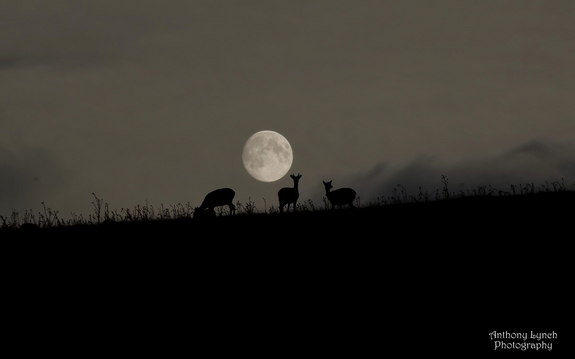
Irish harvest moon & deer (Anthony Lynch 9/19/13 from Space.com)
Total Lunar Eclipse
27 September, 5:11 PM – 10:22 PM, PDT. Maximum at 7:47 PM. Duration 5 hours, 11 minutes.
The plane of the moon’s orbit is tilted 5.1° with respect to the plane of the earth’s orbit around the sun. Thus the moon’s orbit intersects the plane of the earth’s orbit at two points, called lunar nodes. The moon passes through both nodes monthly. Solar eclipses occur when the new moon passes through a node; lunar eclipses occur when the full moon passes through a node. These nodes precess (move backwards) around the ecliptic over an 18.6-year cycle; every 1.5 years the nodes move into the preceeding constellation (e.g. from Gemini into Taurus).
[Note: The equinoxes (vernal and autumnal) themselves precess over a 26,000-year cycle. Every 2167 years, on average, the vernal equinox (March 21) moves into the preceeding constellation. This creates the various astrological ages such as the widely-ballyhood “Age of Aquarius,” the beginning of which was in great dispute between various astrologers. Equinoctial recession also creates the astrological problem of constellations out of sync with the astrological signs. Tropical astrologers use signs based on the equinoxes and solstices; for them Aries begins on March 21, the 1st day of spring. Sidereal astrologers, including the Hindus, use the constellations; for them Aries begins on April 15, 25 days after the vernal equinox. But you knew that.]
Supermoon
The moon’s orbit is not a circle, but an ellipse, with an average distance of 238,000 miles. The farthest point is the apogee, the closest is the perigee. At perigee it appears 7% larger and 16% brighter than the average moon and 14% larger and 30% brighter than the micromoon (at apogee). When a total lunar eclipse occurs during perigee, it is called a supermoon, a phrase coined in 1979 by astrologer Richard Nolle, who defined it as when the moon is within 90% of perigee. By this definition, there have been 6 supermoons in 2015. The technical name is the perigee-syzygy of the Earth-Moon-Sun system. Ocean tides are higher during supermoons, lower during micromoons.
Full Harvest Moon – 27 September, 7:51 pm. Traditionally, this designation goes to the full moon that occurs closest to the Autumnal (Fall) Equinox. At the peak of the harvest, farmers can work into the night by the light of this moon. Usually the moon rises an average of 50 minutes later each night, but for the few nights around the Harvest Moon, the moon seems to rise at nearly the same time each night: just 25 to 30 minutes later across the U.S., and only 10 to 20 minutes later for much of Canada and Europe. Corn, pumpkins, squash, beans and wild rice — the chief Indian staples — are now ready for gathering.
Blood Moon
The rusty-red color of the eclipsed moon is often called “blood on the moon,” but there is another, more esoteric definition. About 1/3rd of lunar eclipses are total. Total eclipses also come in lunar tetrads, four eclipses in a row, 6 months apart. October’s lunar eclipse is the 4th in such a tetrad: 15 April 2014, 8 October 2014, 4 April 2015 and 27 September 2015. As usual, the human penchant for finding personal meaning within environmental events having nothing to do with them is fully operational, and many people see all sorts of religious, mystical and apocalyptic meanings in this sequence of events. This tetrad (in the order given above) coincides with Jewish holidays: Passover, Sukkot, Passover and Sukkot. That the Jewish calendar, including its holidays, is lunisolar – primarily lunar but corrected for actual year length by periodically adding days – seems to be overlooked. Important holidays tied to seasons and moon cycles will of course regularly fall on full moons and lunar eclipses.
Nevertheless, sages find meaning here. “Not only does God’s name have four letters, but it was on the fourth day of creation that God created the sun and the moon, establishing them as signs to mark sacred times, such as the Festival of Passover,” usefully explains Gidon Ariel of Root Source (quoted in Washington Post). Mark Blitz of El Shaddai Ministries says this tetrad of blood moons were partially meant as divine warnings to President Obama about his Middle East policy. “The moons are like flashing red warning lights at a heavenly intersection saying to Israel as well as the nations they will be crossing heavenly red lines, and if they do, they will understand as Pharaoh did on Passover night 3,500 years ago that the Creator backs up what He says.” And thank you for sharing that.
But wait, there’s more! Megachurch pastor John Hagee, believes that this particular blood moon closely precedes the Rapture of Christians, Armageddon and the second coming of Christ. If you recall, less than a week ago we alerted you that the Apostacy was scheduled for the autumnal equinox, because the rapture – yes, that rapture – must be preceded by this Apostacy. Well, the equinox came and went and I didn’t notice any out-of-the-ordinary-apocalyptic events. Did you? [The Washington Post seems to be a great source of apocalyptic information.]
There will be seven more tetrads in the 21st century. Previous lunar tetrads occurred in 1967, 1949, and 1493; there were none at all from 1600 to 1900. No doubt events of unbelievable cataclysmic proportion occurred – and will occur – at those times.
Well, whatever. Don’t miss the full, eclipsed, super, blood moon. Maximum is at 7:47 PM PST. The closer the moon is to the horizon, the bigger it looks.
Interesting & useful factoids on moon averages:
Apparent width of the moon (full or otherwise): 1/2 degree.
Time one full moon to next full moon: 29.5 days
Angle moon moves in 24 hours: 12.2 degrees
Time for moon to move it’s own width (1/2 degree): 59 minutes
Thus, on average, the moon takes just under an hour to move it’s own width. When trying to estimate the size of something, compare it to the moon, a known quantity.
MoonPhases.info – A handy site for a googolplex of moon facts.
The next significant full moon will occur on 27 October, 5:05 a.m. PDT.
Harvest moon information comes to you courtesy of: http://www.space.com/24262-weird-full-moon-names-2014-explained.html written by Joe Rao.
[Chuck Almdale]
Aerial Plankton
If you’ve ever wondered what whales would eat if they could fly, or what whalebirds – both fanciful and real – actually do eat, find out about aerial plankton in an article sent to us by perspicacious blog reader Aurelio Albaisa.
Link to aerial plankton article in the Boothbay Register, 8/29/15
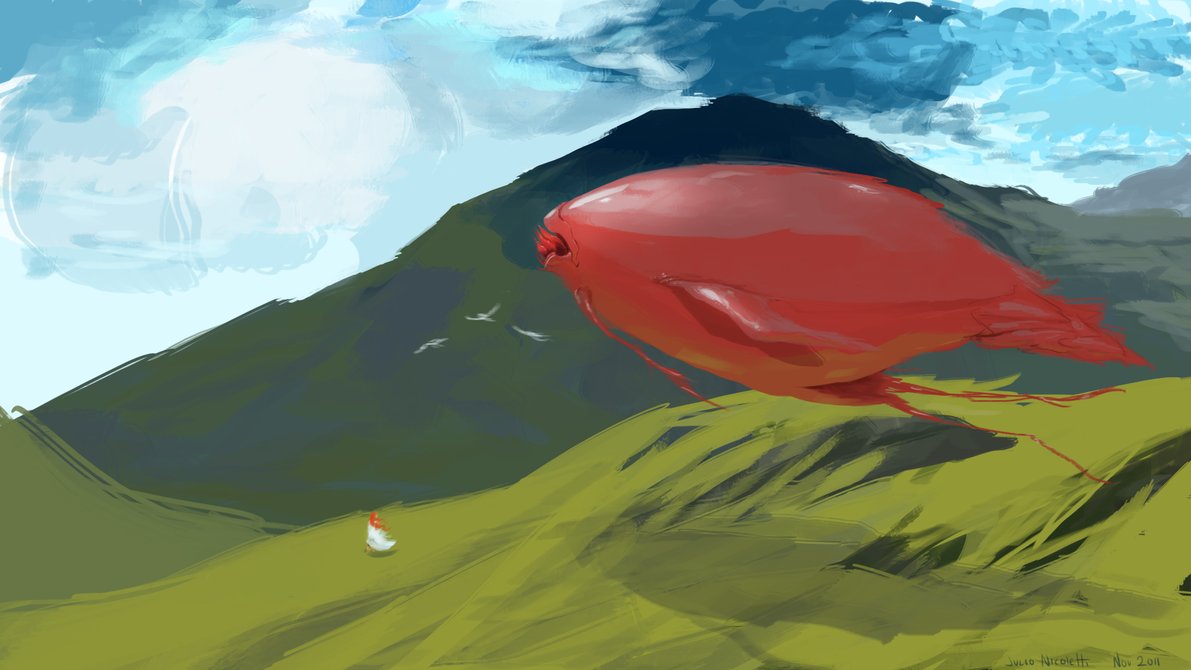
Girl looking at a floating red whale-bird (Julio Nicoletti)
Autumnal Equinox 23 September, 2015, 1:22 AM, PDT
This year we report on that other large object in the sky, known as the sun.

Not a rotting peach, but our Sun – 860,000 miles in diameter, 8 light-minutes away (Alan Friedman ~ 4/22/14, on NASA site)
The next event is the Autumnal Equinox, scheduled in Los Angeles for September 23, 2015 at 1:22 AM PDT (or 0822 UTC – Universal Time Coordinated, if you prefer). Sunrise will be at 6:42 AM, daylight will last 12 hours, 6 minutes, 50 seconds (12:06:50); sunset is at 6:49 PM and nighttime is 11 hours, 53 minutes (rounded). You will note that these periods of day and night are not equal. Day and night will be nearly equal on Sep. 26, with 12:00:32; sunrise is at 6:42 AM, sunset is at 6:42 PM.
Definition of the term
Autumnal: Of or pertaining to Autumn [Latin autumn(us)]
Equinox: When the sun crosses the plane of the earth’s equator [from Latin aequinoctium, the time of equal days and nights].
Equinoctial daytime exceeds nighttime for two reasons
First: Sunrise occurs when the leading (upper) edge of the rising sun first becomes visible above the horizon. Sunset is when the trailing (not the lower) edge drops below the horizon. The width of the sun adds about six minutes of daylight.
Second: Refraction of the sun’s rays by the earth’s atmosphere permits us to see the sun both before it has actually risen and after it has actually set, adding several minutes each to sunrise and sunset.
Seasonal Fluctuation
Because the two equinoxes (vernal and autumnal) mark when the sun crosses the celestial equator (the plane of the earth’s equator projected into space), these are also the only days of the year when the sun rises exactly in the east and sets exactly in the west. The earth’s axis (and equatorial plane) is tilted 23.4° with respect to the plane of the earth’s orbit around the sun. In the northern summer the earth’s

Northern Summer (famous artist – name withheld by request)
north axial pole tilts towards the sun, the sun’s rays have less insulating atmosphere to filter them, and the northern hemisphere warms up. In the northern winter, the north pole tilts

Northern Winter (same famous artist)
away from the sun whose warming rays now must penetrate more atmosphere, and the northern hemisphere cools down. Seasons are opposite south of the equator. The closer you are to the equator, the more equal are day and night, summer and winter, warmth and cold. The temperature extremes of winter and summer are replaced by rainy and dry seasons.

At equinox: right diagram shows view past top of sun towards earth.
Eastern Sunrise, Western Sunset
Throughout the northern winter and spring, the points of sunrise and sunset move farther and farther north. The extremes are the Winter Solstice (around December 21), when the sun rises and sets farthest to the south, and the Summer Solstice (around June 21) when they are farthest to the north. The equinoxes mark the halfway point, when sunrise and sunset are exactly east and west. Well, not exactly.
Using this site, calculating for Santa Monica City Hall (34:00:43° North, -118:29:30° West) on 9/23/15 the sun is exactly at 0° elevation (on the eastern horizon) at 6:43:55 AM, and at 89.71°, slightly north of exactly east. Sunset, when again the sun’s elevation is 0°, is at 6:48:15 PM, and the sun is at 270.04°, again slightly north of exactly west.
If you’ve read this far, you may have noticed that these sunrise and sunset times are a bit slippery, shifting around by 1-2 minutes for what appears to be the same location. The problem is the location isn’t exactly the same. Some locations used are downtown L.A., some are Santa Monica. While both locations have the same clock time, sunrise time changes. Because the earth’s diameter is 24,901 miles, a point on the equator moves 1038 miles per hour, and 17.3 miles per minute. Now invert that. Move 17.3 miles westward from one place, and the sun will rise 1 minute later. Of course, the speed of rotation declines as you move towards the poles; exactly at the poles you don’t move eastward at all. Rotational speed calculations get complicated, but the bottom line is that the sun does rise and set later in Santa Monica than it does in downtown L.A.
So make sure you run outside at 1:22 AM – or thereabouts – on September 23 to witness the autumnal equinox, despite the fact that at that very moment the sun will be undergoing a total eclipse by the earth (aka nighttime), so there really won’t be much to look at for anyone in California. It will be quiet. Probably. By the way – the sun doesn’t rise and set. The earth revolves on its axis. But you knew that.
Autumnal Festivals
The farther one lives from the equator, the more noticeable are seasonal variations in daylight and warmth, and the more important seasonal events such as autumnal festivals become. Most autumn festivals are closely linked to the harvest of crops.
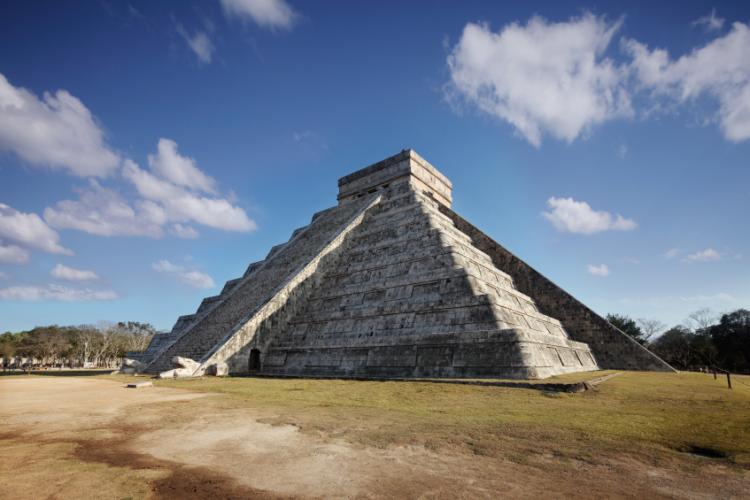
The Snake of Sunlight, main pyramid, Chichen Itza, Yucatan, Mexico
(CostinT from Timeanddate.com)
China and Vietnam celebrate the Mid-Autumn Festival, also known as the Moon or Mooncake Festival, held within 15 days of the Autumnal equinox, during the full moon of early September to early October (Chinese 8th month). Mooncakes are round pastries filled with red bean or lotus seed paste, sometimes containing yolks from salted duck eggs. This is basically a harvest and thanksgiving festival. India has dozens of harvest festivals, not all in autumn. Iran celebrates Mehrgan on October 2 (Gregorian Calendar), a modern form of an ancient Persian Zoroastrian harvest feast. Bavaria’s Oktoberfest, held mid-September to early October, dates back only to 1810 and was originally a celebration for the upcoming marriage of Crown Prince Ludvig (later Ludvig I, the Mad King of Bavaria) to Princess Therese of Saxe-Hildburghausen. Canadian Thanksgiving always falls on the 2nd Monday of October.
The Celts of Ireland-Britain-France celebrated (and Wiccans still do on Sept. 21st) Mabon, or the Second Harvest when acorns, fallen from the oaks, are planted in fertile soil. It was traditional for a young maiden to cut the last sheaf of harvest wheat. Mabon links – through the usual Christian co-opting of earlier pagan festivals – to Michaelmas, celebrating the slaying of the dragon (aka Lucifer) by Archangel Michael, held on September 29, which signals the official end of the harvest season, and the collecting of the accounts by the Lord of the Manor.
This year we get a special treat – an apocalyptic event on the autumnal equinox. Yes! The world ends yet again. This time around it’s the Apostasy – the Great Falling Away. This event must take place before the Rapture – yes, that rapture – and some Very Wise People, by means of calculations beyond the ken of the likes of us, have determined that this is the date. The apostasy, as best as we here at SMBAS Blog Central can determine, is when sinners reject what little faith they have. The end comes, as you may have expected, by means of a comet plowing into the earth and causing tsunamis and earthquakes. So…eat early and stay out late to watch the comet arrive. [Chuck Almdale]
Interesting Links
TimeandDate.com – September Equinox
TimeandDate.com – Los Angeles sunrise, sunset & day length for Sep. 2015
TimeandDate.com – Day and Night map for September Equinox 2015
Heliophysics – A Universal Science
Los Angeles Equinoxes and solstices from 2010–2020



 SANTA MONICA BAY AUDUBON SOCIETY BLOG