Free email delivery
Please sign up for email delivery in the subscription area to the right.
No salesman will call, at least not from us. Maybe from someone else.
Autumnal Equinox 23 September, 2015, 1:22 AM, PDT
This year we report on that other large object in the sky, known as the sun.

Not a rotting peach, but our Sun – 860,000 miles in diameter, 8 light-minutes away (Alan Friedman ~ 4/22/14, on NASA site)
The next event is the Autumnal Equinox, scheduled in Los Angeles for September 23, 2015 at 1:22 AM PDT (or 0822 UTC – Universal Time Coordinated, if you prefer). Sunrise will be at 6:42 AM, daylight will last 12 hours, 6 minutes, 50 seconds (12:06:50); sunset is at 6:49 PM and nighttime is 11 hours, 53 minutes (rounded). You will note that these periods of day and night are not equal. Day and night will be nearly equal on Sep. 26, with 12:00:32; sunrise is at 6:42 AM, sunset is at 6:42 PM.
Definition of the term
Autumnal: Of or pertaining to Autumn [Latin autumn(us)]
Equinox: When the sun crosses the plane of the earth’s equator [from Latin aequinoctium, the time of equal days and nights].
Equinoctial daytime exceeds nighttime for two reasons
First: Sunrise occurs when the leading (upper) edge of the rising sun first becomes visible above the horizon. Sunset is when the trailing (not the lower) edge drops below the horizon. The width of the sun adds about six minutes of daylight.
Second: Refraction of the sun’s rays by the earth’s atmosphere permits us to see the sun both before it has actually risen and after it has actually set, adding several minutes each to sunrise and sunset.
Seasonal Fluctuation
Because the two equinoxes (vernal and autumnal) mark when the sun crosses the celestial equator (the plane of the earth’s equator projected into space), these are also the only days of the year when the sun rises exactly in the east and sets exactly in the west. The earth’s axis (and equatorial plane) is tilted 23.4° with respect to the plane of the earth’s orbit around the sun. In the northern summer the earth’s

Northern Summer (famous artist – name withheld by request)
north axial pole tilts towards the sun, the sun’s rays have less insulating atmosphere to filter them, and the northern hemisphere warms up. In the northern winter, the north pole tilts

Northern Winter (same famous artist)
away from the sun whose warming rays now must penetrate more atmosphere, and the northern hemisphere cools down. Seasons are opposite south of the equator. The closer you are to the equator, the more equal are day and night, summer and winter, warmth and cold. The temperature extremes of winter and summer are replaced by rainy and dry seasons.

At equinox: right diagram shows view past top of sun towards earth.
Eastern Sunrise, Western Sunset
Throughout the northern winter and spring, the points of sunrise and sunset move farther and farther north. The extremes are the Winter Solstice (around December 21), when the sun rises and sets farthest to the south, and the Summer Solstice (around June 21) when they are farthest to the north. The equinoxes mark the halfway point, when sunrise and sunset are exactly east and west. Well, not exactly.
Using this site, calculating for Santa Monica City Hall (34:00:43° North, -118:29:30° West) on 9/23/15 the sun is exactly at 0° elevation (on the eastern horizon) at 6:43:55 AM, and at 89.71°, slightly north of exactly east. Sunset, when again the sun’s elevation is 0°, is at 6:48:15 PM, and the sun is at 270.04°, again slightly north of exactly west.
If you’ve read this far, you may have noticed that these sunrise and sunset times are a bit slippery, shifting around by 1-2 minutes for what appears to be the same location. The problem is the location isn’t exactly the same. Some locations used are downtown L.A., some are Santa Monica. While both locations have the same clock time, sunrise time changes. Because the earth’s diameter is 24,901 miles, a point on the equator moves 1038 miles per hour, and 17.3 miles per minute. Now invert that. Move 17.3 miles westward from one place, and the sun will rise 1 minute later. Of course, the speed of rotation declines as you move towards the poles; exactly at the poles you don’t move eastward at all. Rotational speed calculations get complicated, but the bottom line is that the sun does rise and set later in Santa Monica than it does in downtown L.A.
So make sure you run outside at 1:22 AM – or thereabouts – on September 23 to witness the autumnal equinox, despite the fact that at that very moment the sun will be undergoing a total eclipse by the earth (aka nighttime), so there really won’t be much to look at for anyone in California. It will be quiet. Probably. By the way – the sun doesn’t rise and set. The earth revolves on its axis. But you knew that.
Autumnal Festivals
The farther one lives from the equator, the more noticeable are seasonal variations in daylight and warmth, and the more important seasonal events such as autumnal festivals become. Most autumn festivals are closely linked to the harvest of crops.
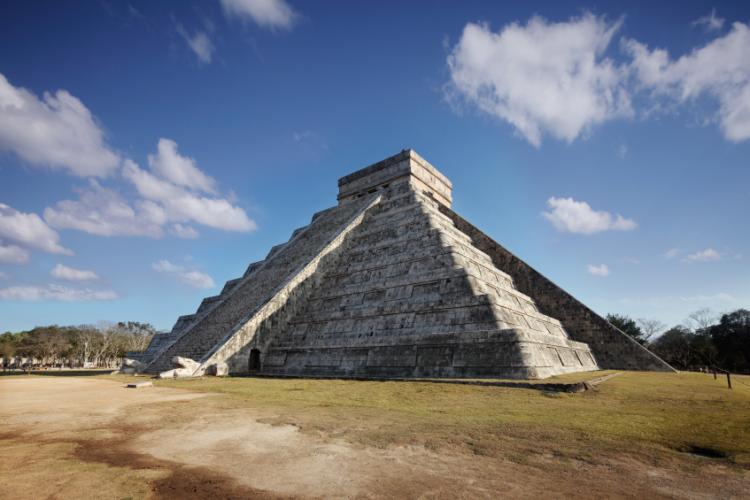
The Snake of Sunlight, main pyramid, Chichen Itza, Yucatan, Mexico
(CostinT from Timeanddate.com)
China and Vietnam celebrate the Mid-Autumn Festival, also known as the Moon or Mooncake Festival, held within 15 days of the Autumnal equinox, during the full moon of early September to early October (Chinese 8th month). Mooncakes are round pastries filled with red bean or lotus seed paste, sometimes containing yolks from salted duck eggs. This is basically a harvest and thanksgiving festival. India has dozens of harvest festivals, not all in autumn. Iran celebrates Mehrgan on October 2 (Gregorian Calendar), a modern form of an ancient Persian Zoroastrian harvest feast. Bavaria’s Oktoberfest, held mid-September to early October, dates back only to 1810 and was originally a celebration for the upcoming marriage of Crown Prince Ludvig (later Ludvig I, the Mad King of Bavaria) to Princess Therese of Saxe-Hildburghausen. Canadian Thanksgiving always falls on the 2nd Monday of October.
The Celts of Ireland-Britain-France celebrated (and Wiccans still do on Sept. 21st) Mabon, or the Second Harvest when acorns, fallen from the oaks, are planted in fertile soil. It was traditional for a young maiden to cut the last sheaf of harvest wheat. Mabon links – through the usual Christian co-opting of earlier pagan festivals – to Michaelmas, celebrating the slaying of the dragon (aka Lucifer) by Archangel Michael, held on September 29, which signals the official end of the harvest season, and the collecting of the accounts by the Lord of the Manor.
This year we get a special treat – an apocalyptic event on the autumnal equinox. Yes! The world ends yet again. This time around it’s the Apostasy – the Great Falling Away. This event must take place before the Rapture – yes, that rapture – and some Very Wise People, by means of calculations beyond the ken of the likes of us, have determined that this is the date. The apostasy, as best as we here at SMBAS Blog Central can determine, is when sinners reject what little faith they have. The end comes, as you may have expected, by means of a comet plowing into the earth and causing tsunamis and earthquakes. So…eat early and stay out late to watch the comet arrive. [Chuck Almdale]
Interesting Links
TimeandDate.com – September Equinox
TimeandDate.com – Los Angeles sunrise, sunset & day length for Sep. 2015
TimeandDate.com – Day and Night map for September Equinox 2015
Heliophysics – A Universal Science
Los Angeles Equinoxes and solstices from 2010–2020
Los Angeles River Field trip report for 12 September, 2015

Semi-palmated Plovers 9/12/2015 Joyce Waterman
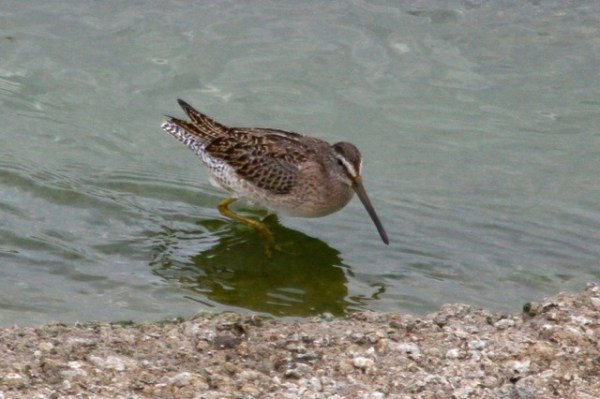
Short-billed Dowitcher (1st year) 9/12/2015 Joyce Waterman
Canada Goose
Mallard
Northern Shoveler
Green-winged Teal
Blue-winged Teal
Cinnamon Teal
Canvasback
Ruddy Duck
Pied-billed Grebe
Double-Crested Cormorant
Great Egret
Green Heron
Snowy Egret
Black-crowned Night-Heron
White-faced Ibis
Turkey Vulture
Osprey
Cooper’s Hawk
Red-tailed Hawk
Semi-palmated Plover
Killdeer
American Avocet
Black-necked Stilt
Willet
Spotted Sandpiper
Lesser Yellowlegs
Greater Yellowlegs
Western Sandpiper
Least Sandpiper
Baird’s Sandpiper
Pectoral Sandpiper
Short-billed Dowitcher
Long-billed Dowitcher
Ring-billed Gull
California Gull
Western Gull
Rock Pigeon
Eurasian Collared-Dove
Mourning Dove
Yellow-chevroned Parakeet
Vaux’s Swift
Anna’s Hummingbird
Belted Kingfisher
Gray Flycatcher
Black Phoebe
Warbling Vireo
AmericanCrow
Barn Swallow
Bushtit
House Wren
Northern Mockingbird
European Starling
Orange-crowned Warbler
Yellow Warbler
Black-throated Gray Warbler
Wilson’s Warbler
Western Tanager
California Towhee
Black-headed Grosbeak
Red-winged Blackbird
Yellow-headed Blackbird
Brown-headed Cowbird
Hooded Oriole
House Finch
Lesser Goldfinch
Northern Red Bishop
Scaly-breasted Munia
Seven Swans a-Swimming
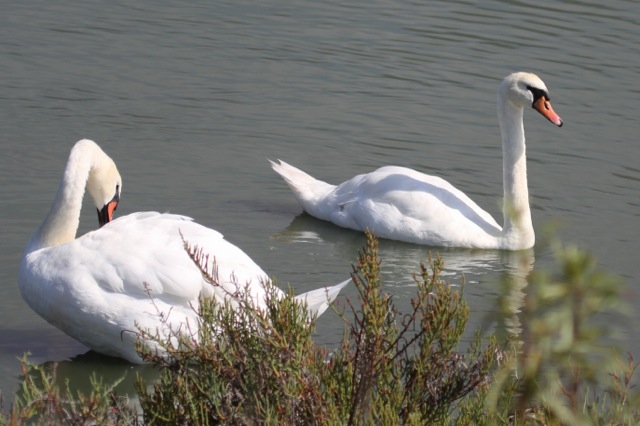
Mute Swan pair – Malibu Lagoon (Joyce Waterman 8/23/15)
Local birders were surprised when two Mute Swans appeared at Malibu Lagoon on July 31st , 2015, and were still there September 6. They rest primarily on sand islands in the channel, but can be seen swimming anywhere in the lagoon or channel, rarely far apart. A local Malibuite told me they had first been seen next to Pacific Coast Highway, and the female had been dinged by a car. She was only slightly bruised, and the pair were reunited and taken to the lagoon. They both have full sets of flight feathers; neither had any bands or tags. Locals are already calling them Romeo & Juliet; one added: “In England they are protected by the Queen.” If any readers know any more about the origin of this pair, please send it to me & I’ll update this post.
Late-breaking local swan information, as promised: Mute Swans live on Lake Sherwood and Westlake Lake. Their populations fluctuate and swans may shift between the two lakes. On Westlake Lake up to 17 swans have been seen at one time; this summer one pair had 5 cygnets. Swan families have been seen on Lake Sherwood, where birds can be quite defensive of their territories. Water levels of both lakes are significantly lower due to drought, numbers of swans are down, and a pair may have fled downstream to Malibu.
[Reported by Jeri Edwards]
Swans of any species are fairly scarce in Southern California, so here’s a bit of swan lore.
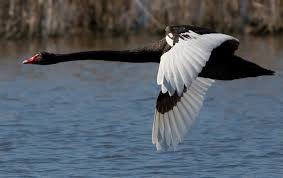
Black Swan – Tasmania, Australia (J.J. Harrison – Sep 2008)
There are truly seven swan species in the world. and a-swimming they all go. Of the seven, only Trumpeter and Tundra Swans are native to North America. Tundra Swans are regular winter visitors to Klamath and Tule Lake refuges on the Oregon-California border, as are a few Trumpeters and, very occasionally, a Whooper or Bewick’s (Eurasian race of the Tundra) appear. A small number of Tundra winter in the Sacramento Valley refuges, especially near Colusa. Tundra Swan is an occasional winter visitor to SoCal, but there are only a few SoCal records for Trumpeter. A few winters ago, when several Tundra Swans spent a few weeks at a small pond near the Antelope Valley Poppy Preserve, many L.A. birders drove out to see them. In general, swans form pair bonds at age 2 – 4, begin nesting at age 4 – 5, mate for life but will remate if the partner dies, and live for 15 – 30 years.
Swan Trivia: The Whooper Swan is the national bird of Finland, the Mute Swan is the national bird of Denmark, and the Black Swan is the state bird of Western Australia. The phylogeny of the Coscoroba Swan is still uncertain: some scientists think it is most closely related to the whistling ducks, but recent evidence suggests that it is most closely related to the Cape Barren Goose of southern Australia, currently considered the world’s largest goose. In middle Pleistocene times (780,000 – 125,000 years ago) the Giant Swan Cygnus falconeri lived in Sicily & Malta. Up to 83 in. long, it was about 1/3rd larger than the Mute Swan, taller than the dwarf elephants then living there, and may have been flightless.
For more on all swan species see:
The Regal Swan Foundation – The Seven Species of Swan
The Swan Sanctuary
The Beauty of Birds – Swans
The Trumpeter Swan Society
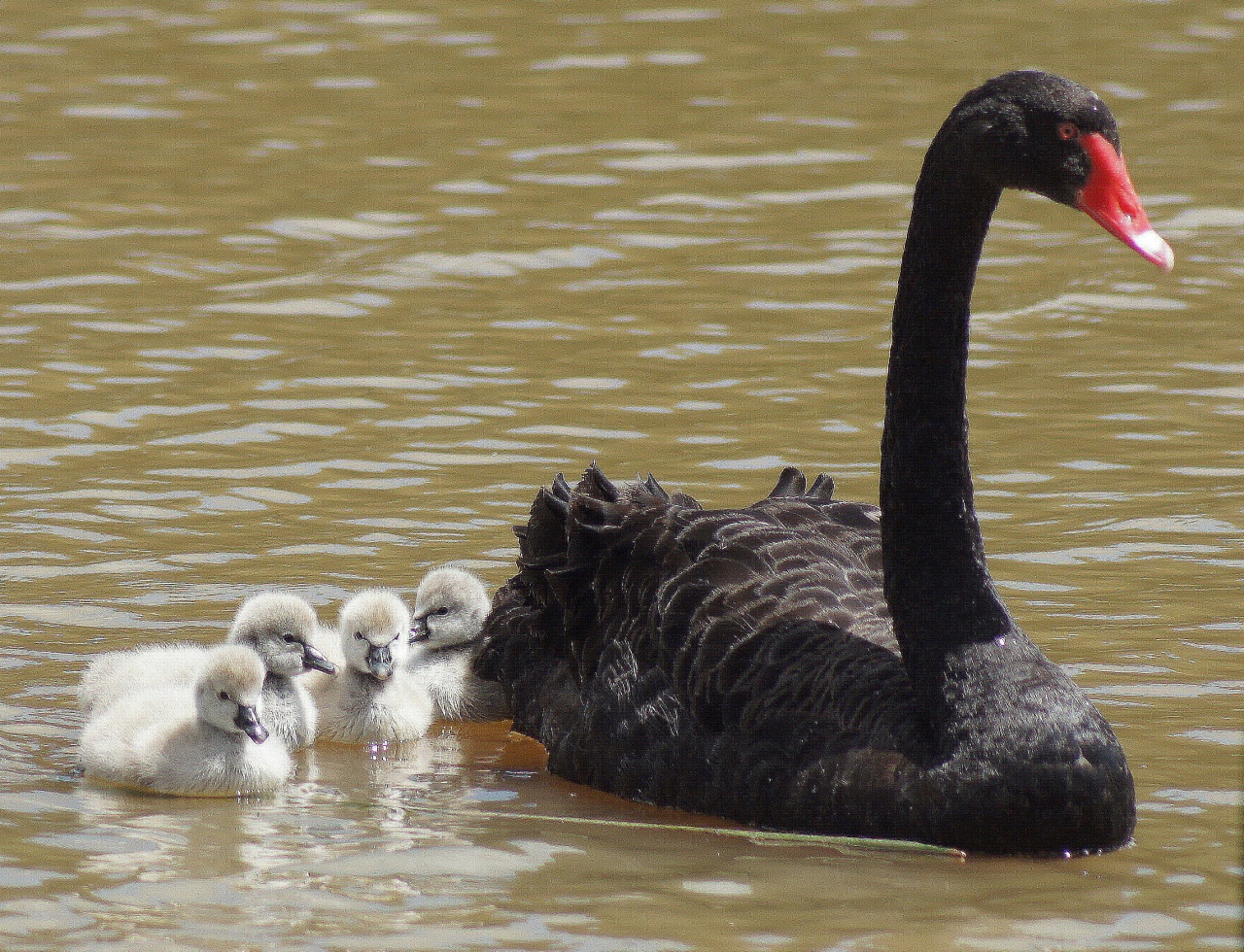
Black Swan, white cygnets – Melbourne, Australia (“Araminta” – 2012)
| English | Scientific | Wing- | Pop | Ave age | |||
| Name | Name | Weight | span | Length | 1,000’s | (Oldest) | Range |
| Mute | Cygnus olor | 14 – 33 | 79-95 | 49-63 | 600 | 21 (70) | Cent. Eurasia |
| Black | C. atratus | 8 – 19 | 63-79 | 43-56 | 10-100 | 20 (40) | Australia-N.Z. |
| Black-necked | C. melanocorypha | 8 – 15 | 53-70 | 40-49 | 90 | 15 (20) | S. So. Amer. |
| Trumpeter | C. buccinator | 16 – 28 | 79-95 | 59-71 | 50 | 24 (32) | US-Canada |
| Tundra (Whistling) |
C. columbianus | 9 – 21 | 66-84 | 47-59 | 300 | 15 (19) | Eurasia, U.S.-Can |
| Tundra (Bewick’s) | C.c.bewickii | 7 – 17 | 66-77 | 45-55 | 37 | 24 (32) | No. Eurasia |
| Whooper | C. cygnus | 16 – 28 | 80-108 | 57-65 | 180 | 16 (28) | No. Eurasia |
| Coscoroba | Coscoroba coscoroba | 7 – 12 | 61-62 | 35-45 | 13 | 20 (36) | S. So. Amer. |
Note: The variety of answers and ranges available on the web for the above categories is astounding. The Trumpeter Swan’s maximum wing span, for example, ranged from 5 ft. to over 10 ft. Sources for the above data include: Cornell’s All About Birds, Birdlife Int’l, Wikipedia, Handbook of Birds of the World, and Audubon Society Encyclopedia of North American Birds.
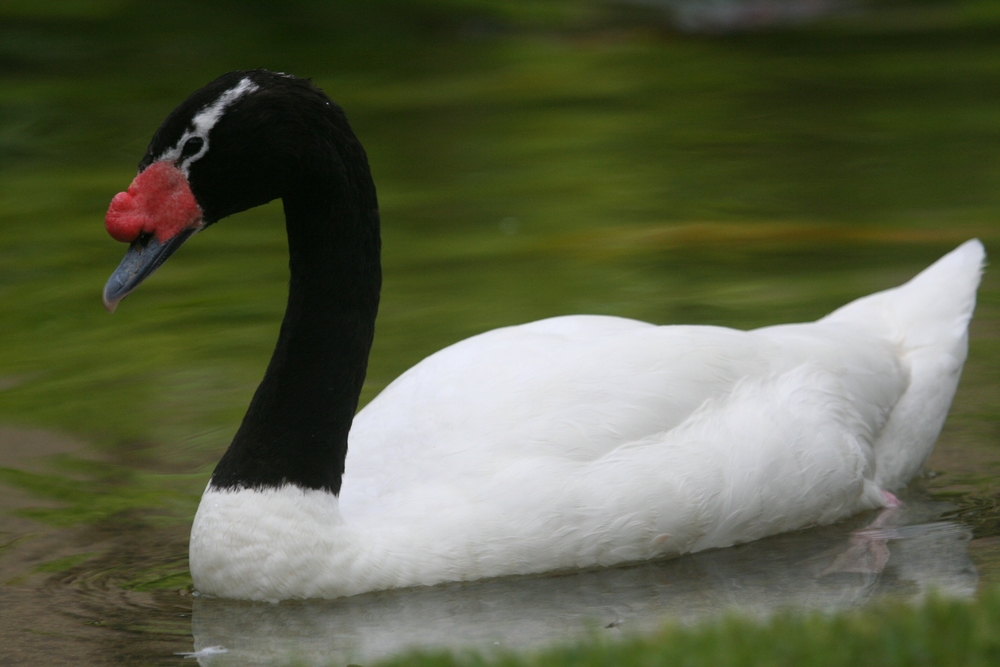
Black-necked Swan – So. South America (David Albeck – Dec 2012)
Mute Swans in North America are primarily domestic or feral birds, kept in private wildfowl collections or living in park ponds. Bird keepers commonly clip their bird’s primaries so they can’t fly away, but the large number of feral and escapee birds in our cities attest to how often they get away anyway. Sizable feral populations of Mute Swan exist along the east coast from Maryland to SE Maine, especially in Connecticut, in the Great Lakes – especially Traverse Bay, Mich., and a small population recently established itself on SE Vancouver Island.
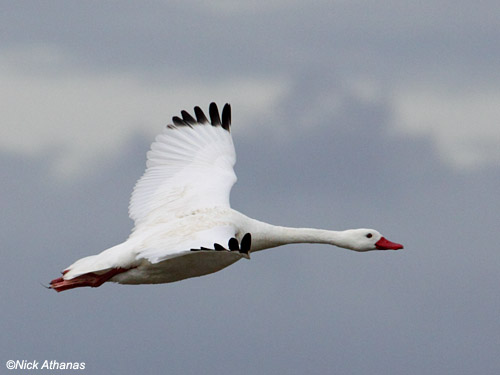
Coscoroba Swan flying (Nick Athanas – Planet of Birds.com)
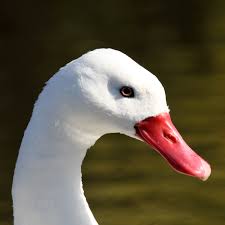
Coscoroba Swan
So. South America
(Ken Billington 9/10/09)
As lovely as Mute Swans are, with their all-white plumage, graceful S-curved neck, and orange bill – often down-turned – with black edging and a bump, they are considered a pest as they are aggressive, often driving other wildfowl from their nesting and feeding territories. Concerted attempts are being made to eradicate them from the Great Lakes region.
Scientifically, the Mute Swan is Cygnus olor: Cygnus is simply the Latin name for “swan”, and derives from kuknos, the Greek name for “swan.” Olor is Latin for, again, “a swan,” and is the word used by Roman naturalist Pliny. According to R.D. MacLeod, olor “appears to be of Celtic origin.” So it’s a “swan swan” – perhaps the archetypal swan. [1]
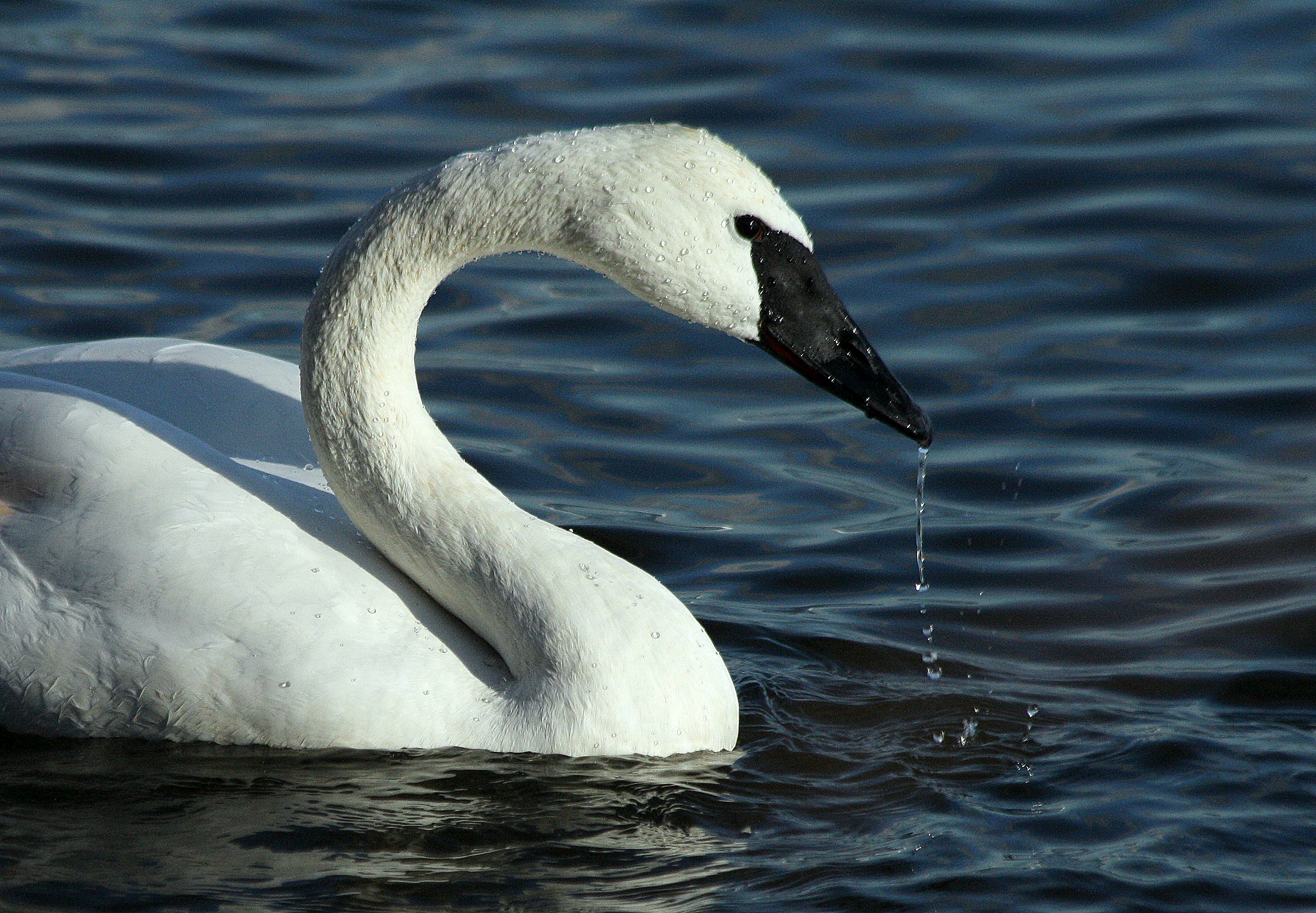
Trumpeter Swan – Burlington, Ontario, Canada (Miriam Bauman – Jan 2012)
The origin of the myth of Cygnus and its placement among the constellations in the northern sky has numerous versions. He was a pet of the Queen Cassiopeia (also a constellation). He was Cionus who, smothered by Achilles in a wrestling match, was saved when his father Neptune turned him into a swan. He was the famous musician Orpheus, murdered by drunken Thracian women, whom Zeus put into the heavens near his harp Lyra. He was Zeus/Jupiter, transformed into a swan in order to seduce Leda, and fathered Pollux (whose twin/half-brother, Castor, was fathered by Queen Leda’s true husband, King Tyndareus of Sparta). The immortal Pollux, grief-stricken when his mortal twin Castor died, asked Zeus to allow Castor to share his immortality, so Zeus turned these two heroes into the constellation Gemini, the Twins. According to Ovid (Metamorphoses II 374-382), Cygnus was a close friend of Phaethon who died while trying to drive the chariot of Sol, the sun god. His own grief transformed him into a swan and, abhorrent of the sun’s fire, he chose to live in damp marshes and rivers. However he got there, the constellation Cygnus contains the Northern Cross asterism, and was one of the original 48 constellations listed by the 2nd-century Greek astronomer/mathematician Ptolomy. See also Wikipedia.
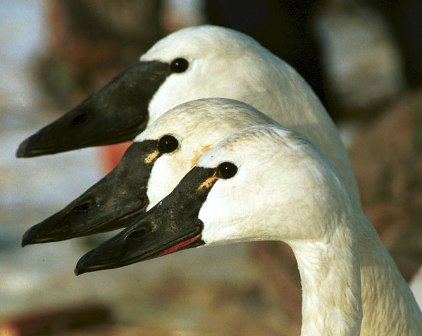
Trumpeter and two Tundra Swans (Swan Paradise.com)
The swan song, Schwanengesang in German, and applied to the final performance or activity of a person’s career, derives from the belief that the Mute Swan sings but once in its life, then immediately dies. This story appears first in Aesop’s Fable, The Swan Mistaken for a Goose: “The swan, who had been caught by mistake instead of the goose, began to sing as a prelude to its own demise. His voice was recognized and the song saved his life.” It later appears in 458 BC in Aeschylus’ Agamemnon. Plato records Socrates saying, only slightly more accurately, that while the swan does sing at other times, its final song is the best. Aristotle claimed they “are musical, and sing chiefly at the approach of death.” By the 3rd century BC, the “swan song” belief was proverbial. In fact, Mute Swans do make weak honking, barking and hissing noises. But a beautiful song as it dies? Sorry…only a myth.
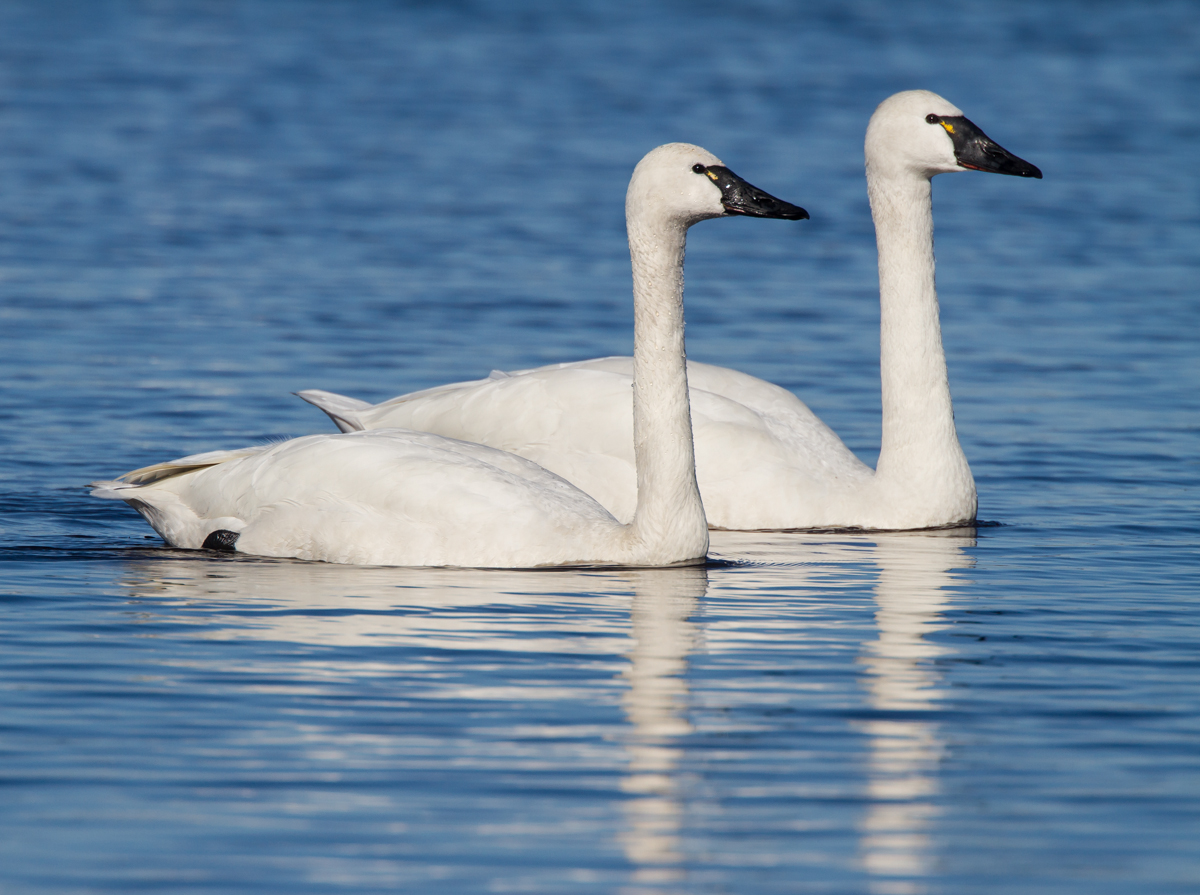
Tundra Swan Pair – Pocosin NWR North Carolina
(Mike – Jan 2014 RoadsEndNaturalist.com)
One of my favorite ballets, primarily because of Tchaikovsky’s music, is Swan Lake. His ballet ends tragically: Prince Siegfried is tricked – much as Wagner’s Siegfried is tricked into rejecting Brünnhilde – into breaking his vow of eternal love for the swan queen Princess Odette (human only at night), dooming her to remain forever a swan. To escape the spell laid upon her by the evil magician Von Rothbart, she chooses to die, the prince chooses to die with her, they drown themselves in the lake but are then reunited eternally in love.
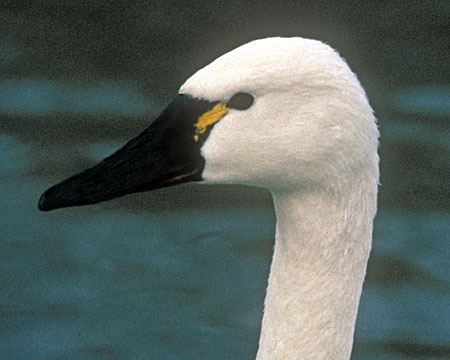
Tundra Swan (Trumpeter Swan Society photo)
Again, the underlying myth has various versions, some happy, some tragic. One version has a hunter stealing the feather robe of a swan maiden as she, temporarily human, bathes. They marry, but when the robe is found and brought to her, she dons it and flies away. The husband searches for her the world over, finally finds her in the land “east o’ the sun, west o’ the moon” and they live happily ever after. This is one form of the innumerable were-animal tales found around the world. Every culture creates their own versions utilizing their own local wildlife: North Atlantic peoples have selkie (seal-people) stories, Greeks had centaurs (horse-people), Inuit have bear-people, Asians have tiger-people.
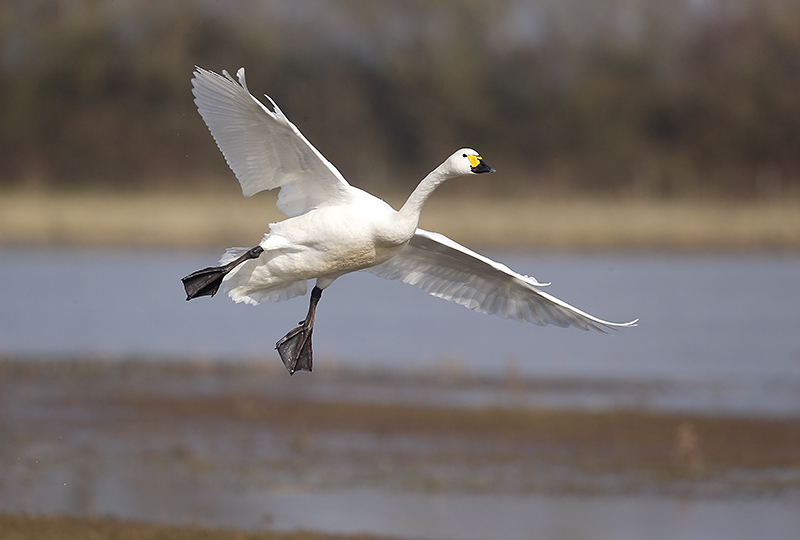
Bewick’s swan – Slimbridge, Gloucestershire, Great Britain
(Mike Lane – Feb 2013)
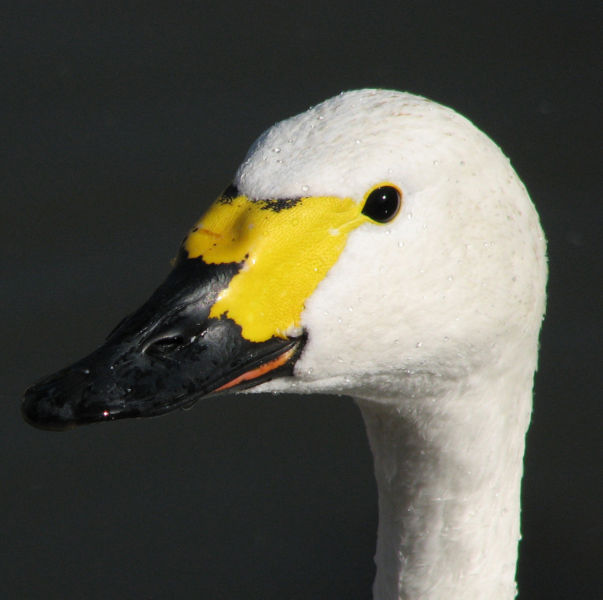
Bewick’s race of Tundra Swan
(Photographer’s Resource)
Mute Swan vies with Trumpeter Swan as the “largest” waterfowl in the world. Some sources say Trumpeter wingspans can exceed 10 feet while Mute gets to about 8 feet. The Mute is certainly the heaviest, regularly ranging from 14 to 33 lbs, but birds weighing up to 50 lbs. have been found. As with all swan species, they rarely dive, but feed by plunging their head and neck under the water’s surface, sometimes tipping up their rear to pull up aquatic plants. Sometimes their head and neck become stained rusty brown from iron in the water or mud. [2]
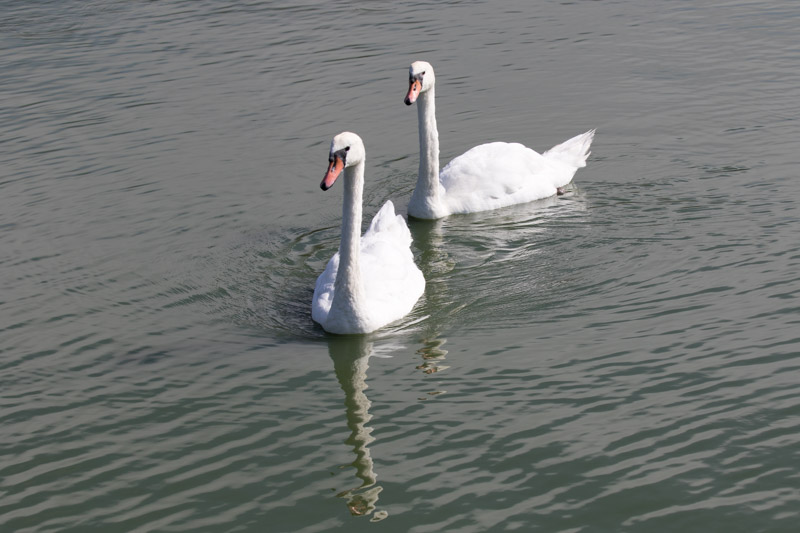
Swimming Mute Swan pair – Malibu Lagoon (Randy Ehler 8/23/15)
The pair maintains a large territory, often an entire pond or small lake, although in some locales such as Abbotsbury Swannery in southern England, they nest in colonies. The nest is a large pile of aquatic vegetation and sticks, lined with feathers and down, located on a small island or embankment. They vigorously defend the nest against all intruders, including dogs and humans, and they can be dangerous. 4-6 gray or blue-green eggs are laid and incubated an average of 35 days, usually solely by the female, with the male protecting her and and replacing her when she forages for food. The light-gray downy precocial chicks stay in the nest for one day before they are taken to water. Often the male takes the first cygnet to hatch to water, while the female continues to incubate the rest of the eggs. Chicks often ride on the parent’s back or under their wings. First flight can occur 100 – 155 days after hatching. Both male and female adults have a black knob at the base of the bill. During the breeding season the male’s knob swells, becoming noticeably larger than the female’s. Outside of breeding season, the knobs are little different.[2]
Chicks of the white (or “Polish”) morph are born all-white, rather than the usual gray (or “Royal”), and the adults may have pink or gray feet and legs, rather than the “Royal’s” black. These swans were imported around 1800 into London from the Baltic Sea coast of Poland. Thought at the time to be a distinct species, they were given the scientific name Cygnus immutabilis (changeless swan). [3]
Although they are widely introduced around the world, their native nesting range is from Great Britain, across Europe and central Asia to at least Lake Baikal. Their wintering range includes north Africa, the Near East, NW India and Korea. Well over half of the estimated 600,000 world population of Mute Swan nest in areas of the former Soviet Union.

Mute Swan breeding range (Planet of Birds.com)
Due to their fragility, bird bones neither fossilize well nor remain intact, but parts of Mute Swan bones have been found in Ireland, England, France, Portugal and Italy, dating to about 6000 years old in England and 13,000 years old in France. Fragments have been found in the western U.S. which belong to either mute swans or allied ancestors. Most sources say Mute Swans were introduced to the U.S. in the mid-1800’s in the vicinity of Long Island and the lower Hudson river, the area where most Mute Swans are still found. A large feral population lives on the coast of Connecticut and can be seen swimming in Long Island Sound. A Delaware population of about 40 birds are the recent result of a few captive birds escaping and breeding. Many states have proposed programs to cull or extirpate Mute Swans, and even more groups have sprung up to thwart such plans and protect the swans.
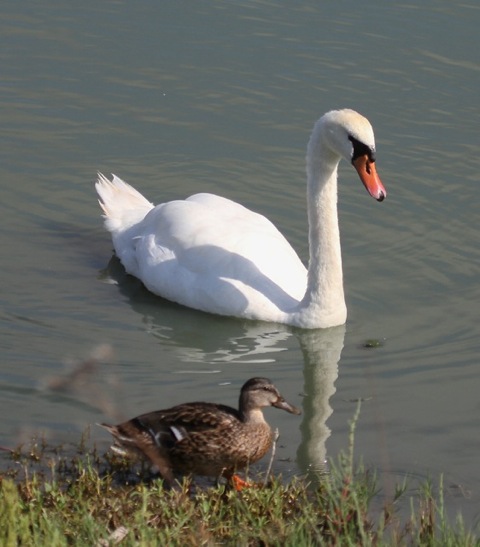
Mute swan, Mallard female – Malibu Lagoon (Joyce Waterman 8/23/15)
Some people hold that Mute Swans are actually circumpolar birds (as are many other wildfowl) and have long appeared in small numbers in North America, flying over from east Asia, accompanying the regularly migrating Tundra Swans. This might explain the old bones found in western U.S. states, especially at Fossil Lake, Oregon, including a recent find in the SE California desert of Anza-Borrego. If only for this reason alone, they say, Mute Swans should be considered native birds and harassment of them should stop.
Here’s three interesting articles on this viewpoint:
The Origins of the Mute Swan and How They Came to be in America
Mute Swans May Have Russian, not English Accents
Birds of Eden – The Mute Swan
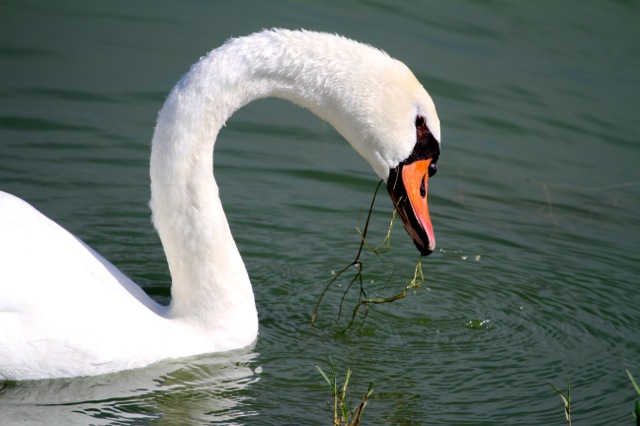
Mute swan, feeding – Malibu Lagoon (Joyce Waterman 8/23/15)
We don’t know the origin of these two swans (and please don’t write in to suggest “eggs”). Fellow birder Aurelio Albaisa reported that a pair residing for several years at Lake Balboa have now disappeared. They were flight-capable and one had a blue band on its right leg.
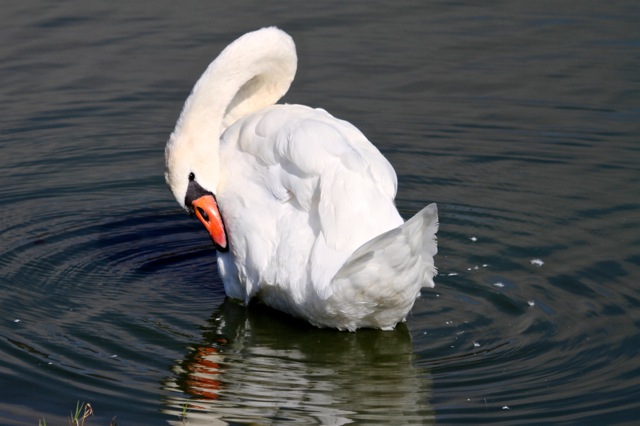
Mute swan, preening – Malibu Lagoon (Joyce Waterman 8/23/15)
Whatever your view on Mute Swans, they are lovely birds. I hope you visit them at Malibu Lagoon before someone decides to remove them or they choose to fly away.
[Chuck Almdale]
Mute Swan pair – Malibu Lagoon (Joyce Waterman 8/23/15)
Notes:
[1] [Dictionary of American Bird Names, Choate Ernest A.; 1985; Boston, MA; Harvard Common Press
[2] Audubon Society Encyclopedia of North American Birds, Terres, John K., Ed.; 1980; New York, Alfred A. Knopf
[3] Cornell’s All About Birds – Mute Swan http://www.allaboutbirds.org/guide/Mute_Swan/lifehistory
Links and credits to photos (in order of appearance)
Mute Swan Pair – Joyce Waterman 8/23/15 – Malibu Lagoon, Malibu, California
Black Swan flying J.J. Harrison 9/11/08 – Tasmania, Australia
Black Swan with white cygnets “Araminta” – 2012 – Melbourne, Australia
Black-necked Swan David Albeck – Dec 2012
Coscoroba Swan flying Nick Athanas – Planet of Birds.com
Coscoroba Swan head Ken Billington 9/10/09
Trumpeter Swan Miriam Bauman – Jan 2012 – Burlington, Ontario, Canada
Trumpeter and two Tundra Swans – heads – Photographer Unknown Swan Paradise.com
Tundra Swan Pair – Pungo Lake, Pocosin NWR 1/15/14 Mike at RoadsEndNaturalist.com
Tundra Swan – Photographer Unknown Trumpeter Swan Society photo
Bewick’s Swan landing Mike Lane – Slimbridge, Gloucestershire, Feb 2013
Bewick’s Swan head Photographer’s Resource
Mute Swan Pair Swimming – Randy Ehler 8/23/15 – Malibu Lagoon, Malibu, California
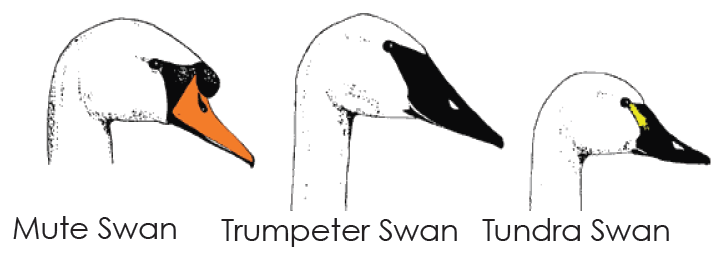
Mute, Trumpeter & Tundra Swan head comparison
North Carolina Wildlife Resources Commission / Trumpeter Swan Society
Mute Swan Breeding Range Map Planet of Birds.com)
Mute Swan and Mallard – Joyce Waterman 8/23/15 – Malibu Lagoon, Malibu, California
Mute Swan Feeding – Joyce Waterman 8/23/15 – Malibu Lagoon, Malibu, California
Mute Swan Preening – Joyce Waterman 8/23/15 – Malibu Lagoon, Malibu, California
Mute Swan Pair – Joyce Waterman 8/23/15 – Malibu Lagoon, Malibu, California
Does this make it eOfficial?
For those interested in the preservation of one of our favorite critters, the (USFW) threatened Western Snowy Plover, please gaze on the latest version of Google maps/earth of the Santa Monica State Beach north:
Warning Calls Decoded: Squirrels Take Up Bird Alarms To Foil The Enemy
Alert blog reader Nadia Albright sent us this link which she found on the NPR iPhone App, but any computer can tune into it.
In the NPR Weekly series:
Close Listening: Decoding Nature Through Sound, Morning Edition
the latest installment (9/3/15) is:
Warning Calls Decoded: Squirrels Take Up Bird Alarms To Foil The Enemy by Christopher Joyce
The series is profiling scientists who explore the natural world by listening to it. This particular installment features an interview with, among others, the late Ted Parker,

Ted Parker in Guyana
(Haroldo Castro, Conservation International – Cornell Labs Website)
who probably had the most extraordinary ear ever in the world of birding, able to identify (I have read) over 10,000 different songs and calls by ear. I didn’t know this, but he was also instrumental in developing the technique of recording singing birds, playing their song back at them, causing the singer to come and find their new competitor, and using this reaction to map the outline of the singer’s territory. They discuss “mobbing” calls birds use and have discovered that squirrels understand and use them as well.
Close listening NPR series Click
Squirrels take up Bird Alarms… Click
Thanks for the heads-up, Nadia.
[Chuck Almdale]



 SANTA MONICA BAY AUDUBON SOCIETY BLOG