Free email delivery
Please sign up for email delivery in the subscription area to the right.
No salesman will call, at least not from us. Maybe from someone else.
Find the hidden animals
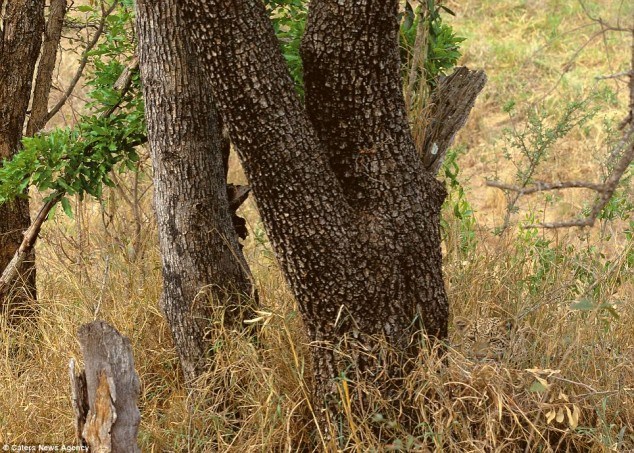
A large part of enjoying nature is seeing what is actually there. Sometimes you find something already looking back at you. See if you can spot the leopard in the photo below.
At 22 words.com there’s a bunch more of these, using photos by Art Wolfe. Check it out and have fun. [Chuck Almdale]
Water-conserving rain barrels, nearly free!
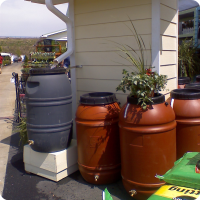
Typical Rain Barrels Int’l products
If you’re trying to save water for your garden or lawn, this is a great deal that comes up every once in a while. You buy rain barrels at a reduced rate, you install them at your house. Often a local official comes to check that you have installed them. In some towns such as Santa Monica, you must annually confirm your continued use of the barrels.
The really good part is that a week or two after you have installed the barrels, you get reimbursed the cost up to $100/barrel, 4 barrels maximum, for your expense! I installed three barrels three years ago and I haven’t used municipal water since then for my numerous potted plants. It also provides enough water for my compost box most years.
You will probably have to do a little modification on some of your roof /gutter downspouts, but I bet you’ll be surprised how much fog drip you will also collect in the non-rainy season.
The barrels cost $94-139 if bought from their website, the same price range as nearly every other rain barrel outlet. But you can pre-order and pre-pay $85 each for them and pick them up at one of their “events.” This must be done no later than the Wednesday prior to the event you’d like to attend. If they have extra barrels on hand, they bring them to the event. The event gives you all the information you need to start saving water.
Here is the link to their events:
Rain Barrels Int’l: http://www.rainbarrelsintl.com/events.asp
Their next event in the Santa Monica area is Sat., 11/7/15, 12-1:30 PM, at the Tree People HQ, 12601 Mulholland Dr., on the valley side (north) of Mulholland at Franklin Canyon Drive. If you want to get some rain barrels at this event, you must prepay no later than Weds. 11/04. Directions!
[NOTE from Chuck Almdale] We picked up 4 terra-cotta colored 58-gallon rain barrels on 10/24/15 at the Tree People “event.” They distributed the barrels, gave out some informative fliers and off we went. There was no slide-show presentation.
Rain Barrels Int’l describes their barrels as follows:
All of the barrels we use are recycled food grade barrels we purchase before they are disposed of into landfills. It is a WIN – WIN situation all the way around. Please help our environment by not only saving water, but by keeping these barrels out of landfills.
Specifications
- Dimensions vary slightly – approximately 40″ tall with 23″ diameter
- 55 + gallon capacity (some barrels slightly larger)
- Brass ¾” spigot for garden hose attachment
- Screen on top to prevent mosquitoes from accessing water
- Side brass overflow where a hose can be attached
- Made from recycled plastic food grade barrels
- Barrels retail in stores for $94.00 to $139.00
Thank you to Grace M. for the alert
[Lu Plauzoles & Chuck Almdale]
Red-hot Egrets: Bolsa Chica report, 10 October, 2015
Mad Dogs, crazy people and birders go out in triple digit sun, as we did at Bolsa Chica. We wore big hats and watched birds (particularly cormorants, herons and egrets) do gular fluttering and others panting. Hot! Our group started with good intentions, but by the end were down to less than half – all oblivious birders – who were trying to find one more bird!
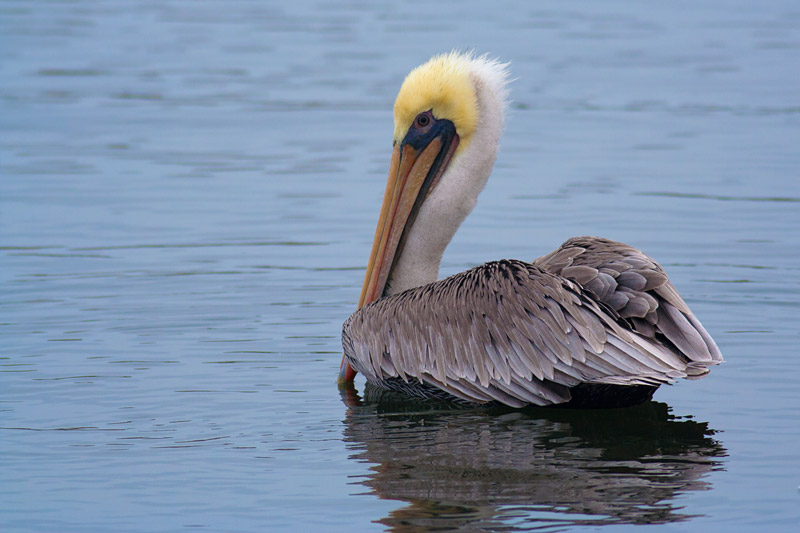
Brown Pelican in winter (basic) plumage (Kirsten Wahlquist 10/11/14)
Bolsa Chica** is an Ecological Reserve in Orange County, separated from the beach by Pacific Coast Highway. Our first exciting bird (not that the kamikaze diving pelicans and terns were not exciting) was a Ridgway’s Rail which emerged from under the bridge,

A new species for California – Ridgway’s Rail!!! (formerly known as Clapper Rail)
(Kirsten Wahlquist 10/11/14)
wandered through the pickle weed and went south. We saw lots of Dowitchers bringing up the old question “Short-billed or Long-billed?” (we concluded both), Willets, Sparrows mostly variations of Savannah: Belding’s, Large-Billed and Common, and assorted other shorebirds, including impressive Long-Billed Curlews.

Belding’s Savannah Sparrow is always found near pickleweed
(Kirsten Wahlquist 10/11/14)

Savannah Sparrow – the usual form (R. Hargraves 10/8/11)
One of our favorites, the Reddish Heron, was represented by one adult and one immature (sort of a pastel version of its parent) – neither was “dancing”; they too were enervated by the heat and did not move much. We saw a Great Blue Heron do a Yoga pose – its wings

Great Blue Heron, sunning, cooling, or perhaps downloading from ‘Twitcher’
(C. Almdale 10/10/15)
akimbo – sort of a fountain – very weird – as we said – Hot! Our best bird (well, mine) was a gorgeous Peregrine Falcon who cruised in over our heads and parked on a dead tree in full view of us and vice versa. It kept looking us over as if to see if we were edible.
***More on Bolsa Chica: It could mean “little pocket” or “small purse,” but also “small bag.” On the other hand, Chica is often “girl” or “young woman”, while bolsa can be “bag,” “pocket,” “sack,” “purse,” etc., so it could mean “bag girl“, “pocket girl,” “sack girl.” Isn’t this fun? However, bolsa may also refer to a “market,” while chica is a diminutive adjective, so it could mean “small market.” Then again, it could mean “market girl,” or “young woman of the market.” As markets were usually “street markets”, maybe it means “young woman of the street” who may or may not be marketing something. What could she be marketing? Hmmm….Best to leave it there.**** 99° by the time we got back to the cars. [Editor]
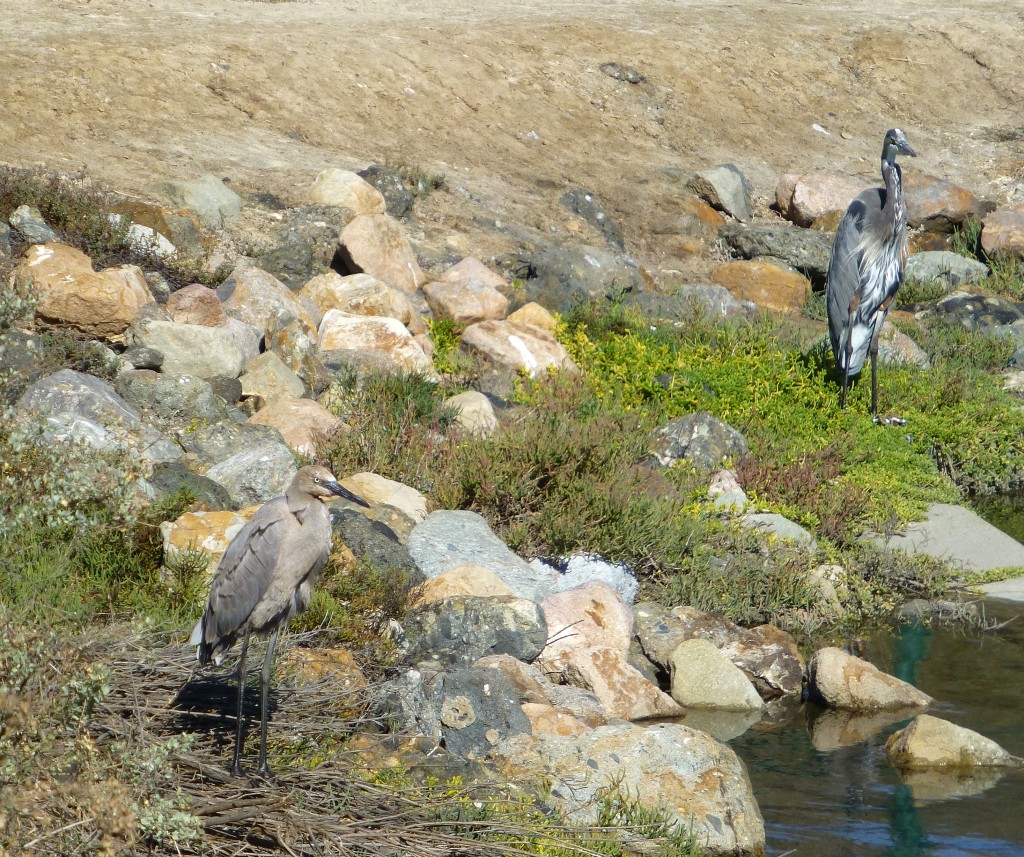
Juvenile Reddish Egret (L) & Great Blue Heron (R) (C. Almdale 10/10/15)
| Bolsa Chica Reserve | 10/10 | 10/11 | 10/12 | 10/6 |
| Trip List | 2015 | 2014 | 2013 | 2012 |
| Brant | X | X | ||
| American Wigeon | X | X | X | |
| Mallard | X | X | ||
| Blue-winged Teal | X | X | ||
| Cinnamon Teal | X | X | ||
| Northern Shoveler | X | X | ||
| Northern Pintail | X | X | ||
| Green-winged Teal | X | X | ||
| Redhead | X | |||
| Lesser Scaup | X | X | ||
| Ruddy Duck | X | X | X | X |
| Pied-billed Grebe | X | X | X | X |
| Eared Grebe | X | X | X | X |
| Western Grebe | X | X | ||
| Brandt’s Cormorant | X | |||
| Double-crested Cormorant | X | X | X | |
| American White Pelican | X | X | X | X |
| Brown Pelican | X | X | X | X |
| Great Blue Heron | X | X | X | X |
| Great Egret | X | X | X | X |
| Snowy Egret | X | X | X | X |
| Reddish Egret | X | X | X | X |
| Green Heron | X | |||
| Black-crowned Night Heron | X | X | X | |
| White-faced Ibis | X | |||
| Turkey Vulture | X | X | X | X |
| Osprey | X | X | X | X |
| White-tailed Kite | X | X | ||
| Northern Harrier | X | X | X | X |
| Red-tailed Hawk | X | X | ||
| Ridgway’s Rail | X | X | ||
| American Coot | X | X | X | X |
| Black-necked Stilt | X | |||
| American Avocet | X | |||
| Black-bellied Plover | X | X | X | X |
| Semipalmated Plover | X | X | ||
| Killdeer | X | X | X | |
| Greater Yellowlegs | X | X | ||
| Willet | X | X | X | X |
| Lesser Yellowlegs | X | |||
| Whimbrel | X | X | X | |
| Long-billed Curlew | X | X | X | X |
| Marbled Godwit | X | X | X | X |
| Ruddy Turnstone | X | X | X | |
| Red Knot | X | X | ||
| Sanderling | X | X | ||
| Western Sandpiper | X | X | X | X |
| Least Sandpiper | X | X | X | X |
| Dunlin | X | X | ||
| Short-billed Dowitcher | X | X | X | X |
| Long-billed Dowitcher | X | |||
| Ring-billed Gull | X | X | X | |
| Western Gull | X | X | X | X |
| California Gull | X | X | ||
| Black Tern | X | |||
| Forster’s Tern | X | X | X | X |
| Royal Tern | X | |||
| Elegant Tern | X | X | X | X |
| Rock Pigeon | X | X | X | X |
| Mourning Dove | X | X | X | |
| Anna’s Hummingbird | X | |||
| Allen’s Hummingbird | X | X | ||
| Belted Kingfisher | X | X | X | X |
| Nuttall’s Woodpecker | X | |||
| Downy Woodpecker | X | |||
| American Kestrel | X | X | X | |
| Peregrine Falcon | X | X | ||
| Black Phoebe | X | X | X | X |
| Say’s Phoebe | X | X | X | X |
| Loggerhead Shrike | X | |||
| American Crow | X | X | X | |
| Bushtit | X | |||
| House Wren | X | X | X | |
| European Starling | X | X | X | |
| American Pipit | X | |||
| Common Yellowthroat | X | X | X | X |
| Yellow-rumped Warbler | X | X | ||
| California Towhee | X | X | ||
| Savannah (Belding’s) Sparrow | X | X | X | |
| Savannah (Large-billed) Sparrow | X | |||
| Savannah Sparrow | X | X | X | X |
| Song Sparrow | X | X | ||
| White-Crowned Sparrow | X | X | X | X |
| House Finch | X | X | X | X |
| Pine Siskin | X | |||
| Total Species – 83 | 60 | 44 | 50 | 69 |
ICYMI: In case you missed it: SHOREBIRDS

ASSOCIATED PRESS: September 30, 2015
CALIFORNIA SHOREBIRDS STARVING
Malnourished seabirds have been appearing across the state in alarming numbers, some shrunken to little more than feather and bone. Many of the thin-billed species are being brought into the International Bird Rescue Center, which says it is taking in the birds at the highest rates in 18 years. The murres’ presence is significant to scientists because they are considered a marker species. That means their movements and numbers signal changes in the ocean’s food supply.
Malibu Lagoon Trip Report: 27 September, 2015

Sanderlings are often misidentified as their roostmates Snowy Plover (R. Ehler 9/27/15)
The big surprise of the day was the really high tide, caused by the blood-red superharvestmoon lunar eclipse. About 2/3rds of the beach was gone; even at high tide rocks showed where we simply don’t see rocks because they are usually covered by sand. A cliff of sand dropped straight into the sea where beach used to be. A footpath now led over the low vegetated hill, and sand was lost to the sea nearly to the Snowy Plover virtual fence.
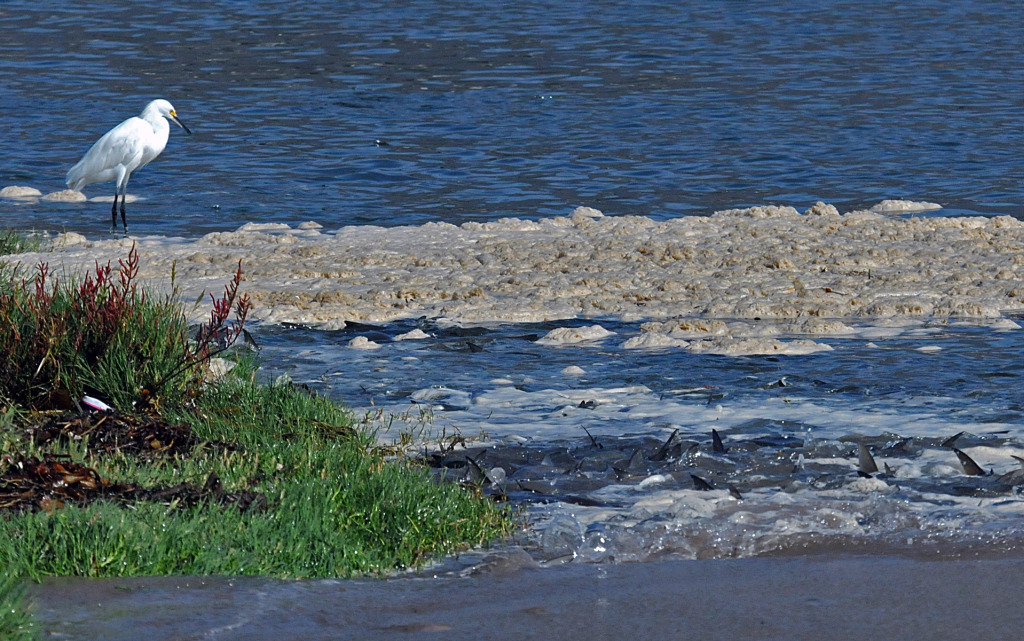
Snowy Egret eyes the mullet, many of whom are larger than the bird
(Jim Kenney 9/28/15)
From a distance we saw waves washing over the beach and into the lagoon, so we dawdled, giving the tide time to subside. High tide at 9:18am was very high at +5.94 ft., but by 10am we were able to pass.
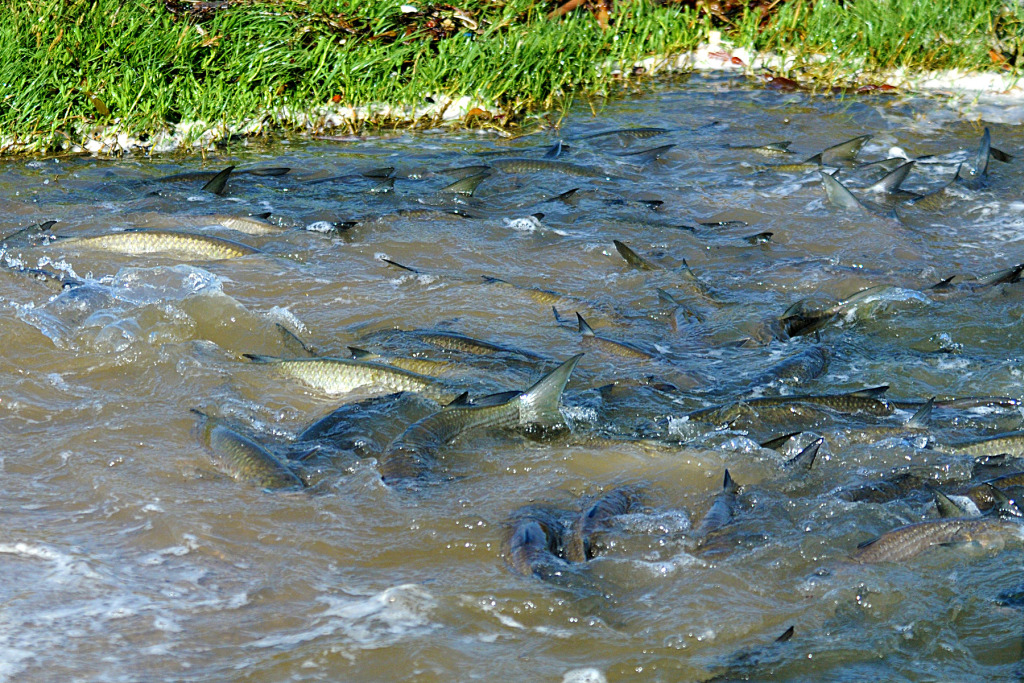
Mullet at lagoon’s edge (Jim Kenney 9/28/15)
An additional surprise was the number of fish in the lagoon. Along the lagoon shoreline, especially at the southern edge nearest the ocean, thousands of fish roiled and thrashed. A local Malibuite confidently averred they were “Sea Bass,” an identification I immediately

Kelp Bass – an actual “Sea Bass” (Aquafind.com)
distrusted for sounding too much like the common misnomer “whitefish,” – there must be hundreds of species called “whitefish” because their flesh is white and humans will eat it. Fish are notoriously renamed in order to suit marketers. When was the last (or first) time you saw “Patagonian Toothfish” (a cod, family Gadidae) on the menu? How about Chilean Sea Bass? Same species – case closed.
I later learned that “Sea Bass” is truly a family, Serranidae, which does not include cod, but does include groupers as well as Kelp Bass (Paralabrax clathratus), SoCal’s most common Sea Bass. But they all looked wrong for our fish. Mark Abramson, Senior Watershed Advisor of Santa Monica Bay Restoration Foundation, advised me that they were Striped Mullet (family Mugilidae, Mugil cephalus).
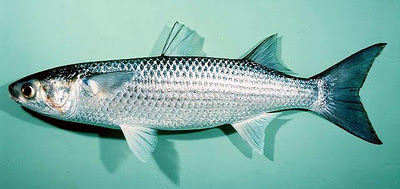
Striped Mullet – definitely not a “Sea Bass” (Smartfarming)
This of course is the same entertaining fish who have been leaping about in the lagoon for many months. Consensus is that the very high supermoon-caused tide and surf washed them over the beach into the lagoon. Fortunately they are able to live in fresh to brackish water as well as salt; I hope they survive to return to the sea when the lagoon entrance reopens.
We witnessed an unfortunate incident in association with all these fish: a young Double-crested Cormorant (not black but brown with beige belly, breast and throat) was struggling mightily to swallow a fish, an event not unusual in and of itself. One alert birder said she saw a fishhook and we realized that there was certainly a 3-prong fishhook and what appeared to be blood near the fish’s head. It might have been a lure, or fish blood, or cormorant blood. At any rate, the cormorant’s difficulty had more to do with this hook than with the fish. We shouted at the bird, hoping to startle it into dropping the fish & hook. This did not work; neither did it startle when I threw a stone at it, as it was about 4 times farther than my poor arm can throw. Sorry…there’s no end to this story beyond the fact that the cormorant, still hooked, swam away.
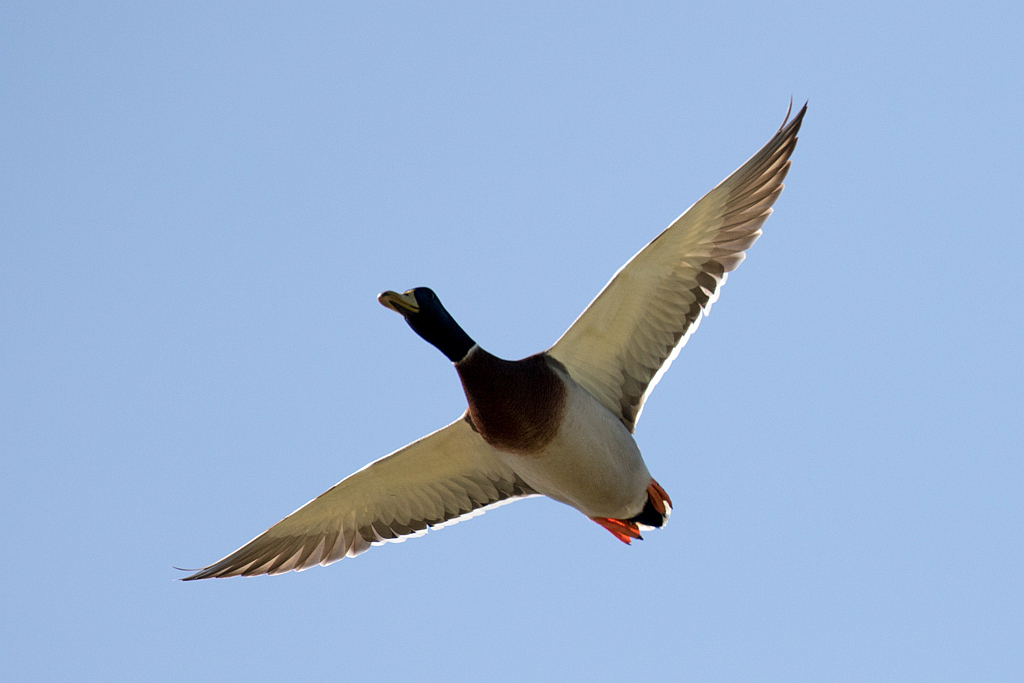
Male Mallard cruises in (R. Ehler 9/27/15)
It’s obviously migration time, with warblers and unusual species appearing all across the county, and the lagoon was no exception. Some new ducks, a Cooper’s Hawk, a nice mix of shorebirds, gulls and terns (including the uncommon Common Tern), Vaux’s Swift, many Anna’s and Allen’s Hummingbirds, 4 Say’s Phoebe,

Say’s Phoebe – here for the winter (R. Ehler 9/27/15)
6 Warbling Vireo!, two wrens, five warbler species including 3 Nashville, Savannah Sparrow and Western Meadowlark. The meadowlarks are hard to find as they prefer the vegetated areas on the sand islands. See the lists below for complete numbers.
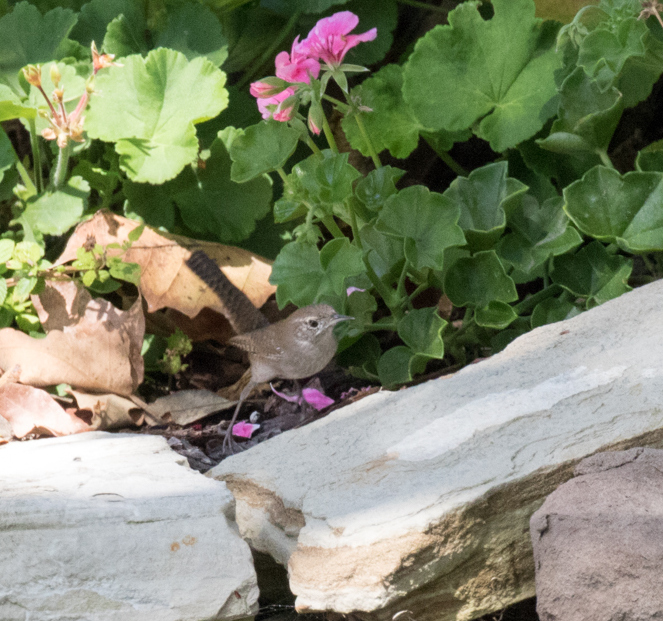
House (not a Marsh) Wren (R. Ehler 9/27/15)
The Marsh Wren was an unexpected but welcome sight, hopping through the small reed patches below the meeting pavilion. Our last sighting of this species, its 35th appearance at the lagoon, was on 1/22/12, almost 4 years ago. The reed beds they require were wiped out by the June’12 – May’13 lagoon reconfiguration, but they recently reappeared, albeit still quite small. I will not be shocked to see Sora appear sometime in 2016 – likely a short visit rather than a winter-long or full-year residency – but it may be an additional year or two before Virginia Rail show up.
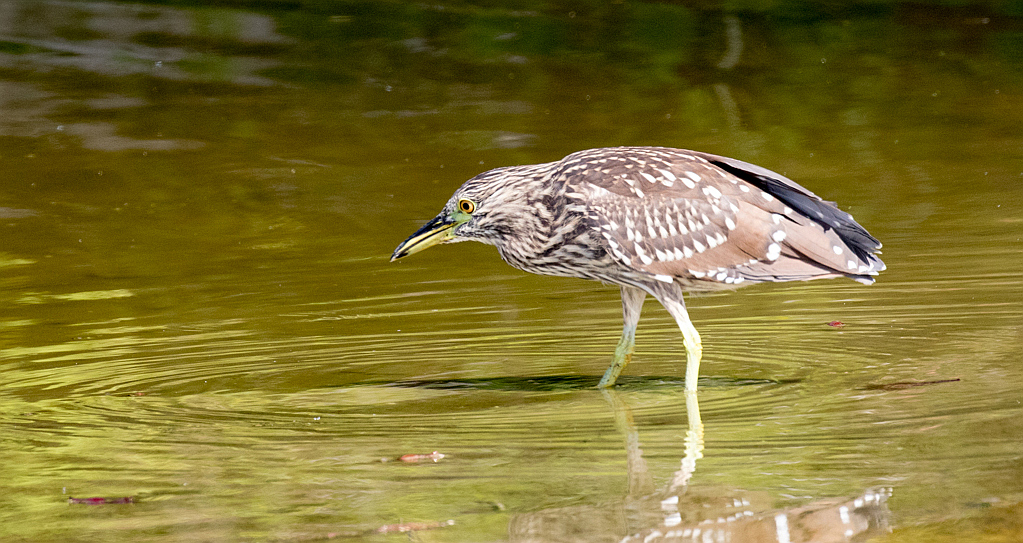
Juvenile Black-crowned Night-Heron stalking (R. Ehler 9/27/15)
Romeo & Juliet, our newly-resident pair of Mute Swans, are still here, gracefully gliding o’er the languid lagoon. The Snowy Plovers continue to increase in number – 32 this month, with ringed bird GA:OY (left Green over Aqua: right Orange over Yellow) putting in an appearance. GA:OY was ringed at Oceano Dunes (near Pismo Beach on the central coast) in Summer 2014. First spotted – and photographed – at the lagoon by Bill Crowe on 10/3/14, it was also seen 12/28/14 and 1/25/15 at the lagoon’s winter roosting colony.
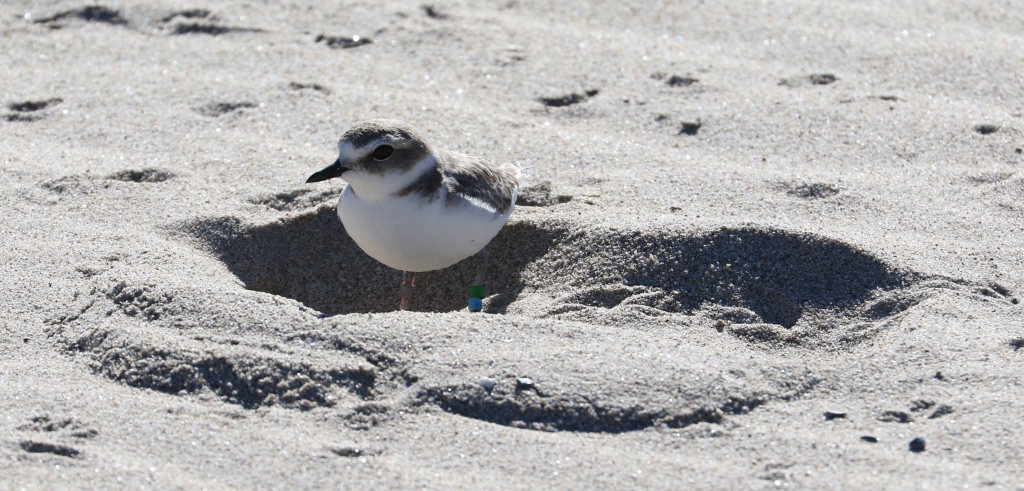
Dwarfed by a footprint – Snowy Plover GA:OY (R. Ehler 1/25/15)
Yielding to the urge to create a chart, I compared this Sept. to earlier years. It proved to be slightly above average.
| Ave of Prior | Variance | Range for prior | ||
| Sept 2015 | 12 Septs | from Ave. | 12 Years | |
| Species | 69 | 63 | +6% | 49 – 78 |
| Numbers | 922 | 869 | +9% | 556 – 1237 |
Birds new for the season are: Green-winged Teal, Ruddy Duck, Eared Grebe, Cooper’s Hawk, Marbled Godwit, Long-billed Dowitcher, Boneparte’s Gull, Common & Forster’s Terns, Vaux’s Swift, Belted Kingfisher, Say’s Phoebe, Warbling Vireo, Oak Titmouse, Marsh Wren, Blue-gray Gnatcatcher, Orange-crowned, Nashville, Yellow and Yellow-rumped Warblers, Savannah and White-crowned Sparrows, Western Meadowlark and Lesser Goldfinch.
Our next three scheduled field trips: Bolsa Chica, 10 October, 8:30am; Malibu Lagoon, 25 October, 8:30 & 10am: Ballona Creek Area, 14 Nov. 8:30am.
Our next program: The Sex Life of Spiders with Martina Ramirez on Tuesday, 6 October, 7:30 pm, at [note change] Chris Reed Park, 1133 7th St., NE corner of 7th and Wilshire Blvd. in Santa Monica.
NOTE: Our 10 a.m. Parent’s & Kids Birdwalk meets at the shaded viewing area. Watch for Willie the Weasel. He’ll be watching for you and your big floppy feet.
Links: Unusual birds at Malibu Lagoon
9/23/02 Aerial photo of Malibu Lagoon
Prior checklists:
2015: Jan-May
2014: Jan-July, July-Dec 2013: Jan-June, July-Dec
2012: Jan-June, July-Dec 2011: Jan-June, July-Dec
2010: Jan-June, July-Dec 2009: Jan-June, July-Dec
The 10-year comparison summaries created during the project period, despite numerous complaints, remain available on our Lagoon Project Bird Census Page. Very briefly summarized, the results unexpectedly indicate that avian species diversification and numbers improved slightly during the period Jun’12-June’14. [Chuck Almdale]
| Malibu Census 2015 | 3/22 | 4/26 | 5/24 | 7/26 | 8/23 | 9/27 |
| Temperature | 60-70 | 66-76 | 59-70 | 70-82 | 70-77 | 68-77 |
| Tide Lo/Hi Height | H+4.78 | L+0.58 | L+0.54 | L+2.37 | L+2.80 | H+5.94 |
| Tide Time | 1138 | 1139 | 0927 | 1143 | 0944 | 0918 |
| Brant | 3 | 7 | 1 | |||
| Canada Goose | 1 | 30 | ||||
| Mute Swan | 2 | 2 | ||||
| Gadwall | 1 | 10 | 22 | 5 | 8 | 54 |
| Mallard | 12 | 8 | 8 | 55 | 35 | 34 |
| Northern Shoveler | 2 | |||||
| Green-winged Teal | 4 | |||||
| Bufflehead | 2 | |||||
| Red-brstd Merganser | 2 | 1 | 1 | |||
| Ruddy Duck | 30 | 4 | 5 | |||
| Red-throated Loon | 3 | |||||
| Pacific Loon | 1 | |||||
| Common Loon | 5 | |||||
| Pied-billed Grebe | 2 | 1 | 3 | 2 | ||
| Horned Grebe | 1 | 1 | ||||
| Eared Grebe | 1 | 8 | ||||
| Western Grebe | 12 | 2 | 1 | |||
| Brandt’s Cormorant | 4 | 1 | 2 | 1 | ||
| Dble-crstd Cormorant | 45 | 16 | 55 | 34 | 43 | 36 |
| Pelagic Cormorant | 1 | 4 | 2 | |||
| Brown Pelican | 27 | 1490 | 70 | 17 | 3 | 6 |
| Great Blue Heron | 1 | 2 | 2 | 4 | 8 | 4 |
| Great Egret | 10 | 5 | 5 | 4 | 6 | 3 |
| Snowy Egret | 12 | 12 | 4 | 6 | 22 | 18 |
| Cattle Egret | 1 | |||||
| Blk-crwnd N-Heron | 2 | 3 | 3 | |||
| Osprey | 1 | |||||
| Cooper’s Hawk | 1 | |||||
| Red-tailed Hawk | 1 | |||||
| American Coot | 45 | 1 | 1 | 4 | 75 | |
| Blk-bellied Plover | 6 | 1 | 27 | 75 | 84 | |
| Snowy Plover | 16 | 21 | 32 | |||
| Semipalmated Plover | 9 | 1 | 5 | 2 | ||
| Killdeer | 3 | 2 | 6 | 4 | 6 | 10 |
| Spotted Sandpiper | 2 | 1 | 1 | 3 | ||
| Willet | 3 | 1 | 1 | 6 | 8 | 15 |
| Whimbrel | 10 | 12 | 1 | 13 | 10 | 4 |
| Marbled Godwit | 8 | 2 | 8 | |||
| Ruddy Turnstone | 1 | 3 | 12 | 15 | ||
| Black Turnstone | 1 | |||||
| Surfbird | 4 | |||||
| Sanderling | 2 | 23 | ||||
| Dunlin | 1 | |||||
| Least Sandpiper | 15 | 8 | 3 | |||
| Western Sandpiper | 45 | 1 | 14 | 15 | ||
| Short-billd Dowitcher | 6 | |||||
| Long-billed Dowitcher | 1 | |||||
| Wilson’s Phalarope | 1 | |||||
| Boneparte’s Gull | 12 | 6 | 1 | 1 | ||
| Heermann’s Gull | 6 | 350 | 45 | 14 | 11 | 25 |
| Ring-billed Gull | 3 | 30 | 8 | |||
| Western Gull | 3 | 110 | 135 | 40 | 40 | 110 |
| California Gull | 40 | 600 | 6 | 2 | 1 | 8 |
| Glaucous-wingd Gull | 1 | 1 | ||||
| Caspian Tern | 10 | 11 | 1 | 6 | 1 | |
| Common Tern | 1 | |||||
| Forster’s Tern | 2 | 2 | ||||
| Royal Tern | 15 | 4 | 2 | 3 | 9 | 15 |
| Elegant Tern | 28 | 3100 | 85 | 45 | 12 | 6 |
| Black Skimmer | 1 | |||||
| Rock Pigeon | 23 | 8 | 9 | 4 | 6 | 12 |
| Mourning Dove | 2 | 2 | 2 | 7 | 7 | 4 |
| Vaux’s Swift | 45 | |||||
| Anna’s Hummingbird | 1 | 2 | 2 | 1 | 3 | 4 |
| Allen’s Hummingbird | 6 | 4 | 6 | 3 | 10 | 5 |
| Belted Kingfisher | 1 | 1 | ||||
| American Kestrel | 1 | |||||
| Black Phoebe | 2 | 2 | 2 | 4 | 6 | 20 |
| Say’s Phoebe | 4 | |||||
| Warbling Vireo | 6 | |||||
| American Crow | 5 | 6 | 5 | 4 | 4 | 20 |
| Rough-winged Swallow | 4 | 4 | 6 | 3 | 8 | |
| Tree Swallow | 10 | 10 | ||||
| Barn Swallow | 2 | 6 | 12 | 12 | 12 | |
| Cliff Swallow | 2 | 10 | 12 | 3 | ||
| Oak Titmouse | 1 | |||||
| Bushtit | 14 | 2 | 2 | 20 | ||
| House Wren | 1 | 4 | ||||
| Marsh Wren | 1 | |||||
| Blue-gray Gnatcatcher | 3 | |||||
| American Robin | 1 | 1 | ||||
| Northern Mockingbird | 3 | 6 | 3 | 4 | 4 | 4 |
| European Starling | 4 | 10 | 3 | 25 | 25 | 35 |
| Cedar Waxwing | 40 | |||||
| Ornge-crwnd Warbler | 2 | |||||
| Nashville Warbler | 3 | |||||
| Common Yellowthroat | 2 | 5 | 5 | 8 | ||
| Yellow Warbler | 1 | |||||
| Yellow-rumpd Warbler | 5 | 3 | ||||
| Spotted Towhee | 1 | |||||
| California Towhee | 3 | 2 | 2 | 4 | 6 | 2 |
| Savannah Sparrow | 2 | |||||
| Song Sparrow | 9 | 6 | 9 | 5 | 8 | 3 |
| White-crwnd Sparrow | 10 | 2 | ||||
| Red-winged Blackbird | 2 | 40 | 15 | |||
| Western Meadowlark | 3 | 4 | ||||
| Brewer’s Blackbird | 2 | |||||
| Great-tailed Grackle | 4 | 3 | 3 | 5 | 12 | |
| Brwn-headed Cowbird | 4 | 4 | ||||
| Hooded Oriole | 3 | |||||
| House Finch | 4 | 12 | 20 | 2 | 12 | 25 |
| Lesser Goldfinch | 1 | 3 | ||||
| Totals by Type | Mar | Apr | May | Jul | Aug | Sep |
| Waterfowl | 50 | 55 | 37 | 62 | 46 | 99 |
| Water Birds – Other | 144 | 1511 | 134 | 57 | 54 | 126 |
| Herons, Egrets & Ibis | 24 | 19 | 11 | 16 | 39 | 28 |
| Quail & Raptors | 1 | 1 | 1 | 0 | 0 | 1 |
| Shorebirds | 37 | 89 | 8 | 71 | 170 | 215 |
| Gulls & Terns | 107 | 4213 | 294 | 105 | 80 | 169 |
| Doves | 25 | 10 | 11 | 11 | 13 | 16 |
| Other Non-Passerines | 7 | 7 | 8 | 4 | 13 | 55 |
| Passerines | 76 | 104 | 86 | 85 | 149 | 213 |
| Totals Birds | 471 | 6009 | 590 | 411 | 564 | 922 |
| Total Species | Mar | Apr | May | Jul | Aug | Sep |
| Waterfowl | 7 | 5 | 3 | 4 | 4 | 5 |
| Water Birds – Other | 9 | 6 | 8 | 5 | 5 | 5 |
| Herons, Egrets & Ibis | 4 | 3 | 3 | 4 | 4 | 4 |
| Quail & Raptors | 1 | 1 | 1 | 0 | 0 | 1 |
| Shorebirds | 8 | 10 | 3 | 8 | 14 | 13 |
| Gulls & Terns | 7 | 10 | 9 | 6 | 7 | 9 |
| Doves | 2 | 2 | 2 | 2 | 2 | 2 |
| Other Non-Passerines | 2 | 3 | 2 | 2 | 2 | 4 |
| Passerines | 17 | 13 | 17 | 13 | 15 | 26 |
| Totals Species – 102 | 57 | 53 | 48 | 44 | 53 | 69 |



 SANTA MONICA BAY AUDUBON SOCIETY BLOG