Free email delivery
Please sign up for email delivery in the subscription area to the right.
No salesman will call, at least not from us. Maybe from someone else.
Blog News
This blog recently passed a milestone – over 100,000 hits – so I thought I’d give you a peek at SMBAS Blog World Headquarters history.
Miscellaneous blog tidbits:
First Posting: 3/29/09
Current total posts: 382 – Event announcements are deleted following the event
Total Hits: 100,400
Subscribers – 315: Email – 268 WordPress Members – 47
All-Time Page Views (did you know we have 19 pages?):
1. 30,855 Home Page
2. 11,874 Los Angeles County Birding Spots 7-page set
3. 2,849 California Bird Festivals
4. 2,809 Bird & Marine Mammal Rescue
5. 1,967 Malibu Lagoon Restoration Project 2012-13 4-page set
6. 1,965 Printable Calendar & Checklist
7. 1,119 Bird Locating – “It’s right there…in the green tree!”
8. 774 Western Snowy Plovers
9. 401 Birding Info. Pages
10. 297 Unusual Birds at Malibu Lagoon
All-Time Top Ten Postings:
1. 3,482 New Hummingbird Species Discovered in L.A. County
2. 1,931 The First Americans of Ballona (3-part series)
3. 1,768 Snowy Plover Likely to be Split from Kentish Plover
4. 1,411 “It’s Right There in the Green Tree!” Getting others onto that bird
5. 1,152 California Bird Festivals 2010-11
6. 1,133 Birders Take Their Lumps with their Splits
7. 1,091 Canyonland Roadrunner Captured on Film
8. 1,070 Full Pink Moon Update for April 15, 2014
9. 1,012 Kestrel Photoshow
10. 754 Western Roof-Owl: Bird of Mystery
Best Day Ever:
4/1/11 – 1,486 hits (April Fool’s Day post on New Hummingbird Species)
Links: Fifty interesting & useful websites – Look to the right > > >
Countries – Hits for 2015 – 70 Countries:
Over 10,000 hits: USA
100 – 200: UK, Canada
40 – 60: Germany, Australia, Taiwan
20 – 39: Netherlands, France, Sweden, India
10 – 19: Italy, Mexico, New Zealand, Brazil, Euro. Union, Finland, Denmark, Spain, Ukraine, Russia, Singapore
1 – 9: Sri Lanka, Poland, Thailand, Japan, Czech Republic, UAE, Hong Kong, Norway, Kenya, Senegal, Bulgaria, Maldives, Macedonia, Pakistan, 36 others
Some 2014 Statistics:
Over 25,000 views
463 pictures presented (thanks to you photographers!)
People linked in through: Facebook, Audubon.org, CA.Audubon.org, SMBAS.atspace.com, WordPress
103 countries represented, including far-flung places like Azerbaijan, Burkina Faso, Fiji, Guyana, and Papua New Guinea.
For the Future:
The plan is to decentralize postings: trip leaders writing their own trip reports, program chairs writing their announcements, other chairs writing reports about what they’re up to, and contributions from YOU! our reader. {Chuck Almdale}
Malibu Lagoon Trip Report: 23 August, 2015

Once the Black Skimmer gets airborne, they’re quite graceful (R. Ehler 8/23/15)
The shorebirds are passing through. We didn’t have a lot of them (129 birds) but 13 species is a good representation. Both counts were up from July’s 71 birds in 8 species. The migrant ducks have not yet arrived, but local nesters Mallards and Gadwalls were resting on the sand islands, and a single Red-breasted Merganser, present since at least June, was with the terns and cormorants. No raptors: the last sightings we had were a Red-tailed Hawk in May and an Osprey in April. Brown Pelicans and Western Gulls are low for August as well. Overall, today’s bird total of 563 birds in 52 species was 7% below average total, but 6% above average species count.
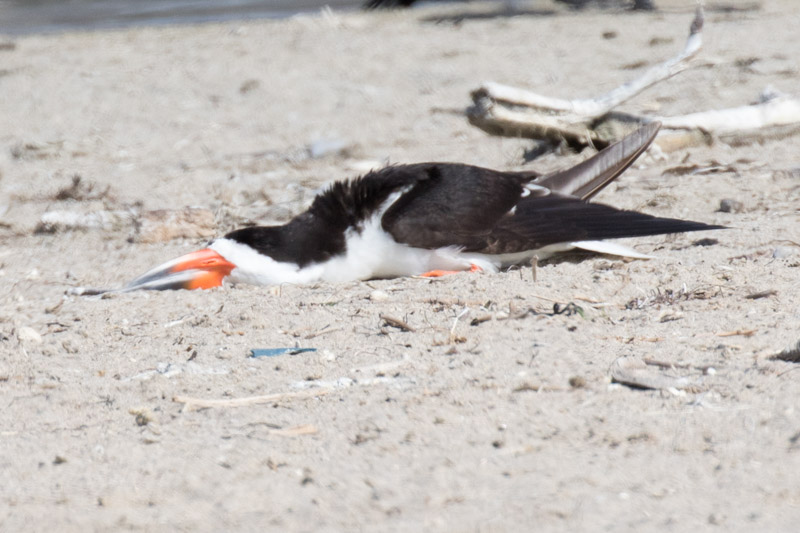
Black Skimmers may look dead when sleeping, but they’re not (R. Ehler 8/23/15)
Hot and sunny, sunny and hot: 72° when we started, 77° when we finished around 11am. Our group of 30 birders had dwindled to about 10 by the time we got to the Snowy Plover “virtual fence” on Surfrider Beach. For a change, the Snowies were mostly inside the enclosure. I think they’d recently returned from the seaward side of the berm, as low tide had been at 9:36am. Snowy Plovers feed primarily on seaweed wrack left on the beach at the high tide line, and the freshest wrack seems to contain the most and the freshest tiny invertebrates which they dearly love. So a typical day for them is to dodge beach strollers, pester one another and snooze from low tide to high tide, venture out just after high tide to check out the new wrack deposits, and return to their roosts when the tide again turns. Today’s 21 birds is up from July’s count of 16 and June’s singleton.
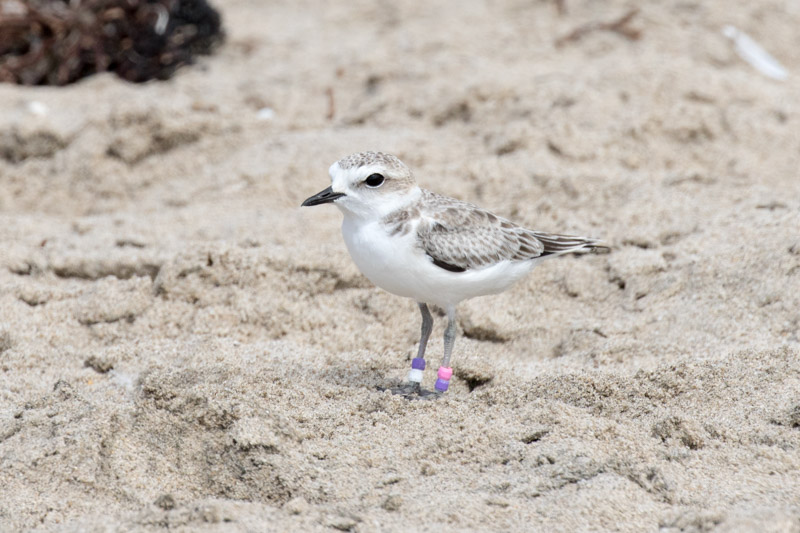
Snowy Plover PV:VW sporting new rings (R. Ehler 8/23/15)
Check out the above picture of Snowy PV:VW (left leg Pink over Violet, right leg Violet over White). I think the bands are a new design; they look thicker than in previous years, and the additional thickness allows for smoothly rounded edges. Sharp edges may have caused problems in the past. Ten to fifteen years ago I used to see far too many Snowies missing a foot – occasionally two – and inquired whether anyone thought the rings might be causing a problem.
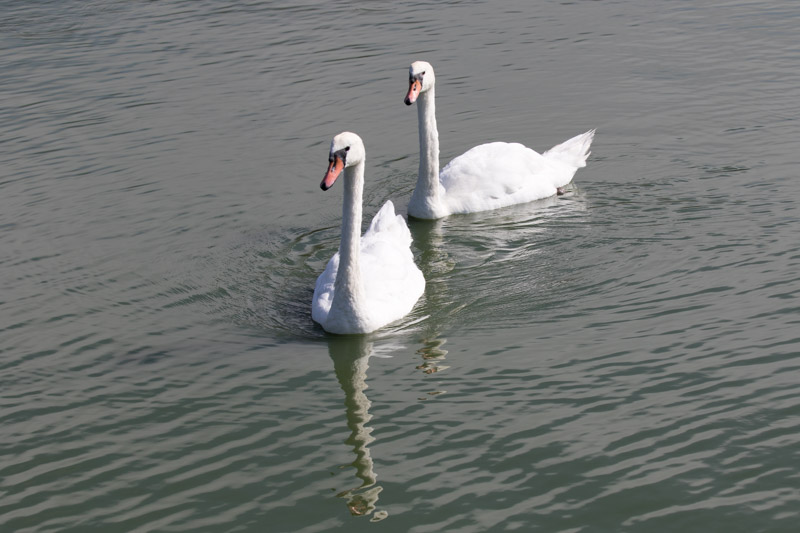
Swimming Mute Swan pair (R. Ehler 8/23/15)
Surprise visitors to the lagoon were a pair of Mute Swans, resting at the end of a sand island in the lagoon channel. Mute Swans are Eurasian birds, widely domesticated across mainland Europe and England, and introduced into the USA probably in the mid-19th century, most likely in Long Island and Hudson River areas of New York. Feral populations live along the Connecticut coast – yes, in the salty sea – and in the Great Lakes, especially Traverse Bay, Mich. Perhaps this pair hitchhiked in, or their keeper got tired of them and dumped them out of his trunk at midnight. However, alert blog reader Aurelio Albaisa advises me that there was a flight-capable pair at Lake Balboa for several years who are now missing. One of those two birds had a blue band on its right leg.
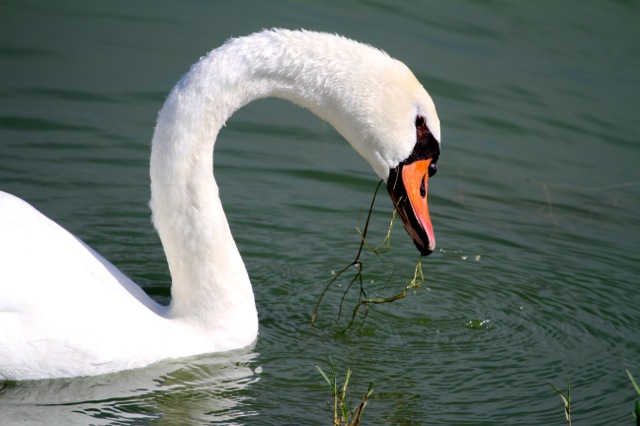
Mute swan, feeding (J. Waterman 8/23/15)
Mute Swans are about the same size and weight as the uncommon and very local Trumpeter Swan, but larger and heavier than the relatively common Tundra Swan. They are something of a pest, driving native wildfowl from nesting and feeding areas. The “swan song” myth is just that, a myth – they do make weak barking and hissing noises. Nevertheless, people admire their graceful S-curved necks, all-white plumage and orange bill – often down-turned – with black edging and a bump. Good field marks, those, by the way, unlike the straight necks and black bills of both Trumpeter and Tundra Swans.

Short-billed Dowitcher (R. Ehler 8/23/15)
Aren’t dowitchers fun? I didn’t get close enough to this bird at the time to ID it for sure (assuming I’m capable of ID’ing any dowitcher for sure), but looking at this picture leads me to believe it’s a Short-billed Dowitcher. (Checking migration arrival and departure dates also helps). The outer 1/3rd of the bill seems to droop, the white superciliums (supercilia?) look wider in front of the eyes, and they don’t meet above the bill. There are other differences between the two species, but I can’t see them from this picture. If anyone thinks it’s a Long-billed, feel free to write in and explain yourself. By the way, we have Dowitcher “cheet sheets,” and many other useful birding aids, on our blogsite here. You too can be an expert! Be the first one on your block to ID the little-known Fargle’s Plonker!
Every month we get one or more people new to birding. Filled with questions, they usually keep me company, which is fine by me. I like questions. I tend not to loudly broadcast information to one and all, so if you want to know something, it’s best to ask. Here’s a couple of tips for new birders: 1) we have inexpensive binoculars to loan, ask for them ASAP after you arrive; 2) wear a hat, sun in your eyes is a major nuisance to birders; 3) dress in layers, the day can warm significantly; 4) try to stay until at least 10am if not 11am as the best bird variety and numbers are down on the beach; 5) get a field guide and have something to carry it in – National Geographic Society, Stokes and Sibley are all good books.
If a pair of binoculars interests you, ask their owner if you may look through them; comfort, weight and fit are important considerations. There are many places to buy binoculars: two good websites are Eagle Optics http://www.eagleoptics.com/ and Optics4Birders http://www.optics4birding.com/ Both sites have loads of additional information. Until you’re quite sure that you love birding and want good (read: expensive) binoculars, don’t spend more than a couple of hundred on them. Avoid “fixed focus” and “fast focus” binoculars like the plague. You will find a broad selection and wide range of quality between $75 and $500. Top-of-the-line binos (or “bins”) above $800 are like expensive cars, incremental differences can be costly.
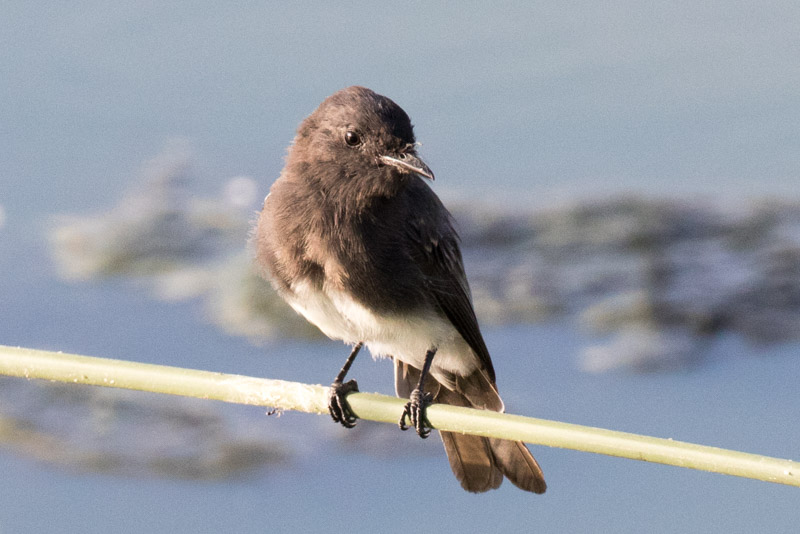
The faithful Black Phoebe, present 99% of the time (R. Ehler 8/23/15)
Birds new for the season: Mute Swan, Spotted Sandpiper, Sanderling, Least Sandpiper, Short-billed Dowitcher, Wilson’s Phalarope, Black Skimmer, Tree Swallow, and House Wren.
Our next three scheduled field trips: Lower Los Angeles River, 12 September, 7:30am; Malibu Lagoon, 27 September, 8:30 & 10am. Bolsa Chica (poss. also Huntington Beach Central Park), 10 October, 8:30am.
Our next program: The Sex Life of Spiders with Martina Ramirez on Tuesday, 6 October, 7:30 pm, at [note change] Chris Reed Park, 1133 7th St., NE corner of 7th and Wilshire Blvd. in Santa Monica.
NOTE: Our 10 a.m. Parent’s & Kids Birdwalk meets at the shaded viewing area. Watch for Willie the Weasel. He’ll be watching for you and your big floppy feet.
Links: Unusual birds at Malibu Lagoon
9/23/02 Aerial photo of Malibu Lagoon
Prior checklists:
2015: Jan-May
2014: Jan-July, July-Dec 2013: Jan-June, July-Dec
2012: Jan-June, July-Dec 2011: Jan-June, July-Dec
2010: Jan-June, July-Dec 2009: Jan-June, July-Dec
The 10-year comparison summaries created during the project period, despite numerous complaints, remain available on our Lagoon Project Bird Census Page. Very briefly summarized, the results unexpectedly indicate that avian species diversification and numbers improved slightly during the period Jun’12-June’14. [Chuck Almdale]
| Malibu Census 2015 | 2/22 | 3/22 | 4/26 | 5/24 | 7/26 | 8/23 |
| Temperature | 55-63 | 60-70 | 66-76 | 59-70 | 70-82 | 70-77 |
| Tide Lo/Hi Height | H+4.51 | H+4.78 | L+0.58 | L+0.54 | L+2.37 | L+2.72 |
| Tide Time | 1137 | 1137 | 1131 | 0919 | 1135 | 0936 |
| Brant | 3 | 7 | 1 | |||
| Canada Goose | 1 | 30 | ||||
| Mute Swan | 2 | |||||
| Gadwall | 30 | 1 | 10 | 22 | 5 | 8 |
| American Wigeon | 18 | |||||
| Mallard | 12 | 12 | 8 | 8 | 55 | 35 |
| Northern Shoveler | 25 | 2 | ||||
| Northern Pintail | 3 | |||||
| Green-winged Teal | 12 | |||||
| Surf Scoter | 15 | |||||
| Bufflehead | 2 | 2 | ||||
| Red-brested Merganser | 2 | 2 | 1 | 1 | ||
| Ruddy Duck | 35 | 30 | 4 | |||
| Red-throated Loon | 1 | 3 | ||||
| Pacific Loon | 3 | 1 | ||||
| Common Loon | 1 | 5 | ||||
| Pied-billed Grebe | 1 | 2 | 1 | 3 | 2 | |
| Horned Grebe | 1 | 1 | 1 | |||
| Eared Grebe | 1 | |||||
| Western Grebe | 15 | 12 | 2 | 1 | ||
| Brandt’s Cormorant | 1 | 4 | 1 | 2 | ||
| Dble-crested Cormorant | 50 | 45 | 16 | 55 | 34 | 43 |
| Pelagic Cormorant | 1 | 1 | 4 | 2 | ||
| Brown Pelican | 28 | 27 | 1490 | 70 | 17 | 3 |
| Great Blue Heron | 2 | 1 | 2 | 2 | 4 | 8 |
| Great Egret | 2 | 10 | 5 | 5 | 4 | 6 |
| Snowy Egret | 26 | 12 | 12 | 4 | 6 | 22 |
| Cattle Egret | 1 | |||||
| Black-crowned N-Heron | 2 | 3 | ||||
| Osprey | 1 | 1 | ||||
| Red-tailed Hawk | 1 | 1 | ||||
| American Coot | 145 | 45 | 1 | 1 | 4 | |
| American Avocet | 1 | |||||
| Black-bellied Plover | 85 | 6 | 1 | 27 | 75 | |
| Snowy Plover | 16 | 21 | ||||
| Semipalmated Plover | 9 | 1 | 5 | |||
| Killdeer | 12 | 3 | 2 | 6 | 4 | 6 |
| Spotted Sandpiper | 3 | 2 | 1 | 1 | ||
| Willet | 3 | 3 | 1 | 1 | 6 | 8 |
| Whimbrel | 4 | 10 | 12 | 1 | 13 | 10 |
| Long-billed Curlew | 1 | |||||
| Marbled Godwit | 10 | 8 | 2 | |||
| Ruddy Turnstone | 1 | 3 | 12 | |||
| Surfbird | 4 | |||||
| Sanderling | 2 | |||||
| Dunlin | 1 | |||||
| Least Sandpiper | 15 | 8 | ||||
| Western Sandpiper | 45 | 1 | 14 | |||
| Short-billed Dowitcher | 6 | |||||
| Wilson’s Phalarope | 1 | |||||
| Boneparte’s Gull | 12 | 6 | 1 | |||
| Heermann’s Gull | 1 | 6 | 350 | 45 | 14 | 11 |
| Ring-billed Gull | 90 | 3 | 30 | 8 | ||
| Western Gull | 95 | 3 | 110 | 135 | 40 | 40 |
| California Gull | 1600 | 40 | 600 | 6 | 2 | 1 |
| Glaucous-winged Gull | 4 | 1 | 1 | |||
| Caspian Tern | 10 | 11 | 1 | 6 | ||
| Forster’s Tern | 2 | |||||
| Royal Tern | 35 | 15 | 4 | 2 | 3 | 9 |
| Elegant Tern | 28 | 3100 | 85 | 45 | 12 | |
| Black Skimmer | 1 | |||||
| Rock Pigeon | 5 | 23 | 8 | 9 | 4 | 6 |
| Mourning Dove | 2 | 2 | 2 | 2 | 7 | 7 |
| Anna’s Hummingbird | 1 | 2 | 2 | 1 | 3 | |
| Allen’s Hummingbird | 3 | 6 | 4 | 6 | 3 | 10 |
| Belted Kingfisher | 1 | |||||
| American Kestrel | 1 | |||||
| Black Phoebe | 2 | 2 | 2 | 2 | 4 | 6 |
| American Crow | 6 | 5 | 6 | 5 | 4 | 4 |
| Common Raven | 2 | |||||
| Rough-winged Swallow | 4 | 4 | 6 | 3 | 8 | |
| Tree Swallow | 10 | |||||
| Barn Swallow | 2 | 6 | 12 | 12 | 12 | |
| Cliff Swallow | 2 | 10 | 12 | 3 | ||
| Oak Titmouse | 1 | |||||
| Bushtit | 14 | 2 | 2 | |||
| House Wren | 1 | |||||
| Hermit Thrush | 2 | |||||
| American Robin | 1 | 1 | ||||
| Northern Mockingbird | 1 | 3 | 6 | 3 | 4 | 4 |
| European Starling | 3 | 4 | 10 | 3 | 25 | 25 |
| Cedar Waxwing | 40 | |||||
| Common Yellowthroat | 3 | 2 | 5 | 5 | ||
| Yellow-rumped Warbler | 8 | 5 | ||||
| Spotted Towhee | 1 | |||||
| California Towhee | 1 | 3 | 2 | 2 | 4 | 6 |
| Song Sparrow | 6 | 9 | 6 | 9 | 5 | 8 |
| White-crowned Sparrow | 12 | 10 | ||||
| Red-winged Blackbird | 2 | 40 | ||||
| Western Meadowlark | 10 | 3 | ||||
| Brewer’s Blackbird | 2 | |||||
| Great-tailed Grackle | 4 | 4 | 3 | 3 | 5 | |
| Brwn-headed Cowbird | 4 | 4 | ||||
| Hooded Oriole | 3 | |||||
| House Finch | 4 | 12 | 20 | 2 | 12 | |
| Lesser Goldfinch | 1 | |||||
| Totals by Type | Feb | Mar | Apr | May | Jul | Aug |
| Waterfowl | 154 | 50 | 55 | 37 | 62 | 46 |
| Water Birds – Other | 247 | 144 | 1511 | 134 | 57 | 54 |
| Herons, Egrets & Ibis | 30 | 24 | 19 | 11 | 16 | 39 |
| Quail & Raptors | 2 | 1 | 1 | 1 | 0 | 0 |
| Shorebirds | 119 | 37 | 89 | 8 | 71 | 169 |
| Gulls & Terns | 1825 | 107 | 4213 | 294 | 105 | 80 |
| Doves | 7 | 25 | 10 | 11 | 11 | 13 |
| Other Non-Passerines | 3 | 7 | 7 | 8 | 4 | 13 |
| Passerines | 61 | 76 | 104 | 86 | 85 | 149 |
| Totals Birds | 2448 | 471 | 6009 | 590 | 411 | 563 |
| Total Species | Feb | Mar | Apr | May | Jul | Aug |
| Waterfowl | 10 | 7 | 5 | 3 | 4 | 4 |
| Water Birds – Other | 11 | 9 | 6 | 8 | 5 | 5 |
| Herons, Egrets & Ibis | 3 | 4 | 3 | 3 | 4 | 4 |
| Quail & Raptors | 2 | 1 | 1 | 1 | 0 | 0 |
| Shorebirds | 8 | 8 | 10 | 3 | 8 | 13 |
| Gulls & Terns | 6 | 7 | 10 | 9 | 6 | 7 |
| Doves | 2 | 2 | 2 | 2 | 2 | 2 |
| Other Non-Passerines | 1 | 2 | 3 | 2 | 2 | 2 |
| Passerines | 14 | 17 | 13 | 17 | 13 | 15 |
| Totals Species – 96 |
57 | 57 | 53 | 48 | 44 | 52 |
Clements Checklist of World Birds – Updated August, 2015
The 6th, and final, edition of James Clements The Clements’ Checklist of Birds of the World was published in 2006, by which time it had become the checklist of choice for most North American birders, especially members of the American Birding Association (ABA). Following the death of Jim Clements (former president of Santa Monica Bay Audubon Society, by the way), the responsibility for its maintenance and update was assumed by The Cornell Laboratory of Ornithology, under whose auspices it has undergone ten updates since then.
Even if you’re not a World Birder (and you know if you are), it is interesting to have a grasp of the variety and classification of the world’s 10,000+ species of birds. The North American bird list – about 900 species seen, many only once, within Canada and mainland U.S.A. (the ABA area) – is only 9% of the world’s total. If you birded steadily for several years, you might expect to see 79 families in the ABA area, about 1/3rd of the total 235 families of birds. It’s interesting to know how “our” birds fit into this larger picture of the world’s avifauna.
The entire checklist is available for free, downloadable in various formats including Excel. Birds are listed in phylogenetic order, starting with Ostrich and ending – 32,000 lines later – with Parasitic Weaver. It includes all currently recognized Orders, Families, Genera, Species and Subspecies. Also included is additional information on species and subspecies that are closely “grouped” to one another.
Click this for a list and discussion of the latest updates (Aug. 2014 – Aug. 2015)
Some highlights of the latest changes:
1. Species – 10473, Subspecies – 20697, Groups – 3013, Families – 234 (with 1 additional, extinct, family)
2. Three newly described species, 73 “splits” and 7 “lumps” for net gain of 69 birds
3. Orders now total 39; new are Leptosomiformes (the Cuckoo-Roller of Madagascar, placed between Mousebirds and Trogons) and Bucerotiformes (Hoopoes, Woodhoopoes & Scimitar-bills, Ground-Hornbills, Hornbills – all Old World birds, mostly tropical, now placed between Trogons and Kingfishers & Allies). The Cuckoo-Roller was previously a monotypic family (a family comprised of a single species) classified within Coraciiformes (Kingfishers & Allies). The four Bucerotiformes families were also previously classified within Coraciiformes.
4. The near-local species Bahama Woodstar was split into 2 species.
5. The following Hawaiian species were changed: Apapane – split into 2 species; Nukupuu – split into 3 species, of which one is extinct and the other two probably extinct; Greater Akialoa – split into 3 species, all extinct; Akepa – split into 3 species, of which one is extinct and another probably extinct. A sad commentary on Hawaiian bird life – extinct before anyone knew they were a separate species.
Here’s a recent (the most recent I could find) diagram of the avian tree of life, from PLOS Currents Tree of Life. It gets bigger and more legible if you view it on the blog and click on it. If you go to their website, they have another, more detailed, diagram.

Simplified summary supertree showing order-level relationships
from PLOS Currents Tree of Life
Now you can figure out just exactly where that Five-toed Farragut you saw last week fits in. [Chuck Almdale]
Malibu Lagoon Trip Report: 26 July, 2015
If you’re wondering what happened to June, it took place – as we have come to expect – between May and July, and the June lagoon trip took place, as usual, on the fourth Sunday (6/28) of the month. I, however, was elsewhere: Lake Louise in Banff National Park, Alberta, Canada, to be exact. It provided a nice view of a large glacier at the far end of a lovely lake, utterly swamped by enormous crowds of people, and appeared to be the “selfie” capital of the world. It also featured Clark’s Nutcrackers hopping everywhere – including the hotel patio – searching for snacks. If you must go, I recommend the off-season, the offer the better. Thus no lagoon report for June.

Still breeding at the lagoon – Mama Mallard and ducklings (R. Ehler 7/26/15)
This month, about 30 birders enjoyed the usual suspects: Mallards, most of whom were ducklings toodling along after their mothers; diving Pied-billed Grebes, an assortment of herons and egrets, a middling-number of cormorants and Brown Pelicans, sandpipers both large and small, barely 100 gulls & terns in six species (unlike April’s 4200 birds!), and a smattering of passerine species – mostly swallows and starlings.
Curiosity drove me to compare this July to earlier Julys, as it seemed low in both species and numbers.
| Lagoon | July Average |
Variance | Hi-Low range |
|
| Birds | July 2015 | Prior 12 years | from Ave. | prior 12 years |
| Species | 44 | 47.3 | -7% | 37 – 52 |
| Numbers | 411 | 718.3 | -43% | 309 – 1428 |
Species diversification was slightly (-7%) below average, and numbers were definitely down (-43%), but both were well within the normal range of variation. I then checked our records on shorebirds (sandpipers) and gulls/terns.
| Malibu | Lagoon | July Average | Variance | Hi-Low range |
| Bird Type | July 2015 | Prior 12 years | from Ave. | prior 12 years |
| Shorebirds | ||||
| Species | 8 | 7.8 | 3% | 2 – 12 |
| Numbers | 71 | 62.8 | 13% | 4 – 163 |
| Gulls-Terns | ||||
| Species | 6 | 6.6 | -9% | 3 – 9 |
| Numbers | 105 | 257 | -59% | 113 – 823 |
The numbers of shorebirds (stilt, avocet, oystercatcher, plover & sandpipers) were unexpectedly (to me) up 13% from the average. The number of gulls & terns were, as expected, down significantly, by almost 60% below the prior average. Species diversification was average for both. Well…we’ve been reading about lack of food causing breeding failures among gulls and terns, particularly the huge Heermann’s Gull and Elegant Tern nesting colonies on Isla Rasa in the Sea of Cortez. Perhaps these low numbers are a symptom of it. Perhaps not. One data point is not a trend.

Black-bellied Plover, Whimbrel and pickleweed (R. Ehler 8/24/14)
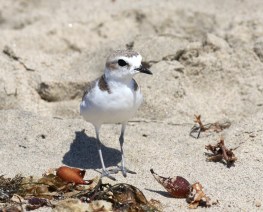
Snowy Plover – note lack of webbing between toes
(R. Ehler 7/26/15)
Four plover species: Killdeer – breeders at the lagoon for many years – are always around, sometimes with chicks in tow. Black-bellied Plovers have returned from their high-arctic breeding grounds; we’ll likely see them until next March or April. Small numbers of Semipalmated Plovers, also arctic breeders, stop briefly during migration, with numbers peaking in April and August-September. Snowy Plovers generally occupy their winter roosts – Malibu Lagoon is one of only seven such roosts in all of Los Angeles County – from June-July to April-May. They had been absent since January, but finally returned with 1 bird on 28 June and 16 birds on 26 July.
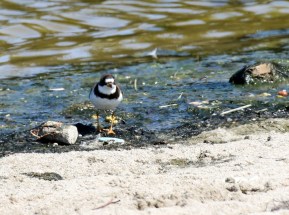
Semipalmated Plover – some “semi”-webbing of toes visible (R. Ehler 7/26/15)
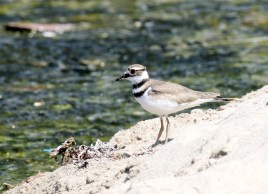
Yet another plover – the Killdeer
(R. Ehler 7/26/15)
Speaking of plovers, there was a recent flap when what may be a very uncommon (in California) Common Ringed Plover (CRPL) showed up on the lower Los Angeles River just south of Willow St. We have links to photos of this bird:
1) Tom Ford-Hutchinson photo with Killdeer, Semipalmated and “mystery bird.”
2) Tom Benson photo showing the toes and webbing.
On-line discussion ensued as to how to distinguish them from the very similar Semipalmated Plover (SEPL).
The best marks seem to be: 1) orbital ring (skin): not yellow/orange in CRPL; 2) chest band a bit bolder and thicker in CRPL; 3) white above & behind eye a bit bolder in CRPL; 4) foot-webbing: SEPL webbed between all 3 front toes, CRPL webbed only between outer & middle toe. I looked through a bunch of photographs after reading this discussion and frankly find it very difficult to see the feet well, if at all, with some SEPLs appearing to have no webbing between inner and middle toe. However, if you’ve ever wondered what the “Semipalmated” referred to, now you know: it’s the short webs between their toes. Other plovers have so little webbing that it’s not worth mentioning. Check the feet (as best you can) in the accompanying pictures.
The discussion was a good example of how birders think and analyze:
1) Tom Ford-Hutchinson’s comments include the “confusion in the literature” about toe-webbing.
2) Tom Benson gives a good synopsis of observations of this particular bird.
3) High-Arctic birder Clare Kines has studied both species on their breeding grounds on Baffin Island, and has a great discussion on his website 10,000 Birds.
Birds new for the season were: Red-breasted Merganser, Black-crowned Night-Heron, Black-bellied and Semipalmated Plovers, Ruddy Turnstone, Western Sandpiper, and Common Yellowthroat.

Still-colorful Ruddy Turnstone (R. Ehler 7/26/15)
Our next three scheduled field trips: Malibu Lagoon, 23 August, 8:30 & 10am. Lower Los Angeles River, 12 September, 7:30am. Malibu Lagoon, 27 September, 8:30 & 10am.
Our next program: Evening meetings will resume on Tuesday, 6 October, 7:30 pm, at [note change] Chris Reed Park, 1133 7th St., NE corner of 7th and Wilshire Blvd. in Santa Monica.
NOTE: Our 10 a.m. Parent’s & Kids Birdwalk meets at the shaded viewing area. Watch for Willie the Weasel. He’ll be watching for you and your big feet.

Some spots remain on this Willet (R. Ehler 7/26/15)
Links: Unusual birds at Malibu Lagoon
9/23/02 Aerial photo of Malibu Lagoon
Prior checklists:
2015: Jan-May
2014: Jan-July, July-Dec 2013: Jan-June, July-Dec
2012: Jan-June, July-Dec 2011: Jan-June, July-Dec
2010: Jan-June, July-Dec 2009: Jan-June, July-Dec
The 10-year comparison summaries created during the project period, despite numerous complaints, remain available on our Lagoon Project Bird Census Page. Very briefly summarized, the results unexpectedly indicate that avian species diversification and numbers improved slightly during the period Jun’12-June’14. [Chuck Almdale]
| Malibu Census 2015 | 1/25 | 2/22 | 3/22 | 4/26 | 5/24 | 7/26 |
| Temperature | 73-81 | 55-63 | 60-70 | 66-76 | 59-70 | 70-82 |
| Tide Lo/Hi Height | L+1.32 | H+4.51 | H+4.78 | L+0.58 | L+0.54 | L+2.37 |
| Tide Time | 0705 | 1137 | 1137 | 1131 | 0919 | 1135 |
| Brant | 3 | 7 | 1 | |||
| Canada Goose | 1 | 30 | ||||
| Gadwall | 22 | 30 | 1 | 10 | 22 | 5 |
| American Wigeon | 18 | 18 | ||||
| Mallard | 12 | 12 | 12 | 8 | 8 | 55 |
| Northern Shoveler | 25 | 2 | ||||
| Northern Pintail | 2 | 3 | ||||
| Green-winged Teal | 25 | 12 | ||||
| Surf Scoter | 13 | 15 | ||||
| Bufflehead | 4 | 2 | 2 | |||
| Red-brstd Merganser | 4 | 2 | 2 | 1 | ||
| Ruddy Duck | 38 | 35 | 30 | 4 | ||
| Red-throated Loon | 1 | 3 | ||||
| Pacific Loon | 1 | 3 | 1 | |||
| Common Loon | 1 | 5 | ||||
| Pied-billed Grebe | 2 | 1 | 2 | 1 | 3 | |
| Horned Grebe | 2 | 1 | 1 | 1 | ||
| Eared Grebe | 3 | 1 | ||||
| Western Grebe | 5 | 15 | 12 | 2 | 1 | |
| Brandt’s Cormorant | 1 | 4 | 1 | |||
| Dble-crstd Cormorant | 35 | 50 | 45 | 16 | 55 | 34 |
| Pelagic Cormorant | 1 | 1 | 1 | 4 | 2 | |
| Brown Pelican | 50 | 28 | 27 | 1490 | 70 | 17 |
| Great Blue Heron | 2 | 2 | 1 | 2 | 2 | 4 |
| Great Egret | 2 | 10 | 5 | 5 | 4 | |
| Snowy Egret | 16 | 26 | 12 | 12 | 4 | 6 |
| Cattle Egret | 1 | |||||
| Blk-crwnd N-Heron | 2 | |||||
| Osprey | 1 | 1 | 1 | |||
| Red-shouldered Hawk | 1 | |||||
| Red-tailed Hawk | 1 | 1 | ||||
| American Coot | 88 | 145 | 45 | 1 | 1 | |
| American Avocet | 1 | |||||
| Blk-bellied Plover | 62 | 85 | 6 | 1 | 27 | |
| Snowy Plover | 29 | 16 | ||||
| Semipalmated Plover | 9 | 1 | ||||
| Killdeer | 12 | 12 | 3 | 2 | 6 | 4 |
| Spotted Sandpiper | 3 | 3 | 2 | 1 | ||
| Willet | 4 | 3 | 3 | 1 | 1 | 6 |
| Whimbrel | 4 | 4 | 10 | 12 | 1 | 13 |
| Long-billed Curlew | 1 | |||||
| Marbled Godwit | 12 | 10 | 8 | 2 | ||
| Ruddy Turnstone | 5 | 1 | 3 | |||
| Surfbird | 4 | |||||
| Sanderling | 8 | |||||
| Dunlin | 1 | |||||
| Least Sandpiper | 15 | |||||
| Western Sandpiper | 45 | 1 | ||||
| Boneparte’s Gull | 12 | 6 | 1 | |||
| Heermann’s Gull | 17 | 1 | 6 | 350 | 45 | 14 |
| Ring-billed Gull | 150 | 90 | 3 | 30 | 8 | |
| Western Gull | 170 | 95 | 3 | 110 | 135 | 40 |
| California Gull | 1650 | 1600 | 40 | 600 | 6 | 2 |
| Herring Gull | 1 | |||||
| Glaucous-wingd Gull | 5 | 4 | 1 | 1 | ||
| Caspian Tern | 10 | 11 | 1 | |||
| Forster’s Tern | 2 | |||||
| Royal Tern | 42 | 35 | 15 | 4 | 2 | 3 |
| Elegant Tern | 28 | 3100 | 85 | 45 | ||
| Rock Pigeon | 4 | 5 | 23 | 8 | 9 | 4 |
| Mourning Dove | 3 | 2 | 2 | 2 | 2 | 7 |
| Anna’s Hummingbird | 1 | 1 | 2 | 2 | 1 | |
| Allen’s Hummingbird | 2 | 3 | 6 | 4 | 6 | 3 |
| Belted Kingfisher | 1 | |||||
| American Kestrel | 1 | |||||
| Black Phoebe | 1 | 2 | 2 | 2 | 2 | 4 |
| Say’s Phoebe | 1 | |||||
| American Crow | 4 | 6 | 5 | 6 | 5 | 4 |
| Common Raven | 2 | |||||
| Rough-wingd Swallow | 4 | 4 | 6 | 3 | ||
| Barn Swallow | 2 | 6 | 12 | 12 | ||
| Cliff Swallow | 2 | 10 | 12 | |||
| Oak Titmouse | 1 | 1 | ||||
| Bushtit | 14 | 2 | 2 | |||
| Blue-gray Gnatcatcher | 1 | |||||
| Hermit Thrush | 2 | |||||
| American Robin | 1 | 1 | ||||
| Northern Mockingbird | 1 | 1 | 3 | 6 | 3 | 4 |
| European Starling | 45 | 3 | 4 | 10 | 3 | 25 |
| Cedar Waxwing | 40 | |||||
| Common Yellowthroat | 3 | 3 | 2 | 5 | ||
| Yellow-rumpd Warbler | 7 | 8 | 5 | |||
| Townsend’s Warbler | 1 | |||||
| Spotted Towhee | 1 | |||||
| California Towhee | 1 | 3 | 2 | 2 | 4 | |
| Song Sparrow | 2 | 6 | 9 | 6 | 9 | 5 |
| White-crwnd Sparrow | 4 | 12 | 10 | |||
| Red-winged Blackbird | 2 | |||||
| Western Meadowlark | 24 | 10 | 3 | |||
| Brewer’s Blackbird | 2 | |||||
| Great-tailed Grackle | 5 | 4 | 4 | 3 | 3 | |
| Brwn-headed Cowbird | 4 | 4 | ||||
| Hooded Oriole | 3 | |||||
| House Finch | 4 | 4 | 12 | 20 | 2 | |
| Lesser Goldfinch | 2 | 1 | ||||
| Totals by Type | Jan | Feb | Mar | Apr | May | Jul |
| Waterfowl | 138 | 154 | 50 | 55 | 37 | 62 |
| Water Birds – Other | 187 | 247 | 144 | 1511 | 134 | 57 |
| Herons, Egrets & Ibis | 18 | 30 | 24 | 19 | 11 | 16 |
| Quail & Raptors | 2 | 2 | 1 | 1 | 1 | 0 |
| Shorebirds | 139 | 119 | 37 | 89 | 8 | 71 |
| Gulls & Terns | 2035 | 1825 | 107 | 4213 | 294 | 105 |
| Doves | 7 | 7 | 25 | 10 | 11 | 11 |
| Other Non-Passerines | 3 | 3 | 7 | 7 | 8 | 4 |
| Passerines | 106 | 61 | 76 | 104 | 86 | 85 |
| Totals Birds | 2635 | 2448 | 471 | 6009 | 590 | 411 |
| Total Species | Jan | Feb | Mar | Apr | May | Jul |
| Waterfowl | 9 | 10 | 7 | 5 | 3 | 4 |
| Water Birds – Other | 9 | 11 | 9 | 6 | 8 | 5 |
| Herons, Egrets & Ibis | 2 | 3 | 4 | 3 | 3 | 4 |
| Quail & Raptors | 2 | 2 | 1 | 1 | 1 | 0 |
| Shorebirds | 9 | 8 | 8 | 10 | 3 | 8 |
| Gulls & Terns | 7 | 6 | 7 | 10 | 9 | 6 |
| Doves | 2 | 2 | 2 | 2 | 2 | 2 |
| Other Non-Passerines | 2 | 1 | 2 | 3 | 2 | 2 |
| Passerines | 16 | 14 | 17 | 13 | 17 | 13 |
| Totals Species – 95 | 58 | 57 | 57 | 53 | 48 | 44 |
Boomers, Birders and Hearing Aids
I happen to be on the leading crest of an incoming wave of aging baby boomers, and my hearing is going, going…away. Behind me are millions more boomers: I wonder how prepared they are for the nuisances of aging which increasingly pester me, or do they still think themselves immortal? One nuisance, important for birders, is hearing loss. Like it or not, ready or not, many of you will get it, so here’s a few comments you may find useful.

Not the best hearing aid design available.
(Vimeo – “The Reinvention of Normal” A Liam Saint-Pierre Film)
After about 5 years of progressively losing bird songs & calls – starting with Golden-crowned Kinglet and working my way well down into the range of human speech, I bit the bullet and bought a pair of hearing aids. I’d taken a few years for research and to psychologically prepare myself, and by the time I got them, it was no big deal.
Mine are ‘mini-behind-the-ear’ style, the Pure Caret CE0123 by Siemens. They aren’t cheap. Other manufacturers making the same style may use different descriptive phrases.
Advantages of this model: 15 volume settings, 5 modes, small, perforated plastic ear cups inside the ear canal permit air and sound to pass by the tiny speaker so you don’t have that “plugged-up” feeling, batteries last about 14-22 days; modes are designed for your individual pattern of hearing loss; the aids “talk” to each other, so one aid can select the mode for both ears, while the other aid adjusts volume for both ears.
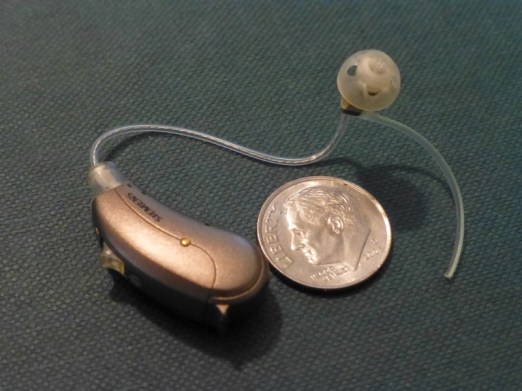
Disadvantages: not water-proof, visible by others (if you care) if you have little hair or no hat, not cheap, need daily wax removal, subject to “wind noise,” may increase difficulty of locating direction of sound.
I had the technician create a birding mode for me which really cranks up the volume for high frequencies – but I can’t use it if people are talking or there’s any ambient sound I can’t control (voices, traffic, music, etc.). Crunching through dry leaves is excruciating.
I’m very happy with them and had minimal difficulty adapting to them. It’s very nice to again understand my wife, hear musical overtones, hear TV and Radio without blasting them, and it’s especially rewarding to hear birds again. I didn’t know they were so noisy right outside my bedroom window, the pesky little critters. Warblers are great. Last year a California Towhee lived in our back yard and, pining for a mate, sang nonstop for a couple of months.
Common Questions answered:
How long have you had them? Any problems? I’ve had them about 3 ½ years. I think my hearing continues to diminish slowly.
Recently I concluded that the aids may emit a sound that honeybees (not solitary bees) don’t like – 3 stings in 3 years. Each time they seemed to home in on my ears. I asked if others had this problem: birders hadn’t, beekeepers have. From now on, when I see a honeybee heading my way, off go the aids.
Are they reliable? I’ve had no problems, but others, who may have gotten lemons, reported having problems within a few months.
How is birding with them? Far, far better, for the reasons given above. But there are two problems: wind and direction of sound.
Wind? Strong or gusty wind makes a loud rattly noise and I have to turn them off.
Direction of sound? My hearing loss and increasing tinnitus developed unequally in both ears, causing me to lose the ability to tell direction of sound from side-to-side or up-and-down. This has not returned, possibly because the sound pickups are behind my ears. I can tell that a bird is singing, but not from where. It’s very frustrating.
Cleaning? I brush them each morning before inserting them. Accumulated earwax hardens overnight at room temperature, making it easy to remove. I think my earwax production declined because wax buildup has dropped to nearly nothing. About once a year, when they’ve gotten a bit gunky, I take them to the retailer for a free cleaning and ear cup replacement.
Do they ever fall out? It’s easy to snag the behind-the-ear unit with your hat cord, glasses, etc. However, the plastic cup in the ear canal keeps them from popping out entirely. Once one fell onto a wood floor, with no damage. One birder lost an aid when – onboard a boat – the wind whipped his hat off, the chin cord snagged an aid, and into the water it went. They’ve also gotten damp from rain and humidity but suffered no damaged.
How long can you wear them? Do they irritate your ears? On birding tours, I wear them from bedrise to bedset. Occasionally, when an ear canal feels itchy, I pull out the aid, wiggle my finger in my ear, re-insert the aid and the problem is gone.
Any screeching feedback? My birding hat, always worn, has a 2-3″ brim which sits just above my ears, and reflects sound to the behind-the-ear microphone. At higher volumes, this creates a tinny ‘talking-down-a-metal-pipe’ sound, especially in birding mode. Either I remove the hat, turn down the volume or change the mode. No one has ever said that my aids emitted feedback.
How high in frequency do they go? I may have known at purchase, but no longer; web research made me no wiser. Other than the more distant songbirds, I seem to hear what people around me hear, except those annoying professional bird tour leaders with unbelievable wolfish ears. I recently heard Golden-crowned Kinglets calling, but they were about 30 ft. away.
What are the ‘modes’? 1) Normal conversation, 2) group, 3) tinnitus, 4) birding, 5) “sports.” I use #1 about 90% of the time. #2 is for noisy restaurants or groups. #3 is – for me – “off.” It’s white noise which I cannot hear, and is supposed to help adaptation to tinnitus, which I’ve had for over 35 years and already learned to ignore. #4 Boosts highs tones, greatly enhancing bird song, but can’t be used when people are (or are likely to be) talking, or when crunching over gravel or dry leaves. #5 is a mystery – I couldn’t get the aid retailer to coherently explain what it did, other than being “good for sports events.”
Can you understand group conversations? This never returned to pre-loss levels, but ‘group’ mode works pretty well most of the time. In places with highly sound-reflective walls-ceilings-floors (e.g. many restaurants), and thus a great deal of echoing ambient noise, it can be very difficult. I try to stay away from such places. [I hated those places before I lost my hearing, so no great inconvenience there.] I adjust the volume and try to face the speaker of the moment. Not being embarrassed about hearing loss means not caring if others see me fiddling with my ear.
Are your batteries rechargeable? No. Rechargers seem to start around $40 and go much higher, and a pair of rechargeable batteries at $20 ($14 at Amazon). One birder reported having two chargers die within a six-month period. If a rechargeable aid battery is anything like a rechargeable AA battery, the charge won’t hold as long.
How long do your batteries last? At first I averaged 21 days per pair of #13 non-rechargeable batteries, primarily because I inserted them when evening TV-time arrived. Now I usually wear them all day, and I get 14-16 days before they die. Others report getting 6-7 days per pair, 12 hours per day. Perhaps they have greater hearing loss and need stronger aids which use more juice per minute than mine. At $7 for an 8-pack, my batteries cost about $30/year and are certainly less hassle at possibly a lower cost than rechargables. Aid retailers commonly give you free batteries for a year or two. The batteries have a steep power-loss curve at the end, meaning that I don’t notice the power is diminishing until perhaps a day before they die altogether.
Will insurance cover the cost? Yours might, my HMO coverage didn’t. You’ll need a hearing test and a recommendation for aids from an audiologist before the insurance company will agree to pay. The hearing aid retailer will probably re-test your hearing for “free.” Such test results are necessary for the aid technician to adjust the aid’s internal computer to your hearing loss profile.
Is it possible to have one mode in one aid and a different mode in the second aid? Some people buy (or need) only one aid, so that aid must be able to adjust both volume and mode. With two such aids, it should be possible but that sounds to me like a good way to get a headache.
Telephone mode? I don’t have it: I wasn’t sure it would work with our ancient land lines and cheap cellular phone, it costs a couple of hundred more, and I don’t talk a lot on the phone. I hear phone conversation just fine 95% of the time – when I can’t, it’s not the aids’ fault, but because the other person has their mouth too far from their tiny microphone. They speak up when I ask them to, and I hear fine.
Do you have molded ear cups? No. The retailer gives me little saucer-shaped ones (see photo) for free, which work fine.
What about the SongFinder hearing amplification device for birders? I haven’t tried it. I don’t like the way they look and I wouldn’t want to wear one around the house or at the theater or restaurant. Reportedly they work well in the field; one birder said he loved his, but it cannot be used while wearing hearing aids.
What about TV hearing devices? I haven’t tried any “remote transmission from TV” gizmos. I thought about them, but the aids work fine 98% of the time.
Loud Travel Alarm Clocks? Research led me to Sonic Alert Model SBP100, $26.14 from Amazon. It’s loud, vibrates, can clip to your pillow, and got me up for those pre-dawn risings inevitable on bird trips. Many other options exist.

Are there any web forums for hearing aid users? I entered “hearing loss chat room” into Google and got 814,000 hits, which seems sufficient to me.
Why did you buy this type (mini-behind-the-ear) rather than another?
1. I wasn’t vain about people seeing my aids, so I wasn’t dead set on the ones that hide completely-in-the-canal.
2. I’ve long had a problem with equalizing pressure in my inner ears, and I didn’t want anything which – by blocking the canal – might exacerbate it. (For reasons unknown to me, my aids seem to have nearly eliminated this annoying condition.) I’d read that in-the-canal aids or anything which projects sound through a hollow tube plug up your ear canal, making your ears feel “stuffy.” My aids have a sound pickup behind the ear; a little wire with a tiny speaker on the end runs into the canal.
3. I wanted to avoid aids which emit loud high-pitched feedback squeals audible to everyone except the wearer.
4. They were expensive – over $4k after the 20% discount they gave to patients of my HMO – but I figured, what the heck – I could afford it and if I didn’t like them, I had 30 days to get my money back.
As the tsunami of aging boomers continues to break, we’re going to be flooded with new products for old people. Hearing aids are no exception: expect continual introduction of new models with new features, and possible price decreases. If you have a few extra bucks lying around, you might invest them in a company that specializes in geezer goodies. I hear it’s a growing market.
Addition questions or information are welcome. If useful and pertinent, I’ll add them to this blog. [Chuck Almdale]



 SANTA MONICA BAY AUDUBON SOCIETY BLOG