Skip to content

Free email delivery

Please sign up for email delivery in the subscription area to the right.
No salesman will call, at least not from us. Maybe from someone else.

Clements Checklist of World Birds – Updated August, 2015

August 16, 2015

The 6th, and final, edition of James Clements The Clements’ Checklist of Birds of the World was published in 2006, by which time it had become the checklist of choice for most North American birders, especially members of the American Birding Association (ABA). Following the death of Jim Clements (former president of Santa Monica Bay Audubon Society, by the way), the responsibility for its maintenance and update was assumed by The Cornell Laboratory of Ornithology, under whose auspices it has undergone ten updates since then.

Even if you’re not a World Birder (and you know if you are), it is interesting to have a grasp of the variety and classification of the world’s 10,000+ species of birds. The North American bird list – about 900 species seen, many only once, within Canada and mainland U.S.A. (the ABA area) – is only 9% of the world’s total. If you birded steadily for several years, you might expect to see 79 families in the ABA area, about 1/3rd of the total 235 families of birds. It’s interesting to know how “our” birds fit into this larger picture of the world’s avifauna.

The entire checklist is available for free, downloadable in various formats including Excel. Birds are listed in phylogenetic order, starting with Ostrich and ending – 32,000 lines later – with Parasitic Weaver. It includes all currently recognized Orders, Families, Genera, Species and Subspecies. Also included is additional information on species and subspecies that are closely “grouped” to one another.

Click this for a list and discussion of the latest updates (Aug. 2014 – Aug. 2015)

Some highlights of the latest changes:
1. Species – 10473,   Subspecies – 20697,   Groups – 3013, Families – 234 (with 1 additional, extinct, family)
2. Three newly described species, 73 “splits” and 7 “lumps” for net gain of 69 birds
3. Orders now total 39; new are Leptosomiformes (the Cuckoo-Roller of Madagascar, placed between Mousebirds and Trogons) and Bucerotiformes (Hoopoes, Woodhoopoes & Scimitar-bills, Ground-Hornbills, Hornbills – all Old World birds, mostly tropical, now placed between Trogons and Kingfishers & Allies). The Cuckoo-Roller was previously a monotypic family (a family comprised of a single species) classified within Coraciiformes (Kingfishers & Allies). The four Bucerotiformes families were also previously classified within Coraciiformes.
4. The near-local species Bahama Woodstar was split into 2 species.
5. The following Hawaiian species were changed: Apapane – split into 2 species; Nukupuu – split into 3 species, of which one is extinct and the other two probably extinct; Greater Akialoa – split into 3 species, all extinct; Akepa – split into 3 species, of which one is extinct and another probably extinct. A sad commentary on Hawaiian bird life – extinct before anyone knew they were a separate species.

Here’s a recent (the most recent I could find) diagram of the avian tree of life, from PLOS Currents Tree of Life. It gets bigger and more legible if you view it on the blog and click on it. If you go to their website, they have another, more detailed, diagram.

Simplified summary supertree showing order-level relationshipsfrom PLOS Currents Tree of Life

Simplified summary supertree showing order-level relationships
from PLOS Currents Tree of Life

Now you can figure out just exactly where that Five-toed Farragut you saw last week fits in. [Chuck Almdale]

Malibu Lagoon Trip Report: 26 July, 2015

August 6, 2015

This slideshow requires JavaScript.


If you’re wondering what happened to June, it took place – as we have come to expect – between May and July, and the June lagoon trip took place, as usual, on the fourth Sunday (6/28) of the month. I, however, was elsewhere: Lake Louise in Banff National Park, Alberta, Canada, to be exact. It provided a nice view of a large glacier at the far end of a lovely lake, utterly swamped by enormous crowds of people, and appeared to be the “selfie” capital of the world. It also featured Clark’s Nutcrackers hopping everywhere – including the hotel patio – searching for snacks. If you must go, I recommend the off-season, the offer the better. Thus no lagoon report for June.

Mama Mallard and ducklings (R. Ehler 7/26/15)

Still breeding at the lagoon – Mama Mallard and ducklings (R. Ehler 7/26/15)

This month, about 30 birders enjoyed the usual suspects: Mallards, most of whom were ducklings toodling along after their mothers; diving Pied-billed Grebes, an assortment of herons and egrets, a middling-number of cormorants and Brown Pelicans, sandpipers both large and small, barely 100 gulls & terns in six species (unlike April’s 4200 birds!), and a smattering of passerine species – mostly swallows and starlings.

Curiosity drove me to compare this July to earlier Julys, as it seemed low in both species and numbers.

 Lagoon July Average
Variance Hi-Low range
 Birds July 2015 Prior 12 years from Ave. prior 12 years
Species 44 47.3 -7% 37 – 52
Numbers 411 718.3 -43% 309 – 1428

Species diversification was slightly (-7%) below average, and numbers were definitely down (-43%), but both were well within the normal range of variation. I then checked our records on shorebirds (sandpipers) and gulls/terns.

 Malibu  Lagoon July Average Variance Hi-Low range
Bird Type July 2015 Prior 12 years from Ave. prior 12 years
Shorebirds
Species 8 7.8 3% 2 – 12
Numbers 71 62.8 13% 4 – 163
Gulls-Terns
Species 6 6.6 -9% 3 – 9
Numbers 105 257 -59% 113 – 823

The numbers of shorebirds (stilt, avocet, oystercatcher, plover & sandpipers) were unexpectedly (to me) up 13% from the average. The number of gulls & terns were, as expected, down significantly, by almost 60% below the prior average. Species diversification was average for both. Well…we’ve been reading about lack of food causing breeding failures among gulls and terns, particularly the huge Heermann’s Gull and Elegant Tern nesting colonies on Isla Rasa in the Sea of Cortez. Perhaps these low numbers are a symptom of it. Perhaps not. One data point is not a trend.

Black-bellied Plover, Whimbrel and pickleweed (R. Ehler 8/24/14)

Black-bellied Plover, Whimbrel and pickleweed (R. Ehler 8/24/14)

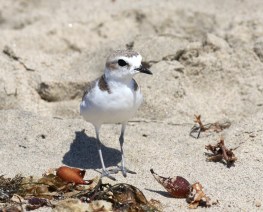
Snowy Plover - note lack of webbing between toes(R. Ehler 7/26/15)

Snowy Plover – note lack of webbing between toes
(R. Ehler 7/26/15)


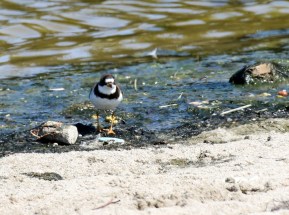
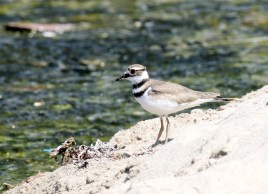
Four plover species: Killdeer – breeders at the lagoon for many years – are always around, sometimes with chicks in tow. Black-bellied Plovers have returned from their high-arctic breeding grounds; we’ll likely see them until next March or April. Small numbers of Semipalmated Plovers, also arctic breeders, stop briefly during migration, with numbers peaking in April and August-September. Snowy Plovers generally occupy their winter roosts – Malibu Lagoon is one of only seven such roosts in all of Los Angeles County – from June-July to April-May. They had been absent since January, but finally returned with 1 bird on 28 June and 16 birds on 26 July.

Semipalmated Plover - some "semi"-webbing of toes  visible(R. Ehler 7/26/15)

Semipalmated Plover – some “semi”-webbing of toes visible (R. Ehler 7/26/15)

Yet another plover - the Killdeer (R. Ehler 7/26/15)

Yet another plover – the Killdeer
(R. Ehler 7/26/15)

 Speaking of plovers, there was a recent flap when what may be a very uncommon (in California) Common Ringed Plover (CRPL)  showed up on the lower Los Angeles River just south of Willow St. We have links to photos of this bird:
1) Tom Ford-Hutchinson photo with Killdeer, Semipalmated and “mystery bird.”
2) Tom Benson photo showing the toes and webbing.

On-line discussion ensued as to how to distinguish them from the very similar Semipalmated Plover (SEPL).
The best marks seem to be: 1) orbital ring (skin): not yellow/orange in CRPL; 2) chest band a bit bolder and thicker in CRPL; 3) white above & behind eye a bit bolder in CRPL; 4) foot-webbing: SEPL webbed between all 3 front toes, CRPL webbed only between outer & middle toe. I looked through a bunch of photographs after reading this discussion and frankly find it very difficult to see the feet well, if at all, with some SEPLs appearing to have no webbing between inner and middle toe. However, if you’ve ever wondered what the “Semipalmated” referred to, now you know: it’s the short webs between their toes. Other plovers have so little webbing that it’s not worth mentioning. Check the feet (as best you can) in the accompanying pictures.

The discussion was a good example of how birders think and analyze:
1) Tom Ford-Hutchinson’s comments include the “confusion in the literature” about toe-webbing.
2) Tom Benson gives a good synopsis of observations of this particular bird.
3) High-Arctic birder Clare Kines has studied both species on their breeding grounds on Baffin Island, and has a great discussion on his website 10,000 Birds.

Birds new for the season were: Red-breasted Merganser, Black-crowned Night-Heron, Black-bellied and Semipalmated Plovers,  Ruddy Turnstone, Western Sandpiper, and Common Yellowthroat.

Still-colorful Ruddy Turnstone (R. Ehler 7/26/15)

Still-colorful Ruddy Turnstone (R. Ehler 7/26/15)

Our next three scheduled field trips:  Malibu Lagoon, 23 August, 8:30 & 10am. Lower Los Angeles River, 12 September, 7:30am. Malibu Lagoon, 27 September, 8:30 & 10am.

Our next program: Evening meetings will resume on Tuesday, 6 October, 7:30 pm, at [note change] Chris Reed Park, 1133 7th St., NE corner of 7th and Wilshire Blvd. in Santa Monica.

NOTE: Our 10 a.m. Parent’s & Kids Birdwalk meets at the shaded viewing area. Watch for Willie the Weasel. He’ll be watching for you and your big feet.

Some spots remain on this Willet (R. Ehler 7/26/15)

Some spots remain on this Willet (R. Ehler 7/26/15)

Links: Unusual birds at Malibu Lagoon
9/23/02 Aerial photo of Malibu Lagoon
Prior checklists:
2015:   Jan-May
2014:   Jan-July,    July-Dec
     2013:   Jan-June,   July-Dec
2012:   Jan-June,   July-Dec
   2011:   Jan-June,   July-Dec
2010:  Jan-June,   July-Dec
     2009:  Jan-June  July-Dec

The 10-year comparison summaries created during the project period, despite numerous complaints, remain available on our Lagoon Project Bird Census Page. Very briefly summarized, the results unexpectedly indicate that avian species diversification and numbers improved slightly during the period Jun’12-June’14.   [Chuck Almdale]

Malibu Census 2015 1/25 2/22 3/22 4/26 5/24 7/26
Temperature 73-81 55-63 60-70 66-76 59-70 70-82
Tide Lo/Hi Height L+1.32 H+4.51 H+4.78 L+0.58 L+0.54 L+2.37
Tide Time 0705 1137 1137 1131 0919 1135
Brant 3 7 1
Canada Goose 1 30
Gadwall 22 30 1 10 22 5
American Wigeon 18 18
Mallard 12 12 12 8 8 55
Northern Shoveler 25 2
Northern Pintail 2 3
Green-winged Teal 25 12
Surf Scoter 13 15
Bufflehead 4 2 2
Red-brstd Merganser 4 2 2 1
Ruddy Duck 38 35 30 4
Red-throated Loon 1 3
Pacific Loon 1 3 1
Common Loon 1 5
Pied-billed Grebe 2 1 2 1 3
Horned Grebe 2 1 1 1
Eared Grebe 3 1
Western Grebe 5 15 12 2 1
Brandt’s Cormorant 1 4 1
Dble-crstd Cormorant 35 50 45 16 55 34
Pelagic Cormorant 1 1 1 4 2
Brown Pelican 50 28 27 1490 70 17
Great Blue Heron 2 2 1 2 2 4
Great Egret 2 10 5 5 4
Snowy Egret 16 26 12 12 4 6
Cattle Egret 1
Blk-crwnd N-Heron 2
Osprey 1 1 1
Red-shouldered Hawk 1
Red-tailed Hawk 1 1
American Coot 88 145 45 1 1
American Avocet 1
Blk-bellied Plover 62 85 6 1 27
Snowy Plover 29 16
Semipalmated Plover 9 1
Killdeer 12 12 3 2 6 4
Spotted Sandpiper 3 3 2 1
Willet 4 3 3 1 1 6
Whimbrel 4 4 10 12 1 13
Long-billed Curlew 1
Marbled Godwit 12 10 8 2
Ruddy Turnstone 5 1 3
Surfbird 4
Sanderling 8
Dunlin 1
Least Sandpiper 15
Western Sandpiper 45 1
Boneparte’s Gull 12 6 1
Heermann’s Gull 17 1 6 350 45 14
Ring-billed Gull 150 90 3 30 8
Western Gull 170 95 3 110 135 40
California Gull 1650 1600 40 600 6 2
Herring Gull 1
Glaucous-wingd Gull 5 4 1 1
Caspian Tern 10 11 1
Forster’s Tern 2
Royal Tern 42 35 15 4 2 3
Elegant Tern 28 3100 85 45
Rock Pigeon 4 5 23 8 9 4
Mourning Dove 3 2 2 2 2 7
Anna’s Hummingbird 1 1 2 2 1
Allen’s Hummingbird 2 3 6 4 6 3
Belted Kingfisher 1
American Kestrel 1
Black Phoebe 1 2 2 2 2 4
Say’s Phoebe 1
American Crow 4 6 5 6 5 4
Common Raven 2
Rough-wingd Swallow 4 4 6 3
Barn Swallow 2 6 12 12
Cliff Swallow 2 10 12
Oak Titmouse 1 1
Bushtit 14 2 2
Blue-gray Gnatcatcher 1
Hermit Thrush 2
American Robin 1 1
Northern Mockingbird 1 1 3 6 3 4
European Starling 45 3 4 10 3 25
Cedar Waxwing 40
Common Yellowthroat 3 3 2 5
Yellow-rumpd Warbler 7 8 5
Townsend’s Warbler 1
Spotted Towhee 1
California Towhee 1 3 2 2 4
Song Sparrow 2 6 9 6 9 5
White-crwnd Sparrow 4 12 10
Red-winged Blackbird 2
Western Meadowlark 24 10 3
Brewer’s Blackbird 2
Great-tailed Grackle 5 4 4 3 3
Brwn-headed Cowbird 4 4
Hooded Oriole 3
House Finch 4 4 12 20 2
Lesser Goldfinch 2 1
Totals by Type Jan Feb Mar Apr May Jul
Waterfowl 138 154 50 55 37 62
Water Birds – Other 187 247 144 1511 134 57
Herons, Egrets & Ibis 18 30 24 19 11 16
Quail & Raptors 2 2 1 1 1 0
Shorebirds 139 119 37 89 8 71
Gulls & Terns 2035 1825 107 4213 294 105
Doves 7 7 25 10 11 11
Other Non-Passerines 3 3 7 7 8 4
Passerines 106 61 76 104 86 85
Totals Birds 2635 2448 471 6009 590 411
             
Total Species Jan Feb Mar Apr May Jul
Waterfowl 9 10 7 5 3 4
Water Birds – Other 9 11 9 6 8 5
Herons, Egrets & Ibis 2 3 4 3 3 4
Quail & Raptors 2 2 1 1 1 0
Shorebirds 9 8 8 10 3 8
Gulls & Terns 7 6 7 10 9 6
Doves 2 2 2 2 2 2
Other Non-Passerines 2 1 2 3 2 2
Passerines 16 14 17 13 17 13
Totals Species – 95 58 57 57 53 48 44


Boomers, Birders and Hearing Aids

July 22, 2015
by

 I happen to be on the leading crest of an incoming wave of aging baby boomers, and my hearing is going, going…away. Behind me are millions more boomers: I wonder how prepared they are for the nuisances of aging which increasingly pester me, or do they still think themselves immortal? One nuisance, important for birders, is hearing loss. Like it or not, ready or not, many of you will get it, so here’s a few comments you may find useful.

Don't try this at home, Kids!(Vimeo - "The Reinvention of Normal" A Liam Saint-Pierre Film)

Not the best hearing aid design available.
(Vimeo – “The Reinvention of Normal” A Liam Saint-Pierre Film)

After about 5 years of progressively losing bird songs & calls – starting with Golden-crowned Kinglet and working my way well down into the range of human speech, I bit the bullet and bought a pair of hearing aids. I’d taken a few years for research and to psychologically prepare myself, and by the time I got them, it was no big deal.

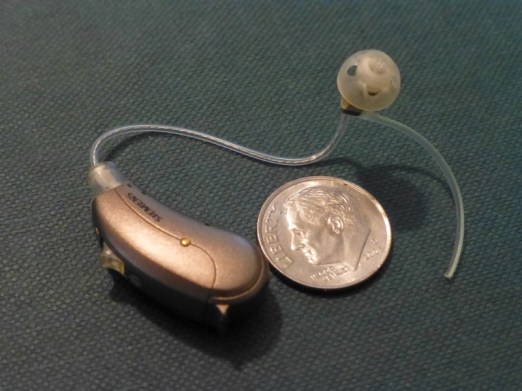
Mine are ‘mini-behind-the-ear’ style, the Pure Caret CE0123 by Siemens. They aren’t cheap. Other manufacturers making the same style may use different descriptive phrases.

Advantages of this model: 15 volume settings, 5 modes, small, perforated plastic ear cups inside the ear canal permit air and sound to pass by the tiny speaker so you don’t have that “plugged-up” feeling, batteries last about 14-22 days; modes are designed for your individual pattern of hearing loss; the aids “talk” to each other, so one aid can select the mode for both ears, while the other aid adjusts volume for both ears.
Hearing Aid_SCR800
Disadvantages: not water-proof, visible by others (if you care) if you have little hair or no hat, not cheap, need daily wax removal, subject to “wind noise,” may increase difficulty of locating direction of sound.

I had the technician create a birding mode for me which really cranks up the volume for high frequencies – but I can’t use it if people are talking or there’s any ambient sound I can’t control (voices, traffic, music, etc.). Crunching through dry leaves is excruciating.

I’m very happy with them and had minimal difficulty adapting to them. It’s very nice to again understand my wife, hear musical overtones, hear TV and Radio without blasting them, and it’s especially rewarding to hear birds again. I didn’t know they were so noisy right outside my bedroom window, the pesky little critters. Warblers are great. Last year a California Towhee lived in our back yard and, pining for a mate, sang nonstop for a couple of months.

Common Questions answered:
How long have you had them? Any problems? I’ve had them about 3 ½ years. I think my hearing continues to diminish slowly.
Recently I concluded that the aids may emit a sound that honeybees (not solitary bees) don’t like – 3 stings in 3 years. Each time they seemed to home in on my ears. I asked if others had this problem: birders hadn’t, beekeepers have. From now on, when I see a honeybee heading my way, off go the aids.

Are they reliable? I’ve had no problems, but others, who may have gotten lemons, reported having problems within a few months.

How is birding with them? Far, far better, for the reasons given above. But there are two problems: wind and direction of sound.

Wind? Strong or gusty wind makes a loud rattly noise and I have to turn them off.

Direction of sound? My hearing loss and increasing tinnitus developed unequally in both ears, causing me to lose the ability to tell direction of sound from side-to-side or up-and-down. This has not returned, possibly because the sound pickups are behind my ears. I can tell that a bird is singing, but not from where. It’s very frustrating.

Cleaning? I brush them each morning before inserting them. Accumulated earwax hardens overnight at room temperature, making it easy to remove. I think my earwax production declined because wax buildup has dropped to nearly nothing. About once a year, when they’ve gotten a bit gunky, I take them to the retailer for a free cleaning and ear cup replacement.

Do they ever fall out? It’s easy to snag the behind-the-ear unit with your hat cord, glasses, etc. However, the plastic cup in the ear canal keeps them from popping out entirely. Once one fell onto a wood floor, with no damage. One birder lost an aid when – onboard a boat – the wind whipped his hat off, the chin cord snagged an aid, and into the water it went. They’ve also gotten damp from rain and humidity but suffered no damaged.

How long can you wear them? Do they irritate your ears? On birding tours, I wear them from bedrise to bedset. Occasionally, when an ear canal feels itchy, I pull out the aid, wiggle my finger in my ear, re-insert the aid and the problem is gone.

Any screeching feedback? My birding hat, always worn, has a 2-3″ brim which sits just above my ears, and reflects sound to the behind-the-ear microphone. At higher volumes, this creates a tinny ‘talking-down-a-metal-pipe’ sound, especially in birding mode. Either I remove the hat, turn down the volume or change the mode. No one has ever said that my aids emitted feedback.

How high in frequency do they go? I may have known at purchase, but no longer; web research made me no wiser. Other than the more distant songbirds, I seem to hear what people around me hear, except those annoying professional bird tour leaders with unbelievable wolfish ears. I recently heard Golden-crowned Kinglets calling, but they were about 30 ft. away.

What are the ‘modes’? 1) Normal conversation, 2) group, 3) tinnitus, 4) birding, 5) “sports.” I use #1 about 90% of the time. #2 is for noisy restaurants or groups. #3 is – for me – “off.” It’s white noise which I cannot hear, and is supposed to help adaptation to tinnitus, which I’ve had for over 35 years and already learned to ignore. #4 Boosts highs tones, greatly enhancing bird song, but can’t be used when people are (or are likely to be) talking, or when crunching over gravel or dry leaves. #5 is a mystery – I couldn’t get the aid retailer to coherently explain what it did, other than being “good for sports events.”

Can you understand group conversations? This never returned to pre-loss levels, but ‘group’ mode works pretty well most of the time. In places with highly sound-reflective walls-ceilings-floors (e.g. many restaurants), and thus a great deal of echoing ambient noise, it can be very difficult. I try to stay away from such places. [I hated those places before I lost my hearing, so no great inconvenience there.] I adjust the volume and try to face the speaker of the moment. Not being embarrassed about hearing loss means not caring if others see me fiddling with my ear.

Are your batteries rechargeable? No. Rechargers seem to start around $40 and go much higher, and a pair of rechargeable batteries at $20 ($14 at Amazon). One birder reported having two chargers die within a six-month period. If a rechargeable aid battery is anything like a rechargeable AA battery, the charge won’t hold as long.

How long do your batteries last? At first I averaged 21 days per pair of #13 non-rechargeable batteries, primarily because I inserted them when evening TV-time arrived. Now I usually wear them all day, and I get 14-16 days before they die. Others report getting 6-7 days per pair, 12 hours per day. Perhaps they have greater hearing loss and need stronger aids which use more juice per minute than mine. At $7 for an 8-pack, my batteries cost about $30/year and are certainly less hassle at possibly a lower cost than rechargables. Aid retailers commonly give you free batteries for a year or two. The batteries have a steep power-loss curve at the end, meaning that I don’t notice the power is diminishing until perhaps a day before they die altogether.

Will insurance cover the cost? Yours might, my HMO coverage didn’t. You’ll need a hearing test and a recommendation for aids from an audiologist before the insurance company will agree to pay. The hearing aid retailer will probably re-test your hearing for “free.” Such test results are necessary for the aid technician to adjust the aid’s internal computer to your hearing loss profile.

Is it possible to have one mode in one aid and a different mode in the second aid? Some people buy (or need) only one aid, so that aid must be able to adjust both volume and mode. With two such aids, it should be possible but that sounds to me like a good way to get a headache.

Telephone mode? I don’t have it: I wasn’t sure it would work with our ancient land lines and cheap cellular phone, it costs a couple of hundred more, and I don’t talk a lot on the phone. I hear phone conversation just fine 95% of the time – when I can’t, it’s not the aids’ fault, but because the other person has their mouth too far from their tiny microphone. They speak up when I ask them to, and I hear fine.

Do you have molded ear cups? No. The retailer gives me little saucer-shaped ones (see photo) for free, which work fine.

What about the SongFinder hearing amplification device for birders? I haven’t tried it. I don’t like the way they look and I wouldn’t want to wear one around the house or at the theater or restaurant. Reportedly they work well in the field; one birder said he loved his, but it cannot be used while wearing hearing aids.

What about TV hearing devices? I haven’t tried any “remote transmission from TV” gizmos. I thought about them, but the aids work fine 98% of the time.

Loud Travel Alarm Clocks? Research led me to Sonic Alert Model SBP100, $26.14 from Amazon. It’s loud, vibrates, can clip to your pillow, and got me up for those pre-dawn risings inevitable on bird trips. Many other options exist.
Alarm Clock_SCR800
Are there any web forums for hearing aid users? I entered “hearing loss chat room” into Google and got 814,000 hits, which seems sufficient to me.

Why did you buy this type (mini-behind-the-ear) rather than another?
1. I wasn’t vain about people seeing my aids, so I wasn’t dead set on the ones that hide completely-in-the-canal.
2. I’ve long had a problem with equalizing pressure in my inner ears, and I didn’t want anything which – by blocking the canal – might exacerbate it. (For reasons unknown to me, my aids seem to have nearly eliminated this annoying condition.) I’d read that in-the-canal aids or anything which projects sound through a hollow tube plug up your ear canal, making your ears feel “stuffy.” My aids have a sound pickup behind the ear; a little wire with a tiny speaker on the end runs into the canal.
3. I wanted to avoid aids which emit loud high-pitched feedback squeals audible to everyone except the wearer.
4. They were expensive – over $4k after the 20% discount they gave to patients of my HMO – but I figured, what the heck – I could afford it and if I didn’t like them, I had 30 days to get my money back.

As the tsunami of aging boomers continues to break, we’re going to be flooded with new products for old people. Hearing aids are no exception: expect continual introduction of new models with new features, and possible price decreases. If you have a few extra bucks lying around, you might invest them in a company that specializes in geezer goodies. I hear it’s a growing market.

Addition questions or information are welcome. If useful and pertinent, I’ll add them to this blog.  [Chuck Almdale]

NSF Grant and SMBAS Endowment Support LMU Study on Birds

June 16, 2015

This article is courtesy of the LMU/LA Seaver News.  A SMBAS research endowment at LMU also supports the work that Dr. Watts is doing.

National Science Foundation Funds Study on a Quirky SongbirdHeather Watts, Ph.D., holding a house finch, a relative of the pine siskin.

“I was very excited to get this grant,” says Watts, who received her Ph.D. in zoology and ecology, evolutionary biology and behavior at Michigan State University in 2007. “Without a grant, it might take a decade or more to do a project of this type and scale.”

Watts’ research investigates the relationships between environmental variation, life history patterns and the behavior of birds and mammals. She is especially interested in gregarious animals, completing her Ph.D. work on spotted hyenas. Pine siskins are also social creatures and are interesting because they’re nomadic and irruptive migrants, meaning that their migration patterns are relatively unpredictable. Unlike many other birds, they do not migrate according to highly predictable schedules and to the same places year after year. Pine siskins also have variable reproductive schedules.

“What I’m interested in trying to understand is how animals use the information in the environment to time their annual schedules, including reproduction and migration,” she explains. “What are they paying attention to in the environment in order to time these events? And what are the hormones that are important in making the transition between life stages?”

Swagger14932

While some field work is involved—Watts has been spending time trapping pine siskins in the San Gabriel Mountains, about an hour and a half from LMU—many birds will be housed in the lab for experiments. Watts welcomes the opportunity to expose undergraduate students to this type of research.

“The NSF encourages undergraduate involvement in research,” she says. “I think it’s cool that students get to be involved in research like this as undergraduates. I like the combination of research and teaching that we have here at LMU. There is support for faculty to do research, but we really value the undergraduates and that they’re involved in research.”

Elegant Terns at Malibu Lagoon

June 13, 2015
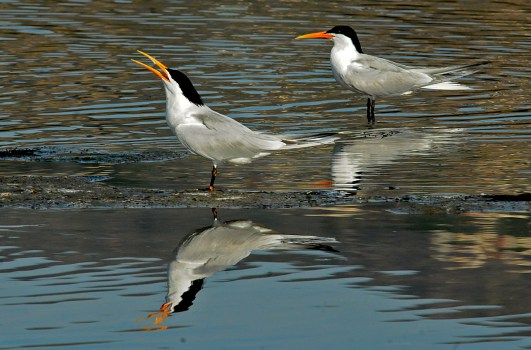
Elegant Terns (Jim Kenney 4/29/15)

Elegant Terns (Jim Kenney 4/29/15)

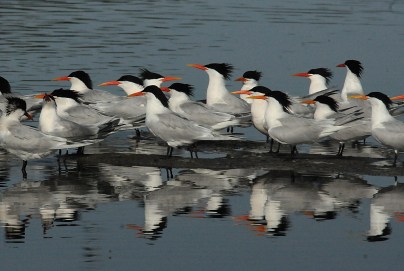
“Elegant Terns are…well, they’re just so elegant!,” founding chapter member Abigail King used to say. They certainly are.

Elegant Terns (Jim Kenney 4/29/15)

More Elegant Terns (J. Kenney 4/29/15)

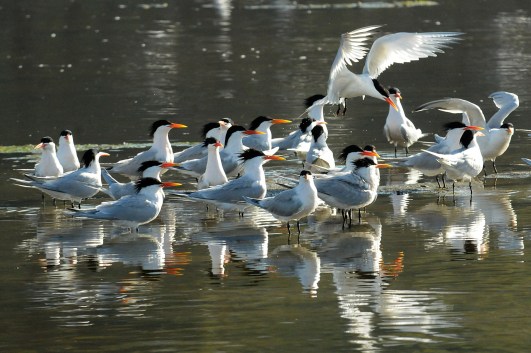
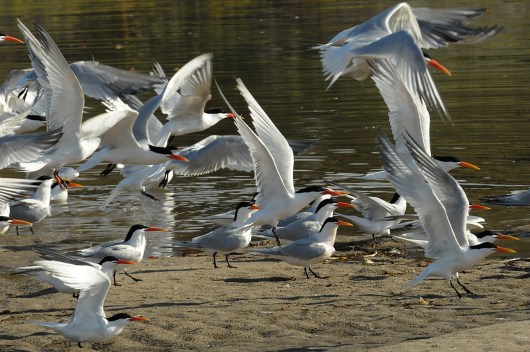
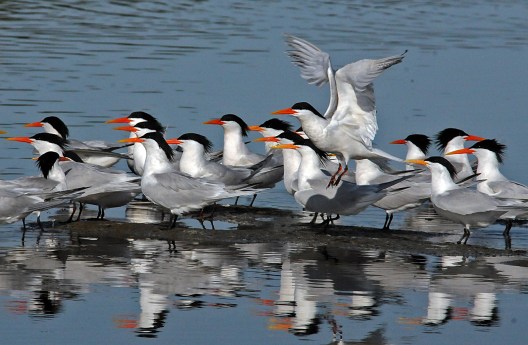
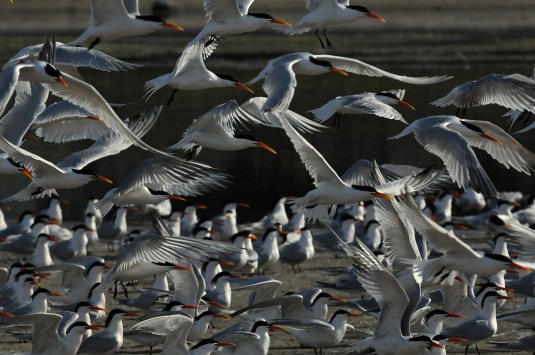
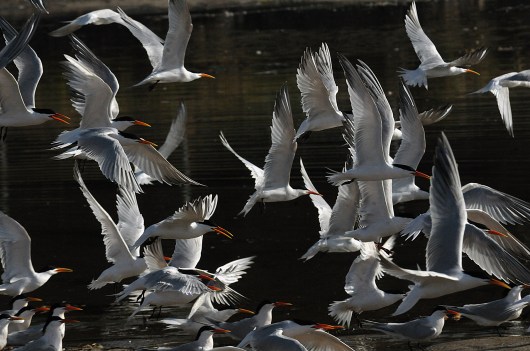
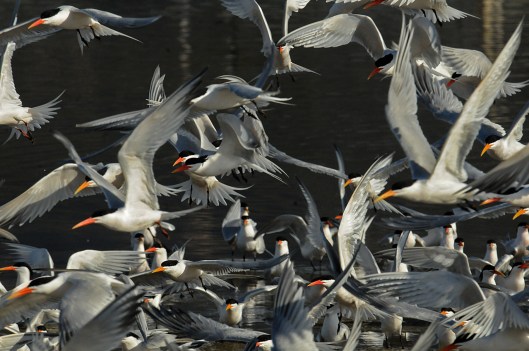
We were recently treated to the sight of thousands of Elegant Terns dropping into Malibu Lagoon, and on April 29 Jim Kenney caught them in action. Often starting off slow, such gatherings can build over several hours, until suddenly you realize you’re in the storm-center of a swirling mass of wings, bills and cries.

Elegant Terns (Jim Kenney 4/29/15)

Even more Elegant Terns (J. Kenney 4/29/15)

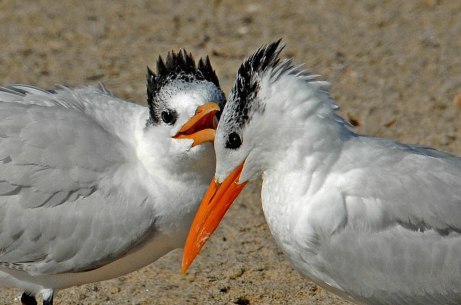
Some of us have been looking at Elegant Tern – and its disconcertingly similar conspecific Royal Tern – for decades, and we still have trouble telling them apart. Here are some tips.

Elegant Terns (Jim Kenney 4/29/15)

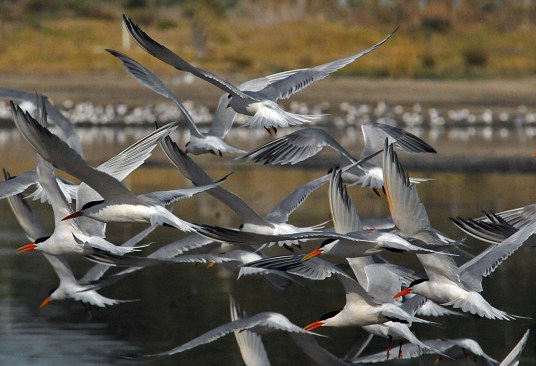
Some of the Elegants get spooked (J. Kenney 4/29/15)

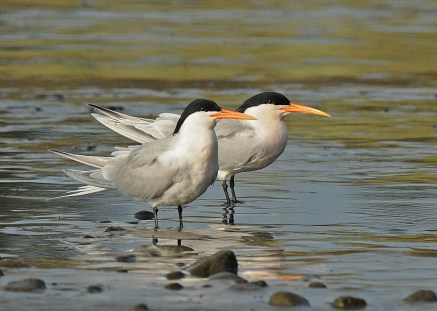
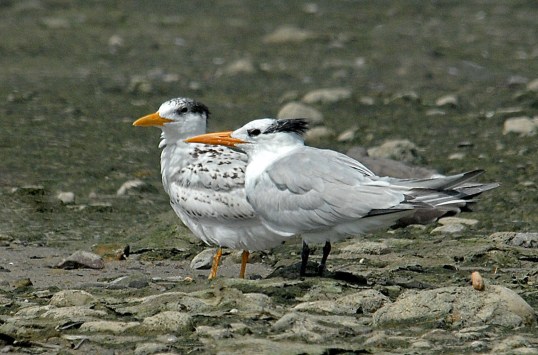
Bill shape and size is one of the best field marks.
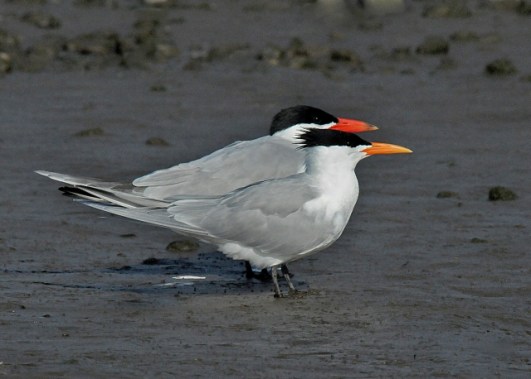
Elegant: Very long and slender. Lower bill lacks any gonydeal angle (bump on lower bill, common among gulls and terns); bottom of lower bill curves slightly downward to tip.

Elegant Tern pair (J. Kenney 4/3/10)

Elegant Terns: bill long & decurved, yellow-orange, black legs and cap, pink breast on right bird (J. Kenney 4/3/10)

Royal: Lower bill has small gonydeal angle near middle; bottom of bill appears either straight or curving slightly upward to tip. Bill is stouter than on Elegant.

Royal Terns (J. Kenney 11/15/06)

Royal Terns: stout orange bill, small gonydeal angle on lower bill, non-breeding dark cap barely reaches dark eye (J. Kenney 11/15/06)

The juveniles of  both species will have shorter bills for a while. Species with large bills take longer to develop a full-sized bill.

Caspian (rear) & Royal (front) Terns (J. Kenney 4/14/10)

Size ranges of Caspian (rear) & Royal (front) Terns overlap (J. Kenney 4/14/10)

Bill color in both species range from pale yellow to bright orange, almost red. Juveniles have the palest bills; adults tend towards darker orange and near-red; colors are brighter during breeding. Royal tends towards orange, Elegant tends towards yellow, but colors vary and overlap so greatly, it is more misleading than useful.

Elegant Terns (Jim Kenney 4/29/15)

Elegant Terns have a variety of bill colors (J. Kenney 4/29/15)

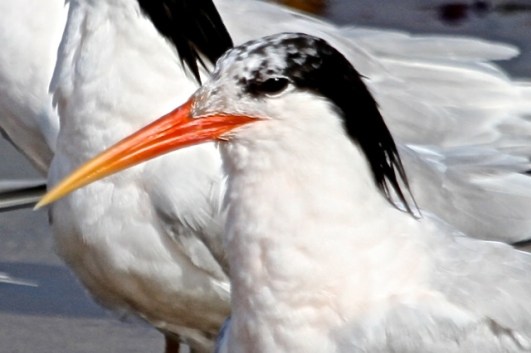
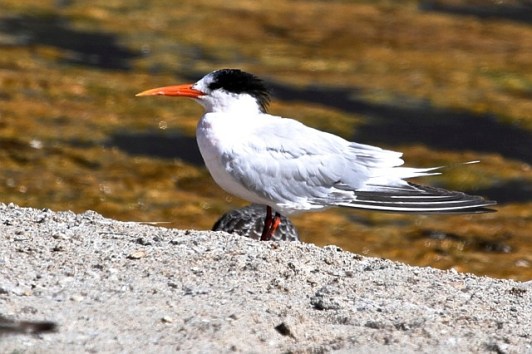
Black Cap: In non-breeding birds, this is the best field mark. In breeding season both have black caps from bill to shaggy nape; the Elegant has a slightly shaggier nape-crest. After breeding, black caps are gradually and partially lost, beginning at the bill. The Royal loses a bit more of the black cap than does the Elegant, and in winter, the black eye of the Royal stands out noticeably from the black crest, whereas the black eye of the Elegant remains ‘buried’ within, or at the very edge, of the black cap.

Elegant Tern non-breeding (Joyce Waterman)

Elegant Tern with non-breeding cap, note black plumage in front of eye. Note decurved lower bill and pale yellow to deep orange bill.
(Joyce Waterman 6/14/14)

Elegant Tern with non-breeding cap (J. Waterman (9/22/13)

Elegant Tern with non-breeding cap; note orange legs (J. Waterman (9/22/13)

Calls are similar: The Elegant perpetually utters a “kreeeeek!” screech, and when the flock is large, it can be extremely noisy. Royals have a lower “koorrick” call, but at the lagoon seem to remain quiet. Maybe they can’t get a word in edgewise when Elegants are around.

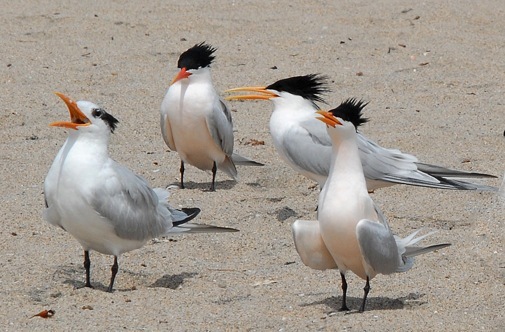
Royal tern (left) with non-breeding crest, 3 Elegant with breeding crest. Royal is noticeably bulkier. Elegant with neck fully extended looks as tall as Royal. (J. Kenney)

Noticeably bulkier Royal Tern (left) before developing breeding crest which Elegant already has. Elegant with fully extended neck seems as tall as Royal.
(J. Kenney Apr’07 Playa del Rey, CA)

Dimensions: Elegant and Royal almost, but not quite, overlap. Royal and Caspian (world’s largest tern) overlap in size, not in weight. Royal and Caspian Terns overlap in all dimensions with Ring-billed Gull.[1]

Species Length (in) Wingspan (in) Weight (oz)
Least Tern 8.7 – 9.5 18.9 – 20.9 1.4 – 1.8
Black Tern 9.1 – 11 22.4 – 25.6 2.1 – 2.6
Common Tern 12.6 – 15.4 28.3 – 32.7 3.4 – 5.1
Forster’s Tern 13 – 14.2 28.7 – 32.3 4.8 – 6.8
Elegant Tern 15.4 – 16.9 29.9 – 31.9 7.6 – 10.6
Royal Tern 17.7 – 20.1 39.8 – 53.1 11.3 – 17.6
Caspian Tern 18.9 – 22 50 – 55.1 20.2 – 27.6
For Comparison
Ring-billed Gull[2] 16.9 – 21.3 47.6 – 50 14.1 – 20.8


Legs and feet: About 90% of adult Elegant have black legs & feet; 10% have orange legs & feet. Adult Royal have black legs & feet. Juveniles of both species often have yellow-to-orange legs & feet.

Royal Tern juvenile and adult (J. Kenney 8/4/09)

Royal Tern juvenile has spotty back & yellow-orange legs. The bill may also be shorter. (J. Kenney 8/4/09)

Breast: White, but breeding Elegant often has a pale pinkish cast. This comes from carotenoids (as in carrot) – specifically astaxanthin from fish and crustaceans in their diet, is in the feathers themselves, and does not occur on the plumage surface or in preen oil, as some have previously speculated. Carotenoids color the plumage of many other birds, including Flamingos and House Finches. (See above photo of Elegant Tern bill shape.)

Elegant Terns (Jim Kenney 4/29/15)

Anxiety spreads (J. Kenney 4/29/15)

Wings are long, slender and pale underneath with limited dark in the primaries; tails are noticeably forked.

Elegant Terns (Jim Kenney 4/29/15)

Waves of flight (J. Kenney 4/29/15)

Still confused? Join the club. Confusion is the proper attitude. The best way to differentiate them is to get them to stand side-by-side. Then – usually! – the differences in bulk, crest, size, bill shape and length, and eye location in the black cap become obvious. Sort of.

All terns are plunge divers, feeding on small fish. Most gulls will eat nearly anything, plucking their food from the surface of the water or ground, robbing other birds (especially terns) or hanging around pelicans, hoping for a freebie.

Royal Terns are not globally threatened. They nest along both coasts of North & South America, the Caribbean, and the west coast of Africa, totaling over 70,000 pairs. Our west coast populations have suffered crashes in the past 40 years due to the virtual disappearance of their staple food, the pacific sardine. The relatively large size of their prey also makes them especially susceptible to pesticides working their way up the food chain.

Elegant Terns (Jim Kenney 4/29/15)

They’re very noisy (J. Kenney 4/29/15)

Elegant Terns are considered near-threatened, numbering 30,000-50,000 pairs, about 90% of which nest on Isla Rasa, 1/3rd way down the sea of Cortez. [See map.] Such concentration on a particular breeding location makes them highly susceptible to local dangers, and gathering of eggs by local fishermen, before the island was declared a sanctuary in 1964, nearly wiped them out. Isla Rasa is also the primary breeding location of Heermann’s Gull, commonly seen at Malibu Lagoon.

Elegant and Royal Terns are not always at the lagoon. Our records show:

Royal Tern Elegant Tern
Month Times Present Total Birds
Times Present Total Birds
Jan 11 105 0 0
Feb 11 92 1 1
Mar 7 45 12 386
Apr 11 45 13 4785
May 11 53 13 430
Jun 9 40 10 460
Jul 6 25 9 1154
Aug 10 44 14 351
Sep 9 50 15 260
Oct 9 26 13 79
Nov 6 11 8 16
Dec 7 61 0 0
Totals 107 597 108 7922
Average 48.9% 5.6 49.3% 73.4
Notes. (1) (2) (1) (3)
1. Presence percentage of 219 census dates
2. Average present on 107 visits
3. Average present on 108 visits

The single Elegant Tern present in Feb. 2010 was an anomaly. Normally they are completely absent from SoCal December through February. As the above table shows, while both species are present nearly equally often, Elegant, absent in winter, still outnumbers Royal 13-to-1.

Elegant Terns (Jim Kenney 4/29/15)

Chaos reigns (J. Kenney 4/29/15)

Birders visiting from the East Coast and around the world often have Elegant Tern high on their ‘want list.’ Although it ranges from southern Washington State to Peru, SoCal is probably the most easily accessible place in the world to find it. Something to think about the next time you see this truly elegant bird on the sand.     [Chuck Almdale]
Notes:
[1] Handbook of Birds of the World (HBW), Vol. 3; Lynx Edicions, 1996; del Hoyo, Elliot & Sargatal
[2] There is wide disagreement on Ring-billed Gull length. Sibley’s & NGS field guides both give 17.5″; HBW 18.1-21.3″, Cornell Lab of Ornithology 16.9-21.3″, BeautyOfBirds.com gave averages of female 18.5″ male 20″, other web sources gave 16″, 17″, 18″, or 19″. I chose to use the Cornell lab length dimension as most inclusive.