Skip to content

Free email delivery

Please sign up for email delivery in the subscription area to the right.
No salesman will call, at least not from us. Maybe from someone else.

NSF Grant and SMBAS Endowment Support LMU Study on Birds

June 16, 2015

This article is courtesy of the LMU/LA Seaver News.  A SMBAS research endowment at LMU also supports the work that Dr. Watts is doing.

National Science Foundation Funds Study on a Quirky SongbirdHeather Watts, Ph.D., holding a house finch, a relative of the pine siskin.

“I was very excited to get this grant,” says Watts, who received her Ph.D. in zoology and ecology, evolutionary biology and behavior at Michigan State University in 2007. “Without a grant, it might take a decade or more to do a project of this type and scale.”

Watts’ research investigates the relationships between environmental variation, life history patterns and the behavior of birds and mammals. She is especially interested in gregarious animals, completing her Ph.D. work on spotted hyenas. Pine siskins are also social creatures and are interesting because they’re nomadic and irruptive migrants, meaning that their migration patterns are relatively unpredictable. Unlike many other birds, they do not migrate according to highly predictable schedules and to the same places year after year. Pine siskins also have variable reproductive schedules.

“What I’m interested in trying to understand is how animals use the information in the environment to time their annual schedules, including reproduction and migration,” she explains. “What are they paying attention to in the environment in order to time these events? And what are the hormones that are important in making the transition between life stages?”

Swagger14932

While some field work is involved—Watts has been spending time trapping pine siskins in the San Gabriel Mountains, about an hour and a half from LMU—many birds will be housed in the lab for experiments. Watts welcomes the opportunity to expose undergraduate students to this type of research.

“The NSF encourages undergraduate involvement in research,” she says. “I think it’s cool that students get to be involved in research like this as undergraduates. I like the combination of research and teaching that we have here at LMU. There is support for faculty to do research, but we really value the undergraduates and that they’re involved in research.”

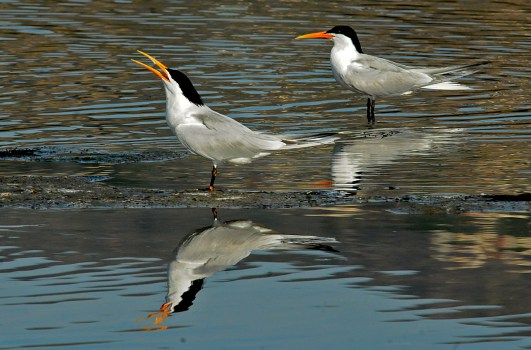
Elegant Terns at Malibu Lagoon

June 13, 2015
Elegant Terns (Jim Kenney 4/29/15)

Elegant Terns (Jim Kenney 4/29/15)

“Elegant Terns are…well, they’re just so elegant!,” founding chapter member Abigail King used to say. They certainly are.
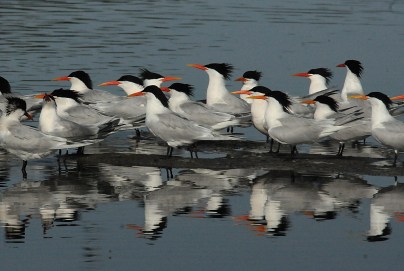
Elegant Terns (Jim Kenney 4/29/15)

More Elegant Terns (J. Kenney 4/29/15)

We were recently treated to the sight of thousands of Elegant Terns dropping into Malibu Lagoon, and on April 29 Jim Kenney caught them in action. Often starting off slow, such gatherings can build over several hours, until suddenly you realize you’re in the storm-center of a swirling mass of wings, bills and cries.
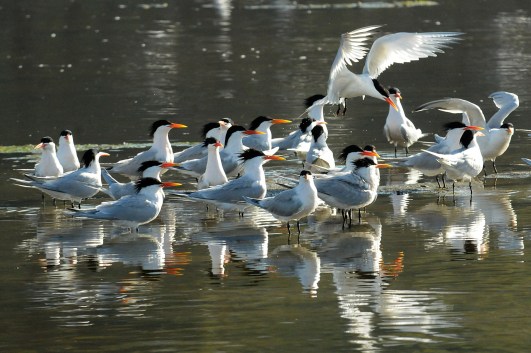
Elegant Terns (Jim Kenney 4/29/15)

Even more Elegant Terns (J. Kenney 4/29/15)

Some of us have been looking at Elegant Tern – and its disconcertingly similar conspecific Royal Tern – for decades, and we still have trouble telling them apart. Here are some tips.
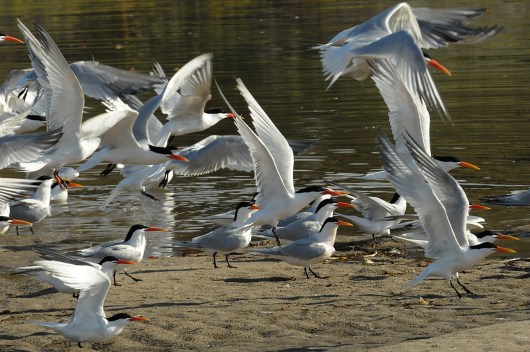
Elegant Terns (Jim Kenney 4/29/15)

Some of the Elegants get spooked (J. Kenney 4/29/15)

Bill shape and size is one of the best field marks.
Elegant: Very long and slender. Lower bill lacks any gonydeal angle (bump on lower bill, common among gulls and terns); bottom of lower bill curves slightly downward to tip.
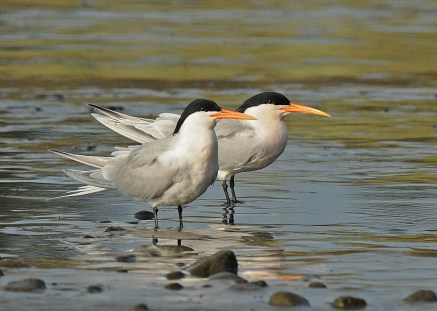
Elegant Tern pair (J. Kenney 4/3/10)

Elegant Terns: bill long & decurved, yellow-orange, black legs and cap, pink breast on right bird (J. Kenney 4/3/10)

Royal: Lower bill has small gonydeal angle near middle; bottom of bill appears either straight or curving slightly upward to tip. Bill is stouter than on Elegant.
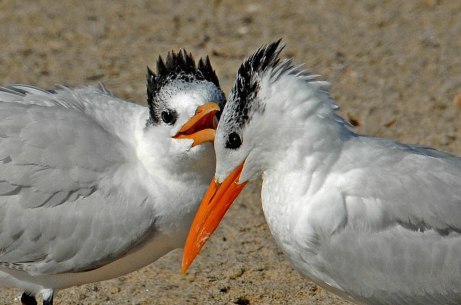
Royal Terns (J. Kenney 11/15/06)

Royal Terns: stout orange bill, small gonydeal angle on lower bill, non-breeding dark cap barely reaches dark eye (J. Kenney 11/15/06)

The juveniles of  both species will have shorter bills for a while. Species with large bills take longer to develop a full-sized bill.
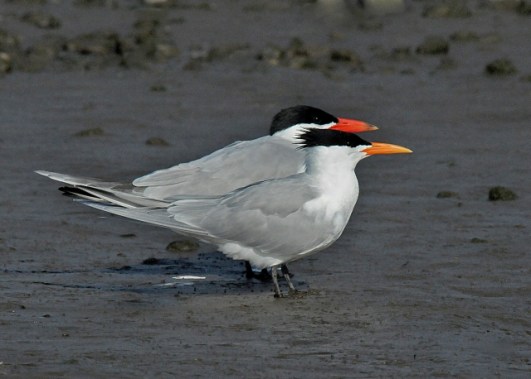
Caspian (rear) & Royal (front) Terns (J. Kenney 4/14/10)

Size ranges of Caspian (rear) & Royal (front) Terns overlap (J. Kenney 4/14/10)

Bill color in both species range from pale yellow to bright orange, almost red. Juveniles have the palest bills; adults tend towards darker orange and near-red; colors are brighter during breeding. Royal tends towards orange, Elegant tends towards yellow, but colors vary and overlap so greatly, it is more misleading than useful.
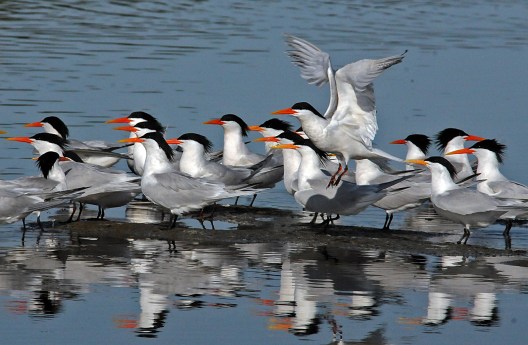
Elegant Terns (Jim Kenney 4/29/15)

Elegant Terns have a variety of bill colors (J. Kenney 4/29/15)

Black Cap: In non-breeding birds, this is the best field mark. In breeding season both have black caps from bill to shaggy nape; the Elegant has a slightly shaggier nape-crest. After breeding, black caps are gradually and partially lost, beginning at the bill. The Royal loses a bit more of the black cap than does the Elegant, and in winter, the black eye of the Royal stands out noticeably from the black crest, whereas the black eye of the Elegant remains ‘buried’ within, or at the very edge, of the black cap.
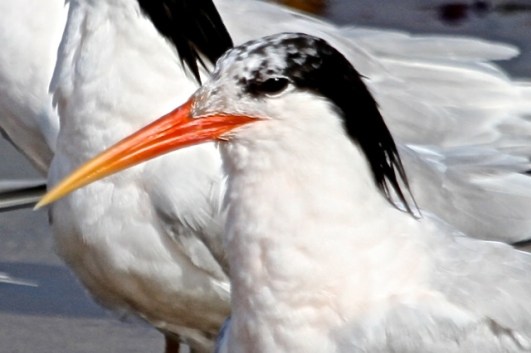
Elegant Tern non-breeding (Joyce Waterman)

Elegant Tern with non-breeding cap, note black plumage in front of eye. Note decurved lower bill and pale yellow to deep orange bill.
(Joyce Waterman 6/14/14)
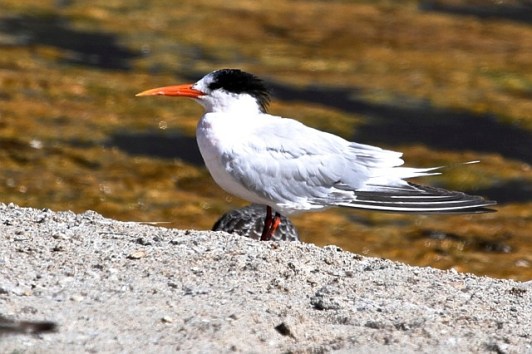
Elegant Tern with non-breeding cap (J. Waterman (9/22/13)

Elegant Tern with non-breeding cap; note orange legs (J. Waterman (9/22/13)

Calls are similar: The Elegant perpetually utters a “kreeeeek!” screech, and when the flock is large, it can be extremely noisy. Royals have a lower “koorrick” call, but at the lagoon seem to remain quiet. Maybe they can’t get a word in edgewise when Elegants are around.
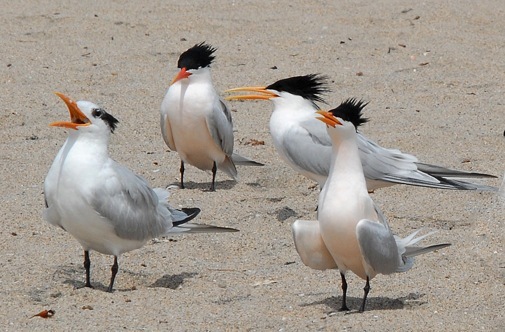
Royal tern (left) with non-breeding crest, 3 Elegant with breeding crest. Royal is noticeably bulkier. Elegant with neck fully extended looks as tall as Royal. (J. Kenney)

Noticeably bulkier Royal Tern (left) before developing breeding crest which Elegant already has. Elegant with fully extended neck seems as tall as Royal.
(J. Kenney Apr’07 Playa del Rey, CA)

Dimensions: Elegant and Royal almost, but not quite, overlap. Royal and Caspian (world’s largest tern) overlap in size, not in weight. Royal and Caspian Terns overlap in all dimensions with Ring-billed Gull.[1]

Species Length (in) Wingspan (in) Weight (oz)
Least Tern 8.7 – 9.5 18.9 – 20.9 1.4 – 1.8
Black Tern 9.1 – 11 22.4 – 25.6 2.1 – 2.6
Common Tern 12.6 – 15.4 28.3 – 32.7 3.4 – 5.1
Forster’s Tern 13 – 14.2 28.7 – 32.3 4.8 – 6.8
Elegant Tern 15.4 – 16.9 29.9 – 31.9 7.6 – 10.6
Royal Tern 17.7 – 20.1 39.8 – 53.1 11.3 – 17.6
Caspian Tern 18.9 – 22 50 – 55.1 20.2 – 27.6
For Comparison
Ring-billed Gull[2] 16.9 – 21.3 47.6 – 50 14.1 – 20.8


Legs and feet: About 90% of adult Elegant have black legs & feet; 10% have orange legs & feet. Adult Royal have black legs & feet. Juveniles of both species often have yellow-to-orange legs & feet.
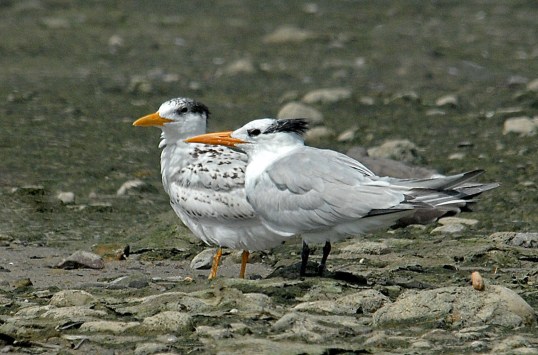
Royal Tern juvenile and adult (J. Kenney 8/4/09)

Royal Tern juvenile has spotty back & yellow-orange legs. The bill may also be shorter. (J. Kenney 8/4/09)

Breast: White, but breeding Elegant often has a pale pinkish cast. This comes from carotenoids (as in carrot) – specifically astaxanthin from fish and crustaceans in their diet, is in the feathers themselves, and does not occur on the plumage surface or in preen oil, as some have previously speculated. Carotenoids color the plumage of many other birds, including Flamingos and House Finches. (See above photo of Elegant Tern bill shape.)
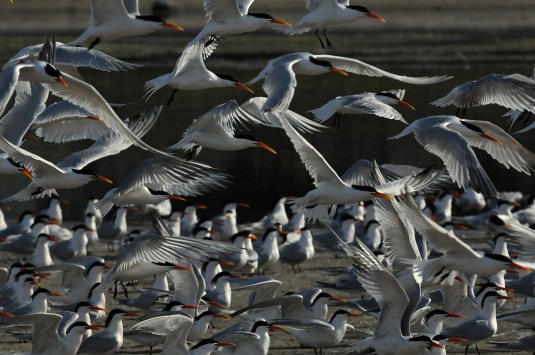
Elegant Terns (Jim Kenney 4/29/15)

Anxiety spreads (J. Kenney 4/29/15)

Wings are long, slender and pale underneath with limited dark in the primaries; tails are noticeably forked.
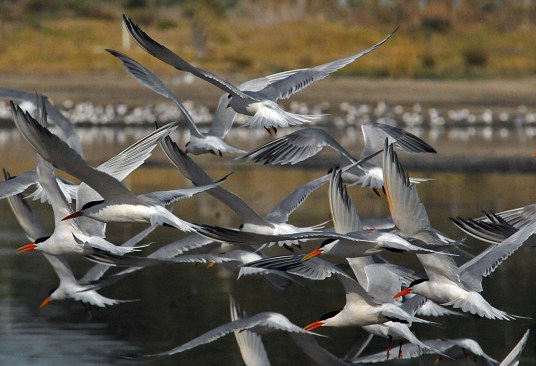
Elegant Terns (Jim Kenney 4/29/15)

Waves of flight (J. Kenney 4/29/15)

Still confused? Join the club. Confusion is the proper attitude. The best way to differentiate them is to get them to stand side-by-side. Then – usually! – the differences in bulk, crest, size, bill shape and length, and eye location in the black cap become obvious. Sort of.

All terns are plunge divers, feeding on small fish. Most gulls will eat nearly anything, plucking their food from the surface of the water or ground, robbing other birds (especially terns) or hanging around pelicans, hoping for a freebie.

Royal Terns are not globally threatened. They nest along both coasts of North & South America, the Caribbean, and the west coast of Africa, totaling over 70,000 pairs. Our west coast populations have suffered crashes in the past 40 years due to the virtual disappearance of their staple food, the pacific sardine. The relatively large size of their prey also makes them especially susceptible to pesticides working their way up the food chain.
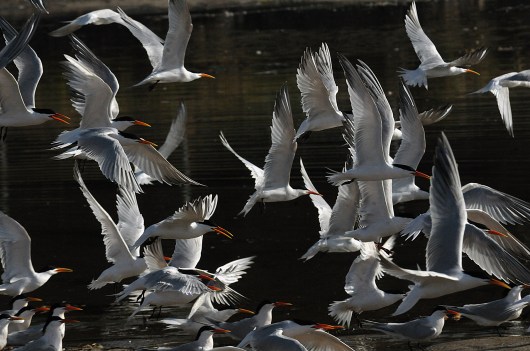
Elegant Terns (Jim Kenney 4/29/15)

They’re very noisy (J. Kenney 4/29/15)

Elegant Terns are considered near-threatened, numbering 30,000-50,000 pairs, about 90% of which nest on Isla Rasa, 1/3rd way down the sea of Cortez. [See map.] Such concentration on a particular breeding location makes them highly susceptible to local dangers, and gathering of eggs by local fishermen, before the island was declared a sanctuary in 1964, nearly wiped them out. Isla Rasa is also the primary breeding location of Heermann’s Gull, commonly seen at Malibu Lagoon.

Elegant and Royal Terns are not always at the lagoon. Our records show:

Royal Tern Elegant Tern
Month Times Present Total Birds
Times Present Total Birds
Jan 11 105 0 0
Feb 11 92 1 1
Mar 7 45 12 386
Apr 11 45 13 4785
May 11 53 13 430
Jun 9 40 10 460
Jul 6 25 9 1154
Aug 10 44 14 351
Sep 9 50 15 260
Oct 9 26 13 79
Nov 6 11 8 16
Dec 7 61 0 0
Totals 107 597 108 7922
Average 48.9% 5.6 49.3% 73.4
Notes. (1) (2) (1) (3)
1. Presence percentage of 219 census dates
2. Average present on 107 visits
3. Average present on 108 visits

The single Elegant Tern present in Feb. 2010 was an anomaly. Normally they are completely absent from SoCal December through February. As the above table shows, while both species are present nearly equally often, Elegant, absent in winter, still outnumbers Royal 13-to-1.
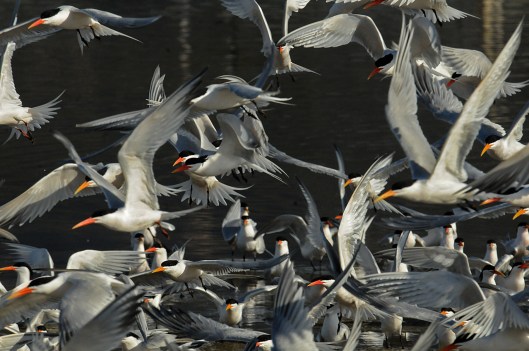
Elegant Terns (Jim Kenney 4/29/15)

Chaos reigns (J. Kenney 4/29/15)

Birders visiting from the East Coast and around the world often have Elegant Tern high on their ‘want list.’ Although it ranges from southern Washington State to Peru, SoCal is probably the most easily accessible place in the world to find it. Something to think about the next time you see this truly elegant bird on the sand.     [Chuck Almdale]

Notes:
[1] Handbook of Birds of the World (HBW), Vol. 3; Lynx Edicions, 1996; del Hoyo, Elliot & Sargatal
[2] There is wide disagreement on Ring-billed Gull length. Sibley’s & NGS field guides both give 17.5″; HBW 18.1-21.3″, Cornell Lab of Ornithology 16.9-21.3″, BeautyOfBirds.com gave averages of female 18.5″ male 20″, other web sources gave 16″, 17″, 18″, or 19″. I chose to use the Cornell lab length dimension as most inclusive.

Malibu Lagoon Trip Report: 24 May, 2015

May 30, 2015

This slideshow requires JavaScript.

Not that I’m complaining, but the weather seems weird to me. Does it to you? When the 24th of May ranged from 59-70° and the 25th of January was 73-81°, well…that’s just plain weird. They must be screwing around with our weather. Again. Whoever they are. Probably the same they as in “They tried to tell us we’re too young, too young to really be in love…” You know. Them.

Great Blue Heron on the 'Osprey pole' (R. Ehler 5/24/15)

Great Blue Heron on the ‘Osprey pole’ (R. Ehler 5/24/15)

Rampant paranoia aside, I prefer cool summers. Bring on the fog! Let it linger until November. Those nattering nabobs of nitwitism who reside in the howling wildernesses east of the Colorado River claim we have no seasons here. Sorry folks; we do have seasons. Roughly equivalent to Spring, Summer, Fall, and Winter are: Fog, Smog, Fire, and Mudslide. Recently, Mudslide season dwindles while Fire expands. ¡Qué lástima!

It always seems odd when lots of birders appear at the lagoon in May and June as, bird-wise, those are the two slowest months. “Don’t be disappointed,” I say, “but it’ll be sparse. Come back September through March, and there’ll be many, many more.” But now, the wintering birds have left, most migrants have passed through, many of our local nesters are concealed, sitting cryptic and quietly on well-hidden nests, or skulking about, trying not to be captured and consumed.

Red-winged Blackbird dempnstrates how he got his name (R. Ehler 5/24/15)

Red-winged Blackbird demonstrates how he got his name. Look closely for yellow, not white, margin below the red epaulets. (R. Ehler 5/24/15)

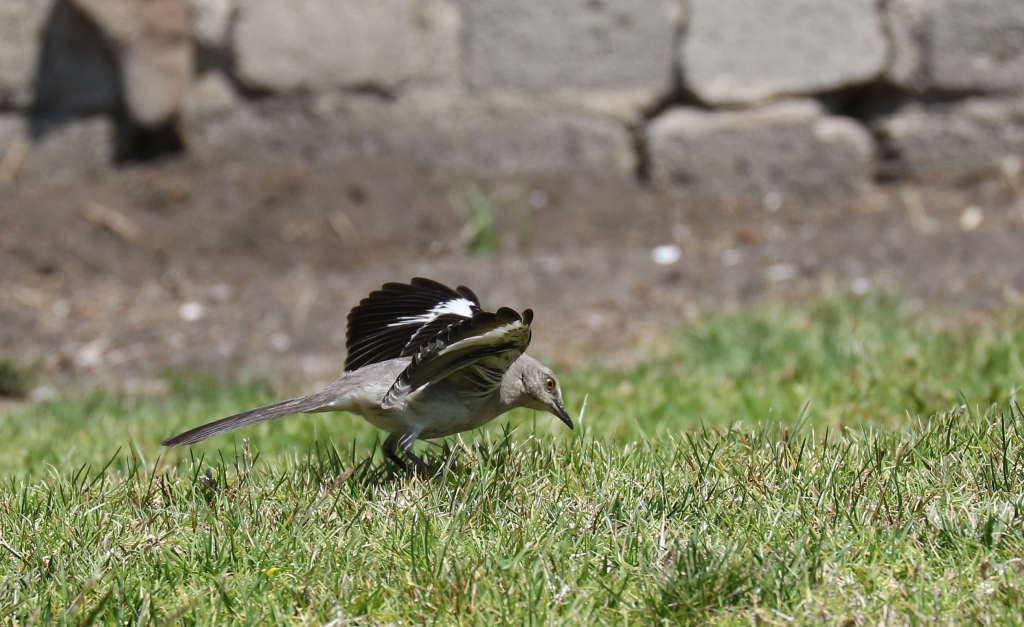
On the lawn at Adamson House we found a foraging Northern Mockingbird. Not an uncommon sight, in itself. But it was frequently flicking its wings as it walked along the

Northern Mockingbird wing-flicking as it hunts (R. Ehler 5/24/15)

Northern Mockingbird wing-flicking as it hunts (R. Ehler 5/24/15)

ground. We didn’t know if this was a foraging behavior, an anxiety/startle behavior, or a display of sexual attractive or aggression. A little research showed that this is a long-debated topic. One paper (Hailman, Wilson Bulletin, Dec 1960) concluded it was primarily a foraging technique, intended to startle insects into movement. Others aren’t so sure, ‘unease’ or alarm being a possibility, as is aggression. All 14 species (4 or 5, depending on who’s talking, in the Galapagos alone) of mockingbirds do this, whether or not they have white wing-panels as do our Northern Mockingbirds. They also flap and leap while singing.

Apropos of nothing whatsoever, here’s a nice hour-long video/soundtrack of birdsong and babbling creek, good for listening to while researching mockingbird behavior.

We had 590 birds in 48 species, down from last month’s 6009 birds in 53 species, a difference of 5419 birds. 98.4% of that decline was due to the drop in 4 species: Brown Pelican, Heermann’s Gull, Western Gull, Elegant Tern. [See the trip lists below.]

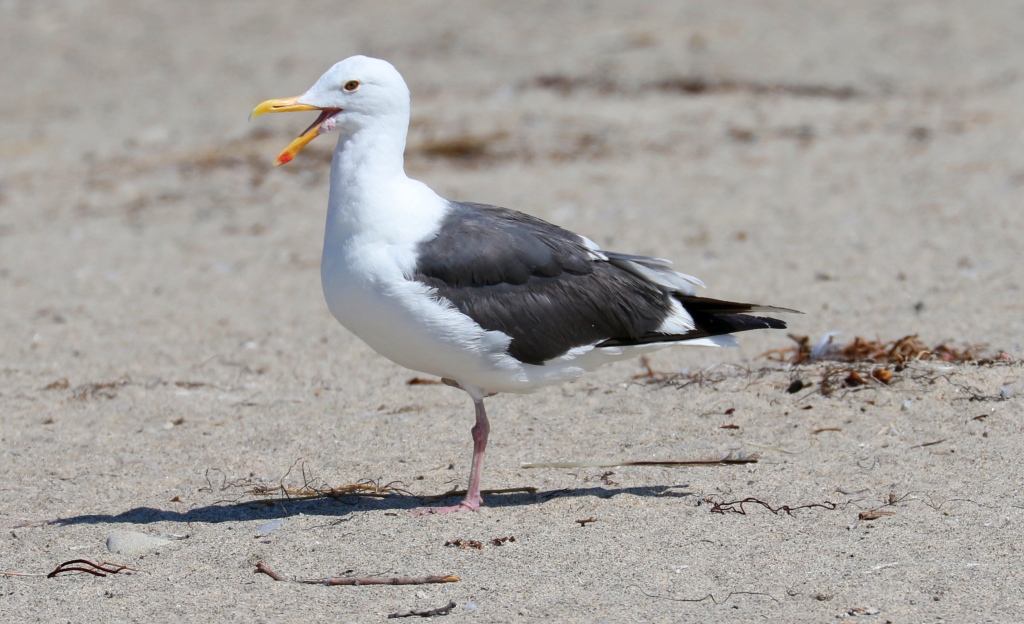
Western Gull in repose (R. Ehler 5/24/15)

Western Gull in repose (R. Ehler 5/24/15)

These birds are all off nesting – or should be, if they know what’s good for them. The Heermann’s, for example, begin laying eggs in late April at their eight known nesting areas; 95% of the species’ 150,000 pairs nest on Isla Rasa, located about halfway down the Sea of Cortez. At the same time, this tiny island also hosts over 90% of the world’s 40,000 pairs of Elegant Terns. It’s a busy, noisy, stinky place this time of year. But changes in weather, sea currents and sea temperatures cause massive changes in availability of food fish. The Elegant Terns may have suffered a complete nesting failure this year on Isla Rasa due to lack of food.

Brown Pelicans discover a small school of fish (R. Ehler 5/24/15)

Brown Pelicans, et. al., discover a small school of fish (R. Ehler 5/24/15)

Many of the Gadwalls looked like young birds – not ducklings, full size but not in adult plumage. Perhaps they are the result of early nesting near the lagoon? We didn’t see any warblers – not a single Yellowthroat – but the Song Sparrows sang up a storm, various swallow species made off with mouthfuls of mud to build nests on nearby walls, and hummingbirds, particularly the Allen’s, were almost abundant on Adamson House’s flowered wall. A couple of cormorants staggered around the lagoon-edge with sticks in their mouth, and across the street, the top of the recently shaved nesting tree next to Starbuck’s was adorned with egrets and their nests.

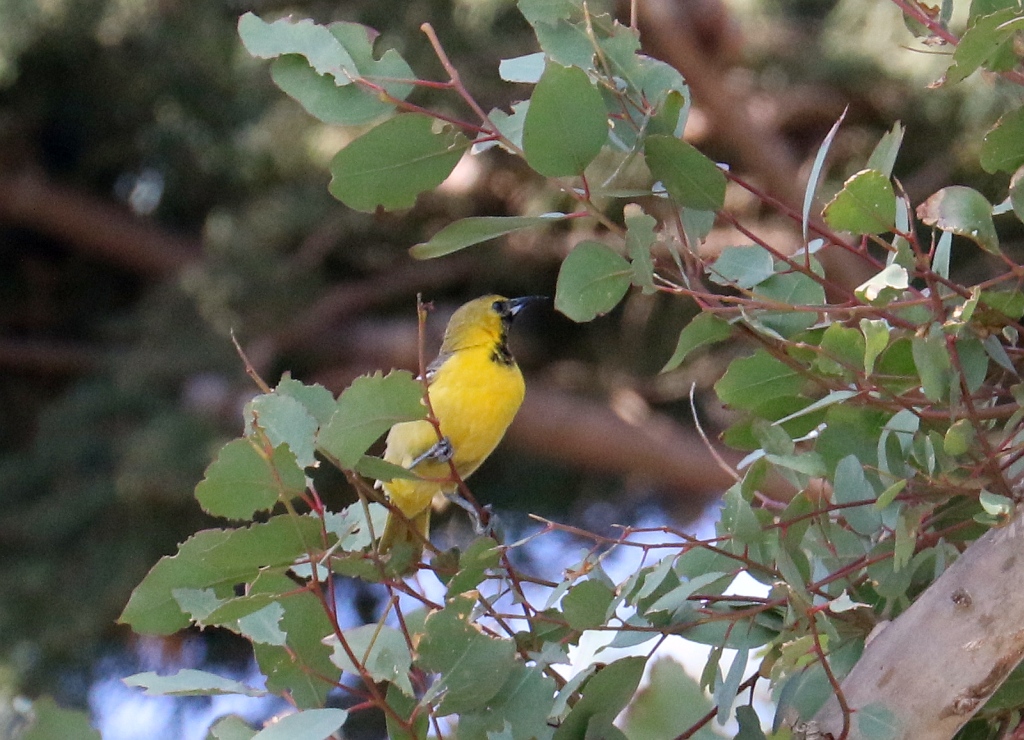
There were even orioles: at least three Hooded Orioles – two females and one yellow-not orange year-old male – were in the trees near the Colony wall. Hooded Orioles – the ‘hood’

Hooded Oriole, one year old male (R. Ehler 5/24/15)

Hooded Oriole, one year old male (R. Ehler 5/24/15)

is yellow in the female and orange in the male – always nest in palm trees. Look on the underside of palm fronds for their light brown pendulous nests, suspended near the central frond shaft, woven of thin fibers from palm leaf and trunk. Adult males have a large black ‘bib’ on their throat. Also around, but not seen today, are deciduous-tree-nesting Bullock’s Orioles; orange & black males have black crowns and small black chin patches; the yellowish females have white bellies, unlike the female Hooded which are all-yellow underneath.

Snowy Plovers, absent since January, remained absent, which is normal for May.

House Finches take a bath at Adamson House (R. Ehler 5/24/15)

House Finches take a bath at Adamson House (R. Ehler 5/24/15)

Birds new for the season were: Pacific Loon, Red-tailed Hawk, Spotted Towhee, Red-winged Blackbird, Brewer’s Blackbird, Hooded Oriole. We finally got over to Adamson House but saw no additional species. The House Finches were busily bathing, so we beat a hasty retreat.

Our next three scheduled field trips:  Mt. Piños Birds & Butterflies, 13-14 June, 8am; Malibu Lagoon & Picnic, 28 June, 8:30 & 10am; Malibu Lagoon, 26 July, 8:30 & 10am.

Our next program: Evening meetings will resume on Tuesday, 6 October, 7:30 pm, at [changed again] Chris Reed Park, 1133 7th St., NE corner of 7th and Wilshire Blvd. in Santa Monica.

NOTE: Our 10 a.m. Parent’s & Kids Birdwalk meets at the shaded viewing area. Watch for Willie the Weasel. He’ll be watching for you.
Links: Unusual birds at Malibu Lagoon
9/23/02 Aerial photo of Malibu Lagoon
Prior checklists:
2014:   Jan-July,    July-Dec
     2013:   Jan-June,   July-Dec
2012:   Jan-June,   July-Dec
   2011:   Jan-June,   July-Dec
2010:  Jan-June,   July-Dec
     2009:  Jan-June  July-Dec

The 10-year comparison summaries created during the project period, despite numerous complaints, remain available on our Lagoon Project Bird Census Page. Very briefly summarized, the results unexpectedly indicate that avian species diversification and numbers improved slightly during the period Jun’12-June’14.   [Chuck Almdale]

Bird Census 2014-15 12/28 1/25 2/22 3/22 4/26 5/24
Temperature 39-61 73-81 55-63 62-71 66-76 59-70
Tide Lo/Hi Height L+1.70 L+1.32 H+4.51 H+4.78 L+0.58 L+0.54
Tide Time 0903 0705 1137 1137 1131 0919
Brant 3 7
Canada Goose 1 30
Gadwall 26 22 30 1 10 22
American Wigeon 10 18 18
Mallard 10 12 12 12 8 8
Northern Shoveler 4 25 2
Northern Pintail 2 3
Green-winged Teal 12 25 12
Surf Scoter 13 15
Bufflehead 8 4 2 2
Hooded Merganser 4
Red-brstd Merganser 25 4 2 2
Ruddy Duck 42 38 35 30 4
Red-throated Loon 3 1 3
Pacific Loon 6 1 3 1
Common Loon 1 1 5
Pied-billed Grebe 8 2 1 2 1
Horned Grebe 4 2 1 1 1
Eared Grebe 12 3 1
Western Grebe 2 5 15 12 2 1
Brandt’s Cormorant 130 1 4 1
Dble-crstd Cormorant 120 35 50 45 16 55
Pelagic Cormorant 1 1 1 4
Brown Pelican 95 50 28 27 1490 70
Great Blue Heron 3 2 2 1 2 2
Great Egret 4 2 10 5 5
Snowy Egret 18 16 26 12 12 4
Cattle Egret 1
Osprey 1 1 1 1
White-tailed Kite 1
Red-shouldered Hawk 1 1
Red-tailed Hawk 1 1 1
American Coot 135 88 145 45 1
American Avocet 1
Blk-bellied Plover 38 62 85 6 1
Snowy Plover 25 29
Semipalmated Plover 9
Killdeer 17 12 12 3 2 6
Spotted Sandpiper 6 3 3 2 1
Greater Yellowlegs 1
Willet 10 4 3 3 1 1
Whimbrel 1 4 4 10 12 1
Long-billed Curlew 1
Marbled Godwit 12 12 10 8 2
Ruddy Turnstone 6 5 1
Surfbird 4
Sanderling 28 8
Dunlin 1
Least Sandpiper 15
Western Sandpiper 45
Boneparte’s Gull 1 12 6 1
Heermann’s Gull 18 17 1 6 350 45
Ring-billed Gull 65 150 90 3 30 8
Western Gull 230 170 95 3 110 135
California Gull 1500 1650 1600 40 600 6
Herring Gull 1
Glaucous-wingd Gull 3 5 4 1 1
Caspian Tern 10 11
Forster’s Tern 2
Royal Tern 22 42 35 15 4 2
Elegant Tern 28 3100 85
Rock Pigeon 6 4 5 23 8 9
Mourning Dove 3 2 2 2 2
Anna’s Hummingbird 1 1 2 2
Allen’s Hummingbird 4 2 3 6 4 6
Belted Kingfisher 1
American Kestrel 1
Peregrine Falcon 1
Black Phoebe 2 1 2 2 2 2
Say’s Phoebe 1
American Crow 8 4 6 5 6 5
Common Raven 2
Rough-wingd Swallow 4 4 6
Barn Swallow 2 6 12
Cliff Swallow 2 10
Oak Titmouse 1 1
Bushtit 14 2
Blue-gray Gnatcatcher 1
Ruby-crowned Kinglet 2
Hermit Thrush 2
American Robin 1 1
Northern Mockingbird 2 1 1 3 6 3
European Starling 25 45 3 4 10 3
Cedar Waxwing 40
Common Yellowthroat 4 3 3 2
Yellow-rumpd Warbler 15 7 8 5
Townsend’s Warbler 1
Spotted Towhee 1
California Towhee 1 3 2 2
Savannah Sparrow 3
Song Sparrow 3 2 6 9 6 9
White-crwnd Sparrow 35 4 12 10
Red-winged Blackbird 2
Western Meadowlark 14 24 10 3
Brewer’s Blackbird 2
Great-tailed Grackle 5 4 4 3
Brwn-headed Cowbird 4 4
Hooded Oriole 3
House Finch 4 4 12 20
Lesser Goldfinch 1 2 1
Totals by Type Dec Jan Feb Mar Apr May
Waterfowl 141 138 154 50 55 37
Water Birds – Other 516 187 247 144 1511 134
Herons, Egrets & Ibis 25 18 30 24 19 11
Quail & Raptors 5 2 2 1 1 1
Shorebirds 144 139 119 37 89 8
Gulls & Terns 1839 2035 1825 107 4213 294
Doves 6 7 7 25 10 11
Other Non-Passerines 4 3 3 7 7 8
Passerines 114 106 61 76 104 86
Totals Birds 2794 2635 2448 471 6009 590
             
Total Species Dec Jan Feb Mar Apr May
Waterfowl 9 9 10 7 5 3
Water Birds – Other 11 9 11 9 6 8
Herons, Egrets & Ibis 3 2 3 4 3 3
Quail & Raptors 5 2 2 1 1 1
Shorebirds 10 9 8 8 10 3
Gulls & Terns 7 7 6 7 10 9
Doves 1 2 2 2 2 2
Other Non-Passerines 1 2 1 2 3 2
Passerines 12 16 14 17 13 17
Totals Species – 100 59 58 57 57 53 48

AAAAA

Black Rock Campground & Morongo Valley Preserve Trip Report: 2-3 May, 2015

May 15, 2015

This slideshow requires JavaScript.

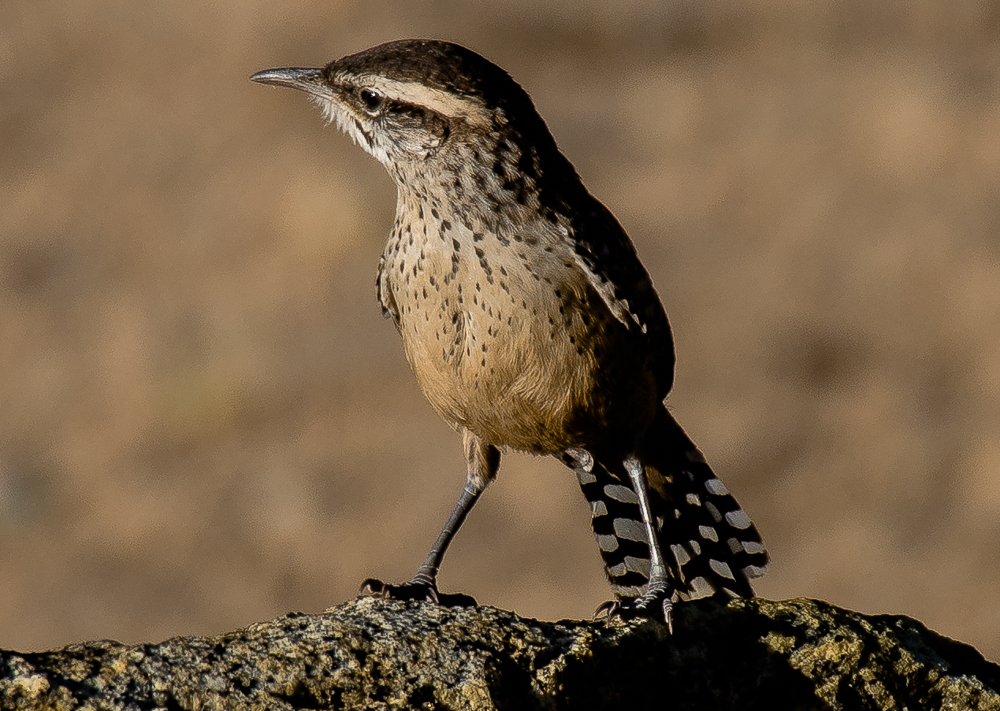
Cactus Wrens sound like a birthday party toy (D. Erwin 5/3/15 Black Rock)

Cactus Wrens sound like a birthday party toy (D. Erwin 5/3/15 Black Rock)

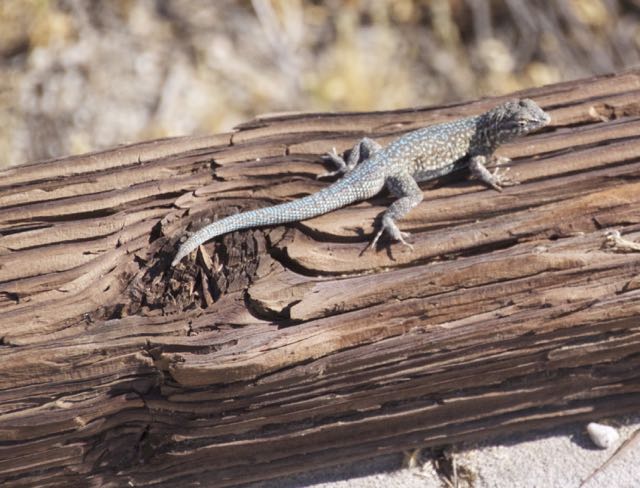
We weren’t even out of our campervan before California Thrashers, Gambel’s Quail and Western Scrub-Jays came by to (maybe) check us out. Colorful lizards sunned themselves in the cactus garden. Unlike the movie, it would be a good day at Black Rock.

Speckled Lizard - Black Rock (R. Seidner 5/2/15)

Speckled Lizard – Black Rock (R. Seidner 5/2/15)

A few years ago we broke this trip into two parts: Saturday afternoon at Black Rock Campground; Sunday morning at Morongo Valley Preserve & adjacent Covington Park. Late afternoon, after the heat of the day, when birds begin rousing themselves for a final burst of feeding, is a good time for Black Rock. Many birders had already taken to moteling Saturday night in Yucca Valley, close to the campground five miles south into northwestern Joshua Tree Nat. Park. The best time to see Piñon Jays is shortly before sunset, when they fly up and downslope above the campground. Other birds are always around the campground, but – as do most birds everywhere – they make themselves scarce mid-day.

Males Gambel's Quail, a desert bird, watches for his mate (D. Erwin 5/3/15 Black Rock)

Males Gambel’s Quail, a desert bird, watches for his mate (D. Erwin 5/3/15 Black Rock)

We found most of the Black Rock specialties: Gambel’s Quail came to water drips and called from the Joshua Treetops, the increasingly more common White-winged Dove, several hummingbirds worked the bushes and ephemeral flowers, Ladderbacked Woodpeckers drilled the Joshuas, the aforementioned Piñon Jay, Verdin with faces the color of yellow mesquite flowers, the squat-jumping Rock Wren and the cranky Cactus Wren, desert early-nesting Phainopeplas, the Black-throated Sparrow who never drinks water, and the lovely-to-see-and-hear Scott’s Oriole. Perhaps the most uncommon sightings were several Chuckwalla lizards warming on rock tops, and a large

Rattlesnake, either Western or Red - Black Rock (R. Seidner 5/2/15)

Rattlesnake, either Western or Red – Black Rock (R. Seidner 5/2/15)

Diamondback Rattlesnake (either Western or Red) near the front door of the ranger station. His rattles had broken off. Mary, temporarily alone, saw a Roadrunner the rest of

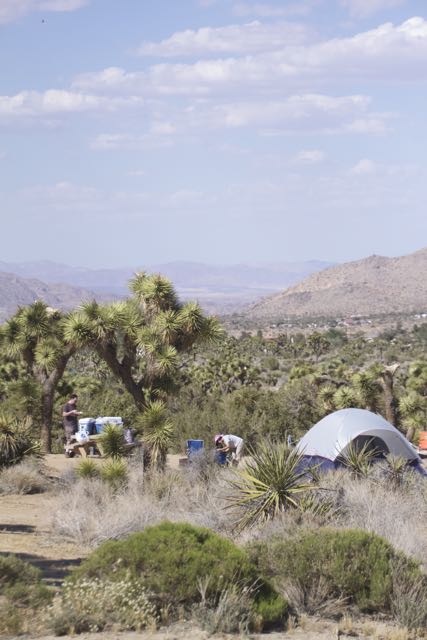
Black Rock campground - no wind, tents still in place (R. Seidner 5/2/15)

Black Rock campground – no wind, tents still in place (R. Seidner 5/2/15)

us missed. We then went off to dinner at La Casita in Yucca Valley, a good Mexican restaurant. Those of us camping returned, stuffed to the gills, to Black Rock and waited for the wind to rise. Infamous for its winds – we call it Windy Ridge – people have seen their tents sail away into yucca-strewn gullies, or been rocked to sleep – or to terror – by a wind-wobbled campervan.

Next morning, on the way from our Black Rock campsite to Morongo Valley, we spotted two Roadrunners, one road-crossing as we coasted down the long road back to the highway, and one crossing the highway itself, right in the middle of town. I almost forgot: Lillian and I witnessed a 6:05am flyover of 60-100 Piñon Jays, heading downcanyon directly above our campsite, each one calling in their peculiar quail-like purr.

Morongo Valley Preserve was moderately birdy and – for a change – neither windy nor unbearably hot. Warblers were few: we did see six of the eleven western warbler species, but

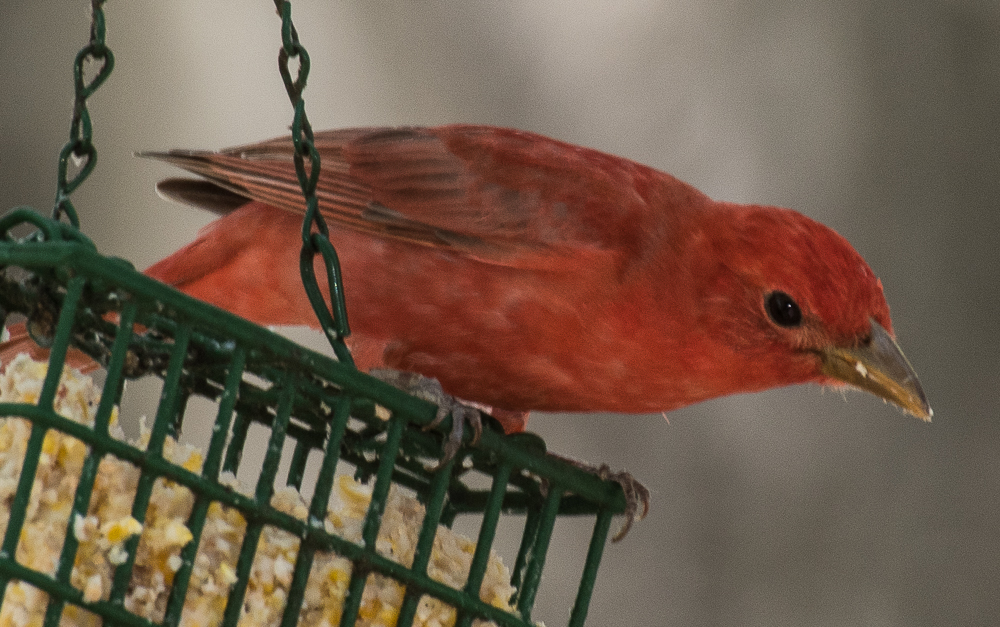
Male Summer Tanater at the seed feeder (D. Erwin 5/3/15 Morongo Valley)

Male Summer Tanater at the seed feeder (D. Erwin 5/3/15 Morongo Valley)

95% of them were Wilson’s Warblers. Summer Tanagers have apparently already paired up; we first spotted them whizzing back and forth, and later at the seed feeder by the warden’s house. Brown-crested Flycatchers were very vocal, as were Yellow-breasted Chats, and we heard them singing and calling over and over before we finally spotted either species. At least one pair of Vermillion Flycatcher were in Covington Park, and we saw a female sitting on her nest near the tennis court, her mate

Male woodpecker, probably a Nuttall's - Ladderbacked hybrid - misshapen black on shoulder (D. Erwin 5/3/15 Morongo Valley)

Male woodpecker, probably a Nuttall’s – Ladderbacked hybrid – misshapen black on shoulder (D. Erwin 5/3/15 Morongo Valley)

busily bringing her flies. Nearby, birds, including Lawrence’s Goldfinches, were coming to the small water drip someone had set up. White-winged Doves were frequently seen; a few years back we had to diligently search for this species, often missing it, but now they seem widespread. At the seed feeders we could admire their blue orbital ring.

Morongo Valley is one of the few areas where the ranges of the Nuttall’s and Ladderbacked Woodpeckers overlap, and they do interbreed. Of the photos taken, none are clearly one or the other species. Check the three photos for some of the annoying details.

This female woodpecker might actually be a hybrid - buffy lores with otherwise Nuttall's appearance (D. Erwin 5/3/15 Morongo Valley)

This female woodpecker might actually be a hybrid – buffy lores with otherwise Nuttall’s appearance (D. Erwin 5/3/15 Morongo Valley)

Female woodpecker belly seems too white to be pure Ladderbacked (D. Erwin 5/3/15 Morongo Valley)

Female woodpecker belly seems too white to be pure Ladderbacked (D. Erwin 5/3/15 Morongo Valley)

All told, we had 66 species in two days, down from 2013’s 76 species (see list below). A lot depends on which winds the birds encounter as they move north from the brushy shore of the Salton Sea. A good tail wind and they sail right on by, high over the hills. A stiff head wind like the screamers that come through San Gorgonio Pass, and they are forced to stay low and slow, moving up through Big Morongo Canyon to rest and refuel at the Preserve.

Brown-crested Flycatcher (D. Erwin 5/3/15 Morongo)

Brown-crested Flycatcher (D. Erwin 5/3/15 Morongo)

Ash-throated and Brown-crested Flycatchers both nest at the preserve. Very similar in appearance, even the thinner bill of the Ash-throated can be mistaken by some (moi!) for the chunkier bill of the Brown-crested. Fortunately, the latter bird has a much more liquid Whit! call and rolly song than the former. If you’re lucky, you’ll see one sing. [Added Note: The fact that this photo was captioned “Ash-throated Flycatcher” in the original email demonstrates how easily they’re confused.]   [Chuck Almdale]

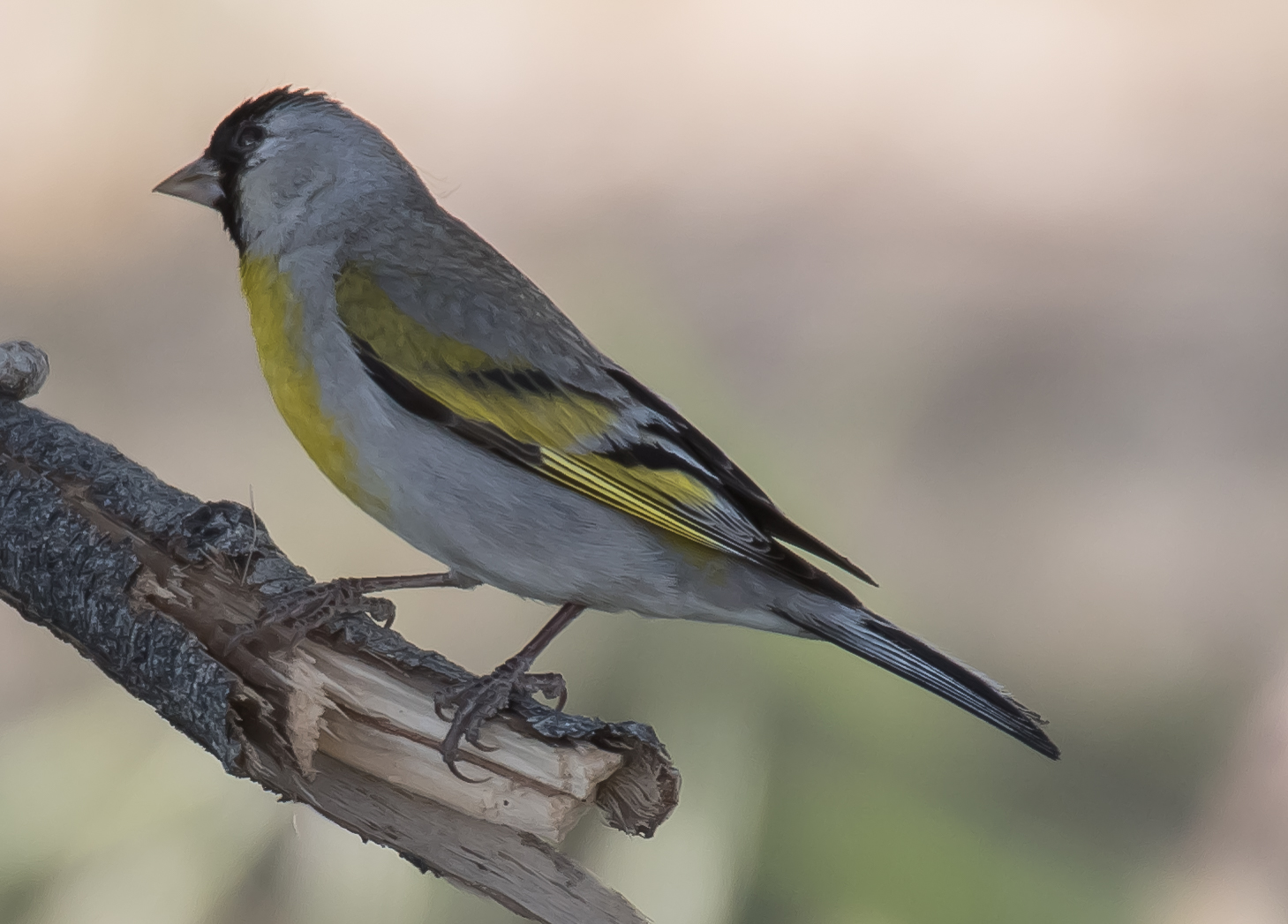
The uncommon male Lawrence's Goldfinch (D. Erwin 5/3/15 Morongo Valley)

The uncommon male Lawrence’s Goldfinch
(Dennis Erwin 5/3/15 Morongo Valley)

Many thanks to Dennis Erwin and Roxie Seidner for all the great photographs!

Black Rock & Morongo Valley
Codes: B – Black Rock Campground
   M – Morongo Valley Preserve & Covington Park
   H – Heard Only
Species List 5/2-3/15 5/4-5/13
Gambel’s Quail MB MB
Green Heron M
Turkey Vulture MB M
Cooper’s Hawk M M
Red-tailed Hawk M
Virginia Rail M-H M-H
Rock Pigeon MB MB
Eurasian Collared-Dove MB M
White-winged Dove MB MB
Mourning Dove MB MB
Greater Roadrunner B
White-throated Swift M
Black-chinned Hummingbird MB MB
Anna’s Hummingbird MB MB
Costa’s Hummingbird MB MB
Allen’s Hummingbird M
Calliope Hummingbird M
Ladder-backed Woodpecker MB MB
Nuttall’s Woodpecker M M
American Kestrel M B
Olive-sided Flycatcher M
Western Wood-Pewee MB MB
Willow Flycatcher M
Pacific-slope Flycatcher M M
Black Phoebe MB MB
Say’s Phoebe B
Vermilion Flycatcher M M
Ash-throated Flycatcher MB B
Brown-crested Flycatcher M M
Cassin’s Kingbird M MB
Western Kingbird  M MB
Loggerhead Shrike M
Bell’s Vireo M M
Cassin’s Vireo M M
Warbling Vireo M M
Pinyon Jay B B
Western Scrub-Jay MB MB
Common Raven MB MB
Mountain Chickadee M
Oak Titmouse MB M
Verdin MB
Bushtit M M
Rock Wren B
House Wren M M
Bewick’s Wren MB MB
Cactus Wren B B
Blue-gray Gnatcatcher M
Western Bluebird MB MB
Townsend’s Solitaire M
Swainson’s Thrush M
Hermit Thrush M
California Thrasher MB MB
Northern Mockingbird B B
European Starling MB MB
Phainopepla MB MB
Orange-crowned Warbler M M
Nashville Warbler M
Common Yellowthroat M M
Yellow Warbler MB M
Yellow-rumped Warbler MB M
Black-throated Gray Warbler M
Townsend’s Warbler M
Hermit Warbler M
Wilson’s Warbler MB MB
Yellow-breasted Chat M M
Spotted Towhee MB
California Towhee MB MB
Brewer’s Sparrow B
Black-throated Sparrow B
Song Sparrow M M
Summer Tanager M M
Western Tanager M M
Black-headed Grosbeak M M
Blue Grosbeak M
Lazuli Bunting M
Great-tailed Grackle M
Brown-headed Cowbird M M
Hooded Oriole M M
Bullock’s Oriole M M
Scott’s Oriole B B
House Finch MB MB
Pine Siskin M
Lesser Goldfinch M MB
Lawrence’s Goldfinch M M
House Sparrow MB MB
Total Species – 85
66 76


Chuck checks Cactus Wren nest to see if anyone home - Black Rock (R. Seidner 5/2/15)

Just before the horribly disfiguring accident, Chuck checks a Cactus Wren nest in a cholla to see if anyone is home (R. Seidner 5/2/15 Black Rock)

A Fond Farewell to Maja

May 1, 2015
by
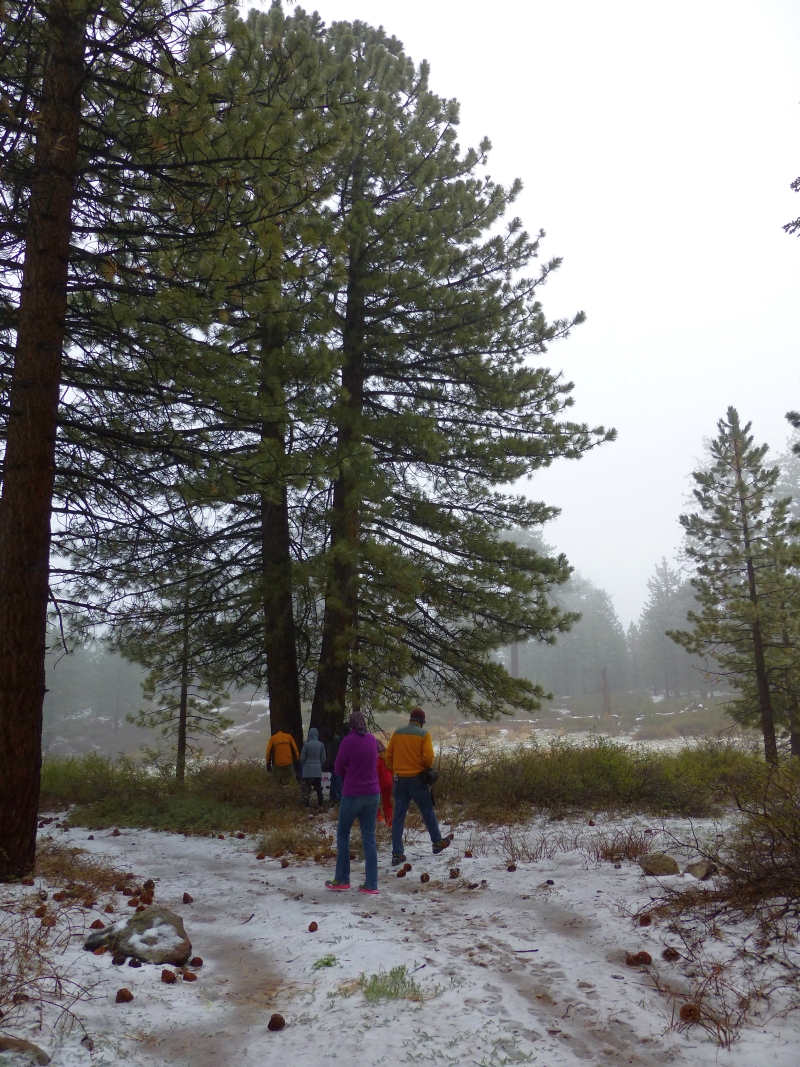
The deepening snow beneath the trees

The deepening snow beneath the trees

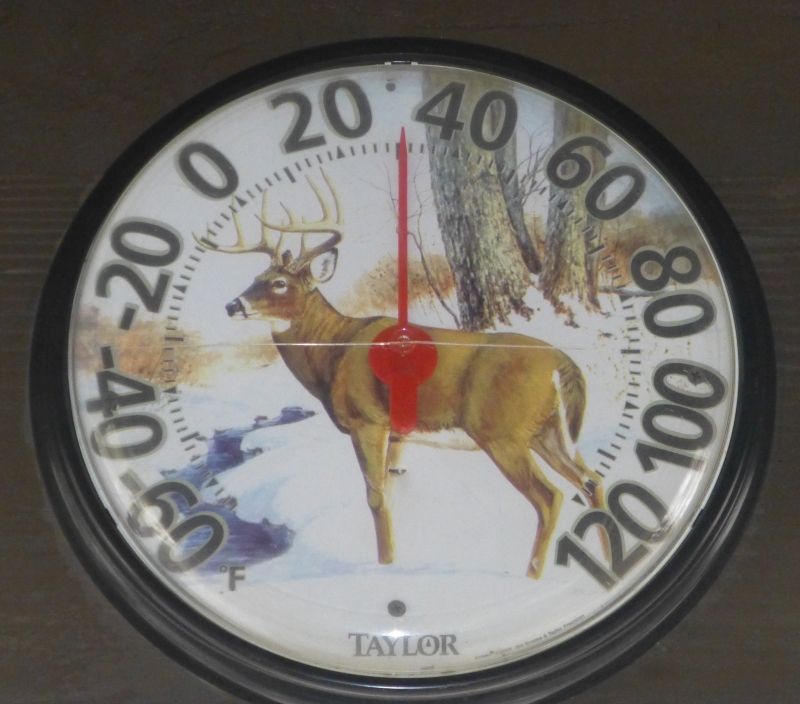
It was a day Maja would have loved….it snowed, and not just a bit, but sticking on the ground snow.  Kevin said on Friday it was beautiful up there, and he had hiked to the top.  We arrived to whiteness and 30°F with wind blowing the snow horizontally at times.

A chilly day

A chilly day

In attendance were the Braggs,  Maja’s family and close friend Christine & her family from North Carolina.

As I said to Kevin when we got out of the car, Maja was there with us and had ordered up the weather for the day, especially for us.

Due to the weather we stood on the porch and held the service.  Kevin read a note from Misha (who could not come), and Chuck, Chuck, Kevin and a couple of others told a few Maja memories.  One that stands out was told by Kevin (more or less like this): Maja was driving her Mercedes down Sunset Blvd to the beach with the kids in the car.  Their friend was driving a VW and started to pass.  Kevin to Maja: “Mom, the VW is passing us” (sound familiar to anyone??), so Maja steps on the gas and goes around the bend on 2 wheels (as the memory goes) and then BLOP, back on all four wheels.  Anyone who remembers Maja’s driving, knows how true that story sounds!!!

Maja's favorite tree

Maja’s favorite tree

We also learned that when Maja went to Nursing School in San Bernardino, she and her German girlfriend (Christine’s mom) had the two highest GPA’s  for their graduating class.  Not bad for two ESLers!!!!!!!!!!!

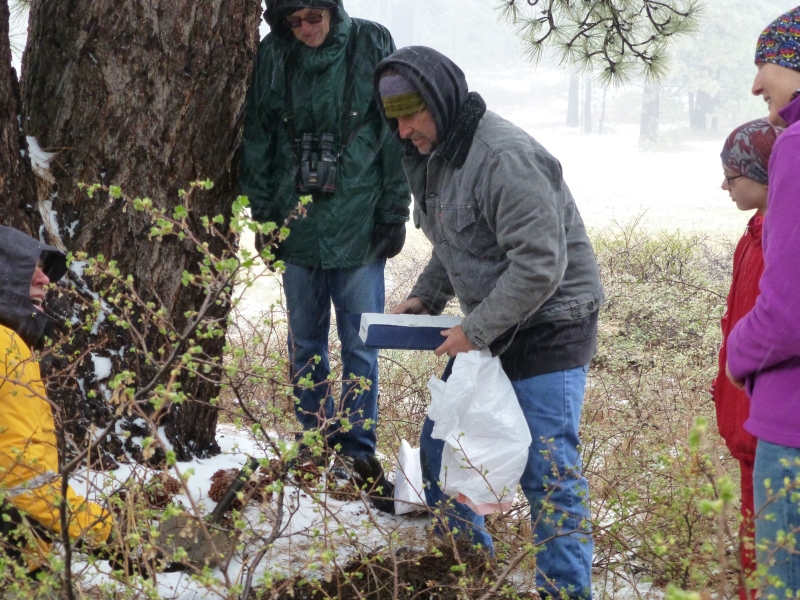
Then we walked down to the meadow, and placed Maja’s ashes under a pine tree near the rock outcrop.  Kevin placed a lovely stone and pine cones over the needles to mark the spot.

Afterwards, back at the parking area, Christine’s twin girls (age 10), were ready to hike to the peak….so off they all went in the snow and wind.  The Braggs and Almdales left for birding adventures below the snow line.

Kevin and Maja

Kevin and Maja

Afterwards, back at the parking area, Christine’s twin girls (age 10), were ready to hike to the peak….so off they all went in the snow and wind.  The Braggs and Almdales left for birding adventures below the snow line.

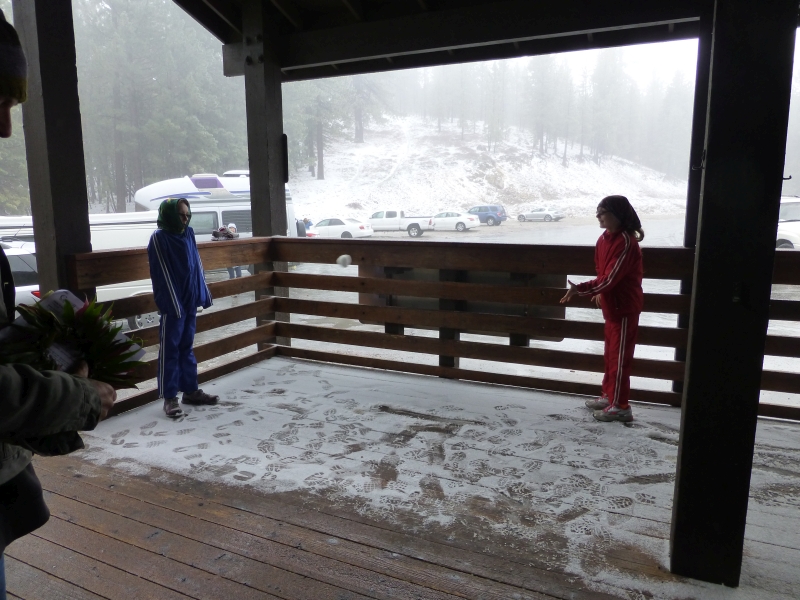
Christine's twins have a small snowball fight

Christine’s twins have a small snowball fight

Kevin mentioned he asked his Mom what she thought death was like.  She replied that she imagined herself flying over the frozen mountains of some northern landscape, with icy fields and pine forests below, the snow glistening in the moonlight.

So, Maja, Saturday’s snowy whiteness was for you, letting us know you were there waiting for the iris to bloom and the birds to sing.

The group gathers to pay last respects to Maja

The group gathers to pay last respects to Maja

To Maja, we raise a toast.

Lillian