Free email delivery
Please sign up for email delivery in the subscription area to the right.
No salesman will call, at least not from us. Maybe from someone else.
Malibu Lagoon Trip Report: 24 May, 2015
Not that I’m complaining, but the weather seems weird to me. Does it to you? When the 24th of May ranged from 59-70° and the 25th of January was 73-81°, well…that’s just plain weird. They must be screwing around with our weather. Again. Whoever they are. Probably the same they as in “They tried to tell us we’re too young, too young to really be in love…” You know. Them.

Great Blue Heron on the ‘Osprey pole’ (R. Ehler 5/24/15)
Rampant paranoia aside, I prefer cool summers. Bring on the fog! Let it linger until November. Those nattering nabobs of nitwitism who reside in the howling wildernesses east of the Colorado River claim we have no seasons here. Sorry folks; we do have seasons. Roughly equivalent to Spring, Summer, Fall, and Winter are: Fog, Smog, Fire, and Mudslide. Recently, Mudslide season dwindles while Fire expands. ¡Qué lástima!
It always seems odd when lots of birders appear at the lagoon in May and June as, bird-wise, those are the two slowest months. “Don’t be disappointed,” I say, “but it’ll be sparse. Come back September through March, and there’ll be many, many more.” But now, the wintering birds have left, most migrants have passed through, many of our local nesters are concealed, sitting cryptic and quietly on well-hidden nests, or skulking about, trying not to be captured and consumed.

Red-winged Blackbird demonstrates how he got his name. Look closely for yellow, not white, margin below the red epaulets. (R. Ehler 5/24/15)
On the lawn at Adamson House we found a foraging Northern Mockingbird. Not an uncommon sight, in itself. But it was frequently flicking its wings as it walked along the
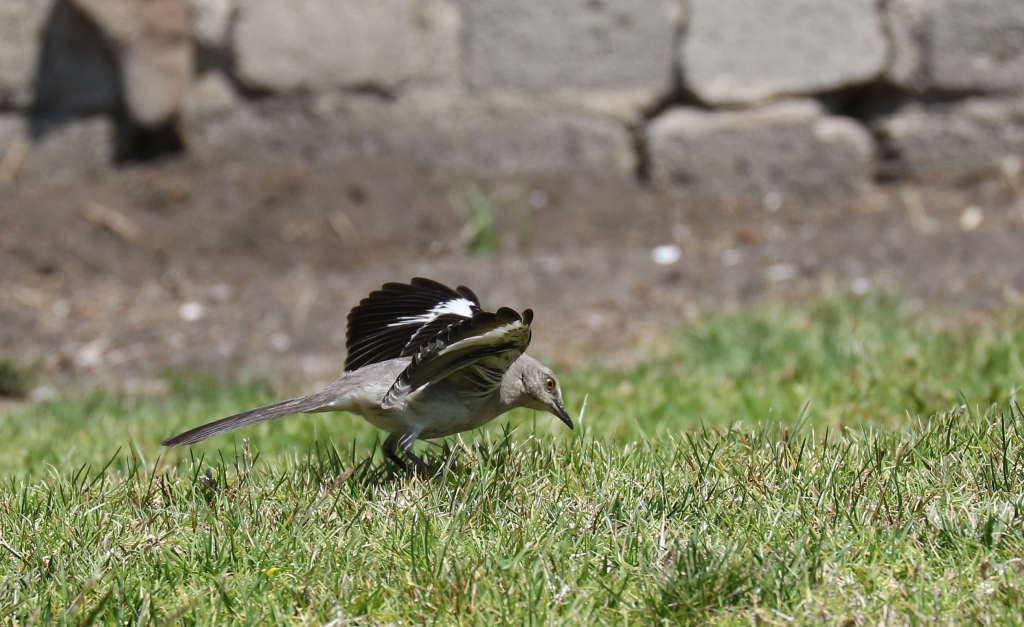
Northern Mockingbird wing-flicking as it hunts (R. Ehler 5/24/15)
ground. We didn’t know if this was a foraging behavior, an anxiety/startle behavior, or a display of sexual attractive or aggression. A little research showed that this is a long-debated topic. One paper (Hailman, Wilson Bulletin, Dec 1960) concluded it was primarily a foraging technique, intended to startle insects into movement. Others aren’t so sure, ‘unease’ or alarm being a possibility, as is aggression. All 14 species (4 or 5, depending on who’s talking, in the Galapagos alone) of mockingbirds do this, whether or not they have white wing-panels as do our Northern Mockingbirds. They also flap and leap while singing.
Apropos of nothing whatsoever, here’s a nice hour-long video/soundtrack of birdsong and babbling creek, good for listening to while researching mockingbird behavior.
We had 590 birds in 48 species, down from last month’s 6009 birds in 53 species, a difference of 5419 birds. 98.4% of that decline was due to the drop in 4 species: Brown Pelican, Heermann’s Gull, Western Gull, Elegant Tern. [See the trip lists below.]
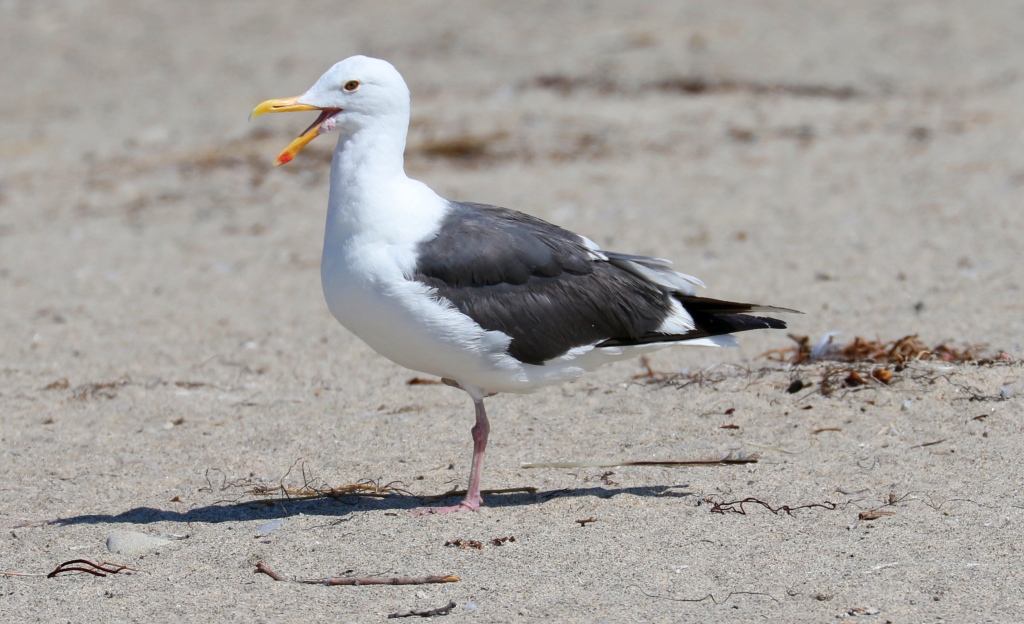
Western Gull in repose (R. Ehler 5/24/15)
These birds are all off nesting – or should be, if they know what’s good for them. The Heermann’s, for example, begin laying eggs in late April at their eight known nesting areas; 95% of the species’ 150,000 pairs nest on Isla Rasa, located about halfway down the Sea of Cortez. At the same time, this tiny island also hosts over 90% of the world’s 40,000 pairs of Elegant Terns. It’s a busy, noisy, stinky place this time of year. But changes in weather, sea currents and sea temperatures cause massive changes in availability of food fish. The Elegant Terns may have suffered a complete nesting failure this year on Isla Rasa due to lack of food.

Brown Pelicans, et. al., discover a small school of fish (R. Ehler 5/24/15)
Many of the Gadwalls looked like young birds – not ducklings, full size but not in adult plumage. Perhaps they are the result of early nesting near the lagoon? We didn’t see any warblers – not a single Yellowthroat – but the Song Sparrows sang up a storm, various swallow species made off with mouthfuls of mud to build nests on nearby walls, and hummingbirds, particularly the Allen’s, were almost abundant on Adamson House’s flowered wall. A couple of cormorants staggered around the lagoon-edge with sticks in their mouth, and across the street, the top of the recently shaved nesting tree next to Starbuck’s was adorned with egrets and their nests.
There were even orioles: at least three Hooded Orioles – two females and one yellow-not orange year-old male – were in the trees near the Colony wall. Hooded Orioles – the ‘hood’
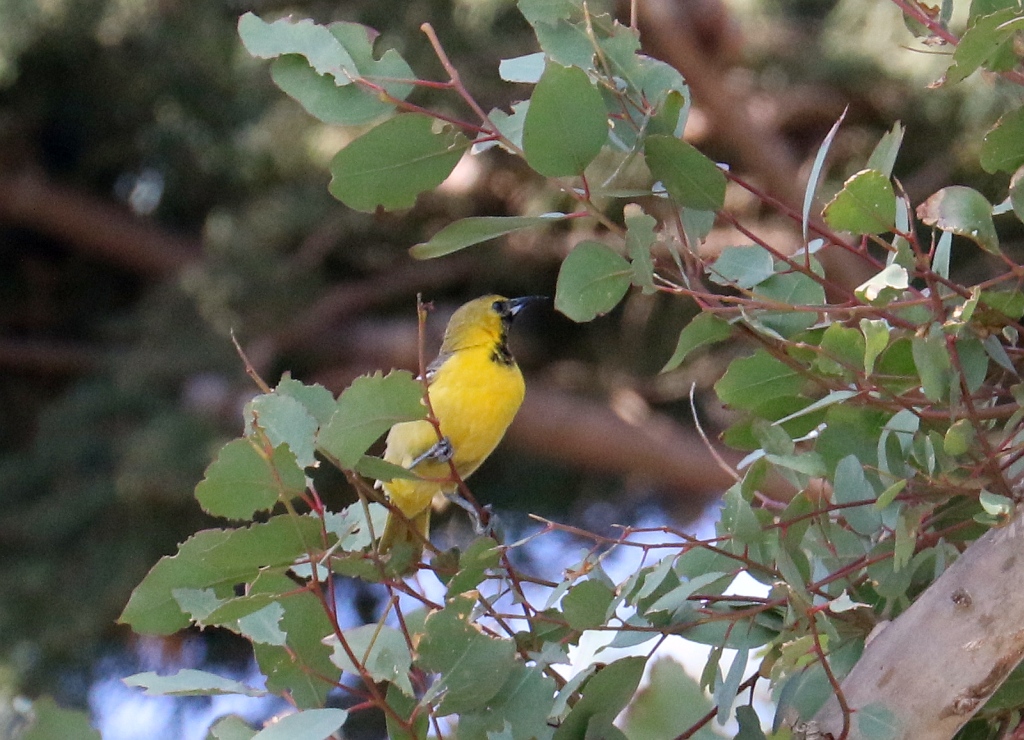
Hooded Oriole, one year old male (R. Ehler 5/24/15)
is yellow in the female and orange in the male – always nest in palm trees. Look on the underside of palm fronds for their light brown pendulous nests, suspended near the central frond shaft, woven of thin fibers from palm leaf and trunk. Adult males have a large black ‘bib’ on their throat. Also around, but not seen today, are deciduous-tree-nesting Bullock’s Orioles; orange & black males have black crowns and small black chin patches; the yellowish females have white bellies, unlike the female Hooded which are all-yellow underneath.
Snowy Plovers, absent since January, remained absent, which is normal for May.

House Finches take a bath at Adamson House (R. Ehler 5/24/15)
Birds new for the season were: Pacific Loon, Red-tailed Hawk, Spotted Towhee, Red-winged Blackbird, Brewer’s Blackbird, Hooded Oriole. We finally got over to Adamson House but saw no additional species. The House Finches were busily bathing, so we beat a hasty retreat.
Our next three scheduled field trips: Mt. Piños Birds & Butterflies, 13-14 June, 8am; Malibu Lagoon & Picnic, 28 June, 8:30 & 10am; Malibu Lagoon, 26 July, 8:30 & 10am.
Our next program: Evening meetings will resume on Tuesday, 6 October, 7:30 pm, at [changed again] Chris Reed Park, 1133 7th St., NE corner of 7th and Wilshire Blvd. in Santa Monica.
NOTE: Our 10 a.m. Parent’s & Kids Birdwalk meets at the shaded viewing area. Watch for Willie the Weasel. He’ll be watching for you.
Links: Unusual birds at Malibu Lagoon
9/23/02 Aerial photo of Malibu Lagoon
Prior checklists:
2014: Jan-July, July-Dec 2013: Jan-June, July-Dec
2012: Jan-June, July-Dec 2011: Jan-June, July-Dec
2010: Jan-June, July-Dec 2009: Jan-June, July-Dec
The 10-year comparison summaries created during the project period, despite numerous complaints, remain available on our Lagoon Project Bird Census Page. Very briefly summarized, the results unexpectedly indicate that avian species diversification and numbers improved slightly during the period Jun’12-June’14. [Chuck Almdale]
| Bird Census 2014-15 | 12/28 | 1/25 | 2/22 | 3/22 | 4/26 | 5/24 |
| Temperature | 39-61 | 73-81 | 55-63 | 62-71 | 66-76 | 59-70 |
| Tide Lo/Hi Height | L+1.70 | L+1.32 | H+4.51 | H+4.78 | L+0.58 | L+0.54 |
| Tide Time | 0903 | 0705 | 1137 | 1137 | 1131 | 0919 |
| Brant | 3 | 7 | ||||
| Canada Goose | 1 | 30 | ||||
| Gadwall | 26 | 22 | 30 | 1 | 10 | 22 |
| American Wigeon | 10 | 18 | 18 | |||
| Mallard | 10 | 12 | 12 | 12 | 8 | 8 |
| Northern Shoveler | 4 | 25 | 2 | |||
| Northern Pintail | 2 | 3 | ||||
| Green-winged Teal | 12 | 25 | 12 | |||
| Surf Scoter | 13 | 15 | ||||
| Bufflehead | 8 | 4 | 2 | 2 | ||
| Hooded Merganser | 4 | |||||
| Red-brstd Merganser | 25 | 4 | 2 | 2 | ||
| Ruddy Duck | 42 | 38 | 35 | 30 | 4 | |
| Red-throated Loon | 3 | 1 | 3 | |||
| Pacific Loon | 6 | 1 | 3 | 1 | ||
| Common Loon | 1 | 1 | 5 | |||
| Pied-billed Grebe | 8 | 2 | 1 | 2 | 1 | |
| Horned Grebe | 4 | 2 | 1 | 1 | 1 | |
| Eared Grebe | 12 | 3 | 1 | |||
| Western Grebe | 2 | 5 | 15 | 12 | 2 | 1 |
| Brandt’s Cormorant | 130 | 1 | 4 | 1 | ||
| Dble-crstd Cormorant | 120 | 35 | 50 | 45 | 16 | 55 |
| Pelagic Cormorant | 1 | 1 | 1 | 4 | ||
| Brown Pelican | 95 | 50 | 28 | 27 | 1490 | 70 |
| Great Blue Heron | 3 | 2 | 2 | 1 | 2 | 2 |
| Great Egret | 4 | 2 | 10 | 5 | 5 | |
| Snowy Egret | 18 | 16 | 26 | 12 | 12 | 4 |
| Cattle Egret | 1 | |||||
| Osprey | 1 | 1 | 1 | 1 | ||
| White-tailed Kite | 1 | |||||
| Red-shouldered Hawk | 1 | 1 | ||||
| Red-tailed Hawk | 1 | 1 | 1 | |||
| American Coot | 135 | 88 | 145 | 45 | 1 | |
| American Avocet | 1 | |||||
| Blk-bellied Plover | 38 | 62 | 85 | 6 | 1 | |
| Snowy Plover | 25 | 29 | ||||
| Semipalmated Plover | 9 | |||||
| Killdeer | 17 | 12 | 12 | 3 | 2 | 6 |
| Spotted Sandpiper | 6 | 3 | 3 | 2 | 1 | |
| Greater Yellowlegs | 1 | |||||
| Willet | 10 | 4 | 3 | 3 | 1 | 1 |
| Whimbrel | 1 | 4 | 4 | 10 | 12 | 1 |
| Long-billed Curlew | 1 | |||||
| Marbled Godwit | 12 | 12 | 10 | 8 | 2 | |
| Ruddy Turnstone | 6 | 5 | 1 | |||
| Surfbird | 4 | |||||
| Sanderling | 28 | 8 | ||||
| Dunlin | 1 | |||||
| Least Sandpiper | 15 | |||||
| Western Sandpiper | 45 | |||||
| Boneparte’s Gull | 1 | 12 | 6 | 1 | ||
| Heermann’s Gull | 18 | 17 | 1 | 6 | 350 | 45 |
| Ring-billed Gull | 65 | 150 | 90 | 3 | 30 | 8 |
| Western Gull | 230 | 170 | 95 | 3 | 110 | 135 |
| California Gull | 1500 | 1650 | 1600 | 40 | 600 | 6 |
| Herring Gull | 1 | |||||
| Glaucous-wingd Gull | 3 | 5 | 4 | 1 | 1 | |
| Caspian Tern | 10 | 11 | ||||
| Forster’s Tern | 2 | |||||
| Royal Tern | 22 | 42 | 35 | 15 | 4 | 2 |
| Elegant Tern | 28 | 3100 | 85 | |||
| Rock Pigeon | 6 | 4 | 5 | 23 | 8 | 9 |
| Mourning Dove | 3 | 2 | 2 | 2 | 2 | |
| Anna’s Hummingbird | 1 | 1 | 2 | 2 | ||
| Allen’s Hummingbird | 4 | 2 | 3 | 6 | 4 | 6 |
| Belted Kingfisher | 1 | |||||
| American Kestrel | 1 | |||||
| Peregrine Falcon | 1 | |||||
| Black Phoebe | 2 | 1 | 2 | 2 | 2 | 2 |
| Say’s Phoebe | 1 | |||||
| American Crow | 8 | 4 | 6 | 5 | 6 | 5 |
| Common Raven | 2 | |||||
| Rough-wingd Swallow | 4 | 4 | 6 | |||
| Barn Swallow | 2 | 6 | 12 | |||
| Cliff Swallow | 2 | 10 | ||||
| Oak Titmouse | 1 | 1 | ||||
| Bushtit | 14 | 2 | ||||
| Blue-gray Gnatcatcher | 1 | |||||
| Ruby-crowned Kinglet | 2 | |||||
| Hermit Thrush | 2 | |||||
| American Robin | 1 | 1 | ||||
| Northern Mockingbird | 2 | 1 | 1 | 3 | 6 | 3 |
| European Starling | 25 | 45 | 3 | 4 | 10 | 3 |
| Cedar Waxwing | 40 | |||||
| Common Yellowthroat | 4 | 3 | 3 | 2 | ||
| Yellow-rumpd Warbler | 15 | 7 | 8 | 5 | ||
| Townsend’s Warbler | 1 | |||||
| Spotted Towhee | 1 | |||||
| California Towhee | 1 | 3 | 2 | 2 | ||
| Savannah Sparrow | 3 | |||||
| Song Sparrow | 3 | 2 | 6 | 9 | 6 | 9 |
| White-crwnd Sparrow | 35 | 4 | 12 | 10 | ||
| Red-winged Blackbird | 2 | |||||
| Western Meadowlark | 14 | 24 | 10 | 3 | ||
| Brewer’s Blackbird | 2 | |||||
| Great-tailed Grackle | 5 | 4 | 4 | 3 | ||
| Brwn-headed Cowbird | 4 | 4 | ||||
| Hooded Oriole | 3 | |||||
| House Finch | 4 | 4 | 12 | 20 | ||
| Lesser Goldfinch | 1 | 2 | 1 | |||
| Totals by Type | Dec | Jan | Feb | Mar | Apr | May |
| Waterfowl | 141 | 138 | 154 | 50 | 55 | 37 |
| Water Birds – Other | 516 | 187 | 247 | 144 | 1511 | 134 |
| Herons, Egrets & Ibis | 25 | 18 | 30 | 24 | 19 | 11 |
| Quail & Raptors | 5 | 2 | 2 | 1 | 1 | 1 |
| Shorebirds | 144 | 139 | 119 | 37 | 89 | 8 |
| Gulls & Terns | 1839 | 2035 | 1825 | 107 | 4213 | 294 |
| Doves | 6 | 7 | 7 | 25 | 10 | 11 |
| Other Non-Passerines | 4 | 3 | 3 | 7 | 7 | 8 |
| Passerines | 114 | 106 | 61 | 76 | 104 | 86 |
| Totals Birds | 2794 | 2635 | 2448 | 471 | 6009 | 590 |
| Total Species | Dec | Jan | Feb | Mar | Apr | May |
| Waterfowl | 9 | 9 | 10 | 7 | 5 | 3 |
| Water Birds – Other | 11 | 9 | 11 | 9 | 6 | 8 |
| Herons, Egrets & Ibis | 3 | 2 | 3 | 4 | 3 | 3 |
| Quail & Raptors | 5 | 2 | 2 | 1 | 1 | 1 |
| Shorebirds | 10 | 9 | 8 | 8 | 10 | 3 |
| Gulls & Terns | 7 | 7 | 6 | 7 | 10 | 9 |
| Doves | 1 | 2 | 2 | 2 | 2 | 2 |
| Other Non-Passerines | 1 | 2 | 1 | 2 | 3 | 2 |
| Passerines | 12 | 16 | 14 | 17 | 13 | 17 |
| Totals Species – 100 | 59 | 58 | 57 | 57 | 53 | 48 |
AAAAA
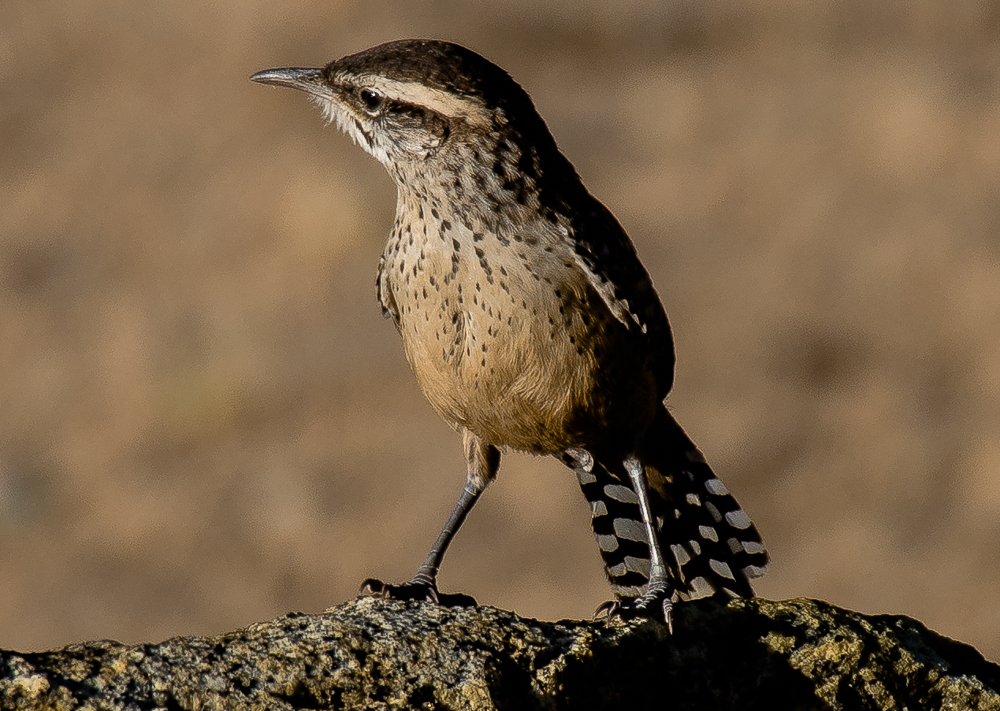
Cactus Wrens sound like a birthday party toy (D. Erwin 5/3/15 Black Rock)
We weren’t even out of our campervan before California Thrashers, Gambel’s Quail and Western Scrub-Jays came by to (maybe) check us out. Colorful lizards sunned themselves in the cactus garden. Unlike the movie, it would be a good day at Black Rock.
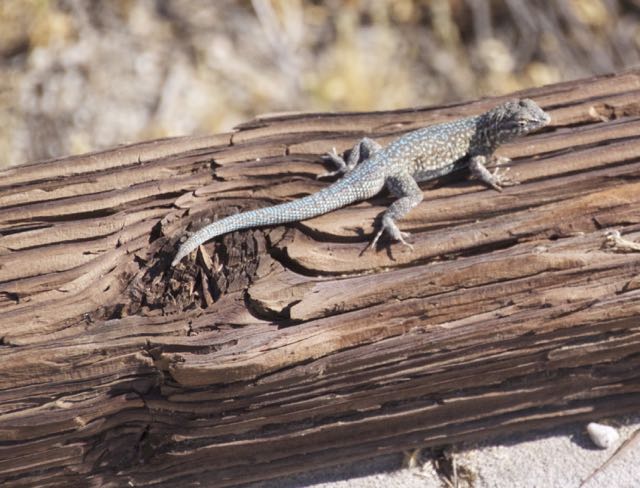
Speckled Lizard – Black Rock (R. Seidner 5/2/15)
A few years ago we broke this trip into two parts: Saturday afternoon at Black Rock Campground; Sunday morning at Morongo Valley Preserve & adjacent Covington Park. Late afternoon, after the heat of the day, when birds begin rousing themselves for a final burst of feeding, is a good time for Black Rock. Many birders had already taken to moteling Saturday night in Yucca Valley, close to the campground five miles south into northwestern Joshua Tree Nat. Park. The best time to see Piñon Jays is shortly before sunset, when they fly up and downslope above the campground. Other birds are always around the campground, but – as do most birds everywhere – they make themselves scarce mid-day.

Males Gambel’s Quail, a desert bird, watches for his mate (D. Erwin 5/3/15 Black Rock)
We found most of the Black Rock specialties: Gambel’s Quail came to water drips and called from the Joshua Treetops, the increasingly more common White-winged Dove, several hummingbirds worked the bushes and ephemeral flowers, Ladderbacked Woodpeckers drilled the Joshuas, the aforementioned Piñon Jay, Verdin with faces the color of yellow mesquite flowers, the squat-jumping Rock Wren and the cranky Cactus Wren, desert early-nesting Phainopeplas, the Black-throated Sparrow who never drinks water, and the lovely-to-see-and-hear Scott’s Oriole. Perhaps the most uncommon sightings were several Chuckwalla lizards warming on rock tops, and a large

Rattlesnake, either Western or Red – Black Rock (R. Seidner 5/2/15)
Diamondback Rattlesnake (either Western or Red) near the front door of the ranger station. His rattles had broken off. Mary, temporarily alone, saw a Roadrunner the rest of
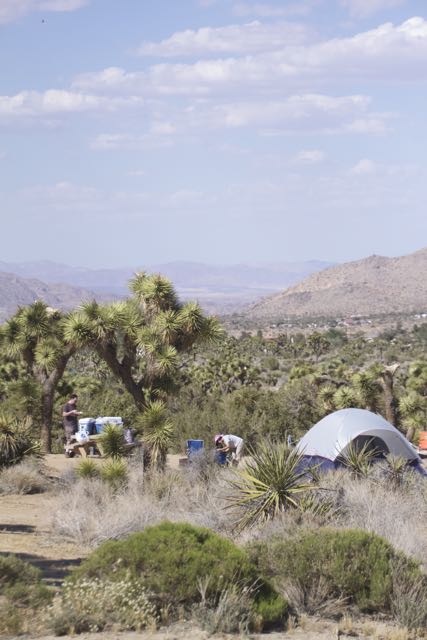
Black Rock campground – no wind, tents still in place (R. Seidner 5/2/15)
us missed. We then went off to dinner at La Casita in Yucca Valley, a good Mexican restaurant. Those of us camping returned, stuffed to the gills, to Black Rock and waited for the wind to rise. Infamous for its winds – we call it Windy Ridge – people have seen their tents sail away into yucca-strewn gullies, or been rocked to sleep – or to terror – by a wind-wobbled campervan.
Next morning, on the way from our Black Rock campsite to Morongo Valley, we spotted two Roadrunners, one road-crossing as we coasted down the long road back to the highway, and one crossing the highway itself, right in the middle of town. I almost forgot: Lillian and I witnessed a 6:05am flyover of 60-100 Piñon Jays, heading downcanyon directly above our campsite, each one calling in their peculiar quail-like purr.
Morongo Valley Preserve was moderately birdy and – for a change – neither windy nor unbearably hot. Warblers were few: we did see six of the eleven western warbler species, but
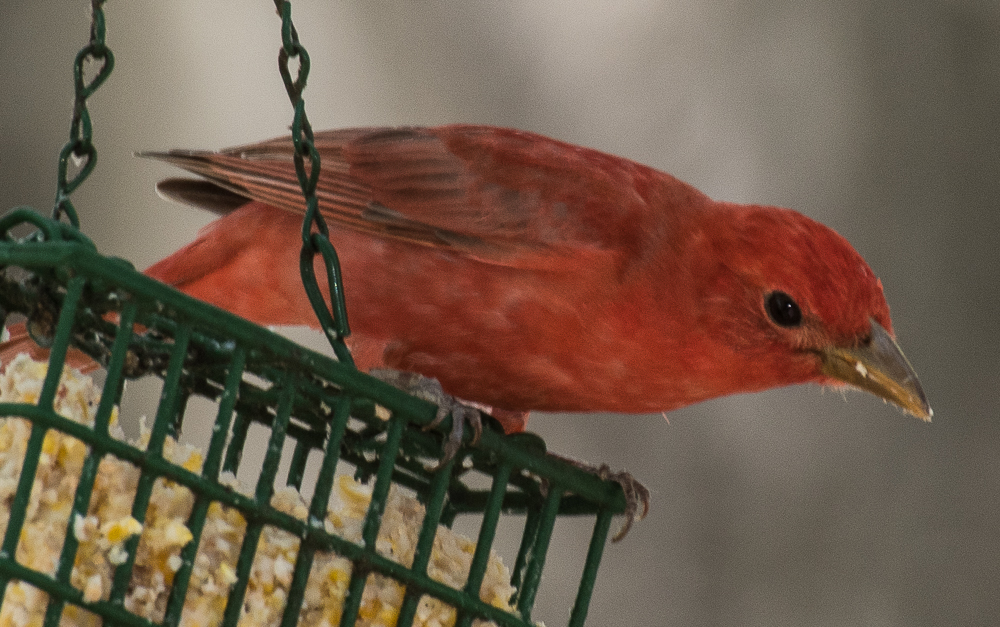
Male Summer Tanater at the seed feeder (D. Erwin 5/3/15 Morongo Valley)
95% of them were Wilson’s Warblers. Summer Tanagers have apparently already paired up; we first spotted them whizzing back and forth, and later at the seed feeder by the warden’s house. Brown-crested Flycatchers were very vocal, as were Yellow-breasted Chats, and we heard them singing and calling over and over before we finally spotted either species. At least one pair of Vermillion Flycatcher were in Covington Park, and we saw a female sitting on her nest near the tennis court, her mate

Male woodpecker, probably a Nuttall’s – Ladderbacked hybrid – misshapen black on shoulder (D. Erwin 5/3/15 Morongo Valley)
busily bringing her flies. Nearby, birds, including Lawrence’s Goldfinches, were coming to the small water drip someone had set up. White-winged Doves were frequently seen; a few years back we had to diligently search for this species, often missing it, but now they seem widespread. At the seed feeders we could admire their blue orbital ring.
Morongo Valley is one of the few areas where the ranges of the Nuttall’s and Ladderbacked Woodpeckers overlap, and they do interbreed. Of the photos taken, none are clearly one or the other species. Check the three photos for some of the annoying details.

This female woodpecker might actually be a hybrid – buffy lores with otherwise Nuttall’s appearance (D. Erwin 5/3/15 Morongo Valley)

Female woodpecker belly seems too white to be pure Ladderbacked (D. Erwin 5/3/15 Morongo Valley)
All told, we had 66 species in two days, down from 2013’s 76 species (see list below). A lot depends on which winds the birds encounter as they move north from the brushy shore of the Salton Sea. A good tail wind and they sail right on by, high over the hills. A stiff head wind like the screamers that come through San Gorgonio Pass, and they are forced to stay low and slow, moving up through Big Morongo Canyon to rest and refuel at the Preserve.

Brown-crested Flycatcher (D. Erwin 5/3/15 Morongo)
Ash-throated and Brown-crested Flycatchers both nest at the preserve. Very similar in appearance, even the thinner bill of the Ash-throated can be mistaken by some (moi!) for the chunkier bill of the Brown-crested. Fortunately, the latter bird has a much more liquid Whit! call and rolly song than the former. If you’re lucky, you’ll see one sing. [Added Note: The fact that this photo was captioned “Ash-throated Flycatcher” in the original email demonstrates how easily they’re confused.] [Chuck Almdale]
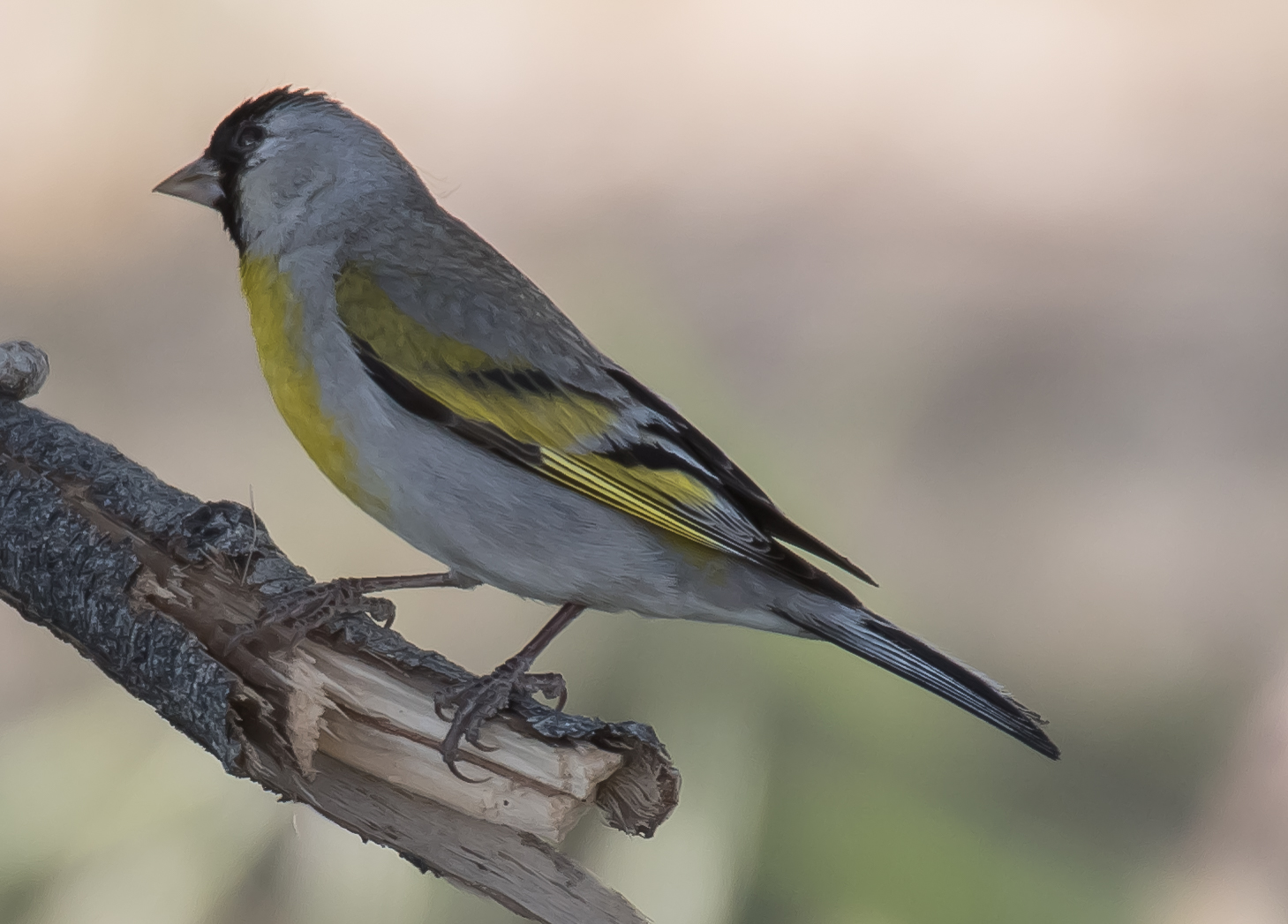
The uncommon male Lawrence’s Goldfinch
(Dennis Erwin 5/3/15 Morongo Valley)
Many thanks to Dennis Erwin and Roxie Seidner for all the great photographs!
| Black Rock & Morongo Valley | ||
| Codes: B – Black Rock Campground | ||
| M – Morongo Valley Preserve & Covington Park | ||
| H – Heard Only | ||
| Species List | 5/2-3/15 | 5/4-5/13 |
| Gambel’s Quail | MB | MB |
| Green Heron | M | |
| Turkey Vulture | MB | M |
| Cooper’s Hawk | M | M |
| Red-tailed Hawk | M | |
| Virginia Rail | M-H | M-H |
| Rock Pigeon | MB | MB |
| Eurasian Collared-Dove | MB | M |
| White-winged Dove | MB | MB |
| Mourning Dove | MB | MB |
| Greater Roadrunner | B | |
| White-throated Swift | M | |
| Black-chinned Hummingbird | MB | MB |
| Anna’s Hummingbird | MB | MB |
| Costa’s Hummingbird | MB | MB |
| Allen’s Hummingbird | M | |
| Calliope Hummingbird | M | |
| Ladder-backed Woodpecker | MB | MB |
| Nuttall’s Woodpecker | M | M |
| American Kestrel | M | B |
| Olive-sided Flycatcher | M | |
| Western Wood-Pewee | MB | MB |
| Willow Flycatcher | M | |
| Pacific-slope Flycatcher | M | M |
| Black Phoebe | MB | MB |
| Say’s Phoebe | B | |
| Vermilion Flycatcher | M | M |
| Ash-throated Flycatcher | MB | B |
| Brown-crested Flycatcher | M | M |
| Cassin’s Kingbird | M | MB |
| Western Kingbird | M | MB |
| Loggerhead Shrike | M | |
| Bell’s Vireo | M | M |
| Cassin’s Vireo | M | M |
| Warbling Vireo | M | M |
| Pinyon Jay | B | B |
| Western Scrub-Jay | MB | MB |
| Common Raven | MB | MB |
| Mountain Chickadee | M | |
| Oak Titmouse | MB | M |
| Verdin | MB | |
| Bushtit | M | M |
| Rock Wren | B | |
| House Wren | M | M |
| Bewick’s Wren | MB | MB |
| Cactus Wren | B | B |
| Blue-gray Gnatcatcher | M | |
| Western Bluebird | MB | MB |
| Townsend’s Solitaire | M | |
| Swainson’s Thrush | M | |
| Hermit Thrush | M | |
| California Thrasher | MB | MB |
| Northern Mockingbird | B | B |
| European Starling | MB | MB |
| Phainopepla | MB | MB |
| Orange-crowned Warbler | M | M |
| Nashville Warbler | M | |
| Common Yellowthroat | M | M |
| Yellow Warbler | MB | M |
| Yellow-rumped Warbler | MB | M |
| Black-throated Gray Warbler | M | |
| Townsend’s Warbler | M | |
| Hermit Warbler | M | |
| Wilson’s Warbler | MB | MB |
| Yellow-breasted Chat | M | M |
| Spotted Towhee | MB | |
| California Towhee | MB | MB |
| Brewer’s Sparrow | B | |
| Black-throated Sparrow | B | |
| Song Sparrow | M | M |
| Summer Tanager | M | M |
| Western Tanager | M | M |
| Black-headed Grosbeak | M | M |
| Blue Grosbeak | M | |
| Lazuli Bunting | M | |
| Great-tailed Grackle | M | |
| Brown-headed Cowbird | M | M |
| Hooded Oriole | M | M |
| Bullock’s Oriole | M | M |
| Scott’s Oriole | B | B |
| House Finch | MB | MB |
| Pine Siskin | M | |
| Lesser Goldfinch | M | MB |
| Lawrence’s Goldfinch | M | M |
| House Sparrow | MB | MB |
| Total Species – 85 |
66 | 76 |

Just before the horribly disfiguring accident, Chuck checks a Cactus Wren nest in a cholla to see if anyone is home (R. Seidner 5/2/15 Black Rock)
A Fond Farewell to Maja

The deepening snow beneath the trees
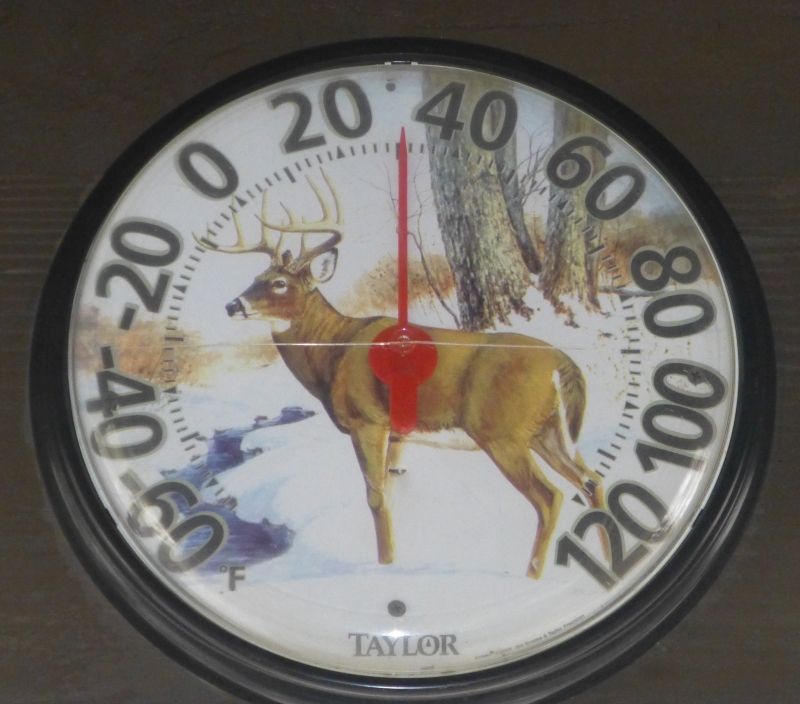
It was a day Maja would have loved….it snowed, and not just a bit, but sticking on the ground snow. Kevin said on Friday it was beautiful up there, and he had hiked to the top. We arrived to whiteness and 30°F with wind blowing the snow horizontally at times.
A chilly day
In attendance were the Braggs, Maja’s family and close friend Christine & her family from North Carolina.
As I said to Kevin when we got out of the car, Maja was there with us and had ordered up the weather for the day, especially for us.
Due to the weather we stood on the porch and held the service. Kevin read a note from Misha (who could not come), and Chuck, Chuck, Kevin and a couple of others told a few Maja memories. One that stands out was told by Kevin (more or less like this): Maja was driving her Mercedes down Sunset Blvd to the beach with the kids in the car. Their friend was driving a VW and started to pass. Kevin to Maja: “Mom, the VW is passing us” (sound familiar to anyone??), so Maja steps on the gas and goes around the bend on 2 wheels (as the memory goes) and then BLOP, back on all four wheels. Anyone who remembers Maja’s driving, knows how true that story sounds!!!
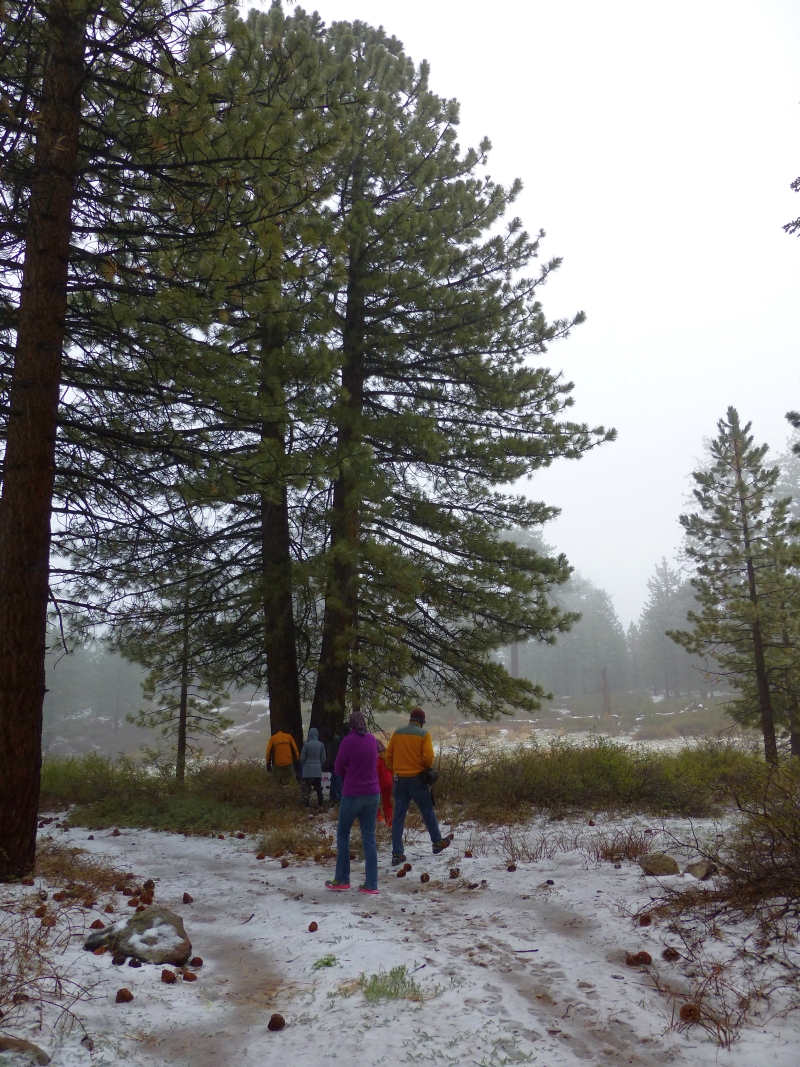
Maja’s favorite tree
We also learned that when Maja went to Nursing School in San Bernardino, she and her German girlfriend (Christine’s mom) had the two highest GPA’s for their graduating class. Not bad for two ESLers!!!!!!!!!!!
Then we walked down to the meadow, and placed Maja’s ashes under a pine tree near the rock outcrop. Kevin placed a lovely stone and pine cones over the needles to mark the spot.
Afterwards, back at the parking area, Christine’s twin girls (age 10), were ready to hike to the peak….so off they all went in the snow and wind. The Braggs and Almdales left for birding adventures below the snow line.
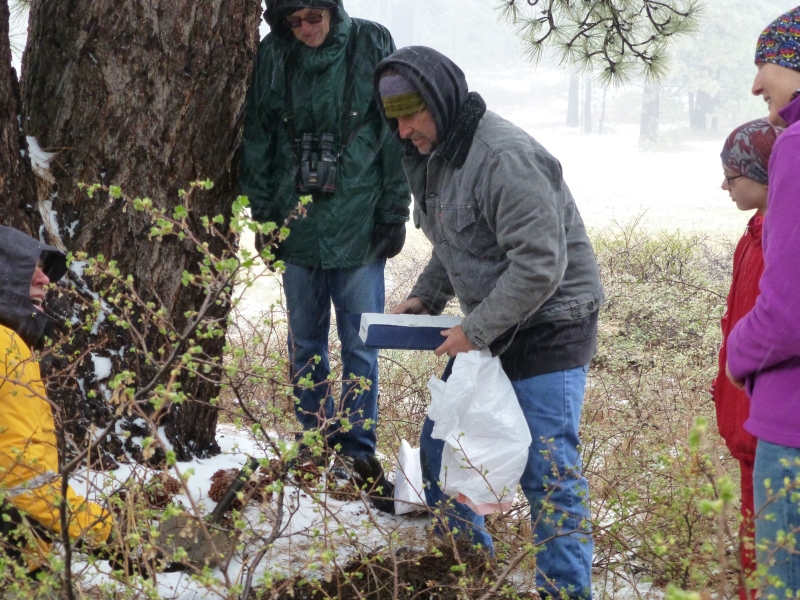
Kevin and Maja
Afterwards, back at the parking area, Christine’s twin girls (age 10), were ready to hike to the peak….so off they all went in the snow and wind. The Braggs and Almdales left for birding adventures below the snow line.
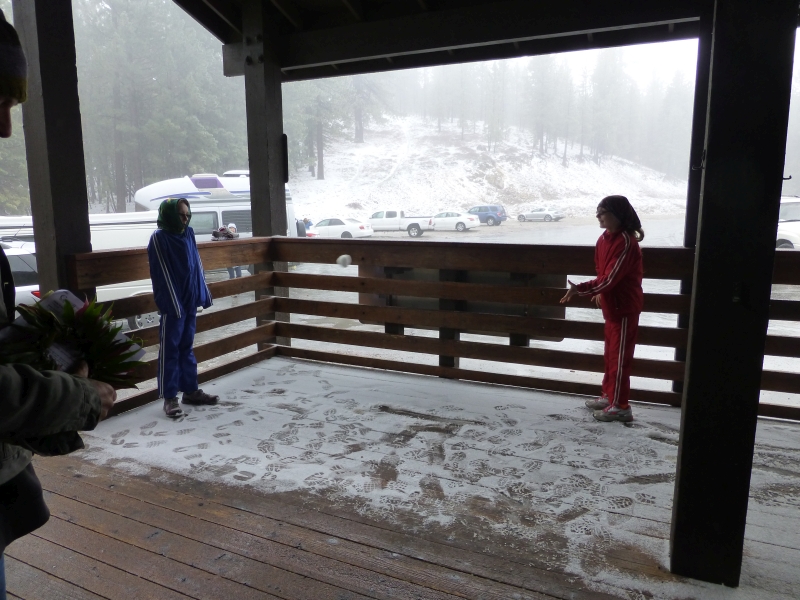
Christine’s twins have a small snowball fight
Kevin mentioned he asked his Mom what she thought death was like. She replied that she imagined herself flying over the frozen mountains of some northern landscape, with icy fields and pine forests below, the snow glistening in the moonlight.
So, Maja, Saturday’s snowy whiteness was for you, letting us know you were there waiting for the iris to bloom and the birds to sing.

The group gathers to pay last respects to Maja
To Maja, we raise a toast.
Lillian
Butterbredt Springs Weekend Trip: 25-26 April, 2015
It was a very special Spring outing to Butterbredt Spring. We do it annually, but this year was different: one of our founding members, who has hosted us for years, turned 90. That is an achievement in itself, but how many 90-year olds do you know who drive in fence posts and stretch wire across them to keep out errant motorcycles? I am referring to Keith Axelson, who became so fond of the beautiful Mojave desert that 20 years or so ago he left

Front porch birding (R.Seidner 4/25/15)
Los Angeles and bought a property at a spring near Butterbredt and moved there. No telephone, gas or electricity, water only from his spring — and it’s beautiful. The spring supports large cottonwood trees and lots of watercress, and Keith has his own collection of trees. Wildlife is abundant and includes California Quail, Say’s Phoebes, Pine Siskins, various warblers, Lazuli Bunting, Western Screech-Owls, a local Bobcat, and Keith’s feeders attract many hummingbirds and finches.

Western Bluebird male off for some more bugs (R.Seidner 4/24/15)
Also nesting Western Bluebirds, two sets, feeding young at the nesting boxes. It is a pleasure to sit on his patio and watch. Before we head off for Keith’s, we spend Saturday morning at Butterbredt Spring, which is now under the ownership of California State Parks.

Cliff over Butterbredt spring (R.Seidner 4/24/15)
They have improved the access gate and put up a sign, listing Santa Monica Bay Audubon Society as one of the entities managing it, and declaring it to be an IBA — an Important Bird Area. Even at the wide space where we parked, there were birds. A pair of particularly colorful Ash-throated Flycatchers were cavorting on the fence, and mourning doves were everywhere. On the drive to the spring, one of us was delighted to spot a Golden Eagle. At the spring in the nearby dry wash were many Warblers: Wilson’s were abundant and MacGillivray’s caused much joy to those who saw them. Lawrence’s and Lesser Goldfinches were busy feeding young. Mr and Mrs Black-headed Grosbeak were present. We saw many hard-to-identify empids, including the Pacific-slope Flycatcher, as well as the similar Hammond’s Flycatcher.
Among the pleasures of going there in Spring is the wildflowers — including a strange thing looking like a mushroom with purple flowers on it called Broomrape, also known as scaly stemmed sand plant, which is parasitic on the roots of Burrobush or Cheesebush. Also Prince’s Plumes, Chia, Prickly Poppies, Paperbag Bushes, Desert Sunflowers, bright rose flowering Beavertail Cacti and Mormon Tea made this a very colorful walk.
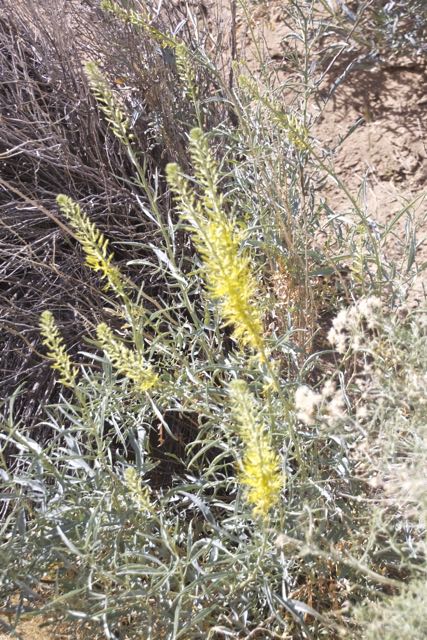
Prince’s Plume (R.Seidner 4/24/15)
And then it was on to the party! You would have thought Keith would be overwhelmed by all the people there, – 17 or so, who assembled from great distances — but he had a constant smile on his face, and I believe he enjoyed every minute.
[Elizabeth Galton and Mary Prismon]

Still life with frog – Keith’s lower pond
(R.Seidner 4/25/15)
| Butterbredt Spring | 2015 | 2013 | 2012 |
| Spring Trips | 4/25-26 | 4/25-27 | 4/27-30 |
| Mallard | X | ||
| Mountain Quail | X | X | |
| California Quail | X | X | X |
| Chukar | X | X | |
| Turkey Vulture | X | ||
| Golden Eagle | X | ||
| Sharp-shinned Hawk | X | ||
| Swainson’s Hawk | X | ||
| Red-tailed Hawk | X | X | X |
| American Coot | X | ||
| Killdeer | X | ||
| Eurasian Collared-Dove | X | X | X |
| Mourning Dove | X | X | X |
| Greater Roadrunner | X | ||
| Western Screech-Owl | X | X | |
| Great Horned Owl | X | ||
| Common Poorwill | X | ||
| Anna’s Hummingbird | X | X | |
| Costa’s Hummingbird | X | X | X |
| Rufous Hummingbird | X | ||
| Ladder-backed Woodpecker | X | X | |
| Nuttall’s Woodpecker | X | X | X |
| Northern Flicker | X | ||
| American Kestrel | X | ||
| Olive-sided Flycatcher | X | ||
| Western Wood-Pewee | X | ||
| Hammond’s Flycatcher | X | X | |
| Dusky Flycatcher | X | ||
| Pacific-slope Flycatcher | X | X | X |
| Say’s Phoebe | X | X | |
| Ash-throated Flycatcher | X | X | X |
| Cassin’s Kingbird | X | ||
| Western Kingbird | X | X | |
| Loggerhead Shrike | X | X | |
| Cassin’s Vireo | X | X | X |
| Warbling Vireo | X | X | |
| Western Scrub-Jay | X | X | |
| Common Raven | X | X | X |
| Bushtit | X | X | X |
| Red-breasted Nuthatch | X | ||
| White-breasted Nuthatch | X | ||
| Rock Wren | X | X | |
| Bewick’s Wren | X | X | X |
| Cactus Wren | X | X | |
| Ruby-crowned Kinglet | X | X | X |
| Western Bluebird | X | X | |
| Townsend’s Solitaire | X | ||
| Hermit Thrush | X | X | |
| California Thrasher | X | ||
| Northern Mockingbird | X | ||
| European Starling | X | X | |
| Phainopepla | X | ||
| Orange-crowned Warbler | X | X | X |
| Nashville Warbler | X | X | |
| MacGillivray’s Warbler | X | X | |
| Common Yellowthroat | X | ||
| Yellow Warbler | X | X | X |
| Yellow-rumped Warbler | X | X | |
| Black-throated Gray Warbler | X | ||
| Townsend’s Warbler | X | X | |
| Hermit Warbler | X | ||
| Wilson’s Warbler | X | X | X |
| Green-tailed Towhee | X | ||
| Spotted Towhee | X | X | |
| California Towhee | X | X | |
| Chipping Sparrow | X | X | |
| Brewer’s Sparrow | X | ||
| Black-throated Sparrow | X | ||
| Bell’s Sparrow | X | X | |
| Fox Sparrow | X | ||
| Song Sparrow | X | ||
| Lincoln’s Sparrow | X | X | |
| White-throated Sparrow | X | ||
| White-crowned Sparrow | X | X | |
| Golden-crowned Sparrow | X | X | X |
| Dark-eyed Junco | X | ||
| Western Tanager | X | X | X |
| Black-headed Grosbeak | X | X | |
| Lazuli Bunting | X | X | X |
| Red-winged Blackbird | X | X | X |
| “Bicolored” Blackbird | X | ||
| Western Meadowlark | X | ||
| Brewer’s Blackbird | X | ||
| Brown-headed Cowbird | X | ||
| Hooded Oriole | X | ||
| Bullock’s Oriole | X | X | |
| Scott’s Oriole | X | X | |
| House Finch | X | X | X |
| Pine Siskin | X | ||
| Lesser Goldfinch | X | X | |
| Lawrence’s Goldfinch | X | X | |
| Total Species – 90 | 37 | 58 | 69 |
Malibu Lagoon Trip Report: 26 April, 2015
Even at the meeting spot the air was filled with the screeching of terns. Flights of Brown Pelicans constantly cruised by, and clouds of terns regularly lifted from the distant beach, only to alight again upon the sand. This promised to be an unusual day.

Finally! An Osprey on the osprey pole (R.Ehlers 4/26/15)
Passerines (songbirds) were few on the ground. Early-arriving photographer Randy Ehlers (thanks for all the great pictures, Randy!) spotted 40 Cedar Waxwings, who were living up to their ‘betcha-can’t-see-just-one’ reputation. No warblers, few sparrows and little of anything else beyond the usual Black Phoebe, Mockingbird, California Towhee and House Finch. Various Swallows have arrived, but not in large numbers.
From the lookout point near the PCH bridge, the terns – save a few Caspian and Forster’s – turned out to all be Elegant. And they looked very elegant as long-time member Abigail King liked to say, with bright white bodies, long forked tails, black crests and legs, and colorful bills ranging from pale yellow through orange to medium red. People often ask if the bill color of Elegant Terns is useful for identification. The short answer is: when comparing the Elegant bill to the Royal bill, look at shape, ignore color.

Elegant Tern (R.Ehlers 4/26/15)
At any rate, there were a boodle – maybe two boodles – of Elegant Terns; I counted 3100. This took a while. They were busy with mating, chasing, flying, feeding and always, always screeching. Some had breasts faintly pink from their oil glands. We did find a few more Caspian and Forster’s among them, and some Royal Terns far out on the exposed shore rocks. And it was a great chance to see the varieties of Elegant bill color.
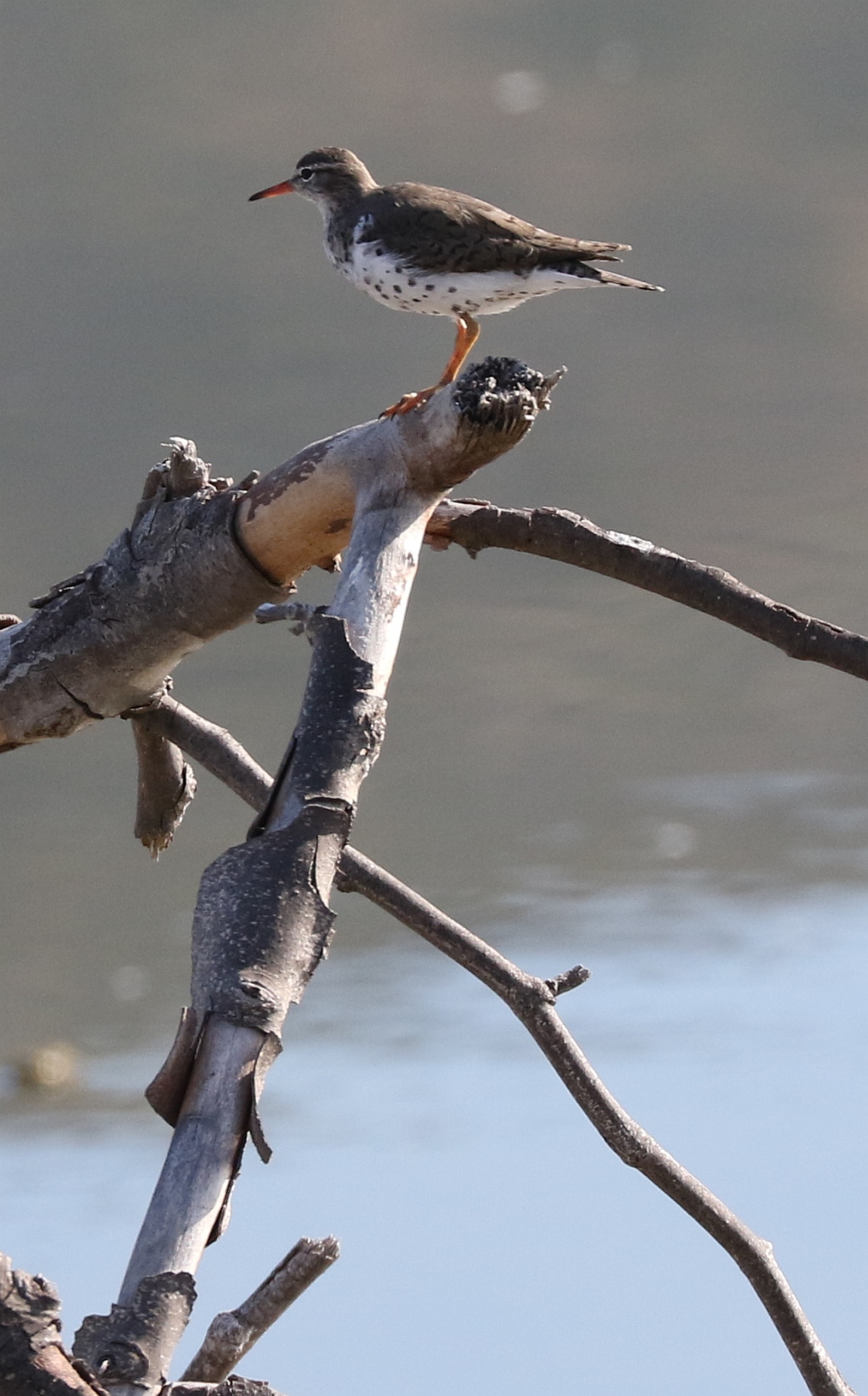
Spotted Sandpiper with his spotty breast (R.Ehlers 4/26/15)
Back home, I checked for previous highs counts for Elegant Tern and Brown Pelican.
Brown Pelican: 1490 (4/26/15), 740 (4/24/11), 630 (5/27/07), 407 (7/24/11), 400 (3/26/06)
Elegant Tern: 3100 (4/26/15), 700 (4/26/09), 600 (7/28/13), 300 (7/25/04), 250 (4/27/03)
Definitely a phenomena of migration.
I asked Kimball Garrett, ‘skin man’ at the Natural History of L.A. County Ornithology Dept., if anything weird was happening with the terns and pelicans. He relates: the Brown Pelican 2014 nesting season in the Sea of Cortez failed almost completely; no info yet on 2015. Warm SoCal coastal water this year may reduce Channel Island nesting. Our Malibu flock may be a mix of failed breeders from Mexico and our Channel Islands. Elegant Tern nesting on Isla Raza in the Sea of Cortez apparently failed completely this year; as in recent past years, the southern California colonies seem to shift around as predators cause abandonment.
Snowy Plovers have been mysteriously absent since January. Populations at other L.A. County winter roosting sites, including nearby Zuma Beach have also been affected, says Stacey Vigallon, L.A. County Snowy Plover maven. She didn’t know why, either.
Birds new for the season were: Brant, Eared Grebe, Semipalmated Plover, Dunlin, Least & Western Sandpipers, Caspian & Forster’s Terns, Belted Kingfisher, Cliff Swallow, Cedar Waxwing. We didn’t get over to Adamson House as the lagoon outlet cut through the beach and by the time I finished counting all those pelicans, gulls and terns, I too was finished.
Our next three scheduled field trips: Morongo Valley & Black Rock Cyn, 2-3 May, 8am; Malibu Lagoon, 24 May, 8:30 & 10am; Mt. Piños Birds & Butterflies, TBA (probably 13-14 June, 8am.)
Our next program: Tuesday, 5 May, 7:30 pm. Icelandic Birding, presented by Joyce & Doug Waterman. PLEASE NOTE THAT WE NOW MEET AT DOUGLAS PARK, 2439 WILSHIRE BLVD.
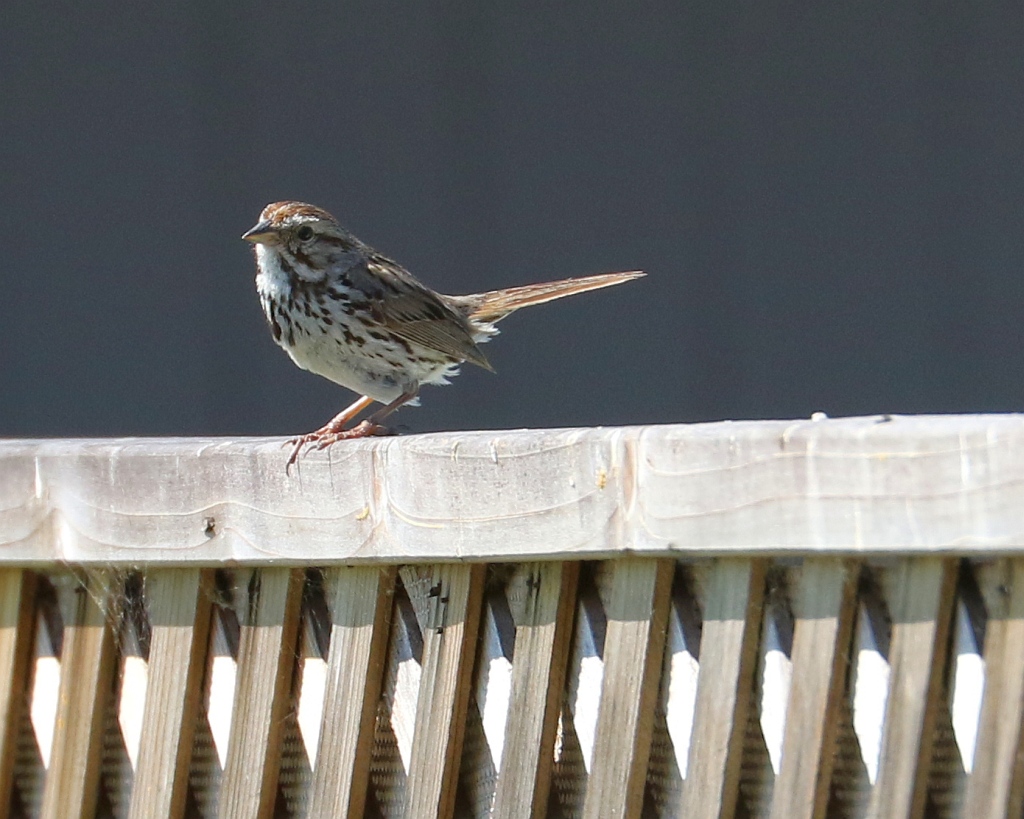
Song Sparrow visits from the Maliby Colony (R.Ehlers 4/26/15)
NOTE: Our 10 a.m. Parent’s & Kids Birdwalk meets at the shaded viewing area. Watch for Willie the Weasel.
Links: Unusual birds at Malibu Lagoon
9/23/02 Aerial photo of Malibu Lagoon
Prior checklists:
2014: Jan-July, July-Dec 2013: Jan-June, July-Dec
2012: Jan-June, July-Dec 2011: Jan-June, July-Dec
2010: Jan-June, July-Dec 2009: Jan-June, July-Dec
The 10-year comparison summaries created during the project period remain available on our Lagoon Project Bird Census Page. Very briefly summarized, the results unexpectedly indicate that avian species diversification and numbers improved slightly during the period Jun’12-June’14. [Chuck Almdale]
| Malibu Census 2015 | 11/23 | 12/28 | 1/25 | 2/22 | 3/22 | 4/26 |
| Temperature | 60-70 | 39-61 | 73-81 | 55-63 | 62-71 | 66-76 |
| Tide Lo/Hi Height | H+6.41 | L+1.70 | L+1.32 | H+4.51 | H+4.78 | L+0.58 |
| Tide Time | 0849 | 0903 | 0705 | 1137 | 1137 | 1131 |
| Brant | 3 | |||||
| Canada Goose | 1 | 30 | ||||
| Gadwall | 26 | 22 | 30 | 1 | 10 | |
| American Wigeon | 10 | 18 | 18 | |||
| Mallard | 2 | 10 | 12 | 12 | 12 | 8 |
| Northern Shoveler | 4 | 25 | 2 | |||
| Northern Pintail | 2 | 3 | ||||
| Green-winged Teal | 1 | 12 | 25 | 12 | ||
| Surf Scoter | 13 | 15 | ||||
| Bufflehead | 8 | 4 | 2 | 2 | ||
| Hooded Merganser | 4 | |||||
| Red-brstd Merganser | 25 | 25 | 4 | 2 | 2 | |
| Ruddy Duck | 36 | 42 | 38 | 35 | 30 | 4 |
| Red-throated Loon | 3 | 1 | 3 | |||
| Pacific Loon | 6 | 1 | 3 | |||
| Common Loon | 1 | 1 | 5 | |||
| Pied-billed Grebe | 1 | 8 | 2 | 1 | 2 | |
| Horned Grebe | 2 | 4 | 2 | 1 | 1 | 1 |
| Eared Grebe | 8 | 12 | 3 | 1 | ||
| Western Grebe | 12 | 2 | 5 | 15 | 12 | 2 |
| Brandt’s Cormorant | 2 | 130 | 1 | 4 | ||
| Dble-crstd Cormorant | 9 | 120 | 35 | 50 | 45 | 16 |
| Pelagic Cormorant | 1 | 1 | 1 | |||
| Brown Pelican | 32 | 95 | 50 | 28 | 27 | 1490 |
| Great Blue Heron | 4 | 3 | 2 | 2 | 1 | 2 |
| Great Egret | 4 | 4 | 2 | 10 | 5 | |
| Snowy Egret | 20 | 18 | 16 | 26 | 12 | 12 |
| Cattle Egret | 1 | |||||
| Osprey | 1 | 1 | 1 | 1 | ||
| White-tailed Kite | 1 | |||||
| Red-shouldered Hawk | 1 | 1 | ||||
| Red-tailed Hawk | 1 | 1 | 1 | |||
| American Coot | 100 | 135 | 88 | 145 | 45 | |
| American Avocet | 1 | |||||
| Blk-bellied Plover | 45 | 38 | 62 | 85 | 6 | 1 |
| Snowy Plover | 40 | 25 | 29 | |||
| Semipalmated Plover | 9 | |||||
| Killdeer | 1 | 17 | 12 | 12 | 3 | 2 |
| Spotted Sandpiper | 2 | 6 | 3 | 3 | 2 | 1 |
| Greater Yellowlegs | 1 | |||||
| Willet | 4 | 10 | 4 | 3 | 3 | 1 |
| Whimbrel | 1 | 1 | 4 | 4 | 10 | 12 |
| Long-billed Curlew | 1 | |||||
| Marbled Godwit | 3 | 12 | 12 | 10 | 8 | 2 |
| Ruddy Turnstone | 6 | 6 | 5 | 1 | ||
| Surfbird | 4 | |||||
| Sanderling | 32 | 28 | 8 | |||
| Dunlin | 1 | |||||
| Least Sandpiper | 1 | 15 | ||||
| Western Sandpiper | 45 | |||||
| Boneparte’s Gull | 2 | 1 | 12 | 6 | ||
| Heermann’s Gull | 1 | 18 | 17 | 1 | 6 | 350 |
| Ring-billed Gull | 60 | 65 | 150 | 90 | 3 | 30 |
| Western Gull | 81 | 230 | 170 | 95 | 3 | 110 |
| California Gull | 1500 | 1650 | 1600 | 40 | 600 | |
| Herring Gull | 1 | |||||
| Glaucous-wingd Gull | 3 | 5 | 4 | 1 | ||
| Caspian Tern | 10 | |||||
| Forster’s Tern | 3 | 2 | ||||
| Royal Tern | 22 | 42 | 35 | 15 | 4 | |
| Elegant Tern | 4 | 28 | 3100 | |||
| Rock Pigeon | 6 | 4 | 5 | 23 | 8 | |
| Mourning Dove | 3 | 2 | 2 | 2 | ||
| Anna’s Hummingbird | 1 | 1 | 2 | |||
| Allen’s Hummingbird | 4 | 2 | 3 | 6 | 4 | |
| Belted Kingfisher | 1 | 1 | ||||
| American Kestrel | 1 | 1 | ||||
| Peregrine Falcon | 1 | |||||
| Black Phoebe | 1 | 2 | 1 | 2 | 2 | 2 |
| Say’s Phoebe | 2 | 1 | ||||
| American Crow | 8 | 4 | 6 | 5 | 6 | |
| Common Raven | 2 | |||||
| Rough-wingd Swallow | 4 | 4 | ||||
| Barn Swallow | 2 | 6 | ||||
| Cliff Swallow | 2 | |||||
| Oak Titmouse | 1 | 1 | ||||
| Bushtit | 14 | |||||
| Blue-gray Gnatcatcher | 1 | |||||
| Ruby-crowned Kinglet | 2 | |||||
| Hermit Thrush | 2 | |||||
| American Robin | 1 | |||||
| Northern Mockingbird | 2 | 1 | 1 | 3 | 6 | |
| European Starling | 60 | 25 | 45 | 3 | 4 | 10 |
| Cedar Waxwing | 40 | |||||
| Common Yellowthroat | 2 | 4 | 3 | 3 | 2 | |
| Yellow Warbler | 1 | |||||
| Yellow-rumpd Warbler | 2 | 15 | 7 | 8 | 5 | |
| Townsend’s Warbler | 1 | |||||
| California Towhee | 1 | 3 | 2 | |||
| Savannah Sparrow | 3 | |||||
| Song Sparrow | 3 | 2 | 6 | 9 | 6 | |
| White-crwnd Sparrow | 35 | 4 | 12 | 10 | ||
| Western Meadowlark | 7 | 14 | 24 | 10 | 3 | |
| Great-tailed Grackle | 1 | 5 | 4 | 4 | ||
| Brwn-headed Cowbird | 4 | 4 | ||||
| House Finch | 4 | 4 | 12 | |||
| Lesser Goldfinch | 1 | 2 | 1 | |||
| Totals by Type | Nov | Dec | Jan | Feb | Mar | Apr |
| Waterfowl | 64 | 141 | 138 | 154 | 50 | 55 |
| Water Birds – Other | 166 | 516 | 187 | 247 | 144 | 1511 |
| Herons, Egrets & Ibis | 28 | 25 | 18 | 30 | 24 | 19 |
| Quail & Raptors | 2 | 5 | 2 | 2 | 1 | 1 |
| Shorebirds | 135 | 144 | 139 | 119 | 37 | 89 |
| Gulls & Terns | 151 | 1839 | 2035 | 1825 | 107 | 4213 |
| Doves | 0 | 6 | 7 | 7 | 25 | 10 |
| Other Non-Passerines | 1 | 4 | 3 | 3 | 7 | 7 |
| Passerines | 76 | 114 | 106 | 61 | 76 | 104 |
| Totals Birds | 623 | 2794 | 2635 | 2448 | 471 | 6009 |
| Total Species | Nov | Dec | Jan | Feb | Mar | Apr |
| Waterfowl | 4 | 9 | 9 | 10 | 7 | 5 |
| Water Birds – Other | 8 | 11 | 9 | 11 | 9 | 6 |
| Herons, Egrets & Ibis | 3 | 3 | 2 | 3 | 4 | 3 |
| Quail & Raptors | 2 | 5 | 2 | 2 | 1 | 1 |
| Shorebirds | 10 | 10 | 9 | 8 | 8 | 10 |
| Gulls & Terns | 6 | 7 | 7 | 6 | 7 | 10 |
| Doves | 0 | 1 | 2 | 2 | 2 | 2 |
| Other Non-Passerines | 1 | 1 | 2 | 1 | 2 | 3 |
| Passerines | 8 | 12 | 16 | 14 | 17 | 13 |
| Totals Species – 97 | 42 | 59 | 58 | 57 | 57 | 53 |
a



 SANTA MONICA BAY AUDUBON SOCIETY BLOG