Free email delivery
Please sign up for email delivery in the subscription area to the right.
No salesman will call, at least not from us. Maybe from someone else.
One Avian Taxonomic List to Rule them All | AviList
[by Chuck Almdale]
It’s not as dire as the title implies, but reportedly the proponents of the four major avian taxonomic checklists in the world have been negotiating among themselves to reconcile the many differences between their lists, in order to arrive at One List, hereafter to be known as AviList.

I’m not shocked to learn this but at the same time I didn’t know people were closing in on accomplishing it. As diehard readers of this blog will easily recall, we posted a long piece about the Four Different Checklists of the Birds of the World back in March 2019. At that time the numbers looked like this:
Total recognized species:
- BirdLife Int’l/Handbook of Birds of the World – 11,126 species
- International Ornithological Congress (IOC) – 10,896 (230 fewer than BirdLife)
- Clements/eBird – 10,585 (541 fewer than Birdlife, 311 fewer than IOC)
- Howard & Moore – 10,175 (951 fewer than BirdLife, 721 fewer than IOC, 410 fewer than Clements)
Total species recognized by at least one of the four lists was 11,524, of which 86.5%% or 9,968 species were accepted by all, leaving 1,556 (13.5%) in dispute. The breakdown of that 1,556 was:
- 496 species, or 4.3% of the total, are recognized by three taxonomic authorities.
- 362 species, or 3.14%, are recognized by two authorities.
- 698 species, or 6.1%, are recognized by a single authority only.
Checklist agreement was as follows:
- BirdLife Int’l: 89.6% of species shared with all others; 5.6% shared with one or two other lists; 4.8% unique to itself.
- Clements: 94.2% of species shared with all others, 5.6% with 1-2 other lists, 0.21% unique to itself.
- IOC: 91.5% of species shared with all others, 7.4% with 1-2 other lists, 1.13% unique to itself.
- Howard & Moore: 98% of species shared with all others, 1.8% with 1-2 other lists, 0.2% unique to itself.
That’s where it stood six years ago, and that’s what the ornithological taxonomists had to deal with in order to reconcile that mess.
Word has it that as of June 11 2025, three of the lists (Howard & Moore the exception) have reconciled their differences. The AviList checklist v2025 (perhaps also version 15.1) lists:
| Species | 11,131 |
| Subspecies | 19,879 |
| Orders | 46 |
| Families | 252 |
| Genera | 2,376 |
The last time I checked eBird, last fall, they had 11,017 species, so now there’s another 114 species I’ll probably never see. Plus a new family. Which ones are they? Figure that out, write it up (including scientific name and breeding range would be very nice to include), send me the list and I’ll post it and give you the credit. Fame and fortune for you will no doubt swiftly ensue.
This article from the Birding Ecotours website was just sent to me. It’s worth reading to catch up on what’s up, including topics like “biological species concept” which is critically important to us all, especially those who wish to have viable offspring someday.
Birds of the World website doesn’t add much, but here it is.
Same thing for Birdlife International here.
After that, go to the AviList website and poke around. You can download, for free, Avilist v2025 in Extended (.xlsx) at 8.7 MB, and Short (.xlsx) at 5.1 MB, and then while away the hours seeing what’s what. I haven’t yet screwed up my courage to tackle that.
Then toss out all your old field guides, handbooks, bird photo books, checklists and lifelists and start over.
Just kidding. They’re mostly still useful. Just hope that the dingbats who want to cancel all eponymous bird names find something else to waste their time on and stop adding to our troubles and annoying everyone.
There. That takes care of your weekend.
Los Angeles County Parks: closings, hours & cuts
[Posted by Chuck Almdale]
I received the following announcement from a birding compatriot over at Eaton Canyon. Thanks, Kathryn.
Dear LA County Parks Community:
I want to share with you important information, updates, and changes that will take place at the County of Los Angeles Department of Parks and Recreation (LA County Parks).
LA County Parks manages 183 parks countywide with over 40,000 acres of parkland and welcomes over 50 million visits to our park system annually.
As federal, state, city, and local governments face budget cuts, so will Los Angeles County Departments, including LA County Parks. Specifically, LA County Parks is facing a substantial $22.2 million budget reduction. To address this significant budget reduction, we have made some difficult but necessary decisions to continue our stewardship of parklands and provide core and safety-net programs that our youth, families, seniors, and communities depend on.
Our commitment to public park access, programs, and services remains our top priority as we are confronted with these unprecedented challenges. In order to address our budget reduction, LA County Parks will reduce the following services, hours of operation, and enhanced programming starting this summer:
1. Regional Parks will be closed on Mondays and Tuesdays effective Monday, June 30, 2025.
Regional Parks: Castaic, Frank G. Bonelli, Kenneth Hahn, Peter F. Schabarum, Santa Fe Dam and Whittier Narrows.
Regional Parks will be open to the public for full operations from Wednesday thru Sunday (5 days a week).
2. Regional Park Lakes will close on Mondays and Tuesdays effective Monday, June 30, 2025.
Regional Park Lakes will be closed for swimming, boating and fishing at Castaic, Frank G. Bonelli, and Santa Fe Dam.
Regional Parks will be open to the public for swimming, boating, and fishing from Wednesday through Sunday (5 days a week).
3. The enhanced Summer Pool season will be reduced from 23 weeks to 11 weeks.
Summer Pools will open from June 2, 2025, through August 16, 2025 for a full array of free and low-cost aquatic programming.
4. Parks After Darks enhanced programming will be suspended at 34 Parks countywide for summer, winter, and spring.
Local and community parks will continue to provide and host park programming such as summer camps for youth, nutrition and snack program for youth 17 years and under, senior programs, and will continue to partner with community-based organizations on program partnerships.
5. Staffing and administrative reductions, including but not limited to part-time staff and their benefits, available overtime, and services and supplies.
While most LA County Parks programming will continue to be free, to preserve core programs and services, we are seeking to increase the following select fees:
1. Admission fees at the Arboretum and Botanic Gardens.
Arboretum and Botanic Gardens: Descanso Gardens, Los Angeles County Arboretum & Botanic Garden, South Coast Botanic Garden and Virginia Robinson Gardens.
To address access, a new community benefit program will provide free-admission for low-income youth, families, and seniors in Los Angeles County who hold Electronic Benefits Transfer (EBT) cards.
2. Vehicle entrance fees at Regional Parks
- Regional Parks: Castaic, Frank G. Bonelli, Kenneth Hahn, Peter F. Schabarum, Santa Fe Dam and Whittier Narrows.
- Nevertheless, park entrance will remain free for accessing the park via walking, cycling, skateboarding, and on alternate and public transportation.
3. Facility rental fees
- After an extensive fees and charges benchmarking analysis, rental fee increases are comparable to parks and recreation organizations.
While these changes are significant, the majority of your LA County Parks will remain open and free to the public 7 days a week. Core and safety-net programming like youth after-school programs, youth team sports, teen centers, senior programs, summer nutrition and lunch and year-round snack programs for youth, and aquatic programming at our summer pools and year-round pools aquatic will remain open, free and/or low-cost to you “ the public.”
For those of you that can and want to help your LA County Parks:
- Donate to the Los Angeles County Parks Foundation to support a park, program, and/or service. Donate (tax-deductible) at https://www.lacpf.org
- Volunteer as a coach, docent, or offer your talents to support youth, family and senior programs. Contact us at volunteers@parks.lacounty.gov
- Care for our LA County Parks by leaving no trace behind and picking up after yourselves when visiting a park.
- Be patient and understanding with your LA County Parks staff who are doing more with less.
For more information, including changes to LA County Parks programs, services, and hours of operation, please visit 2025 Budget News – Parks & Recreation
We understand how much you rely on LA County Parks for recreation, respite, friend and family-time, physical, social and mental well-being and connection to the outdoors. The dedicated LA County Parks staff remain committed to the stewardship of our parklands, core programs, and safety-net services that we provide you – our community.
Be well,
Norma E. Garcia-Gonzalez
Director, County of Los Angeles Department of Parks and Recreation
About the County of Los Angeles Department of Parks and Recreation
The County of Los Angeles Department of Parks and Recreation manages 183 parks. It also operates a network of 9 regional parks, 38 neighborhood parks, 20 community parks, 16 wildlife sanctuaries, 8 nature centers, 44 public swimming pools, 25 splash pads, 14 lakes including 3 with swimming beaches, more than 240 miles of multi-use trails for hiking, biking, and horseback riding, and the largest municipal golf system in the nation, consisting of 20 golf courses at 18 facilities. The department also maintains four botanical centers: The Los Angeles County Arboretum and Botanic Garden, the South Coast Botanic Garden, Descanso Gardens, and Virginia Robinson Gardens. The department also owns the iconic Hollywood Bowl, and the John Anson Ford Amphitheatre (The Ford), providing County residents with valuable entertainment and cultural resources.
Visit: https://parks.lacounty.gov/
The Bird Family Tree | Eric Ray
[Posted by Chuck Almdale]
This is a pretty good presentation of recent knowledge of the avian evolutionary tree, and includes photos of many of the families and most of the orders of birds. It packs a lot into 30 minutes. Eric also discusses topics like convergent evolution, the paleognathes, and the mobile-like maneuverability of the lineages at the nodes. I disagree with him slightly on his polytomies as I think there is recent information on dating the nodes which he didn’t use. Not sure what all that means? Watch the film. Then you’ll know, probably for forever. Then, knowing all this, your birding ventures will be that much more interesting.
If you know of a better explanation of reasonable length, send it to me and I’ll post it.
I’ve written a few blogs on this subject.
Cladogram of forty-one Avian Orders | Taxonomy 9. Link
Avian Checklist of 41 Orders & 251 Families | Taxonomy 10. Link.
Kenneth Hahn Park field trip, 12 April 2025
[By Lucien Plauzoles, photos by Ray Juncosa, domestic waterfowl comment by Chuck Almdale]
A typical spring day in coastal California starts with a cloudy chill and it was in fine tradition that we started our exploration in the native plant garden at the Stoneview Nature Center in the Blair Hills neighborhood of Culver City. We spotted a number of typical species there but were surprised by a captive quail exhibit probably used by educators when they welcome school groups.
Chris Tosdevin who has quail frequently in his Topanga yard opined that the young birds were not our usual CA quail. Having reviewed some of my photos I would guess they were Sooty Grouse, native to the Sierra ecosystem rather than the local mountains. (On the other hand, they could have been Northern Bobwhite Colinus virginianus, common in the eastern U.S., widely kept in cages and introduced elsewhere.–Ed.)
Near the quail enclosure was a small pond with a variety of waterfowl.

Notice the curly tail on this “pond duck.”

It’s not a goiter on this goose.
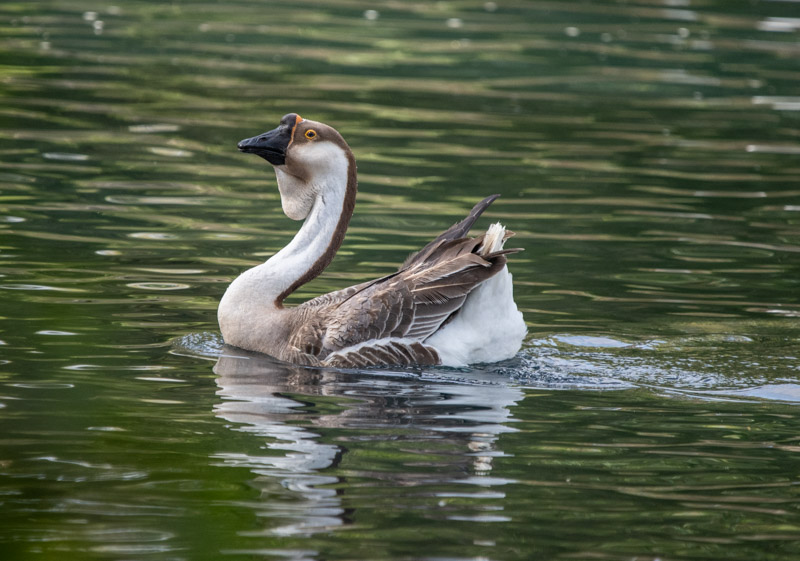
Domestic geese and ducks can go by many names which only those who fancy domestic wildfowl need concern themselves with. Most domesticated ducks that live in barnyards and wind up on someone’s plate are descended from the ubiquitous Mallard Anas platyrhynchos. The males have a little curl in their tail (see duck above), even if they’re totally white. In the Americas from Mexico southward, domestic Muscovy Ducks Cairina moschata, the ones with the knobbly red faces, are fairly common, not so much in the USA. Most domestic geese in the world are descended from Graylag Goose Anser anser, common in the wild from England to east Asia. The other species of domesticated goose is the Swan Goose Anser cygnoides, breeding in the wild in Mongolia, northeastern China and adjacent Siberia. In its domesticated versions, it is often called the Knob Goose, and it comes in two flavors: Chinese Goose and African Goose. (Some good photos on these two sites.) The latter is not from Africa but from China, as is the Chinese Goose, as you probably guessed, but it got hung up in Madagascar before making its domesticated way onward to Europe, so…African Goose it is. The chin wattle or dewlap can be found in both domestic versions, but the African seems to have it more commonly and larger. So…the goose in the pond at Kenneth Hahn park may be a Chinese Goose but in my mind the dewlap suggests a Brown African Goose, which is also called the African Wattled Goose, Knob Goose, African Knob Goose, Brown Goose, African Brown Goose, Super Goose, Super African Goose, and Dewlap African Goose. But they’re all Anser cygnoides or Swan Goose, so call then what you like, just don’t call them late for dinner or you’ll wind up with an angry goose banging on your kneecaps. – Ed.
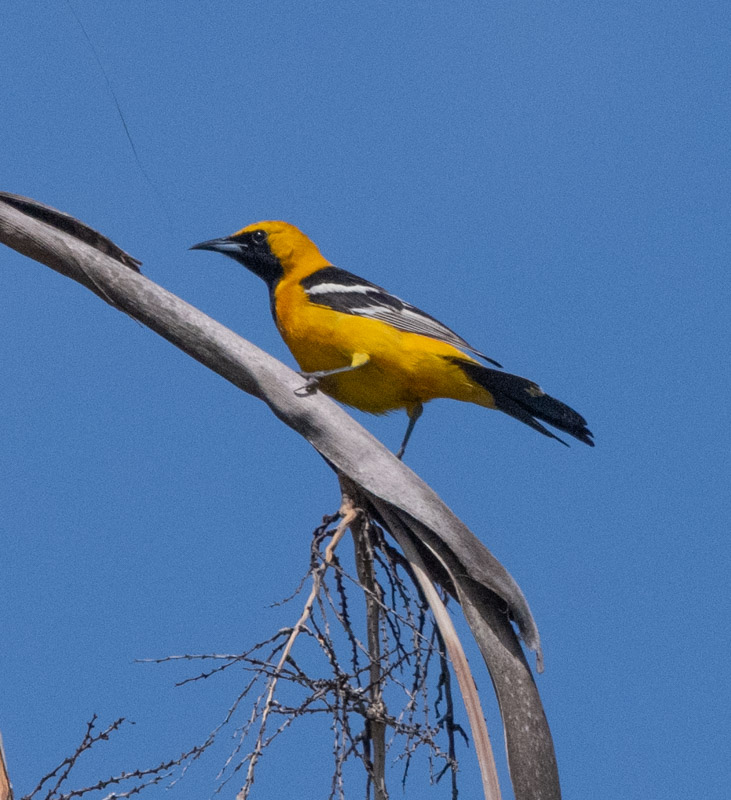
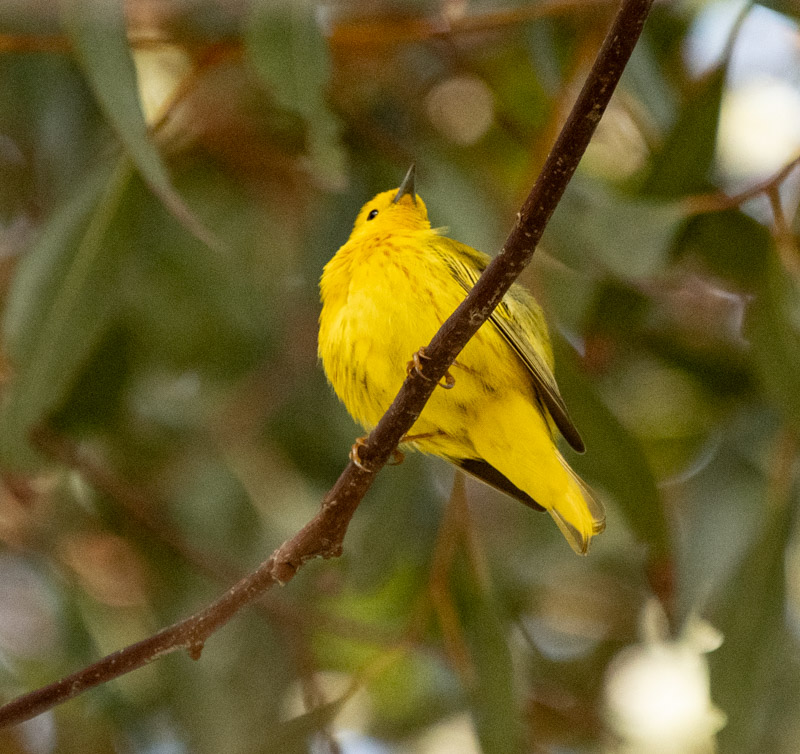
The walk continued over the steel pedestrian bridge over La Cienega Blvd and we spent an hour and half exploring the grassy areas of Kenneth Hahn Park A decent number of species seen and heard, but surprisingly few warblers. The exception was a show-off singing male yellow Warbler who welcomed the sunny half of our trip, but nary a Yellow-rumped Warbler! For next year, I would suggest a date in late March rather than waiting for April, despite the general opinion of many SoCal birders that we are in a late migration year.

Larry Allen, birder: In memoriam
[Posted by Chuck Almdale]

I met Larry Allen way back, sometime in the late ’80’s or early 90’s. Western Tanager, the newsletter of Los Angeles Audubon Society, listed an upcoming trip as Gull-watching from Malibu Lagoon to Point Mugu. Or something like that. “Gulls,” I thought, “I can’t tell them apart. I gotta go on this.” And I did, and I repeatedly went for some number of years thereafter. Larry Allen was always the leader. He was fun and very knowledgeable. He had little hand-outs on telling gulls apart. He looked like a freak (which was a good thing, in case you’ve forgotten), as I used to look; still do, sometimes.
I think I have a mental block on gulls. I’m still trying to figure them out, and every time I think I’ve learned something, the next gull sets me back to zero. Larry never seemed to have that problem. But on the other hand…
After I began leading the Malibu Lagoon field trip, I was frequently stumped on gulls, and occasionally I’d email a photo to Larry for help. On my first photo to him he thought he knew what it was (I’ve since forgotten what) but then added, “…but the bill looks a little zaftig.” Zaftig? What the devil is that? Some sort of birder’s term, like Jizz, coverts, or remiges? Upon inquiry, he said, “it means a bit off.” Oh-kay. [Google now says “plump,” but what does google know.] I went with his conclusion, whatever it was. I knew he knew more than me.
We’d bump into Larry here and there — Mt. Piños, Antelope Valley, Angeles Crest Hwy, Morongo Valley, Bolsa Chica, South End Salton Sea, pelagics on the Vantuna, Audubon Quarterly Chapter meetings, Audubon annual meetings, pelagics in Monterey Bay, rare bird sighting stakeouts — but the next meeting of consequence was when the Las Angeles County Birding Atlas Project began in 1995.
Lillian and I went to Eaton Canyon for an orientation meeting for volunteer atlas bird censusers, taught by…guess who? Larry led a half-dozen of us up the canyon and together we figured out the numerous sighting codes for signs of nesting behavior — carrying building material, carrying food to nest, carrying fecal sacs away from nest, young in nest, fledglings on twigs, fledged young still lying on the couch, and so on. We learned the ropes and over the next five years, Lillian and I surveyed five blocks and felt quite volunteerish and accomplished about it. Especially the family of eight Burrowing Owls we found in the western Antelope Valley!
At some point in time Kimball Garrett, then at the L.A. County Natural History Museum and deeply involved in the atlas project, mentioned to me that Larry had done 79 of the 3 x 3.5 mile rectangular blocks, 55 as primary observer (13% of the entire county!) and 24 more as second observer. (See appendix H of the atlas.)
I think I lost a few teeth when my jaw dropped onto the floor. A great many of Larry’s census blocks were in the mountains where no one else was sufficiently willing or physically fit to clamber through the brush and trees, down cliffs and up slopes, perhaps without benefit of even a trail, looking for “signs of breeding.” The mind boggles in contemplation of such a feat! If you’ve hiked through the San Gabriel Mountains (highest point 10,064 ft), you’ll understand. Many others were in the sandy washes, stony slopes and occasional windbreak or woodlot of the eastern Antelope Valley. Following the finish of the five-year census, Larry spent the next fifteen years as the lead writer on the atlas, published in 2016.
Larry was very generous with whatever spare time he had, and he’d happily take people around the Pasadena area to see their flocks of wild-living parrots. Santa Monica Bay Audubon Society went with him a couple of times, and we probably saw a dozen parrot or parakeet species, numbering anywhere from a pair or two per species to flocks of thousands, covering the cars and lawns below with parrot poop.
Larry was also a member of Los Angeles Birders. He presented a program for them on Urban Tropicana: Parrots of Southern California in November 2021. Link Now you can see our parrots too.
Somehow, in the midst of all this working, birding, writing and editing, Larry managed to found the Harpsicord Society of Los Angeles, which later became the Southern California Early Music Society. Here’s a link to an article he wrote about the history of that society.
A man of many talents, good humor, abundant energy and immense good will. Those who knew him as a close friend are fortunate. Even a casual birding acquaintance like me are better for having known him.
He is missed.
Page three of the Pasadena Audubon Society’s newsletter The Wrentit for June-August 2025 has remembrances from other birders who knew Larry.
I had no idea Larry was an aficionado of harpsicords and Early Music, so much so that in his obituary below, birding is described as “another passion,” which amounts almost to heresy. It’s amazing what birders get up to when they’re not looking at birds, talking about birds, thinking about birds or writing about birds.
The Neptune Society also has his obituary as well as details on the June 19 Celebration of Life for Larry.
Western Field Ornithologists has his obituary and remembrances from members.
The following obituary was posted in the Los Angeles Times. There’s also a page for him on Legacy.com. It has a couple of suggestions should you wish to donate in his name.
Larry Wayne Allen
October 26, 1946 – April 3, 2025. Larry was the eldest son of Harry R. Allen and Clara M. Allen who married and moved to California shortly after WW II. Larry grew up in Rosemead, attended school in the San Gabriel Valley and graduated from California State College Los Angeles in 1968 with dual degrees in Economics and Philosophy.
Larry continued his graduate studies in Economics at Harvard University.
After college, he took civilian employment with the US Navy. Larry planned that he would work full time for at most ten years, targeting his “retirement” in April 1984. He served as a civilian Contracting Officer for the US Army and the US Air Force.
Larry’s plan to retire came to fruition. He acquired rental income property in the Los Angeles neighborhood of El Sereno and retired to a frugal lifestyle in January 1982.
One of Larry’s passions was Early Music as performed and interpreted using period instruments and historically informed practices. He was a founding member of the Harpsichord Society of Los Angeles. When the Harpsichord Society became the Southern California Early Music Society, Larry joined its board and served for over 25 years, in every office, including President.
Larry volunteered for many additional Early Music organizations, including serving on the Boards of Musica Angelica Baroque Orchestra (Treasurer and Secretary) and the Foundation of the Neo-Renaissance (President and Vice-President).
Larry had another passion.
Birding. During the first year of his retirement, Larry became aware of the great beauty and variety of avian life. He became deeply involved in birding, quickly became proficient and joined several professional ornithological organizations.
Later, he lectured, led field trips, and wrote widely on the subject. His most ambitious publication was as first author of the 660-page Los Angeles County Breeding Bird Atlas. In later years, Larry birded on all seven continents.
He traveled our country from one end to the other visiting friends, art museums, classical music events and remote points of natural interest including separate driving trips to the Bering Sea and Artic Ocean. The best of these adventures was with wife and lover Marilyn with whom he spent 30 years. Their last years were spent happily in Altadena, California. His home and its rich collection of Native American art, voluminous library, and a collection Allen and Wright family heirlooms were lost in the 2025 Eaton Fire.
To his friends, Larry was smart, quick-witted, well-informed, warm and loyal. The sort of man anyone would be lucky to call a friend.

Larry in Bhutan, 2nd from left, ready to see some birds. (Tom Stephenson)



 SANTA MONICA BAY AUDUBON SOCIETY BLOG