Free email delivery
Please sign up for email delivery in the subscription area to the right.
No salesman will call, at least not from us. Maybe from someone else.
Malibu Lagoon Fish Life

Striped Mullet (Wikipedia)
According to Wikipedia, Striped Mullet goes by many names, including: Black mullet (Cuba, US), Bully mullet (Australia, Vietnam), Callifaver mullet (Cuba, Netherlands Antilles, US), Common grey mullet (UK), Common mullet (Cuba, Netherlands Antilles, US), Flathead grey mullet (India, Philippines, UK), Flathead mullet (Europe, FAO, UN), Grey mullet (Thailand, Turkey, Australia, Taiwan, Cuba, Fiji, Hong Kong, Mauritius, Netherlands Antilles, New Zealand, Spain, Tonga, UK, US, Mediterranean, Egypt), Hardgut mullet (Australia), Mangrove mullet (Australia), and Sea mullet (Australia, Fiji, Papua New Guinea, UK).
Decades ago, British and American bird mavens decided to agree on English names for all the world’s birds. They’ve made much progress, with some exceptions such as when the bird Americans knew as Common Gallinule was renamed Common Moorhen to satisfy British intransigence (recently rectified), whereupon some American birders pointed out that we don’t have moors, they’re not all hens, and they’re not all that common. LAAS’s Western Tanager newsletter, highlighting this problem of multiple nomenclature once ran an article, by Garrett & Dunn, I believe, detailing how to differentiate between three then-widespread egrets: Common, Great and American. [It was an April issue in I forget which year.]
Fish lovers have made no such progress, as any piscivore should know. Surely you are aware that Chilean sea bass was previously known as Patagonian toothfish; the name change was a marketing decision – sea bass sounded far more scrumptious than toothfish, and anyway, no real American knows where Patagonia is. [The good sales people at REI will gladly point you in the right direction.]
Which brings us around to the mullet many have seen leaping friskily from Malibu Lagoon in recent months. The New England Aquarium says they are also called jumping mullet or jumping jack (take that, Wikipedia!) because of this behavior. I couldn’t find out if this is a courting display, a feeding behavior, an attempt to shake off parasites or a recreational activity. [Anyone out there know?]
If you haven’t personally witnessed this phenomenon, check out the Dance of the Striped Mullet slideshow on Bob Purvey’s EcoMalibu website.
EcoMalibu also has a video page of over 20 different films pertaining to the lagoon and the reconfiguration project. The following is a list of short underwater films taken near the water monitoring stations (those posts with vertical depth gauges) ; you’ll be surprised at how much life is swimming around down there. This list, along with many other delights, is on our permanent Malibu Lagoon Project page. [Chuck Almdale]
1. Aug. 7, 2013 Length 1:48 minutes “Life Below the Surface”
2. Aug. 12, 2013 Length 9:20 minutes “Malibu Lagoon Aquarium”
3. Aug. 26, 2013 Length 3:53 minutes “Malibu Lagoon Aquarium II”
4. Sep. 9, 2013 Length 4:55 minutes “Malibu Lagoon Aquarium III”
5. Sep. 30, 2013 Length 1:47 minutes “Shrimpfest”
6. Oct. 2, 2013 Length 2:42 minutes “Malibu Lagoon Aquarium IV”
7. Oct. 22, 2013 Length 8:31 minutes “Fish, Fish, Fish”
8. Nov. 4, 2013 Length 0:57 minutes “The Big Fish”
9. Apr. 30, 2014 Length 3:36 minutes “Lagoon Crustaceans”
10. Jun. 18, 2014 Length 3:49 minutes “Aquarium & Aviary”
11. Jun. 25, 2014 Length 2:21 minutes “Got Fish? Malibu Lagoon Does”
12. Jun. 25, 2014 Length 2:08 minutes “Shrimpfest II”
13. May-June, 2014 Slide Show “Dance of the Striped Mullet”
14. Jul. 7, 2014 Length 1:56 minutes “Mullet Adult School”
More to Come
Sharpen those pencils…for the gnatcatcher!
Please read the article on page one of LATEXTRA in this morning’s L.A. Times. Another assault based on dubious science by the Pacific Legal Foundation, the organization that believes that developers have a constitutional right to build wherever and whatever they wish, no matter what the damage caused to nature or other people.
A comment period will be announced by the US Fish and Wildlife Service and I hope each of us delivers a letter or postcard supporting the protection of the few California Gnatcatchers that survive to this day. Stay tuned for updates.
http://www.latimes.com/science/la-me-gnatcatcher-20140630-story.html
My new binoculars
I just got a replacement pair of binoculars for my old Zeiss “Diafun’s” and I went to my stack of unread or un-acted-upon items that seems to permanently decorate my desk. There I found a copy of the Cornell Ornithology Lab’s Fall 2013 article on the birding binocular evaluation that Steven Zax generously handed me in November.
Cornell doesn’t go through the process of evaluating binos very often. The last bank of test was five years earlier, and as pointed out in the article, there have been many changes in equipment and prices since 2008. So, if you are in the market to replace your current pair, or to know what you would get in case of a loss or accident, the articles are worth reading, and Cornell generously puts them on line for you at no fee.
A few notes about their conclusions.
1. You can spend nearly $3,000 including sales tax for the best of the best nowadays.
2. Their basic advice (Jessie Barry and Ken Rosenberg are the authors of the main article) is to buy the best you can afford. I disagree, or put it differently. I would say the best you can afford to lose or break.
3. There are a lot of good binoculars available under $700 now.
4. There are no under-$100 binoculars that will satisfy a serious birder.
To read all the information, go to http://www.birds.cornell.edu/Page.aspx?pid=1642&q=best%20binoculars
[If the above link is broken try: https://www.allaboutbirds.org/news/the-cornell-lab-review-affordable-full-size-8×42-binoculars/]
You will find a whole lineup of links to the binocular review including the main article, Ken Rosenberg’s explanation of how to make a good buying decision, and the results of the evaluation in a table version.
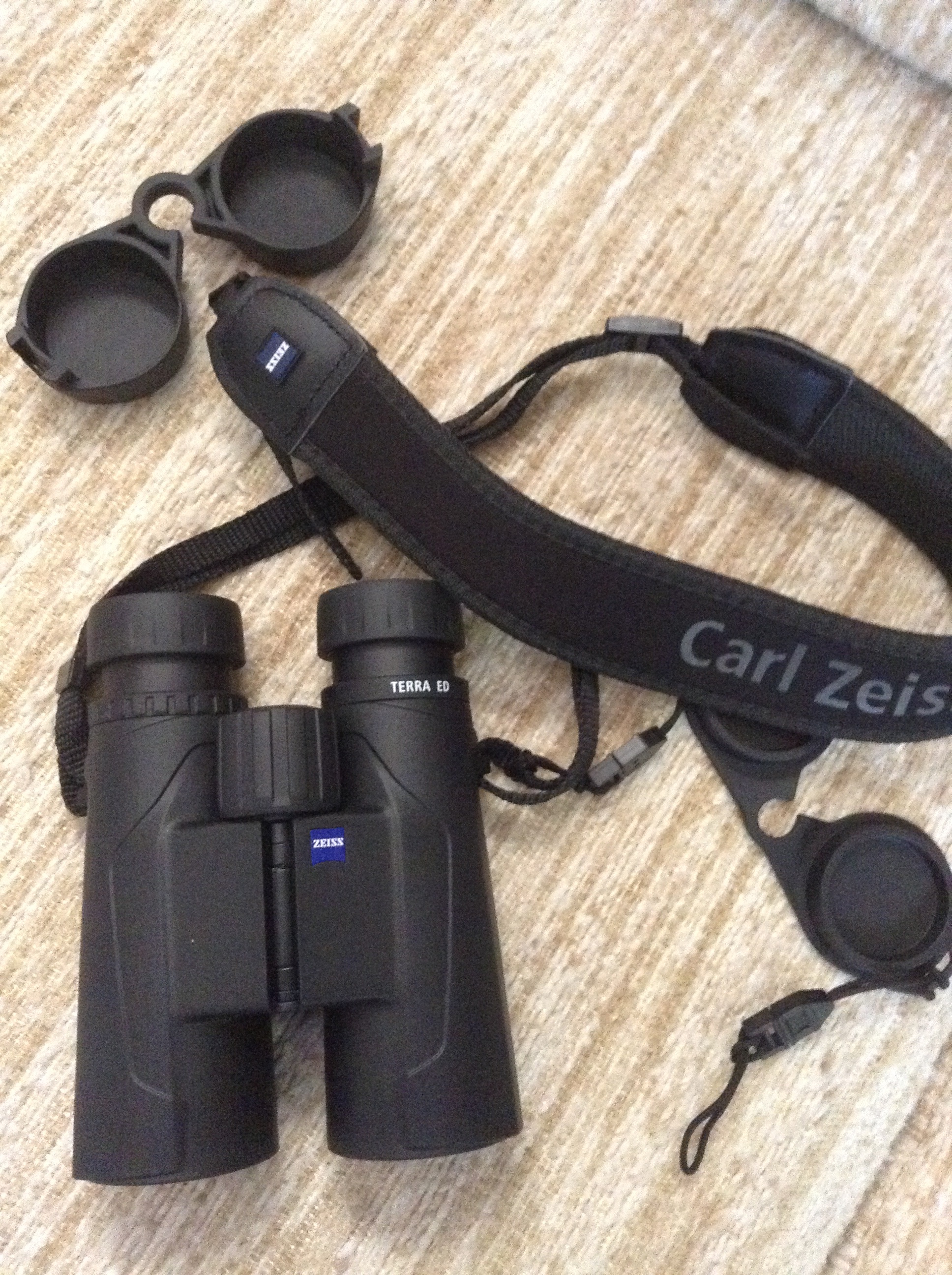
It turns out for me that the replacement for my Diafun’s is a pair of Zeiss “Terra ED’s”, slightly heavier, brighter, and amazingly sharp edge to edge.
Happy birding! Feedback welcome.
Lu Plauzoles
Apps Anyone?
For those who have a smartphone or a pad, I recommend you quickly go to the Nature Share page of the iTunes store or Google Play. Four of the best Audubon apps are available for $1.99 each through the 4th of July weekend. These are photo guides and I find the apps far superior to the book version of the same title. I was especially surprised at the number of bird vocalizations on my California Birds app.
I only look at the butterflies app occasionally but it’s great having it in my pocket for those occasions. Check carefully. Not all apps are available both for iPad AND Android.
Malibu Lagoon Trip Report: 22 June, 2014
June seems to be when many people decide that birding looks like fun. When they show up at the lagoon I always feel both sad and hopeful – sad they selected SoCal’s slowest month for birds; hopeful they won’t be discouraged and quit.

Two Whimbrels (Laurel Jones 6/22/14)
I always let them know that after June the birding can only get better. We had 465 total birds in 43 species – typical for June; compare that to Oct’13 (1671 & 75 species, or Feb’14 (1564 & 59 species). SoCal hosts a lot of migrant and wintering birds; breeding bird populations seem sparse in comparison. Of course, if we ever see the long-awaited publishing of L.A. County’s breeding bird atlas, we’ll know what’s what.
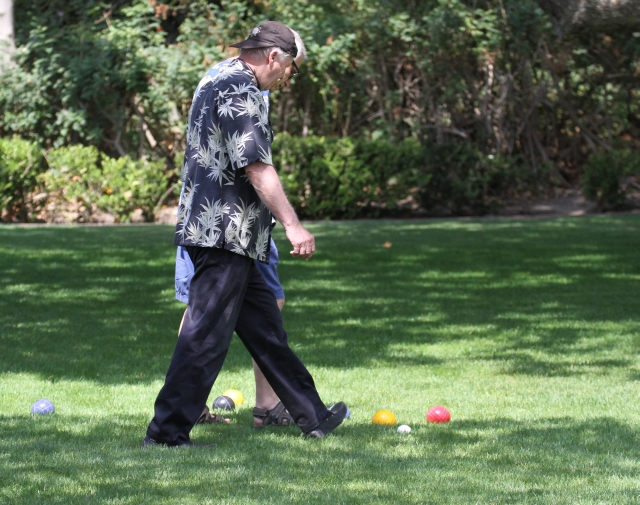
Civilizations rise and fall, yet bocce ball remains. (R. Ehler 6/22/14)
After wandering around the perimeter of the channel, out to the beach and on to Adamson House, we found two old men (I’m old, so I’m able to call others old) playing bocce ball on the lawn. The slope of the lawn towards the beach caused their bowls to significantly curve, a fact to which they had not yet adjusted, so we – or maybe it was just I – gave them a hard time about it, as a form of encouragement of course, of course. It looked like fun, and it struck me that it could easily be one of the most primitive forms of game known to humankind, the ancestor of countless other games and sports. What could be simpler than tossing or rolling objects, trying to hit a target? Acorns or pebbles serve as well as perfect spheres; you don’t even need an opposable thumb, as one player pointed out. I’ve seen monkeys in trees pelt humans below with – ahem – stuff, a practice at which they are acknowledged to be very unpleasantly skilled. [Note: Wikipedia says you can toss or bowl the bocce ball; the game goes back at least to Ancient Rome and Greece, and probably Egypt before that.]

Juvenile (left) & adult (right) American Crows.
Note juvenile bill size. (R. Ehler 6/22/14)
With the exception of a Phainopepla – a new lagoon record for me – perched in a tree near Adamson House, we had no new birds for the season. Instead we had various breeding birds busily gathering food or shepherding their young: Gadwalls, Mallards, Killdeer, Black Phoebes, American Crows, Barn Swallows, Mockingbirds, Song Sparrows and House Finches, among others.

Young Barn Swallows prefer a perch that sways (R. Ehler 6/22/14)
After the birdwalk we held our annual picnic at our favorite site in Tapia Park, a few miles up Malibu Canyon. It was very quiet, except for Mockingbirds, California Thrashers and California Towhees tootling away, and very pleasant in the live oak shade. After eating some great food we played “Bird Bingo,” which works much like regular bingo except, as one might guess, with bird pictures instead of letters. The birds were from all around the world, so you might find a Shoebill next to a Song Sparrow, an unlikely event in the real world. Winners won bars from Ellen’s cornucopia of world chocolate.

Mallard duckling – looking for mom, perhaps?
(R. Ehler 6/22/14)
Our next three scheduled field trips: Malibu Lagoon, 27 July, 8:30 & 10am; Lower Los Angeles River, Aug, or early Sept 7:30am; Malibu Lagoon, 24 August, 8:30 & 10am;.
Our next program: Tuesday, 7 Oct., 7:30 pm. To Be Announced.
NOTE: Our 10 a.m. Parent’s & Kids Birdwalk meets at the shaded viewing area. Watch for Willie the Weasel.
Links: Unusual birds at Malibu Lagoon
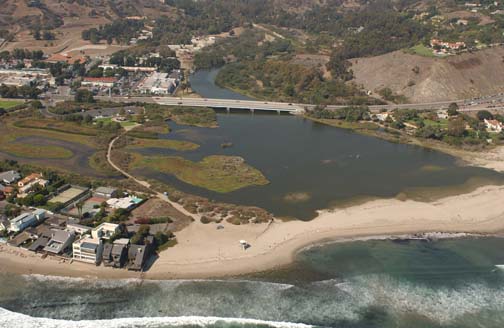
Aerial photo of Malibu Lagoon from 9/23/02.
Prior checklists: July-Dec’11, Jan-June’11, July-Dec ’10, Jan-June ’10, Jul-Dec ‘09, and Jan-June ‘09.
Comments on Bird Lists Below
Total Birds: June 2014 total birds of 465 is 15% below the 6-year June average of 549.
Summary of total birds from the 6-year average: Jun’12 +36%, Jul’12 -9%, Aug’12 -9%, Sep’12 +12%, Oct’12 +3%, Nov’12 -5%, Dec’12 +30%, Jan’13 -20%, Feb’13 -29%, Mar’13 -30%, Apr’13 -34%, May’13 -37%, Jun’13 -24%, Jul’13 +83%, Aug’13 +37%, Sep’13 +23%, Oct’13 +41%, Nov’13 -58%, Dec’13 -49%, Jan’14 -62%, Feb’14 -28%, Mar’14 +51%, May’14 -14%, June’14 -15%.
Species Diversity: June 2014 with 43 species was fractionally higher that the 6-year May average of 42.5.
Summary of species diversity from the 6-year average: Jun’12 -10%, Jul’12 +10%, Aug’12. -6%, Sep’12 -20%, Oct’12 +5%, Nov’12 +2%, Dec’12 -4%, Jan’13 +2%, Feb’13 -8%, Mar’13 +9%, Apr’13 -2%, May’13 +3%, Jun’13 +13%, Jul’13 0%, Aug’13 +11%, Sep’13 -14%, Oct’13 +19%, Nov’13 -3%, Dec’13 -6%, Jan’14 -2% Feb’14 +9%, Mar’14 +6%, May’14 +20%, June’14 +1%.
10-year comparison summaries are available on our Lagoon Project Bird Census Page. [Chuck Almdale]
Note: Beginning July, we will return to our pre-project form of bird list, which will report most recent 6-month periods. Two years of tracking census data in this format has amply demonstrated that the project, even during its messiest days, had no ill effects on bird life, despite the claims of the few, but very vocal, complainers.
| Malibu Census | 2009 | 2010 | 2011 | 2012 | 2013 | 2014 | |
| June 2009-2014 | 6/28 | 6/27 | 6/26 | 6/24 | 6/23 | 6/22 | |
| Temperature | 68-75 | 65-75 | 68-76 | 70-76 | 62-75 | 68-74 | |
| Tide Lo/Hi Height | L+0.4 | H+3.81 | H+3.0 | L+0.07 | H+4.22 | H+3.48 | Ave. |
| Tide Time | 0838 | 1139 | 0754 | 0714 | 1037 | 0712 | Birds |
| Brant | 1 | 11 | 2.0 | ||||
| Gadwall | 15 | 4 | 5 | 2 | 2 | 21 | 8.2 |
| Mallard | 25 | 40 | 41 | 24 | 59 | 32 | 36.8 |
| Red-brstd Merganser | 2 | 0.3 | |||||
| Ruddy Duck | 7 | 1.2 | |||||
| Pied-billed Grebe | 2 | 2 | 3 | 4 | 8 | 1 | 3.3 |
| Brandt’s Cormorant | 2 | 1 | 0.5 | ||||
| Dble-crstd Cormorant | 22 | 5 | 54 | 17 | 17 | 37 | 25.3 |
| Pelagic Cormorant | 3 | 0.5 | |||||
| Brown Pelican | 71 | 205 | 28 | 340 | 52 | 63 | 126.5 |
| Great Blue Heron | 8 | 6 | 4 | 1 | 2 | 2 | 3.8 |
| Great Egret | 3 | 2 | 5 | 2 | 2 | 2.3 | |
| Snowy Egret | 14 | 14 | 8 | 4 | 8 | 10 | 9.7 |
| Green Heron | 1 | 0.2 | |||||
| Blk-crwnd N-Heron | 3 | 6 | 1 | 2 | 1 | 2.2 | |
| Osprey | 1 | 1 | 0.3 | ||||
| White-tailed Kite | 1 | 1 | 0.3 | ||||
| Cooper’s Hawk | 1 | 0.2 | |||||
| Red-shouldered Hawk | 1 | 0.2 | |||||
| Red-tailed Hawk | 1 | 2 | 2 | 1 | 1.0 | ||
| Peregrine Falcon | 1 | 0.2 | |||||
| American Coot | 22 | 5 | 12 | 4 | 6 | 4 | 8.8 |
| Blk-bellied Plover | 15 | 2.5 | |||||
| Killdeer | 2 | 5 | 1 | 4 | 10 | 3.7 | |
| Black Oystercatcher | 1 | 0.2 | |||||
| Willet | 3 | 1 | 1 | 0.8 | |||
| Whimbrel | 5 | 8 | 5 | 3.0 | |||
| Long-billed Curlew | 2 | 0.3 | |||||
| Western Sandpiper | 1 | 2 | 0.5 | ||||
| Short-billd Dowitcher | 2 | 0.3 | |||||
| Heermann’s Gull | 48 | 17 | 15 | 44 | 18 | 4 | 24.3 |
| Ring-billed Gull | 7 | 1.2 | |||||
| Western Gull | 72 | 61 | 68 | 84 | 62 | 57 | 67.3 |
| California Gull | 1 | 1 | 1 | 1 | 0.7 | ||
| Caspian Tern | 3 | 9 | 10 | 1 | 6 | 3 | 5.3 |
| Royal Tern | 2 | 1 | 4 | 3 | 18 | 4.7 | |
| Elegant Tern | 15 | 4 | 240 | 14 | 23 | 49.3 | |
| Black Skimmer | 5 | 1 | 1.0 | ||||
| Rock Pigeon | 6 | 4 | 4 | 3 | 9 | 6 | 5.3 |
| Band-tailed Pigeon | 5 | 0.8 | |||||
| Mourning Dove | 4 | 4 | 5 | 1 | 2 | 2 | 3.0 |
| White-throated Swift | 1 | 0.2 | |||||
| Anna’s Hummingbird | 2 | 2 | 1 | 3 | 2 | 2 | 2.0 |
| Allen’s Hummingbird | 4 | 1 | 8 | 10 | 4 | 4.5 | |
| Belted Kingfisher | 1 | 0.2 | |||||
| Downy Woodpecker | 1 | 0.2 | |||||
| Black Phoebe | 15 | 2 | 10 | 5 | 12 | 3 | 7.8 |
| Cassin’s Kingbird | 1 | 1 | 0.3 | ||||
| Western Scrub-Jay | 1 | 1 | 0.3 | ||||
| American Crow | 12 | 4 | 4 | 4 | 8 | 9 | 6.8 |
| Rough-wingd Swallow | 6 | 6 | 1 | 8 | 3.5 | ||
| Barn Swallow | 8 | 40 | 25 | 4 | 23 | 40 | 23.3 |
| Cliff Swallow | 7 | 30 | 15 | 4 | 2 | 10 | 11.3 |
| Oak Titmouse | 1 | 1 | 0.3 | ||||
| Bushtit | 4 | 8 | 1 | 2 | 2.5 | ||
| Marsh Wren | 1 | 0.2 | |||||
| American Robin | 1 | 0.2 | |||||
| Wrentit | 1 | 0.2 | |||||
| Northern Mockingbird | 2 | 2 | 3 | 6 | 6 | 3 | 3.7 |
| European Starling | 20 | 65 | 21 | 5 | 65 | 12 | 31.3 |
| Phainopepla | 1 | 0.2 | |||||
| Common Yellowthroat | 1 | 1 | 1 | 2 | 0.8 | ||
| California Towhee | 1 | 4 | 1 | 6 | 3 | 2.5 | |
| Song Sparrow | 6 | 3 | 3 | 6 | 15 | 10 | 7.2 |
| Red-winged Blackbird | 1 | 55 | 2 | 30 | 14.7 | ||
| Great-tailed Grackle | 3 | 2 | 4 | 4 | 2.2 | ||
| Brwn-headed Cowbird | 1 | 2 | 1 | 3 | 2 | 1.5 | |
| Hooded Oriole | 4 | 1 | 1 | 2 | 1.3 | ||
| Bullock’s Oriole | 1 | 2 | 0.5 | ||||
| House Finch | 6 | 4 | 14 | 8 | 14 | 11 | 9.5 |
| Lesser Goldfinch | 2 | 4 | 2 | 2 | 1.7 | ||
| House Sparrow | 2 | 0.3 | |||||
| Totals by Type | 6/28 | 6/27 | 6/26 | 6/24 | 6/23 | 6/22 | |
| Waterfowl | 41 | 62 | 46 | 26 | 61 | 55 | 49 |
| Water Birds-Other | 117 | 217 | 97 | 368 | 85 | 106 | 165 |
| Herons, Egrets | 28 | 28 | 19 | 5 | 14 | 15 | 18 |
| Raptors | 3 | 1 | 4 | 1 | 3 | 1 | 2 |
| Shorebirds | 9 | 2 | 7 | 25 | 9 | 16 | 11 |
| Gulls & Terns | 139 | 105 | 96 | 373 | 104 | 106 | 154 |
| Doves | 10 | 8 | 9 | 4 | 16 | 8 | 9 |
| Other Non-Pass. | 6 | 3 | 2 | 12 | 13 | 6 | 7 |
| Passerines | 93 | 220 | 122 | 49 | 169 | 152 | 134 |
| Totals Birds | 446 | 646 | 402 | 863 | 474 | 465 | 549 |
| 2009 | 2010 | 2011 | 2012 | 2013 | 2014 | ||
| Total Species | 6/28 | 6/27 | 6/26 | 6/24 | 6/23 | 6/22 | |
| Waterfowl | 3 | 4 | 2 | 2 | 2 | 3 | 2.7 |
| Water Birds-Other | 4 | 4 | 4 | 5 | 5 | 5 | 4.5 |
| Herons, Egrets | 4 | 4 | 5 | 2 | 4 | 4 | 3.8 |
| Raptors | 3 | 1 | 3 | 1 | 2 | 1 | 1.8 |
| Shorebirds | 3 | 1 | 2 | 4 | 4 | 3 | 2.8 |
| Gulls & Terns | 5 | 7 | 6 | 5 | 6 | 6 | 5.8 |
| Doves | 2 | 2 | 2 | 2 | 3 | 2 | 2.2 |
| Other Non-Pass. | 2 | 2 | 2 | 3 | 3 | 2 | 2.3 |
| Passerines | 16 | 15 | 19 | 13 | 19 | 17 | 16.5 |
| Totals Species | 42 | 40 | 45 | 37 | 48 | 43 | 43 |



 SANTA MONICA BAY AUDUBON SOCIETY BLOG