Free email delivery
Please sign up for email delivery in the subscription area to the right.
No salesman will call, at least not from us. Maybe from someone else.
Malibu Lagoon, April 27, 2014
We had great weather, just beating the recent heat wave by one day. The water level at the lagoon was the highest we have seen since the renovation; it may have reduced the number of birds because there was no mud exposed and only a couple of small islands to perch on safely. On the other hand, we saw many Killdeer chicks close to the pathways, and that is not at all expected. One of our group saw a dozen chicks before they were called off a pathway by their parents.

Killdeer chick; photo by Adrian Douglas
There were several reports of large fish jumping and we had one Osprey fly over; no reports yet of a nest so we assume this was merely a visitor. Another unusual set of visitors were some Vaux’s Swifts flying low, mixed in with the Barn, Cliff, Rough-winged and Violet-green swallows. It was a good opportunity to observe the different flight characteristics of swallows and swifts.
For whatever reason, we saw virtually no warblers – only two of the resident Common Yellowthroats. Migration and breeding season did give us a good look at Spotted Sandpipers with real spots on them, not in their plain winter plumage.

Spotted Sandpiper; photo by Adrian Douglas
The Elegant Terns were all clustered together on one of the small islands and the Urge to Merge ran rampant among them. And yes, there was one Royal Tern among them, standing out with its larger size, bald forehead and slightly stronger bill. We also had six of the Big Boys, Caspian Terns.

Caspian Terns; photo by Laurel Jones
Maybe it was the high water (few waders) or the change in the weather (lots of good birds found the same weekend at Butterbredt on their way north for the summer) the lagoon lacked variety for a May trip. We still saw a lot: results below.

Whimbrel; photo by Laurel Jones
| Pied-billed Grebe | 1 |
| Double-crested Cormorant | 24 |
| Brown Pelican | 105 |
| Red-breasted Merganser | 1 |
| Snowy Egret | 12 |
| Black-crowned Night-Heron | 1 |
| Osprey | 1 |
| American Coot | 20 |
| Marbled Godwit | 25 |
| Whimbrel | 7 |
| Spotted Sandpiper | 3 |
| Western Sandpiper | 5 |
| Least Sandpiper | 1 |
| Killdeer | 22 |
| Heermann’s Gull | 27 |
| California Gull | 3 |
| Western Gull | 27 |
| Caspian Tern | 6 |
| Royal Tern | 1 |
| Elegant Tern | 63 |
| Rock Pigeon | 5 |
| Allen’s Hummingbird | 3 |
| Black Phoebe | 5 |
| Western Scrub-Jay | 1 |
| American Crow | 8 |
| Northern Mockingbird | 4 |
| European Starling | 6 |
| Bushtit | 6 |
| Violet-green Swallow | 6 |
| Northern Rough-winged Swallow | 4 |
| Barn Swallow | 20 |
| Cliff Swallow | 5 |
| House Finch | 6 |
| Common Yellowthroat | 2 |
| Song Sparrow | 12 |
| California Towhee | 4 |
| Brown-headed Cowbird | 1 |
To guide or app?
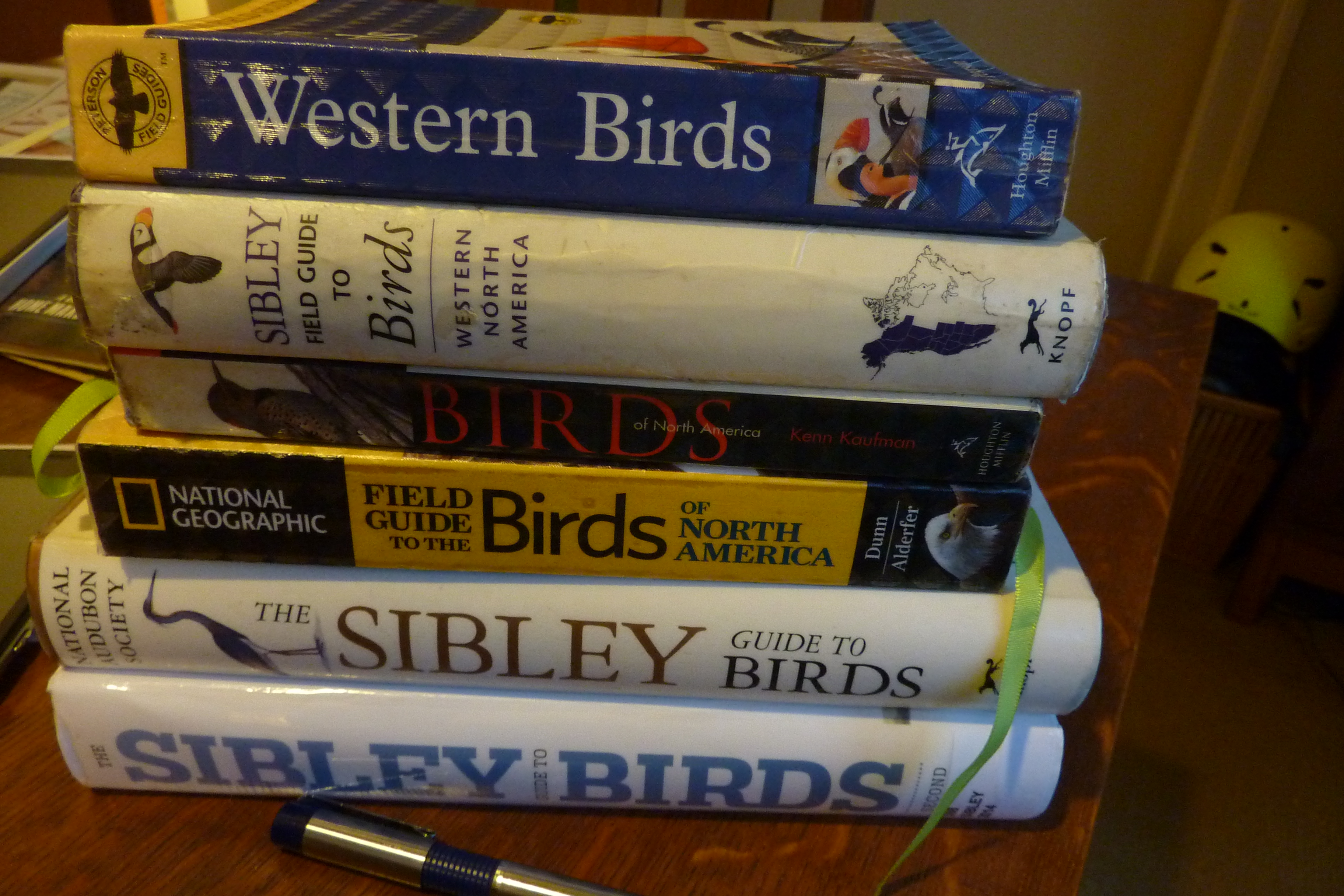
This doesn’t include the 4 apps on my iPod Touch!
I was recently trying to answer questions from an intellectually curious beginning birder seeking information on our local birds. And it was fairly obvious that for those who are not accustomed to spending hours on the web, we have not recently put out much information on our “secret sources” to bird identification.
Far from having secret arcane knowledge about birds, we are citizen scientists and nature enthusiasts awash in a corpus of popular reference books and phone/pad apps. Here are a few ideas for a first-time visitor on one of our monthly Malibu Lagoon walks.
Try the library first! Just like choosing binoculars, find out what you like by reading and using a field guide first.
I think there is value in starting with a local guide that makes it easier to focus on what is likely to be seen in our area. Kimball Garrett’s BIRDS OF THE LOS ANGELES REGION is a compact (4×6”) photo guide that will get you started. Kimball is the local authority on bird sightings in the L.A. region and he often opines on the Yahoo group “LACounty birds”. He certainly can’t answer every query, but he is quite generous in his online opinions.
Another good photo guide is Kenn Kauffman’s FIELD GUIDE TO THE BIRDS OF NORTH AMERICA although it includes a lot more species. I have not seen much change in this guide since its inception in 2000, however, it has merit for “starting serious” birders. It is also one of the lightest books to carry at app. 17oz in the ppb edition.
After a year of birding you will probably want to start using one of the more complete guides that present multiple illustrations (usually paintings) of birds. That is because artists can highlight specific field marks or characteristics that are used to identify birds. The most widely used guides are the series painted by David Allen Sibley. He has published guides to all the North American birds, to Eastern and to Western species in more portable format, and iPhone/iPad “apps” that can be used in the field. The iPad app even allows two species to be compared on the same screen, side by side. (works on the iPad Mini also)
The big news in the guide world today is the March 2014 publishing of Sibley’s second edition—the first since its original 2000 printing. In short, it is a knockout, especially for advanced birders who will relish its new verbal detail. It is 45 pages thicker and therefore heavier. Only the truly dedicated will want to carry a three pound 6 x 10” $40 tome into the field.
The National Geographic GUIDE TO THE BIRDS OF NORTH AMERICA, currently in its sixth edition, covers all of the US and is also widely used by many advanced birders who want to have a reference to migrating strays. Like the large Sibley above, it is packed with notes & maps about sub-species , and the more detail in the book, the heavier it is to carry in the field. (5.5×8”, 2 lbs.)
Many good birders still use the Peterson Guides, which were the first to use field marks, because of their careful illustrations and handy format. Granted there is less information here than we’ve seen in the recent bigger volumes , but the 4.5 x 7.25” fits easily in a jacket pocket. (18oz. for my 10-year-old printing)
You will eventually find that your choice of guides will be made on the basis of illustration clarity, weight of the field guide, and indices that make reference faster in the field. (i.e. before the bird flies away.)
Learning about the behavior of species often helps in learning to identify birds and field guides get boring as evening reading. That’s why so many teachers have written learning tomes on birds over the years. These are not textbooks! Consider them naturalists’ field lectures put into written form. My favorites are the UC Press Natural History Guides No. 83 and 84 INTRODUCTION TO CALIFORNIA BIRDLIFE, and INTRODUCTION TO THE BIRDS OF THE SOUTHERN CALIFORNIA COAST. Both are written in a pleasant informal manner and are well illustrated. I often use them as a brush-up before going to an area with birds I haven’t seen in a while.
If you want just one (substantial) reference book about bird behavior, I vote for the SIBLEY GUIDE TO BIRD LIFE AND BEHAVIOR.
I hope many of you feel free to respond to this posting with your favorites. A stream of comments about the new Sibley guide would be especially à propos.
I will follow this posting in a week with some “discovery” comments following my visit to the Santa Monica Public Library. I was shocked by the discoveries!
LucienP
The weather was great, the hiking was great, the company was wonderful, but the lack of significant winter rain kept many of the flowers from blooming. Many annuals, such as lupines, Miner’s Lettuce, Golden Yarrow, Chinese Houses, Purple Owl’s Clover, Caterpillar Phacelia and Fiesta Flower, usually seen, did not sprout. Even the bird species sighted was below average.
Our first birds were a large flock of 19 American Crows poking around in the Paramount Ranch grassy field, up to something devious, no doubt. After a flock of 7 Nanday Parakeets (aka Black-hooded) flew noisily by, a warbler sang from near

Acorn Woodpecker trio (C. Almdale 4/12/14)
the footbridge into the movie set; this turned out to be a male Yellow Warbler, replete with red breast streaks. The movie ranch, set among large live oaks, held theusual Acorn Woodpeckers, House Finches, and Lesser Goldfinches, plus a noisy but hard-to-find Downy Woodpecker. Out in the field, ground squirrels and rabbits went about their snuffling business.
The path up to Mulholland Dr. passes through a small wooded area where shade-loving plants find a home. Wild Cucumber, Lace Pod, Golden Current, Wild Radish and that weird, unidentifiable Onion can be found here.

The mystery onion (A. Albaisa 4/12/14)
On the Reagan Ranch section we generally find orioles, Cassin’s & Western Flycatchers, Black-headed Grosbeak, towhees, sparrows, finches and warblers. Hawks, ravens and crows pass by overhead. Ash-throated Flycatchers sing everywhere. The expected First American and extraterrestrial artifacts were all in their usual places.

Gumplant (C. Almdale 4/12/14)
We saw a few groups of hikers along the way, most sporting pairs of aluminum walking poles. We slowly made our way up past the Reagan Ranch buildings and down the Yearling Trail leading to Crags Drive, the main trail through Malibu Creek State Park. Lots of flowers and birds along this section. Crags Dr. was packed with hoards of hikers and families, most of them heading for the M.A.S.H. film site. Several large groups of students were diligently taking notes on clipboards. Bike riders wove through the crowds: parents had to frequently admonish their children to not ride so close to the walkers. We always find Dudleaya and blooming Yucca along this section of trail.

Common Fiddleneck (C. Almdale 4/12/14)
Century Lake had a nice mixed flock of swallows and swifts catching insects over the dam at the head of the gorge; Violet-green Swallows snagged drinks from the lake surface; one got more of a bath than a sip.
It’s nearly noon by the time we get to Malibu Creek: it’s getting hot, we’re tired, and although we’re more-or-less dead-heading for the parking lot where we left two cars for the shuttle back to Paramount Ranch, we stop to check for Chia on the last hillside before we reach Las Virgenes Creek. It’s taken us about 4 hours for this 4 ½ mile hike, so you can see that we not exactly burning up the trail! There is always much to see, smell, hear and discuss.
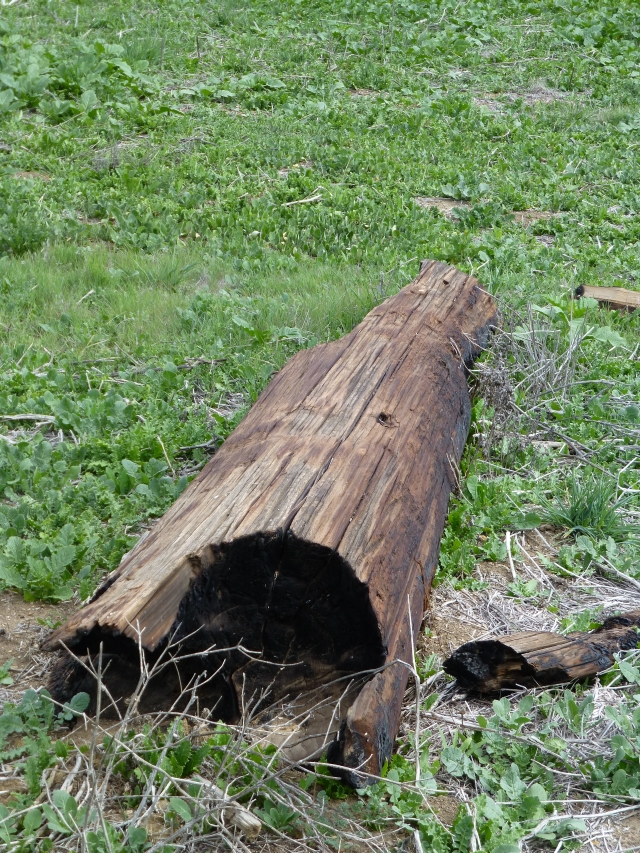
Burnt log (C. Almdale 4/12/14)
If you check out the map link, our trail route runs generally SE from Paramount Ranch.
Links to previous trips: April 2013, April 2012, April 2011, April 2010, March 2009
As always, the hike was led by Peggy Burhenn, Calif. State Parks docent specializing in native plants and wildflowers. I’ve also been advised – rather insistently – to mention that there are actually “several” small up and down slopes along the route.
The lists below give a six-year comparison of what we’ve seen on this hike. There are significant differences from year-to-year, both in what we find and what is in bloom. [Chuck Almdale]
| PLANT TRIP LISTS – PARAMOUNT TO MALIBU CREEK | ||||||
| X – Seen NB – Not in Bloom * – Introduced Species | ||||||
| 4/12 | 4/6 | 4/15 | 4/9 | 4/10 | 3/29 | |
| WHITE | 2014 | 2013 | 2012 | 2011 | 2010 | 2009 |
| Ashy-leafed Buckwheat | X | NB | X | |||
| Big Pod Ceanothus | X | X | NB | X | X | |
| California Buckwheat | NB | NB | X | X | NB | |
| California Everlasting | X | X | ||||
| Cliff Aster | X | X | ||||
| Coyote Brush | X | X | X | NB | NB | NB |
| Dodder | NB | X | X | X | ||
| Dudleaya | NB | NB | X | |||
| Elderberry | X | X | X | NB | X | X |
| Horehound* | NB | NB | X | X | X | X |
| Lace Pod (green) | X | X | X | X | ||
| Lanceleaf Dudleaya | NB | |||||
| Linanthus | X | |||||
| Miner’s Lettuce | X | X | X | X | ||
| Morning Glory | X | X | X | |||
| Mulefat | NB | X | X | X | X | |
| Narrow-leafed Bedstraw | X | X | ||||
| Narrow-leafed Milkweed | NB | |||||
| Onion – not specified | X | X | ||||
| Poison Hemlock | NB | NB | X | |||
| Poison Oak | X | X | ||||
| Popcorn Flower | X | X | X | X | X | |
| Soap Plant | NB | NB | X | X | ||
| Western Ragweed* | X | |||||
| White Nightshade | X | X | ||||
| White Sage | NB | NB | X | X | X | X |
| Wild Cucumber | X | X | X | X | X | X |
| Yucca | NB | X | X | NB | X | X |
| YELLOW | ||||||
| Burr Clover* | X | |||||
| Canyon Sunflower | X | |||||
| Collarless California Poppy | X | |||||
| Common Fiddleneck | X | X | X | X | X | X |
| Common Goldfields | X | |||||
| Deerweed | X | X | ||||
| Golden Currant | X | NB | X | X | X | X |
| Golden Yarrow | X | X | X | |||
| Johnny Jump-up | X | X | X | X | X | |
| Lomatium | X | X | ||||
| Microseris | X | |||||
| Mountain Dandelion | X | X | X | |||
| Mustard* | X | X | X | X | X | X |
| Pineapple Weed* | X | X | X | X | X | X |
| Stringose Lotus | X | X | X | |||
| Western Wallflower | X | X | X | |||
| ORANGE | ||||||
| Bush/sticky Monkeyflower | X | X | X | X | NB | |
| California Poppy | X | X | X | X | ||
| Scarlet Pimpernel* | X | X | ||||
| RED | ||||||
| Chalk Live-forever | X | |||||
| Crimson Pitcher (Hummingbird) Sage | NB | X | X | X | X | NB |
| Heart-leaved Penstemon | NB | |||||
| Indian Paintbrush | X | NB | X | |||
| PINK | ||||||
| Bush Mallow | X | |||||
| Chinese Houses | X | X | X | X | X | |
| Milk Thistle* | X | NB | X | X | NB | NB |
| Prickly Phlox | X | X | ||||
| Purple Clarkia | X | |||||
| Purple Owl’s Clover | X | X | X | |||
| Purple Sage | NB | X | X | X | X | X |
| Red-stem Filaree* | X | X | X | X | X | X |
| Spring Vetch* | X | X | X | X | X | |
| Tom Cat Clover | X | X | ||||
| Wild Radish* | X | X | X | X | X | |
| Wild Sweet Pea | X | X | X | |||
| Wooly Aster | X | |||||
| PURPLE / BLUE | ||||||
| Baby Blue Eyes | X | X | ||||
| Bajada Lupine | X | |||||
| Black Sage | NB | X | X | X | ||
| Blue Dicks | X | X | X | X | X | X |
| Blue Larkspur | X | X | ||||
| Bush Lupine | X | X | X | X | X | |
| California Peony | X | |||||
| Caterpillar Phacelia | X | X | X | X | X | |
| Chia | X | X | X | X | X | |
| Common Vervain | X | X | X | |||
| Danny’s Skullcap | X | X | ||||
| Dove Lupine | X | X | X | |||
| Fern-leaf Phacelia | X | X | X | X | ||
| Fiesta Flower | X | X | X | X | X | |
| Green Bark Ceanothus | NB | X | X | N | X | X |
| Henbit* | X | |||||
| Italian Thistle* | X | |||||
| Parry’s Phacelia | X | X | X | X | ||
| Purple Nightshade | X | X | X | X | X | X |
| Sticky Phacelia | X | |||||
| Winter Vetch* | X | X | ||||
| Wooly Blue Curls | NB | |||||
| BROWN | ||||||
| Curly Dock | X | X | ||||
| English Plantain* | NB | X | ||||
| TREES, SHRUBS, OR | ||||||
| NOT IN BLOOM | ||||||
| Arroyo Willow | X | X | X | X | X | X |
| California Bay Laurel | X | X | X | |||
| California Bickelbush | X | |||||
| California Sagebrush | X | X | X | X | X | |
| Chamise | X | X | X | X | ||
| Coast Live Oak | X | X | X | X | X | X |
| Coffee Berry | X | X | ||||
| Gum Plant | X | |||||
| Hog Fennel | X | X | X | |||
| Laurel Sumac | X | X | X | X | X | X |
| Mistletoe | X | X | X | X | X | |
| Mugwort | X | X | X | X | X | X |
| Poison Oak | X | X | X | X | ||
| Scrub Oak | X | X | X | |||
| Squaw Bush | X | X | X | |||
| Stinging Nettle | X | |||||
| Sugarbush | X | X | X | X | X | |
| Toyon | X | X | X | X | X | |
| Valley Oak | X | X | X | X | ||
| Western Sycamore | X | X | X | X | X | X |
| Whitethorn | X | |||||
| Wild Rose | X | X | X | X | X | |
| Total Plants – 110 | 51 | 66 | 73 | 60 | 70 | 56 |
H= Heard
| Paramount – Malibu Creek S.P. | 4/14 | 4/6 | 4/15 | 4/9 | 4/10 | 3/29 |
| Bird Trip Lists |
2014 | 2013 | 2012 | 2011 | 2010 | 2009 |
| Canada Goose | 3 | 2 | 4 | 2 | ||
| Gadwall | 3 | X | ||||
| American Wigeon | X | |||||
| Mallard | 3 | 6 | 8 | 7 | 10 | X |
| Ring-necked Duck | 6 | |||||
| Bufflehead | X | |||||
| Ruddy Duck | X | |||||
| California Quail | 3H | 20 | 6 | 4H | ||
| Pied-billed Grebe | X | |||||
| Great Blue Heron | 1 | 3 | 1 | 2 | ||
| Turkey Vulture | 4 | 4 | 3 | 4 | 2 | X |
| Northern Harrier | 1 | |||||
| Sharp-shinned Hawk | 1 | 1 | 1 | |||
| Cooper’s Hawk | 2 | 1 | 1 | X | ||
| Red-shouldered Hawk | 1+2H | 3 | 1 | 6 | 2 | X |
| Red-tailed Hawk | 3 | 2 | 3 | 3 | 5 | X |
| American Coot | 2 | 9 | 4 | 4 | X | |
| Spotted Sandpiper | 1 | |||||
| California Gull | 20 | |||||
| Band-tailed Pigeon | 3 | 3 | 3 | 9 | ||
| Mourning Dove | 6 | 1 | 4 | 8 | 12 | |
| Barn Owl | 1 | |||||
| Vaux’s Swift | 20 | |||||
| White-throated Swift | 4 | 4 | 2 | 4 | 12 | X |
| Black-chinned Hummingbird | 1 | 1 | 1 | 1 | ||
| Anna’s Hummingbird | 1 | 5 | 1 | 2 | 4 | X |
| Rufous Hummingbird | 1 | |||||
| Allen’s Hummingbird | 2 | 1 | 1 | X | ||
| Belted Kingfisher | 1 | 1 | X | |||
| Acorn Woodpecker | 14 | 12 | 9 | 8 | 11 | X |
| Nuttall’s Woodpecker | 2+3H | 4 | 5 | 2 | 2H | X |
| Downy Woodpecker | 2+1H | X | ||||
| Northern Flicker | 2 | 3 | 2 | X | ||
| American Kestrel | X | |||||
| Black-hooded Parakeet | 7 | 5+4H | 3 | 1 | ||
| Hammond’s Flycatcher | 1 | |||||
| Pacific-slope Flycatcher | 3 | 1 | 1 | 2 | X | |
| Black Phoebe | 3 | 4 | 4 | 8 | 8 | X |
| Say’s Phoebe | 3 | 1 | 3 | 1 | ||
| Ash-throated Flycatcher | 6+3H | 3+2H | ||||
| Cassin’s Kingbird | 1 | 9 | 3 | 4 | 2 | X |
| Western Kingbird | 1 | 1 | 4 | 3 | X | |
| Hutton’s Vireo | 1 | |||||
| Warbling Vireo | 2 | X | ||||
| Western Scrub-Jay | 17 | 6+4H | 10+20H | 12 | 14 | X |
| American Crow | 19 | 12 | 15 | 20 | 6 | X |
| Common Raven | 8 | 9 | 2 | 4 | 5 | X |
| Tree Swallow | 10 | 6 | 4 | |||
| Violet-green Swallow | 4 | 20 | 20 | 12 | ||
| Northern Rough-winged Swallow | 12 | 15 | 25 | 35 | 24 | X |
| Cliff Swallow | 1 | 3 | 1 | 20 | X | |
| Barn Swallow | 2 | X | ||||
| Oak Titmouse | 4 | 4+15H | 2+20H | 9 | 4 | X |
| Bushtit | 10 | 5 | 8 | 8 | 4 | X |
| White-breasted Nuthatch | 3 | 2 | 2 | 2 | X | |
| Canyon Wren | 1 | 1H | H | |||
| House Wren | 4+18H | 4+30H | 4+40H | 25 | 32 | X |
| Bewick’s Wren | 2H | 4 | 12 | 2 | X | |
| Blue-gray Gnatcatcher | 1 | 3H | 1 | |||
| Ruby-crowned Kinglet | 1 | 2 | 2 | X | ||
| Wrentit | 1+5H | 14H | 20H | 7H | H | X |
| Western Bluebird | 3 | 10 | 10 | 13 | 10 | X |
| Hermit Thrush | 1 | X | ||||
| American Robin | 2 | 1 | ||||
| Northern Mockingbird | 6 | 6+3H | 2 | X | ||
| California Thrasher | 1+3H | 4H | H | |||
| European Starling | 11 | 10 | 1 | 6 | 12 | X |
| Phainopepla | 1H | |||||
| Orange-crowned Warbler | 3+5H | 1+2H | 1H | 5 | 6 | X |
| Common Yellowthroat | 1+4H | 2 | 1H | 6 | 2 | X |
| Yellow Warbler | 1 | 1+6H | H | |||
| Yellow-rumped Warbler | 1 | 4+2H | 6 | 6 | 10 | X |
| Black-throated Gray Warbler | X | |||||
| Townsend’s Warbler | X | |||||
| Spotted Towhee | 3 | 4+6H | 5+5H | 8 | 5 | X |
| California Towhee | 9 | 4+4H | 10 | 20 | 6 | X |
| Savannah Sparrow | 1 | |||||
| Song Sparrow | 3+5H | 5+4H | 7+6H | 13 | 7 | X |
| Lincoln’s Sparrow | X | |||||
| White-crowned Sparrow | 10 | 1 | X | |||
| Golden-crowned Sparrow | 4 | 2 | ||||
| Dark-eyed Junco | 7 | 10 | X | |||
| Black-headed Grosbeak | 10 | 4H | 8 | 3 | 4 | |
| Red-winged Blackbird | 5 | 12 | 20 | X | ||
| Western Meadowlark | 5 | X | ||||
| Brown-headed Cowbird | 2 | 1 | ||||
| Hooded Oriole | 4 | 4 | 6 | |||
| Bullock’s Oriole | 5 | 5+3H | 6 | 3 | 6 | |
| Purple Finch | H | |||||
| House Finch | 16+26H | 20+30H | 90 | 60 | 20 | X |
| Lesser Goldfinch | 6+6H | 6+6H | 8 | 12 | 16 | X |
| American Goldfinch | 30 | |||||
| House Sparrow | X | |||||
| Total – 93 species | 50 | 59 | 62 | 52 | 60 | 58 |
Full Pink Moon Update for April 15, 2014, 12:42 AM PDT
Here’s another update from SMBAS Blog on that large, disc-shaped, shining object which has frequently and mysteriously appeared in our nighttime sky this year (known to many as the moon).

The Moon as seen from Earth (T. Hinnebusch 2/14/14)
April 15, 12:42 a.m. PDT — Full Pink Moon. The grass pink or wild ground phlox is one of the earliest widespread flowers of spring. Other names were the Full Sprouting Grass Moon, the Egg Moon, and —among coastal tribes —the Full Fish Moon, when the shad come upstream to spawn. In 2014 this is also the Paschal Full Moon; the first full moon of the spring season.
The first Sunday following the Paschal Moon is Easter Sunday, which indeed will be observed five days later on Sunday, April 20. This full moon will also undergo a total lunar eclipse for which we have a ringside seat, as it occurs in the early morning hours. Totality will last almost 78 minutes. [Photos of a Total Lunar Eclipse] The next lunar eclipse will be 8 October, 2014.
The next significant full moon will occur on May 14, 12:16 p.m. PDT. Keep an eye on this spot for late-breaking news on this unprecedented event.
Have a nice moon photo? Send it to us at: misclists [AT] verizon [DOT] net, along with name to credit and time/location of photo.
This information comes to you courtesy of: http://www.space.com/24262-weird-full-moon-names-2014-explained.html
written by Joe Rao. Joe Rao serves as an instructor and guest lecturer at New York’s Hayden Planetarium. He writes about astronomy for Natural History magazine, the Farmer’s Almanac and other publications, and he is also an on-camera meteorologist for News 12 Westchester, N.Y.
But that’s waaay too long to type in, and besides, you don’t need to go there because SMBAS has done the work for you!
[Chuck Almdale]
Wilson Canyon Field Trip, 5 April 2014
It was cold when we started, but right from the parking lot we saw two Lewis’ Woodpeckers – one of the more difficult-to-find woodpeckers. Warmed by early success we took the right-hand path beyond the “Authorized Vehicles Only” sign and tramped up a canyon looking for our target Rufous-crowned Sparrow. It didn’t take long before we had a really great view of an adult. It hung around long enough that we regretted nobody had brought a camera on the trip.
We heard singing titmice, towhees and both “crowned” sparrows. Even with the small amount of rain, green grass was coming up beside the trail and a few wildflowers (yerba santa, deer weed, checkerbloom wishbone bush) as well.
Back down in the oak forests, which are extensive here, we found many Yellow-rumped Warblers, most of whom were still in drab winter plumage. The Orange-crowned Warblers were as bright as they can be, so somebody is confused about springtime. We found more Lewis’ Woodpeckers (or the original two were following us around), and Nashville and Black-throated Gray Warbler. The biggest concentration of hummingbirds was around a grove of tree tobacco (exotic) because, we assume, they were in full bloom.
Back at the parking area we saw White-throated (correction from first posting) Swifts flying at eye level and close up. All in all, a very nice walk, even though it’s obvious that the drought has affected the canyon.
Trip List:
Red-tailed Hawk.
American Kestrel.
Band-tailed Pigeon.
Mourning Dove.
White-throated Swift.
Anna’s Hummingbird.
Rufous Hummingbird.
Allen’s Hummingbird.
Lewis’s Woodpecker.
Acorn woodpecker.
Nuttall’s Woodpecker.
Pacific-slope Flycatcher.
Black Phoebe.
Ash-throated Flycatcher.
Western Kingbird.
Western Scrub-Jay.
Common Raven.
Hutton’s Vireo.
Bewick’s Wren.
House Wren.
Blue-Grey Gnatcatcher.
Bushtit.
Violet-green Swallow.
Ruby-crowned Kinglet.
Oak Titmouse.
Lesser Goldfinch.
House Finch.
Orange-crowned Warbler.
Nashville Warbler.
Yellow-rumped Warbler.
Black-throated Grey Warbler.
Common Yellowthroat.
Song Sparrow.
White-crowned Sparrow.
Rufous-crowned Sparrow.
Spotted Towhee.
California Towhee.
Hooded Oriole.
Total: 38



 SANTA MONICA BAY AUDUBON SOCIETY BLOG