Free email delivery
Please sign up for email delivery in the subscription area to the right.
No salesman will call, at least not from us. Maybe from someone else.
Plover Protection Zone

(Noa Rishe photo)
Here’s a picture of the symbolic fence erected on Wednesday March 19th by State Parks employees and volunteers (including SMBAS members) at Malibu Lagoon. The plovers have been difficult to spot on the beach for the past two weeks, partly due to the kelp washed up by the storm surge at the start of the month. The area dedicated to the birds is wider this year, thanks to the support shown by State Parks biologists. Come on out on Sunday to check for the “little guys”.
Lu Plauzoles
Common Murres and Black-throated Blue Warblers
And very, very rarely shall the twain e’er meet. This blog may be the exception.
Simi Valley birder and photographer Bill Crowe was at Malibu Lagoon on 3/6/14, and reported the following on LACoBirds:
Yesterday between 11:30 a.m. and 1:00 p.m. I birded Malibu Lagoon. I was amazed at how the recent storm changed the shoreline. Sand was pushed into the lagoon and much of the beach appeared to be washed away. There were no Western Snowy Plovers to be seen. The usual shorebirds and dabbling ducks were present along with a small group of Western and Least Sandpipers. When I reach the mouth of the creek (where it enters the ocean), I was surprised to see a Common Murre resting on the beach. At first I thought the bird was injured, but as I approached the bird it began to swim away. It stayed close to shore, about 100′ or so away.
Common Murre is – as the name implies – common, with a world population around 9 million pairs. But it’s an ocean bird and unless you are out sailing around on a boat or happen to be near one of their nesting or roosting sites – steep rocky cliffs with ledges and without rats – you’re not likely to see one. The Pacific population has nesting sites from central California to Alaska, over to northeast Siberia and down to Japan. The Atlantic population breeds from Maine up to Greenland and from Portugal up to Russia’s Noväja Zeml’a (northeast of Finland – but you knew that) and most islands in between.
The only place where a Common Murre is likely to be within earshot of a Black-throated Blue Warbler might be in Canada’s Maritime Provinces during the summer.
The Common Murre below appears to be in an intermediate plumage between basic (winter) or juvenile and alternate (breeding).

Common Murre swims just off Surfrider Beach (Bill Crowe 3/6/14)
Birder and Photographer Dennis Erwin joined us on our San Jacinto Wildlife Area trip a few weeks ago, but he didn’t return home in time to send me his photos before I posted that trip report. So here’s his shot of the female Black-throated Blue Warbler we located and viewed well. This eastern warbler breeds from Manitoba east to Nova Scotia and southward down the Appalachian Mountains to northeast Georgia. They normally spend their winter in the Caribbean, ranging from coastal southeastern Mexico to Honduras and over to Jamaica, Cuba, Hispaniola, Puerto Rico and the Bahamas. As a result, they’re fairly rare in California, but a few do appear during the winter, possibly the result of their internal geomagnetic compass being out of whack – instead of flying southeast, they fly southwest.
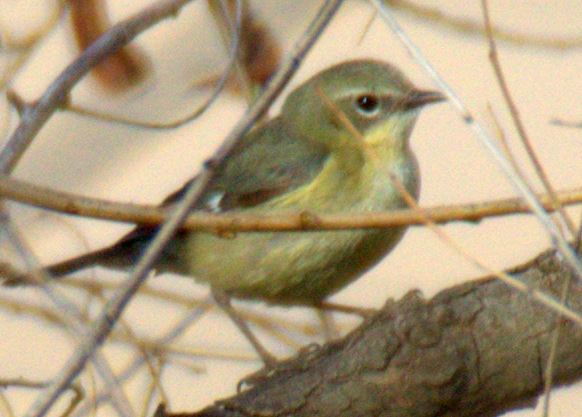
Female Black-throated Blue Warbler (Dennis Erwin 2/15/14)
This female is neither black nor blue: rather it is more a composite of of brownish and yellow-green shades. The white squarish patch in its wing, its relatively bold white supercilium (line above the eye), white semicircle below the eye, and its white undertail coverts gave it away. Unfortunately, not all these characteristics could be captured in a single photo. The photo is a bit fuzzy due to severe cropping.
The rest of Dennis’s photos have been added to the original San Jacinto Wildlife Area trip report.
[Chuck Almdale]
Full Moon Worm Update for 16 March, 2014, 10:09 AM PDT
Here’s another update from SMBAS Blog on that large, disc-like, shining object which has frequently and mysteriously appeared in our nighttime sky this year (known to many as the moon).

Refuge Moonrise (T. Hinnebusch 2/14/14)
March 16, 10:09 a.m. PDT — Full Worm Moon. In this month, the ground softens and the earthworm casts reappear, inviting the return of the robins. The more northern tribes called this the Full Crow Moon, when the cawing of crows signals the end of winter, or the Full Crust Moon because the snow cover becomes crusted from thawing by day and freezing at night. The Full Sap Moon, marking the time to tap maple trees, is another variation. Other names include the Chaste Moon and the Death Moon. Christian settlers also called this the Lenten Moon and considered it the last moon of winter.
Note: Pacific Daylight Time started on March 9, 2014 at 2 AM (becoming 3 AM) and ends November 2, 2014 at 2 AM (becoming 1 AM).
The next significant full moon will occur on 15 April, 12:42 a.m. PDT. Keep an eye on this spot for additional late-breaking news on this unprecedented event.
Have a nice moon photo? Send it to us at: misclists [AT] verizon [DOT] net, along with name to credit and time/location of photo.
[Infographic: Moon Phases & Lunar Cycles]
This information comes to you courtesy of: http://www.space.com/24262-weird-full-moon-names-2014-explained.html
written by Joe Rao. Joe Rao serves as an instructor and guest lecturer at New York’s Hayden Planetarium. He writes about astronomy for Natural History magazine, the Farmer’s Almanac and other publications, and he is also an on-camera meteorologist for News 12 Westchester, N.Y.
But that’s waaay too long to type in, and besides, you don’t need to go there because SMBAS has done the work for you!
[Chuck Almdale]
A fine clear day for exploring the Santa Monica Mountains on Saturday. Despite the commotion in the parking lot where numerous students and Sierra Club Trail Crew were gathering, we started seeing local species within minutes of the start.
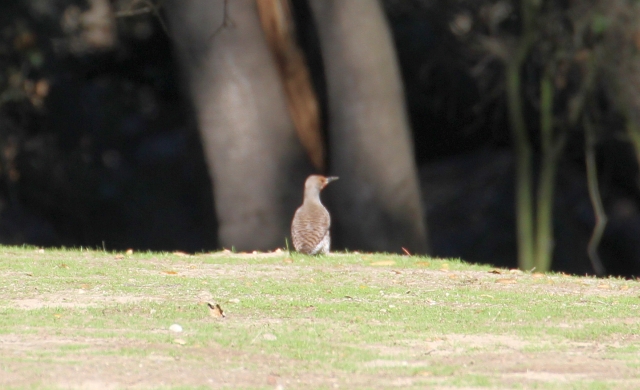
Northern Flicker hunting invertebrates on the ground
(R. Ehler 3/8/14)
Typical to the area in spring are the Lark Sparrows, Dark-eyed Juncos, and Ruby-crowned Kinglets. One of the latter even flashed us with a “crown” display, while most of the Yellow-rumped Warblers remained in the gray winter plumage. A pleasant sighting occurred just after 11:30 when a pair of leaf-gleaning Hutton’s Vireos gave us pause in one of the live oak groves. Luckily one was repeatedly singing which allowed us to identify it. Two expected species did not appear: Bewick’s Wren and Spotted Towhee – even to the diminished group that hiked out to the overlook portion of the nature trail. We were lucky in our timing, the warm breezes started about 11am and it became quite hot in the afternoon. [Lucien Plauzoles]
| Trippet Ranch Trip List |
No. |
3/8/2014 | No. |
| Cooper’s Hawk | 1 | Common Raven | 2 |
| Red-shouldered Hawk | 1 | Oak Titmouse | 15 |
| Red-tailed Hawk | 3 | Bushtit | 6 |
| Band-tailed Pigeon | 2 | Blue-gray Gnatcatcher | 1 |
| Anna’s Hummingbird | 2 | Ruby-crowned Kinglet | 18 |
| Acorn Woodpecker | 10 | Hermit Thrush | 1 |
| Nuttall’s Woodpecker | 4 | California Thrasher | 2 |
| Downy Woodpecker | 1 | Orange-crowned Warbler | 14 |
| Northern Flicker | 2 | Yellow-rumped Warbler | 15 |
| Pacific-slope Flycatcher | 2 | California Towhee | 2 |
| Black Phoebe | 1 | Lark Sparrow | 3 |
| Hutton’s Vireo | 2 | Song Sparrow | 2 |
| Western Scrub-Jay | 1 | Dark-eyed Junco | 30 |
| American Crow | 6 | Lesser Goldfinch | 3 |
| Total Species | 28 |
Knobby at Malibu
SMBAS member and prolific photographer Jim Kenney documented the presence of the Black Skimmer known as “Knobby” at Surfrider Beach on March 2, 2014.

Knobby in repose (Jim Kenney 3/2/14)
Knobby was first sighted last winter by Peter Knapp of the California Dept. of Fish & Game, and has been seen in San Diego and Long Beach. No one knows what the knob is. It’s appearance never changes, and the bird seems otherwise healthy.

Knobby in transit (Jim Kenney 3/2/14)
Knobby was the only skimmer there that day. If anyone has any information on Knobby, let us know. [Chuck Almdale]



 SANTA MONICA BAY AUDUBON SOCIETY BLOG