Free email delivery
Please sign up for email delivery in the subscription area to the right.
No salesman will call, at least not from us. Maybe from someone else.
Malibu Lagoon Trip Report: 27 July, 2014
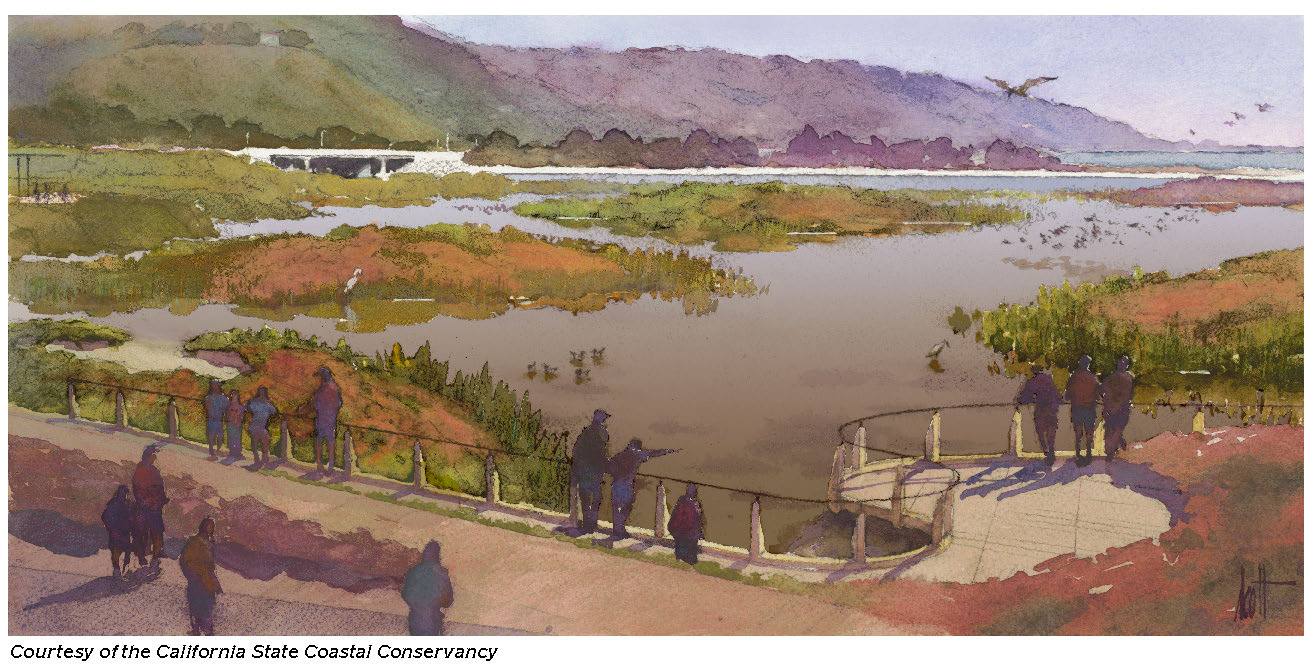
2012 Artist’s perspective of west channels view from SW corner (RestoreMalibuLagoon . com)
The above 2012 Artist’s Perspective of the proposed channels bears a remarkable similarity to July’14 reality.
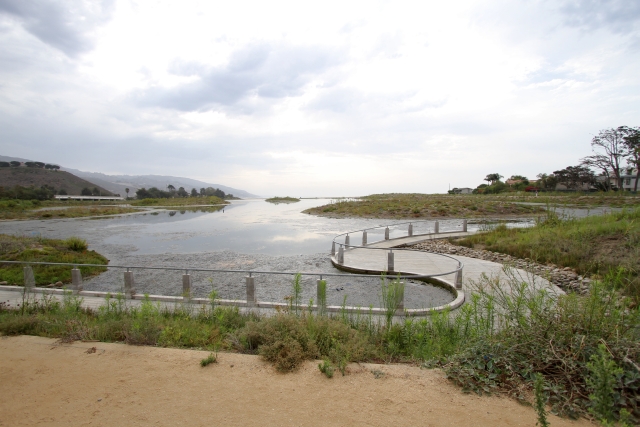
View to east across channel towards lagoon (Randy Ehler 7/27/14)
I thought it was hot, the many surfers and sunbathers thought it was hot, but the weather service claims it was 66-72° while we were at the lagoon, so that’s what I’m reporting. As expected, species present rose from the annual low in June, which you can see from the trip list below.

Snowy Plover have returned to their wintering roost (J. Waterman 7/27/14)
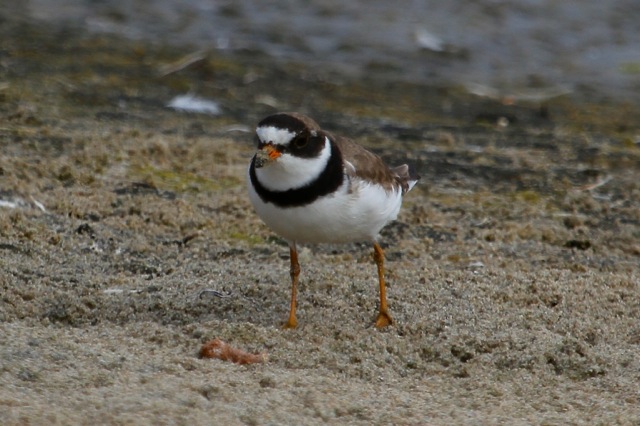
Semipalmated Plovers stop here briefly during their southward migration (J. Waterman 7/27/14)
Also as expected, the Snowy Plovers have begun to return, with sixteen resting on the beach at the edge of their ‘enclosure.’ One Semipalmated Plover, a species who stops briefly during their spring & fall migrations, also made an appearance. We will probably see them here in August and September as well, then not again until next April.
Birds new for the season were: Black-bellied Plover, Snowy Plover, Semipalmated Plover, Ruddy Turnstone, Western & Least Sandpipers, Least Tern, and Spotted Towhee. A Little Blue Heron, an east- & gulf-coast bird, was spotted by early arrivers on the beach but missed by the later group, despite intensive searching. We have recorded it – always a single bird – only three times previously: 10/23/88, 6/25/00, 6/24/07.

Question: Do two heads help a Brown Pelican catch more fish or just confuse him? (J. Waterman 7/27/14)
Two-headed birds, especially two-headed pelicans, are uncommon at the lagoon, so keep an eye out for this unusual bird. The other Brown Pelicans didn’t seem to notice anything odd about it.
Our next four scheduled field trips: Malibu Lagoon, 24 August, 8:30 & 10am; Lower Los Angeles River, 6 Sep, 7:30am; Coastal Cleanup, 20 Sep, 9am–noon; Malibu Lagoon, 28 Sep, 8:30 & 10am.
Our next program: Tuesday, 7 Oct., 7:30 pm. To Be Announced.
NOTE: Our 10 a.m. Parent’s & Kids Birdwalk meets at the shaded viewing area. Watch for Willie the Weasel.
Links: Unusual birds at Malibu Lagoon
Aerial photo of Malibu Lagoon from 9/23/02.
Prior checklists:
2013: Jan-June, July-Dec
2012: Jan-June, July -Dec
2011: Jan-June, July-Dec,
2010: Jan-June, July-Dec.
2009: Jan-June, July-Dec.
As promised last month, we now return to our pre-project style of trip-list recording. The 10-year comparison summaries created during the project period remain available on our Lagoon Project Bird Census Page. Results unexpectedly indicate that avian species diversification and numbers improved slightly during the period Jun’12-June’14. [Chuck Almdale]
| Malibu Census 2014 | 1/26 | 2/23 | 3/23 | 5/25 | 6/22 | 7/27 |
| Temperature | 58-68 | 60-65 | 62-70 | 64-69 | 68-74 | 66-72 |
| Tide Lo/Hi Height | L -0.17 | L +0.31 | L +0.39 | H +3.94 | H +3.48 | H +4.21 |
| Tide Time | 1224 | 1104 | 1010 | 0810 | 0712 | 1100 |
| Gadwall | 21 | 30 | 25 | 12 | 21 | |
| American Wigeon | 11 | 20 | 31 | 2 | ||
| Mallard | 10 | 18 | 19 | 26 | 32 | 55 |
| Northern Shoveler | 15 | 25 | ||||
| Green-winged Teal | 17 | 12 | 4 | |||
| Redhead | 1 | |||||
| Surf Scoter | 3 | |||||
| Bufflehead | 10 | 8 | 1 | |||
| Red-brstd Merganser | 1 | 6 | 7 | 3 | 2 | 3 |
| Ruddy Duck | 51 | 70 | 23 | 6 | ||
| Pacific Loon | 1 | 1 | 1 | |||
| Common Loon | 2 | 1 | 1 | |||
| Pied-billed Grebe | 2 | 4 | 2 | 2 | 1 | 6 |
| Horned Grebe | 3 | |||||
| Eared Grebe | 1 | 3 | ||||
| Western Grebe | 22 | |||||
| Blk-vented Shearwater | 55 | many | ||||
| Brandt’s Cormorant | 2 | 2 | 1 | 4 | ||
| Dble-crstd Cormorant | 50 | 33 | 45 | 31 | 37 | 35 |
| Pelagic Cormorant | 1 | 1 | 1 | |||
| Brown Pelican | 100 | 5 | 390 | 37 | 63 | 78 |
| Great Blue Heron | 1 | 2 | 2 | 4 | 2 | 4 |
| Great Egret | 2 | 4 | 2 | 2 | 2 | 4 |
| Snowy Egret | 8 | 8 | 8 | 12 | 10 | 22 |
| Little Blue Egret | 1 | |||||
| Blk-crwnd N-Heron | 2 | 1 | 1 | |||
| Osprey | 1 | 2 | 1 | 1 | ||
| White-tailed Kite | 1 | |||||
| Red-shouldered Hawk | 2 | 1 | ||||
| Red-tailed Hawk | 2 | 1 | 1 | 1 | ||
| American Kestrel | 1 | |||||
| Merlin | 1 | 1 | ||||
| Peregrine Falcon | 1 | 1 | ||||
| American Coot | 60 | 210 | 104 | 2 | 4 | 14 |
| Blk-bellied Plover | 93 | 3 | 25 | |||
| Snowy Plover | 45 | 24 | 5 | 16 | ||
| Semipalmated Plover | 1 | |||||
| Killdeer | 2 | 6 | 6 | 4 | 10 | 8 |
| Black Oystercatcher | 2 | 2 | ||||
| Spotted Sandpiper | 3 | 2 | 1 | 3 | 1 | |
| Willet | 10 | 5 | 4 | 1 | 5 | |
| Whimbrel | 1 | 3 | 5 | 4 | 5 | 28 |
| Marbled Godwit | 11 | 3 | 4 | |||
| Ruddy Turnstone | 1 | 2 | ||||
| Sanderling | 26 | 140 | ||||
| Western Sandpiper | 1 | |||||
| Least Sandpiper | 3 | |||||
| Long-billed Dowitcher | 5 | |||||
| Boneparte’s Gull | 2 | 1 | ||||
| Heermann’s Gull | 2 | 3 | 155 | 2 | 4 | 8 |
| Ring-billed Gull | 4 | 35 | 18 | |||
| Western Gull | 46 | 70 | 190 | 64 | 57 | 71 |
| California Gull | 120 | 110 | 135 | 1 | 1 | |
| Herring Gull | 1 | |||||
| Glaucous-wingd Gull | 3 | 1 | ||||
| Least Tern | 3 | |||||
| Caspian Tern | 1 | 17 | 3 | |||
| Common Tern | 1 | |||||
| Forster’s Tern | 2 | |||||
| Royal Tern | 1 | 6 | 8 | 8 | 18 | 11 |
| Elegant Tern | 135 | 37 | 23 | 127 | ||
| Rock Pigeon | 5 | 4 | 4 | 6 | 6 | 16 |
| Eur. Collared-Dove | 1 | |||||
| Mourning Dove | 2 | 2 | 2 | |||
| Anna’s Hummingbird | 1 | 1 | 2 | 2 | ||
| Allen’s Hummingbird | 2 | 4 | 4 | 5 | 4 | 3 |
| Western Wood-Pewee | 1 | |||||
| Pac.Slope Flycatcher | 1 | |||||
| Black Phoebe | 5 | 6 | 8 | 6 | 3 | 11 |
| Say’s Phoebe | 3 | 3 | ||||
| Cassin’s Kingbird | 1 | 1 | ||||
| Western Scrub-Jay | 1 | |||||
| American Crow | 11 | 4 | 6 | 6 | 9 | 4 |
| Rough-wingd Swallow | 20 | 2 | 8 | 7 | ||
| Tree Swallow | 1 | 8 | ||||
| Barn Swallow | 12 | 19 | 40 | 35 | ||
| Cliff Swallow | 6 | 10 | 7 | |||
| Bushtit | 20 | 2 | 6 | 8 | 2 | 7 |
| Bewick’s Wren | 2 | |||||
| House Wren | 1 | |||||
| Ruby-crowned Kinglet | 2 | 2 | ||||
| Hermit Thrush | 2 | 1 | ||||
| American Robin | 1 | 2 | ||||
| Northern Mockingbird | 2 | 2 | 7 | 3 | 3 | 6 |
| European Starling | 35 | 15 | 8 | 12 | 22 | |
| Phainopepla | 1 | |||||
| Ornge-crwnd Warbler | 1 | 1 | 1 | |||
| Yellow-rumpd Warbler | 30 | 28 | 18 | |||
| Townsend’s Warbler | 1 | |||||
| Common Yellowthroat | 2 | 5 | 4 | 3 | 1 | |
| Spotted Towhee | 2 | 2 | ||||
| California Towhee | 2 | 1 | 3 | 3 | 3 | 3 |
| Savannah Sparrow | 7 | |||||
| Song Sparrow | 3 | 18 | 14 | 11 | 10 | 11 |
| White-crwnd Sparrow | 6 | 15 | 2 | |||
| Red-winged Blackbird | 12 | 6 | 30 | 8 | ||
| Western Meadowlark | 3 | 3 | ||||
| Great-tailed Grackle | 3 | 3 | 4 | 2 | 4 | 16 |
| Brwn-headed Cowbird | 2 | 2 | 2 | |||
| Hooded Oriole | 2 | 1 | ||||
| House Finch | 6 | 8 | 11 | 13 | 11 | 14 |
| Lesser Goldfinch | 8 | 12 | 28 | 2 | 2 | 4 |
| House Sparrow | 12 | |||||
| Totals by Type | Jan | Feb | Mar | May | Jun | July |
| Waterfowl | 137 | 192 | 110 | 49 | 55 | 58 |
| Water Birds-Other | 272 | 259 | 566 | 77 | 106 | 138 |
| Herons, Egrets | 11 | 14 | 12 | 20 | 15 | 32 |
| Raptors | 7 | 7 | 0 | 3 | 1 | 1 |
| Shorebirds | 99 | 278 | 35 | 11 | 16 | 90 |
| Gulls & Terns | 179 | 224 | 643 | 132 | 106 | 221 |
| Doves | 5 | 5 | 4 | 8 | 8 | 18 |
| Other Non-Pass. | 2 | 4 | 5 | 6 | 6 | 5 |
| Passerines | 122 | 156 | 189 | 104 | 152 | 161 |
| Totals Birds | 834 | 1139 | 1564 | 410 | 465 | 724 |
| Total Species | Jan | Feb | Mar | May | Jun | July |
| Waterfowl | 9 | 9 | 7 | 5 | 3 | 2 |
| Water Birds-Other | 8 | 7 | 9 | 8 | 5 | 6 |
| Herons, Egrets | 3 | 3 | 3 | 4 | 4 | 5 |
| Raptors | 5 | 6 | 0 | 3 | 1 | 1 |
| Shorebirds | 8 | 9 | 9 | 3 | 3 | 10 |
| Gulls & Terns | 8 | 5 | 8 | 8 | 6 | 6 |
| Doves | 1 | 2 | 1 | 2 | 2 | 2 |
| Other Non-Pass. | 1 | 1 | 2 | 2 | 2 | 2 |
| Passerines | 20 | 23 | 20 | 20 | 17 | 18 |
| Totals Species – 103 | 63 | 65 | 59 | 55 | 43 | 52 |
Learning to Bird By Ear
There are many resources available to help you identify birds by ear, as well as resources to help you learn how to identify by ear. I recently ran across EarBirding.com, a useful, informative and free website created by Nathan Pieplow. Nathan has recently signed a contract with Houghton Mifflin Harcourt to create a comprehensive field guide to bird song, The Petersen Field Guide to Bird Sounds.
Among Nathan’s many interesting postings, I want to draw your attention to a series which can quickly teach you how to listen to birds, sorting their sounds into various categories. Sample songs are embedded in each posting. Click on them and you’ll immediately hear, and see in sonogram form, exactly what he’s writing about. It doesn’t get easier than this.
You can find these postings on the right sidebar of his website, but here they are:
1. The Five Basic Pitch Patterns: Monotone, upslur, downslur, overslur and underslur
2. The Four Basic Song Patterns: Phrase, series, warble and trill.
3. Changes in Speed and Pitch, and Multi-noted Series: A song pattern can accelerate, decelerate, upslur, overslur, peak, be 2-, 3- or 4-note series.
4. The Seven Basic Tone Qualities: Whistle, hoot, click, buzzy or burry, nasal, noisy and polyphonic.
Explore the rest of his website. A permanent link to EarBirding.com is now on our right sidebar under Bird Links.
Are all (you) birders happy?
Last month, I was birding on a lonely 2-lane road near the south fork of the Kaweah River, just south of Sequoia National Park. It was early evening and I was passed by a tall energetic local woman out for her evening walk. She paused to talk birding for a minute, and as she marched on, she noted that every birder she has ever seen seems to be smiling. “Is it true that you are all happy when you’re birding?” she asked.
Well, we want to test that theory locally. Every summer your Board gathers for a planning meeting and one of the main topics is The List of field trips to be made available to all of you members and any others who may want to join us in the great outdoors. Often various board members give reason A or reason B for adding or changing The List or date of sites where a number of us will be meeting on a chilly Saturday morning months hence.
However, should this be the decision of only 12 people, no matter how experienced?
The Board would like to hear/read your spirited suggestions. What trip(s) did you love? Should it have been at another season? What trip was a waste of your precious time? How far are you willing to drive/carpool in this age of $4 carbon-conscious gasoline? What day of the week is best? What birds and habitats would you like to discover?
Our Malibu Lagoon walks are pretty much “set in stone” on the fourth Sunday of every month. We also schedule up to 15 other field trips each year. Most of these are on the second Saturday of the month; occasionally they may be on a different Saturday or on a Sunday. A few may be led by members of other chapters or organizations.
This blog is the ideal town square to post your thoughts. We live within reach of a great diversity of habitats and birds. You have time to think. The List will not be decided until the 20th of July.
I hope we hear from you soon.
Lu Plauzoles
Full Buck Moon Update – 12 July, 2014, 4:25 AM PDT
Here’s another update from SMBAS Blog on that large, disc-like, shining object which has frequently and mysteriously appeared in our nighttime sky this year (known to many as the moon).

Montage of moon in eclipse (Sebastien Gauthier 5/14/14; NASA website)
July 12, 4:25 a.m. PDT — Full Buck Moon. This is the season when the new antlers of buck deer push out from their foreheads in coatings of velvety fur. It was also often called the Full Thunder Moon, thunderstorms being most frequent at this time. Sometimes this is also called the Full Hay Moon.
Barroom bet question: How long is the mean average period of daylight (sunrise to sunset) at exactly the North or the South geographic pole? For purposes of this question, mean average = total hours of daylight / number of periods of daylight in a year.
a. 8 hours
b. 11 hours, 58 minutes
c. 12 hours
d. 16 hours
e. 182.625 days
No peeking!
Tick, tock
Tick, tock
The answer is e, which is 1/2 year. At the North Pole the sun begins to appear above the horizon on March 21, rises slowly until June 21, then slowly sinks until disappearing below the horizon on Sept. 21. The converse happens at the South Pole. Thus there is ONLY ONE period of daylight per (non-calendar) year. With only one period of daylight, average and actual lengths are equal.
The next significant full moon will occur on August 10, 11:09 a.m August 10, 11:09 a.m. PDT. Keep an eye on this spot for additional late-breaking news on this unprecedented event.
This information comes to you courtesy of: http://www.space.com/24262-weird-full-moon-names-2014-explained.html
written by Joe Rao. Joe Rao serves as an instructor and guest lecturer at New York’s Hayden Planetarium. He writes about astronomy for Natural History magazine, the Farmer’s Almanac and other publications, and he is also an on-camera meteorologist for News 12 Westchester, N.Y.
But that’s waaay too long to type in, and besides, you don’t need to go there because SMBAS has done the work for you!
[Chuck Almdale]
Malibu Lagoon Fish Life

Striped Mullet (Wikipedia)
According to Wikipedia, Striped Mullet goes by many names, including: Black mullet (Cuba, US), Bully mullet (Australia, Vietnam), Callifaver mullet (Cuba, Netherlands Antilles, US), Common grey mullet (UK), Common mullet (Cuba, Netherlands Antilles, US), Flathead grey mullet (India, Philippines, UK), Flathead mullet (Europe, FAO, UN), Grey mullet (Thailand, Turkey, Australia, Taiwan, Cuba, Fiji, Hong Kong, Mauritius, Netherlands Antilles, New Zealand, Spain, Tonga, UK, US, Mediterranean, Egypt), Hardgut mullet (Australia), Mangrove mullet (Australia), and Sea mullet (Australia, Fiji, Papua New Guinea, UK).
Decades ago, British and American bird mavens decided to agree on English names for all the world’s birds. They’ve made much progress, with some exceptions such as when the bird Americans knew as Common Gallinule was renamed Common Moorhen to satisfy British intransigence (recently rectified), whereupon some American birders pointed out that we don’t have moors, they’re not all hens, and they’re not all that common. LAAS’s Western Tanager newsletter, highlighting this problem of multiple nomenclature once ran an article, by Garrett & Dunn, I believe, detailing how to differentiate between three then-widespread egrets: Common, Great and American. [It was an April issue in I forget which year.]
Fish lovers have made no such progress, as any piscivore should know. Surely you are aware that Chilean sea bass was previously known as Patagonian toothfish; the name change was a marketing decision – sea bass sounded far more scrumptious than toothfish, and anyway, no real American knows where Patagonia is. [The good sales people at REI will gladly point you in the right direction.]
Which brings us around to the mullet many have seen leaping friskily from Malibu Lagoon in recent months. The New England Aquarium says they are also called jumping mullet or jumping jack (take that, Wikipedia!) because of this behavior. I couldn’t find out if this is a courting display, a feeding behavior, an attempt to shake off parasites or a recreational activity. [Anyone out there know?]
If you haven’t personally witnessed this phenomenon, check out the Dance of the Striped Mullet slideshow on Bob Purvey’s EcoMalibu website.
EcoMalibu also has a video page of over 20 different films pertaining to the lagoon and the reconfiguration project. The following is a list of short underwater films taken near the water monitoring stations (those posts with vertical depth gauges) ; you’ll be surprised at how much life is swimming around down there. This list, along with many other delights, is on our permanent Malibu Lagoon Project page. [Chuck Almdale]
1. Aug. 7, 2013 Length 1:48 minutes “Life Below the Surface”
2. Aug. 12, 2013 Length 9:20 minutes “Malibu Lagoon Aquarium”
3. Aug. 26, 2013 Length 3:53 minutes “Malibu Lagoon Aquarium II”
4. Sep. 9, 2013 Length 4:55 minutes “Malibu Lagoon Aquarium III”
5. Sep. 30, 2013 Length 1:47 minutes “Shrimpfest”
6. Oct. 2, 2013 Length 2:42 minutes “Malibu Lagoon Aquarium IV”
7. Oct. 22, 2013 Length 8:31 minutes “Fish, Fish, Fish”
8. Nov. 4, 2013 Length 0:57 minutes “The Big Fish”
9. Apr. 30, 2014 Length 3:36 minutes “Lagoon Crustaceans”
10. Jun. 18, 2014 Length 3:49 minutes “Aquarium & Aviary”
11. Jun. 25, 2014 Length 2:21 minutes “Got Fish? Malibu Lagoon Does”
12. Jun. 25, 2014 Length 2:08 minutes “Shrimpfest II”
13. May-June, 2014 Slide Show “Dance of the Striped Mullet”
14. Jul. 7, 2014 Length 1:56 minutes “Mullet Adult School”
More to Come



 SANTA MONICA BAY AUDUBON SOCIETY BLOG