Free email delivery
Please sign up for email delivery in the subscription area to the right.
No salesman will call, at least not from us. Maybe from someone else.
Bobcats and Lynxes
Bobcat & Lynx facts:
The Middle English name “Lynx” – meaning “light” or “brightness,” in reference to its eyeshine – came from Latin, previously from Greek and originally from Indo-European. There are four species in the Lynx genus:
Eurasian Lynx: Lynx lynx, the most numerous and widespread, found throughout Western Europe and Northern Asia. Weight 40-66 lbs, 32-51″ long & 28″ high.
Iberian Lynx: Lynx pardinus, the rarest, found only in Spain and Portugal. They weigh 21-28 lbs, are 33-43″ long & 24-28″ high.
Canadian Lynx: Lynx canadensis, found in Canada and a few northern U.S. states including Maine, Minnesota, Montana, Wyoming and Washington. They weigh 17.6-24.3 lbs, are 31-41″ long & 19-22″ high.
Bobcat: Lynx rufus, which dominates the North American continent. It tolerates a varied habitat — from marshes and swampy areas in the southern part of the continent, to desert and scrub in the western regions to mountainous, forested areas in the north. The Canadian Lynx prefers forested areas since that’s where its main source of food, the Snowshoe Hare, lives. The only area where the Canadian lynx and bobcat coexist is along the U.S.-Canada border. Bobcats weigh 16-31 lbs, are 28-39″ long & 20-24″ high.
Telling them apart in North America: They are roughly the same size with short (“bobbed”) tails, but the Bobcat seems to have more of an attitude. Canadian Lynx has extra-long tufts on its ear-tips, a shaggy mane of cheek fur, and bigger feet and longer legs adapted to deep snowy habitats. Bobcats look much like an overgrown feral housecat. Both sound much like a crying baby.
When you “whip your weight in wildcats,” it’s Bobcats you’re talking about. Good luck with that, and be sure to notify your next of kin beforehand.
Now that you know there’s a difference, and what it is, here’s a film of two Lynx conversing at night. It takes a while before you can see the dark eartufts on both of them. The above information was cribbed from Wikipedia and HowStuffWorks.
Links to articles about bobcat trapping near Joshua Tree National Park:
Here Kitty Kitty…Bobcat Trapping Endangers Desert Wildlife – SunRunner Dec’12
Bad Science, Dead Bobcats – SunRunner Feb’13
Bobcat Protection Act Passes California State Assembly – SunRunner May’14
[This article was originally part of a program announcement about urban bobcats, but is now re-purposed into a stand-alone piece.]
[Chuck Almdale]
Malibu Lagoon Field Trip Report: 26 January, 2014
On an overcast day, the assembled birders were treated to a raptor show within the first half hour of our monthly walk at Malibu. A Merlin perched on a sycamore long enough for our expert Jim Kenney to snap his portrait.

Merlin (J. Kenney 1/26/14)
Soon after, the Peregrine Falcon, reported earlier by other birders at nearby Legacy Park, scattered the gulls in the lagoon as he made a quick pass at the available food supply. After the group took a long look at the ducks and coots from the east observation deck, we were stopped along the wall to the private golf course by an Osprey and a Red-shouldered Hawk perched only a few feet from each other in one of the tall sycamores. Who needs more excitement? Our only “miss” was the White-tailed Kite. Our two unusual sightings for the day were a male Redhead seen under the bridge and a Hermit Thrush that re-appeared a number of times on one of the Malibu Colony fences.
Birds new for the season were: Black-vented Shearwater; Herring & Glaucous-winged Gulls; Cassin’s Kingbird; Hermit Thrush and (gasp!) House Sparrow. We rarely see House Sparrow at the lagoon although they’re all over the shopping area across the highway.
Our next three scheduled field trips: San Jacinto Wildlife Refuge (Riverside County), 15 Feb, 8:30am; Malibu Lagoon, 23 Feb, 8:30 & 10am; Hiker Lu’s Santa Monica Mountains adventure, 8 Mar, 8:30am.
Our next program: Tuesday, 4 Mar., 7:30 pm. Antarctica: your next shopping destination, presented by Chuck Bragg.
NOTE: Our 10 a.m. Parent’s & Kids Birdwalk meets at the shaded viewing area.
Links: Unusual birds at Malibu Lagoon
Aerial photo of Malibu Lagoon from 9/23/02.
Prior checklists: July-Dec’11, Jan-June’11, July-Dec ’10, Jan-June ’10, Jul-Dec ‘09, and Jan-June ‘09.
Comments on Bird Lists Below
Total Birds: January total birds of 834 is 62% below the 6-year Jan. average, due primarily to the absence of gulls and terns scattered by the Peregrine Falcon before they were counted.
Summary of total birds from the 6-year average so far: Jun’12 +36%, Jul’12 -9%, Aug’12 -9%, Sep’12 +12%, Oct’12 +3%, Nov’12 -5%, Dec’12 +30%, Jan’13 -20%, Feb’13 -29%, Mar’13 -30%, Apr’13 -34%, May’13 -37%, Jun’13 -24%, Jul’13 +83%, Aug’13 +37%, Sep’13 +23%, Oct’13 +41%, Nov’13 -58%, Dec’13 -49%, Jan’14 -62%.
Species Diversity: January 2014 with 63 species was slightly below (-2%) the 6-year average of 64.2.
Summary of species diversity from the 6-year average so far: Jun’12 -10%, Jul’12 +10%, Aug’12. -6%, Sep’12 -20%, Oct’12 +5%, Nov’12 +2%, Dec’12 -4%, Jan’13 +2%, Feb’13 -8%, Mar’13 +9%, Apr’13 -2%, May’13 +3%, Jun’13 +13%, Jul’13 0%, Aug’13 +11%, Sep’13 -14%, Oct’13 +19%, Nov’13 -3%, Dec’13 -6%, Jan’14 -2%.
10-year comparison summaries are available on our Lagoon Project Bird Census Page. [Chuck Almdale]
| Malibu Census | 2009 | 2010 | 2011 | 2012 | 2013 | 2014 | |
| January 2009 – 14 | 1/25 | 1/24 | 1/23 | 1/22 | 1/27 | 1/26 | |
| Temperature | 53-57 | 41-65 | 68-75 | 50-59 | 52-62 | 58-68 | |
| Tide Lo/Hi Height | H+5.9 | L+0.65 | H+4.94 | H+6.49 | H+5.76 | L-0.17 | Ave. |
| Tide Time | 0814 | 1131 | 1117 | 0803 | 0849 | 1224 | Birds |
| Brant | 1 | 0.2 | |||||
| Gadwall | 15 | 20 | 15 | 31 | 34 | 21 | 22.7 |
| American Wigeon | 10 | 12 | 2 | 7 | 11 | 7.0 | |
| Mallard | 18 | 10 | 24 | 23 | 45 | 10 | 21.7 |
| Northern Shoveler | 16 | 4 | 4 | 46 | 22 | 15 | 17.8 |
| Northern Pintail | 10 | 4 | 2.3 | ||||
| Green-winged Teal | 14 | 7 | 12 | 37 | 19 | 17 | 17.7 |
| Redhead | 1 | 0.2 | |||||
| Lesser Scaup | 1 | 0.2 | |||||
| Surf Scoter | 12 | 35 | 14 | 15 | 12.7 | ||
| Long-tailed Duck | 1 | 0.2 | |||||
| Bufflehead | 11 | 6 | 5 | 26 | 10 | 10 | 11.3 |
| Red-brstd Merganser | 4 | 8 | 6 | 6 | 6 | 1 | 5.2 |
| Ruddy Duck | 20 | 30 | 40 | 59 | 55 | 51 | 42.5 |
| Red-throated Loon | 1 | 2 | 0.5 | ||||
| Pacific Loon | 1 | 1 | 1 | 1 | 5 | 1.5 | |
| Common Loon | 1 | 2 | 0.5 | ||||
| Pied-billed Grebe | 1 | 1 | 3 | 3 | 2 | 2 | 2.0 |
| Horned Grebe | 1 | 1 | 1 | 2 | 0.8 | ||
| Eared Grebe | 3 | 3 | 4 | 7 | 1 | 3.0 | |
| Western Grebe | 23 | 15 | 6 | 8 | 46 | 16.3 | |
| Blk-vented Shearwater | 200 | 55 | 42.5 | ||||
| Brandt’s Cormorant | 2 | 1 | 3 | 7 | 2 | 2.5 | |
| Dble-crstd Cormorant | 30 | 42 | 57 | 37 | 33 | 50 | 41.5 |
| Pelagic Cormorant | 1 | 4 | 1 | 2 | 1.3 | ||
| Brown Pelican | 256 | 35 | 42 | 48 | 73 | 100 | 92.3 |
| Great Blue Heron | 4 | 2 | 2 | 7 | 4 | 1 | 3.3 |
| Great Egret | 2 | 3 | 1 | 2 | 2 | 1.7 | |
| Snowy Egret | 8 | 15 | 8 | 7 | 9 | 8 | 9.2 |
| Blk-crwnd N-Heron | 1 | 2 | 0.5 | ||||
| Osprey | 1 | 1 | 1 | 1 | 0.7 | ||
| Cooper’s Hawk | 1 | 0.2 | |||||
| Red-shouldered Hawk | 1 | 1 | 1 | 2 | 0.8 | ||
| Red-tailed Hawk | 1 | 1 | 1 | 2 | 0.8 | ||
| Merlin | 1 | 0.2 | |||||
| Peregrine Falcon | 2 | 1 | 0.5 | ||||
| Virginia Rail | 1 | 0.2 | |||||
| Sora | 1 | 1 | 4 | 2 | 1.3 | ||
| American Coot | 180 | 284 | 145 | 345 | 270 | 60 | 214 |
| Blk-bellied Plover | 38 | 45 | 1 | 65 | 62 | 35.2 | |
| Snowy Plover | 42 | 54 | 60 | 81 | 61 | 45 | 57.2 |
| Killdeer | 1 | 4 | 3 | 2 | 2 | 2 | 2.3 |
| Black Oystercatcher | 2 | 5 | 1.2 | ||||
| American Avocet | 4 | 2 | 4 | 2 | 3 | 2.5 | |
| Spotted Sandpiper | 1 | 4 | 2 | 2 | 3 | 3 | 2.5 |
| Willet | 10 | 15 | 1 | 3 | 7 | 10 | 7.7 |
| Whimbrel | 2 | 2 | 1 | 1 | 3 | 1 | 1.7 |
| Marbled Godwit | 12 | 4 | 15 | 11 | 7.0 | ||
| Ruddy Turnstone | 9 | 13 | 15 | 10 | 1 | 8.0 | |
| Sanderling | 60 | 85 | 200 | 17 | 26 | 64.7 | |
| Least Sandpiper | 2 | 21 | 10 | 12 | 7.5 | ||
| Boneparte’s Gull | 2 | 0.3 | |||||
| Heermann’s Gull | 46 | 5 | 62 | 16 | 12 | 2 | 23.8 |
| Mew Gull | 2 | 0.3 | |||||
| Ring-billed Gull | 180 | 55 | 120 | 150 | 90 | 4 | 99.8 |
| Western Gull | 125 | 45 | 100 | 120 | 75 | 46 | 85.2 |
| California Gull | 450 | 875 | 2500 | 1900 | 480 | 120 | 1054 |
| Herring Gull | 1 | 1 | 1 | 0.5 | |||
| Glaucous-wingd Gull | 6 | 6 | 2 | 5 | 1 | 3 | 3.8 |
| Forster’s Tern | 1 | 0.2 | |||||
| Royal Tern | 4 | 12 | 16 | 2 | 1 | 5.8 | |
| Elegant Tern | 1 | 0.2 | |||||
| Black Skimmer | 30 | 6 | 6.0 | ||||
| Rock Pigeon | 8 | 8 | 5 | 5 | 8 | 5 | 6.5 |
| Mourning Dove | 2 | 2 | 2 | 2 | 1.3 | ||
| Blk-hooded Parakeet | 6 | 1.0 | |||||
| Anna’s Hummingbird | 2 | 3 | 3 | 2 | 1 | 1.8 | |
| Allen’s Hummingbird | 4 | 2 | 6 | 2 | 5 | 2 | 3.5 |
| Belted Kingfisher | 1 | 1 | 1 | 0.5 | |||
| Black Phoebe | 8 | 4 | 4 | 3 | 4 | 5 | 4.7 |
| Say’s Phoebe | 1 | 1 | 1 | 1 | 3 | 1.2 | |
| Western Scrub-Jay | 1 | 0.2 | |||||
| American Crow | 10 | 5 | 6 | 4 | 3 | 11 | 6.5 |
| Tree Swallow | 8 | 1.3 | |||||
| Barn Swallow | 1 | 0.2 | |||||
| Oak Titmouse | 2 | 0.3 | |||||
| Bushtit | 5 | 4 | 9 | 26 | 20 | 10.7 | |
| Bewick’s Wren | 2 | 2 | 1 | 1 | 1.0 | ||
| House Wren | 1 | 1 | 0.3 | ||||
| Marsh Wren | 1 | 0.2 | |||||
| Ruby-crowned Kinglet | 1 | 3 | 2 | 1.0 | |||
| Hermit Thrush | 2 | 0.3 | |||||
| Northern Mockingbird | 1 | 2 | 1 | 1 | 2 | 2 | 1.5 |
| European Starling | 60 | 35 | 1 | 22 | 19.7 | ||
| Ornge-crwnd Warbler | 2 | 1 | 0.5 | ||||
| Yellow-rumpd Warbler | 10 | 8 | 6 | 3 | 14 | 30 | 11.8 |
| Common Yellowthroat | 1 | 3 | 4 | 4 | 3 | 2 | 2.8 |
| Spotted Towhee | 1 | 1 | 1 | 2 | 0.8 | ||
| California Towhee | 4 | 2 | 1 | 2 | 1.5 | ||
| Savannah Sparrow | 2 | 0.3 | |||||
| Song Sparrow | 6 | 3 | 8 | 2 | 8 | 3 | 5.0 |
| White-crwnd Sparrow | 5 | 4 | 22 | 6 | 6 | 7.2 | |
| Red-winged Blackbird | 3 | 1 | 0.7 | ||||
| Great-tailed Grackle | 1 | 1 | 13 | 3 | 3.0 | ||
| Brwn-headed Cowbird | 2 | 0.3 | |||||
| House Finch | 8 | 12 | 5 | 25 | 2 | 6 | 9.7 |
| Lesser Goldfinch | 2 | 4 | 1 | 8 | 2.5 | ||
| American Goldfinch | 8 | 1.3 | |||||
| House Sparrow | 12 | 2.0 | |||||
| Totals by Type | 1/25 | 1/24 | 1/23 | 1/22 | 1/27 | 1/26 | Ave. |
| Waterfowl | 120 | 134 | 106 | 255 | 217 | 137 | 162 |
| Water Birds-Other | 496 | 386 | 267 | 452 | 649 | 272 | 420 |
| Herons, Egrets | 15 | 20 | 11 | 18 | 13 | 11 | 15 |
| Raptors | 1 | 4 | 2 | 2 | 3 | 7 | 3 |
| Shorebirds | 181 | 251 | 82 | 388 | 183 | 99 | 197 |
| Gulls & Terns | 841 | 1006 | 2785 | 2207 | 663 | 179 | 1280 |
| Doves | 10 | 10 | 7 | 7 | 8 | 5 | 8 |
| Other Non-Pass. | 12 | 5 | 10 | 5 | 7 | 2 | 7 |
| Passerines | 125 | 90 | 70 | 110 | 75 | 122 | 99 |
| Totals Birds | 1801 | 1906 | 3340 | 3444 | 1818 | 834 | 2191 |
| 2009 | 2010 | 2011 | 2012 | 2013 | 2014 | ||
| Total Species | 1/25 | 1/24 | 1/23 | 1/22 | 1/27 | 1/26 | Ave. |
| Waterfowl | 9 | 11 | 7 | 11 | 10 | 9 | 9.5 |
| Water Birds-Other | 10 | 12 | 11 | 10 | 12 | 8 | 10.5 |
| Herons, Egrets | 4 | 3 | 3 | 4 | 2 | 3 | 3.2 |
| Raptors | 1 | 3 | 2 | 2 | 3 | 5 | 2.7 |
| Shorebirds | 11 | 12 | 8 | 11 | 10 | 8 | 10.0 |
| Gulls & Terns | 7 | 9 | 6 | 6 | 8 | 8 | 7.3 |
| Doves | 2 | 2 | 2 | 2 | 1 | 1 | 1.7 |
| Other Non-Pass. | 3 | 2 | 3 | 3 | 3 | 1 | 2.5 |
| Passerines | 16 | 16 | 17 | 16 | 16 | 20 | 16.8 |
| Totals Species – 99 | 63 | 70 | 59 | 65 | 65 | 63 | 64 |
Santa Monica Bay Audubon Society Funds Local Eco-Projects
Santa Monica Bay Audubon Society has funded seven eco-projects that will benefit the local area and beyond. These gifts cover a balanced slate of categories including education, research, habitat restoration, and the arts, and were made possible through a one-time bequest from the estate of Norma Foster, a former chapter member.
The Board of SMBAS discussed how to best use these funds. In the end, it was decided that we were a conduit rather than an end for Ms. Foster’s thoughtfulness. So, rather than keep the gift and use it a little at a time to fund numerous small grants and annual expenses, we decided to fund several large and significant projects which, with our usual income, we could never afford.
Ballona Wetlands Education Project, Abigail King Bus Scholarship — set-aside funds to provide a minimum of ten buses per school year for an estimated 7 to 10 years. Bus funding will not be dependent on annual budget allocations for the term of this grant.


Birds at the Beach Exhibit — set-aside funds for a photography and artwork exhibit proposed for display at the Annenberg Community Beach House in late 2014.
Loyola Marymount University, Seaver College of Science and Engineering — a lifetime endowment gift to provide assistance to faculty and students in Biology or Environmental Science whose study and research further the understanding of ecological, environmental and biological variables on birds and other wildlife. The money will, in part, fund student presentations at student science conferences.

Richard Plumb, Dean, Seaver College of Science and Engineering at Loyola Marymount University accepts SMBAS endowment check from Jane Beseda
Loyola Marymount University, Seaver College of Science and Engineering, Watts Lab — a one-time gift to Watts Lab to help fund the study of birds and the relationship of environmental variation on the behavior of individual birds. The research will shed light on the potential for a species to adapt to environmental changes.
Santa Monica College — a lifetime endowment gift to provide financial aid to a continuing student in the field of Biological Sciences, Environmental Sciences or Policy Studies impacting the birds of Los Angeles County.
Student Conservation Association — a one-time grant to provide full funding for one 2-year internship in the Santa Monica Mountains, or partial funding for an intern in the Butterbredt Spring area. SCA will use our gift to secure matching funds.
Walgrove Elementary School Wildlands Project — funding provided for the purchase of plants, signage and seating platforms. Walgrove, a LAUSD elementary school, is converting 25,000 square feet of asphalt into a Wildlands of native plants to attract birds, insects and butterflies.

Lu Plauzoles helps with planting at Walgrove School
A committee of board members Jane Beseda, Lu Plauzoles, Ellen Vahan and chaired by Lillian Almdale spent six months researching potential grant recipients whose use of the funds would have a substantial impact in our local area. After reviewing 24 proposals, 10 were submitted to the board of directors at the annual planning meeting in August, and 7 were selected.
I would like to thank Jane, Lu and Ellen for their passion and the many hours of hard work that went into bringing this process to an exemplary conclusion. I would also like to thank the Board for spending time prior to the meeting doing an in depth review of the final 10 proposals, and for their keen insight and patience as we built consensus at the planning meeting.
Most of all, thank you to our grant recipients who will make the vision a reality. Together, we make a difference!
Lillian Johnson Almdale
Chairperson, Norma Foster Grant Distributions
Full Wolf Moon Update For 15 January, 2014, 8:52 PM PST
Here’s another update from SMBAS Blog on that large, disc-shaped, shining object which has frequently been seen mysteriously hovering in our nighttime sky this year (known to many as the moon).
Jan. 15, 8:52 p.m. PST — Full Wolf Moon. Amid the zero cold and deep snows of midwinter, the wolf packs howled hungrily outside Indian villages. January’s full moon was also known as the Old Moon or the Moon after Yule. In some tribes, this was the Full Snow Moon, but most applied that name to next month’s moon. Since the moon arrives at apogee — its farthest point from Earth — less than three hours earlier, this will also be the smallest full moon of 2014. In terms of apparent size, it will appear 12.2-percent smaller than the full moon of Aug.10, the biggest full moon of the year. [Infographic: Moon Phases & Lunar Cycles]
The next significant full moon will occur on 14 February, 3:53 pm. Keep an eye on this spot for additional breaking news on this unprecedented event.
This information comes to you courtesy of: http://www.space.com/24262-weird-full-moon-names-2014-explained.html
written by Joe Rao. Joe Rao serves as an instructor and guest lecturer at New York’s Hayden Planetarium. He writes about astronomy for Natural History magazine, the Farmer’s Almanac and other publications, and he is also an on-camera meteorologist for News 12 Westchester, N.Y.
But that’s waaay too long to type in, and besides, you don’t need to go there because SMBAS has done the work for you!
[Chuck Almdale]
Antelope Valley Raptor Search, 11 January 2014
The weather was perfect when we turned off the 14 Fwy at Palmdale Blvd. It was clear, calm and warm (50 F) but the effects of the drought were evident. Red-tailed Hawks were absent from the power poles along Ave P as we drove east toward our first stop, the Desert Aire Golf Club. In past years, we have seen many hawks perched on the poles along that road. When we stopped to scan the grounds of the golf club, we saw no sprinklers in use and the ground looked very dry. We saw a handful of birds, including 2 Red-tailed Hawks, a few European Starlings and a Say’s Phoebe. We heard some Yellow-rumped Warblers and House Finches.
From the golf club, we drove north on 40th St East, stopping just after the road turns right and becomes Ave N. There were many Horned Larks on the sod farm on the south side of the road as well as the undeveloped land on the north side. There were a few Western Meadowlarks and an American Kestrel was perched on a power pole.
We continued east and turned north on 50th St East, slowing to scan an irrigated field where we saw a few White-crowned Sparrows and House Finches. After we crossed Ave L, we stopped to scan the fields on both sides of the road. We had good scope views of a perched Red-tailed Hawk before it flew off and we saw Savannah Sparrows, a Song Sparrow, some Western Meadowlarks and House Finches.
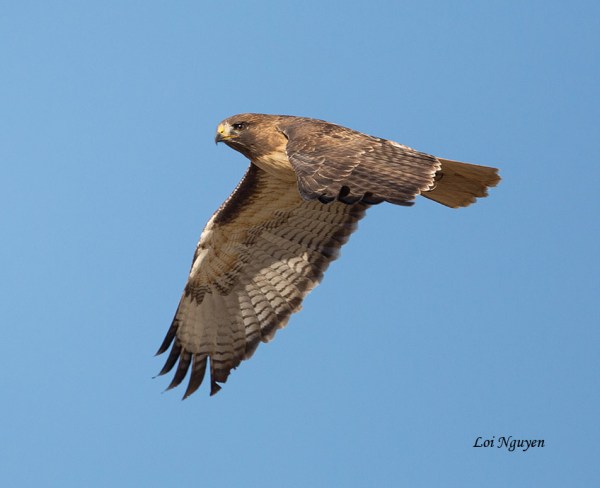
Red-tailed Hawk, Loi Nyugen
We doubled back to Ave L and went west to 40th St East. We turned south and stopped just before we reached Ave M. In past years, both the undeveloped land on the west side and the farmland on the east side of this road have been productive. This year, most of the birds we saw were on the cultivated land. There we found a many Killdeer, a large flock of Mountain Bluebirds, several Say’s Phoebes, many Savannah Sparrows and some White-crowned Sparrows. A flock of Horned Larks that we estimated to be more than 200 birds flew overhead and landed in the fallow hay field. We could see 2 Red-tailed Hawks perched on distant farm buildings. We scanned in all directions but did not see any other raptors but we saw a solar farm that had been built at the corner of Ave M & 40th St East. As the day went on, we saw more solar farms in various stages of construction.
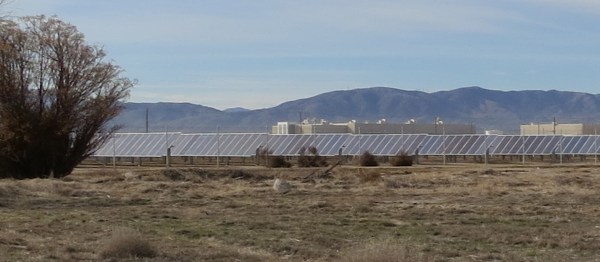
Solar farm, Schotte
We turned our cars around and started north once again. As we made our way toward Ave J & 110th St East, we saw very few birds other than Common Ravens, which were widespread. After we crossed 110th St East on Ave J we scanned the farmland on the north side of the road and stopped when we saw 2 Ferruginous Hawks. Our initial views (looking north from Ave J) were poor; the birds were in the center of the fields, well-away from the road so we decided to go around the block so we could look into the fields from the north side. As we drove toward the corner of Ave J & 110th St East, we stopped when we noticed a Ferruginous Hawk perched in a tree close to the road. The views were excellent.
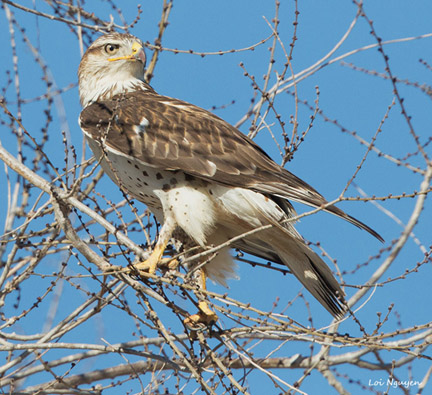
Ferruginous Hawk, Loi Nguyen

Ferruginous Hawk, Loi Nguyen
After the hawk flew off, we drove around the corner and went north on 110th St East. Fortunately, the car windows were open so we were able to hear a Ladder-backed Woodpecker calling from the trees beside the road. We pulled over, got out of our cars and began looking for the birds. Thanks to many sharp eyes and ears, we found it; it was a female.
We got back into our cars, drove to the corner, turned east onto Ave I and stopped mid-way along the block. Unfortunately, we were no closer to the Ferruginous Hawks we’d seen from Ave J but there were many other birds in the fields on both side of the road. There were Killdeer, Horned Larks, Mountain Bluebirds, European Starlings, American Pipits, Savannah Sparrows and Brewer’s Blackbirds. There were several Red-tailed Hawks, a few Say’s Phoebes and, at the end of the block, one participant saw a Loggerhead Shrike. We did not find any Mountain Plovers.
Although we counted 4 Ferruginous Hawks at that site, the only one we’d seen well was the hawk that had been perched at the corner of Ave J & 110th St East. We discussed our options and decided to go to the west side of the valley since raptors have been common there in past years. Since it was nearing lunch time, we started toward Apollo Park. As we drove north on 110th St East we stopped to check a field where sheep were grazing. We found blackbirds but no Mountain Plovers.

Blackbirds with sheep, Mei Kwan
We saw very few birds other than Common Ravens between that stop and Apollo Park. As we drove, we passed a few Red-tailed Hawks and 2 Eurasian Collared-Doves but we saw no large flocks of larks, pipits or sparrows, perhaps because the uncultivated land was so dry.
Apollo Park was very birdy so we scanned the lake and surrounding vegetation while we had lunch. It was an ideal day for a picnic. The temperature was 61 F and the breeze was light. There were lots of waterfowl on the lake, including Snow, Ross’s and Canada Geese, Mallards (and assorted hybrids), Northern Shovelers, one scaup, Bufflehead and Ruddy Ducks. We saw one American White Pelican, some Double-crested Cormorants, the usual complement of American Coots, some Ring-billed & California Gulls and a Cooper’s Hawk flew directly overhead. There were very few passerines in the park.
When we left the park we went west to 60th St West and turned north. We saw very few birds along that road. The fields were dry and the power poles were bare. When we reached Gaskell Ave we turned west. As we drove west along Gaskell the wind picked up but so did the birding. We spent time on both Gaskell & Ave A in the area west of 90th St West. We found Killdeer, larks, pipits, Mountain Bluebirds, sparrows, Yellow-rumped Warblers, blackbirds, Western Meadowlarks, House Finches and we finally got a good look at a perched Loggerhead Shrike.
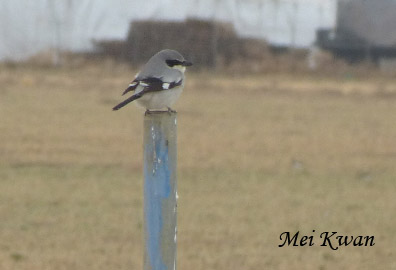
Loggerhead Shrike, Mei Kwan
Best of all, it seemed as if there were raptors everywhere.

Ferruginous Hawks on the ground, Mei Kwan

Ferruginous Hawk, Loi Nguyen

Ferruginous Hawk, Loi Nguyen
We found at least 10 Ferruginous Hawks, including a stunning dark morph bird that gave us excellent views as it soared nearby. At one point when we were driving, a male Northern Harrier flew right past us. We immediately turned the cars around and tried to follow it. We spotted it and, as it turned out, a Prairie Falcon had also noticed the harrier and was harassing it. We stopped to watch the agile falcon diving at the harrier which seemed almost lumbering in its flight as it sought to evade the falcon. The tussle ended with the harrier flying off, seemingly unharmed, and the falcon on the ground eating some small prey item.
With that as a grand finale, some of the group decided to start back to LA while others chose to visit Quail Lake before going home. To reach Quail Lake, we went south on 140th St West toward Rt 138, stopping once to look at some Horned Larks that were close to the road.
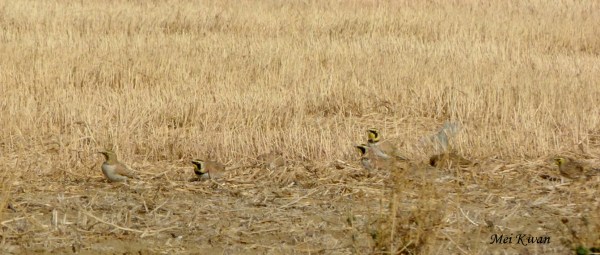
A Harlan’s Hawk had recently been reported from 140th St West but we did not see it.
It was warm but windy by the time we reached Quail Lake so we didn’t spend much time scoping the birds on the lake. However, we were able to see Bufflehead, Red-breasted Mergansers, Ruddy Ducks and at least one Horned Grebe. There were 2 Common Goldeneyes in the outlet channel
A few general impressions: we saw fewer species and, with the exception of Mountain Bluebirds, fewer individuals of those species than in past years; most of the birds we saw were on cultivated rather than undeveloped land.
The counts in the table below undoubtedly underestimate the numbers of ground birds (larks, pipits & sparrows) because the vegetation in the fallow alfalfa fields was tall enough that the birds were very hard to see.
It was a great day, thanks to all who participated. A special thanks to Loi and Mei for generously sharing their photos with us.
|
Sat, 11 Jan 2014 |
SMBAS |
Numbers | Antelope Valley Location |
|
Snow Goose |
Chen caerulescens |
2 |
Apollo Pk |
|
Ross’s Goose |
Chen rossii |
2 |
Apollo Pk |
|
Canada Goose |
Branta canadensis |
15 |
Apollo Pk |
|
Mallard |
Anas platyrhynchos |
10 |
Apollo Pk |
|
Northern Shoveler |
Anas clypeata |
30 |
Apollo Pk |
|
Scaup sp. |
Aythya sp. |
1 |
Apollo Pk |
|
Bufflehead |
Bucephala albeola |
20+ |
Apollo Pk; Quail Lake |
|
Common Goldeneye |
Bucephala clangula |
2 |
Quail Lake |
|
Red-breasted Merganser |
Mergus serrator |
10+ |
Quail Lake |
|
Ruddy Duck |
Oxyura jamaicensis |
40+ |
Apollo Pk; Quail Lake |
|
Pied-billed Grebe |
Podilymbus podiceps |
1 |
Apollo Pk |
|
Horned Grebe |
Podiceps nigricollis |
1 |
Quail Lake |
|
American White Pelican |
Pelecanus erythrorhynchos |
1 |
Apollo Pk |
|
Double-crested Cormorant |
Phalocrocorax auritus |
25 |
Apollo Pk |
|
Northern Harrier |
Circus cyaneus |
1 |
Gaskell/Ave A west of 90th St W |
|
Cooper’s Hawk |
Accipiter cooperii |
1 |
Flew over Apollo Pk |
|
Red-tailed Hawk |
Buteo jamaicensis |
30+ |
widespread |
|
Ferruginous Hawk |
Buteo regalis |
14 |
Av I x E110th; Gaskell/Ave A w. of 90th St W |
|
American Kestrel |
Falco sparverius |
4 |
scattered sites |
|
Prairie Falcon |
Falco mexicanus |
1 |
Gaskell/Ave A west of 90th St W |
|
American Coot |
Fulica americana |
25 |
Apollo Pk |
|
Killdeer |
Charadrius vociferus |
50 |
several sites |
|
Ring-billed Gull |
Larus delawarensis |
5 |
Apollo Pk |
|
California Gull |
Larus californicus |
35 |
Palmdale; Apollo Pk |
|
Rock Pigeon [I] |
Columba livia |
35 |
Palmdale |
|
Eurasian Collared-Dove [I] |
Streptopelia decaoto |
2 |
Av G east of Hwy 14 |
|
Mourning Dove |
Zenaida macroura |
1 |
Av J east of 90th St E |
|
Ladder-backed Woodpecker |
Picoides scalaris |
1 |
Av P golf course area |
|
Say’s Phoebe |
Sayornis saya |
8 |
scattered sites |
|
Loggerhead Shrike |
Lanius ludovicianus |
2 |
Av I x 120th St E; Gaskell Av |
|
Common Raven |
Corvus corax |
100+ |
widespread |
|
Horned Lark |
Eremophila alpestris |
600+ |
several sites |
|
Mountain Bluebird |
Sialia currucoides |
500+ |
several sites |
|
European Starling [I] |
Sturnus vulgaris |
25 |
scattered sites |
|
American Pipit |
Anthus rubescens |
150 |
Gaskell Rd |
|
Savannah Sparrow |
Passerculus sandwichensis |
75 |
scattered sites |
|
Song Sparrow |
Melospiza melodia |
1 |
E40th north of Av M |
|
White-crowned Sparrow |
Zonotrichia leucophrys |
100 |
scattered sites |
|
Western Meadowlark |
Sturnella neglecta |
100+ |
scattered sites |
|
Brewer’s Blackbird |
Euphagus cyanocephalus |
150 |
scattered sites |
|
House Finch |
Carpodacus mexicanus |
200 |
scattered sites |
|
House Sparrow [I] |
Passer domesticus |
60 |
Palmdale; Apollo Pk |



 SANTA MONICA BAY AUDUBON SOCIETY BLOG