Free email delivery
Please sign up for email delivery in the subscription area to the right.
No salesman will call, at least not from us. Maybe from someone else.
Malibu Lagoon Trip Report: 25 May, 2014
Summer approaches: days grow warmer, sunbathers arrive, surfers blanket the waves, birds begin to leave. Still we found a record-high (for May) species count, while total birds was below average. Nesting season is well along: Killdeer chicks have been spotted, hummingbirds sat on nests, Red-winged Blackbirds
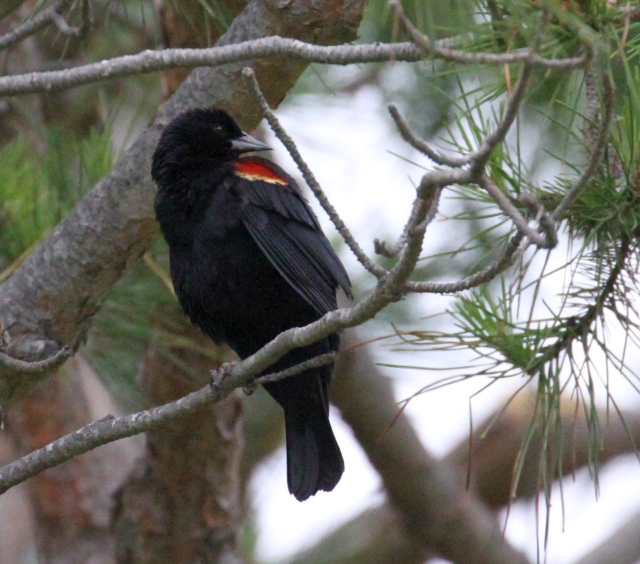
Red-winged Blackbird checks out the situation (R. Ehler 5/25/14)
displayed their epaulets, Black Phoebes collected flies, and Mockingbirds and Song Sparrows sang from nearly every bush.
Present since November, the Osprey apparently has been able to find sufficient large fish to stay satisfied. Many of us saw one (or more, as the location kept changing) such fish jumping high out of the water, and someone wise to the ways of fish identified it as a Steelhead (trout), a species endangered and long absent from the lagoon. I recall several meetings of the lagoon

Neither Kite nor Eagle, but an Osprey (R. Ehler 5/25/14)
task force, decades ago, at which a representative of Trout Unlimited spoke of the steelhead and his organization’s hope that the lagoon and creek could again be a home for them. It didn’t seem likely to me at the time, but now…things are looking up! The steelhead’s presence in the lagoon, first noted on 5/15/14 by fish monitors, was soon reported elsewhere (KPCC, Malibu Patch, KCET). The local anti-lagoon-reconfiguration diehards immediately scoffed, of course. Personally, I’ve often seen Mullet – another large fish – in the lagoon, but can’t recall ever seeing one jump. I have seen several species of trout elsewhere (Oregon, Michigan, Great Lakes) and they are definitely jumpers, exciting to watch. While we’re on the topic of fish, the Tidewater Gobies are reportedly doing very well indeed, as their habitat was greatly increased by the lagoon channel reconfiguration.
[Comment inserted 6/6/14
According to an article in the Malibu Patch, “An adult steelhead trout, approximately 20 inches in length, was discovered on May 15 during post-construction fish monitoring by the Resource Conservation District-Santa Monica Mountains, California State Parks and The Bay Foundation.” ON 6/6/14 I received an email from Mark Abramson: “The jumpers are almost always striped mullet. However Rosi and her fish team saw a 20-inch steelhead in the back of the channel when they were there doing fish surveys.”
So it seems that the fish we saw jumping on May 25 were actually Striped Mullet, and not the steelhead. Link to slide show of jumping Striped Mullet on EcoMalibu. Malibu Patch has a picture of the steelhead. End of inserted comment]
Also reported from the lagoon were numbers of dead Brown Pelicans (we saw three) as well as unusual numbers of adult pelicans. They should be nesting on offshore islands – Anacapa, for example – rather than lounging at Malibu Lagoon. It turns out that Brown Pelican nesting failures have been reported throughout California and Baja. One Baja colony, which would normally have over 10,000 nestlings by now, has produced well under 100. Failure of the nests is due to the lack of suitable prey fish, which in turn is the result of a change in ocean currents, which is believed to be linked to the ENSO (El Nino – Southern Oscillation) phenomenon. This, in addition to other factors, is leading scientists to predict El Nino for next winter. Stay tuned! [Link to reports: KPCC blog & audio report featuring Dan Cooper, Kimball Garrett & Kathy Molina; partial transcript of audio report.]
Connection to a Vimeo film on Steelhead, 19:25 minutes. Vimeo runs poorly on my computer; perhaps it works on yours.

Caspian Tern with a gift for his mate (R. Ehler 5/25/14)
Birds new for the season were: White-tailed Kite, a single Bonaparte’s Gull, a very *uncommon and unexpected Common Tern, Mourning Dove (which are always close by, I don’t know where they’ve been hiding), Western Wood-Pewee, Pacific-slope Flycatcher, and American Robin.
*Out of the lagoon 207 visits for which censusing was done, Common Tern was present 12 times (5.8%) with a total of 49 birds.
Our next three scheduled field trips: Mt. Piños Birds & Butterflies, 14-15 June, 8am; Malibu Lagoon, 22 June, 8:30 & 10am; Malibu Lagoon, 27 July, 8:30 & 10am.
Our next program: Tuesday, 7 Oct., 7:30 pm. To Be Announced.
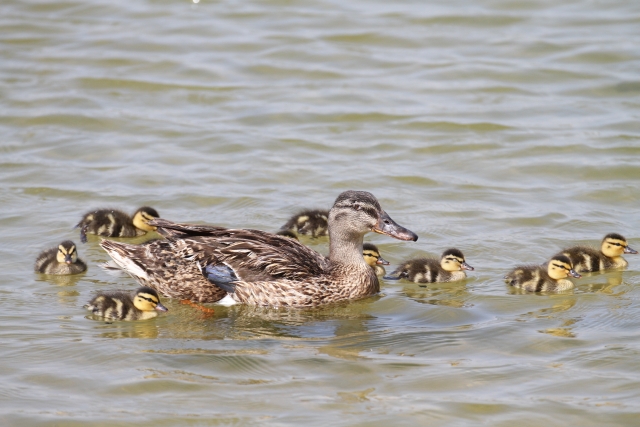
Despite cries from “those of little faith,” the Mallards are doing quite well, thank you. (R. Ehler 5/25/14)
NOTE: Our 10 a.m. Parent’s & Kids Birdwalk meets at the shaded viewing area. Look for Willie the Weasel.
Links: Unusual birds at Malibu Lagoon
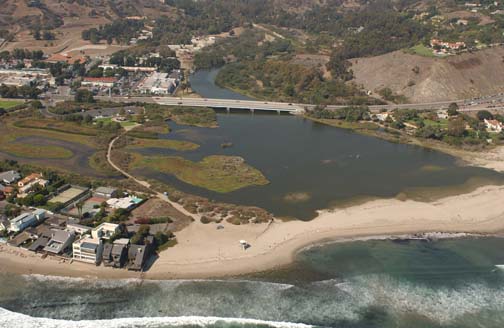
Aerial photo of Malibu Lagoon from 9/23/02.
Prior checklists: July-Dec’11, Jan-June’11, July-Dec ’10, Jan-June ’10, Jul-Dec ‘09, and Jan-June ‘09.
Comments on Bird Lists Below
Total Birds: May total birds of 410 is 14% below the 6-year May average of 474.
Summary of total birds from the 6-year average so far: Jun’12 +36%, Jul’12 -9%, Aug’12 -9%, Sep’12 +12%, Oct’12 +3%, Nov’12 -5%, Dec’12 +30%, Jan’13 -20%, Feb’13 -29%, Mar’13 -30%, Apr’13 -34%, May’13 -37%, Jun’13 -24%, Jul’13 +83%, Aug’13 +37%, Sep’13 +23%, Oct’13 +41%, Nov’13 -58%, Dec’13 -49%, Jan’14 -62%, Feb’14 -28%, Mar’14 +51%, May -14%.
Species Diversity: May 2014 with 55 species, a 10-year high, was 20% above the 6-year May average of 46.
Summary of species diversity from the 6-year average so far: Jun’12 -10%, Jul’12 +10%, Aug’12. -6%, Sep’12 -20%, Oct’12 +5%, Nov’12 +2%, Dec’12 -4%, Jan’13 +2%, Feb’13 -8%, Mar’13 +9%, Apr’13 -2%, May’13 +3%, Jun’13 +13%, Jul’13 0%, Aug’13 +11%, Sep’13 -14%, Oct’13 +19%, Nov’13 -3%, Dec’13 -6%, Jan’14 -2% Feb’14 +9%, Mar’14 +6%, May +20%. Up, down, up, down, etc., etc.
10-year comparison summaries are available on our Lagoon Project Bird Census Page. [Chuck Almdale]
Note: Beginning July, we will return to our pre-project form of bird list, which will report the most recent 6-month periods.
| Malibu Census | 2009 | 2010 | 2011 | 2012 | 2013 | 2014 | |
| May 2009-2014 | 5/24 | 5/23 | 5/22 | 5/27 | 5/26 | 5/25 | |
| Temperature | 59-64 | 54-62 | 58-63 | 68-72 | 63-64 | 64-69 | |
| Tide Lo/Hi Height | H+3.7 | H+3.76 | L-0.13 | L+0.38 | H+4.08 | H+3.94 | Ave. |
| Tide Time | 1042 | 0638 | 0816 | 0844 | 1138 | 0810 | Birds |
| Brant | 4 | 7 | 1 | 2.0 | |||
| Gadwall | 12 | 12 | 3 | 5 | 2 | 12 | 7.7 |
| American Wigeon | 2 | 0.3 | |||||
| Mallard | 20 | 18 | 48 | 32 | 5 | 26 | 24.8 |
| Northern Shoveler | 1 | 0.2 | |||||
| Red-brstd Merganser | 2 | 3 | 0.8 | ||||
| Ruddy Duck | 2 | 3 | 6 | 1.8 | |||
| Pacific Loon | 1 | 5 | 1 | 1.2 | |||
| Common Loon | 1 | 0.2 | |||||
| Pied-billed Grebe | 2 | 3 | 3 | 2 | 1.7 | ||
| Western Grebe | 1 | 0.2 | |||||
| Brandt’s Cormorant | 1 | 2 | 0.5 | ||||
| Dble-crstd Cormorant | 28 | 7 | 46 | 15 | 9 | 31 | 22.7 |
| Pelagic Cormorant | 1 | 1 | 0.3 | ||||
| Brown Pelican | 70 | 124 | 81 | 265 | 7 | 37 | 97.3 |
| Great Blue Heron | 1 | 2 | 1 | 3 | 2 | 4 | 2.2 |
| Great Egret | 4 | 2 | 3 | 3 | 2 | 2.3 | |
| Snowy Egret | 7 | 12 | 3 | 14 | 3 | 12 | 8.5 |
| Green Heron | 1 | 0.2 | |||||
| Blk-crwnd N-Heron | 2 | 3 | 1 | 2 | 1.3 | ||
| Osprey | 1 | 1 | 1 | 0.5 | |||
| White-tailed Kite | 1 | 1 | 0.3 | ||||
| Cooper’s Hawk | 1 | 0.2 | |||||
| Red-tailed Hawk | 1 | 1 | 1 | 0.5 | |||
| Peregrine Falcon | 1 | 0.2 | |||||
| American Coot | 32 | 8 | 25 | 30 | 1 | 2 | 16.3 |
| Blk-bellied Plover | 3 | 22 | 4.2 | ||||
| Snowy Plover | 1 | 0.2 | |||||
| Semipalmated Plover | 2 | 0.3 | |||||
| Killdeer | 1 | 4 | 2 | 3 | 6 | 4 | 3.3 |
| Spotted Sandpiper | 3 | 0.5 | |||||
| Willet | 4 | 0.7 | |||||
| Whimbrel | 4 | 1 | 20 | 1 | 4 | 5.0 | |
| Marbled Godwit | 1 | 0.2 | |||||
| Black Turnstone | 1 | 0.2 | |||||
| Boneparte’s Gull | 1 | 1 | 1 | 0.5 | |||
| Heermann’s Gull | 20 | 17 | 15 | 35 | 2 | 14.8 | |
| Ring-billed Gull | 1 | 2 | 16 | 1 | 3.3 | ||
| Western Gull | 65 | 68 | 10 | 85 | 22 | 64 | 52.3 |
| California Gull | 95 | 8 | 4 | 1 | 18.0 | ||
| Glaucous-wingd Gull | 1 | 0.2 | |||||
| Caspian Tern | 15 | 25 | 4 | 6 | 2 | 17 | 11.5 |
| Common Tern | 1 | 0.2 | |||||
| Forster’s Tern | 2 | 0.3 | |||||
| Royal Tern | 2 | 5 | 5 | 8 | 3.3 | ||
| Elegant Tern | 40 | 9 | 12 | 35 | 121 | 37 | 42.3 |
| Black Skimmer | 2 | 0.3 | |||||
| Rock Pigeon | 6 | 6 | 8 | 2 | 6 | 4.7 | |
| Eur. Collared-Dove | 1 | 0.2 | |||||
| Mourning Dove | 4 | 6 | 1 | 2 | 5 | 2 | 3.3 |
| Anna’s Hummingbird | 2 | 1 | 1 | 2 | 1 | 1 | 1.3 |
| Allen’s Hummingbird | 8 | 6 | 4 | 5 | 1 | 5 | 4.8 |
| Belted Kingfisher | 1 | 0.2 | |||||
| Western Wood-Pewee | 1 | 0.2 | |||||
| Pac.Slope Flycatcher | 1 | 1 | 0.3 | ||||
| Black Phoebe | 12 | 10 | 4 | 13 | 2 | 6 | 7.8 |
| Say’s Phoebe | 1 | 0.2 | |||||
| American Crow | 6 | 4 | 3 | 5 | 3 | 6 | 4.5 |
| Common Raven | 2 | 0.3 | |||||
| Rough-wingd Swallow | 10 | 1 | 2 | 1 | 2 | 2.7 | |
| Violet-green Swallow | 1 | 1 | 0.3 | ||||
| Barn Swallow | 1 | 8 | 8 | 2 | 6 | 19 | 7.3 |
| Cliff Swallow | 12 | 12 | 31 | 12 | 14 | 6 | 14.5 |
| Oak Titmouse | 1 | 0.2 | |||||
| Bushtit | 4 | 4 | 10 | 8 | 4.3 | ||
| Bewick’s Wren | 1 | 0.2 | |||||
| American Robin | 1 | 0.2 | |||||
| Wrentit | 1 | 0.2 | |||||
| Northern Mockingbird | 6 | 4 | 2 | 6 | 3 | 3 | 4.0 |
| European Starling | 2 | 3 | 40 | 45 | 3 | 8 | 16.8 |
| Cedar Waxwing | 32 | 5.3 | |||||
| Ornge-crwnd Warbler | 1 | 0.2 | |||||
| Common Yellowthroat | 2 | 3 | 3 | 1.3 | |||
| Spotted Towhee | 2 | 0.3 | |||||
| California Towhee | 5 | 1 | 1 | 1 | 3 | 1.8 | |
| Song Sparrow | 8 | 10 | 4 | 12 | 8 | 11 | 8.8 |
| Red-winged Blackbird | 4 | 2 | 10 | 9 | 6 | 5.2 | |
| Brewer’s Blackbird | 2 | 0.3 | |||||
| Great-tailed Grackle | 16 | 2 | 4 | 2 | 4.0 | ||
| Brwn-headed Cowbird | 2 | 1 | 3 | 1 | 2 | 1.5 | |
| Hooded Oriole | 1 | 1 | 0.3 | ||||
| Bullock’s Oriole | 2 | 1 | 1 | 0.7 | |||
| House Finch | 8 | 6 | 8 | 8 | 3 | 13 | 7.7 |
| Lesser Goldfinch | 1 | 2 | 4 | 2 | 1.5 | ||
| House Sparrow | 5 | 0.8 | |||||
| Totals by Type | 5/24 | 5/23 | 5/22 | 5/27 | 5/26 | 5/25 | |
| Waterfowl | 38 | 37 | 51 | 42 | 9 | 49 | 38 |
| Water Birds-Other | 132 | 148 | 152 | 313 | 20 | 77 | 140 |
| Herons, Egrets | 13 | 16 | 6 | 23 | 9 | 20 | 15 |
| Raptors | 1 | 1 | 3 | 0 | 2 | 3 | 2 |
| Shorebirds | 5 | 5 | 5 | 51 | 10 | 11 | 15 |
| Gulls & Terns | 144 | 216 | 51 | 151 | 189 | 132 | 147 |
| Doves | 10 | 12 | 9 | 5 | 5 | 8 | 8 |
| Other Non-Pass. | 10 | 7 | 5 | 8 | 2 | 6 | 6 |
| Passerines | 79 | 106 | 131 | 127 | 76 | 104 | 104 |
| Totals Birds | 432 | 548 | 413 | 720 | 322 | 410 | 474 |
| 2009 | 2010 | 2011 | 2012 | 2013 | 2014 | ||
| Total Species | 5/24 | 5/23 | 5/22 | 5/27 | 5/26 | 5/25 | |
| Waterfowl | 4 | 3 | 2 | 4 | 4 | 5 | 3.7 |
| Water Birds-Other | 5 | 7 | 3 | 4 | 4 | 8 | 5.2 |
| Herons, Egrets | 4 | 3 | 3 | 4 | 4 | 4 | 3.7 |
| Raptors | 1 | 1 | 3 | 0 | 2 | 3 | 1.7 |
| Shorebirds | 2 | 2 | 2 | 6 | 4 | 3 | 3.2 |
| Gulls & Terns | 7 | 6 | 6 | 7 | 8 | 8 | 7.0 |
| Doves | 2 | 2 | 2 | 3 | 1 | 2 | 2.0 |
| Other Non-Pass. | 2 | 2 | 2 | 3 | 2 | 2 | 2.2 |
| Passerines | 16 | 19 | 16 | 16 | 17 | 20 | 17.3 |
| Totals Species – 85 | 43 | 45 | 39 | 47 | 46 | 55 | 46 |
For you of little faith…
If you think you saw something that was NOT a carp jumping in Malibu Lagoon on Sunday’s SMBAS birds+ walk… KPCC just broadcast a piece featuring Suzanne Goode about the health of the reconfigured lagoon,…and stating that steelhead (a salmonid native fish) has been spotted in Malibu Lagoon! Welcome back fish! Welcome back lagoon!
Comment added 6/6/14
According to an article in the Malibu Patch, “An adult steelhead trout, approximately 20 inches in length, was discovered on May 15 during post-construction fish monitoring by the Resource Conservation District-Santa Monica Mountains, California State Parks and The Bay Foundation.” ON 6/6/14 I received an email from Mark Abramson: “The jumpers are almost always striped mullet. However Rosi and her fish team saw a 20-inch steelhead in the back of the channel when they were there doing fish surveys.”
So it seems that the fish we saw jumping on May 25 were actually Striped Mullet, and not the steelhead.
Link to slide show of jumping Striped Mullet on EcoMalibu.
Links: KPCC, KCET, Malibu Patch (has picture of the steelhead)
[Chuck Almdale]
LucienP, Conservation Chair
Update on Beach Parking for Seniors
For those of us who have reached age 62, and like to bird at the beach, please note! According to Supervisor Zev Yaroslavsky’s blog, the Beaches and Harbors Department will be considering a $25 fee for the Seniors Beach Parking Pass. Act now to avoid the higher fee. See my March 6th entry on Senior Parking Passes by clicking on the “select month” link on the right hand side of the page.
Full Flower Moon Update – 14 May, 2014, 12:16 PM PDT
Here’s another update from SMBAS Blog on that large, disc-like, shining object which has frequently and mysteriously appeared in our nighttime sky this year (known to many as the moon).

Refuge Moonrise (T. Hinnebusch 2/14/14)
May 14, 12:16 p.m. PDT — Full Flower Moon. Flowers are abundant everywhere at this time. May’s full moon was also known as the Full Corn Planting Moon or the Milk Moon. [Gallery: The Fantastic Full Moon]
The next significant full moon will occur on June 12, 9:11 p.m. PDT. Keep an eye on this spot for additional late-breaking news on this unprecedented event.
This information comes to you courtesy of: http://www.space.com/24262-weird-full-moon-names-2014-explained.html
written by Joe Rao. Joe Rao serves as an instructor and guest lecturer at New York’s Hayden Planetarium. He writes about astronomy for Natural History magazine, the Farmer’s Almanac and other publications, and he is also an on-camera meteorologist for News 12 Westchester, N.Y.
But that’s waaay too long to type in, and besides, you don’t need to go there because SMBAS has done the work for you!
[Chuck Almdale]
Malibu Lagoon, April 27, 2014
We had great weather, just beating the recent heat wave by one day. The water level at the lagoon was the highest we have seen since the renovation; it may have reduced the number of birds because there was no mud exposed and only a couple of small islands to perch on safely. On the other hand, we saw many Killdeer chicks close to the pathways, and that is not at all expected. One of our group saw a dozen chicks before they were called off a pathway by their parents.

Killdeer chick; photo by Adrian Douglas
There were several reports of large fish jumping and we had one Osprey fly over; no reports yet of a nest so we assume this was merely a visitor. Another unusual set of visitors were some Vaux’s Swifts flying low, mixed in with the Barn, Cliff, Rough-winged and Violet-green swallows. It was a good opportunity to observe the different flight characteristics of swallows and swifts.
For whatever reason, we saw virtually no warblers – only two of the resident Common Yellowthroats. Migration and breeding season did give us a good look at Spotted Sandpipers with real spots on them, not in their plain winter plumage.

Spotted Sandpiper; photo by Adrian Douglas
The Elegant Terns were all clustered together on one of the small islands and the Urge to Merge ran rampant among them. And yes, there was one Royal Tern among them, standing out with its larger size, bald forehead and slightly stronger bill. We also had six of the Big Boys, Caspian Terns.

Caspian Terns; photo by Laurel Jones
Maybe it was the high water (few waders) or the change in the weather (lots of good birds found the same weekend at Butterbredt on their way north for the summer) the lagoon lacked variety for a May trip. We still saw a lot: results below.

Whimbrel; photo by Laurel Jones
| Pied-billed Grebe | 1 |
| Double-crested Cormorant | 24 |
| Brown Pelican | 105 |
| Red-breasted Merganser | 1 |
| Snowy Egret | 12 |
| Black-crowned Night-Heron | 1 |
| Osprey | 1 |
| American Coot | 20 |
| Marbled Godwit | 25 |
| Whimbrel | 7 |
| Spotted Sandpiper | 3 |
| Western Sandpiper | 5 |
| Least Sandpiper | 1 |
| Killdeer | 22 |
| Heermann’s Gull | 27 |
| California Gull | 3 |
| Western Gull | 27 |
| Caspian Tern | 6 |
| Royal Tern | 1 |
| Elegant Tern | 63 |
| Rock Pigeon | 5 |
| Allen’s Hummingbird | 3 |
| Black Phoebe | 5 |
| Western Scrub-Jay | 1 |
| American Crow | 8 |
| Northern Mockingbird | 4 |
| European Starling | 6 |
| Bushtit | 6 |
| Violet-green Swallow | 6 |
| Northern Rough-winged Swallow | 4 |
| Barn Swallow | 20 |
| Cliff Swallow | 5 |
| House Finch | 6 |
| Common Yellowthroat | 2 |
| Song Sparrow | 12 |
| California Towhee | 4 |
| Brown-headed Cowbird | 1 |



 SANTA MONICA BAY AUDUBON SOCIETY BLOG