Free email delivery
Please sign up for email delivery in the subscription area to the right.
No salesman will call, at least not from us. Maybe from someone else.
Stranded Sailors on the Sand
[Posted by Chuck Almdale, Photos by Chris & Ruth Tosdevin]

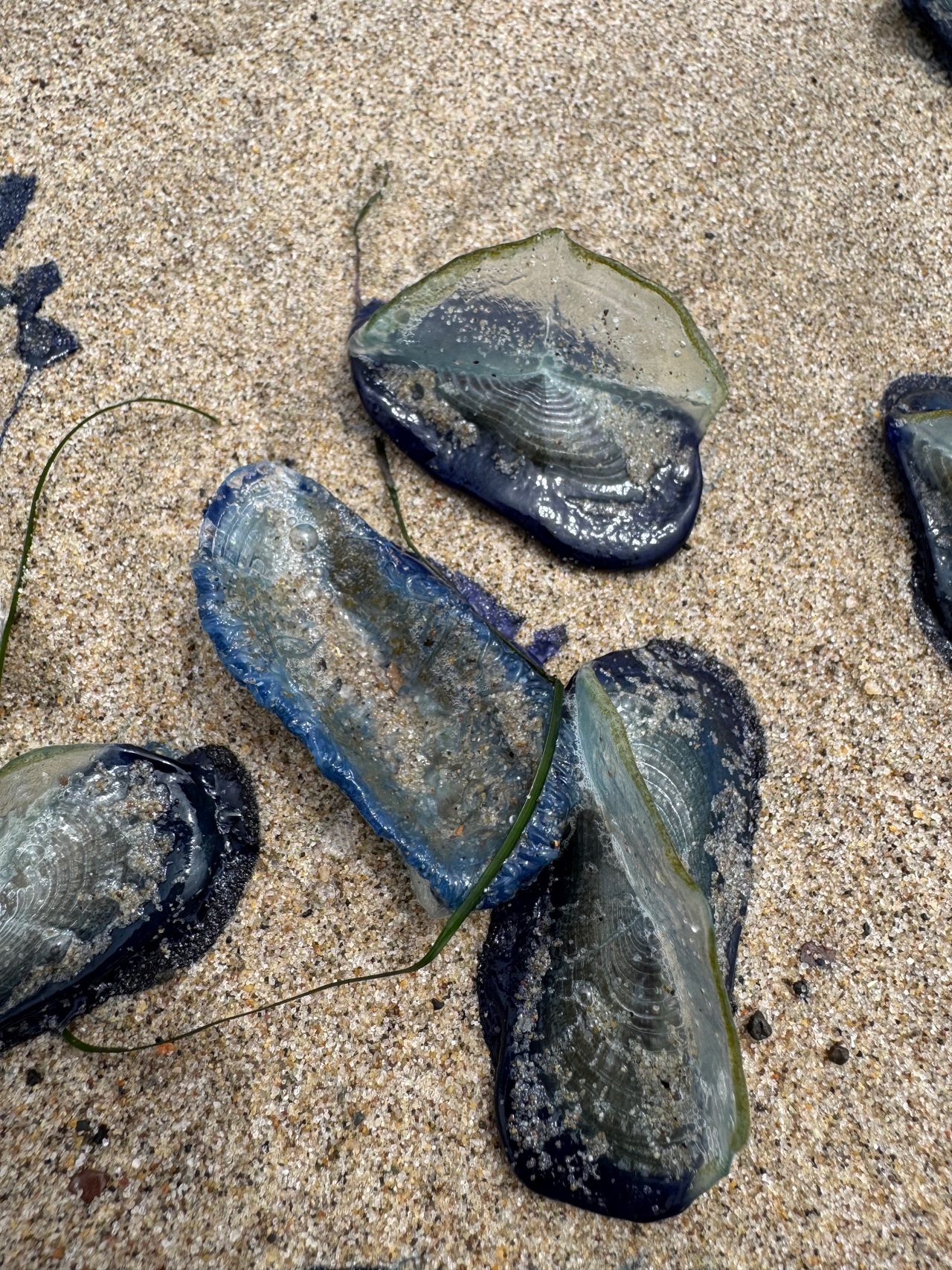
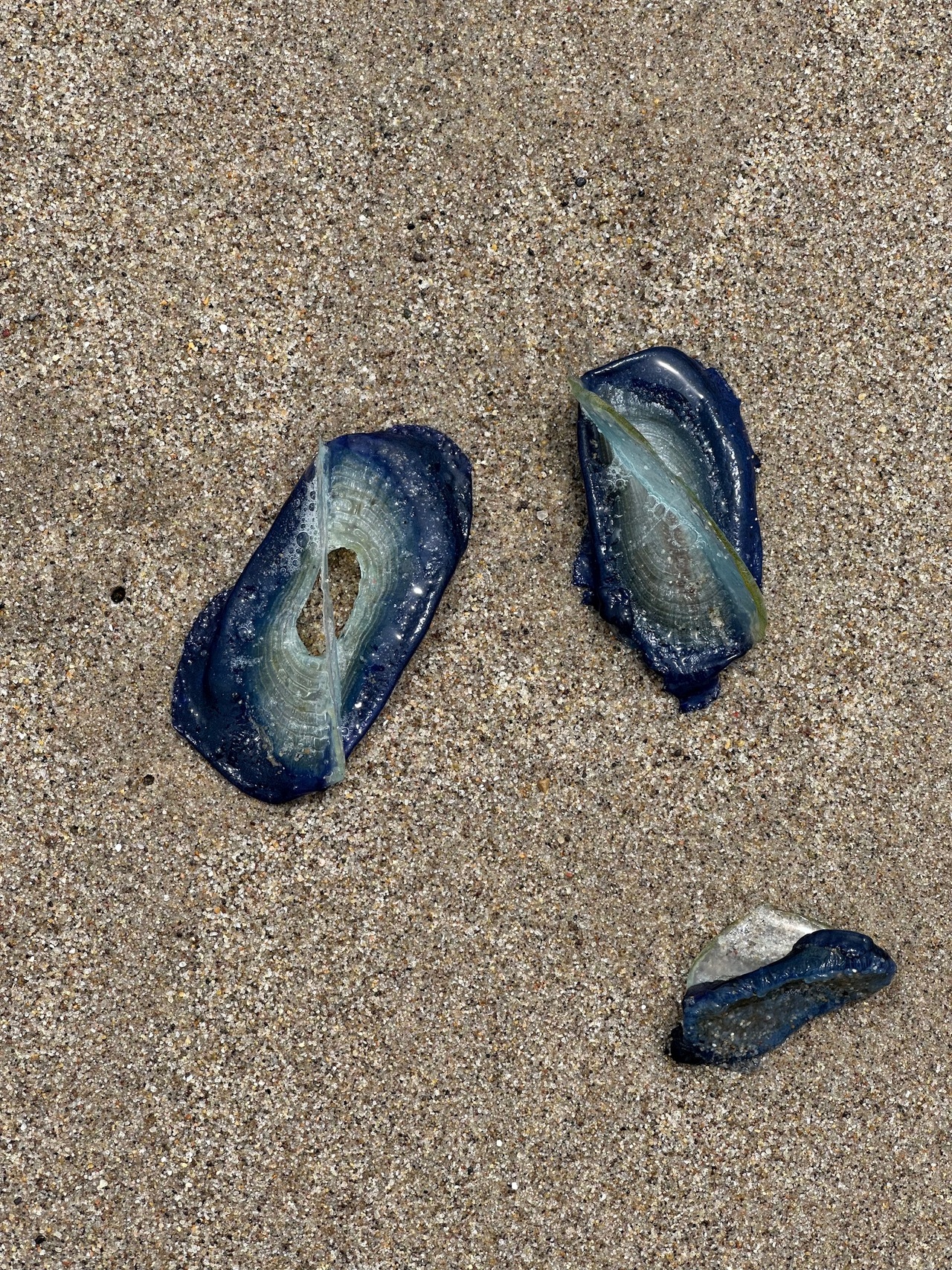
Velella Velella is also known as Velella, or sea raft, purple sail, little sail, or my preferred name, By-the-wind Sailor. They are a hydrozoa in the family Porpitidae, genus Velella. Velella is a monotypic genus, its only known species is Velella velella, a widely distributed free-floating hydrozoan that lives on the surface of the open ocean, mostly in tropical or temperate waters.

If you look closely, you can see the sail is oriented about 30-45° counter-clockwise to the long axis of the polyp’s top layer (the part with the whorl structure). The effect is that if the long axis of the body is parallel to the wind’s direction (as is normal), they will be pushed off to the right by the wind blowing from their rear. In the western pacific the predominate wind direction is from the northwest, which will push Velella off the wind’s direction 30-45% towards the south or southwest. This causes them to float “by-the-wind” approximately parallel to the eastern shore of the Pacific.

But when the wind shifts and comes from the west or southwest, this causes the sailors to be blown eastward, towards our shores. They can be washed onto the western shores of the Americas by the millions.
Velella velella is the only species in genus Velella.
Classification:
Kingdom: Animalia
Subkingdom: Eumatazoa
….. https://en.wikipedia.org/wiki/Eumetazoa
Clade: ParaHoxozoa
….. https://en.wikipedia.org/wiki/ParaHoxozoa
Phylum: Cnidaria (stinging cells)
….. https://en.wikipedia.org/wiki/Cnidaria
Subphylum: Medusozoa (jellyfish or jellies)
….. https://en.wikipedia.org/wiki/Medusozoa
Class: Hydrozoa (water animal)
….. https://en.wikipedia.org/wiki/Hydrozoa
Subclass: Hydroidolina
….. https://en.wikipedia.org/wiki/Hydroidolina
Order: Anthoathecata (always have polyp stage)
….. https://en.wikipedia.org/wiki/Anthoathecata
Suborder: Capitata (tentacles end in “heads”)
….. https://en.wikipedia.org/wiki/Capitata
Family: Chondrophora (Porphitidae) (gas-filled float) .
….. https://en.wikipedia.org/wiki/Chondrophore
Genus: Velella (sail)
….. https://en.wikipedia.org/wiki/Velella
In the Western Pacific, the sails are oriented 30-45° clockwise to keep them from blowing ashore in Japan and China. There is still much that is unknown about these small creatures. Some sources consider each sailor a colony, others say no, each sailor is a single animal. Are the east and west Pacific varieties different species, if not, what is the mechanism of differentiation?
This is an excellent article about the sailors and their adventures in the San Francisco Bay area.
A nice YouTube about them.

After a while they begin to lose their color and become crispy. Their tentacles do contain stinging cells which are strong enough to subdue their tiny zooplankton prey, but won’t do much to human skin.
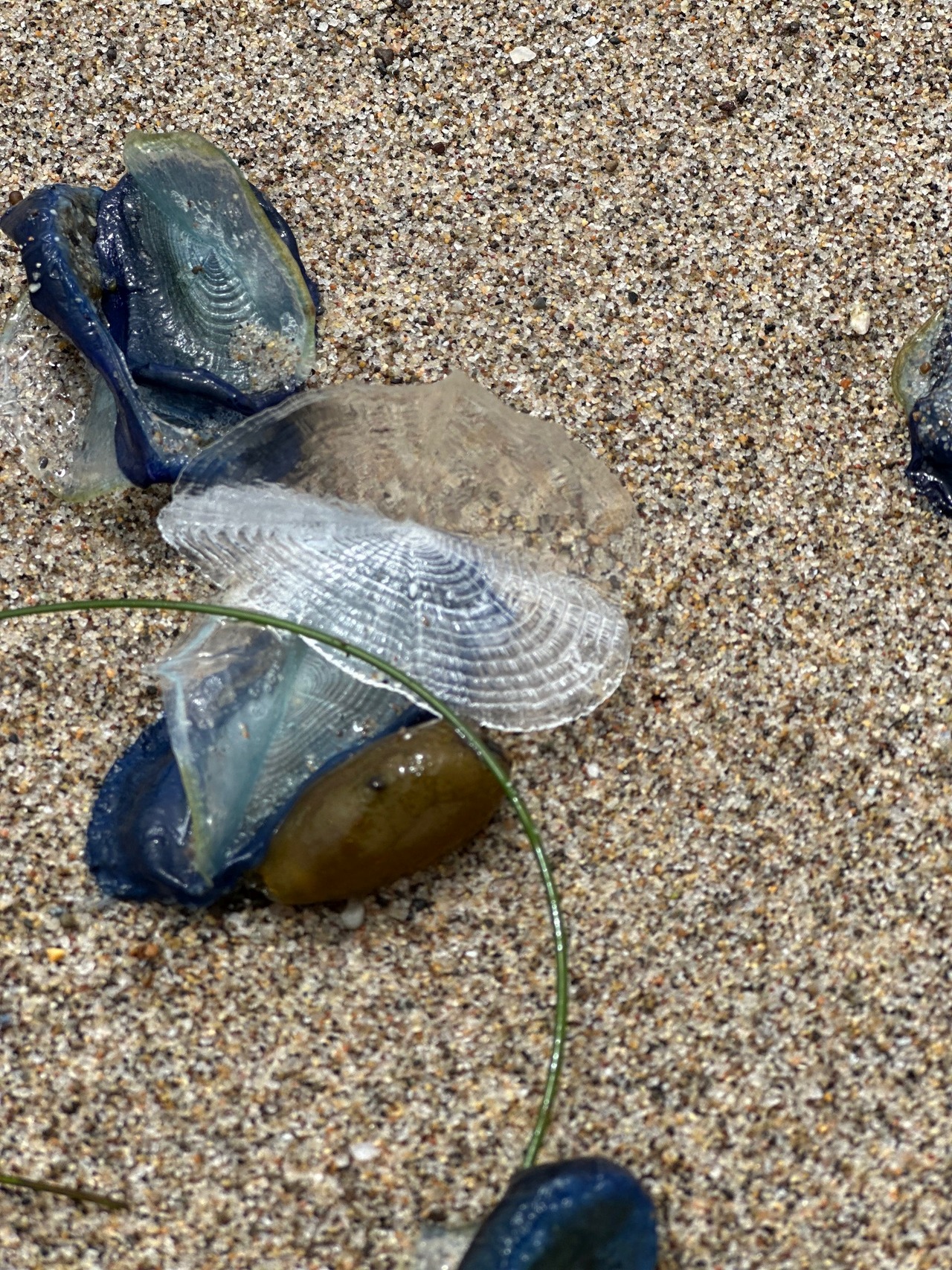
When they dry out they look like plastic….
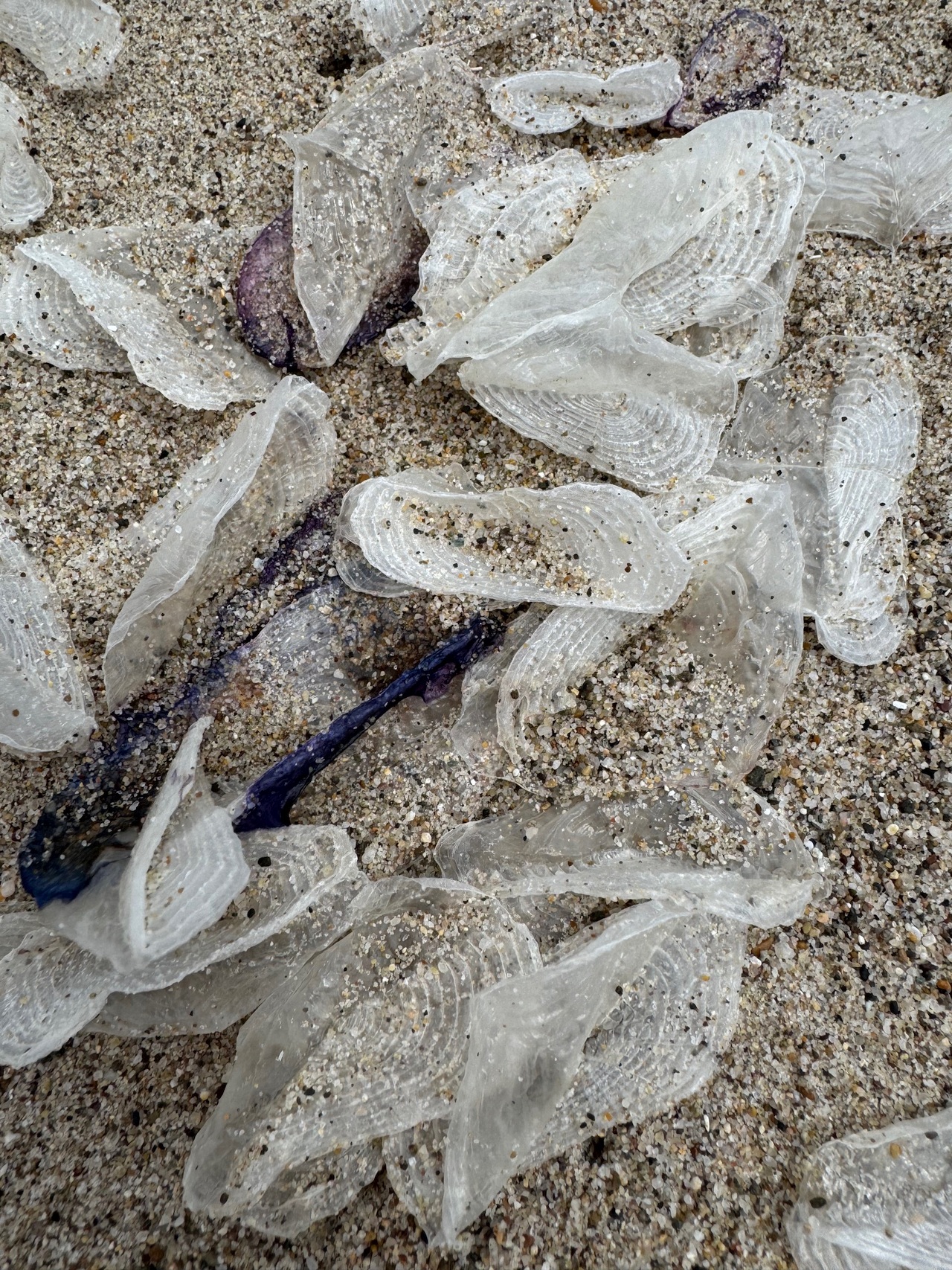
…..and their bodies look like litter on the breach.
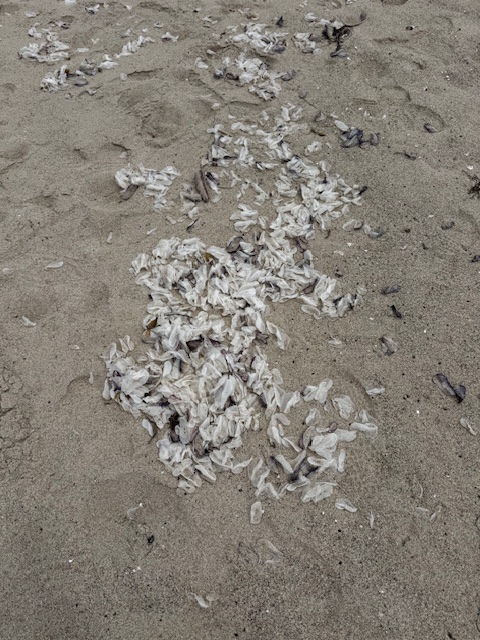
Miscellaneous peeps and pipers can find something edible here, like this Short-billed Dowitcher.

When the winds blow badly for them, they can die by the millions.

Adaptations to one’s environment need not work all the time to be of overall benefit to survival of the species.
More on our Birding Slow Spring | Paul Lehman
[Posted by Chuck Almdale]
Paul Lehman is a well-known and long-time birder, bird tour leader, author of books on birds, contributor to books and magazines about birds, lives locally and just happens to be leading in the eBird Top 100 eBirders for 2025, with 323 species seen out of 464 total for California since January 1 (this number will probably change before any readers check it). I don’t know if that last item is intentional or completely by accident (he might not even know about it – if not, congratulations Paul!), as he happens to go out birding a lot (77 checklists for 106 days is an indication) and then diligently records it all on eBird. So…his comments on the slow spring of 2025 are worth reading. We posted Kimball Garrett’s comments on this subject a week ago. Since then reports of Hooded Orioles have been flooding in to me, of all people, and they seem to have suddenly and widely appeared in SoCal. I saw three last Saturday, including a pair closely examining the crown of a palm tree, but I don’t think that moves me to the top of any list.
It should be noted that neither Paul and Kimball were expecting to see their words appear here – surprise, surprise! – but I did ask their prior permission, something I occasionally skip.

Paul Lehman writes:
I think almost everyone in California would agree that the passerine migration so far this April is notably LATE and SLOW. Down here in parts of southern California, a number of folks (including myself) have commented on it being a good migration earlier in the season for Violet-green Swallow, and since then OK for Western Kingbird and Chipping Sparrow. But almost everything else….late and slow! One very common refrain virtually statewide has been, “Where are all the Hooded Orioles?” Here in San Diego County, where common and widespread, they were remarkably scarce until just a little over a week ago Still below average, but at least they have filled in a fair bit of their widespread range locally–but this is almost A FULL MONTH LATE. Bullock’s Orioles and Black-headed Grosbeaks have also finally begun to increase, but still below normal and running 2-3 weeks late. And where are all the many Ash-throated Flycatchers that normally start appearing by late March? Anyway, the list goes on and on. So, what’s happening? Major population declines? Inappropriate local weather conditions locally for migration? Or something odd going on farther to the south(east), either en route or closer to the wintering grounds? In support of the latter factor are reports that a fair chunk of southern Arizona had it driest winter on record, EVER, and–perhaps more important–one friend of mine reported that parts of Mexico had a cooler or colder than usual (relatively speaking) winter and early spring–which could well translate into a lot of stuff running late. We will certainly know a lot more once the next month plays out!
It’s another first half of April, and yet another year of multiple reports of the following species that are way early and which in most cases likely reflect misidentifications. (And all of which could really use photo documentation.) Western Wood-Pewees are not expected to start arriving until after about 15 April, so any reports before that need to come with strong documentation, and need to be flagged by eBird filters. (For example, the all-time early arrival in San Diego County is around 8 April.) Most such early reports involve either heard-only birds (think vocalizing starlings or a number of other mimics) or are poorly documented and have no photos. Often these reports are from observers who do not at all appreciate how unusually early their bird would be. And a problem that I bet many birders don’t realize is that the first Olive-sided Flycatchers actually arrive before wood-pewees do–and probably get misidentified. This month, there were several poorly documented early reports, but also one well photographed bird in Orange County on 10 April. The next species is Swainson’s Thrush, which already has a bunch of reports in California during the first half of the month. This species is not reliable until around late the third week in the month, with a just a few documented records as early as the 12th-15th. A fair number of the earliest records are of birds at breeding sites, arriving even earlier than through-migrants do farther to the SOUTH, but such local breeders need to be heard SINGING. Unfortunately, almost all of the early reports this month have involved birds not seen and only heard calling, or heard calling and seen rather poorly, again mostly by folks who don’t appreciate the true status of this species so early–and who report the bird giving the “wink” or “wheet” call only, but some other species (e.g., Song Sparrow) can give similar calls. Last but not least comes Black Swift. There are a small number of legit records for the last week or perhaps ten days of April in California (some associated with southern or lowland nesting areas), but of course this species is a notorious late arriver and typically doesn’t show until into May. The problem here is the usual one of an observer not appreciating the true status and seasonal timing, and either seeing a White-throated or Vaux’s Swift at a distance or in mediocre light and not properly assessing size and/or color. And the other recurring problem is misidentifying male Purple Martins. Heck, some especially early reports of Black Swift, if indeed of a large all-dark swift, might need to also consider either Common Swift or White-collared Swift. So far this year, there have already been one or two Black Swift reports. From previous years, there is an especially “egregious” report with very limited details coming from Butte County on 30 March 2021 and apparently being validated by eBird…..
Anyway, I’d recommend all county ebird filters be tightened for these and several other migrants that are notoriously reported “too early” almost every spring (e.g., add Willow and Dusky Flycatchers to the list), and set to 0 [zero] until these species are truly known to occur REGULARLY in at least small numbers.
Exceptional arrival and departure dates certainly DO exist But such exceptional occurrences need to be appreciated by the observer AT THE TIME OF THE OBSERVATION and need to be exceptionally well documented.
–Paul Lehman, San Diego
Colossal squid filmed alive in deep ocean for the first time ever | Discover Wildlife
[Posted by Chuck Almdale]
Colossal squid filmed alive in deep ocean for the first time ever.
The incredible footage of a juvenile colossal squid in its natural environment was captured in the South Atlantic Ocean 100 years after the species was identified.
Discover Wildlife | Melissa Hobson | 15 Apr 2025
Link to article and film: Click This
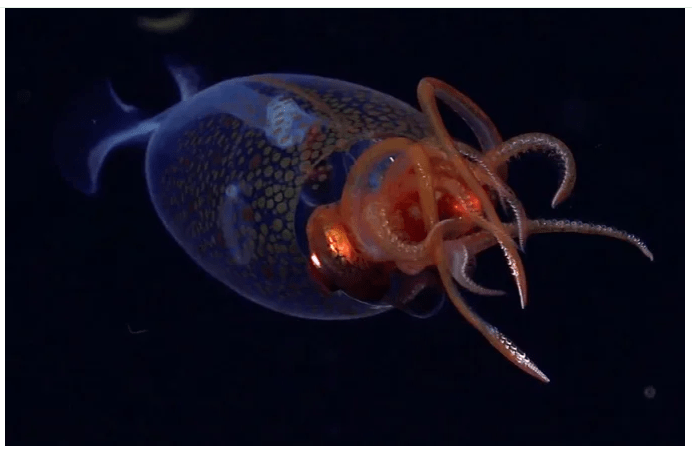
From the article:
Deep sea scientists have filmed a live colossal squid in its natural environment for the first time since the species was named 100 years ago. In a surprising twist, the individual – caught on film at a depth of 600 metres by researchers onboard Schmidt Ocean Institute’s Falkor (too) – was a baby. Reaching up to seven metres long and tipping the scales at 500kg, the colossal squid (Mesonychoteuthis hamiltoni) is the heaviest invertebrate on Earth. But this see-through juvenile measured just 30 centimetres long.
A Slow Start to Spring? | Kimball Garrett
[Posted by Chuck Almdale]
The following comments were posted Thursday, 10 April 2025 on bird chat line LACoBirds by Kimball Garrett, retired Collections Manager in Ornithology at the Natural History Museum of Los Angeles County, and reposted here with permission from Kimball. I think they are of interest and import to all birders, especially those of us living in SoCal.
LACoBirds@Groups.io website
LACoBirds@Groups.io To Join (100% free)
Birders,
A discussion on the San Diego Birding listserv the past few days on how slow and poor the spring has been, up to this point, in San Diego region (e.g., many people reporting that Hooded Orioles were very late) has prompted me to post something similar for my neck of the woods. It has been an excruciatingly slow spring so far in the Antelope Valley for passerine migrants and summer visitors (apart from swallows).
Scott’s Orioles arrived in Juniper Hills 21 March, much later than the mean arrival date in seven springs here, and are still few and far between. A couple of Hooded Orioles arrived at Pearblossom Park and in Juniper Hills (but not until this week), but fewer than expected. And Bullock’s didn’t arrive at the Valyermo Post Office area until 7 April. Still no Lazuli Buntings, Ash-throated Flycatchers, Black-headed Grosbeaks, Gray Flycatchers, Warbling Vireos, Black-throated Gray Warblers, etc., in our neighborhood (all expected by the first week of April).
Well-birded Piute Ponds [advance permission to enter from Edwards AFB is necessary] has had very few passerine migrants (apart from swallows) so far this spring, save for hordes of Yellow-rumped Warblers passing through.
Speaking of Piute Ponds, there is very good shorebird habitat on the southern and western parts of Duckbill pond, and also plenty of shorebirds on Thoreau and Friends, with scattered birds elsewhere. On 9 April I estimated over 1000 shorebirds of 13 species (greatly dominated by Long-billed Dowitchers and Western Sandpipers). At the rate Duckbill is drying, the good habitat will probably be greatly diminished by early to mid-May. My eBird list for 9 April is here: https://ebird.org/checklist/S224178046
I have no idea what accounts for the late spring with low numbers, and of course things will likely pick up dramatically any time now. But one factor is probably the continued decline of most migratory bird populations, a trend that doesn’t seem likely to be reversed any time soon.
Kimball Garrett
Juniper Hills

[Posted by Chuck Almdale]
I’m passing this along to you, dear reader, because the National Audubon Society online article written by Megan Moriarty announcing this festival is so beautifully done that it’s worthwhile reading it even if you can never again venture outdoors or lift a pair of binoculars.
Link to National Audubon posting.
If you want to attend, sign up through the Yakutat festival page.
Great photos and really interesting short films!
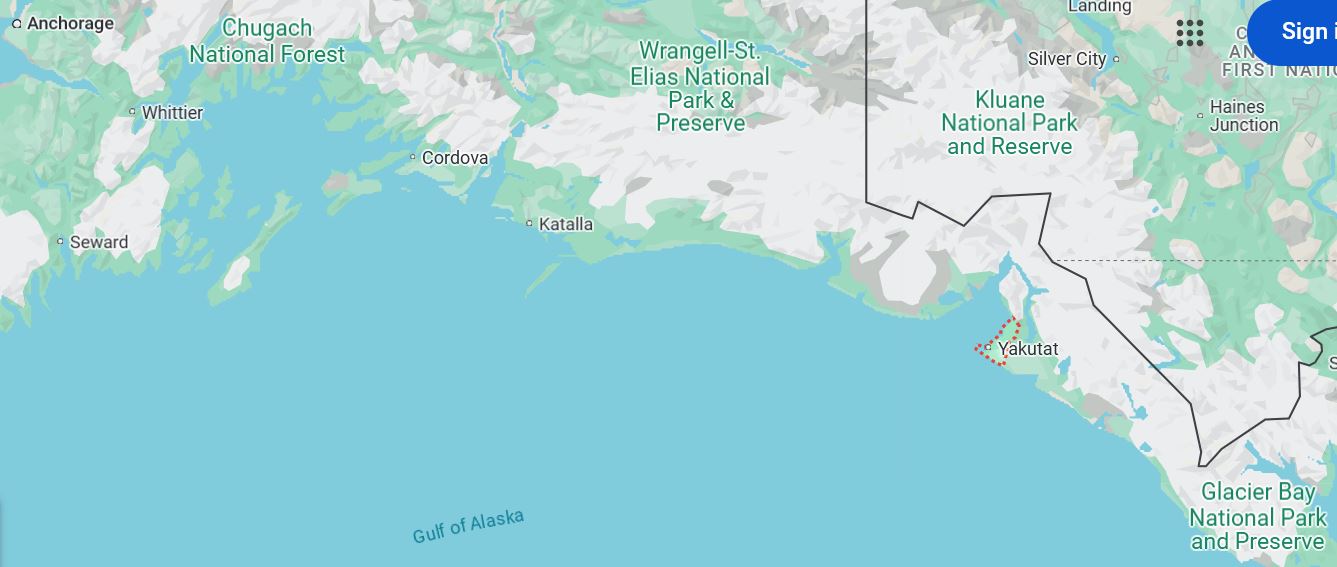
Yakutat is conveniently located between Anchorage and Glacier Bay National Park, 150 air miles west of Skagway.
You’ll be quite surprised at what some of these birds do when released after banding.

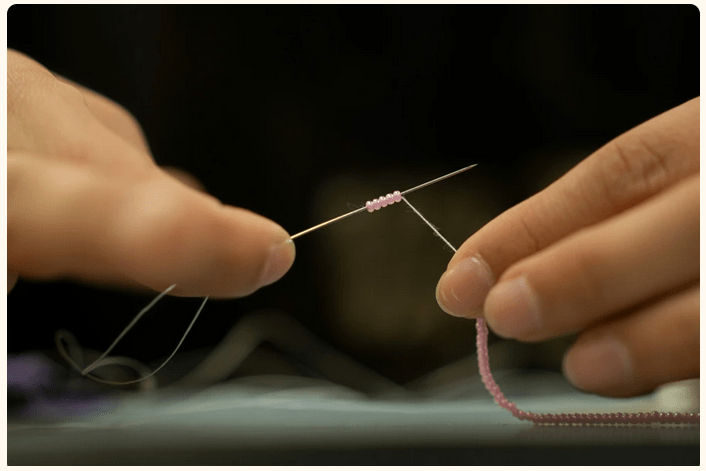
At the 2024 festival, featured artist Chantil Bremner-Firestack taught the kids traditional Tlingit beading using the two-needle applique method her grandmother taught her.
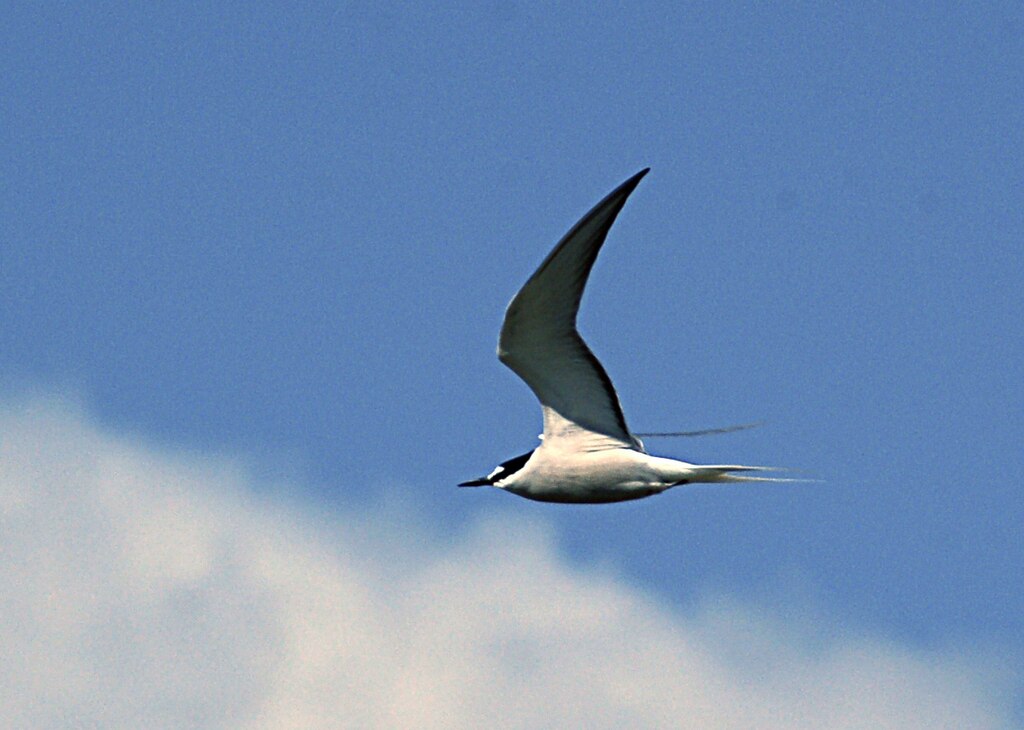
And of course Aleutian Terns. Yakutat is the site of the largest and southernmost known Aleutian Tern nesting colony, according to the Forest Service. In May and June, these annoyingly elusive seabirds can be seen by the hundreds (not a large number for a seabird colony) along Blacksand Spit, a barrier island in the Tongass near Yakutat.
Of approximately 31,000 Aleutian Terns worldwide (which means around the Bering Sea and Gulf of Alaska), 18% breed in Alaska (5,500 birds in 111 colonies), especially the Aleutians, the rest in Siberia. Their numbers seem be declining, no one knows why. Their wintering range is “poorly known”, but is believed to lie off Indonesia and Malaysia. They regularly appear off Hong Kong in the fall, suggesting a possible route for southbound migrants. Small flocks are sighted near the coast of Hong Kong in spring and fall, Singapore and Indonesia October to April, and Java, Bali and Sulawesi in December. It’s the only species in the Onychoprion genus that migrates between a subarctic breeding zone and tropical waters of the South Pacific.
Don’t assume Aleutian Terns are easy to find once you get to Alaska or even the Aleutians, despite the existence of 111 breeding colonies. I know people who have cruised and avidly birded around Nome, St. Lawrence Island, the Aleutians and Pribelofs between Nome and Anchorage for several weeks in June and never saw an Aleutian Tern.



 SANTA MONICA BAY AUDUBON SOCIETY BLOG