Free email delivery
Please sign up for email delivery in the subscription area to the right.
No salesman will call, at least not from us. Maybe from someone else.
Least Terns at Malibu Lagoon
Here’s a message from Stacey Vigallon at the LAAS Least Tern HQ:

Terrifically cute Least Tern chick
We had some exciting weeks at Malibu Lagoon with Least Terns attempting to nest in the Snowy Plover enclosure in late May and early June. This was the first known nesting at the lagoon since 1940! Though it looks like the Least Terns have moved on from Malibu, we’d still love your help with keeping eyes on the beach periodically at this site. There are still about two months in the nesting season, so anything could happen!
In the past, Least Terns who fledged young at other colonies have brought their families to Malibu Lagoon just before heading back to Mexico and South America. If you’ll be birding Malibu Lagoon (or know people who will be birding this site) in the coming summer months, please let us know if you see any Least Terns. We’re coordinating with management agencies to monitor this area, and any information you could provide this summer would be extremely helpful.
Please contact the Los Angeles Audubon Volunteer Coordinator at 323 481 4037 or tern@laaudubon.org. Thank you!
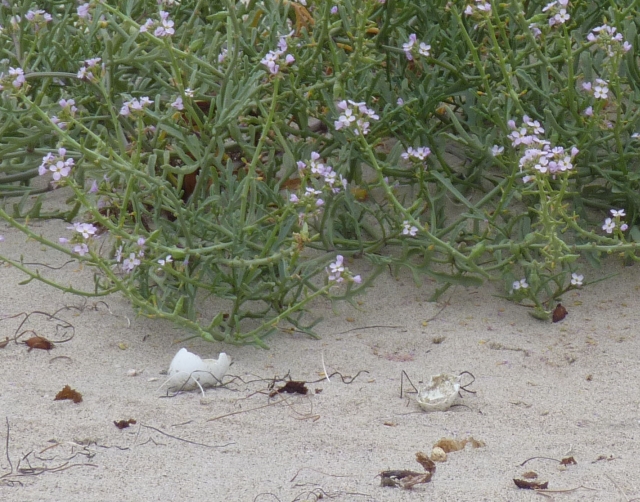
Broken egg found within enclosure may – or may not – have been a Least Tern egg (A Albaisa 6/14/13)
Plover Welcome To Be Improved
After a meeting at the site of the Western Snowy Plover roost on Santa Monica’s north beach, City officials agreed today in principal to try to erect the protective and educational fencing for the birds in July rather than in September or October. This represents major progress in the protection of those little birds who usually arrive on “our” shores in mid-July and stay until late April most years.
The observed number of birds in the flock has grown over the 13 seasons we have monitored this area near the Annenberg Community Beach House along Santa Monica’s Gold Coast. In the first survey, coordinated by our own Chuck Almdale in 2001, I was elated to find two plovers. Since then, because of the protection afforded by the City’s fencing and the greater proliferation of the species at Central California breeding beaches, we have observed up to 56 birds in a typically loose flock at or near the enclosure. The plovers are spending 39 to 44 weeks on these local L.A. County beaches. The coastal population of the species is around 10,000 birds and it is listed as “threatened” under the Endangered Species Act.

(above, a banded Snowy Plover on Santa Monica Beach , 2010 LP photo)
Even though the plovers have not bred on an L.A. County beach for nearly 60 years, they spend up to 84% of their lives here. Researchers have started turning their attention to the survival of the birds in their “wintering” habitat. Erection of the snow fencing on Santa Monica Beach at the time of their arrival, when they have lost considerable weight in migration, should result in reduced human harassment, healthier birds, and we hope, a higher over-wintering survival rate.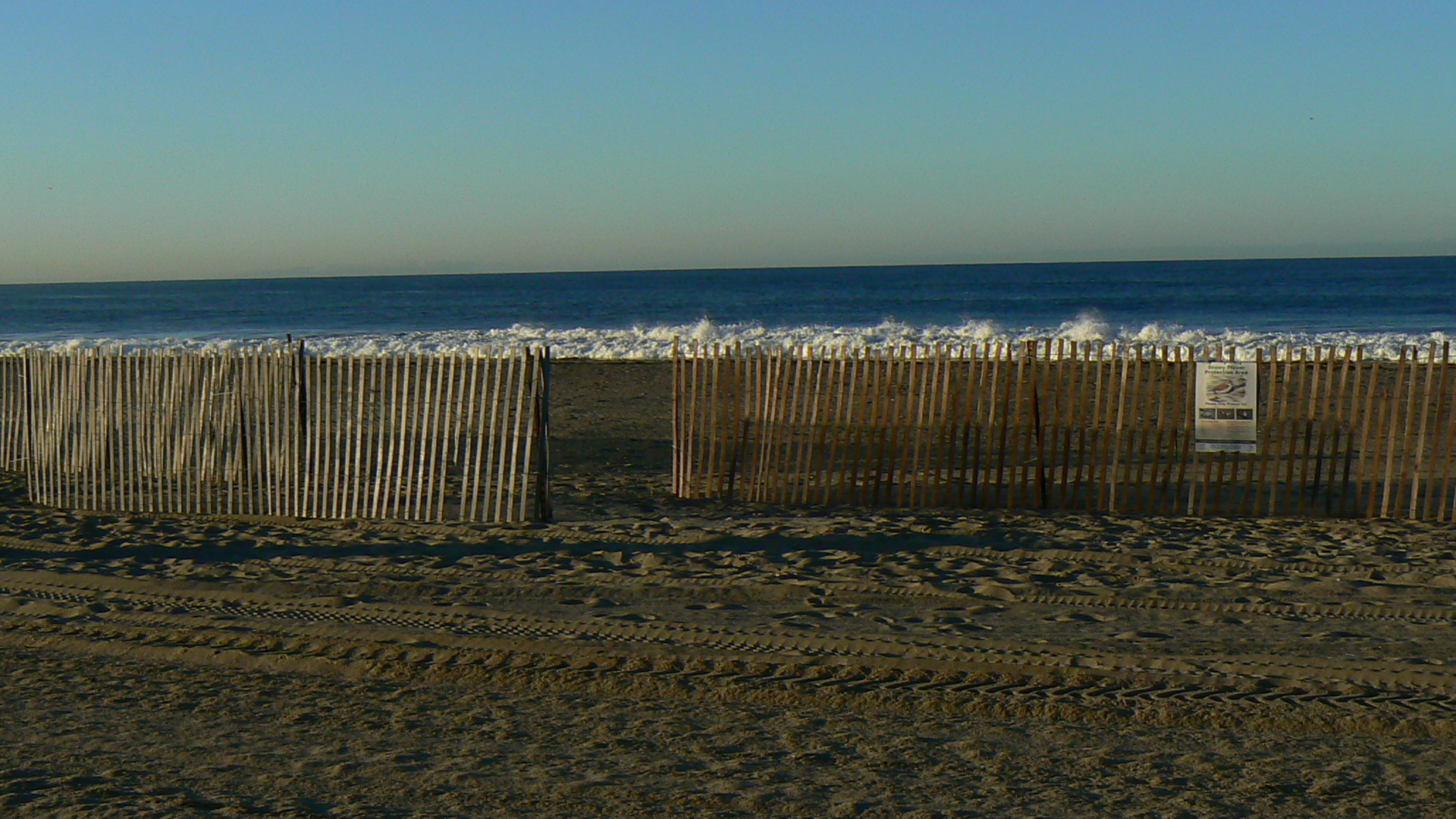
Our thanks to the City of Santa Monica will take the form of an SMBAS subsidy for fencing material for the next ten years. If you wish to contribute to the effort, please send your check payable to SMBAS to our P.O. Box with the mention “plovers”.
Lu Plauzoles Co-chair, Conservation
Local Urban Birdlife observations
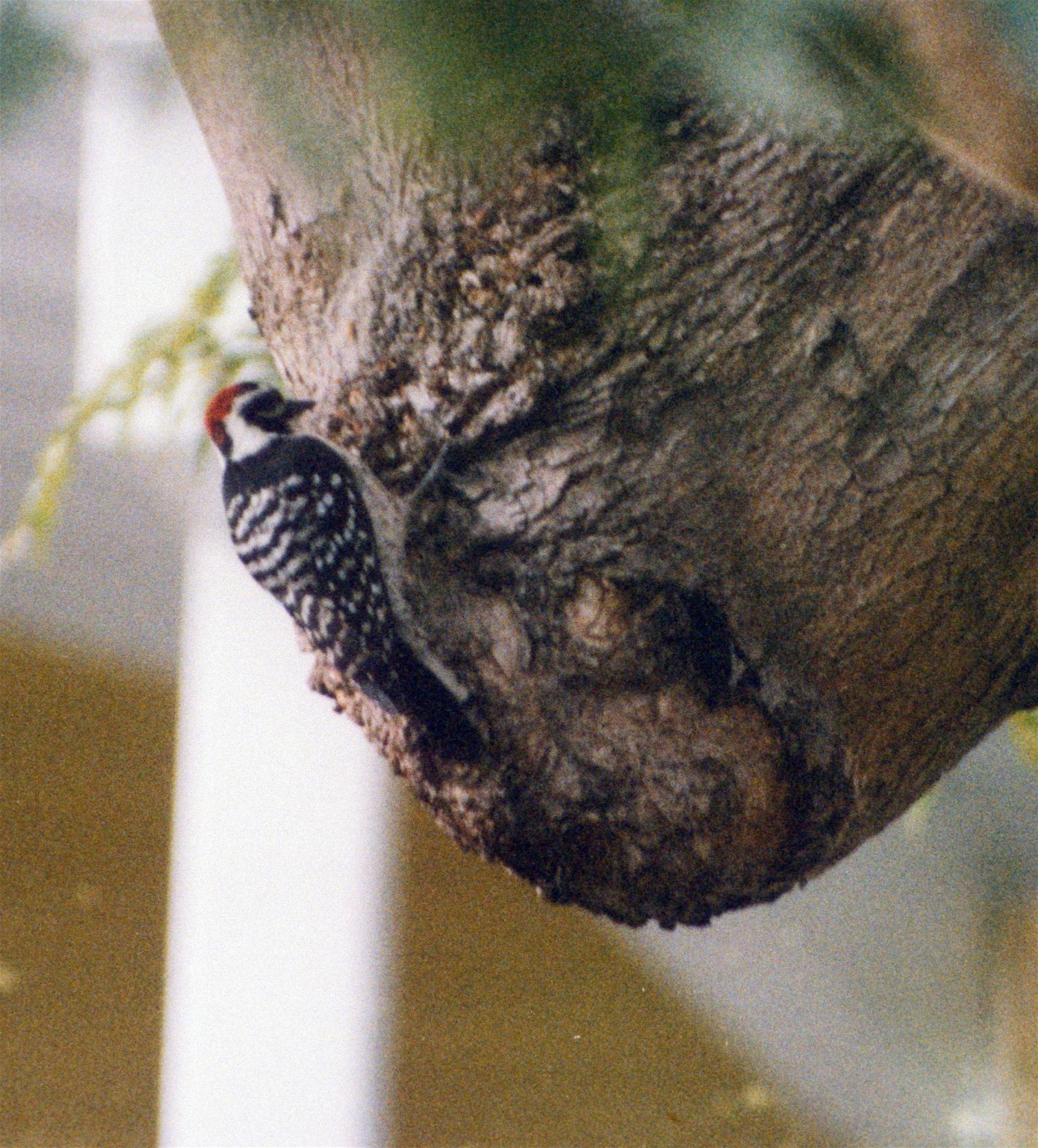
Tis the season for nesting, and in my neighborhood we have a lot to celebrate this year! The Cedar Waxwing flocks hadn’t flown north in late May before we started seeing young Song Sparrows, followed by young Crows (boo!), and Oak Titmice (is that a legit plural of Titmouse?). But this week gives us even more to celebrate. From the tag-along behavior I’ve observed we probably have Nuttall’s a n d Downy Woodpecker families in the neighborhood! And last week I spotted a Cooper’s Hawk nest in the tall eucalyptus on 7th Street ( above the front yard at 702 7th. ) Dark-eyed Juncos are now common north of Montana from 4th to 14th Streets. Two weeks ago I observed immature and adult Western Bluebirds on Palisades Avenue near 4th Street. And when I posted notes in May about this diversity on L.A County Birds (the Yahoo! group) I received similar remarks from two other local birdwatchers within hours.
 How do we account for all these species that were not common at all 10 years ago in the same location? Global warming? Rampant development? Hardly. It is a sign of the maturing birder (that means white hair) that we take some local variations in stride. Some years there may be more of one species or less. We may alter our walking habits, even though I haven’t varied path nor time of my “patch” by much. And, …I think a lot has to do with the available habitat. I believe I’m in an urban forest that is reaching a level of maturity that encourages a number of native species to move from the wilder areas of the Santa Monica Mountains to our local back yards. I walk an area that is only half a mile from Santa Monica Canyon. As the urban forest of Santa Monica matures, it becomes more attractive to species which are cavity nesters (e.g. bluebirds, woodpeckers, owls) for example. Meanwhile, a number of species have diminished or disappeared in our very local landscape (Spotted Doves, Mourning Doves, Western Scrub-jays).
I recently became a member of the Santa Monica Urban Forest Task Force and I have become very conscious of the maturity of trees and what it implies in maintenance and replacement costs, not to mention public hazards. I now look on the trees of my neighborhood as much more than just perches and nesting sites for birds. Of course I still have a rational soft spot for native trees. If you have any comments about nests,birds, trees in your community, please post them here. I and probably a considerable number of our readers are eager to know what you think of your urban forest.
P.S. I’m eager to know if any of you have seen or heard our Barn Owls yet. This would be the fourth year in a row that they are present in the north end of Santa Monica. Listen for the screech at 9PM! Look at the birds flying over the bluffs of Palisade Park at dusk.
Lu Plauzoles, Co-chair Conservation SMBAS
Elementary: it starts from the ground up
A recent report from Walgrove Elementary School, located near the Santa Monica Airport. Their wildlands project is starting to bloom, literally! We’ll be helping with the fall planting schedule.
http://walgrovewildlands.com/2013/06/07/buckwheat-blooming-in-the-wildlands/
Malibu Lagoon Field Trip Report: 26 May, 2013
The plants of the new reconfigured Malibu Lagoon were starting to green the dunes and islands and we were pleased that there was some “June Gloom” cloud cover to cool us as we birded the late spring birds. The beach berm had breached on May 16 (naturally or human-assisted? – debate continues), and the lagoon water level was so low that the recently-inaugurated “Tidal Clock” was dry. Actually, the Lagoon was mimicking natural conditions as it would be drying at this season were it not from runoff from the Calabasas and Malibu hill residents. The
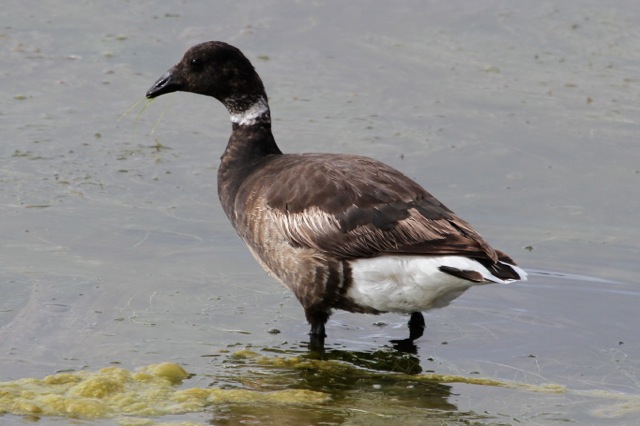
This Brant should have migrated north by now (J. Waterman 5/26/13)
Brant was still present in the lagoon and we spotted a solitary Snowy Plover who hadn’t decided to migrate north to the Central California coast, nor south to Bolsa Chica in Orange County. The area on the right hand side of the path to the beach was a source of worry to many old hands of SMBAS as it seems to be growing ragweed and pepperweed, among other invasive plants. The good news is that State Parks is well aware of the situation, but unluckily, they did not budget for exceptional early-growth weeding.
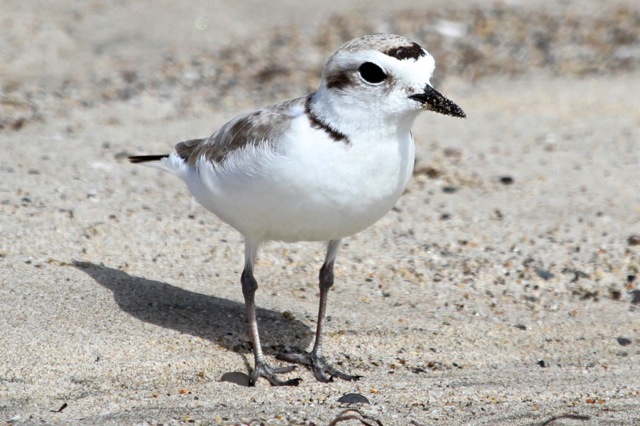
This Snowy Plover has an extremely thin black neck bar!
(J. Waterman 5/26/13)
A few days later, Least Terns were discovered nesting in the Snowy Plover enclosure, although they were not seen on 5/26. Eggs were present and mated birds were courting each other with gifts of small fish. State Parks rushed in additional fencing, volunteer observers were found and deployed. Unfortunately, the local American Crows also found the eggs and ate them all. This was the first known nesting attempt for the Endangered Least Terns since 1940. It’s possible that they may try later this season, and probable they will try in future years, as long as there is an area, like the enclosure, where people won’t go. Crows, unfortunately, follow no such rules, which is the reason they are a major barrier to the recovery of this species.
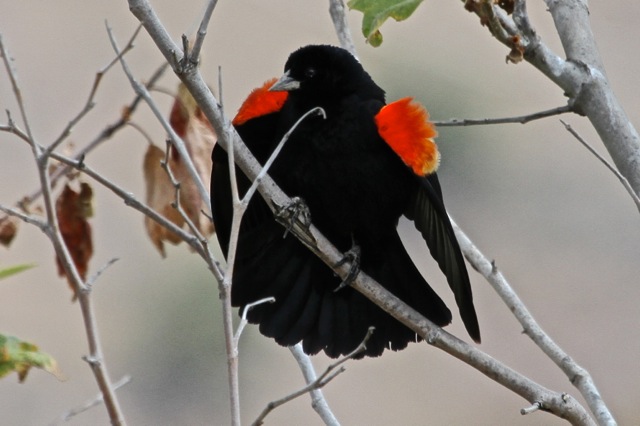
Male Red-winged Blackbird in full breeding display
(J. Waterman 5/26/13)
Even though your Board had thought that the Lagoon site was insufficiently grown and settled to welcome a picnic this year, there are some celebratory diehards who will be bringing and sharing goodies to the June birdwalk. All are free to join them after the walk at the picnic tables at the beach path’s left turn. [Lucien Plauzoles]
Our next three field trips: Malibu Lagoon, 23 June, 8:30am; Mt. Piños Birds & Butterflies, 29-30 June; Malibu Lagoon, 28 July, 8:30am.
Our next program: Tuesday, 1 Oct., 7:30 pm. To be announced, as usual, from the blog.
NOTE: Our 10 a.m. Parent’s & Kids Birdwalks have resumed.
Links: Unusual birds at Malibu Lagoon
Aerial photo of Malibu Lagoon from 9/23/02.
Prior checklists: July-Dec’11, Jan-June’11, July-Dec ’10, Jan-June ’10, Jul-Dec ‘09, and Jan-June ‘09.
Comments on Bird Lists Below
Total Birds: May total birds of 322 are 37% below the 6-year average; low numbers are mainly in the Ducks (-27), Brown Pelicans (-123), Coots (-16) and Passerines (-34), mostly in Starlings, no great loss there.
Summary of total birds from the 6-year average so far: June +36%, July -9%, Aug. -9%, Sep. +12%, Oct. +3%, Nov -5%, Dec +30%, Jan -20%, Feb -29%, March -30%, April -34%, May -37%. Increasingly downward.
Species Diversity: May 2013 with 46 species was 3.4% above the 44.5 6-year average, a minor variance.
Summary of species diversity from the 6-year average so far: June -10%, July +10%, Aug. -6%, Sep. -20%, Oct. +5%, Nov +2%, Dec -4%, Jan +2%, Feb -8%, March +9%, April -2%, May +3%.
10-year comparison summaries are available on our Lagoon Project Bird Census Page. [Chuck Almdale]
| Malibu Census | 2008 | 2009 | 2010 | 2011 | 2012 | 2013 | |
| 2008 – 2013 | 5/25 | 5/24 | 5/23 | 5/22 | 5/27 | 5/26 | |
| Temperature | 65-70 | 54-62 | 68-72 | ||||
| Tide Lo/Hi Height | L +0.1 | H +3.7 | H +3.76 | L -0.13 | L +0.38 | H +4.08 | Ave. |
| Tide Time | 0801 | 1042 | 0638 | 0816 | 0844 | 1138 | Birds |
| Brant | 4 | 7 | 1 | 2.0 | |||
| Gadwall | 8 | 12 | 12 | 3 | 5 | 2 | 7.0 |
| Mallard | 20 | 20 | 18 | 48 | 32 | 5 | 23.8 |
| Northern Shoveler | 1 | 0.2 | |||||
| Surf Scoter | 9 | 1.5 | |||||
| Red-brstd Merganser | 2 | 0.3 | |||||
| Ruddy Duck | 1 | 2 | 3 | 1.0 | |||
| Pacific Loon | 1 | 5 | 1.0 | ||||
| Common Loon | 2 | 0.3 | |||||
| Pied-billed Grebe | 3 | 2 | 3 | 3 | 1.8 | ||
| Western Grebe | 1 | 0.2 | |||||
| Brandt’s Cormorant | 5 | 1 | 1.0 | ||||
| Dble-crstd Cormorant | 5 | 28 | 7 | 46 | 15 | 9 | 18.3 |
| Pelagic Cormorant | 1 | 0.2 | |||||
| Brown Pelican | 231 | 70 | 124 | 81 | 265 | 7 | 129.7 |
| Great Blue Heron | 2 | 1 | 2 | 1 | 3 | 2 | 1.8 |
| Great Egret | 4 | 4 | 2 | 3 | 3 | 2.7 | |
| Snowy Egret | 9 | 7 | 12 | 3 | 14 | 3 | 8.0 |
| Green Heron | 1 | 0.2 | |||||
| Blk-crwnd N-Heron | 10 | 2 | 3 | 1 | 2.7 | ||
| Osprey | 1 | 1 | 0.3 | ||||
| White-tailed Kite | 1 | 0.2 | |||||
| Cooper’s Hawk | 1 | 0.2 | |||||
| Red-tailed Hawk | 1 | 1 | 1 | 0.5 | |||
| Peregrine Falcon | 1 | 0.2 | |||||
| American Coot | 6 | 32 | 8 | 25 | 30 | 1 | 17.0 |
| Blk-bellied Plover | 3 | 22 | 4.2 | ||||
| Snowy Plover | 1 | 0.2 | |||||
| Semipalmated Plover | 2 | 0.3 | |||||
| Killdeer | 1 | 1 | 4 | 2 | 3 | 6 | 2.8 |
| Willet | 4 | 0.7 | |||||
| Whimbrel | 4 | 1 | 20 | 1 | 4.3 | ||
| Marbled Godwit | 1 | 0.2 | |||||
| Black Turnstone | 1 | 0.2 | |||||
| Boneparte’s Gull | 2 | 1 | 1 | 0.7 | |||
| Heermann’s Gull | 1 | 20 | 17 | 15 | 35 | 14.7 | |
| Ring-billed Gull | 2 | 1 | 2 | 16 | 1 | 3.7 | |
| Western Gull | 56 | 65 | 68 | 10 | 85 | 22 | 51.0 |
| California Gull | 1 | 95 | 8 | 4 | 1 | 18.2 | |
| Glaucous-wingd Gull | 1 | 1 | 0.3 | ||||
| Caspian Tern | 61 | 15 | 25 | 4 | 6 | 2 | 18.8 |
| Royal Tern | 1 | 2 | 5 | 5 | 2.2 | ||
| Elegant Tern | 23 | 40 | 9 | 12 | 35 | 121 | 40.0 |
| Black Skimmer | 2 | 0.3 | |||||
| Rock Pigeon | 2 | 6 | 6 | 8 | 2 | 4.0 | |
| Eur. Collared-Dove | 1 | 0.2 | |||||
| Mourning Dove | 4 | 6 | 1 | 2 | 5 | 3.0 | |
| White-throated Swift | 2 | 0.3 | |||||
| Anna’s Hummingbird | 2 | 2 | 1 | 1 | 2 | 1 | 1.5 |
| Allen’s Hummingbird | 8 | 6 | 4 | 5 | 1 | 4.0 | |
| Belted Kingfisher | 1 | 0.2 | |||||
| Pac.Slope Flycatcher | 1 | 0.2 | |||||
| Black Phoebe | 6 | 12 | 10 | 4 | 13 | 2 | 7.8 |
| Say’s Phoebe | 1 | 0.2 | |||||
| American Crow | 4 | 6 | 4 | 3 | 5 | 3 | 4.2 |
| Common Raven | 1 | 2 | 0.5 | ||||
| Rough-wingd Swallow | 10 | 10 | 1 | 2 | 1 | 4.0 | |
| Violet-green Swallow | 2 | 1 | 1 | 0.7 | |||
| Barn Swallow | 6 | 1 | 8 | 8 | 2 | 6 | 5.2 |
| Cliff Swallow | 40 | 12 | 12 | 31 | 12 | 14 | 20.2 |
| Oak Titmouse | 1 | 0.2 | |||||
| Bushtit | 20 | 4 | 4 | 10 | 6.3 | ||
| Bewick’s Wren | 1 | 0.2 | |||||
| Wrentit | 1 | 0.2 | |||||
| Northern Mockingbird | 5 | 6 | 4 | 2 | 6 | 3 | 4.3 |
| European Starling | 20 | 2 | 3 | 40 | 45 | 3 | 18.8 |
| Cedar Waxwing | 32 | 5.3 | |||||
| Common Yellowthroat | 2 | 2 | 3 | 1.2 | |||
| Spotted Towhee | 1 | 2 | 0.5 | ||||
| California Towhee | 1 | 5 | 1 | 1 | 1 | 1.5 | |
| Song Sparrow | 2 | 8 | 10 | 4 | 12 | 8 | 7.3 |
| Red-winged Blackbird | 6 | 4 | 2 | 10 | 9 | 5.2 | |
| Brewer’s Blackbird | 2 | 0.3 | |||||
| Great-tailed Grackle | 4 | 16 | 2 | 4 | 4.3 | ||
| Brwn-headed Cowbird | 2 | 1 | 3 | 1 | 1.2 | ||
| Hooded Oriole | 4 | 1 | 1 | 1.0 | |||
| Bullock’s Oriole | 2 | 1 | 1 | 0.7 | |||
| House Finch | 3 | 8 | 6 | 8 | 8 | 3 | 6.0 |
| Lesser Goldfinch | 2 | 1 | 2 | 4 | 1.5 | ||
| House Sparrow | 5 | 0.8 | |||||
| Totals by Type | 5/25 | 5/24 | 5/23 | 5/22 | 5/27 | 5/26 | Ave. |
| Waterfowl | 38 | 38 | 37 | 51 | 42 | 9 | 36 |
| Water Birds-Other | 252 | 132 | 148 | 152 | 313 | 20 | 170 |
| Herons, Egrets | 25 | 13 | 16 | 6 | 23 | 9 | 15 |
| Raptors | 1 | 1 | 1 | 3 | 0 | 2 | 1 |
| Shorebirds | 1 | 5 | 5 | 5 | 51 | 10 | 13 |
| Gulls & Terns | 148 | 144 | 216 | 51 | 151 | 189 | 150 |
| Doves | 2 | 10 | 12 | 9 | 5 | 5 | 7 |
| Other Non-Pass. | 4 | 10 | 7 | 5 | 8 | 2 | 6 |
| Passerines | 139 | 79 | 106 | 131 | 127 | 76 | 110 |
| Totals Birds | 610 | 432 | 548 | 413 | 720 | 322 | 508 |
| 2008 | 2009 | 2010 | 2011 | 2012 | 2013 | ||
| Total Species | 5/25 | 5/24 | 5/23 | 5/22 | 5/27 | 5/26 | Ave. |
| Waterfowl | 4 | 4 | 3 | 2 | 4 | 4 | 3.5 |
| Water Birds-Other | 6 | 5 | 7 | 3 | 4 | 4 | 4.8 |
| Herons, Egrets | 4 | 4 | 3 | 3 | 4 | 4 | 3.7 |
| Raptors | 1 | 1 | 1 | 3 | 0 | 2 | 1.3 |
| Shorebirds | 1 | 2 | 2 | 2 | 6 | 4 | 2.8 |
| Gulls & Terns | 9 | 7 | 6 | 6 | 7 | 8 | 7.2 |
| Doves | 1 | 2 | 2 | 2 | 3 | 1 | 1.8 |
| Other Non-Pass. | 2 | 2 | 2 | 2 | 3 | 2 | 2.2 |
| Passerines | 19 | 16 | 19 | 16 | 16 | 17 | 17.2 |
| Totals Species | 47 | 43 | 45 | 39 | 47 | 46 | 44.5 |



 SANTA MONICA BAY AUDUBON SOCIETY BLOG