Free email delivery
Please sign up for email delivery in the subscription area to the right.
No salesman will call, at least not from us. Maybe from someone else.
Malibu Lagoon Field Trip Report: 28 April, 2013
A foggy morning at the lagoon, outlet closed, the water high, colored flags marking the small plants, an occasional unflagged weed and, frankly, not many birds. See the charts below and on our Lagoon Project Page for the statistics.
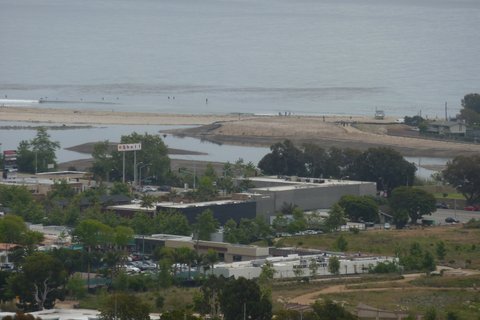
Channel area view from Las Virgenes Rd. (L. Plauzoles 04/13/13)
The ducks are dwindling as springtime calls them north. It was an off day for the shorebirds, with only five “peeps” present: two Western Sandpipers, a single Ruddy Turnstone, two Spotted Sandpipers now sporting breeding breast-spots. The gulls continue to be fewer than average: we didn’t find any Ring-bills among the few California and Western Gulls, but Heermann’s, absent since January, begin to return from their breeding grounds on islands near the tip of Baja California. A single Clark’s Grebe was out past the kelp with a small group of Western Grebes.

“Elegant, my foot! He tries that with me, Marge, and he’s going to be the least tern you ever saw.” (C.Bragg 2011)
The Elegant Terns returned, resting en route to breeding grounds farther north. They looked great and they knew it, breasts rosy from a crustacean diet, with fine black crests. Many attempted mating. A Black-crowned Night Heron hid in the trees by the Adamson House beach fence, a White-tailed Kite searched the perimeter, eight Semipalmated Plovers combed the beach wrack, two Black Oystercatchers worked the low-tide rocks, six Caspian and three Royal Terns kept the cacophonous Elegant Terns company, and a young male Hooded Oriole – yellow, not orange – was a nice treat near the picnic table corner.
The tidal clock was working – 8 ft. 4 in. was the time, I think. A good high tide with some wave action may well open an outlet near Adamson House.
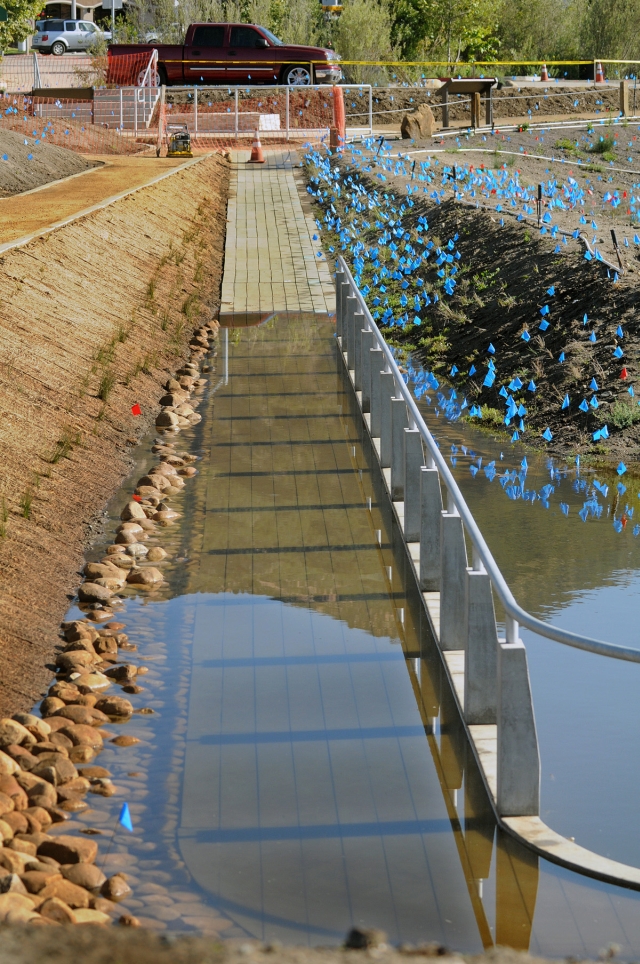
Tidal Clock at work, ticking away (J. Kenney 4/16/13)
Our next three field trips: Morongo Valley Preserve, 4-5 May; Malibu Lagoon, 26 May, 8:30am; Malibu Lagoon, 23 June, 8:30am.
Our next program: Tuesday, 7 May., 7:30 pm. Eight-legged Science: The Spider Lab at Loyola Marymount University, with Dr. Martin Ramirez. The usual reminders will be emailed from the blog.
NOTE: Our 10 a.m. Parent’s & Kids Birdwalks have resumed.
Links: Unusual birds at Malibu Lagoon
Aerial photo of Malibu Lagoon from 9/23/02.
Prior checklists: July-Dec’11, Jan-June’11, July-Dec ’10, Jan-June ’10, Jul-Dec ‘09, and Jan-June ‘09.
Comments on Bird Lists Below
Total Birds: March total birds of 666 are 34% below average; low numbers are mainly in the Brown Pelicans (-158) and Gulls & Terns (-197).
Species Diversity: April 2013 with 56 species was 2% below the 57.2 6-year average, a minor variance.
Summary of species diversity from the 6-year average so far: June -10%, July +10%, Aug. -6%, Sep. -20%, Oct. +5%, Nov +2%, Dec -4%, Jan +2%, Feb -8%, March +9%, April -2%. Still, the only constant is change.
10-year comparison summaries are available on our Lagoon Project Bird Census Page. [Chuck Almdale]
| 2008 | 2009 | 2010 | 2011 | 2012 | 2013 | ||
| 27-Apr | 26-Apr | 25-Apr | 24-Apr | 22-Apr | 28-Apr | ||
| Temperature | 75-90 | 60-70 | 62-70 | 59-68 | 60-65 | 57-68 | |
| Tide Lo/Hi Height | L +0.5 | H +3.7 | H +4.57 | L +0.19 | H +3.67 | L -1.10 | Ave. |
| Tide Time | 1000 | 1128 | 0744 | 1014 | 1106 | 0609 | Birds |
| Brant | 1 | 3 | 3 | 1.2 | |||
| Gadwall | 15 | 6 | 12 | 24 | 14 | 12 | 13.8 |
| American Wigeon | 4 | 9 | 2.2 | ||||
| Mallard | 25 | 16 | 20 | 22 | 16 | 30 | 21.5 |
| Northern Shoveler | 12 | 2.0 | |||||
| Surf Scoter | 30 | 5.0 | |||||
| Red-brstd Merganser | 4 | 3 | 5 | 3 | 2.5 | ||
| Ruddy Duck | 10 | 3 | 9 | 20 | 7.0 | ||
| Pacific Loon | 2 | 2 | 4 | 20 | 3 | 1 | 5.3 |
| Common Loon | 1 | 3 | 1 | 0.8 | |||
| Pied-billed Grebe | 4 | 4 | 1 | 2 | 6 | 2.8 | |
| Eared Grebe | 6 | 2 | 1.3 | ||||
| Western Grebe | 50 | 35 | 2 | 1 | 28 | 19.3 | |
| Brandt’s Cormorant | 8 | 1 | 3 | 1 | 7 | 3.3 | |
| Dble-crstd Cormorant | 25 | 14 | 22 | 19 | 65 | 22 | 27.8 |
| Pelagic Cormorant | 2 | 1 | 1 | 2 | 1 | 1.2 | |
| Brown Pelican | 35 | 78 | 182 | 740 | 80 | 34 | 191.5 |
| Great Blue Heron | 2 | 1 | 4 | 1 | 2 | 1.7 | |
| Great Egret | 2 | 2 | 2 | 2 | 1.3 | ||
| Snowy Egret | 8 | 7 | 13 | 11 | 9 | 9 | 9.5 |
| Blk-crwnd N-Heron | 1 | 1 | 1 | 1 | 0.7 | ||
| Red-tailed Hawk | 1 | 2 | 0.5 | ||||
| Sora | 1 | 1 | 1 | 0.5 | |||
| American Coot | 65 | 38 | 35 | 32 | 95 | 58 | 53.8 |
| Blk-bellied Plover | 30 | 7 | 11 | 8.0 | |||
| Snowy Plover | 1 | 3 | 6 | 1.7 | |||
| Semipalmated Plover | 15 | 15 | 13 | 25 | 3 | 8 | 13.2 |
| Killdeer | 4 | 2 | 4 | 8 | 4 | 2 | 4.0 |
| Black-necked Stilt | 4 | 0.7 | |||||
| Spotted Sandpiper | 1 | 3 | 3 | 1 | 2 | 1.7 | |
| Willet | 4 | 4 | 1 | 1 | 1.7 | ||
| Whimbrel | 1 | 6 | 5 | 3 | 5 | 8 | 4.7 |
| Marbled Godwit | 10 | 4 | 8 | 3.7 | |||
| Ruddy Turnstone | 5 | 25 | 2 | 1 | 1 | 5.7 | |
| Black Turnstone | 1 | 2 | 0.5 | ||||
| Surfbird | 3 | 0.5 | |||||
| Western Sandpiper | 15 | 10 | 12 | 16 | 2 | 9.2 | |
| Least Sandpiper | 4 | 2 | 30 | 25 | 5 | 11.0 | |
| Boneparte’s Gull | 5 | 2 | 1.2 | ||||
| Heermann’s Gull | 3 | 1 | 45 | 3 | 1 | 14 | 11.2 |
| Ring-billed Gull | 8 | 4 | 4 | 52 | 20 | 14.7 | |
| Western Gull | 35 | 85 | 105 | 160 | 85 | 112 | 97.0 |
| California Gull | 65 | 6 | 108 | 450 | 75 | 25 | 121.5 |
| Glaucous-wingd Gull | 3 | 1 | 2 | 1 | 3 | 1.7 | |
| Caspian Tern | 13 | 41 | 30 | 61 | 25 | 6 | 29.3 |
| Forster’s Tern | 2 | 1 | 0.5 | ||||
| Royal Tern | 4 | 2 | 1 | 3 | 1.7 | ||
| Elegant Tern | 245 | 700 | 40 | 12 | 65 | 134 | 199.3 |
| Rock Pigeon | 6 | 4 | 4 | 4 | 3 | 12 | 5.5 |
| Mourning Dove | 2 | 2 | 6 | 4 | 2 | 2 | 3.0 |
| Anna’s Hummingbird | 2 | 1 | 2 | 2 | 2 | 1 | 1.7 |
| Allen’s Hummingbird | 3 | 4 | 3 | 2 | 2 | 4 | 3.0 |
| Black Phoebe | 6 | 10 | 10 | 8 | 4 | 7 | 7.5 |
| American Crow | 4 | 5 | 4 | 5 | 5 | 4 | 4.5 |
| Rough-wingd Swallow | 4 | 3 | 10 | 16 | 6 | 10 | 8.2 |
| Barn Swallow | 8 | 4 | 2 | 10 | 1 | 6 | 5.2 |
| Cliff Swallow | 20 | 4 | 2 | 4.3 | |||
| Bushtit | 6 | 2 | 6 | 2 | 4 | 3.3 | |
| Bewick’s Wren | 2 | 1 | 1 | 0.7 | |||
| Northern Mockingbird | 4 | 1 | 2 | 2 | 2 | 5 | 2.7 |
| European Starling | 6 | 6 | 4 | 4 | 4 | 4.0 | |
| Cedar Waxwing | 20 | 3.3 | |||||
| Yellow-rumpd Warbler | 2 | 4 | 1.0 | ||||
| Common Yellowthroat | 1 | 2 | 6 | 3 | 2.0 | ||
| Spotted Towhee | 1 | 1 | 4 | 1.0 | |||
| California Towhee | 3 | 2 | 0.8 | ||||
| Song Sparrow | 8 | 6 | 12 | 10 | 8 | 15 | 9.8 |
| Red-winged Blackbird | 2 | 1 | 1 | 6 | 1.7 | ||
| Great-tailed Grackle | 1 | 2 | 8 | 5 | 2.7 | ||
| Brwn-headed Cowbird | 1 | 2 | 1 | 2 | 1.0 | ||
| House Finch | 6 | 4 | 6 | 10 | 6 | 8 | 6.7 |
| Lesser Goldfinch | 2 | 1 | 2 | 0.8 | |||
| Totals by Type | 27-Apr | 26-Apr | 25-Apr | 24-Apr | 22-Apr | 28-Apr | Ave. |
| Waterfowl | 74 | 37 | 38 | 51 | 65 | 68 | 56 |
| Water Birds-Other | 200 | 138 | 284 | 820 | 250 | 160 | 309 |
| Herons, Egrets | 13 | 8 | 15 | 16 | 13 | 14 | 13 |
| Raptors | 0 | 2 | 0 | 3 | 1 | 1 | 1 |
| Shorebirds | 52 | 109 | 73 | 74 | 63 | 32 | 67 |
| Gulls & Terns | 373 | 844 | 339 | 743 | 272 | 297 | 478 |
| Doves | 9 | 6 | 10 | 9 | 5 | 14 | 9 |
| Other Non-Pass. | 6 | 5 | 5 | 4 | 4 | 5 | 5 |
| Passerines | 80 | 53 | 92 | 83 | 60 | 75 | 74 |
| Totals Birds | 807 | 1202 | 856 | 1803 | 733 | 666 | 1011 |
| 2008 | 2009 | 2010 | 2011 | 2012 | 2013 | ||
| Total Species | 27-Apr | 26-Apr | 25-Apr | 24-Apr | 22-Apr | 28-Apr | Ave. |
| Waterfowl | 4 | 5 | 4 | 4 | 6 | 5 | 4.7 |
| Water Birds-Other | 12 | 7 | 9 | 9 | 9 | 10 | 9.3 |
| Herons, Egrets | 4 | 2 | 2 | 3 | 4 | 4 | 3.2 |
| Raptors | 0 | 2 | 0 | 2 | 1 | 1 | 1.0 |
| Shorebirds | 11 | 12 | 11 | 6 | 12 | 9 | 10.2 |
| Gulls & Terns | 7 | 9 | 9 | 9 | 7 | 7 | 8.0 |
| Doves | 3 | 2 | 2 | 3 | 2 | 2 | 2.3 |
| Other Non-Pass. | 3 | 2 | 2 | 2 | 2 | 2 | 2.2 |
| Passerines | 17 | 15 | 18 | 17 | 15 | 16 | 16.3 |
| Totals Species | 61 | 56 | 57 | 55 | 58 | 56 | 57.2 |
The weather was nearly ideal for this tradition of more than 30 years – not too hot, too cold, nor windy. The starry nights were extraordinary, as usual, and for those not too sleepy to hear, punctuated with the hoots of Great Horned Owls and the warbles of little Western Screech-Owls. Sunday before daybreak, Common Poorwills called from the area of the old swimming pool at Axelson’s Creek and gulch.
We were much aware of the desiccation of foliage and shortage of spring flowers, but deep blue patches of tall Lupines could still be found, blooming bushes, amazing magenta flowers on Beavertail Cactus, a few Chia blooms and the remnants of Joshua Tree flowers which seemed to have hurried into the season to take advantage of what little rain had fallen.
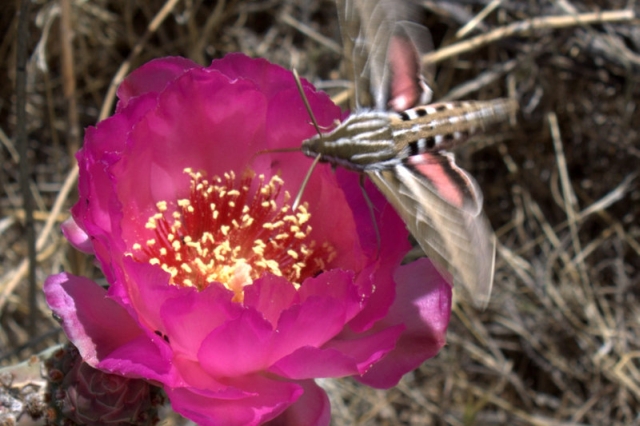
Sphinx Moth at Beavertail Cactus flower (R. Seidner 4/27/13)
Birds, however, were plentiful, and numerous moths and butterflies: Blues by the stream, scattered Ladies, were noted, and, most spectacularly, Hawk moths on blooming chaparral mimicking little hummingbirds.
Of all the birds, the leader’s favorite turned up Saturday at Sageland Ranch, our camp site, while we were lounging, reviewing our day’s findings, sitting by the pond and watching Black-headed Grosbeaks taking nectar in the blooming locust trees. There was activity at the blue bird nest box nearby which Keith had checked and found that one of five eggs had hatched. But, I complained that our count was missing Lazuli Buntings!

Fearless Leader Mary (R. Seidner 4/27/13)
Almost instantly, members scanning the dry grass clumps on the open area below called out, “It’s a Lazuli Bunting”! An amazing coincidence there, a beautiful male, gleaming azure, orange, white, riding grass stems for their seeds at the tips! That too, was totally unexpected behavior, since we traditionally have seen them after fires, and singing in trees.
The next morning, following Saturday night’s feasting and Birthday congratulations and wishes to our host, we hiked up Axelson’s beautiful creek for more birding, and, for some, to see the apiary on Dove Spring Road, well known by us for its Joshua Trees, nesting birds and very attractive campsite. The shock of finding it totally trashed by cattle was almost too much! In general, the whole Butterbredt upper canyon was also devastated by Cattle’s attempts to graze, largely due to the drought. There was literally no forage available for cattle. The ranchers were in the process of removing them, but damage done, and the cows’ fates sealed as they were being trucked away! Nevertheless, despite this downside, our weekend was a memorable and joyful one.
Follows is the list of bird sightings during the drive down and up Butterbredt Canyon RD, walking through the Sanctuary area, scouting along Kelso Valley Road and all the area around Sageland Ranch. It is amended by sightings of those who went farther and saw more. [Mary Prismon]

Butterbredt Spring gate (L. Johnson 4/26/13)
| Butterbredt Trip List | April 27-29, 2013 |
| Mountain Quail | Cactus Wren |
| California Quail | Ruby-crowned Kinglet |
| Chukar | Townsend’s Solitaire |
| Red-tailed Hawk | Hermit Thrush |
| Killdeer | Northern Mockingbird |
| Eurasian Collared-Dove | European Starling |
| Mourning Dove | Phainopepla |
| Western Screech-Owl | Orange-crowned Warbler |
| Common Poorwill | Nashville Warbler |
| Costa’s Hummingbird | Yellow Warbler |
| Rufous Hummingbird | Yellow-rumped Warbler |
| Ladder-backed Woodpecker | Black-throated Gray Warbler |
| Nuttall’s Woodpecker | Townsend’s Warbler |
| Northern Flicker | Wilson’s Warbler |
| Hammond’s Flycatcher | California Towhee |
| Dusky Flycatcher | Sage Sparrow |
| Pacific-slope Flycatcher | Fox Sparrow |
| Ash-throated Flycatcher | Lincoln’s Sparrow |
| Cassin’s Kingbird | White-crowned Sparrow |
| Western Kingbird | Golden-crowned Sparrow |
| Loggerhead Shrike | Western Tanager |
| Cassin’s Vireo | Lazuli Bunting |
| Warbling Vireo | Red-winged Blackbird |
| Common Raven | Brewer’s Blackbird |
| Bushtit | Hooded Oriole |
| Red-breasted Nuthatch | Bullock’s Oriole |
| White-breasted Nuthatch | Scott’s Oriole |
| Rock Wren | House Finch |
| Bewick’s Wren | Lesser Goldfinch |
| Total Species – 58 |
a
It’s Official!
Malibu Lagoon has it’s official opening ceremony on Friday, 3 May at 11 AM.
It was a long and often acrimonious process, but now little remains to be done except watch the plants grow.
Santa Monica Bay Audubon Society has long supported this project, and we have been especially invited to attend. California State Parks asked if we could have members with telescopes on hand to help attendees see and learn about the birds. We have a couple of volunteers so far, but we need more. How about you? The more birders we have on hand, the better.
To volunteer, send an email to: webinfo49 [at] att.net.
To simply attend, just come.
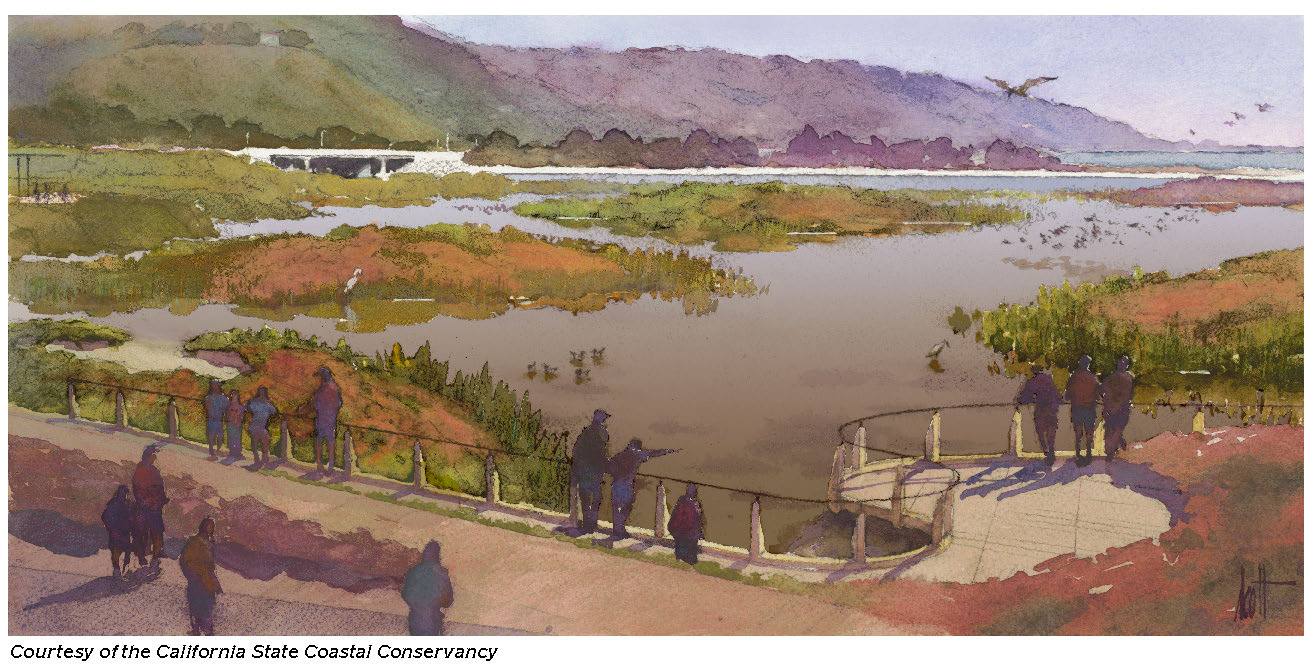
- The vegetation hasn’t grown back yet, but you get the idea. (RestoreMalibuLagoon . com)
Directions: Malibu Lagoon is at the intersection of Pacific Coast Highway and Cross Creek Road. Look around for people wearing binoculars. Parking in the official lagoon lot is $12+ or by annual pass. You may also park either along PCH west of Cross Creek Road, on Cross Creek Road, or on Civic Center Way north (inland) of the shopping center. Be careful – some parts of PCH are off-limits (read the signs carefully). Lagoon parking in the shopping center lot is not permitted.
Map to Meeting Place
Chuck Almdale]
Placerita Canyon Field Trip Report, April 13.
We had a good group (around 20) of birders for this trip. The weather was just about perfect too. The only exoskeletal life forms in the pomade were a couple of adults (with an enormous group of boy scouts) who were repairing a park kiosk with power tools. By power tools I mean a huge yellow pickup truck with an air compressor to drive the nail guns and so on. They managed to pack a dozen cars into the picnic area too. All this to fix about a dozen square feet of kiosk roof.
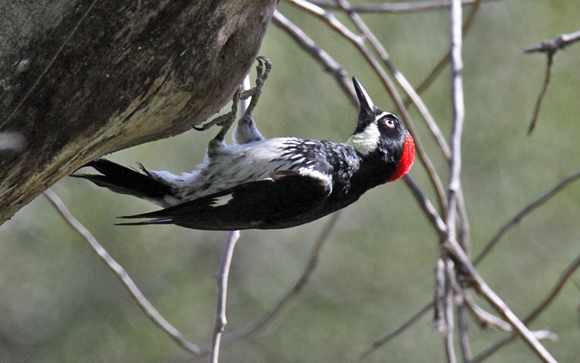
Acorn Woodpecker [Scott Baker]
Fortunately we were able to leave the noise behind as we went up the Waterfall Trail and the birds came out to see us. We had a lot of the usual suspects, foremost in number being Acorn Woodpeckers, followed closely by vocalizing House Wrens and Oak Titmice. The birds were apparently trying to drown out the people noise.
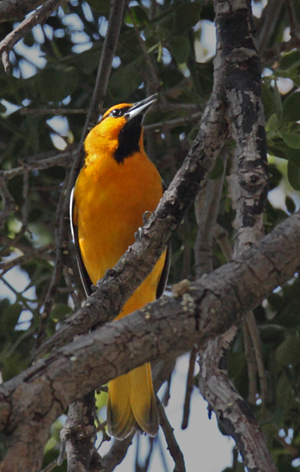
Bullock’s Oriole [Scott Baker]
The highlight of the walk had to be sighting 7 (seven!) different warblers! This is not the most you can see, but asking for more on one trip is just rude. We had to search carefully because most of them were Yellow-rumps, and one flitting warbler looks a lot like another until you pay attention. The biggest surprise was probably the Hermit Warbler – a gorgeous male in full breeding plumage. Those of us partial to Townsend’s Warblers had to wait until nearly the end of the trip to find one, and it was the lucky seventh species.
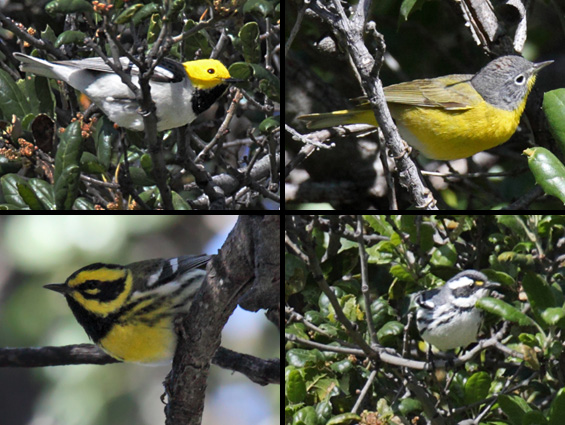
Warbler Collage. Clockwise from upper left: Hermit, Nashville, Black-throated Grey, Townsend’s [Scott
Baker]
After the walk we adjourned to the picnic area down at the Nature Center where a Cooper’s Hawk posed in a nearby tree as we ate our lunches.
Recommendation: go to Placerita on a weekday if you can to avoid the crowds.
Bird List:
Turkey Vulture
White-tailed Kite
Cooper’s Hawk
Red-tailed Hawk
Mountain Quail [H]
California Quail
Mourning Dove
White-throated Swift
Anna’s Hummingbird
Allen’s Hummingbird ♀ [probable]
Acorn Woodpecker
Nuttall’s Woodpecker
Northern Flicker
Grey Flycatcher
Pacific-slope Flycatcher
Ash-throated Flycatcher
Steller’s Jay
Western Scrub-Jay
Common Raven
Western Warbling-Vireo
Phainopepla
Western Bluebird
Northern Mockingbird
European Starling
White-breasted Nuthatch [H]
Bewick’s Wren
House Wren
Bushtit
Violet-green Swallow
Wrentit [H]
Oak Titmouse
Lesser Goldfinch
Purple Finch [H]
House Finch
Orange-crowned Warbler
Nashville Warbler
Yellow-rumped Warbler
Black-throated Grey Warbler
Townsend’s Warbler
Hermit Warbler
Wilson’s Warbler
Song Sparrow
White-crowned Sparrow
Golden-crowned Sparrow
Chipping Sparrow
Spotted Towhee
California Towhee
Western Tanager
Black-headed Grosbeak
Bullock’s Oriole
Brown-headed Cowbird
51 species
Special thanks to Scott Baker for all the photos!
Announcing dates for Grant Applications
College Students: Are you a full-time student? Do you qualify for one of our Field Study Grants? Here is the new Santa Monica Bay Audubon Small Grants Poster that explains the very basic requirements. Our application form is easily downloaded and printed: SMBAS sm grt APP , and it could quickly net you a tax-free grant for hundreds of dollars for your field study project! The application is short and we award direct grants at least twice a year. Don’t pass it up, and share the info with your colleagues. There are frequently multiple awards.



 SANTA MONICA BAY AUDUBON SOCIETY BLOG