Free email delivery
Please sign up for email delivery in the subscription area to the right.
No salesman will call, at least not from us. Maybe from someone else.
[Posted by Chuck Almdale]
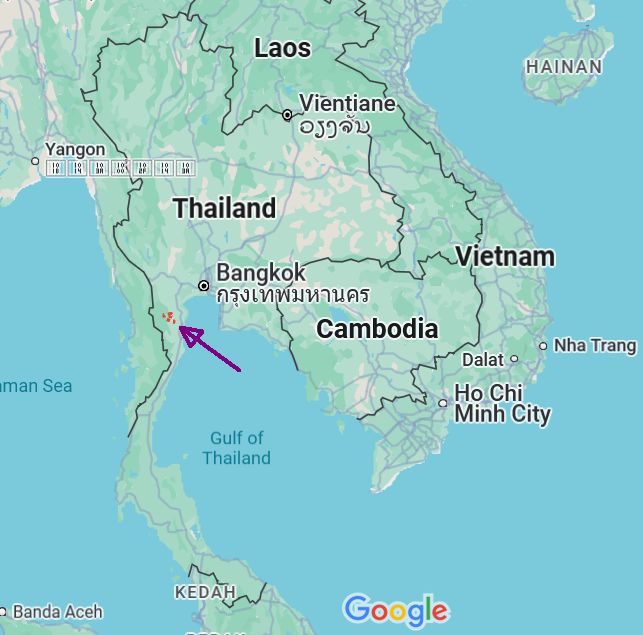
Femi Faminu, who frequently birds with (and without) us at Malibu Lagoon and elsewhere, recently returned from Thailand, where the birdlife is significantly different from South America, Africa, and even Southern California. Among the birdlife in her film I counted six bird families you’ll never see in SoCal, plus several primate species also absent here. Lunch will be supplied on the clifftop.
Enjoyable and colorful as always.
If you go here https://www.youtube.com/@femif9792 you can see her many other films.
Banding Birds at Bear Divide | 9 May 2025
[Posted by Chuck Almdale, photos by Elyse Jankowski]
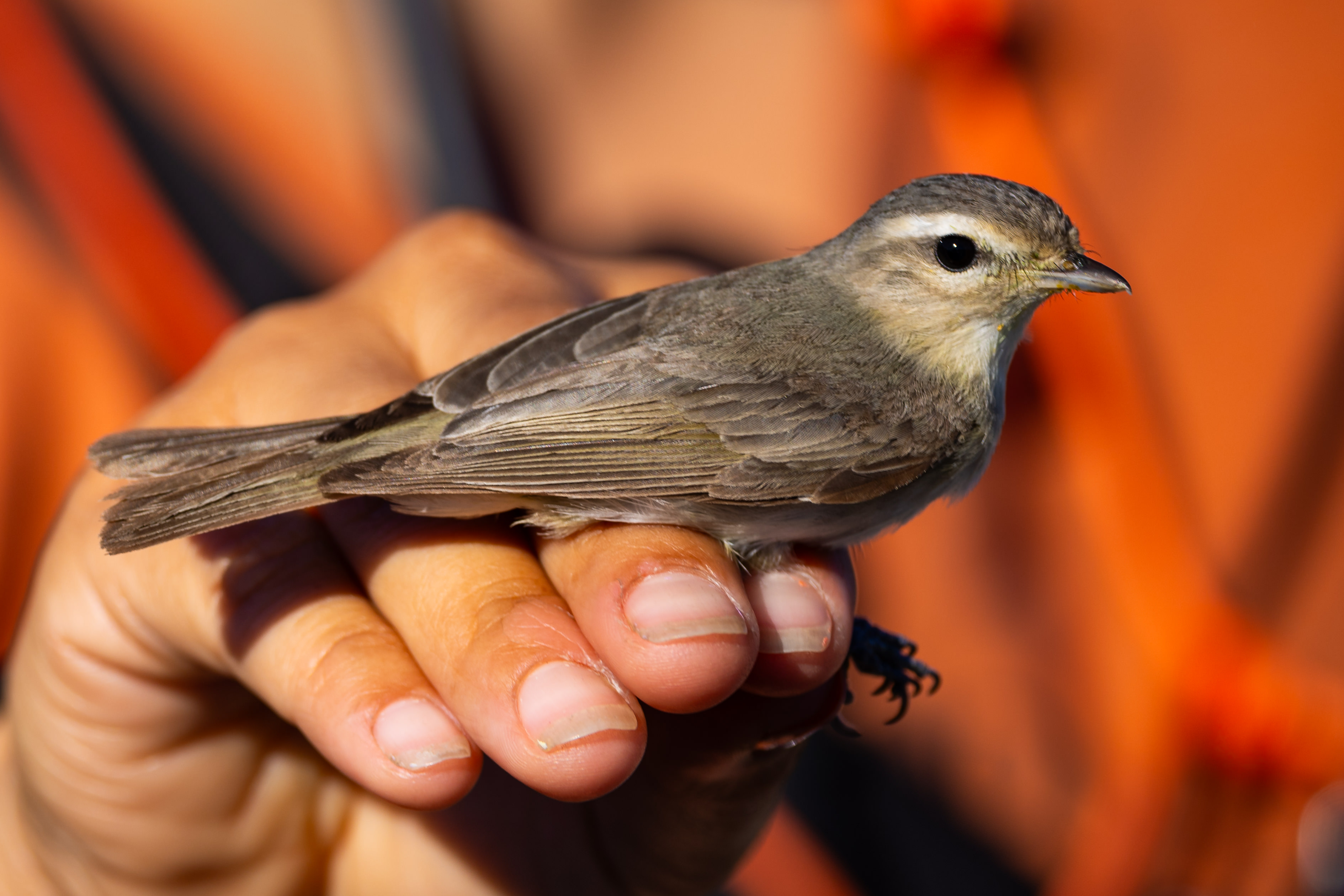
When we went to Bear Divide on 3 May, it was very foggy and the banding operation was canceled for the day and for the following few days as well. We had fun and during the birding party that ensued we managed to see some fogbirds…but still, no bird-in-the-hand banding.
Elyse Jankowski and Stephanie Salwen went back a few days later. The weather was better, the sky was clear, the banders were banding and the birds themselves graciously cooperated by flying into the mist nets.
Follow this link to Elyse’s collection of photos. Birds seen (in alphabetical order): Lazuli Bunting, Black-headed Grosbeak, Costa’s Hummingbird, Sagebrush Sparrow, Warbling Vireo, Hermit Warbler (at Placerita Canyon), MacGillivray’s Warbler, Nashville Warbler, and Yellow Warbler. You get to figure out which is which.
Banding season is either over or close to it. But they’ll be back next year.
Visit their website for information.
Audubon Action Alerts
[Posted by Chuck Almdale]
The good folks at California Audubon and National Audubon wants you to read and act on these two messages.
Add Your Name: Oppose Efforts to Undermine the Endangered Species Act
The Endangered Species Act (ESA) protects the habitat of threatened and endangered species, but a proposal is pending that would weaken the law.
The proposed rule to remove the definition of harm under Endangered Species Act regulations could be devastating to a vast number of birds and other wildlife by weakening protections for habitat. Bird populations are in decline, with a loss of three billion birds in North America since 1970, and numerous species of birds are now protected under the ESA, primarily due to habitat loss.
This proposed rule could open the door to habitat loss for some of our most vulnerable species and discourage proactive measures, making it harder for species to recover.
Add your name [by clicking the above link] to support Audubon in opposing the harmful proposal to undermine the Endangered Species Act.

Take Action to Protect Habitat for Birds and People
Many birds depend on urban areas for nesting, migration, and wintering habitat. At a time when habitat loss threatens the health of bird populations and our communities, conserving and improving urban habitats is essential to a healthy future for birds and people. The Local Communities and Bird Habitat Stewardship Act would benefit these habitats by improving local parks, reducing hazards to birds in urban environments—such as collisions with buildings—and engaging communities with birds and nature.
Act now [by clicking the above link] and urge your U.S. Representative to support the Local Communities and Bird Habitat Stewardship Act.
The recording of this program from 6 May 2025 is now available online.

Dark-eyed Juncos (Junco hyemalis) have become prolific in Californian urban spaces, which makes them a model species to study urban adaptation. Joey Di Liberto and Suu Zhou will discuss their recent two years of research on how juncos are shifting crucial behavioral responses while living in urban environments. While it is known that urban populations of Dark-eyed Juncos’ exhibit altered territorial aggression compared to montane counterparts, we recently found that discrete populations in different urban areas, as well as in a non-urban area, show differing aggressive responses. Additionally, Dark-eyed Juncos have been found to have reduced flight initiation distance and fear response in urban spaces, but little work has focused on how these behavioral responses vary across the birds’ annual cycle. New research indicates that the juncos’ breeding phenology may not have a direct impact on their fear response, but there are signs that the specific time of year, among other variables, may instead impact their flight initiation distance. This research allows us to gain key insights on how wildlife may be affected by human activity, and how they may be adapting their behavior to thrive in the city.
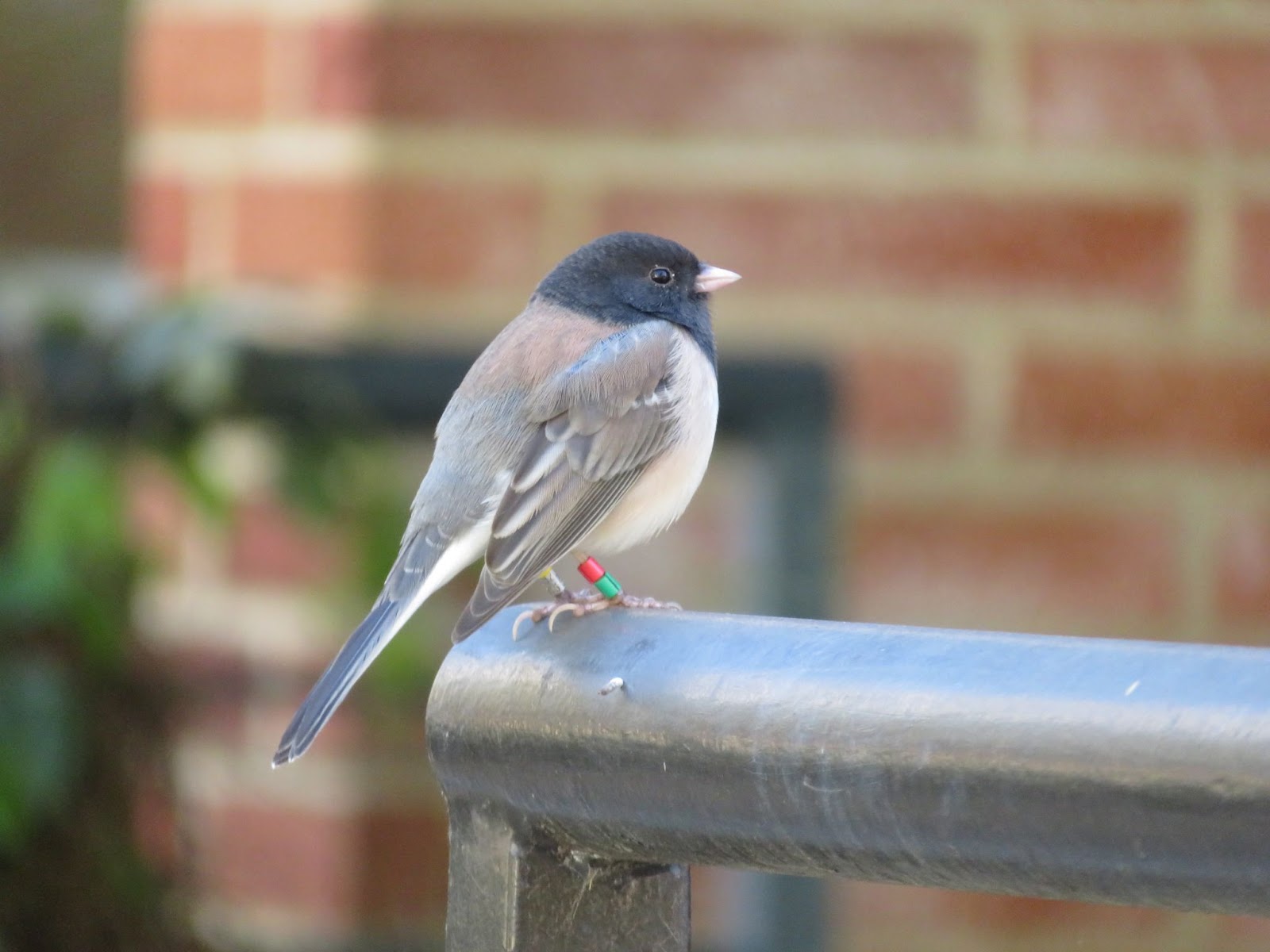
Joey Di Liberto is a second year PhD student in the Yeh Lab. He attended UC San Diego for his Bachelors and The College of William and Mary for his Masters; both in the field of Biology. His work broadly seeks to understand how birds on the front lines of anthropogenic changes adapt and change in response. When not birding, you can find him jamming out on his trumpet, hiking, or listening to music. His favorite bird is the Satin Bowerbird.
Suu Zhou is a second year MS student in the Yeh Lab. They attended Mount Holyoke College, where they majored in Biology. Their research focuses on seasonal changes in urban Junco behavior. Their hobbies include birding (of course), reading, and their favorite bird is the Steller’s Jay.
Link to all SMBAS Zoom Recordings

[Posted by Chuck Almdale, photos by Armando Martinez]
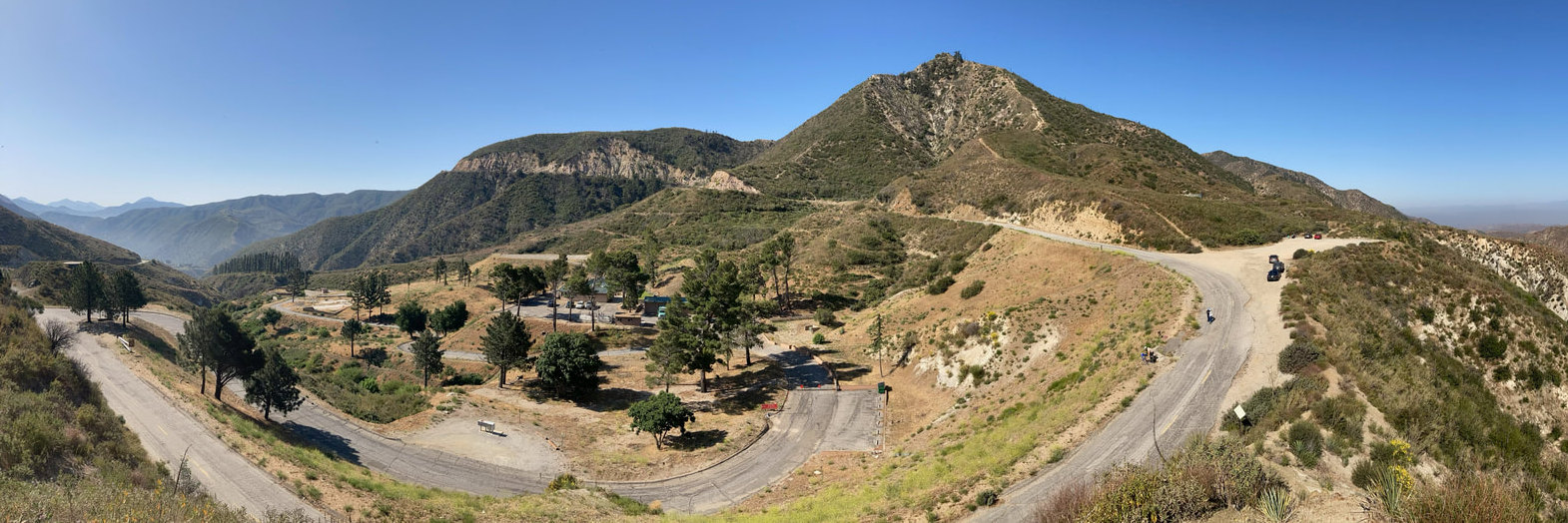
A total of nine birders in four vehicles met at the banding site around 7:30 am, as planned, a small logistical miracle in itself. It was very foggy. One of the banding personnel had been kind enough to call us at 6 am to tell us it was fogged in and they wouldn’t be banding today, but off we went anyway. When we arrived we found another twenty or so people, bundled up, standing around in the fog and hoping to see some birds, so it became a bit of a party, as when a rarity is reported and birders gather at the stake-out spot, hoping for a glimpse of a lifer and chattering away while they wait.
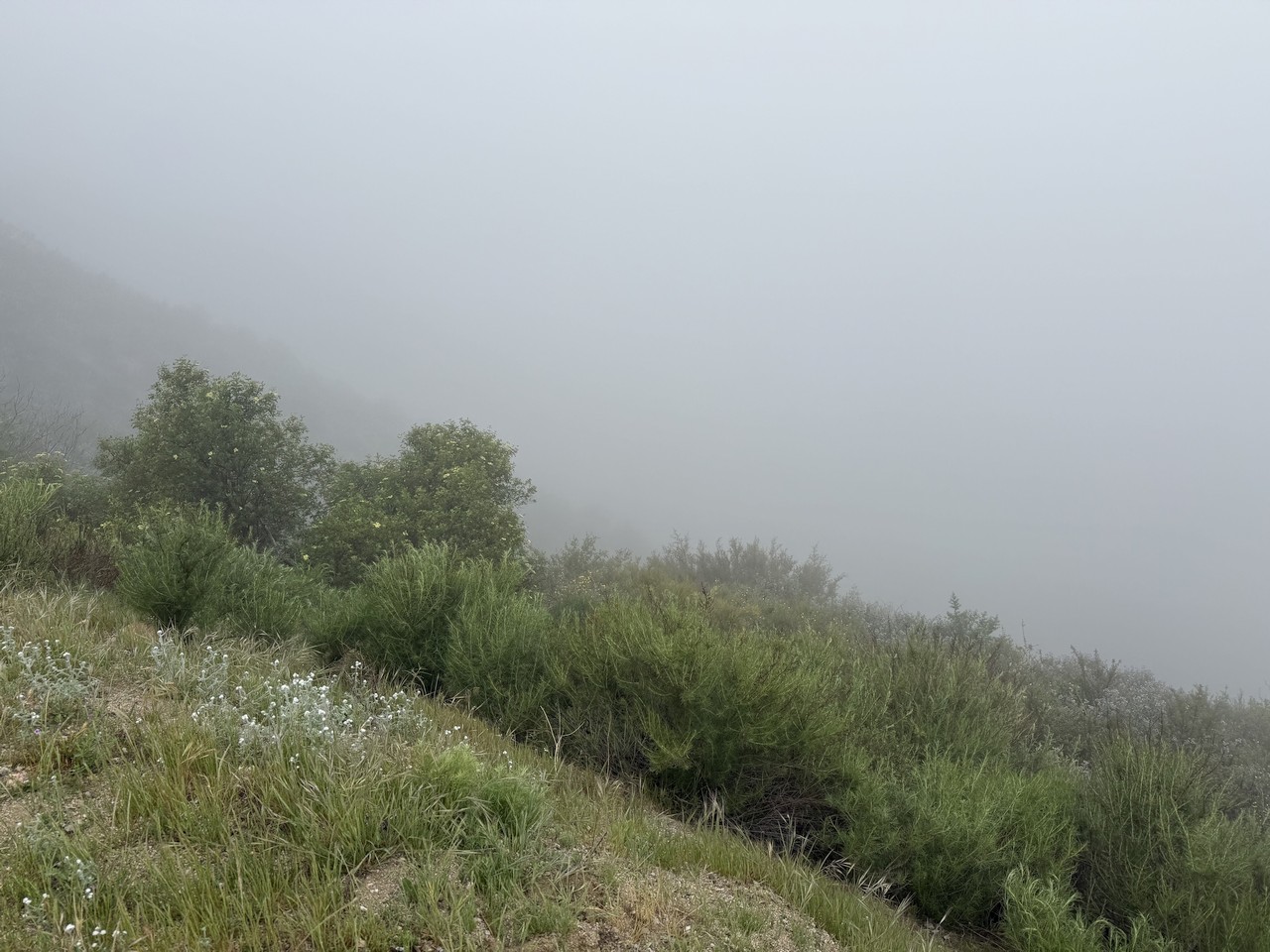
They call off the banding when it’s foggy because 1) most of the birds know enough to fly over the fog if it’s not too high, and (in my opinion) 2) it’s cold, fingers get cold, it’s harder to manipulate the tools and the live birds and thus the fun dissipates faster than the fog.
Every now and then a bird would appear. If it didn’t shoot right on by but landed somewhere we’d all try to spot it and identify it, tricky business in the fog. Here’s one that we thought at the time was a Western Flycatcher (formerly Pacific-slope Flycatcher) but weren’t too sure. Upon examination of Armando’s photograph, I still think it’s a Western Flycatcher, but when it comes to empids (members of the difficult Empidonax genus of Tyrant Flycatchers) one likes decent looks and/or clear photographs.

Fortunately, not all birds were so difficult. We also had both female and male Black-headed Grosbeaks.

Even on the fly, they’re colorful and easy to recognize.

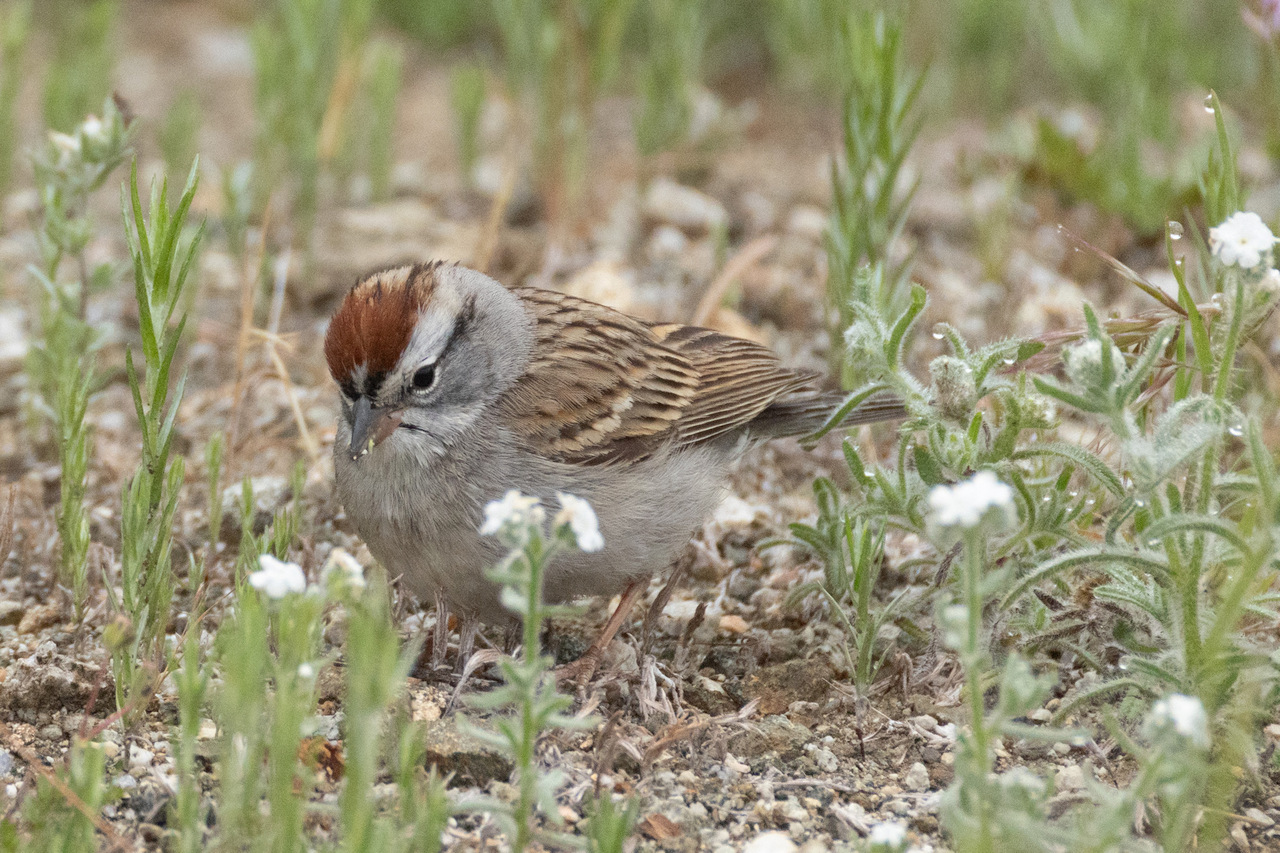
Amazingly enough, the most common species of the day were Chipping Sparrows, which discretely patrolled the grassy verge of the road and sipped most delicately from small cracks in the pavement where the foggy foggy dew collected. Sparrows are (you’ll be shocked to learn!) small birds, and the Chipping at 5.5″ is among the smallest of the bunch. As a result, they’re easy to overlook, looking as they do like small, nearly immobile clods of dirt or clumps of rustling leaves.
We saw several groups of California Quail (or the same group twice, moving in the interim across the ravine). Perhaps it’s just me, but I don’t see them as often as I used to, making me think they are declining in numbers. They used to be just about everywhere, popping in and out of the bushes, calling from the hillsides and bushtops. Shortly before we left a coyote came strolling up the road by the fire station. He or she looked a lot like Wiley Coyote – long legged, a bit skinny and looking hungry, his fur somewhat disheveled, as if he’d slept in it all night.
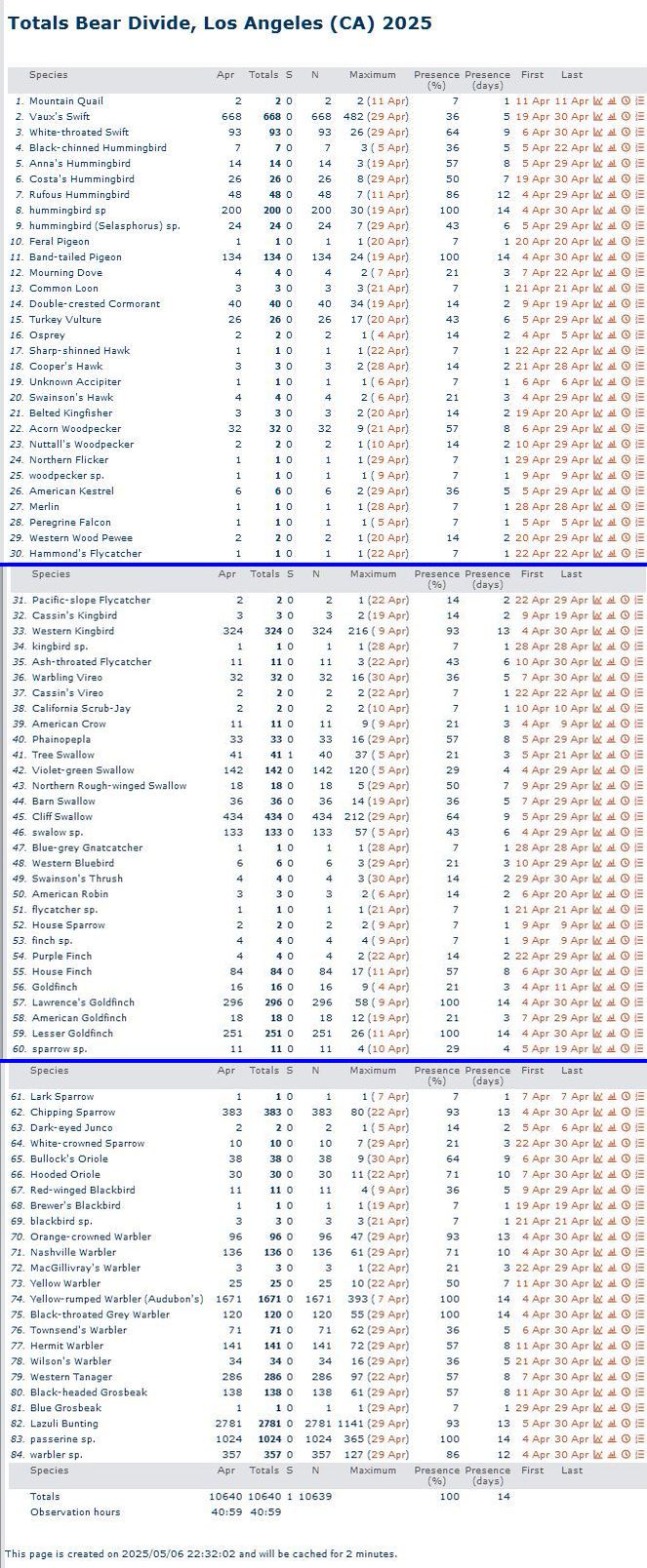
Bear Divide Banding Station of course keeps track of all the birds. Here’s their list for April 2025. For foggy May they have only one day so far. [Link to data page]
Onward to Walker Ranch
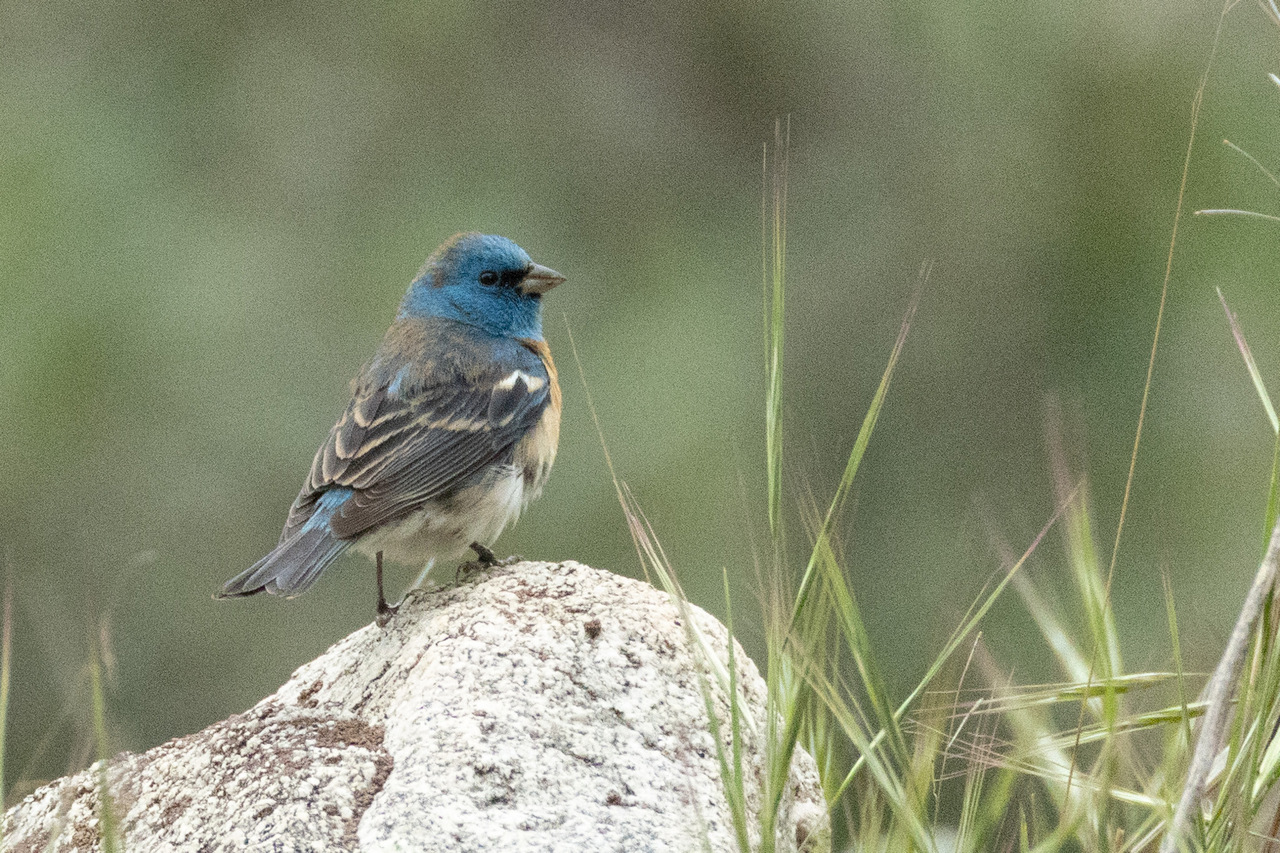
About 9:30 we piled into our cars and rolled back down the hill to Walker Ranch, part of Placerita Canyon Park, then strolled down the hill to the group campground, which was full of some sort of scouting activity and lots of noise. We had barely squeezed our cars into the roadside parking area, but someone left, leaving room. Above us on the hillside were two Lazuli Buntings. For decades they’ve been moderately reliable within 100 yds. of this particular spot. They like recently burned areas – I’m guessing because of food plants that spring up when everything else has been burned away, or the insects that live on such plants, but I don’t know for sure – so their frequent presence says something about Placerita’s burnability rating. “Lazuli” refers to the beautiful shade of blue on their face.
We avoided the campground noise by heading up the path to the “waterfall” which is closer to a very large streamside rock with water flowing along one side than a “fall.” It can be very good for birds sometimes, passing through and down the hillside, but not so much today. What we saw most of was Poison Oak which those who are allergic to it (not everyone is) had to bob and twist while walking to avoid. This section of the path is nice and shady and used to be reliable for California Quail (“chi-CA-go”) and less often Mountain Quail (“perp!”) who occasionally need to drink.
Poison Oak Newsbreak

Western Poison Oak (Toxicodendron (formerly Rhus) diversilobum), Eastern Poison Oak (T. pubescens), Poison Ivy (a complex of three species: T. radicans, T. rydbergii, and T. orientale), and Poison Sumac (T. vernix), as their generic name suggests (toxicodendron = toxic tree), are all poisonous to human touch because they contain the oil urushiol. The Cleveland Clinic writes “…almost everyone is allergic to [urushiol]. Rashes from these plants usually go away within two weeks.” They are in the sumac family, Anacardiaceae. Other plants in this family may also contain urushiol, as do Pistachio (Pistacia vera), Cashew (Anacardium occidentale) and Mango (Mangifera indica), but fewer people react to it in these foods. In the early 1900s Japanese chemists determined that the irritation was caused by the chemical urushiol, a type of alkyl catechol which, due to its structure, was able to penetrate the skin and survive on surfaces for months to years. Urushiol’s ability to polymerise into a hard glossy coating is the chemical basis for traditional lacquerware in many Asian countries. After urushiol comes in contact with oxygen, under certain conditions it becomes a black lacquer and has been named urushi lacquer. [I included this newsbite because I don’t have this allergy and also love pistachios, cashews and mangoes, especially the last two, and was curious about their toxic connection.]

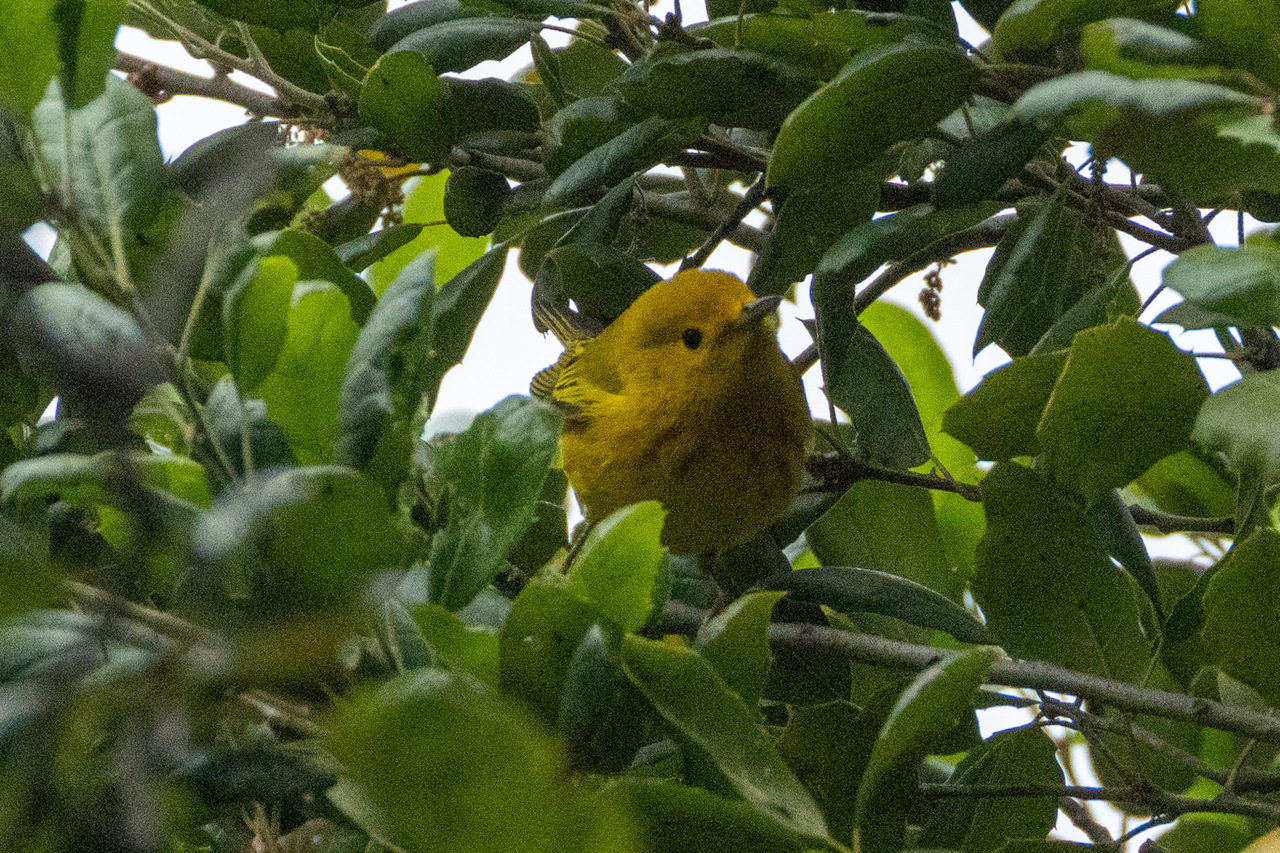
Back to the birds. We found the above bird on the underside of the foliage of an oak tree. Again, a difficult view as it kept flitting around, but again we thought it to be a Western Flycatcher. By the time we reached the group campground everyone had left, so we strolled through the tall grass, which looks like oats to me with seeds drooping from the stems. We walked down-canyon until we encountered an oak tree with several warblers in it. I think everyone got looks at both birds although both were quite busy gleaning in the foliage.

If you look very closely at the above photo you can see the tiny yellow spot in the lores, diagnostic for this species. The male Yellow Warbler had his red breast streaks and was quite lovely.
On the way out of Walker Ranch we spotted this pair high overhead. A nice way to end the day.

eBird trip lists below
Angeles NF–Bear Divide, Los Angeles, California, US
You might want to take a look at their website: https://beardividebanding.com/visit/
May 3, 2025 7:30 AM – 9:30 AM
Protocol: Stationary
Checklist Comments: Very foggy morning, banding station canceled for the day. Temps low 50s °F. No wind. Altitude ~1700 ft. About 20 other birders around. Low counts due to lack of visibility & migrants flying above the fog.
19 species
California Quail 5
Band-tailed Pigeon 4
Mourning Dove 2
Anna’s Hummingbird 2
Acorn Woodpecker 1
Western Flycatcher 1
California Scrub-Jay 1
Common Raven 8
Wrentit 4 Heard only
European Starling 1
Western Bluebird 3
House Finch 10
Chipping Sparrow 15 In grassy verges of road & on road sipping water from pavement cracks.
Lark Sparrow 1
California Towhee 6
Spotted Towhee 2
Bullock’s Oriole 1
Yellow-rumped Warbler 10
Black-headed Grosbeak 2
View this checklist online at https://ebird.org/checklist/S233526603
Placerita Canyon SP–Walker Ranch, Los Angeles, California, US
May 3, 2025 10:00 AM – 11:30 AM
Protocol: Traveling
1.5 mile(s)
Checklist Comments: Temps hi 50s-low 60s °F. Below the fog. Walked to waterfall & down canyon a bit. Low water in stream. Lots of poison oak, few insects.
32 species
Band-tailed Pigeon 3
Mourning Dove 4
Vaux’s Swift 20
Anna’s Hummingbird 3
Turkey Vulture 2
Cooper’s Hawk 2 A pair soaring overhead heading down canyon (NW). Initially ID’d as Merlin, later changed due to protest from eBird.
Red-shouldered Hawk 1 Heard near group campground.
Red-tailed Hawk 1
Acorn Woodpecker 20
Nuttall’s Woodpecker 1 Male
American Kestrel 1
Western Flycatcher 1 On underside of leafy tree up canyon 0.1 mile from campground.
California Scrub-Jay 6
American Crow 4
Common Raven 2
Oak Titmouse 1
Bushtit 1
Wrentit 6 Heard
Ruby-crowned Kinglet 1
Northern House Wren 5 4 heard only
European Starling 6
House Finch 15
Lesser Goldfinch 1 Heard
Song Sparrow 2 Heard
California Towhee 8
Spotted Towhee 4
Bullock’s Oriole 1
Yellow Warbler 1
Black-throated Gray Warbler 1
Townsend’s Warbler 1
Western Tanager 2
Lazuli Bunting 4 Pair above parking place on road. Two others up-canyon from campground.
View this checklist online at https://ebird.org/checklist/S233538100





 SANTA MONICA BAY AUDUBON SOCIETY BLOG