Free email delivery
Please sign up for email delivery in the subscription area to the right.
No salesman will call, at least not from us. Maybe from someone else.
Field Trip Report: Ballona Creek, del Rey Lagoon & Ballona Fresh Water Marsh, 9 Feb., 2013

Black Turnstone on mussels (C.Almdale)
On to the marsh…. we had another grebe – Pied-billed- and even more ducks: Ruddy Ducks, Green-Winged Teal and a really stunning glowing Cinnamon Teal with a bright eye. Blue-Gray Gnatcatchers, Common Yellowthroats and Yellow-Rumped Warblers bounced in the bushes. There were glorious vibrant Allen’s and Anna’s hummingbirds. We decided that there was a Right-Wing Red-Winged Blackbird as you could only see the red patch on…… It is interesting that while the marsh and the jetty are so close together the birds are rarely the same as one is salt water and the other fresh.
Birds seen – J =Jetty & del Rey Lagoon, F =Freshwater marsh.
| Ballona Jetty, Fresh Water | ||
| Marsh & del Rey Lagoon | ||
| Gadwall | F | |
| Mallard | J | F |
| Cinnamon Teal | F | |
| Northern Shoveler | F | |
| Green-winged Teal | F | |
| Lesser Scaup | J | F |
| Surf Scoter | J | |
| Bufflehead | J | |
| Red-breasted Merganser | J | |
| Ruddy Duck | F | |
| Red-throated Loon | J | |
| Pacific Loon | J | |
| Common Loon | J | |
| Pied-billed Grebe | F | |
| Horned Grebe | J | |
| Eared Grebe | J | |
| Western Grebe | J | |
| Brandt’s Cormorant | J | |
| Double-crested Cormorant | J | |
| Pelagic Cormorant | J | |
| Brown Pelican | J | |
| Great Blue Heron | J | |
| Great Egret | J | F |
| Snowy Egret | J | |
| White-tailed Kite | F | |
| Red-tailed Hawk | F | |
| American Coot | J | F |
| Black Oystercatcher | J | |
| Willet | J | |
| Ruddy Turnstone | J | |
| Black Turnstone | J | |
| Sanderling | J | |
| Western Sandpiper | F | |
| Least Sandpiper | J | |
| Heermann’s Gull | J | |
| Ring-billed Gull | J | |
| Western Gull | J | |
| California Gull | J | |
| Rock Pigeon | J | |
| Mourning Dove | J | |
| Anna’s Hummingbird | F | |
| Allen’s Hummingbird | J | F |
| Northern Flicker | F | |
| American Kestrel | F | |
| Black Phoebe | J | F |
| Say’s Phoebe | F | |
| American Crow | J | |
| Common Raven | F | |
| Tree Swallow | F | |
| Bushtit | F | |
| House Wren | J | |
| Blue-gray Gnatcatcher | F | |
| Ruby-crowned Kinglet | J | F |
| Hermit Thrush | J | F |
| Common Yellowthroat | F | |
| Yellow-rumped Warbler | J | F |
| Savannah Sparrow | J | |
| Song Sparrow | F | |
| White-crowned Sparrow | J | F |
| Red-winged Blackbird | F | |
| House Finch | J | F |
| Lesser Goldfinch | F | |
|
Total Trip Birds – 62 |
41 |
32 |
Badgers, Lagoons, Owls, Islands and Harriers
Jim Kenney was out on the Carrizo Plains a few weeks back and got these shots.
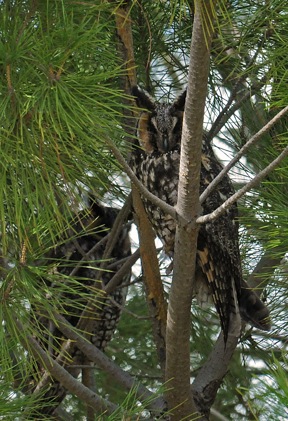
Long-eared Owl in Carrizo Plains (J. Kenney 1/27/13)
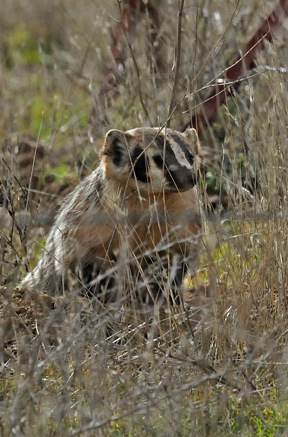
Badger in Carrizo Plains (J. Kenney 1/27/13)
The badger was seen near the small community of California Valley and the owl was roosting in pine trees a bit north of the Carrizo Plains Visitor Center.
*********************************

Malibu Lagoon at high tide 1/29/13 (LightHawk courtesy of SMBRC)
Just in case you didn’t see this aerial photo on our Lagoon Project Page. Is the new channel bigger than you thought?
*********************************
Working With Nature, A Sneak Peek at Malibu Lagoon
Carren Jao write about the Malibu Lagoon Project on KCET website, 1/28/13.
*********************************
Birding by Misbehavior
Rick Wright takes a look at a couple of Northern Harriers, 1/30/13.
*********************************
Owl Mystery Unraveled:
Scientists Explain How Bird Can Rotate Its Head Without Cutting Off Blood Supply to Brain
Science Daily online: 1/31/13.
Originally from Johns Hopkins Medicine
*********************************
I’ll bet you never heard of the
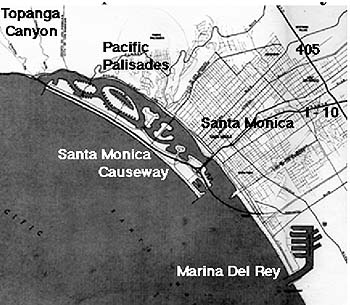
Map of the causeway (from the article).
extraordinary plan, begun in 1961, to create a chain of artificial islands just off the Santa Monica shoreline, connected to the mainland by a causeway. Well, it’s true.
by Mark McGuigan, Santa Monica Lookout: 9/28/12.
*************************
[Chuck Almdale]
Educational Research Grants – 2013
SMBAS is proud to announce the following grants made in January, 2013:
Laurel Klein Serieys – continuing her PhD research on the effects of rodenticides on the bobcats in the Santa Monica Mountains. This is the sixth year we have supported Laurel’s research in pursuing her PhD at UCLA. See Laurel’s website for more information: http://www.urbancarnivores.com/
Richard Hedley – UCLA student in the Department of Ecology and Evolutionary Biology in conjunction with the Electrical Engineering Department is working to develop a template-based computer algorithm that will permit rapid assessment of bird species diversity from field recordings.
“Unsupervised recordings have been used for flight-call monitoring of migratory birds, endangered bird species monitoring, and biodiversity research. Organizations that have utilized these technologies have found that they produce datasets consisting of thousands of hours of contiguous recordings; the limiting factor is not our ability to record soundscapes, but our ability to extract useful information from those recordings. As a result, recent research has focused on the development of automated species recognition algorithms that can automatically identify species from long recordings without human intervention.”
Tanner Saul – High School Senior assisting Laurel Serieys. He is responsible for tracking a radio-collared bobcat in Topanga. Using animal signs on the trails and radio telemetry data from the bobcat, Tanner chooses locations for wildlife cameras and independently monitors the cameras. He is monitoring both the frequency of notoedric mange in Topanga and the movement patterns and health of the collared bobcat. Since March 2012 he has worked over 400 hours on this project, averaging 3 days per week. [Lillian Johnson]
Malibu Lagoon Field Trip Report: 27 January, 2013
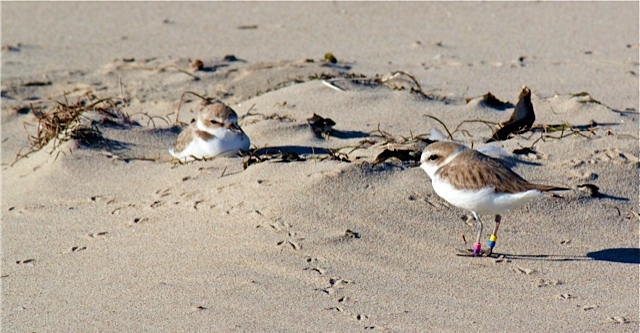
Snowy Plover PV:YB and friend (Cynthia Aylesworth 1/19/13)
We looked for the Arctic Loon reported earlier this month, but the loons were well offshore and towards the sun, so plumage patterns were difficult to see. Chinstraps were visible on the Pacific Loon-looking birds. Oh well.
The early morning rain had ended before we arrived, the sky cleared as the morning progressed, and everything was wet. Someone had placed boards across the numerous puddles on the beach path, for which we were grateful. The project permit is extended to mid-March, so – we hope – we’ll finally be able to use the new paths on our 3/24 walk, rather than be channeled like rats in a maze down the current narrow strait. It will be a relief to see the channel clearly rather than peering at it over the fence.
Despite such obstacles, we’ve tried to get a relatively accurate handle on the birds in the channel during the project period. The channel is now permanently open to the lagoon and the birds paddle in and out at will, so the population fluctuates constantly. Here’s what we found before 9am today. Most of the ducks were in one large flock on the channel’s north shore, still snoozing.
Ducks: Gadwall 20, Mallard 40, No. Shoveler, 20, No. Pintail 4, Green-winged Teal 20, Bufflehead 6, Ruddy Duck 20.
Others: Great Blue Heron 1, Snowy Egret 2, Coot 65, Black-bellied Plover 6, Killdeer 2, Black Phoebe 1, Allen’s Hummingbird 1, Yellow-rumped Warbler 3, Song Sparrow 3, House Finch 2.
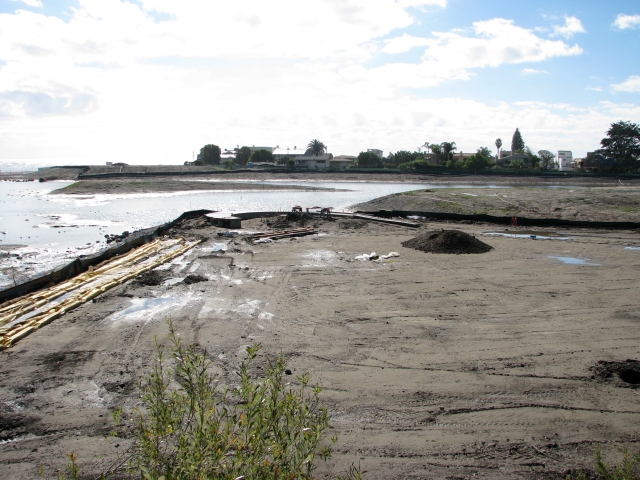
Viewing platform construction north side of channel (L. Johnson 1/27/13)
Progress continues on permanent installations such as paths and viewing platforms.
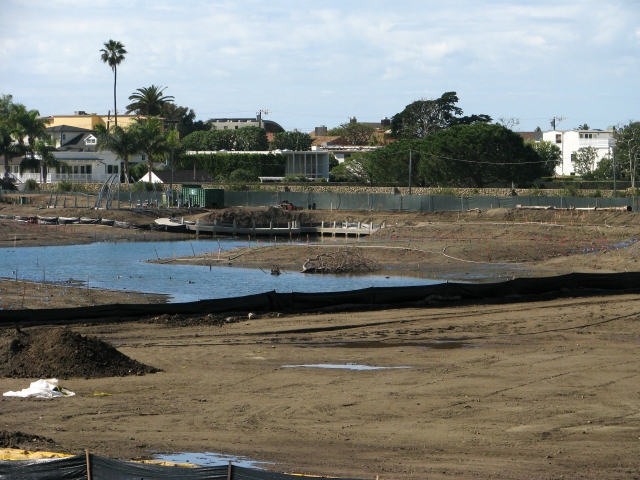
Viewing platform & path construction southwest side of channel (L. Johnson 1/27/13)
The gull flock has subsided significantly from the horde which covered the beach in December, dropping from about 2600 birds to about 660. Northern Pintails finally appeared, with two pair crusing around the lagoon and channel. Other new arrivals are: an Osprey (last seen in August), 3 American Avocets still in winter plumage, and 2 Mew Gulls.
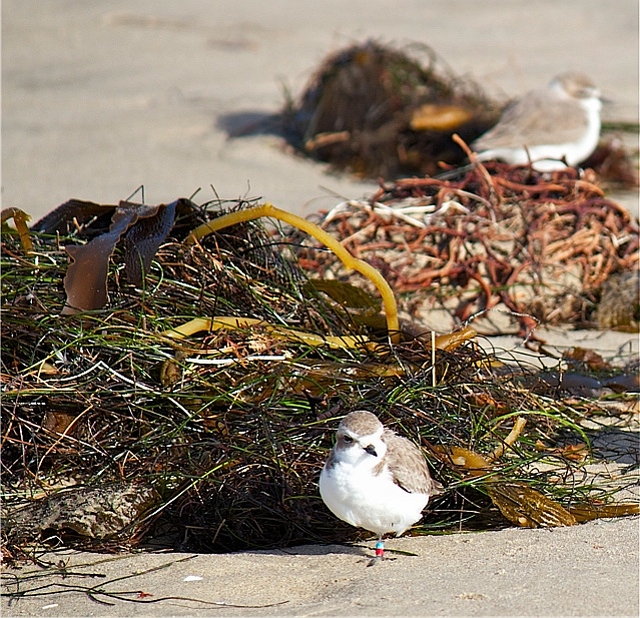
Snowy Plover GG:AR who 1st appeared on Surfrider Beach on 9/25/11 (Cynthia Aylesworth 1/6/13)
Snowy Plover PV:YB wasn’t seen among the flock of 61 roosting on the beach, waiting for the tide to begin dropping, but GG:AR and NO:WW were there. GG:AR (Left: green over green, Right: Aqua over Red) first appeared on Surfrider on 9/25/11 and was seen 11/25/12. NO:WW (Left: tan over orange, Right: white over white) appeared on 10/25/09 and recorded intermittently through 12/25/11.
Our next three field trips: Ballona Creek Jetty, 9 Feb; 8:00am; Malibu Lagoon, 24 Feb, 8:30am; Hiker Lu’s Santa Monica Mountains Explorama, 9 Mar, 8am.
Our next program: Tuesday, 5 Feb., 7:30 pm. Bird Photography, presented by Ralph Clevenger. Note that the meeting place has changed. The usual reminders will be emailed from the blog.
NOTE: Our 10 a.m. Parent’s & Kids Birdwalk will resume on 28 April, 2013.
Links: Unusual birds at Malibu Lagoon
Aerial photo of Malibu Lagoon from 9/23/02.
Prior checklists: July-Dec’11, Jan-June’11, July-Dec ’10, Jan-June ’10, Jul-Dec ‘09, and Jan-June ‘09.
Comments on Bird Lists Below
Total Birds: January total birds of 1,818 are 20% below average for the same reason Dec. 2012 birds were 30% above average: large fluctuations in the number of gulls. Monthly numbers relative to average continue to be up, down, up, down, etc.
Species Diversity: January 2013 with 65 species was a whopping 2% above the 63.7 6-year average.
Summary of species diversity from the 6-year average so far: June -10%, July +10%, Aug. -6%, Sep. -20%, Oct. +5%, Nov +2%, Dec -4%, Jan +2%. Still, the only constant is change.
10-year comparison summaries are available on our Lagoon Project Page.
[Chuck Almdale]
| Malibu Census | 2008 | 2009 | 2010 | 2011 | 2012 | 2013 | |
| January 2008 – 2013 | 27-Jan | 25-Jan | 24-Jan | 23-Jan | 22-Jan | 27-Jan | |
| Temperature | 65-70 | 41-65 | 68-75 | 50-59 | 52-62 | ||
| Tide Lo/Hi Height | L +1.7 | H +5.9 | L +0.65 | H +4.94 | H +6.49 | H +5.76 | Ave. |
| Tide Time | 0622 | 0814 | 1131 | 1117 | 0803 | 0849 | Birds |
| Brant | 1 | 0.2 | |||||
| Gadwall | 7 | 15 | 20 | 15 | 31 | 34 | 20.3 |
| American Wigeon | 10 | 12 | 2 | 7 | 5.2 | ||
| Mallard | 4 | 18 | 10 | 24 | 23 | 45 | 20.7 |
| Cinnamon Teal | 2 | 0.3 | |||||
| Northern Shoveler | 23 | 16 | 4 | 4 | 46 | 22 | 19.2 |
| Northern Pintail | 10 | 4 | 2.3 | ||||
| Green-winged Teal | 9 | 14 | 7 | 12 | 37 | 19 | 16.3 |
| Lesser Scaup | 1 | 0.2 | |||||
| Surf Scoter | 7 | 12 | 35 | 14 | 15 | 13.8 | |
| Long-tailed Duck | 1 | 0.2 | |||||
| Bufflehead | 2 | 11 | 6 | 5 | 26 | 10 | 10.0 |
| Red-brstd Merganser | 4 | 8 | 6 | 6 | 6 | 5.0 | |
| Ruddy Duck | 5 | 20 | 30 | 40 | 59 | 55 | 34.8 |
| Red-throated Loon | 1 | 1 | 2 | 0.7 | |||
| Pacific Loon | 1 | 1 | 1 | 1 | 5 | 1.5 | |
| Common Loon | 2 | 1 | 0.5 | ||||
| Pied-billed Grebe | 1 | 1 | 3 | 3 | 2 | 1.7 | |
| Horned Grebe | 1 | 1 | 1 | 1 | 2 | 1.0 | |
| Eared Grebe | 2 | 3 | 3 | 4 | 7 | 3.2 | |
| Western Grebe | 65 | 23 | 15 | 6 | 8 | 46 | 27.2 |
| Blk-vented Shearwater | 200 | 33.3 | |||||
| Brandt’s Cormorant | 5 | 2 | 1 | 3 | 7 | 3.0 | |
| Dble-crstd Cormorant | 21 | 30 | 42 | 57 | 37 | 33 | 36.7 |
| Pelagic Cormorant | 1 | 1 | 4 | 1 | 2 | 1.5 | |
| Brown Pelican | 34 | 256 | 35 | 42 | 48 | 73 | 81.3 |
| Great Blue Heron | 2 | 4 | 2 | 2 | 7 | 4 | 3.5 |
| Great Egret | 4 | 2 | 3 | 1 | 2 | 2.0 | |
| Snowy Egret | 6 | 8 | 15 | 8 | 7 | 9 | 8.8 |
| Blk-crwnd N-Heron | 4 | 1 | 2 | 1.2 | |||
| Osprey | 1 | 1 | 1 | 0.5 | |||
| Cooper’s Hawk | 2 | 1 | 0.5 | ||||
| Red-shouldered Hawk | 1 | 1 | 1 | 0.5 | |||
| Red-tailed Hawk | 1 | 1 | 1 | 0.5 | |||
| Peregrine Falcon | 2 | 0.3 | |||||
| Virginia Rail | 1 | 0.2 | |||||
| Sora | 1 | 1 | 4 | 2 | 1.3 | ||
| American Coot | 298 | 180 | 284 | 145 | 345 | 270 | 253.7 |
| Blk-bellied Plover | 16 | 38 | 45 | 1 | 65 | 62 | 37.8 |
| Snowy Plover | 39 | 42 | 54 | 60 | 81 | 61 | 56.2 |
| Killdeer | 2 | 1 | 4 | 3 | 2 | 2 | 2.3 |
| Black Oystercatcher | 2 | 5 | 1.2 | ||||
| American Avocet | 3 | 4 | 2 | 4 | 2 | 3 | 3.0 |
| Spotted Sandpiper | 1 | 4 | 2 | 2 | 3 | 2.0 | |
| Willet | 6 | 10 | 15 | 1 | 3 | 7 | 7.0 |
| Whimbrel | 1 | 2 | 2 | 1 | 1 | 3 | 1.7 |
| Marbled Godwit | 7 | 12 | 4 | 15 | 6.3 | ||
| Ruddy Turnstone | 2 | 9 | 13 | 15 | 10 | 8.2 | |
| Sanderling | 106 | 60 | 85 | 200 | 17 | 78.0 | |
| Least Sandpiper | 2 | 21 | 10 | 12 | 7.5 | ||
| Heermann’s Gull | 9 | 46 | 5 | 62 | 16 | 12 | 25.0 |
| Mew Gull | 2 | 0.3 | |||||
| Ring-billed Gull | 80 | 180 | 55 | 120 | 150 | 90 | 112.5 |
| Western Gull | 110 | 125 | 45 | 100 | 120 | 75 | 95.8 |
| California Gull | 192 | 450 | 875 | 2500 | 1900 | 480 | 1066.2 |
| Herring Gull | 1 | 1 | 1 | 0.5 | |||
| Thayer’s Gull | 1 | 0.2 | |||||
| Glaucous-wingd Gull | 2 | 6 | 6 | 2 | 5 | 1 | 3.7 |
| Caspian Tern | 1 | 0.2 | |||||
| Forster’s Tern | 3 | 1 | 0.7 | ||||
| Royal Tern | 9 | 4 | 12 | 16 | 2 | 7.2 | |
| Elegant Tern | 1 | 0.2 | |||||
| Black Skimmer | 8 | 30 | 6 | 7.3 | |||
| Rock Pigeon | 6 | 8 | 8 | 5 | 5 | 8 | 6.7 |
| Mourning Dove | 4 | 2 | 2 | 2 | 2 | 2.0 | |
| Blk-hooded Parakeet | 6 | 1.0 | |||||
| Anna’s Hummingbird | 1 | 2 | 3 | 3 | 2 | 1 | 2.0 |
| Allen’s Hummingbird | 2 | 4 | 2 | 6 | 2 | 5 | 3.5 |
| Belted Kingfisher | 1 | 1 | 1 | 0.5 | |||
| Black Phoebe | 6 | 8 | 4 | 4 | 3 | 4 | 4.8 |
| Say’s Phoebe | 1 | 1 | 1 | 1 | 0.7 | ||
| Western Scrub-Jay | 1 | 0.2 | |||||
| American Crow | 21 | 10 | 5 | 6 | 4 | 3 | 8.2 |
| Tree Swallow | 8 | 1.3 | |||||
| Barn Swallow | 1 | 0.2 | |||||
| Oak Titmouse | 2 | 0.3 | |||||
| Bushtit | 5 | 4 | 9 | 26 | 7.3 | ||
| Bewick’s Wren | 2 | 2 | 1 | 1 | 1.0 | ||
| House Wren | 1 | 0.2 | |||||
| Marsh Wren | 1 | 0.2 | |||||
| Blue-gray Gnatcatcher | 1 | 0.2 | |||||
| Ruby-crowned Kinglet | 1 | 3 | 0.7 | ||||
| Northern Mockingbird | 1 | 2 | 1 | 1 | 2 | 1.2 | |
| European Starling | 100 | 60 | 35 | 1 | 22 | 36.3 | |
| Ornge-crwnd Warbler | 2 | 0.3 | |||||
| Yellow-rumpd Warbler | 17 | 10 | 8 | 6 | 3 | 14 | 9.7 |
| Common Yellowthroat | 2 | 1 | 3 | 4 | 4 | 3 | 2.8 |
| Spotted Towhee | 1 | 1 | 1 | 1 | 0.7 | ||
| California Towhee | 4 | 2 | 1 | 1.2 | |||
| Savannah Sparrow | 2 | 0.3 | |||||
| Song Sparrow | 5 | 6 | 3 | 8 | 2 | 8 | 5.3 |
| Lincoln’s Sparrow | 1 | 0.2 | |||||
| White-crwnd Sparrow | 17 | 5 | 4 | 22 | 6 | 9.0 | |
| Red-winged Blackbird | 3 | 1 | 0.7 | ||||
| Brewer’s Blackbird | 6 | 1.0 | |||||
| Great-tailed Grackle | 1 | 1 | 1 | 13 | 2.7 | ||
| Brwn-headed Cowbird | 2 | 0.3 | |||||
| House Finch | 22 | 8 | 12 | 5 | 25 | 2 | 12.3 |
| Lesser Goldfinch | 2 | 4 | 1 | 1.2 | |||
| American Goldfinch | 8 | 1.3 | |||||
| Totals by Type | 27-Jan | 25-Jan | 24-Jan | 23-Jan | 22-Jan | 27-Jan | Ave. |
| Waterfowl | 59 | 120 | 134 | 106 | 255 | 217 | 149 |
| Water Birds-Other | 430 | 496 | 386 | 267 | 452 | 649 | 447 |
| Herons, Egrets | 16 | 15 | 20 | 11 | 18 | 13 | 16 |
| Raptors | 2 | 1 | 4 | 2 | 2 | 3 | 2 |
| Shorebirds | 182 | 181 | 251 | 82 | 388 | 183 | 211 |
| Gulls & Terns | 416 | 841 | 1006 | 2785 | 2207 | 663 | 1320 |
| Doves | 10 | 10 | 10 | 7 | 7 | 8 | 9 |
| Other Non-Pass. | 3 | 12 | 5 | 10 | 5 | 7 | 7 |
| Passerines | 200 | 125 | 90 | 70 | 110 | 75 | 112 |
| Totals Birds | 1318 | 1801 | 1906 | 3340 | 3444 | 1818 | 2271 |
| 2008 | 2009 | 2010 | 2011 | 2012 | 2013 | ||
| Total Species | 27-Jan | 25-Jan | 24-Jan | 23-Jan | 22-Jan | 27-Jan | Ave. |
| Waterfowl | 8 | 9 | 11 | 7 | 11 | 10 | 9.3 |
| Water Birds-Other | 10 | 10 | 12 | 11 | 10 | 12 | 10.8 |
| Herons, Egrets | 4 | 4 | 3 | 3 | 4 | 2 | 3.3 |
| Raptors | 1 | 1 | 3 | 2 | 2 | 3 | 2.0 |
| Shorebirds | 9 | 11 | 12 | 8 | 11 | 10 | 10.2 |
| Gulls & Terns | 11 | 7 | 9 | 6 | 6 | 8 | 7.8 |
| Doves | 2 | 2 | 2 | 2 | 2 | 1 | 1.8 |
| Other Non-Pass. | 2 | 3 | 2 | 3 | 3 | 3 | 2.7 |
| Passerines | 13 | 16 | 16 | 17 | 16 | 16 | 15.7 |
| Totals Species | 60 | 63 | 70 | 59 | 65 | 65 | 63.7 |
Antelope Valley Raptor Search Report, Saturday, 12 January 2013
It was 30 degrees, sunny and windless when we turned off Hwy 14 at Palmdale Blvd. and drove east. Our first stop was at an undeveloped area along E10th St. north of Rancho Vista (Ave. Q). The area was not as productive as it has been in past years but we saw the first raptors of the day: a Northern Harrier that flew by and several Red-tailed Hawks.
Our next stop was on the shoulder of the road by the Desert Aire Golf Club (Ave. P x E40th St.). A puddle of water on the grass near the edge of the golf course was attracting a mixed flock of passerines including White-crowned Sparrows & House Finches. In the scrub across the road, we found a small flock of California Quail, a Loggerhead Shrike and more sparrows and finches, including one Golden-crowned Sparrow.
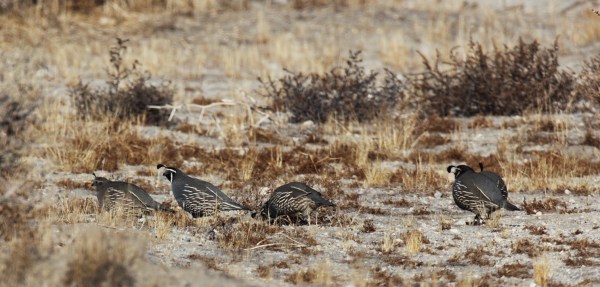
California Quail, S. Baker, 01/12/13
From the Golf Club, we drove north on E40th St. Just after E40th St. turns right and becomes Ave. N we stopped and scanned the sod fields. In the distance, we saw a flock of Horned Larks that we estimated at 1,000+ birds. It was impressive to see the flock in the air and we were disappointed that the strong sun that was making the cold temperature more tolerable for us was also causing heat shimmer that reduced the clarity of the views through our scopes.
Our next stop was along E40th St. just north of Ave. M (Columbia Way). There were many Brewer’s Blackbirds, some Killdeer, and at least one Say’s Phoebe in the field where a large flock of sheep was grazing.
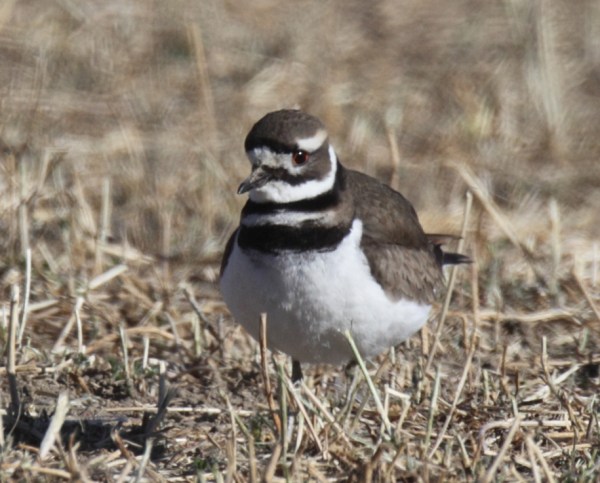
Killdeer, S. Baker, 01/12/13
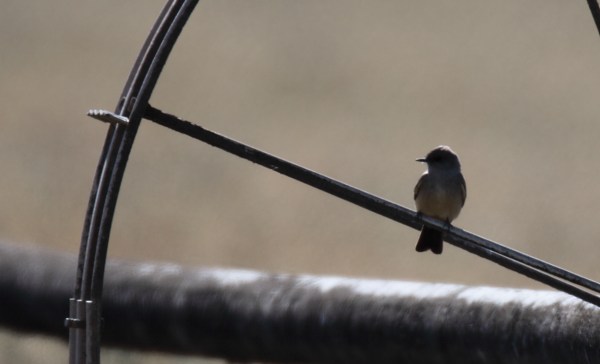
Say’s Phoebe, S. Baker, 01/12/13
Although there had been Mountain Plovers close to the road one week earlier, the only birds resembling Mountain Plovers that we could see were at the back of the field where they were barely visible. Our disappointment was quickly forgotten when one of the members of the group spotted a Prairie Falcon perched on a power pole across the road. We watched it for a time, getting excellent looks at the bird when it was perched and as it flew from one perch to another.
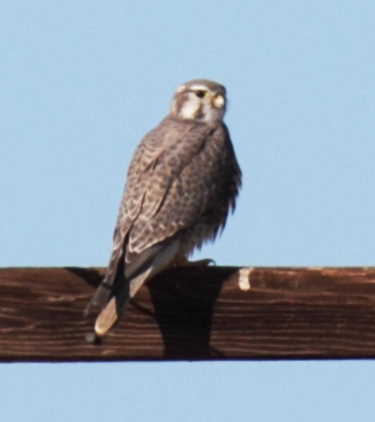
Prairie Falcon, S. Baker, 01/12/13
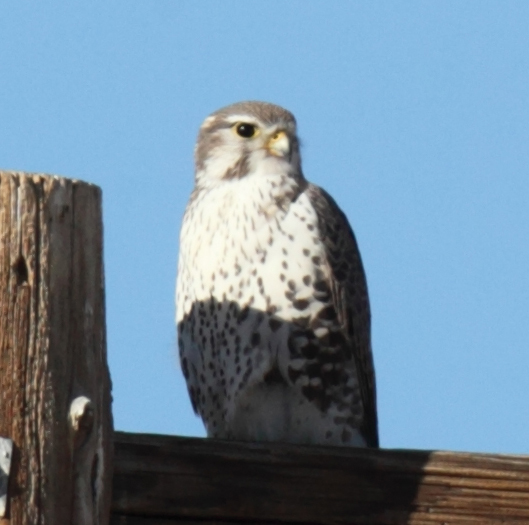
Prairie Falcon, S. Baker, 01/12/13
As we drove north on E40th St we noticed a flock of Western Meadowlarks in the field south of Ave. L. We turned onto Ave. L where we found 2 Eurasian Collared-Doves, several Savannah Sparrows and a Cooper’s Hawk that was perched in a tree behind a house.
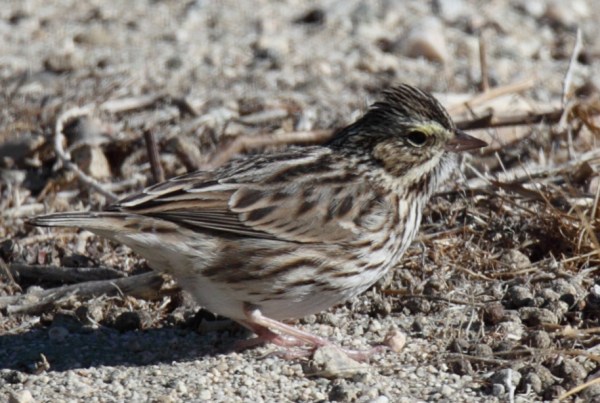
Savannah Sparrow, S. Baker, 01/12/13
From there we went east on Ave. K, turned north and drove east on Ave. J. After we crossed E110th St., we saw several Red-tailed Hawks. A flock of sheep was grazing in a field on the north side of Ave. J so we went 1 block north to Ave. I so we could look at the field from the north side. As we turned onto Ave. I we saw a Ferruginous Hawk perched on a power pole beside the road and we stopped our cars so we could get a good look at the bird without flushing it. As we looked around, we realized that there were numerous raptors in the immediate area so we pulled off the road and got out of our cars.
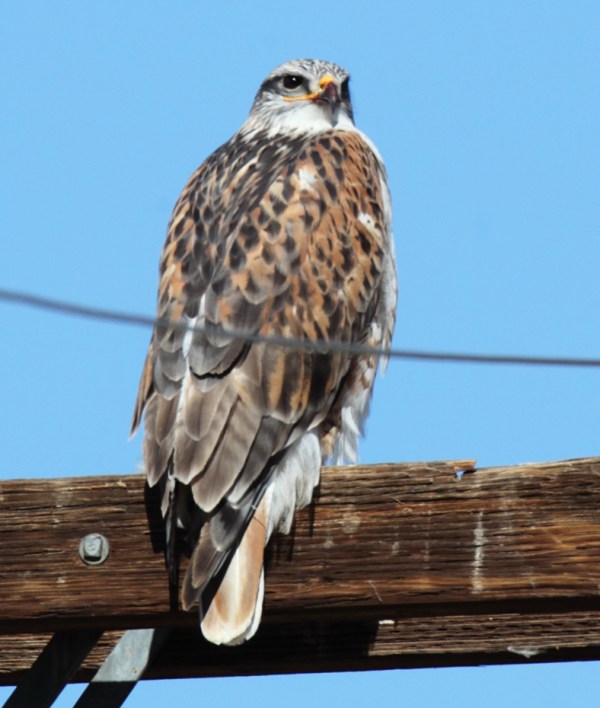
Ferruginous Hawk, S. Baker, 01/12/13
The viewing conditions could not have been better. The sky was clear, the vegetation in the fields was short and there were numerous power poles on which raptors could perch. It was easy to see and compare the general size & shape as well as the field marks of some of the Red-tailed Hawks, Ferruginous Hawks and Common Ravens while they were flying as well as when they were perched.
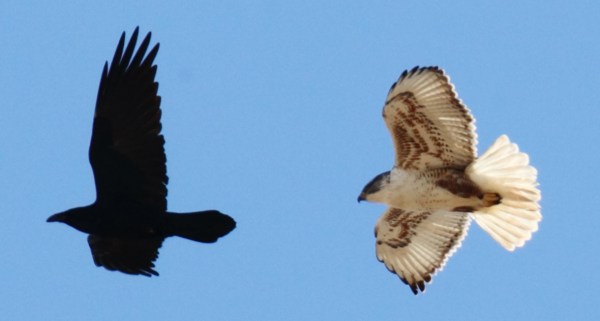
Common Raven & Ferruginous Hawk, S. Baker, 01/12/13
After a short time, a truck pulled up and the driver got out and walked over to talk with us. When we explained that we had come to look at the birds, he was genuinely pleased. He told us that bird numbers seemed low, probably because the past two years had been dry. He said that the sheep had been brought down from the high country just for the winter. He told us that Mountain Plovers seem to prefer pasture that has just been grazed so they usually stay close to the sheep. Unfortunately for us, at that moment the sheep were in the middle of the field so we were only able to see the silhouettes of a few Mountain Plovers in the distance though there were Killdeer, American Pipits, Savannah Sparrows and Western Meadlowlarks in the fields.
After we talked for several minutes, we thanked him and said goodbye. We started to drive away but stopped when we saw a dark buteo soaring nearby. It proved to be a stunning dark morph Ferruginous Hawk that flew right over us.
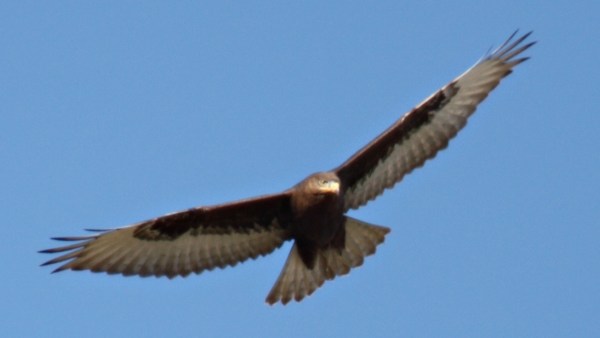
Dark morph Ferruginous Hawk, S. Baker, 01/12/13
Our final raptor tally for that site was 4 light & 1 dark morph Ferruginous Hawks, 8 or more Red-tailed Hawks, 3 Norther Harriers and an American Kestrel.
Since it was nearly lunch time we drove to Apollo Park, which was busy despite the chilly weather. As usual, we birded while we ate lunch. In addition to the usual assortment of ducks and geese of questionable ancestry, we saw 2 Ross’s Geese, several Eared Grebes, 8 American White Pelicans, some Northern Shovelers and Hooded Mergansers. The only passerines we saw were Brewer’s Blackbirds and House Sparrows.
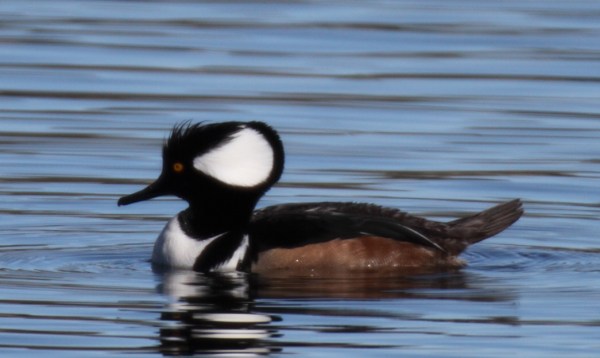
Hooded Merganser, S. Baker, 01/12/13
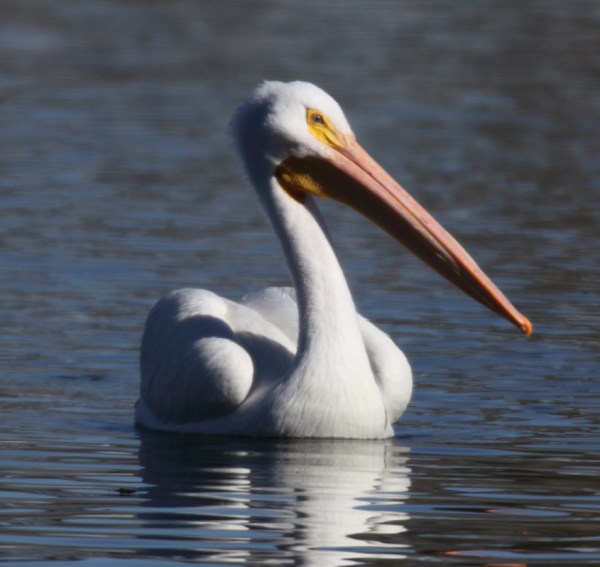
American White Pelican, S. Baker, 01/12/13
From Apollo Park we drove north on W60th St. The farm fields were dry and the flocks of passerines were scattered and small but we found a Northern Harrier, a Merlin and a Prairie Falcon.
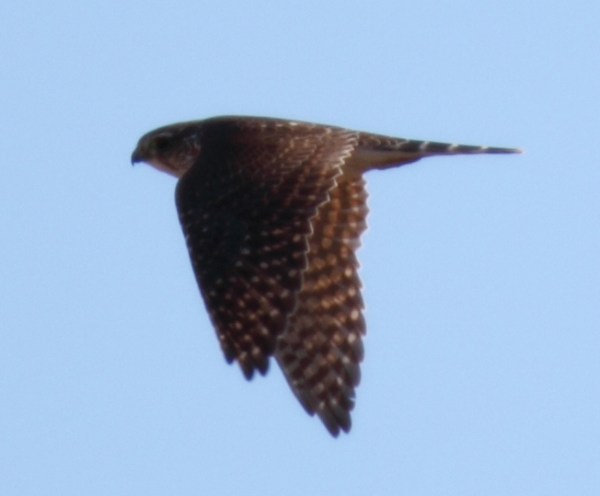
Merlin, S. Baker, 01/12/13
We turned onto Gaskell Road and drove west. As in past years, the area was good for raptors. We saw several Red-tailed Hawks (including 2 that were sparring in flight), 4 light morph Ferruginous Hawks and a few more Prairie Falcons. Passerine numbers and diversity were lower than in past years but we had good looks at a small flock of American Pipits, a Loggerhead Shrike and some Say’s Phoebes. A Coyote was hunting in one of the fields. The best bird was a dark morph Ferruginous Hawk that we first noticed when it was soaring nearby. As we watched, it came closer and closer and finally flew right over our heads.
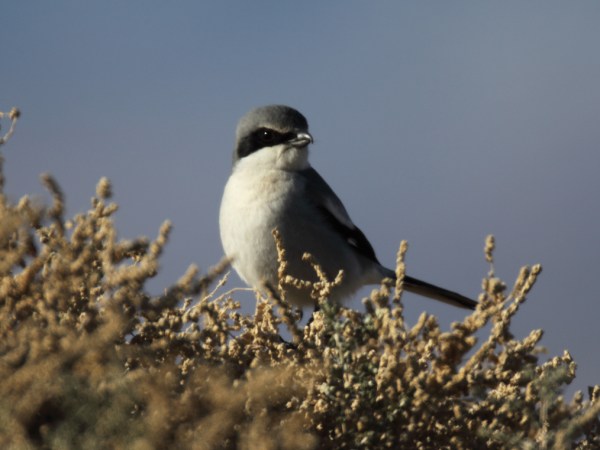
Loggerhead Shrike, S. Baker, 01/12/13
At that point we assumed — incorrectly, as it turned out — that we’d seen our last, best raptor of the day so we turned around and started back toward Hwy 14. As we drove east along Ave. A, we noticed a small, dark bird on a power pole. It was a very dark male Merlin that remained perched as we stopped to watch it in the afternoon light. It was the perfect end to an excellent day of raptor watching in the Antelope Valley.
Thanks to everyone who participated and a special “thank you” to Scott Baker for sharing his photos.
|
Sat, 12 Jan 2013 |
SMBAS, Antelope Valley |
||
|
numbers |
location |
||
|
Ross’s Goose |
Chen rossii |
2 |
Apollo Pk |
|
Canada Goose |
Branta canadensis |
10 |
Apollo Pk |
|
Mallard |
Anas platyrhynchos |
30 |
Apollo Pk |
|
Northern Shoveler |
Anas clypeata |
10 |
Apollo Pk |
|
Bufflehead |
Bucephala albeola |
2 |
Apollo Pk |
|
Hooded Merganser |
Lophodytes cucullatus |
6 |
Apollo Pk |
|
Ruddy Duck |
Oxyura jamaicensis |
2 |
Apollo Pk |
|
California Quail |
Callipepla californica |
9 |
Av P x E40th |
|
Eared Grebe |
Podiceps nigricollis |
3 |
Apollo Pk |
|
American White Pelican |
Pelecanus erythrorhynchos |
8 |
Apollo Pk |
|
Double-crested Cormorant |
Phalocrocorax auritus |
6 |
Apollo Pk |
|
Great Blue Heron |
Ardea herodias |
1 |
Apollo Pk |
|
Northern Harrier |
Circus cyaneus |
5 |
E10th x Rancho Vista; Av I x E110th; W60th x Av B |
|
Cooper’s Hawk |
Accipiter cooperii |
1 |
Av L x E40th |
|
Red-tailed Hawk |
Buteo jamaicensis |
50+ |
widespread |
|
Ferruginous Hawk |
Buteo regalis |
10 |
Av I x E110th; Gaskell Ave |
|
American Kestrel |
Falco sparverius |
15 |
scattered sites |
|
Merlin |
Falco columbarius |
3 |
W60th x Av B; Gaskell Rd; Av A x W100th |
|
Prairie Falcon |
Falco mexicanus |
6 |
E40th no. of Av M; W60th x Av D; Gaskell Av |
|
American Coot |
Fulica americana |
40 |
Apollo Pk |
|
Killdeer |
Charadrius vociferus |
100 |
widespread |
|
Mountain Plover |
Charadrius montanus |
10+ |
E40th St X Av M (prob); Av I x E110th |
|
Ring-billed Gull |
Larus delawarensis |
10 |
Apollo Pk |
|
California Gull |
Larus californicus |
225 |
E 10th north of Palmdale Blvd; Apollo Pk |
|
Rock Pigeon [I] |
Columba livia |
35 |
Palmdale Blvd; W60th St x Ave D |
|
Eurasian Collared-Dove [I] |
Streptopelia decaoto |
4 |
Av L x E4th; Gaskell Rd |
|
Mourning Dove |
Zenaida macroura |
6 |
scattered sites |
|
Say’s Phoebe |
Sayornis saya |
12 |
scattered sites |
|
Loggerhead Shrike |
Lanius ludovicianus |
15 |
scattered sites |
|
American Crow |
Corvus brachyrhynchos |
4 |
Palmdale Blvd; E10th x Rancho Vista |
|
Common Raven |
Corvus corax |
100+ |
widespread |
|
Horned Lark |
Eremophila alpestris |
1,500+ |
several sites inc Av N x E40th |
|
Western Bluebird |
Sialia currucoides |
1 |
Av P x E40th St |
|
Northern Mockingbird |
Mimus polyglottos |
2 |
Av P x E40th St; Gaskell |
|
European Starling [I] |
Sturnus vulgaris |
25 |
several sites, inc E40th x Av P |
|
American Pipit |
Anthus rubescens |
150 |
Gaskell Rd |
|
Sage Sparrow |
Amphispiza belli |
2 |
Av I x E120th St |
|
Savannah Sparrow |
Passerculus sandwichensis |
75 |
scattered sites |
|
Song Sparrow |
Melospiza melodia |
1 |
E40th north of Av M |
|
White-crowned Sparrow |
Zonotrichia leucophrys |
100 |
widespread |
|
Golden-crowned Sparrow |
Zonotrichia atricapilla |
1 |
Av P x E40th |
|
Western Meadowlark |
Sturnella neglecta |
100 |
widespread |
|
Brewer’s Blackbird |
Euphagus cyanocephalus |
150 |
widespread |
|
House Finch |
Carpodacus mexicanus |
200 |
widespread |
|
Lesser Goldfinch |
Carduelis psaltria |
1 |
Av P x E40th |
|
House Sparrow [I] |
Passer domesticus |
60 |
Palmdale Blvd; Apollo Pk |



 SANTA MONICA BAY AUDUBON SOCIETY BLOG