Free email delivery
Please sign up for email delivery in the subscription area to the right.
No salesman will call, at least not from us. Maybe from someone else.
Full Beaver Moon 11/28/12 6:46 a.m. PST
Here’s another update from SMBAS Blog on that large, disc-like, shining object which has frequently and mysteriously appeared in our nighttime sky this year (country folk call it the moon).
Nov. 28, 6:46 a.m. PST — Full Beaver Moon. Now it is time to set beaver traps before the swamps freeze to ensure a supply of warm winter furs. Another interpretation suggests that the name Beaver Full Moon comes from the fact that the beavers are now active in their preparation for winter. This full moon is also called the Frosty Moon. Since the moon arrives at apogee less than six hours later, this will also be the smallest full moon of 2012. In terms of apparent size, it will appear 12 percent smaller than the full moon of May 5. There is also a penumbral lunar eclipse with this full moon; observers in the western parts of the U.S. and Canada might notice the upper part of the moon appearing slightly darker as 92 percent of the moon’s diameter becomes immersed in the fainter penumbral shadow of Earth.
The next significant full moon will occur on Dec. 28, 2:21 a.m. PST. Keep an eye on this spot for additional breaking news on this unprecedented event.
This information comes to you courtesy of:
http://www.msnbc.msn.com/id/45911225/ns/technology_and_science-space/t/how-s-full-moons-got-their-strange-names/#.T16CDHlIXUx
But that’s way too long to type in, and besides, you don’t need to go there because SMBAS has done the work for you!
[Chuck Almdale]
Malibu Creek State Park field trip report, 10 November 2012
It was a perfect day for birding — clear, cool and calm — when we left the parking lot and started toward the High Road Trail. As we started down the slope toward Las Virgenes Creek, we saw a flock of Bushtits foraging in an oak beside the trail. There were 3 Mallards in the creek and these proved to be the only waterfowl we saw all day. Although there was water in Las Virgenes Creek, Malibu Creek was dry as far upstream as we could see. Since there was no water in Malibu Creek, we did not see many species that are usually found in the park at this time of year. For example, we saw no American Coots or Pied-billed Grebes and we neither heard nor saw any Common Yellowthroats.
We heard the melodious song of a Purple Finch and had good views of a female that perched atop a shrub above the trail. A Phainopepla was not so cooperative; it remained out of sight although it called repeated from a stand of oaks. As we walked on, we got scope views of a Loggerhead Shrike that was perched on some shrubs on the far side of the creek. Two Bewick’s Wrens perched in an oak by the trail long enough that we were able to see them well.

Bewick’s Wren, J. Kenney, 11/10/12
A Hermit Thrush came out in the open long enough for us to see its rufous tail and spotted breast and we saw several Black Phoebes during the walk.

Black Phoebe, J. Kenney, 11/10/12
We were admiring a handsome male Amerian Kestrel that regularly perches in a dead tree above the trail when a Red-tailed Hawk came soaring in our direction. The little Kestrel (wingspan ~21″) flew at the hawk (wingspan ~49″), calling loudly as it dived repeatedly at the hawk until the hawk flew away.

American Kestrel, J. Kenney, 11/12/12
We spent some time watching a group of Acorn Woodpeckers that were caching acorns in a dead tree above the trail.

Acorn Woodpecker, J. Kenney, 11/10/12

Acorn Woodpecker, J. Kenney, 11/10/12
While we were watching those woodpeckers, we spotted some other good birds in the nearby grasses and shrubs. These included a Rufous-crowned Sparrow, and adult Golden-crowned Sparrow and some California Towhees.
Before we crossed the bridge that goes to the Visitors’ Center, we saw a Cooper’s Hawk, an immature Red-shouldered Hawk, and 2 Northern Flickers. There were 2 Red-breasted Sapsuckers, a Nuttall’s Woodpecker and several Yellow-rumped Warblers in the Chinese Elm trees near the Visitors’ Center.

Red-breasted Sapsucker, J. Kenney, 11/10/12

Nuttall’s Woodpecker, J. Kenney, 11/10/12

Yellow-rumped Warbler, J. Kenney, 11/10/12
From the Visitors’ Center, we walked along the Crags Road Trail in the direction of the parking lot. We saw numerous White-crowned Sparrows, Dark-eyed Juncos and a small flock of handsome Lark Sparrows.
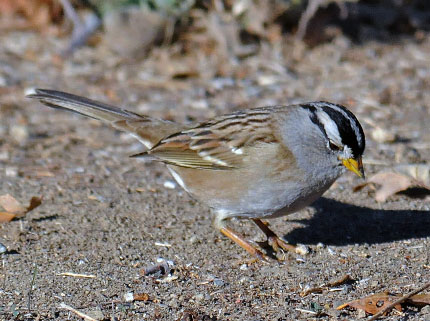
White-crowned Sparrow, J. Kenney, 11/10/12
As we neared the junction of the Crags & High Road Trails we heard a Phainopepla calling from the oaks. As we approached those trees, a male flew off but a female perched in the open where we were able to see her.
We were greeted by a couple of Western Bluebirds when we returned to the parking lot at midday. From there, several of us walked to the campground. That area is usually quite birdy but it was quiet when we looked around. The field by the Braille Trail was definitely worth a look. There was a Say’s Phoebe forging actively and a California Thrasher flew across the field twice so we all had a good look at it. That was a good way to end a very good day of birding in the park.
| MCSP, 10 Nov 2012 | final list | |
| Mallard | Anas platyrhynchos | 3 |
| Cooper’s Hawk | Accipiter cooperii | 1 ad, 1 imm |
| Red-shouldered Hawk | Buteo lineatus | 1 imm |
| Red-tailed Hawk | Buteo jamaicensis | 5 |
| American Kestrel | Falco sparverius | 1M |
| Black-hooded Parakeet [I] | Nandayus nenday | 20 |
| Acorn Woodpecker | Melanerpes formicivorus | 8 |
| Red-breasted Sapsucker | Sphyrapicus varius | 2 |
| Nuttall’s Woodpecker | Picoides nuttallii | 2 |
| Northern Flicker | Colaptes auratus | 2 |
| Black Phoebe | Sayornis nigricans | 6 |
| Say’s Phoebe | Sayornis saya | 3 |
| Loggerhead Shrike | Lanius ludovicianus | 1 |
| Western Scrub-Jay | Aphelocoma californica | 2 |
| American Crow | Corvus brachyrhynchos | 30 |
| Common Raven | Corvus corax | 2 |
| Oak Titmouse | Baeolophus inornatus | 20+ (most heard) |
| Bushtit | Psaltriparus minimus | 25+ |
| White-breasted Nuthatch | Sitta carolinensis | 2 |
| Bewick’s Wren | Thryomanes bewickii | 3 |
| House Wren | Troglodytes aedon | 1H |
| Ruby-crowned Kinglet | Regulus calendula | 2 |
| Western Bluebird | Sialia mexicana | 10 |
| Wrentit | Chamaea fasciata | 1 |
| California Thrasher | Toxostoma redivivum | 1 |
| Phainopepla | Phainopepla nitens | 1M, 1F |
| Yellow-rumped Warbler | Dendroica coronata | 40+ (most heard) |
| Spotted Towhee | Pipilo maculatus | 8 |
| California Towhee | Pipilo crissalis | 6 |
| Rufous-crowned Sparrow | Aimophila carpalis | 1 |
| Lark Sparrow | Chondestes grammacus | 10 |
| White-crowned Sparrow | Zonotrichia leucophrys | 20 |
| Golden-crowned Sparrow | Zonotrichia atricapilla | 1M |
| Dark-eyed Junco | Junco hyemalis | 25+ |
| Purple Finch | Carpodacus purpureus | 1F |
| House Finch | Carpodacus mexicanus | 30+ |
| Lesser Goldfinch | Carduelis psaltria | 4 |
| total = 37 species |
Thanks to all who came out with us and a special “thank you” to Jim Kenney for his outstanding photographs.
Butterbredt Spring Holloween Campout Report: 3-4 November, 2012

Keith & Lis (R. Seidner 11/3/12)
Besides expected White-crowned & Sage Sparrows, there were Loggerhead Shrikes (2), numbers of Northern Flickers, a Ladder-backed Woodpecker, American Robins, Bewick’s Wrens, Ruby-crowned Kinglets and Rock Wrens. The most unexpected bird of the day was a Golden-crowned Kinglet in and near the big cottonwood tree below Butterbredt Spring. It was beautifully viewed by all, and the first I personally have ever found on about 25 of these outings. Another great bird was the Western Screech Owl who came out of his nest-hole at the Ranch, and most spectacular, 40 Chukars which flew up from the edge of Tunnel Spring and scurried up the hill beside us for excellent views where we had stopped on Kelso Valley Rd. No hoped-for Snipes or Solitary Sandpipers foraging there around the cattle-muddied waters of that spring, however.

Cattle trough below Butterbredt Spring (R. Seidner 11/3/12)
In fact, heavy use by cattle was evident in all of the open land except in the Butterbredt Spring area and around Keith’s at Sageland. Tanks for water and feeder units had been installed for those animals. Hopefully, wildlife and birds also benefited in this very dry year. Another quite shocking experience to me was coming upon huge wind turbines standing on wide, graded platforms beside Jawbone Cyn. Road at the summit of Humbolt Pass. That pass would be a natural flyway for migrating birds, and for Golden Eagles, which we would have expected this trip, but none were found.
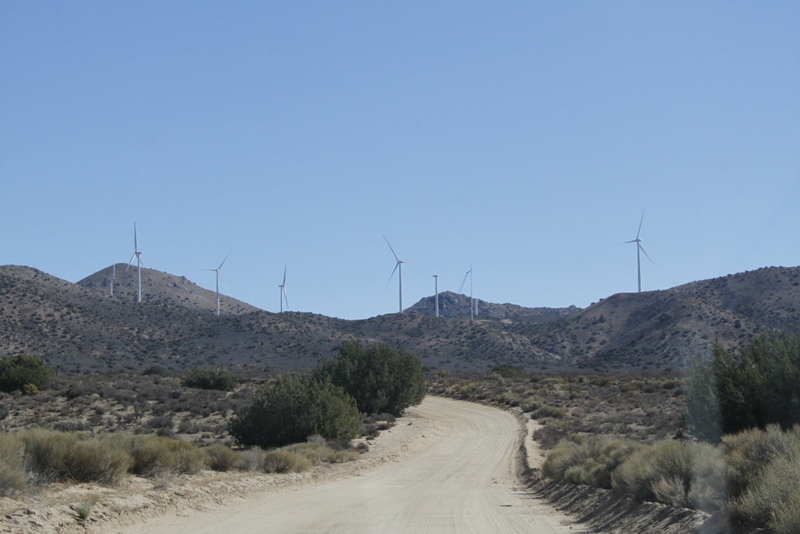
Not the windmills of your mind – Jawbone Cyn (R Seidner 11/3/12)
Other fun birds were a Golden-crowned Sparrow, California Thrasher, a Roadrunner, Towhees, Western Bluebirds, numerous California Quail, Anna’s Hummingbirds on a feeder, a Sharp-shinned Hawk at Keith’s, a Red-breasted & Red-naped Sapsucker (the last not seen well by most}, the ever present Western Scrub Jays and Dark-eyed Juncos, one of which was slate-colored. Unfortunately for the Braggs, a flock of Pinyon Jays flew over the house five minutes after they had departed on Sunday. Maybe next Spring? Another visitor was a sleek, healthy appearing coyote which strolled through the grounds. One had to guess it had been well fed and seemed not afraid.

We few! We carven few! We group of gourds! (R. Seidner 11/3/12)
However, no one missed the great shared dinner Saturday night and the pumpkin carving contest, won predictably by Mr. Bragg (the judge). Competition was fierce and could only be appreciated if you were there.
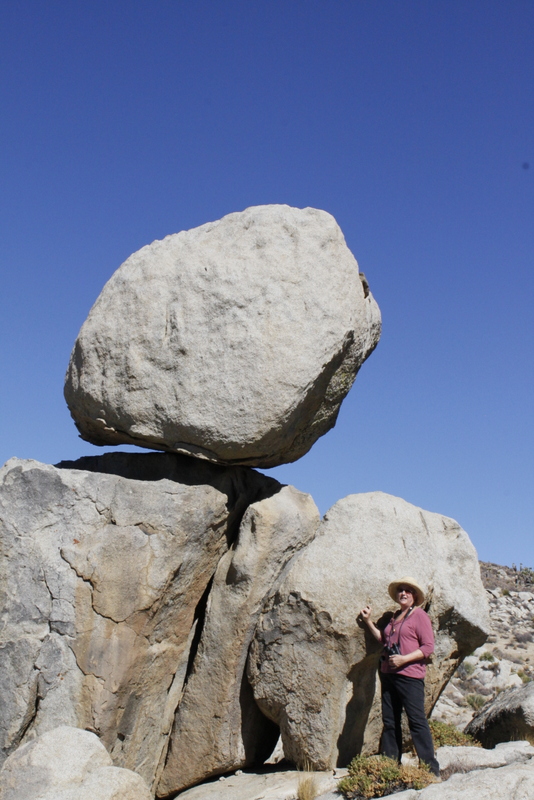
Roxie & the rox (R. Seidner 11/3/12)
Many took the hike up the rocky canyon off Dove Spring Rd on Sunday for a view of an amazing balanced rock, the surrounding beautiful hills and foliage turning gold for fall in the canyons, with brilliant, yellow Rabbit Brush everywhere.

Painted Lady butterfly in the Rabbit Brush (R. Seidner 11/3/12)
We owe much thanks to Mr. Axelson for welcoming us at his ranch and for instituting Butterbredt Spring and these trips many years ago. We hope lots of participants will venture to enjoy our next outing there in the southern Sierra mountains. [Mary Prismon, leader]
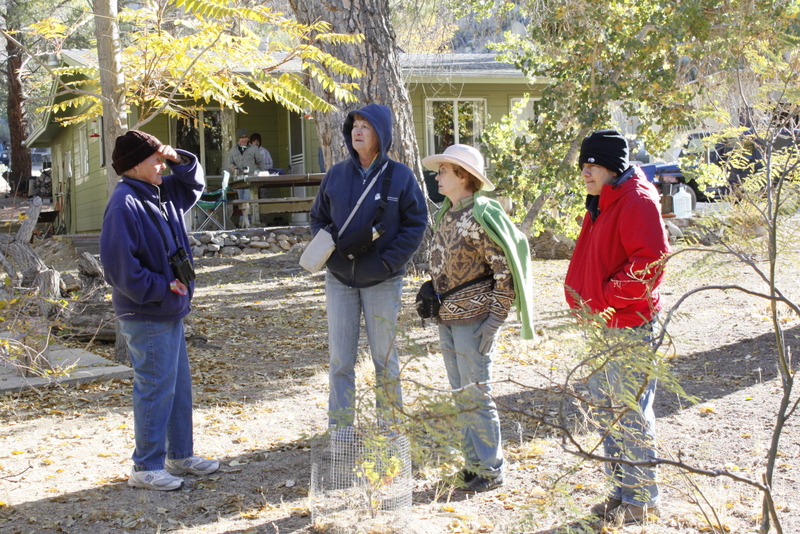
Chilly Sageland Ranch morn (R. Seidner 11/3/12)
PS: Did you notice the mention of Chukars?
Malibu Lagoon Trip Report: 28 October, 2012
Don’t forget to visit our new page for the Malibu Lagoon 2012 Project, frequently updated with new photos. We just added a new interview with Suzanne Goode, Also look for the link to the plant revegetation list.
The Malibu Lagoon reconfiguration continues apace, as you’ll see from some of the photos in the slideshow above. According to Don Harvey in Bob Purvey’s interview of 10/24/12, now on our Project Page, over 25,000 plants have been implanted and are being sprinkled until the rains are more dependable. You can’t really see them yet, but that forest of flags marks their locations.
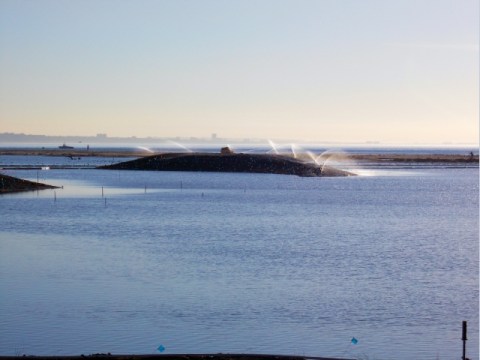
Boottoe Island looks like a surfacing whale (L. Plauzoles 10/28/12)
Trip leader Lu Plauzoles reports that weather was sunny and warm, not unusual for October. Migrants continue to arrive, including: American Wigeon, Horned and Clark’s Grebes, Black-crowned Night Heron, Dunlin, Glaucous-winged Gull, Belted Kingfisher, Say’s Phoebe, Ruby-crowned Kinglet, Yellow-rumped (Audubon’s) Warbler, Savannah & White-crowned Sparrows, and Western Meadowlark. The Elegant Terns, so numerous for the past 6 months – peaking at 240 in June – have dwindled down to two and will likely be off to warmer climes in November. Duck and gull numbers continue their fall increase. Coot numbers remains high as always, probably to taper off next March.
Snowy Plover PV:YB (left leg Pink above Violet: right leg Yellow above Blue) was found on Surfrider Beach last Monday, 10/22, by alert SMBAS photographer Joyce Waterman. [The violet ring is just barely visible.] We sent this photo to Pt. Reyes Bird Observatory which informed us that PV:YB was born this year at Oceano Dunes (near Pismo Beach) where it was banded as a nestling, then later seen at Guadalupe Dunes in August, then on Surfrider in September. If you see it on the beach, give it some room, and it will likely spend the winter with us.

New beach resident Snowy Plover PV:YB, born last summer at Oceano Dunes (J. Waterman 10/22/12)
NOTE: Our 10 a.m. Parent’s & Kids Birdwalk remains canceled until the parking lot is again fully available.
Links: Unusual birds at Malibu Lagoon
Aerial photo of Malibu Lagoon from 9/23/02.
Prior checklists: July-Dec’11, Jan-June’11, July-Dec ’10, Jan-June ’10, Jul-Dec ‘09, and Jan-June ‘09.
Comments on Bird Lists Below
Total Birds: Oct. total birds of 1099 are 3% above average (Jul – Sep were all down), an insignificant amount. Brown Pelican numbers remain down, probably due to the large west coast die-off due to lack of food. Sanderlings, Terns, Yellow-rumped Warblers and Red-winged Blackbirds are well above average. Monthly total bird numbers have been up & down, up & down during the project so far.
Species Diversity: Of 104 total species appearing in October for 2007-12, no more than 62% of them appeared on any single day. Whenever you visit, expect to see about 5/8ths of what is possible at that time of year. October 2012 with 64 species is 5% above average, an insignificant amount. All 9 categories of birds were about average. Passerines were up slightly despite the lack of vegetation, probably the result of a more alert trip leader.
Summary of species diversity from the 6-year average so far: May +4%, June -10%, July +10%, Aug. -6%, Sep. -20%, Oct. +5%. The only constant is change. It will be interesting to see the results when the project is done, the workmen are gone and the vegetation is beginning to grow. [Chuck Almdale]
| Malibu Census | 2007 | 2008 | 2009 | 2010 | 2011 | 2012 | |
| October 2007-12 | 28-Oct | 26-Oct | 25-Oct | 24-Oct | 23-Oct | 28-Oct | |
| Temperature | 60-74 | 60-65 | 59-64 | 72-78 | |||
| Tide Lo/Hi Height | H +6.9 | H +5.9 | L +3.5 | H +6.02 | H +5.40 | H +5.93 | Ave. |
| Tide Time | 1036 | 0813 | 0941 | 0952 | 0718 | 0845 | Birds |
| Wood Duck | 1 | 0.2 | |||||
| Gadwall | 2 | 4 | 4 | 2 | 6 | 8 | 4.3 |
| Eurasian Wigeon | 1 | 0.2 | |||||
| American Wigeon | 3 | 10 | 1 | 16 | 5.0 | ||
| Mallard | 24 | 8 | 24 | 10 | 25 | 10 | 16.8 |
| Blue-winged Teal | 4 | 2 | 1.0 | ||||
| Cinnamon Teal | 2 | 0.3 | |||||
| Northern Shoveler | 15 | 25 | 8 | 12 | 18 | 13.0 | |
| Green-winged Teal | 2 | 4 | 2 | 1.3 | |||
| Greater Scaup | 5 | 0.8 | |||||
| Bufflehead | 1 | 2 | 0.5 | ||||
| Red-brstd Merganser | 1 | 0.2 | |||||
| Ruddy Duck | 3 | 8 | 18 | 7 | 4 | 6.7 | |
| Pacific Loon | 1 | 0.2 | |||||
| Common Loon | 1 | 1 | 0.3 | ||||
| Pied-billed Grebe | 5 | 1 | 10 | 3 | 4 | 2 | 4.2 |
| Horned Grebe | 1 | 2 | 0.5 | ||||
| Eared Grebe | 3 | 1 | 6 | 5 | 3 | 4 | 3.7 |
| Western Grebe | 18 | 1 | 20 | 6 | 10 | 5 | 10.0 |
| Clark’s Grebe | 1 | 0.2 | |||||
| Blk-vented Shearwater | 12 | 2.0 | |||||
| Brandt’s Cormorant | 1 | 3 | 0.7 | ||||
| Dble-crstd Cormorant | 24 | 20 | 25 | 15 | 32 | 45 | 26.8 |
| Pelagic Cormorant | 1 | 0.2 | |||||
| Brown Pelican | 182 | 55 | 8 | 40 | 12 | 6 | 50.5 |
| Great Blue Heron | 5 | 6 | 4 | 3 | 3 | 2 | 3.8 |
| Great Egret | 2 | 1 | 2 | 2 | 6 | 2.2 | |
| Snowy Egret | 17 | 16 | 15 | 2 | 26 | 6 | 13.7 |
| Blk-crwnd N-Heron | 5 | 4 | 6 | 1 | 2.7 | ||
| Osprey | 1 | 1 | 1 | 0.5 | |||
| White-tailed Kite | 1 | 0.2 | |||||
| Cooper’s Hawk | 1 | 0.2 | |||||
| Red-shouldered Hawk | 2 | 0.3 | |||||
| Red-tailed Hawk | 1 | 2 | 1 | 0.7 | |||
| American Kestrel | 1 | 1 | 0.3 | ||||
| Merlin | 1 | 0.2 | |||||
| Peregrine Falcon | 1 | 1 | 0.3 | ||||
| Virginia Rail | 2 | 0.3 | |||||
| Sora | 2 | 1 | 4 | 1 | 1 | 1.5 | |
| American Coot | 105 | 140 | 266 | 100 | 370 | 250 | 205.2 |
| Blk-bellied Plover | 92 | 114 | 100 | 700 | 75 | 180.2 | |
| Snowy Plover | 58 | 61 | 5 | 62 | 31.0 | ||
| Killdeer | 26 | 2 | 5 | 15 | 12 | 10.0 | |
| Black Oystercatcher | 2 | 0.3 | |||||
| Spotted Sandpiper | 1 | 3 | 4 | 3 | 3 | 3 | 2.8 |
| Willet | 25 | 16 | 40 | 26 | 10 | 7 | 20.7 |
| Whimbrel | 6 | 6 | 28 | 2 | 7.0 | ||
| Marbled Godwit | 17 | 12 | 25 | 9.0 | |||
| Ruddy Turnstone | 12 | 5 | 10 | 15 | 7.0 | ||
| Black Turnstone | 2 | 3 | 2 | 1.2 | |||
| Sanderling | 1 | 145 | 200 | 57.7 | |||
| Western Sandpiper | 5 | 1 | 6 | 2.0 | |||
| Least Sandpiper | 6 | 12 | 16 | 14 | 8.0 | ||
| Dunlin | 4 | 2 | 2 | 1.3 | |||
| Short-billd Dowitcher | 20 | 3.3 | |||||
| Long-billed Dowitcher | 30 | 2 | 5.3 | ||||
| Wilson’s Snipe | 1 | 0.2 | |||||
| Heermann’s Gull | 18 | 45 | 12 | 41 | 14 | 8 | 23.0 |
| Mew Gull | 2 | 0.3 | |||||
| Ring-billed Gull | 45 | 27 | 14 | 97 | 18 | 39 | 40.0 |
| Western Gull | 128 | 65 | 82 | 52 | 80 | 6 | 68.8 |
| California Gull | 5 | 6 | 123 | 8 | 120 | 60 | 53.7 |
| Herring Gull | 2 | 1 | 1 | 1 | 0.8 | ||
| Glaucous-wingd Gull | 1 | 1 | 0.3 | ||||
| Caspian Tern | 2 | 1 | 0.5 | ||||
| Forster’s Tern | 2 | 1 | 22 | 4.2 | |||
| Royal Tern | 2 | 1 | 1 | 11 | 2.5 | ||
| Elegant Tern | 4 | 2 | 11 | 4 | 2 | 3.8 | |
| Rock Pigeon | 35 | 3 | 6 | 45 | 4 | 20 | 18.8 |
| Mourning Dove | 2 | 1 | 10 | 1 | 2 | 2.7 | |
| Anna’s Hummingbird | 4 | 3 | 1 | 10 | 2 | 1 | 3.5 |
| Allen’s Hummingbird | 4 | 5 | 2 | 6 | 2 | 7 | 4.3 |
| Belted Kingfisher | 1 | 1 | 2 | 1 | 0.8 | ||
| Black Phoebe | 6 | 3 | 6 | 8 | 10 | 8 | 6.8 |
| Say’s Phoebe | 1 | 1 | 1 | 2 | 1 | 1.0 | |
| Western Scrub-Jay | 1 | 2 | 2 | 0.8 | |||
| American Crow | 9 | 8 | 5 | 18 | 4 | 9 | 8.8 |
| Tree Swallow | 1 | 0.2 | |||||
| Oak Titmouse | 1 | 1 | 0.3 | ||||
| Bushtit | 8 | 15 | 20 | 7.2 | |||
| Bewick’s Wren | 5 | 2 | 1 | 1.3 | |||
| House Wren | 1 | 1 | 2 | 1 | 1 | 1.0 | |
| Marsh Wren | 1 | 2 | 0.5 | ||||
| Ruby-crowned Kinglet | 3 | 2 | 1 | 1.0 | |||
| Hermit Thrush | 4 | 0.7 | |||||
| Northern Mockingbird | 5 | 1 | 3 | 2 | 2 | 2.2 | |
| European Starling | 45 | 35 | 12 | 60 | 10 | 27.0 | |
| American Pipit | 3 | 1 | 0.7 | ||||
| Ornge-crwnd Warbler | 1 | 0.2 | |||||
| Yellow-rumpd Warbler | 12 | 20 | 3 | 15 | 8 | 25 | 13.8 |
| Blk-throated G. Warbler | 1 | 0.2 | |||||
| Common Yellowthroat | 3 | 3 | 3 | 10 | 9 | 5 | 5.5 |
| Spotted Towhee | 3 | 1 | 1 | 1 | 1.0 | ||
| California Towhee | 5 | 2 | 2 | 1.5 | |||
| Savannah Sparrow | 1 | 8 | 1 | 1.7 | |||
| Song Sparrow | 7 | 3 | 6 | 1 | 4 | 3 | 4.0 |
| Lincoln’s Sparrow | 2 | 0.3 | |||||
| White-crwnd Sparrow | 4 | 6 | 4 | 10 | 18 | 4 | 7.7 |
| Red-winged Blackbird | 5 | 40 | 7.5 | ||||
| Western Meadowlark | 1 | 1 | 1 | 1 | 0.7 | ||
| Brewer’s Blackbird | 9 | 2 | 1 | 2 | 2.3 | ||
| Great-tailed Grackle | 1 | 4 | 8 | 8 | 3.5 | ||
| House Finch | 4 | 4 | 4 | 5 | 4 | 3.5 | |
| Lesser Goldfinch | 2 | 5 | 1 | 4 | 2.0 | ||
| Totals by Type | 28-Oct | 26-Oct | 25-Oct | 24-Oct | 23-Oct | 28-Oct | Ave. |
| Waterfowl | 37 | 46 | 86 | 28 | 48 | 57 | 50 |
| Water Birds-Other | 340 | 231 | 341 | 170 | 440 | 315 | 306 |
| Herons, Egrets | 29 | 26 | 20 | 13 | 31 | 15 | 22 |
| Raptors | 5 | 0 | 2 | 3 | 5 | 1 | 3 |
| Shorebirds | 173 | 93 | 455 | 164 | 797 | 400 | 347 |
| Gulls & Terns | 210 | 149 | 244 | 203 | 233 | 149 | 198 |
| Doves | 37 | 4 | 16 | 46 | 6 | 20 | 22 |
| Other Non-Pass. | 8 | 9 | 3 | 17 | 6 | 9 | 9 |
| Passerines | 138 | 119 | 66 | 76 | 157 | 133 | 115 |
| Totals Birds | 977 | 677 | 1233 | 720 | 1723 | 1099 | 1072 |
| Total Species | 28-Oct | 26-Oct | 25-Oct | 24-Oct | 23-Oct | 28-Oct | Ave. |
| Waterfowl | 6 | 8 | 7 | 5 | 6 | 6 | 6.3 |
| Water Birds-Other | 8 | 8 | 9 | 7 | 12 | 8 | 8.7 |
| Herons, Egrets | 4 | 3 | 3 | 4 | 3 | 4 | 3.5 |
| Raptors | 4 | 0 | 2 | 3 | 4 | 1 | 2.3 |
| Shorebirds | 7 | 7 | 14 | 5 | 13 | 12 | 9.7 |
| Gulls & Terns | 10 | 9 | 7 | 6 | 5 | 8 | 7.5 |
| Doves | 2 | 2 | 2 | 2 | 2 | 1 | 1.8 |
| Other Non-Pass. | 2 | 3 | 2 | 3 | 3 | 3 | 2.7 |
| Passerines | 22 | 21 | 17 | 14 | 17 | 21 | 18.7 |
| Totals Species | 65 | 61 | 63 | 49 | 65 | 64 | 61.2 |
Full Hunter’s Moon 10/29/12 12:49 a.m. PDT
Here’s another update from SMBAS Blog on that large, disc-like, shining object which has frequently and mysteriously appeared in our nighttime sky this year (known to many as the moon).
Oct. 29, 12:49 a.m. PDT — Full Hunter’s Moon. With the leaves falling and the deer fattened, it is time to hunt. Since the fields have been reaped, hunters can ride over the stubble, and can more easily see the foxes and other animals that have come out to glean and can be caught for a Thanksgiving banquet after the harvest. [Top 10 Amazing Moon Facts]
The Chinese see a rabbit rather than a man in the moon. Look for the rabbit. It might take a while.
The next significant full moon will occur on Nov. 28, 6:46 a.m. PST. Keep an eye on this spot for additional breaking news on this unprecedented event.
This information comes to you courtesy of:
http://www.msnbc.msn.com/id/45911225/ns/technology_and_science-space/t/how-s-full-moons-got-their-strange-names/#.T16CDHlIXUx
But that’s far too long to type in, and besides, you don’t need to go there because SMBAS has done the work for you!
[Chuck Almdale]



 SANTA MONICA BAY AUDUBON SOCIETY BLOG