Free email delivery
Please sign up for email delivery in the subscription area to the right.
No salesman will call, at least not from us. Maybe from someone else.
Malibu Lagoon Trip Report: 23 September, 2012
Don’t forget to visit our new page for the Malibu Lagoon 2012 Project, frequently updated with new photos. We just added 3 new interviews with Mark Abramson & Suzanne Goode, plus a link to the plant revegetation list.
It’s hard to see the channel area over the fence, but most of the grading seems to be done. The dike separating the channels area west basin from the lagoon reportedly comes down on Oct. 2, so presumably the grading will be done by then. A lot of fill dirt will then be trucked off, some already in piles (see photos), plus the removed portions of the dike. Revegetation utilizing 70,000 plants will begin soon.

Great-tailed Grackles practice formal greetings (C. Bragg 9/23/12)
Our heat wave continues: downtown L.A. had a record 103° earlier this week, and it was 80° at the lagoon before 11am. Our birding group was thin at the start, but people kept drifting in as time went by. Path-side brush birds were very quiet, so we quickly got to the lagoon. We almost missed the Pectoral Sandpiper reported the day before, and frankly, species diversity was low. Even Adamson House was un-birdy, possibly due to the many people checking out the exhibit of beautifully maintained Model-T Fords (plus a Woody & a McCord). It’s frightening to contemplate the number of human-hours it must take to keep these cars running and looking so stunning.
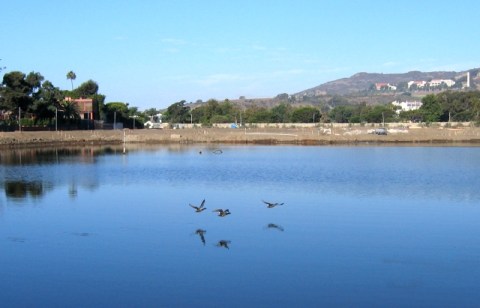
Three Mallards above channel water basin (L. Johnson 9/23/12)
Dewatering seems intermittent: the main basin has a lot of water, and the discharge pipe started spouting water while we were checking out the offshore birds. Speaking of offshore, it’s quite likely that many of the birds usually loafing in the lagoon were in the very large congregation of birds many hundreds of yards offshore. There must have been a sizable fish shoal: besides the gulls, terns and pelicans diving, we could see dolphins cutting through the crowd. Even shearwaters got into the action, peeling off from a steady stream of north-bound birds. I counted about 70 shearwaters per minute passing by. They were probably either Pink-footed or Sooty, which typically migrate through SoCal this time of year, whereas Black-vented Shearwaters pass by Nov – early March. They were much too far away for me to tell the difference. They are in the species list below as “Shearwater sp.” (sp. means “species not determined.”), but they’re not included in any of the totals.
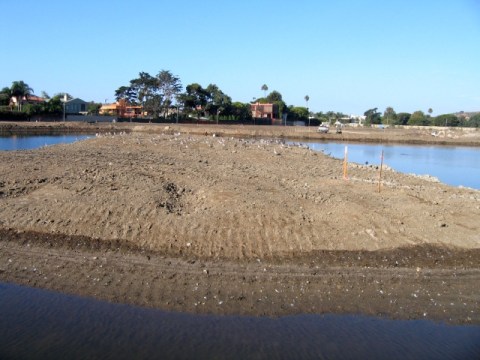
How many of the 100+ Black-bellied Plovers can can find in this picture of the channel area island? (L. Johnson 9/23/12)
There is an island now in the channels area and the Western Gulls and Black-bellied Plovers have moved in and made themselves quite comfortable: I counted 36 of the former and 100 (at least) of the latter. Otherwise, channel area birds were few: 3 Mallard, 3 Double-crested Cormorant, 1 Brown Pelican, 1 Snowy Egret, 3 California Gull, 2 Black Phoebe, 1 American Crow, 2 Great-tailed Grackle, plus 1 Bewick’s Wren in the vegetation between the path and PCH.
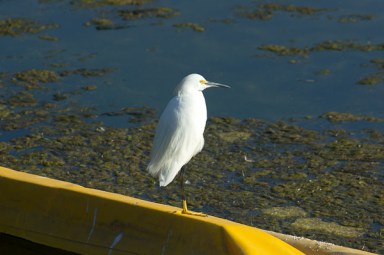
Snowy Egret’s feet match perfectly the yellow turbidity curtain float (C. Bragg 9/23/12)
This island reminded me of the long sand & gravel island which used to be in the middle of the lagoon. Until it disappeared during one of the El Nino winters in the ‘90’s, it was the favorite resting location for the birds. Except when feeding in the surf zone, they didn’t really use the beach much back then. Just like humans, they prefer feeling safe when they’re trying to sleep or loaf, and this island (except at the highest tides) gave them such protection.
The dead Brown Pelicans continue: I counted 8 in various stages of decomposition on the sand islands near the beach. The die-off, apparently due to starvation from lack of sufficient small fish, has been noted all along the U.S. west coast for many months.
While returning from Adamson House, Mary Prismon found the elusive Pectoral Sandpiper near the SE end of the PCH bridge, feeding in the mud among the reed stalks. I’d checked that area, but alas, it was not there for me. Thanks, Mary!
Our next three field trips: Bolsa Chica, 6 Oct. 8:30am; Malibu Lagoon, 28 Oct., 8:30am., Butterbredt Fall Campout, Nov 3-4, 8:30am.
Our next program: Tuesday, 2 October, 7:30 pm. Water Conservation and Sustainability – Kimberly O’Cain. The usual reminders will be emailed from the blog.
NOTE: Our 10 a.m. Parent’s & Kids Birdwalk remains canceled until the parking lot is again fully available.
Links: Unusual birds at Malibu Lagoon
Aerial photo of Malibu Lagoon from 9/23/02.
Prior checklists: July-Dec’11, Jan-June’11, July-Dec ’10, Jan-June ’10, Jul-Dec ‘09, and Jan-June ‘09.
Comments on Bird Lists Below
Total Birds: Sept. total birds of 1013 are 12% above average (Jul & Aug were down 9%), or 107 over the 6-year average of 906, which is not really significant. Brown Pelican numbers remain down, but Black-bellied Plover are well above average. Whimbrels and Elegant Terns are high, Snowy Plovers about average. Except for Starlings and Black Phoebes, passerines are down, probably due to the lack of vegetation. During the project so far, total bird numbers have been up & down, up & down, but usually not far from average either way, and such variations are typical.
Species Diversity: Of 115 total species appearing in September for 2007-12, no more than 68% of them appeared on any one count day. Since we began these 6-year comparisons in May, this “appearance rate” has fluctuated from 61% to 68% – intriguingly consistent. It seems to indicate that – whenever you visit – what you see is 1/2 – 2/3rds of what is possible at that time of year. September 2012 with 51 species is 20% below average. Reduced diversity was spread across all 9 categories of birds, but most significant in the passerines which was 7 species below the 6-year average of 22. We didn’t even have any swallows! The lack of vegetation, plus our inability to get to the remaining perimeter vegetation, seems to me to be the probable cause.
Summary of species diversity from the 6-year average so far: May +4%, June -10%, July +10%, August -6%, September -20%. September is the first significant variation from average, and was, in fact, the lowest September species count in 10 years. I suspect that census diversity will recover once we have full access to the lagoon perimeter and after vegetation (not yet planted) has taken hold, but we’ll have to wait and see. [Chuck Almdale]
| Malibu Census | 2007 | 2008 | 2009 | 2010 | 2011 | 2012 | |
| September 2007-12 | 9/23 | 9/28 | 9/27 | 9/26 | 9/25 | 9/23 | |
| Temperature | 72-80 | 70-79 | 61-69 | 73-80 | |||
| Tide Lo/Hi Height | H +4.5 | H +5.7 | H +3.9 | H +5.54 | H +5.33 | L +2.88 | Ave. |
| Tide Time | 0819 | 0917 | 0731 | 1055 | 0830 | 1021 | Birds |
| Brant | 5 | 0.8 | |||||
| Gadwall | 4 | 4 | 11 | 20 | 10 | 8.2 | |
| American Wigeon | 8 | 1 | 3 | 2.0 | |||
| Mallard | 44 | 16 | 22 | 48 | 48 | 34 | 35.3 |
| Cinnamon Teal | 5 | 0.8 | |||||
| Northern Shoveler | 4 | 6 | 8 | 4 | 10 | 11 | 7.2 |
| Northern Pintail | 1 | 0.2 | |||||
| Greater Scaup | 1 | 0.2 | |||||
| Red-brstd Merganser | 1 | 0.2 | |||||
| Ruddy Duck | 15 | 8 | 5 | 4.7 | |||
| Pacific Loon | 2 | 0.3 | |||||
| Pied-billed Grebe | 14 | 6 | 4 | 18 | 13 | 7 | 10.3 |
| Eared Grebe | 2 | 1 | 2 | 5 | 3 | 2.2 | |
| Western Grebe | 2 | 4 | 12 | 3.0 | |||
| Shearwater sp. | xxxxx | ||||||
| Brandt’s Cormorant | 1 | 1 | 4 | 1.0 | |||
| Dble-crstd Cormorant | 25 | 17 | 14 | 38 | 47 | 45 | 31.0 |
| Pelagic Cormorant | 1 | 3 | 2 | 1.0 | |||
| Brown Pelican | 62 | 43 | 12 | 46 | 60 | 22 | 40.8 |
| Great Blue Heron | 7 | 10 | 5 | 5 | 2 | 5 | 5.7 |
| Great Egret | 6 | 1 | 3 | 6 | 2 | 1 | 3.2 |
| Snowy Egret | 23 | 16 | 14 | 14 | 23 | 8 | 16.3 |
| Green Heron | 2 | 1 | 1 | 1 | 0.8 | ||
| Blk-crwnd N-Heron | 8 | 4 | 10 | 12 | 5.7 | ||
| Osprey | 1 | 1 | 0.3 | ||||
| Cooper’s Hawk | 1 | 1 | 0.3 | ||||
| Red-shouldered Hawk | 1 | 0.2 | |||||
| Red-tailed Hawk | 1 | 0.2 | |||||
| Merlin | 1 | 0.2 | |||||
| Peregrine Falcon | 1 | 1 | 0.3 | ||||
| Virginia Rail | 1 | 1 | 0.3 | ||||
| Sora | 1 | 2 | 1 | 3 | 1.2 | ||
| American Coot | 82 | 95 | 147 | 230 | 410 | 270 | 205.7 |
| Blk-bellied Plover | 85 | 102 | 78 | 40 | 160 | 77.5 | |
| Snowy Plover | 10 | 45 | 33 | 62 | 62 | 46 | 43.0 |
| Semipalmated Plover | 3 | 2 | 2 | 11 | 1 | 3.2 | |
| Killdeer | 6 | 4 | 4 | 1 | 6 | 6 | 4.5 |
| Black-necked Stilt | 1 | 0.2 | |||||
| Spotted Sandpiper | 2 | 3 | 1 | 2 | 2 | 3 | 2.2 |
| Willet | 16 | 18 | 33 | 56 | 7 | 3 | 22.2 |
| Whimbrel | 2 | 6 | 17 | 26 | 38 | 14.8 | |
| Long-billed Curlew | 1 | 0.2 | |||||
| Marbled Godwit | 1 | 4 | 4 | 22 | 2 | 3 | 6.0 |
| Ruddy Turnstone | 3 | 15 | 4 | 10 | 7 | 14 | 8.8 |
| Sanderling | 20 | 41 | 20 | 3 | 14.0 | ||
| Western Sandpiper | 18 | 1 | 28 | 7.8 | |||
| Least Sandpiper | 2 | 3 | 14 | 3 | 3.7 | ||
| Pectoral Sandpiper | 2 | 1 | 1 | 0.5 | |||
| Dunlin | 2 | 2 | 0.7 | ||||
| Short-billd Dowitcher | 6 | 1 | 1.2 | ||||
| Long-billed Dowitcher | 2 | 3 | 0.3 | ||||
| Wilson’s Snipe | 1 | 0.2 | |||||
| Wilson’s Phalarope | 1 | 0.2 | |||||
| Red-necked Phalarope | 1 | 0.2 | |||||
| Heermann’s Gull | 29 | 9 | 14 | 68 | 15 | 8 | 23.8 |
| Ring-billed Gull | 2 | 2 | 30 | 7 | 1 | 7.0 | |
| Western Gull | 72 | 80 | 84 | 73 | 66 | 93 | 78.0 |
| California Gull | 1 | 20 | 15 | 22 | 16 | 7 | 13.5 |
| Herring Gull | 1 | 0.2 | |||||
| Black Tern | 1 | 0.2 | |||||
| Common Tern | 8 | 1.3 | |||||
| Forster’s Tern | 1 | 6 | 1.2 | ||||
| Royal Tern | 1 | 1 | 15 | 11 | 4.7 | ||
| Elegant Tern | 5 | 8 | 5 | 40 | 4 | 87 | 24.8 |
| Parasitic Jaeger | 1 | 0.2 | |||||
| Rock Pigeon | 6 | 6 | 4 | 12 | 5 | 4 | 6.2 |
| Mourning Dove | 1 | 2 | 2 | 2 | 1.2 | ||
| Black Swift | 1 | 0.2 | |||||
| Vaux’s Swift | 20 | 100 | 20.0 | ||||
| Anna’s Hummingbird | 8 | 1 | 3 | 2 | 3 | 2.8 | |
| Allen’s Hummingbird | 3 | 6 | 2 | 1 | 1 | 3 | 2.7 |
| Belted Kingfisher | 1 | 1 | 1 | 1 | 1 | 0.8 | |
| Western Wood-Pewee | 2 | 1 | 0.5 | ||||
| Gray Flycatcher | 1 | 0.2 | |||||
| Pac.Slope Flycatcher | 2 | 0.3 | |||||
| Black Phoebe | 8 | 6 | 7 | 5 | 6 | 9 | 6.8 |
| Say’s Phoebe | 1 | 1 | 0.3 | ||||
| Ash-throated Flycatcher | 1 | 0.2 | |||||
| Cassin’s Kingbird | 2 | 1 | 0.5 | ||||
| Western Kingbird | 4 | 0.7 | |||||
| Western Scrub-Jay | 1 | 0.2 | |||||
| American Crow | 5 | 6 | 6 | 3 | 2 | 1 | 3.8 |
| Rough-wingd Swallow | 20 | 4 | 1 | 4.2 | |||
| Tree Swallow | 1 | 0.2 | |||||
| Barn Swallow | 14 | 2 | 1 | 30 | 7.8 | ||
| Oak Titmouse | 2 | 0.3 | |||||
| Bushtit | 10 | 25 | 7 | 11 | 6 | 4 | 10.5 |
| Bewick’s Wren | 1 | 1 | 1 | 0.5 | |||
| House Wren | 1 | 3 | 2 | 1 | 1 | 1.3 | |
| Marsh Wren | 1 | 1 | 4 | 1.0 | |||
| Northern Mockingbird | 3 | 2 | 3 | 3 | 2 | 3 | 2.7 |
| European Starling | 6 | 16 | 8 | 62 | 23 | 45 | 26.7 |
| American Pipit | 1 | 0.2 | |||||
| Ornge-crwnd Warbler | 3 | 1 | 1 | 1 | 1 | 1.2 | |
| Yellow Warbler | 2 | 2 | 0.7 | ||||
| Blk-throated G. Warbler | 1 | 0.2 | |||||
| Townsend’s Warbler | 1 | 0.2 | |||||
| Common Yellowthroat | 2 | 3 | 3 | 4 | 5 | 2 | 3.2 |
| Wilson’s Warbler | 10 | 1 | 2 | 2.2 | |||
| Spotted Towhee | 1 | 1 | 0.3 | ||||
| California Towhee | 3 | 2 | 2 | 1 | 3 | 1.8 | |
| Savannah Sparrow | 2 | 2 | 1 | 1 | 1.0 | ||
| Song Sparrow | 3 | 2 | 4 | 4 | 3 | 1 | 2.8 |
| White-crwnd Sparrow | 6 | 4 | 1.7 | ||||
| Blue Grosbeak | 1 | 0.2 | |||||
| Lazuli Bunting | 6 | 1.0 | |||||
| Bobolink | 1 | 0.2 | |||||
| Red-winged Blackbird | 30 | 7 | 14 | 18 | 8 | 12.8 | |
| Western Meadowlark | 1 | 4 | 3 | 1.3 | |||
| Brewer’s Blackbird | 1 | 15 | 2.7 | ||||
| Great-tailed Grackle | 2 | 12 | 6 | 3.3 | |||
| Brwn-headed Cowbird | 3 | 1 | 3 | 1.2 | |||
| Bullock’s Oriole | 1 | 0.2 | |||||
| House Finch | 8 | 4 | 4 | 10 | 12 | 1 | 6.5 |
| Lesser Goldfinch | 10 | 1 | 2 | 2 | 4 | 3.2 | |
| Lawrence’s Goldfinch | 2 | 0.3 | |||||
| Totals by Type | 9/23 | 9/28 | 9/27 | 9/26 | 9/25 | 9/23 | Ave. |
| Waterfowl | 57 | 26 | 51 | 93 | 79 | 51 | 60 |
| Water Birds-Other | 188 | 164 | 185 | 339 | 542 | 363 | 297 |
| Herons, Egrets | 46 | 27 | 27 | 36 | 40 | 14 | 32 |
| Raptors | 1 | 3 | 1 | 1 | 1 | 2 | 2 |
| Shorebirds | 147 | 116 | 243 | 325 | 161 | 279 | 212 |
| Gulls & Terns | 107 | 122 | 120 | 249 | 124 | 207 | 155 |
| Doves | 6 | 7 | 6 | 14 | 7 | 4 | 7 |
| Other Non-Pass. | 33 | 8 | 6 | 4 | 105 | 3 | 27 |
| Passerines | 158 | 83 | 61 | 176 | 133 | 90 | 117 |
| Totals Birds | 743 | 556 | 700 | 1237 | 1192 | 1013 | 907 |
| Total Species | 9/23 | 9/28 | 9/27 | 9/26 | 9/25 | 9/23 | Ave. |
| Waterfowl | 4 | 3 | 6 | 6 | 5 | 4 | 4.7 |
| Water Birds-Other | 7 | 7 | 8 | 7 | 9 | 7 | 7.5 |
| Herons, Egrets | 5 | 3 | 5 | 5 | 5 | 3 | 4.3 |
| Raptors | 1 | 3 | 1 | 1 | 1 | 2 | 1.5 |
| Shorebirds | 11 | 11 | 14 | 16 | 12 | 12 | 12.7 |
| Gulls & Terns | 4 | 8 | 5 | 9 | 7 | 6 | 6.5 |
| Doves | 1 | 2 | 2 | 2 | 2 | 1 | 1.7 |
| Other Non-Pass. | 5 | 3 | 3 | 3 | 4 | 1 | 3.2 |
| Passerines | 27 | 19 | 18 | 29 | 23 | 15 | 21.8 |
| Totals Species – 115 | 65 | 59 | 62 | 78 | 68 | 51 | 63.8 |
Recent Blog Changes
All additional pages are listed just below the Snowy Plover photo.
Printable Calendar: We changed the format so it now prints as a 2-page letter format PDF file.
Printable Malibu Lagoon Checklist: New to the blog. Same location and set-up as the Calendar. Same checklist as the one we hand out at the lagoon.
Los Angeles County Birding Spots: Many changes, with more to come.
1. New section on Parakeets & Parrots
2. New section on Doves and Other Oddities
3. New jump links so you can get to the section you want at hyperspeed!
4. More maps
Tell your friends & neighbors!
[Chuck Almdale]
Pole to Pole: A Global WarNing – How the Ice Foretells the Next Systemic Transformation
An Oppenheim Lecture featuring Sebastian Copeland, award-winning photographer, explorer, and environmental advocate
Link to UCLA Blog about the program.
Wednesday, October 24, 2012
6:00 PM Reception
7:00 PM – 8:30 PM Lecture
UCLA Fowler Museum, Lenart Auditorium
Los Angeles, CA 90095
RSVP by Wednesday, October 17, 2012
RESERVATIONS ARE REQUIRED
In 2011 Mr. Copeland walked to the North Pole, to honor the 100th anniversary of Admiral Peary’s first expedition to the geographic North Pole, and to do this before the Arctic ice is too thin from global warming to make the trip by foot. Join him as he shares this incredible trip, the discoveries he made during this journey and the geopolitical consequences of these changes in the Arctic.
The above announcement is supplied as being of possible interest to our readers.
[Chuck Almdale]
L.A. River Trip Report: 8 Sep., 2012
Our third annual field trip along the banks of the lower reaches of the L.A. River turned out to be relatively quiet. Our leader Dick Barth had urged us to set an early start time of 7:30 to avoid the seasonal heat. We were glad we did–it was quite warm by mid-morning. Some of us were stuck behind an accident clearing traffic break on the I-405 and we didn’t make it for the official start time near the Willow Street bridge.
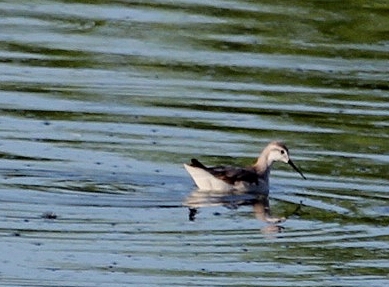
Notice the self-make whirlpool behind this basic-plumage Wilson’s Phalarope (J. Waterman 9/8/12)
This first stop features a look at the most vegetated area of the River, where the willows and other plants have succeeded in blocking most of the view of the Harbor’s huge derricks only a couple miles downstream. The brushy habitat provides cover and food for bush birds, and sediment makes many pools and sandbanks for ducks and waders. Even though there were fewer ducks than last year, almost all expected species were there. Hundreds of Black-necked Stilts browsed in the shallows of the river. The treat was a number of Wilson’s Phalaropes, in and out of the water. As we moved back toward the cars, we got to compare the features of a Red-necked Phalarope – juvenile moulting into basic plumage (see slideshow photo) – and compare it to the Wilson’s.
The most uncommon bird for this location was – oddly enough – a Brandt’s Cormorant. We see this normally pelagic species in small numbers on most Malibu Lagoon trips, swimming or sitting on the offshore rocks. Dick said he is unaware of any prior records of Brandt’s this far (3 miles) up the river.
Hoping to see some of the rarer
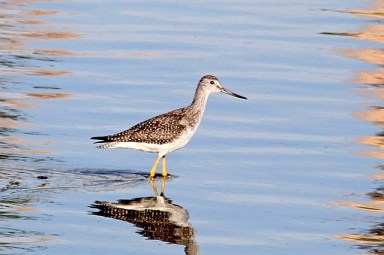
The bill of the Greater Yellowlegs has a slight upturn (unlike the slim straight bill of the Lesser). Fairly common at the Willow St. spot. (J. Waterman 9/8/12)
sandpiper species that have been spotted in the past few weeks, at 9AM we skipped all the way upstream to the Allondra bridge in Paramount. Our 40 minutes there gained us a few new species and we were able to spend time studying the proportions of the Lesser Yellowlegs which – at 3-4 birds – were almost abundant.
We then traveled back down river by car to De Forest Park. The park trees held only a few Yellow-rumped Warblers and our observations of the river were a repeat of the earlier species of our walk. At 11AM, just as we were preparing to leave, we saw a two-minute hunt from a juvenile Peregrine Falcon, followed by a Red-shouldered Hawk overflight.

Red-shouldered Hawk seems very interested in that tree to his left (J. Waterman 9/8/12)
We didn’t try to estimate numbers this trip. The most abundant birds, by far, were Black-necked Stilts and Long-billed Dowitchers.
Many thanks to Richard Barth who knows this area better than anyone. His knowledge and enthusiastic explanations of difficult plumage are invaluable, especially during migration season!
Link to 2011 LA River Trip Report
Link to 2010 LA River Trip Report
Link to Map of Trip
[Lucien Plauzoles]
| Los Angeles River Trip | 8 Sept., 2012 – 56 species |
| Mallard | Long-billed Dowitcher |
| Cinnamon Teal | Wilson’s Phalarope |
| Northern Shoveler | Red-necked Phalarope |
| Northern Pintail | Ring-billed Gull |
| Green-winged Teal | Western Gull |
| Ruddy Duck | California Gull |
| Pied-billed Grebe | Rock Pigeon |
| Brandt’s Cormorant | Eurasian Collared-Dove |
| Double-crested Cormorant | Mourning Dove |
| Brown Pelican | Anna’s Hummingbird |
| Great Blue Heron | Peregrine Falcon |
| Great Egret | Black Phoebe |
| Snowy Egret | Western Scrub-Jay |
| Green Heron | American Crow |
| Black-crwned Night-Heron | No. Rough-winged Swallow |
| Turkey Vulture | Cliff Swallow |
| Red-Shouldered Hawk | Barn Swallow |
| American Coot | Bushtit |
| Semipalmated Plover | Northern Mockingbird |
| Killdeer | European Starling |
| Black-necked Stilt | Common Yellowthroat |
| American Avocet | Yellow-rumped Warbler |
| Spotted Sandpiper | California Towhee |
| Greater Yellowlegs | Song Sparrow |
| Lesser Yellowlegs | Red-winged Blackbird |
| Western Sandpiper | House Finch |
| Least Sandpiper | House Sparrow |
| Short-billed Dowitcher | Orange Bishop |
Cliff Swallow needs Flock; Pesticide-laden Wild Bird Food
The California WIldlife Center in Malibu is urgently looking for a flock of Cliff Swallows that have not yet migrated south, in order to release a rehabbed bird to join them. If there are any sightings of cliff swallows, please notify them right away at 818-591-9453.
[Submitted by Monica Minden, volunteer at CWC]
[Note – I called them, suggesting checking Malibu Civic Center & lagoon to see if any Cliff Swallows were still around. Chukar.]
The Environmental Protection Agency on Friday slapped $12.5 million in fines and penalties on Scotts Miracle-Gro after the company admitted it had added pesticides to its wild bird food in order to protect the product while in storage. The EPA stated that, in an earlier plea deal, Scotts acknowledged the pesticides Actellic 5E and Storcide II were applied even though EPA had prohibited their use for that.
“Scotts admitted that it used these pesticides contrary to EPA directives and in spite of the warning label appearing on all Storicide II containers stating, ‘Storcide II is extremely toxic to fish and toxic to birds and other wildlife’,” said the EPA. [More on the website.]
[From NBC News.com, by Miguel Llanos, 9/7/12]
[Chuck Almdale]



 SANTA MONICA BAY AUDUBON SOCIETY BLOG