Free email delivery
Please sign up for email delivery in the subscription area to the right.
No salesman will call, at least not from us. Maybe from someone else.
Blogs & Websites
Series on the Western Snowy Plover
I recently finished a 7-part series on Western Snowy Plovers, which is now posted on the Malibu (California) Patch blogsite.
It contains a couple of typographical errors.
*************************************
If you’ve looked at our permanent page on the Malibu Lagoon Restoration Project, you know that we’ve been doing 10-year comparative censuses of the birds of the lagoon. I recently put these figures into a Malibu Patch blog, with a bit more explanation for the general reader who might not know a raptor from a passerine. Bottom line: So far, the project is not having a significant effect on the birds.
*************************************
The Cornell Laboratory of Ornithology is a great outfit, well worth supporting if you have a few extra dollars rattling around. They also have a great website. One of their useful features is All About Birds. On various species it has photos, sounds, videos, facts of all sorts. One useful feature, difficult to find elsewhere, is it shows the entire range of a species including its wintering range south of the border. So if you’re wondering about the Cerulean Warbler, for example, a name-search will quickly show you that it breeds in the Eastern U.S., migrates through eastern Mexico and winters in South America from Venezuela to Bolivia.
[Chuck Almdale]

One of the Ballona Salt Marsh channels (Leslie Davidson ’07)
Ballona Wetlands is recruiting volunteers for the Audubon Society’s education program to lead small groups of schoolchildren on nature walks. No experience necessary. Six Tuesday classes of docent training will be offered beginning Sept 11, 2012 from 9 a.m. to noon. For more information call Diana at 310-821-6444.
Link to our website.
Thanks so much.
Diana Spurlin
SANTA MONICA BAY AUDUBON SOCIETY
STATEMENT OF SUPPORT FOR
THE MALIBU LAGOON RESTORATION PROJECT
August 3, 2012
The Board of Directors of Santa Monica Bay Audubon Society (SMBAS) supports the Malibu Lagoon Restoration Project. This is not a new position for us. Members of SMBAS began attending the Malibu Lagoon Task Force (MTLF) meetings in the 1990’s. We took part in the numerous MLTF discussions, and our suggestion to add ornithological expert Kimball Garrett to the Lagoon Technical Advisory Committee was accepted. At the conclusion of the planning phase, we voted in favor of the MTLF final recommendations. In October 2010, we sent a statement to the California Coastal Commission affirming our support for the project; we now reiterate our continuing support.
Over the past two months we have observed the progress of the project and have witnessed nothing unexpected, unplanned or dangerous. We continue to hold monthly bird walks at the lagoon as we have done for almost thirty years. We continue our monthly censusing of the birds at the lagoon and of the Western Snowy Plovers at their winter roost on the beach. Our results indicate that as yet the project has had no affect on the lagoon’s birdlife, either in species diversification or total bird numbers; both quantities are varying within their usual ranges for the most recent ten-year period. Western Snowy Plovers, a threatened species which roosts on Surfrider Beach adjacent to the lagoon, are similarly unaffected.
Based on our observations, bird population in the channels average approximately five percent of that in the main lagoon. Our understanding is that low oxygen and high bacteria levels in the channels severely limited invertebrate populations in the mud substrate, leaving little for the birds to eat.
We continue to support the plan: to remove the fill dirt placed there decades ago, redesign the channels to create better water circulation and increase ground area subject to water level fluctuation, replant the area with native plants appropriate to a brackish wetland, and redesign the pathway to the beach.
The Board of Santa Monica Bay Audubon Society
Charles G. Bragg, President
*******************************************
The above notice was sent on August 3, 2012 to California State Parks for their records. It also was sent to the California Coastal Commission, to reiterate SMBAS’s support for the project. The Coastal Commission currently is reviewing a petition from project opponents to revoke the project permit. [Chuck Almdale]
Full Sturgeon Moon 8/1/12 4:27 p.m. PDT
Here’s another update from SMBAS Blog on that large, circular, shining object which has frequently and mysteriously appeared in our nighttime sky this year (some, speaking in hushed whispers, call it…the moon).
Aug. 1, 4:27 p.m. PDT — Full Sturgeon Moon, when this large fish of the Great Lakes and other major bodies of water, such as Lake Champlain, is most readily caught. A few tribes knew this moon as the Full Red Moon because when the moon rises, it appears reddish through sultry haze (in 2012, “The Old Farmer’s Almanac” gives this moniker to the full moon of Aug. 31). Other variations include the Green Corn Moon or Grain Moon.
The next significant full moon will occur on Aug. 31, 6:58 a.m. PDT. Keep an eye on this spot for additional breaking news on this unprecedented event.
This information comes to you courtesy of:
http://www.msnbc.msn.com/id/45911225/ns/technology_and_science-space/t/how-s-full-moons-got-their-strange-names/#.T16CDHlIXUx
But that’s waaaaay too long to type in, and besides, you don’t need to go there because SMBAS has done the work for you!
[Chuck Almdale]
Malibu Lagoon Trip Report: 22 July, 2012
Don’t forget to visit our new page for the Malibu Lagoon 2012 Project, frequently updated with new photos.
The west channels area continues as a muddy mess. The remaining vegetation is almost gone and the footbridges are gone. In the channel area we found 10 Mallards, 7 Snowy Egrets, 1 Coot, 1 Spotted Sandpiper, 2 Western Gulls and 3 Black Phoebes. At the southwest corner of the path, which is slated to get a few picnic tables, we found an active feeding flock: Mourning Dove, Allen’s Hummingbird, Black Phoebe, Western Scrub Jay, American Crow, Oak Titmouse, Bushtit, Northern Mockingbird, European Starling, California Towhee, Song and Lincoln’s Sparrows, Hooded Oriole and House Finch. Whew!

How many birds and what are they? Answers below; no peeking! (A.Albaisa 7/22/12)
Almost nothing was on the sea, save a few Snowy Egrets staggering across the floating kelp, which always shocks those who haven’t witnessed this before. An odd-looking White-winged Scoter, uncommon here at any time of year, was diving in the surf zone. Next to the colony fence we found the dewatering system outlet pipe, the end of which was hanging over a large wooden framework full of boulders. The boulders are to dissipate the force of the discharged water so it doesn’t significantly erode the sand.
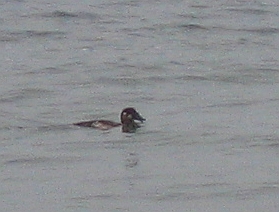
Odd-looking White-winged Scoter (L. Johnson 7/22/12)
As usual, most of the sea- and shorebirds were on the sand islands near the lagoon’s south shore. June’s unusually large flock of 340 Brown Pelicans had dwindled to only 17 birds. The numbers of Swallows – Rough-winged, Barn and Cliff – were also about average. The Barn Swallows were especially busy swooping low over the sand, scarfing up the sand flies.
Snowy Plovers were back from breeding, as they always are in late July. It was just before high tide, so all 22 of them were still roosting about 75 yds. east of the symbolic enclosure. If they continue roosting there, we may have to move the enclosure.
The large “cliffs” at either end of the controversial June beach breach area had eroded to become almost unnoticeable. In fact, I didn’t notice their absence until pointed out to me. Farther on, Adamson House was notable primarily for a single Bullock’s Oriole, and the 8 Allen’s Hummingbirds frequenting the flowers. Other than being cool and overcast, it was a fairly typical July day for birding at the beach.
Our next three field trips: Malibu Lagoon, 26 Aug.; Lower Los Angeles River, 8 Sept., 7:30am; Malibu Lagoon, 23 Sep., 8:30am.
Our next program: Tuesday, 2 October, 7:30 pm. Water Conservation and Sustainability – Kimberly O’Cain. The usual blog reminders will be emailed.
NOTE: Our 10 a.m. Parent’s & Kids Birdwalk remains canceled until the lagoon project is completed and the parking lot is again fully available.
Links: Unusual birds at Malibu Lagoon
Aerial photo of Malibu Lagoon from 9/23/02.
Prior checklists: July-Dec’11, Jan-June’11, July-Dec ’10, Jan-June ’10, Jul-Dec ‘09, and Jan-June ‘09.
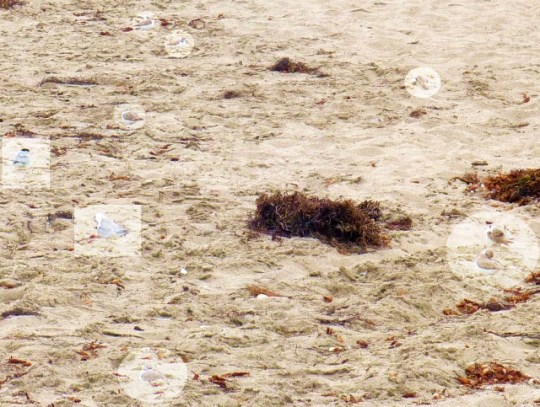
Photographer thinks 7 Snowy Plover, 2 Least Tern; I think one more Snowy. (A.Albaisa 7/22/12)
Comments on Bird Lists Below
Species Diversity: No census was taken in July 2008, so June 2006 is included to keep comparisons at six years. Of 79 total species appearing in July for 2006-12, no more than 66% of them appeared on any one count day, something to keep in mind if you wonder why what is there is much less than what could be there. July 2012 gets the species high count of 52, 5 species (11%) above average; so far, the project is not having an adverse effect on diversity. This contradicts my expectation expressed in June that diversity would continue lower than average, so my only prediction this month is that some of you will get the plover quiz right, some won’t.
Total Birds: The opposite of June – species diversity was high, but total numbers were low, 556 (91%) of the 610 average, which is not really significant. Unusually low numbers of Brown Pelican (17) was the primary reason.
[Chuck Almdale]
| Malibu Census | 2006 | 2007 | 2009 | 2010 | 2011 | 2012 | |
| June 2006 – 2012 | 23-Jul | 22-Jul | 26-Jul | 25-Jul | 24-Jul | 22-Jul | |
| Temperature | 68-75 | 60-67 | 65-72 | 64-70 | |||
| Tide Lo/Hi Height | H +3.9 | L +2.2 | L +0.4 | H +4.05 | L +2.61 | H +2.34 | Ave. |
| Tide Time | 1015 | 0848 | 0704 | 1036 | 0947 | 1121 | Birds |
| Brant | 1 | 6 | 1.2 | ||||
| Gadwall | 7 | 12 | 4 | 3.8 | |||
| Mallard | 65 | 50 | 25 | 49 | 54 | 42 | 47.5 |
| White-winged Scoter | 1 | 0.2 | |||||
| Red-brstd Merganser | 2 | 0.3 | |||||
| Ruddy Duck | 1 | 3 | 2 | 1.0 | |||
| Pied-billed Grebe | 1 | 12 | 6 | 5 | 4 | 4 | 5.3 |
| Dble-crstd Cormorant | 6 | 9 | 15 | 20 | 31 | 24 | 17.5 |
| Pelagic Cormorant | 1 | 1 | 0.3 | ||||
| Brown Pelican | 37 | 78 | 40 | 187 | 407 | 17 | 127.7 |
| Great Blue Heron | 11 | 9 | 3 | 6 | 6 | 1 | 6.0 |
| Great Egret | 17 | 5 | 5 | 4 | 4 | 1 | 6.0 |
| Snowy Egret | 12 | 10 | 40 | 14 | 11 | 11 | 16.3 |
| Green Heron | 2 | 1 | 0.5 | ||||
| Blk-crwnd N-Heron | 5 | 3 | 2 | 4 | 11 | 4.2 | |
| Osprey | 1 | 1 | 0.3 | ||||
| Cooper’s Hawk | 1 | 0.2 | |||||
| Red-tailed Hawk | 1 | 1 | 1 | 1 | 0.7 | ||
| Sora | 1 | 0.2 | |||||
| American Coot | 2 | 28 | 20 | 15 | 20 | 12 | 16.2 |
| Blk-bellied Plover | 1 | 4 | 45 | 8.3 | |||
| Snowy Plover | 10 | 4 | 1 | 26 | 13 | 22 | 12.7 |
| Semipalmated Plover | 6 | 2 | 1.3 | ||||
| Killdeer | 2 | 3 | 2 | 3 | 1.7 | ||
| Black Oystercatcher | 1 | 0.2 | |||||
| Spotted Sandpiper | 1 | 0.2 | |||||
| Greater Yellowlegs | 1 | 0.2 | |||||
| Willet | 3 | 1 | 7 | 1.8 | |||
| Whimbrel | 5 | 3 | 1 | 48 | 42 | 16.5 | |
| Ruddy Turnstone | 3 | 7 | 5 | 2.5 | |||
| Black Turnstone | 8 | 1 | 2 | 1.8 | |||
| Red Knot | 2 | 0.3 | |||||
| Sanderling | 6 | 4 | 1.7 | ||||
| Western Sandpiper | 8 | 1 | 20 | 2 | 2 | 5.5 | |
| Least Sandpiper | 2 | 1 | 3 | 1.0 | |||
| Short-billd Dowitcher | 2 | 0.3 | |||||
| Boneparte’s Gull | 2 | 0.3 | |||||
| Heermann’s Gull | 7 | 12 | 12 | 125 | 41 | 12 | 34.8 |
| Ring-billed Gull | 8 | 4 | 4 | 1 | 2.8 | ||
| Western Gull | 55 | 109 | 30 | 80 | 107 | 95 | 79.3 |
| California Gull | 2 | 1 | 2 | 0.8 | |||
| Least Tern | 12 | 8 | 36 | 13 | 3 | 12.0 | |
| Caspian Tern | 6 | 5 | 13 | 3 | 4.5 | ||
| Common Tern | 1 | 0.2 | |||||
| Royal Tern | 2 | 2 | 3 | 1.2 | |||
| Elegant Tern | 33 | 10 | 8 | 45 | 16.0 | ||
| Black Skimmer | 35 | 1 | 1 | 6.2 | |||
| Rock Pigeon | 2 | 6 | 1 | 6 | 6 | 2 | 3.8 |
| Eur. Collared-Dove | 1 | 0.2 | |||||
| Mourning Dove | 2 | 1 | 4 | 3 | 2 | 2.0 | |
| Anna’s Hummingbird | 2 | 3 | 1 | 1 | 3 | 1 | 1.8 |
| Allen’s Hummingbird | 2 | 4 | 3 | 6 | 3 | 9 | 4.5 |
| Belted Kingfisher | 1 | 0.2 | |||||
| Black Phoebe | 7 | 4 | 6 | 2 | 8 | 5 | 5.3 |
| Western Kingbird | 5 | 1 | 1.0 | ||||
| Western Scrub-Jay | 1 | 0.2 | |||||
| American Crow | 7 | 6 | 1 | 6 | 4 | 6 | 5.0 |
| Rough-wingd Swallow | 3 | 6 | 2 | 5 | 20 | 5 | 6.8 |
| Barn Swallow | 20 | 30 | 12 | 20 | 18 | 20 | 20.0 |
| Cliff Swallow | 5 | 25 | 24 | 10 | 25 | 15 | 17.3 |
| Oak Titmouse | 1 | 0.2 | |||||
| Bushtit | 8 | 6 | 6 | 8 | 8 | 6.0 | |
| Bewick’s Wren | 1 | 0.2 | |||||
| Wrentit | 1 | 1 | 0.3 | ||||
| Northern Mockingbird | 3 | 2 | 3 | 2 | 2 | 5 | 2.8 |
| European Starling | 8 | 8 | 6 | 80 | 38 | 17 | 26.2 |
| Common Yellowthroat | 1 | 3 | 2 | 4 | 1 | 1 | 2.0 |
| California Towhee | 1 | 2 | 2 | 3 | 1 | 1.5 | |
| Song Sparrow | 1 | 4 | 1 | 3 | 1 | 4 | 2.3 |
| Lincoln’s Sparrow | 1 | 0.2 | |||||
| Western Tanager | 1 | 0.2 | |||||
| Red-winged Blackbird | 37 | 6 | 2 | 1 | 17 | 10.5 | |
| Great-tailed Grackle | 1 | 1 | 3 | 5 | 1.7 | ||
| Brwn-headed Cowbird | 1 | 1 | 1 | 3 | 6 | 2.0 | |
| Hooded Oriole | 2 | 4 | 6 | 2 | 2.3 | ||
| Bullock’s Oriole | 1 | 0.2 | |||||
| House Finch | 5 | 6 | 24 | 2 | 4 | 35 | 12.7 |
| Lesser Goldfinch | 2 | 0.3 | |||||
| House Sparrow | 4 | 0.7 | |||||
| Totals by Type | 23-Jul | 22-Jul | 26-Jul | 25-Jul | 24-Jul | 22-Jul | Ave. |
| Waterfowl | 73 | 62 | 26 | 58 | 56 | 49 | 54 |
| Water Birds-Other | 47 | 128 | 81 | 227 | 463 | 57 | 167 |
| Herons, Egrets | 47 | 28 | 50 | 28 | 32 | 13 | 33 |
| Quail & Raptors | 2 | 2 | 1 | 1 | 0 | 1 | 1 |
| Shorebirds | 22 | 23 | 4 | 127 | 32 | 128 | 56 |
| Gulls & Terns | 123 | 140 | 44 | 306 | 175 | 161 | 158 |
| Doves | 2 | 8 | 3 | 10 | 9 | 4 | 6 |
| Other Non-Pass. | 4 | 7 | 5 | 7 | 6 | 10 | 7 |
| Passerines | 99 | 121 | 95 | 152 | 167 | 133 | 128 |
| Totals Birds | 419 | 519 | 309 | 916 | 940 | 556 | 610 |
| Total Species | 23-Jul | 22-Jul | 26-Jul | 25-Jul | 24-Jul | 22-Jul | Ave. |
| Waterfowl | 3 | 2 | 2 | 3 | 2 | 4 | 2.7 |
| Water Birds-Other | 5 | 5 | 4 | 4 | 5 | 4 | 4.5 |
| Herons, Egrets | 5 | 5 | 4 | 4 | 4 | 3 | 4.2 |
| Quail & Raptors | 2 | 2 | 1 | 1 | 0 | 1 | 1.2 |
| Shorebirds | 4 | 7 | 4 | 10 | 8 | 11 | 7.3 |
| Gulls & Terns | 7 | 6 | 3 | 9 | 8 | 7 | 6.7 |
| Doves | 1 | 2 | 3 | 2 | 2 | 2 | 2.0 |
| Other Non-Pass. | 2 | 2 | 3 | 2 | 2 | 2 | 2.2 |
| Passerines | 13 | 18 | 16 | 16 | 19 | 18 | 16.7 |
| Totals Species – 79 | 42 | 49 | 40 | 51 | 50 | 52 | 47.3 |



 SANTA MONICA BAY AUDUBON SOCIETY BLOG