Free email delivery
Please sign up for email delivery in the subscription area to the right.
No salesman will call, at least not from us. Maybe from someone else.
Magnetic Birds? Or not? Birds & Other Science in the News
Here’s a good article with lots of pictures of fossil birds. Because birds have such thin bones (pneumaticized and all that), there really aren’t many good fossils of them.
Paleobirding: What Birds Looked Like 125 Million Years ago
By Daniela Hernandez
From: Wired Science, April 9, 2012
http://www.wired.com/wiredscience/2012/04/paleo-birding/?pid=3498&viewall=true
**********************************************
New Study Overturns Prevailing Theory of How Birds Navigate
By Matt Mendenhall
From: Bird Watching Daily, April 13, 2012
Scientists have thrown cold water on the theory that iron-rich nerve cells in birds’ bills help them navigate using Earth’s magnetic field.
http://cs.birdwatchingdaily.com/BRDCS/blogs/field_of_view/archive/2012/04/11/New-study-overturns-prevailing-theory-of-how-birds-navigate.aspx
**********************************************
The Los Angeles Times reports on the same study.
Bird’s Sense of Direction Still Up In the Air
A new study undermines a long-held theory that certain cells in the beak act as magnetoreceptors to detect the Earth’s magnetic field. The findings conclude those cells just fight off infection.
By Amina Khan
From: Los Angeles Times, April 13, 2012
http://www.latimes.com/news/science/la-sci-bird-navigation-beaks-20120414,0,4807202.story
**********************************************
**********************************************
If you are a regular reader of the Los Angeles Times, you may have noticed that many of the science articles are written by Amina Khan. The only biographical information I could find on her was: “Science writer at the Los Angeles Times. I geek out for a living.” She’s very good: she writes on great topics, she’s succinct and clear. I’m a fan of hers. Here’s a few of her many many articles from the LA Times.
***********************
Supernova Traced to Collision of White Dwarf Stars
Two scientists studying a Type 1a supernova may have pinned down the cause of such massive stellar explosions, they report in the journal Nature. 1/14/12
[This is one of my favorites, as it discusses the impact this discovery may have on the existence (or non-existence) of “dark energy”, the proposed driver of the presumed increasing speed of expansion of the universe.]
http://www.latimes.com/news/science/la-sci-supernova-20120114,0,2324818.story
**********************************************
Dinosaur feathers: Fossils indicate T. rex cousin had shaggy coat
Yutyrannus huali fossils, found in China, show that the giants had primitive fuzzy feathers at least in patches and probably in a full coat, a scientist says. 1/4/12
http://www.latimes.com/news/science/la-sci-giant-feathered-dinosaur-20120405,0,5455707.story
**********************************************
A gun in hand makes a man look taller, study says
In a study of how people assess danger, participants who looked at photos of hands holding different objects thought the gun bearers were the tallest. 4/12/12
http://www.latimes.com/news/science/la-sci-weapons-height-20120412,0,809520.story
**********************************************
Study finds link between autism and obesity during pregnancy
Women with diabetes or hypertension were also more likely to have children with developmental delays. 4/8/12
http://www.latimes.com/health/la-he-autism-obese-mothers-20120409,0,1741964.story
**********************************************
Human ancestors used fire earlier than thought, study says
Charred bones in a South African cave suggest that Homo erectus was utilizing fire a million years ago, and may even have been cooking, researchers say. 4/3/12
http://www.latimes.com/news/science/la-sci-fire-20120403,0,5516323.story
**********************************************
[Chuck Almdale]
Walker Ranch Trip Report: Sat. 7 April, 2012
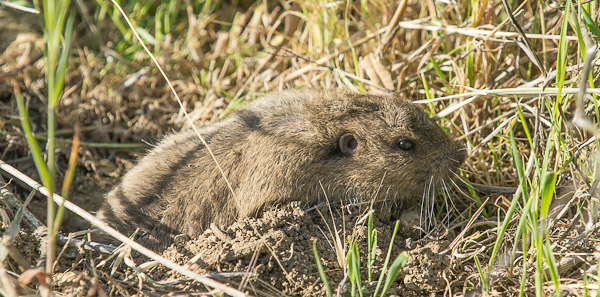
Pocket Gopher, most likely Botta's - Thomomys bottae. (C.Bragg 4/7/12)
A shame we didn’t have more people out for this trip – the weather was perfect and the warblers were moving through. We started the day with a UFO (Unidentified Furry Object) that we suppose was a vole. [Later examination makes me think it is a pocket gopher. – Ed.] Down in the many many oak trees we found many many Acorn Woodpeckers, more Nuttall’s Woodpeckers heard than seen, and a few flickers.
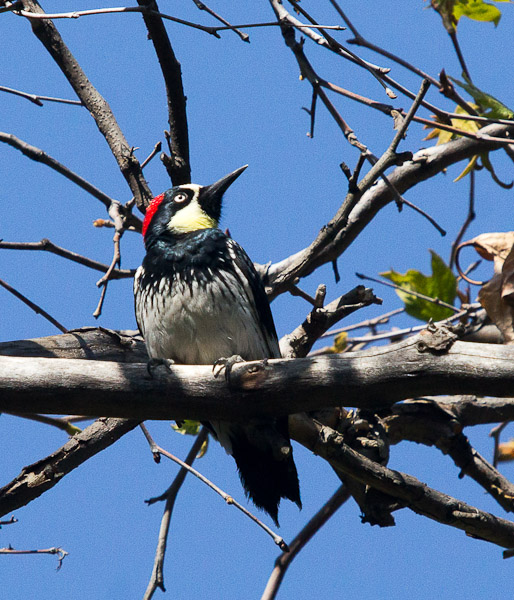
Acorn Woodpeckers were everywhere. (C.Bragg 4/7/12)
Walker Ranch is well-known among local birders as one of the few places where you can find Western Scrub-Jay and Steller’s Jays in the same trees. The chaparral-loving ‘scrubbies’ are usually found at lower altitudes than the Steller’s, which are more commonly found in conifers. Upstream in the early morning, Mountain Quail come down to drink, and can often be heard calling.
Warblers abounded (see list below).
The Nashville Warbler was probably the most notable; although most people saw only one or two, the other Chuck saw a larger group when he wandered off through the picnic area. There were at least a dozen or so Black-throated Gray Warblers, and one of them was incautious enough to be photographed. [Check out the difficult-to-see yellow loral spot! – Ed]
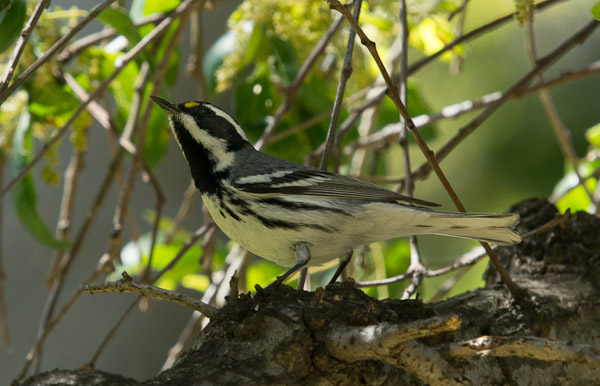
Black-throated Gray Warbler dressed in his breeding best. (C.Bragg 4/7/12)
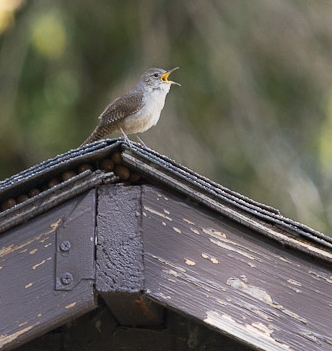
House Wren loudly singing. (C.Bragg 4/7/12)
House Wrens did most of the singing and seemed to be everywhere. All in all we didn’t walk very far because there were birds everywhere!
[Chuck Bragg]
To give you an idea of the racket these small (4.75″) birds can make, here’s a link to a YouTube video of a House Wren in his house, and singing:
http://www.youtube.com/watch?v=W8wjCGQhhRI
Read more about Pocket Gophers – beloved by gardeners everywhere – at:
http://acwm.lacounty.gov/scripts/gophers.htm
| Placerita Canyon S.P. |
Date |
| Walker Ranch section |
4/7/12 |
| California Quail | 5 |
| Turkey Vulture | 10 |
| White-tailed Kite | 2 |
| Cooper’s Hawk | 2 |
| Red-shouldered Hawk | 2 |
| Red-tailed Hawk | 2 |
| Rock Pigeon | 2 |
| Band-tailed Pigeon | 1 |
| Mourning Dove | 10 |
| White-throated Swift | 6 |
| Anna’s Hummingbird | 3 |
| Allen’s Hummingbird | 3 |
| Acorn Woodpecker | 30 |
| Nuttall’s Woodpecker | 4 |
| Northern Flicker | 4 |
| Hammond’s Flycatcher | 3 |
| Pacific-slope Flycatcher | 1 |
| Black Phoebe | 2 |
| Warbling Vireo | 4 |
| Steller’s Jay | 3 |
| Western Scrub-Jay | 8 |
| American Crow | 8 |
| Common Raven | 6 |
| Oak Titmouse | 10 |
| Bushtit | 15 |
| White-breasted Nuthatch | 5 |
| Bewick’s Wren | 3 |
| House Wren | 25 |
| Ruby-crowned Kinglet | 10 |
| Wrentit | 3 Heard |
| Western Bluebird | 8 |
| Hermit Thrush | 6 |
| Northern Mockingbird | 1 |
| Phainopepla | 2 |
| Orange-crowned Warbler | 20 |
| Nashville Warbler | 10 |
| Yellow Warbler | 4 |
| Yellow-rumped Warbler-Audubon | 60 |
| Black-throated Gray Warbler | 20 |
| Wilson’s Warbler | 1 |
| Spotted Towhee | 6 |
| Rufous-crowned Sparrow | 1 |
| California Towhee | 8 |
| Fox Sparrow | 1 |
| Song Sparrow | 2 |
| Lincoln’s Sparrow | 2 |
| White-crowned Sparrow | 1 |
| Golden-crowned Sparrow | 3 |
| Dark-eyed Junco | 10 |
| Black-headed Grosbeak | 12 |
| Brown-headed Cowbird | 2 |
| Bullock’s Oriole | 6 |
| Purple Finch | 2 |
| House Finch | 10 |
| Lesser Goldfinch | 2 |
| Total Species | 55 |
Wildflowers of Mineral King show at Theodore Paine
Wildflowers of Mineral King
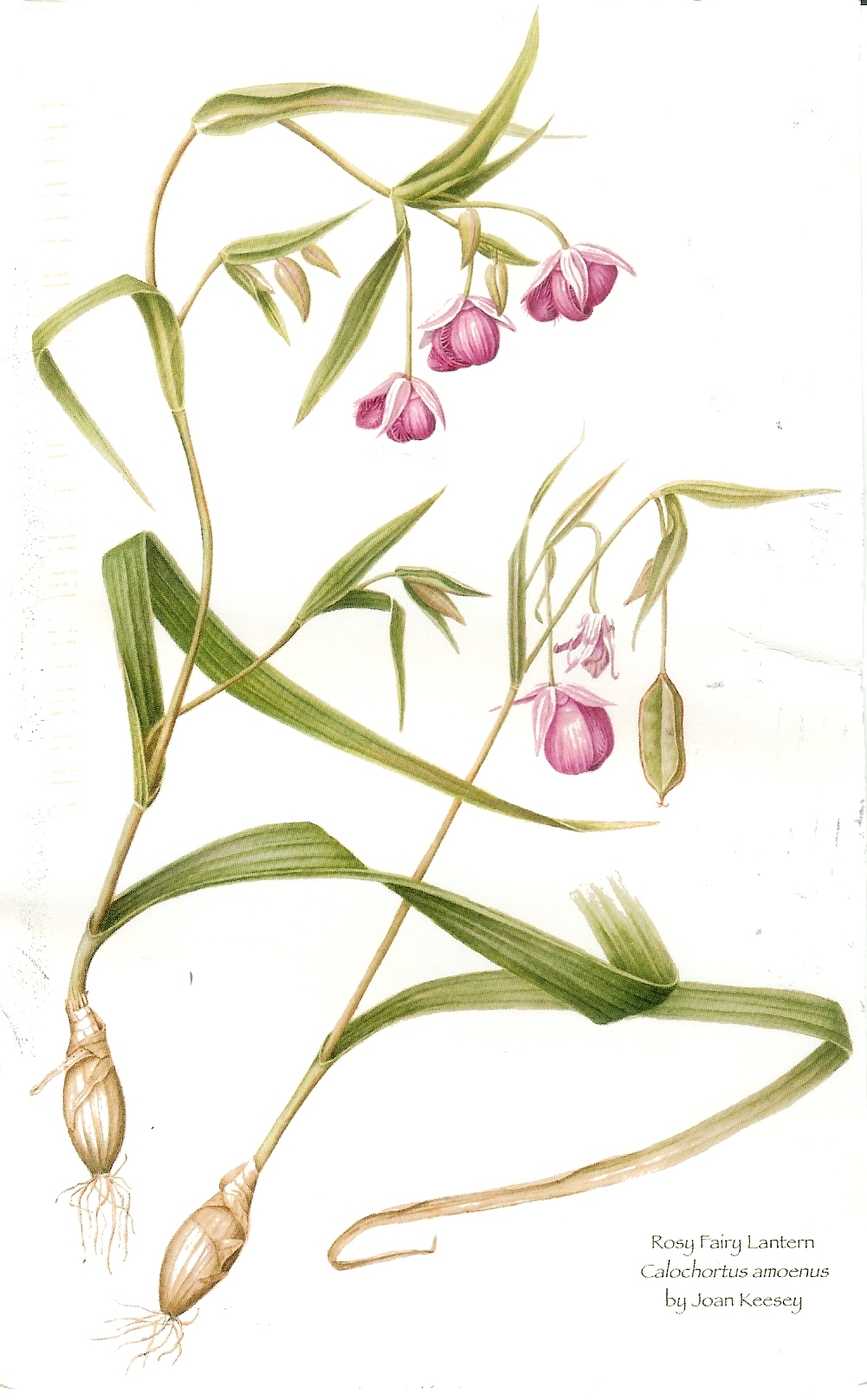
Rosy Fairy Lantern - Calochortus amoenus watercolor by Joan Keesey
An exhibition of botanical watercolors by Joan Keesey,
is now on show at the Theodore Payne Foundation for Wild Flowers and Native Plants.
When:
Friday, March 30 through Saturday, June 30, 2012
Tuesday – Saturday,
8:30 a.m. – 4:30 p.m.
Where:
Theodore Payne Foundation for Wild flowers and Native Plants, Inc.
10459 Tuxford Street
Sun Valley, CA 91352
818-768-1802
theodorepayne.org
Google Map
[Chuck Almdale]
Full Pink Moon 6 April, 7:21 a.m.
Here’s another update from SMBAS Blog on that large, round, shining object which has frequently appeared in our nighttime sky this year (known to many as the moon).
April 6, 7:21 a.m. PDT — Full Pink Moon. The grass pink, or wild ground phlox, is one of the earliest widespread flowers of spring. Other names for this month’s moon were the Full Sprouting Grass Moon, the Egg Moon, and — among coastal tribes — the Full Fish Moon, when the shad came upstream to spawn. This is also the Paschal Full Moon; the first full moon of the spring season. The first Sunday following the Paschal Moon is Easter Sunday, which indeed will be observed two days later on Sunday, April 8. [Gallery: The Fantastic Full Moon]
The next significant full moon will occur on May 5 at 8:35 p.m. PDT. Keep an eye on this spot for additional breaking news on this unprecedented event.
This information comes to you courtesy of:
http://www.msnbc.msn.com/id/45911225/ns/technology_and_science-space/t/how-s-full-moons-got-their-strange-names/#.T16CDHlIXUx
But that’s way too long to type in, and besides, you don’t need to go there because SMBAS has done the work for you!
[Chuck Almdale]
More Birds in the Science Press
Here’s some more bird-related articles that have appeared in recent months.
Hitchcock Horror Mystery Possibly Solved
Scientists have finally found an explanation to the real events that inspired Alfred Hitchcock’s 1963 classic, “The Birds.”
http://www.mail.com/scitech/news/938468-hitchcock-horror-mystery-solved.html#.23140-stage-hero1-3
From Mail.Com Sci/Tech Online – 12/29/11
********************************************
Mere fear shrinks bird families
Just hearing recordings of predators, in the absence of any real danger, caused sparrows to raise fewer babies.
http://www.sciencenews.org/view/generic/id/336823/title/Mere_fear_shrinks_bird_families
From Science News Online – 12/9/11
********************************************
Pigeons rival primates in number task
Trained on one-two-three, the birds can apply the rule of numerical order to such lofty figures as five and nine.
http://www.sciencenews.org/view/generic/id/337104/title/Pigeons_rival_primates_in_number_task
From Science News Online – 12/23/11
********************************************
Archaeopteryx wore black
Microscopic structures in an iconic fossil feather suggest that it was the color of a crow.
http://www.sciencenews.org/view/generic/id/337887/title/Archaeopteryx_wore_black
From Science News Online – 1/22/12
********************************************
Nurturing Nests Lift These Birds to a Higher Perch
The quietly dogged parenting style of the New Caledonian crow
http://www.nytimes.com/2011/02/01/science/01angier.html?_r=1&nl=todaysheadlines&emc=tha210
From New York Times Science Online – 1/31/12
********************************************
Bird flu leaves tracks in brain
H5N1 infection might make survivors vulnerable to Parkinson’s or other neurological disorders, a study in mice indicates.
http://www.sciencenews.org/view/generic/id/338071/title/Bird_flu_leaves_tracks_in_brain
From Science News Online – 2/01/12
********************************************
Bird flu less deadly, but more widespread, than official numbers suggest
The H5N1 virus appears to have infected far more than the 573 officially confirmed victims.
http://www.sciencenews.org/view/generic/id/338725/title/Bird_flu_less_deadly%2C_but_more_widespread%2C_than_official_numbers_suggest
From Science News Online – 2/24/12
********************************************
Pesticide-dosed bees lose future royalty, way home
Unusual field tests reveal how common insecticides, even at nonfatal doses, can erode colonies and threaten the future of bumblebees and honeybees.
[Not birds, and yet they fly]
http://www.sciencenews.org/view/generic/id/339548/title/Pesticide-dosed_bees_lose_future_royalty%2C_way_home
From Science News Online – 3/30/12
********************************************
And finally, this might be a look in your mirror…
“Things” Birder’s Say
A YouTube short film on what may be the archetypal birder’s conversation.
http://www.youtube.com/watch?v=NaX7i1Q7-Rw&feature=share
From Boulder Oak Films – 3/25/12
********************************************
[Chuck Almdale]



 SANTA MONICA BAY AUDUBON SOCIETY BLOG