Free email delivery
Please sign up for email delivery in the subscription area to the right.
No salesman will call, at least not from us. Maybe from someone else.
On Wednesday, March 15, Stacey Vigallon (Los Angeles Audubon & Snowy Plover Coordinator), Eleanor Osgood (LA Audubon & Snowy Plover Volunteer), Jamie King (California State Parks), Jamie’s mom, and I (Chuck Almdale) met to erect a Snowy Plover “virtual enclosure” on Malibu Beach, adjacent to the lagoon. [Jamie’s mom, whose name I didn’t catch, was in town on a visit and came along both to help and to see the lagoon and beach.] We spent a couple of hours driving a lot of metal poles into the sand, running a rope through the poles and hanging plenty of signs on the poles and rope. Stacey had been out a few days earlier to see where the plovers were currently roosting. But it’s impossible to be certain about these little birds: their preferred roosting site changes with the tides, lagoon outlet location, human beach use, and – one can only suppose – their mood of the day.

Snowy Plover information sign created by local artist. (C.Almdale (3/15/12)
Making the location even more a matter of guesswork was the fact that n0t one of the birds was roosting: all were running around down by the water’s edge and “nosing” around in the numerous clumps of wrack dotting the beach.

Snowy Plover contemplates beach wrack clump. (C.Almdale)
This is a “symbolic fence” because it consists of only a line of fence posts connected by a rope. Signs are hung are regular intervals, but it’s far from an impenetrable barrier. However, in my experience, it adequately serves to eliminate the vast majority of beach traffic. I’d guesstimate that 95% of people stay out. The plovers are so small and cryptically plumaged that people simply don’t see them, especially if they are walking along deep in thought or conversation and unaware of tiny birds at their feet. The Snowies also look a lot like the far more numerous and definitely not-threatened Sanderlings: with what seems like hundreds or thousands of the same tiny bird running all over, the uninformed person is far less likely to be concerned.
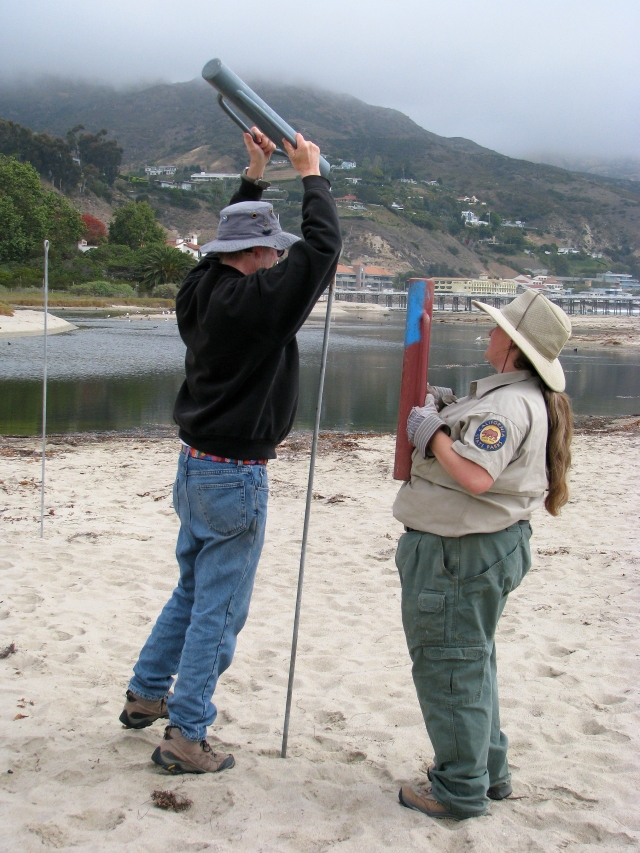
Chuck handles the tall posts. Some people pay health club dues to get this kind of exercise. (C.Almdale (3/15/12)
But they are quite threatened. Total west coast population in 2011 was under 2300 birds, breeding at only 28 sites. The Los Angeles County winter population had fluctuated in recent years from 200 to about 350 birds, concentrated exclusively in only seven roosting locations, of which Malibu Lagoon is one. So chances are that the roosting flock of Snowies which people perpetually saunter through comprises about 20% of their total LA County population, and about 3% of the total west coast population. Compare that to the millions of humans populating the same area and you’ll see what these tiny birds are up against. People need to be more careful and – when informed – are more careful.
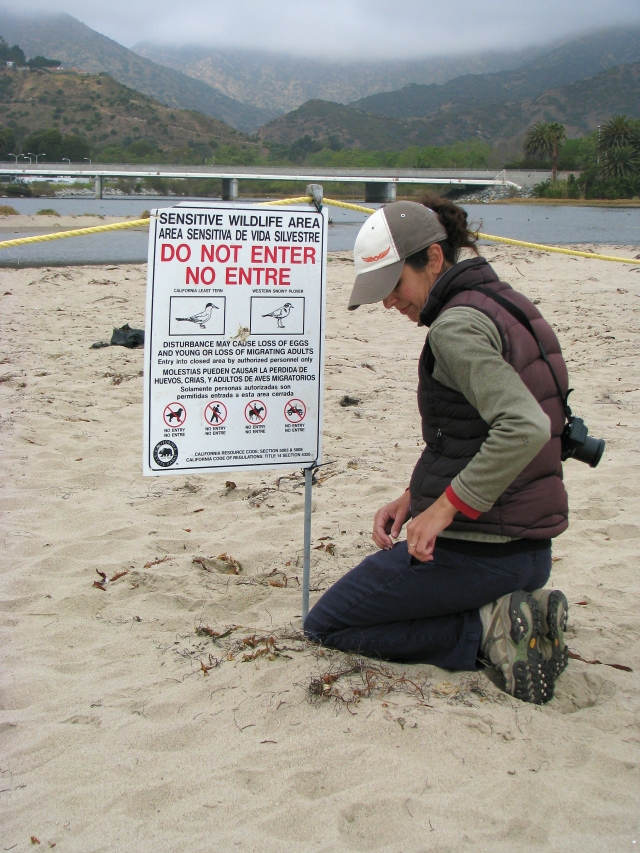
Stacey: professional sign hanger. (C.Almdale (3/15/12)
So the fence and the signs inform the public while setting aside a small area for the birds, a place where we hope they can get a bit of shut-eye. The current plan is to leave the enclosure up until October 1 and see what happens. Keep an eye on the enclosure: in the past, quite a bit of vegetation began reappearing within a few weeks, demonstrating that without foot traffic and beach cleaning, it could actually be a real habitat. [Chuck Almdale]
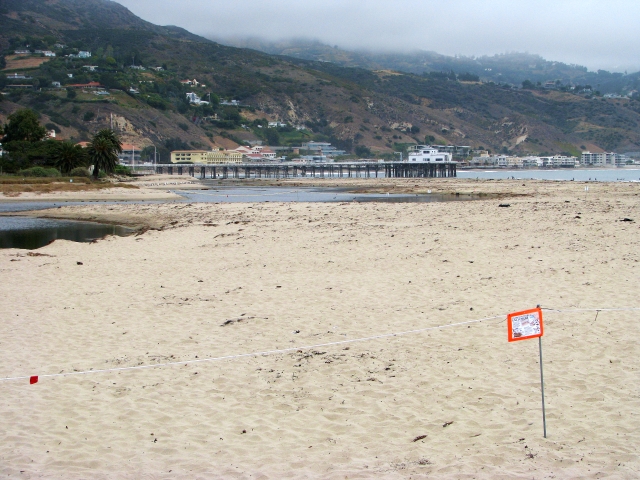
Completed fence, pier in background. Note lack of vegetation. (C.Almdale (3/15/12)
Birds in the Science Press
News in Brief: Urban Noise Ruined My Marriage
Bird marriages of Great Tits hurt by city hubbub in this week’s news.
http://www.sciencenews.org/view/generic/id/333954/title/News_in_Brief_Life
From Science News Online
********************************************
News in Brief: Killer baby birds
Honeyguide chicks kill their nestmates in this week’s news.
http://www.sciencenews.org/view/generic/id/334336/title/News_in_Brief_Life
From Science News Online
********************************************
Dinosaur-era feathers sealed in amber
The richest collection yet of primordial plumage preserves pigment and fine details found modern birds.
http://www.sciencenews.org/view/generic/id/334380/title/Dinosaur-era_feathers_sealed_in_amber
From Science News Online
********************************************
Penguins may sniff out relatives
A zoo study sees hints of odor-based kin recognition in colony-dwelling birds.
http://www.sciencenews.org/view/generic/id/334672/title/Penguins_may_sniff_out_relatives
From Science News Online
********************************************
News in Brief: Birds’ share of dinosaur extinction
Birds’ share of dinosaur extinction in this week’s news.
http://www.sciencenews.org/view/generic/id/334775/title/News_in_Brief_Life
From Science News Online
********************************************
[Chuck Almdale]
Full Worm Moon
Just in case you missed this important news, this is an alert from SMBAS blog that the full moon on March 8 at 1:39 a.m., only 4 days ago was the Full Worm Moon. Here is the explanation for this significant event.
In this month, the ground softens and the earthworm casts reappear, inviting the return of the robins. The more northern tribes called this the Full Crow Moon, when the cawing of crows signals the end of winter, or the Full Crust Moon because the snow cover becomes crusted from thawing by day and freezing at night. The Full Sap Moon, marking the time to tap maple trees, is another variation.
The next significant full moon will occur on April 6 at 7:21 a.m. PDT. Keep an eye on this spot for additional breaking news on this unprecedented event.
This information comes to you courtesy of:
http://www.msnbc.msn.com/id/45911225/ns/technology_and_science-space/t/how-s-full-moons-got-their-strange-names/#.T16CDHlIXUx
But that’s way too long to type in, so don’t bother going there.
[Chuck Almdale]
More on Spiders & Birds in the Science Press
As our program this week was on spiders, we thought the following item might interest you.
Spiders Spin Wet Blanket over Wagga Wagga
Rising flood waters endanger thousands of spiders
So many webs it looks like snow.
From: Herald Sun: 3/7/12
********************************************
Now, on to more Birds In The News.
********************************************
News in Brief: Neurons make Owls Take Notice
Food tastes less fatty to overweight people, plus an itch protein and thirsty rats in this week’s news.
http://www.sciencenews.org/view/generic/id/72403/title/News_in_Brief_Body_%2B_Brain
From Science News Online
********************************************
News in Brief: Secret to birds’ steady gaze
http://www.sciencenews.org/view/generic/id/331530/title/News_in_Brief_MoleculesMatter_%2B_Energy
From Science News Online
********************************************
News in Brief: Penguins smells dinnertime
Krill-sniffing penguins in this week’s news.
http://www.sciencenews.org/view/generic/id/332513/title/News_in_Brief_MoleculesMatter_%2B_Energy
From Science News Online
********************************************
News in Brief: Zebra Finches without Mommas
Stay-at-home finch dads in this week’s news.
http://www.sciencenews.org/view/generic/id/332797/title/News_in_Brief_Life
From Science News Online
********************************************
Early stress is contagious in adulthood
A zebra finch’s tough childhood shortens both its life and its mate’s.
http://www.sciencenews.org/view/generic/id/333416/title/Early_stress_is_contagious_in_adulthood
From Science News Online
********************************************
News in Brief: Ancient Big Bird
Ancient Big Bird found in Kazakhstan in this week’s news.
http://www.sciencenews.org/view/generic/id/333436/title/News_in_Brief_Life
From Science News Online
********************************************
The Iceman’s last meal: goat, deer, vegetables & wheat
Two decades after he was discovered sticking out of an Alpine glacier, a famous 5,300-year-old mummy’s diet details and hiking habits are revealed.
http://www.sciencenews.org/view/generic/id/333533/title/The_Icemans_last_meal_goat
From Science News Online
********************************************
The Sopranos with feathers
Stories from a day of bird searching
http://www.sciencenews.org/view/generic/id/333765/title/The_Sopranos_with_feathers
From Science News Online
********************************************
[Chuck Almdale]
Rescuing Birds – Information
After our earlier posting about oiled birds, I was alerted that I overlooked several other wildlife rescue organizations in our area. Here is all the information I currently have. We now have a permanent Bird Rescue page on our blog with this information, listed just below our Snowy Plover picture. If you learn of any other organization, let me know and I will update this page. All of these organizations are non-profit, need donations and frequently solicit volunteers. [Chuck Almdale]
California Wildlife Center
In the Malibu area, CWC is the closest place to call.
Emergency Hotline Number: (310) 458-WILD [9453]
PO Box 2022
Malibu, CA 90265
Phone (818) 222-2658 Fax: (818) 222-2685
Email:
Website: http://www.cawildlife.org/
Email Contacts:
Marine Mammal Response: rescue@cawildlife.org
Hospital: jo@cawildlife.org or 818.591.9453
Administration: admin@cawildlife.org or 818.222.2658
Donations of any kind: admin@cawildlife.org or 818.222.2658
Media Inquiries/Communications: cindy@cawildlife.org or 818.222.2658
Volunteer Inquiries: volunteer@cawildlife.orgor 818.222.2658
International Bird Rescue:
Website: http://www.bird-rescue.org/
San Pedro Office:
Phone: 310-514-2573
Fax: 310-514-8219
3601 South Gaffey Street
San Pedro, Ca. 90731
South Bay Wildlife Rehab
26363 Silver Spur Rd., Rancho Palos Verdes, California 90275
Phone: (310) 378-9921 Fax: (310) 378-0969
Email: info@sbwr.org
Website: http://www.sbwr.org/
Project Wildlife
Wildlife Triage Center
887 1/2 Sherman Street
San Diego, CA 92110
Phone: 619-225-9453
Hours: 9:00a.m. – 5:00p.m.
Open 7 days a week (except Thanksgiving, Christmas & New Year’s Day)
Website: http://www.projectwildlife.org/index.php



 SANTA MONICA BAY AUDUBON SOCIETY BLOG