Free email delivery
Please sign up for email delivery in the subscription area to the right.
No salesman will call, at least not from us. Maybe from someone else.
Malibu Lagoon Trip Report: 22 January, 2012
SMBAS Links: Website Blog Facebook
The beach looked typical for a January high tide day: surf surging across the sand in two places into the lagoon; water rushing seaward through the outlet channel, now shifted far to the east. Fifty degrees, warming to fifty-nine by noon. Gulls and ducks galore, with enough American Coots mixed in to keep them honest.
Beyond the shear numbers of birds, we didn’t see much that was unusual for this typical winter day. Large waves and high tide combined to keep birds from the offshore rocks and out of the surf zone. Farther out – too far to identify – we could see large rafts of gulls resting on the water. Low fog prevented us from seeing if Black-vented Shearwaters were even further away.
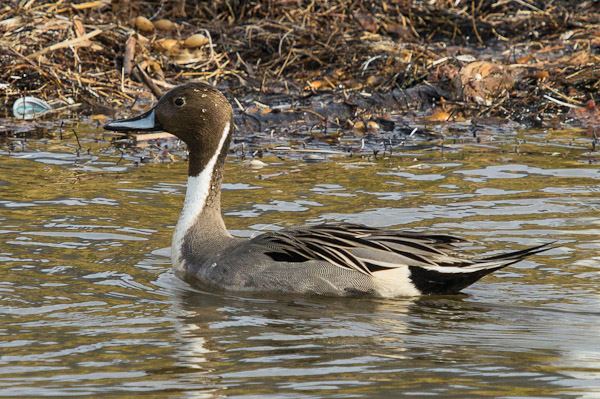
Northern Pintail male in the third channel (C. Bragg 1/22/12)
The Northern Pintails were still there, increased to ten from seven in December. The 81 Snowy Plovers on the beach set yet another record. Banded bird GG:AR was present. Fellow bandee NO:WW was not seen, but with so many birds present and shifting around, it’s difficult to make sure all are actually checked.
A question arose as to the life-span of our local gulls. Here’s some information from The Audubon Society Encyclopedia of North American Birds. I personally think the erratic longevities reported are the result of scanty data rather than actual likely life-spans. As with most species of birds, and as it used to be with humans, mortality in the first year is very high.
Gulls
California: Longest reported 12 years, 2 months
Glaucous-winged: One banded on San Juan Is., WA still alive at 22 years, 1 month
Herring: One banded in Holland lived to 31 years 11 months. Two captive birds in Morehead City, NC lived to 45 and 49 years.
Mew: One reported from Denmark to be 24 years, 2 months.
Ring-billed: A Mich. study recorded 67% were 3-5 years old. One bird banded in Mich died at 21 years.
Western: Oldest reported 16 years; probably much longer lived, as with Herring.
Black-legged Kittiwake: One banded in Denmark lived 15 years, 10 months.
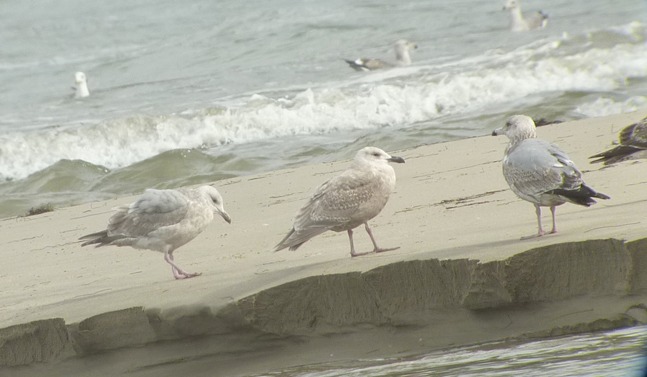
2nd winter Thayer's Gull on the left, 1st winter Glaucous-winged in the center (A. Albaisa 1/22/12)
Terns
Caspian: One banded on Lake Michigan & collected at 26 years, 2 months.
Common: One banded bird recovered in England 25 years.
Least: One banded in Mass. lived 21 years.
Royal: One banded in SC lived 10 years, 8 months.
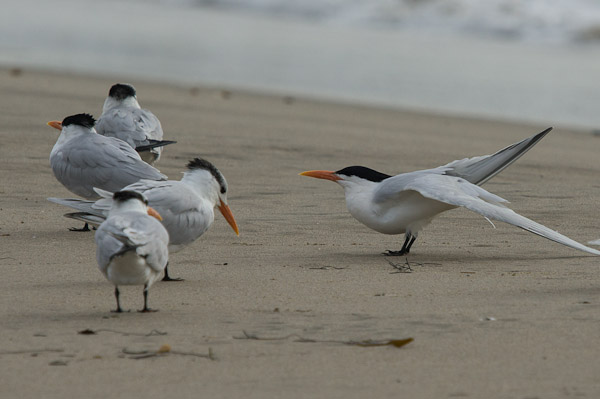
Royal Tern already in breeding plumage stretching its wing (C. Bragg 1/22/12)
Our next three field trips: Salton Sea – 11/12 Feb, 9am; Malibu Lagoon – 26 Feb. 8:30 & 10am; Sycamore Canyon 10 Mar., 8:30am.
Our next program: Tuesday, 7 February, 7:30 pm – Owls of Southern California, presented by Lance Benner.
The usual reminders will be emailed from the blog.
As a reminder to those coming to our 10 a.m. Parent’s & Kids Birdwalk, it meets at the beach trail footbridge closest to the parking lot.
Links: Unusual birds at Malibu Lagoon
Aerial photo of Malibu Lagoon from 9/23/02.
Prior checklists: July-Dec’11, Jan-June’11, July-Dec ’10, Jan-June ’10, Jul-Dec ‘09, and Jan-June ‘09.
[Chuck Almdale].
| Malibu Census 2012 | 22-Jan |
| Temperature | 50 – 59 |
| Tide Height | +6.49 |
| Low/High &Time | H:0803 |
| Brant | 1 |
| Gadwall | 31 |
| American Wigeon | 2 |
| Mallard | 23 |
| Northern Shoveler | 46 |
| Northern Pintail | 10 |
| Green-winged Teal | 37 |
| Surf Scoter | 14 |
| Bufflehead | 26 |
| Red-brstd Merganser | 6 |
| Ruddy Duck | 59 |
| Pacific Loon | 1 |
| Pied-billed Grebe | 3 |
| Eared Grebe | 4 |
| Western Grebe | 8 |
| Brandt’s Cormorant | 3 |
| Dble-crstd Cormorant | 37 |
| Pelagic Cormorant | 1 |
| Brown Pelican | 48 |
| Great Blue Heron | 7 |
| Great Egret | 2 |
| Snowy Egret | 7 |
| Blk-crwnd N-Heron | 2 |
| Osprey | 1 |
| Red-shouldered Hawk | 1 |
| Sora | 2 |
| American Coot | 345 |
| Blk-bellied Plover | 65 |
| Snowy Plover | 81 |
| Killdeer | 2 |
| Black Oystercatcher | 5 |
| American Avocet | 2 |
| Spotted Sandpiper | 2 |
| Willet | 3 |
| Whimbrel | 1 |
| Ruddy Turnstone | 15 |
| Sanderling | 200 |
| Least Sandpiper | 12 |
| Heermann’s Gull | 16 |
| Ring-billed Gull | 150 |
| Western Gull | 120 |
| California Gull | 1900 |
| Glaucous-wingd Gull | 5 |
| Royal Tern | 16 |
| Rock Pigeon | 5 |
| Mourning Dove | 2 |
| Anna’s Hummingbird | 2 |
| Allen’s Hummingbird | 2 |
| Belted Kingfisher | 1 |
| Black Phoebe | 3 |
| Say’s Phoebe | 1 |
| American Crow | 4 |
| Bushtit | 26 |
| Bewick’s Wren | 1 |
| Marsh Wren | 1 |
| Northern Mockingbird | 1 |
| European Starling | 1 |
| Yellow-rumpd Warbler | 3 |
| Common Yellowthroat | 4 |
| Spotted Towhee | 1 |
| Song Sparrow | 2 |
| White-crwnd Sparrow | 22 |
| Great-tailed Grackle | 13 |
| Brwn-headed Cowbird | 2 |
| House Finch | 25 |
| Totals by Type | Jan |
| Waterfowl | 255 |
| Water Birds-Other | 452 |
| Herons, Egrets | 18 |
| Quail & Raptors | 2 |
| Shorebirds | 388 |
| Gulls & Terns | 2207 |
| Doves | 7 |
| Other Non-Pass. | 5 |
| Passerines | 110 |
| Totals Birds | 3444 |
| Total Species | Jan |
| Waterfowl | 11 |
| Water Birds-Other | 10 |
| Herons, Egrets | 4 |
| Quail & Raptors | 5 |
| Shorebirds | 11 |
| Gulls & Terns | 6 |
| Doves | 2 |
| Other Non-Pass. | 3 |
| Passerines | 16 |
| Totals Species | 65 |
Antelope Valley Raptor Search Field Trip Report: 14 January, 2012
SMBAS Links: Website Blog Facebook
The weather looked promising as we left LA on our way to the Antelope Valley. Although it was cold, it was sunny and calm as we turned off Hwy 14 and went east on Palmdale Blvd. Our first stop was an undeveloped area along E10th St. north of Ave Q. It was 32° F but there were a few birds stirring, including a cooperative Cactus Wren.
We went east on Ave. P, stopping at the corner of E40th St. where we found a mixed flock of White-crowned Sparrows and House Finches.
We drove north on E40th St. At the right turn onto Ave N, we stopped to scan an agricultural field that had many birds. We spotted the first Say’s Phoebe of the day and many Killdeer but the highlight was a flock of more than 500 Horned Larks, some of which were so close to the road that we had good looks at them.
In the fields on either side of E 40th St. between Ave. M & Ave. L we found a large flock of California Quail, more Killdeer, numerous White-crowned & Savannah Sparrows, as well as some Western Meadowlarks and Brewer’s Blackbirds.
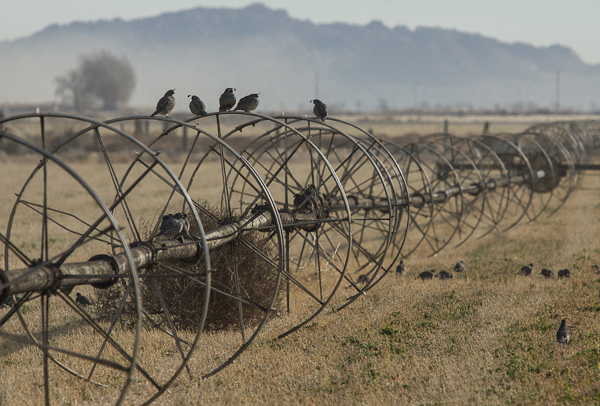
California Quail on the irrigation wheels (C.Bragg 1/14/12)
Unfortunately there was no sign of the flock of Mountain Plovers that had been in the farm field on the east side of the road one week earlier. Just to be sure we hadn’t missed them, we drove to the end of the block and turned east onto Ave. L and scanned the field again. Although we didn’t see any Mountain Plovers south of Ave. L, we spotted 2 Sage Thrashers in the brush on the north side of the road. While we were watching them, we were treated to the sight of a Prairie Falcon hunting in the distance.
As we went back toward the corner, we noticed a large number of plover-sized birds in field that where we had initially found no Mountain Plovers so we went back for a second look. We were delighted to find 60 Mountain Plovers. Most were close to the road so we had excellent looks at them. We were even able to compare Killdeer and Mountain Plover in one field of view of our scopes.

Mountain Plover in a mowed field (C.Bragg 1/14/12)
As we continued north on E 40th St. we found a Merlin perched in a bare tree beside the road. It was very cooperative, allowing for very good looks and some excellent photographs.

Merlin resting (C.Bragg 1/14/12)
Just after we turned east onto Ave. K we stopped to look at a flock of 500+ Tricolored Blackbirds that were close to the road.
We found our first Ferruginous Hawk of the day perched on a power pole beside Ave. J east of E 110th St. There were numerous Red-tailed Hawks in the area and we found some American Pipits in the fields. Three Northern Harriers were hunting in the field near the corner of Ave. I & E120th St.
We made a brief stop at Ave. H & E110th St. where we got a brief look at Cooper’s Hawk.
We stopped for lunch at Apollo Park where we saw the only Black Phoebe of the day. In addition to the usual collection of “dodgy” ducks and geese, we saw Northern Shovelers, a male Redhead, Ruddy Ducks, 2 Great Blue Herons, a Black-crowned Night-Heron, some Yellow-rumped Warblers and a flock of Dark-eyed Juncos.
As we left Apollo Park, we drove north on W60th St. A farm field north of Ave. D that had been flooded the week before was nearly dry and not productive but a little farther north we found 17 Long-billed Curlew, another Ferruginous Hawk, several Loggerhead Shrikes and a Coyote. Another field had a Greater Yellowlegs and we had scope views of a perched Prairie Falcon.
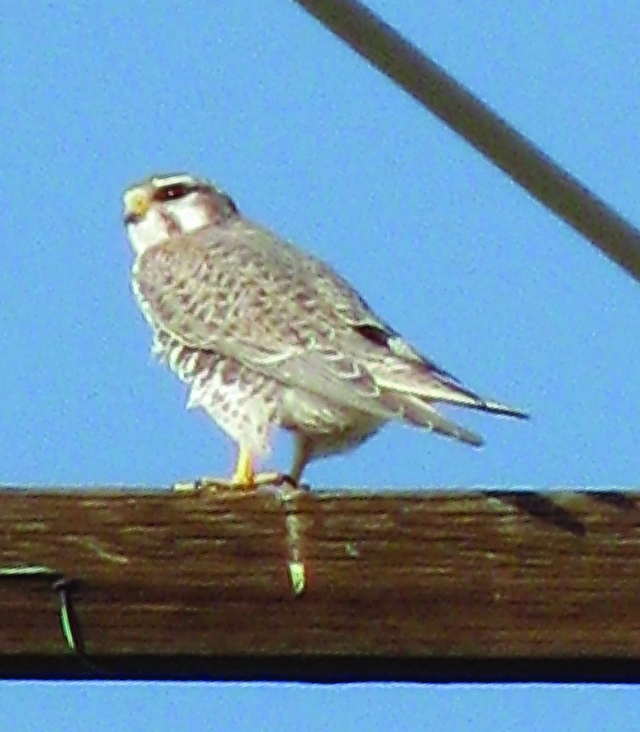
Prairie Falcon (Cindy S 1/14/12)
We went west on Gaskell Ave. to W100th St. where we finally found a flock of Mountain Bluebirds that looked especially beautiful in the afternoon sun. A bit farther west on Gaskell, we came upon 2 more Sage Thrashers and another Prairie Falcon. There were numerous Red-tailed Hawks and several Ferruginous Hawks in the area.

Ferruginous Hawk scouting for prey (C.Bragg 1/14/12)
Our last stop of the day was Quail Lake where we saw many Lesser Scaup, a White-winged Scoter, Bufflehead, some Common Goldeneye, Ruddy Ducks, and a few Pied-billed, Eared and Western Grebes.
All-in-all, it was a lovely day in the Antelope Valley. Although we were disappointed not to find any Golden Eagles, the weather conditions were ideal for viewing all the birds we found. [Cindy S.]
Link to January, 2011 trip report
| SMBAS |
Antelope Valley |
No. | Sat, 14 Jan 2012 – Location |
| Canada Goose | Branta canadensis | 10 | Apollo Pk |
| Mallard | Anas platyrhynchos | 30 | Apollo Pk |
| Northern Shoveler | Anas clypeata | 6 | Apollo Pk |
| Redhead | Aythya americana | 1 | Apollo Pk |
| Lesser Scaup | Aythya affinis | 300 | Quail Lake |
| White-winged Scoter | Melanitta fusca | 1 | Quail Lake |
| Bufflehead | Bucephala albeola | 80 | Apollo Pk; Quail Lake |
| Common Goldeneye | Bucephala clangula | 20 | Quail Lake |
| Ruddy Duck | Oxyura jamaicensis | 30 | Apollo Pk; Quail Lake |
| California Quail | Callipepla californica | 110 | E 10th north of Ave P; E 40th north of Ave M |
| Pied-billed Grebe | Podilymbus podiceps | 10 | Quail Lake |
| Eared Grebe | Podiceps nigricollis | 5 | Quail Lake |
| Western Grebe | Aechmophorus occidentalis | 2 | Quail Lake |
| Double-crested Cormorant | Phalocrocorax auritus | 2 | Apollo Pk |
| Great Blue Heron | Ardea herodias | 2 | Apollo Pk |
| Black-crowned Night-Heron | Nycticorax nycticorax | 1 | Apollo Pk |
| Northern Harrier | Circus cyaneus | 3 | Ave I east of E110th |
| Cooper’s Hawk | Accipiter cooperii | 1 | Ave H x E110th |
| Red-tailed Hawk | Buteo jamaicensis | 50+ | widespread |
| Ferruginous Hawk | Buteo regalis | 8 | Ave J x E110th; Gaskell Ave; along W Ave D |
| American Kestrel | Falco sparverius | 15 | widespread |
| Merlin | Falco columbarius | 1 | E40th north of Ave L |
| Prairie Falcon | Falco mexicanus | 4 | Ave L x E40th; W60th north of Ave D; Gaskell Ave |
| American Coot | Fulica americana | 40 | Apollo Pk; Quail Lake |
| Killdeer | Charadrius vociferus | 100 | widespread |
| Mountain Plover | Charadrius montanus | 70 | E40th south of Ave L; Ave I east of E110th |
| Greater Yellowlegs | Tringa melanoleuca | 1 | W60th north of Ave D |
| Long-billed Curlew | Numenius americanus | 17 | W60th north of Ave D |
| Ring-billed Gull | Larus delawarensis | 30 | E 10th north of Palmdale Blvd; Apollo Pk |
| California Gull | Larus californicus | 30 | E 10th north of Palmdale Blvd; Apollo Pk |
| Rock Dove [I] | Columba livia | 80 | scattered sites |
| Eurasian Collared-Dove [I] | Streptopelia decaoto | 4 | Palmdale Blvd; Apollo Pk |
| Mourning Dove | Zenaida macroura | 4 | scattered sites |
| Anna’s Hummingbird | Calypte anna | 2 | E10th north of Ave Q |
| Northern Flicker | Colaptes auratus | 1 | Ave J x E90th |
| Black Phoebe | Sayornis nigricans | 1 | Apollo Pk |
| Say’s Phoebe | Sayornis saya | 12 | widespread |
| Loggerhead Shrike | Lanius ludovicianus | 15 | widespread |
| Western Scrub-Jay | Aphelocoma californica | 2 | Palmdale Blvd |
| American Crow | Corvus brachyrhynchos | 5 | Palmdale Blvd |
| Common Raven | Corvus corax | 150+ | widespread |
| Horned Lark | Eremophila alpestris | 1,500+ | widespread |
| Cactus Wren | Campylorhynchus brunneicapillus | 2 | E 10th north of Ave P; E 110th x Ave J |
| Bewick’s Wren | Thryomanes bewickii | 1H | Little Rock Wash south of Ave K |
| Mountain Bluebird | Sialia currucoides | 20 | Gaskell x W100th |
| Northern Mockingbird | Mimus polyglottos | 1 | Ave J x E90th |
| Sage Thrasher | Oreoscoptes montanus | 4 | Ave L x E 40th; Gaskell west of W 100th |
| European Starling [I] | Sturnus vulgaris | 45 | Palmdale Blvd; E 40th x Ave P |
| American Pipit | Anthus rubescens | 30 | Ave J east of E110th |
| Yellow-rumped Warbler | Dendroica coronata | 12 | Apollo Pk |
| Sage Sparrow | Amphispiza belli | 20 | Little Rock Wash south of Ave K |
| Savannah Sparrow | Passerculus sandwichensis | 50 | scattered sites |
| White-crowned Sparrow | Zonotrichia leucophrys | 300+ | widespread |
| Dark-eyed Junco | Junco hyemalis | 14 | Apollo Pk |
| Red-winged Blackbird | Agelaius phoeniceus | 60 | scattered sites |
| Tricolored Blackbird | Agelaius tricolor | 500 | E40th x Ave K |
| Western Meadowlark | Sturnella neglecta | 80 | widespread |
| Brewer’s Blackbird | Euphagus cyanocephalus | 60 | widespread |
| House Finch | Carpodacus mexicanus | 300+ | widespread |
| House Sparrow [I] | Passer domesticus | 30 | Palmdale |
| [I] – Introduced | Total Species – 60 |
Malibu Lagoon Trip Report & July-Dec Bird Census: 25 December, 2011
SMBAS Links: Website Blog Facebook

Birders gather on 1st footbridge (C. Almdale 12/25/11)
Many years ago on Christmas Day I woke up with a start, realizing that no one had volunteered to lead that day’s lagoon field trip. So off I went to make sure the trip took place.
Meanwhile, Maja Block awoke, thinking the same thing. She jumped in her car, binos in hand, and we discovered each other at the lagoon. No one else came! So we led each other around the lagoon. It was very cold and clear: ice rimmed the edges of the lagoon, believe it or not. The beach was empty, very peaceful, and loads of birds made the best of the lack of humans.
Today couldn’t have been more different. About 20 people showed up, much to my surprise. Temperatures rose to about 66°, and we had to remove clothing layers. Surfers surfed; walkers walked and resters zoned out on the beach. High tide waves were washing over a stretch of beach into the lagoon. The only similarity was bunches of birds.
Loads of ducks: 10 species in all.

Osprey (C.Bragg)
Only 12 Brown Pelicans, but far out on the sea were hundreds of Black-vented Shearwaters cruising along to the west on stiff wings. One Cattle Egret poked through the pickleweed with a couple of Snowy Egrets – this species usually follow grazing animals (hence the name) around, eating insects stirred by the animals’ hooves, and they’re appear at the lagoon about 1 out of 8 visits, mostly in Nov-Dec. Black-bellied Plovers remain relatively abundant, and the Osprey continues the every-other-month appearance schedule he’s maintained since June.
Species and numbers are probably under-counted, as many birds stayed to the inland side of the sandy island, visible only from inland. At that distance it’s difficult to identify and count them and they can and do move around by the time we get to the beach. So I just don’t count them when I can’t see them.
New arrivals were: 9 Northern Pintail, 1 Lesser Scaup, 1 Red-throated Loon, 200 (at least) Black-vented Shearwaters far out at sea, 1 Cooper’s Hawk, 1 American Avocet, 1 Mew Gull, 1 Marsh Wren, 1 Ruby-crowned Kinglet, and 2 Western Meadowlarks.
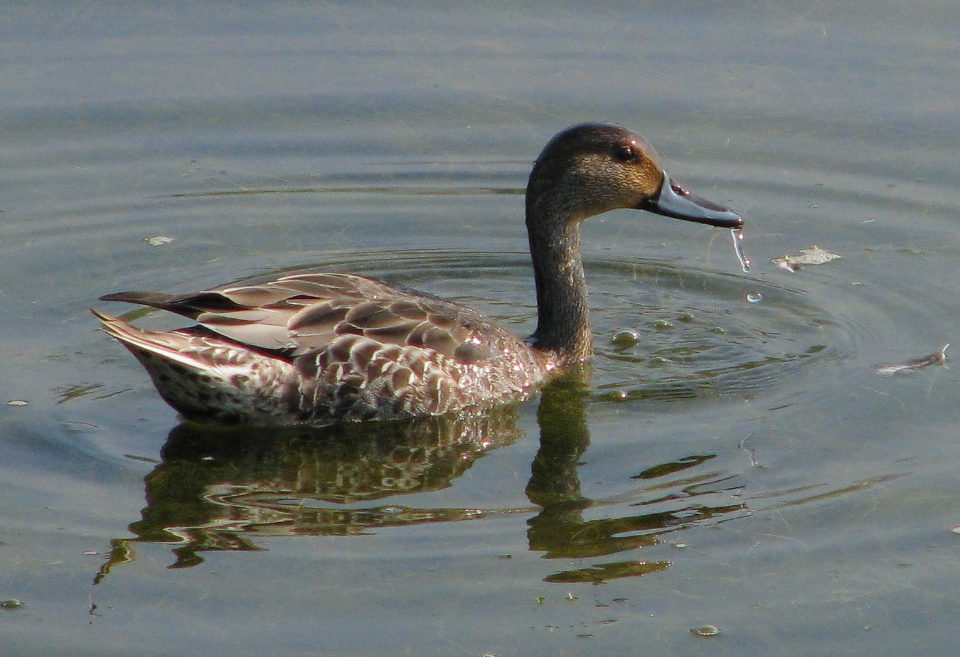
Northern Pintail Female (C.Almdale)
Pintails don’t show up a lot at the lagoon: only 19 visits out of 180 trips for which we have counts, including 9 visits since December 1998. Western Meadowlarks are even less common: of their 18 visits, 13 have occurred since August 2000. These birds have been hanging out on the beach – not exactly a meadow! – for a couple of weeks not. Apparently they find the wrack left at the high tide line productive for invertebrates.
Mew Gulls don’t show up often. For some reason, they really enjoy sewage plants, and in winter there is nearly always a flock of them out in front of the Hyperion Water Reclamation Plant in El Segundo. The single bird found lurking among the Ring-billed Gulls was a welcome surprise.
Back in the 1970’s when I first began birding at the lagoon, I could find Marsh Wrens only upstream of the bridge where there was a large bed of reeds. The torrents from a big El Nino winter in the 80’s (I think) washed all those reeds out to sea, but they’ve gradually reappeared, primarily in the 1st channel and near Adamson House. All of the wren’s 34 lagoon appearances for which we have counts have been after August 1993.
This blog gives us width sufficient only for 6 months of data, but if you check the prior lagoon June & December reports, we now have 3 years of lagoon data on our blogsite.
Our next three field trips: Antelope Valley Raptors – 14 January, 8am; Malibu Lagoon – 22 January, 8:30am; Salton Sea – 11/12 February, 9am
Our next program: Tuesday, 7 February, 7:30 pm – Owls of Southern California, presented by Lance Benner.
The usual reminders will be emailed from the blog.
As a reminder to those coming to our 10 a.m. Parent’s & Kids Birdwalk, it meets at the beach trail footbridge closest to the parking lot.
Links: Unusual birds at Malibu Lagoon
Aerial photo of Malibu Lagoon from 9/23/02.
Prior checklists: Jan-June’11, July-Dec ’10, Jan-June ’10, Jul-Dec ‘09, and Jan-June ‘09.
[Chuck Almdale].
| Malibu Census 2011 |
24-Jul |
28-Aug |
25-Sep |
23-Oct |
27-Nov |
25-Dec |
| Temperature |
65-72 |
72 – 81 |
61-69 |
59-64 |
70 |
50-66 |
| Tide Height |
+2.61 |
+5.03 |
+5.33 |
+5.40 |
+6.63 |
+6.80 |
| Low/High &Time |
L:0947 |
H:0942 |
H:0830 |
H:0178 |
H:0945 |
H:0850 |
| Canada Goose |
9 |
|||||
| Gadwall |
10 |
6 |
4 |
35 |
||
| Eurasian Wigeon |
1 |
|||||
| American Wigeon |
3 |
15 |
4 |
|||
| Mallard |
54 |
60 |
48 |
25 |
30 |
8 |
| Blue-winged Teal |
2 |
|||||
| Northern Shoveler |
10 |
12 |
10 |
30 |
||
| Northern Pintail |
7 |
|||||
| Green-winged Teal |
2 |
4 |
40 |
|||
| Lesser Scaup |
1 |
|||||
| Bufflehead |
8 |
12 |
||||
| Red-brstd Merganser |
9 |
4 |
||||
| Ruddy Duck |
2 |
5 |
8 |
3 |
40 |
|
| Red-throated Loon |
1 |
|||||
| Pacific Loon |
1 |
|||||
| Common Loon |
1 |
1 |
||||
| Pied-billed Grebe |
4 |
15 |
13 |
4 |
1 |
3 |
| Eared Grebe |
5 |
3 |
6 |
3 |
||
| Western Grebe |
10 |
6 |
25 |
|||
| Blk-vented Shearwater |
200 |
|||||
| Brandt’s Cormorant |
3 |
1 |
3 |
2 |
6 |
|
| Dble-crstd Cormorant |
31 |
48 |
47 |
32 |
31 |
62 |
| Pelagic Cormorant |
1 |
3 |
2 |
1 |
1 |
|
| Brown Pelican |
407 |
77 |
60 |
12 |
8 |
12 |
| Great Blue Heron |
6 |
3 |
2 |
3 |
2 |
2 |
| Great Egret |
4 |
2 |
2 |
2 |
3 |
|
| Snowy Egret |
11 |
15 |
23 |
26 |
30 |
22 |
| Cattle Egret |
1 |
1 |
||||
| Green Heron |
1 |
|||||
| Blk-crwnd N-Heron |
11 |
4 |
12 |
5 |
||
| Osprey |
1 |
1 |
1 |
|||
| Cooper’s Hawk |
1 |
|||||
| Red-tailed Hawk |
2 |
2 |
||||
| American Kestrel |
1 |
|||||
| Merlin |
1 |
|||||
| Peregrine Falcon |
1 |
1 |
||||
| Virginia Rail |
1 |
2 |
1 |
2 |
||
| Sora |
3 |
1 |
3 |
2 |
||
| American Coot |
20 |
75 |
410 |
370 |
57 |
280 |
| Blk-bellied Plover |
4 |
46 |
40 |
700 |
263 |
140 |
| Snowy Plover |
13 |
36 |
62 |
5 |
52 |
58 |
| Semipalmated Plover |
2 |
4 |
||||
| Killdeer |
2 |
8 |
6 |
15 |
5 |
1 |
| Black Oystercatcher |
2 |
|||||
| Black-necked Stilt |
1 |
|||||
| American Avocet |
1 |
|||||
| Spotted Sandpiper |
2 |
2 |
3 |
2 |
2 |
|
| Wandering Tattler |
1 |
|||||
| Willet |
4 |
7 |
10 |
4 |
1 |
|
| Whimbrel |
41 |
26 |
28 |
3 |
||
| Marbled Godwit |
2 |
2 |
1 |
|||
| Ruddy Turnstone |
7 |
4 |
7 |
10 |
1 |
2 |
| Black Turnstone |
1 |
3 |
||||
| Sanderling |
15 |
3 |
308 |
110 |
||
| Western Sandpiper |
2 |
11 |
1 |
|||
| Least Sandpiper |
1 |
6 |
3 |
16 |
15 |
12 |
| Dunlin |
2 |
|||||
| Long-billed Dowitcher |
2 |
2 |
||||
| Red-necked Phalarope |
7 |
|||||
| Heermann’s Gull |
41 |
24 |
15 |
14 |
13 |
|
| Mew Gull |
1 |
|||||
| Ring-billed Gull |
1 |
7 |
18 |
60 |
175 |
|
| Western Gull |
107 |
146 |
66 |
80 |
50 |
90 |
| California Gull |
8 |
16 |
120 |
30 |
1200 |
|
| Herring Gull |
1 |
|||||
| Glaucous-wingd Gull |
1 |
|||||
| Least Tern |
13 |
|||||
| Caspian Tern |
3 |
12 |
||||
| Common Tern |
1 |
|||||
| Forster’s Tern |
3 |
2 |
3 |
|||
| Royal Tern |
18 |
15 |
1 |
|||
| Elegant Tern |
8 |
36 |
4 |
|||
| Black Skimmer |
1 |
1 |
||||
| Rock Pigeon |
6 |
5 |
5 |
4 |
4 |
|
| Mourning Dove |
3 |
2 |
2 |
2 |
2 |
|
| Vaux’s Swift |
100 |
|||||
| Anna’s Hummingbird |
3 |
4 |
3 |
2 |
2 |
1 |
| Allen’s Hummingbird |
3 |
2 |
2 |
2 |
||
| Belted Kingfisher |
2 |
1 |
2 |
1 |
1 |
|
| Nuttall’s Woodpecker |
1 |
|||||
| Western Wood-Pewee |
1 |
|||||
| Black Phoebe |
8 |
10 |
6 |
10 |
5 |
3 |
| Say’s Phoebe |
1 |
2 |
2 |
|||
| Cassin’s Kingbird |
1 |
|||||
| Western Kingbird |
1 |
4 |
||||
| Western Scrub-Jay |
2 |
|||||
| American Crow |
4 |
3 |
2 |
4 |
4 |
4 |
| Rough-wingd Swallow |
20 |
22 |
1 |
|||
| Barn Swallow |
18 |
45 |
30 |
|||
| Cliff Swallow |
25 |
2 |
||||
| Oak Titmouse |
2 |
|||||
| Bushtit |
8 |
6 |
6 |
20 |
30 |
30 |
| Bewick’s Wren |
1 |
1 |
1 |
1 |
1 |
2 |
| House Wren |
1 |
1 |
||||
| Marsh Wren |
1 |
|||||
| Ruby-crowned Kinglet |
1 |
|||||
| Wrentit |
1 |
|||||
| Northern Mockingbird |
2 |
3 |
2 |
2 |
1 |
1 |
| European Starling |
38 |
20 |
23 |
60 |
40 |
5 |
| Ornge-crwnd Warbler |
1 |
1 |
||||
| Yellow-rumpd Warbler |
8 |
2 |
8 |
|||
| Common Yellowthroat |
1 |
8 |
5 |
9 |
4 |
4 |
| Wilson’s Warbler |
1 |
2 |
||||
| California Towhee |
3 |
1 |
||||
| Savannah Sparrow |
1 |
1 |
||||
| Song Sparrow |
1 |
5 |
3 |
4 |
3 |
4 |
| White-crwnd Sparrow |
18 |
8 |
15 |
|||
| Bobolink |
1 |
|||||
| Red-winged Blackbird |
17 |
32 |
18 |
15 |
||
| Western Meadowlark |
2 |
|||||
| Brewer’s Blackbird |
2 |
|||||
| Great-tailed Grackle |
3 |
5 |
12 |
8 |
4 |
2 |
| Brwn-headed Cowbird |
6 |
|||||
| Hooded Oriole |
6 |
|||||
| House Finch |
4 |
8 |
12 |
5 |
30 |
5 |
| Lesser Goldfinch |
4 |
2 |
1 |
2 |
5 |
|
| Totals by Type |
July |
Aug |
Sep |
Oct |
Nov |
Dec |
| Waterfowl |
56 |
65 |
79 |
48 |
92 |
181 |
| Water Birds-Other |
463 |
221 |
542 |
440 |
115 |
598 |
| Herons, Egrets |
32 |
24 |
40 |
31 |
36 |
30 |
| Quail & Raptors |
0 |
3 |
1 |
5 |
1 |
2 |
| Shorebirds |
32 |
187 |
161 |
797 |
650 |
331 |
| Gulls & Terns |
175 |
248 |
124 |
233 |
143 |
1482 |
| Doves |
9 |
7 |
7 |
6 |
0 |
6 |
| Other Non-Pass. |
6 |
7 |
106 |
6 |
3 |
4 |
| Passerines |
167 |
181 |
133 |
157 |
134 |
111 |
| Totals Birds |
940 |
943 |
1193 |
1723 |
1174 |
2745 |
| Total Species |
July |
Aug |
Sep |
Oct |
Nov |
Dec |
| Waterfowl |
2 |
2 |
5 |
6 |
9 |
10 |
| Water Birds-Other |
5 |
6 |
9 |
12 |
9 |
13 |
| Herons, Egrets |
4 |
4 |
5 |
3 |
4 |
4 |
| Quail & Raptors |
0 |
2 |
1 |
4 |
1 |
2 |
| Shorebirds |
8 |
14 |
12 |
13 |
8 |
11 |
| Gulls & Terns |
8 |
8 |
7 |
5 |
5 |
6 |
| Doves |
2 |
2 |
2 |
2 |
0 |
2 |
| Other Non-Pass. |
2 |
3 |
4 |
3 |
2 |
3 |
| Passerines |
19 |
18 |
23 |
17 |
13 |
20 |
| Totals Species – 116 |
50 |
59 |
68 |
65 |
51 |
71 |
Carrizo Plains Field Trip Report: 12 December, 2011
Luck was ours, as the cold and windy weather of the week before had disappeared, providing us with an absolutely beautiful day: clear, windless, with temperatures beginning in the 40’s and ending in the high 60’s. As always, the plains were very quiet and peaceful. Wow!
Soda Lake was dry, at it has been for many years. The staff at the nearby Carrizo Plains Education Center told me that even when water is present, there isn’t much for the Sandhill Cranes to eat as there are no longer crops being grown in the nearby fields. When the crops were harvested, the process left lots of grain on the ground. Food for cranes! Alas, no more. You’ll have to go over the hill to the San Joachin Valley, or down to the Imperial Valley to find cranes these days.
We had a very nice variety of raptors, especially falcons. Eagles were notably missing (although we know they’re there). As always, there were plenty of ground birds: American Pipit, Horned Lark, Yellow-rumped Warbler, Western Meadowlark, House Finch, and a variety of sparrows, particularly White-crowned Sparrow. Mountain Bluebirds were present, but not abundant. We never saw any large flocks of them as we often do; instead, they were scattered around in small groups of 1-6 birds.
The Burrowing Owl was at the south end of Soda Lake Rd., standing in his hole among the Ground Squirrels. We hadn’t seen any there in 4-5 years, so it was nice to see one out-and-about. Loggerhead Shrikes– a species increasingly difficult to find anywhere – were common, as is usual in the Carrizo in Winter.
We had a long lunch break at the abandoned farmstead, located a couple of miles north of Soda Lake Rd. down a two-track side road. What with doodling and diddling around, it was almost sunset by the time we got to the San Andreas earthquake fault zone, which always amazes those who think they are standing on solid ground in California. [Chuck Almdale]
| Carrizo Plains 12/10/11 |
Count |
| Northern Harrier |
1 |
| Red-tailed Hawk |
20 |
| Ferruginous Hawk |
2 |
| American Kestrel |
9 |
| Merlin |
1 |
| Prairie Falcon |
2 |
| Killdeer |
1 |
| Mountain Plover |
2 |
| Mourning Dove |
6 |
| Great Horned Owl |
1 |
| Burrowing Owl |
1 |
| Say’s Phoebe |
3 |
| Loggerhead Shrike |
12 |
| Common Raven |
40 |
| Horned Lark |
200 |
| Mountain Bluebird |
30 |
| Northern Mockingbird |
1 |
| Le Conte’s Thrasher |
1 |
| European Starling |
33 |
| American Pipit |
1 |
| Yellow-rumped (Audubon’s) Warbler |
100 |
| Brewer’s Sparrow |
15 |
| Lark Sparrow |
25 |
| Sage Sparrow |
25 |
| Savannah Sparrow |
55 |
| White-crowned Sparrow |
100 |
| Golden-crowned Sparrow |
2 |
| Western Meadowlark |
27 |
| House Finch |
500 |
| Total Species |
29 |
Malibu Lagoon Trip Report: 27 November, 2011
SMBAS Links: Website Blog Facebook
Your usual reporter wasn’t present, so this month’s data is supplied by Lucien Plauzoles. Temperatures were warm, about 70°, and there was a 10-15 mph breeze. Human turnout was good with 25 persons. The avian species count of 51 was a bit low for November, as the average is closer to 62. Nothing particularly unusual showed up, but the 9 Canada Geese were nice to see. The Black-bellied Plover count of 263 was down from last month’s estimate of 700, but that was an estimate of flocks continually coming and going.
The new arrivals were: 9 Canada Geese, 8 Bufflehead, 9 Red-breasted Merganser, 1 Cattle Egret, 1 American Kestrel, and 1 Glaucous-winged Gull.
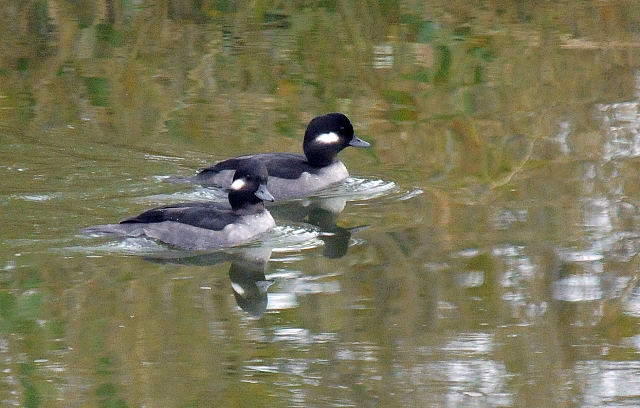
Two female Buffleheads cruising down the creek (J. Kenney 11/12/11)
Incidentally, on 6 Dec., 9:15am, Chuck & Ellen counted 67 Snowy Plovers gathered around the western life guard station, which appears to be an all-time high. This included two returning banded birds – GG:AR; NO:WW. GG:AR is a young bird, banded last summer at its nest site at Oceano Dunes (near Pismo Beach), and first showing up at Malibu in September. NO:WW, on the other hand, is an old-timer, first appearing at Malibu in October 2009, after being hatched at Vandenburg Air Force Base that summer. He (or she) apparently likes Malibu, as it was there in Nov. 09 – Feb. 10, Dec. 10 – Feb. 11, and now Nov. 11.
I presume that everyone had a wonderful time as I have heard no complaints. [Let’s keep it that way.]

Long term lagoon resident, Snowy Plover NO:WW, catches a few rays (C.Almdale)
Our next three field trips: Malibu Lagoon – 25 December (yes!, Christmas Day); Antelope Valley Raptors – 14 January; Malibu Lagoon – 22 January
Our next program: Tuesday, 7 February, 7:30 pm – Owls of Southern California, presented by Lance Benner.
The usual reminders will be emailed from the blog.
As a reminder to those coming to our 10 a.m. Parent’s & Kids Birdwalk, it meets at the beach trail footbridge closest to the parking lot.
Links: Unusual birds at Malibu Lagoon
Aerial photo of Malibu Lagoon from 9/23/02.
Prior checklists: Jan-June’11, July-Dec ’10, Jan-June ’10, Jul-Dec ‘09, and Jan-June ‘09.
[Chuck Almdale]
| Malibu Census 2011 |
24-Jul |
28-Aug |
25-Sep |
23-Oct |
27-Nov |
| Temperature |
65-72 |
72 – 81 |
61-69 |
59-64 |
70 |
| Tide Height |
+2.61 |
+5.03 |
+5.33 |
+5.40 |
+6.63 |
| Low/High &Time |
L:0947 |
H:0942 |
H:0830 |
H:0178 |
H:0945 |
| Canada Goose |
9 |
||||
| Gadwall |
10 |
6 |
4 |
||
| Eurasian Wigeon |
1 |
||||
| American Wigeon |
3 |
15 |
|||
| Mallard |
54 |
60 |
48 |
25 |
30 |
| Blue-winged Teal |
2 |
||||
| Northern Shoveler |
10 |
12 |
10 |
||
| Green-winged Teal |
2 |
4 |
|||
| Bufflehead |
8 |
||||
| Red-brstd Merganser |
9 |
||||
| Ruddy Duck |
2 |
5 |
8 |
3 |
|
| Pacific Loon |
1 |
||||
| Common Loon |
1 |
||||
| Pied-billed Grebe |
4 |
15 |
13 |
4 |
1 |
| Eared Grebe |
5 |
3 |
6 |
||
| Western Grebe |
10 |
6 |
|||
| Brandt’s Cormorant |
3 |
1 |
3 |
2 |
|
| Dble-crstd Cormorant |
31 |
48 |
47 |
32 |
31 |
| Pelagic Cormorant |
1 |
3 |
2 |
1 |
|
| Brown Pelican |
407 |
77 |
60 |
12 |
8 |
| Great Blue Heron |
6 |
3 |
2 |
3 |
2 |
| Great Egret |
4 |
2 |
2 |
2 |
3 |
| Snowy Egret |
11 |
15 |
23 |
26 |
30 |
| Cattle Egret |
1 |
||||
| Green Heron |
1 |
||||
| Blk-crwnd N-Heron |
11 |
4 |
12 |
||
| Osprey |
1 |
1 |
|||
| Red-tailed Hawk |
2 |
2 |
|||
| American Kestrel |
1 |
||||
| Merlin |
1 |
||||
| Peregrine Falcon |
1 |
1 |
|||
| Virginia Rail |
1 |
2 |
1 |
||
| Sora |
3 |
1 |
3 |
||
| American Coot |
20 |
75 |
410 |
370 |
57 |
| Blk-bellied Plover |
4 |
46 |
40 |
700 |
263 |
| Snowy Plover |
13 |
36 |
62 |
5 |
52 |
| Semipalmated Plover |
2 |
4 |
|||
| Killdeer |
2 |
8 |
6 |
15 |
5 |
| Black Oystercatcher |
2 |
||||
| Black-necked Stilt |
1 |
||||
| Spotted Sandpiper |
2 |
2 |
3 |
2 |
|
| Wandering Tattler |
1 |
||||
| Willet |
4 |
7 |
10 |
4 |
|
| Whimbrel |
41 |
26 |
28 |
||
| Marbled Godwit |
2 |
2 |
|||
| Ruddy Turnstone |
7 |
4 |
7 |
10 |
1 |
| Black Turnstone |
1 |
3 |
|||
| Sanderling |
15 |
3 |
308 |
||
| Western Sandpiper |
2 |
11 |
1 |
||
| Least Sandpiper |
1 |
6 |
3 |
16 |
15 |
| Dunlin |
2 |
||||
| Long-billed Dowitcher |
2 |
2 |
|||
| Red-necked Phalarope |
7 |
||||
| Heermann’s Gull |
41 |
24 |
15 |
14 |
|
| Ring-billed Gull |
1 |
7 |
18 |
60 |
|
| Western Gull |
107 |
146 |
66 |
80 |
50 |
| California Gull |
8 |
16 |
120 |
30 |
|
| Herring Gull |
1 |
||||
| Glaucous-wingd Gull |
1 |
||||
| Least Tern |
13 |
||||
| Caspian Tern |
3 |
12 |
|||
| Common Tern |
1 |
||||
| Forster’s Tern |
3 |
2 |
|||
| Royal Tern |
18 |
15 |
1 |
||
| Elegant Tern |
8 |
36 |
4 |
||
| Black Skimmer |
1 |
1 |
|||
| Rock Pigeon |
6 |
5 |
5 |
4 |
|
| Mourning Dove |
3 |
2 |
2 |
2 |
|
| Vaux’s Swift |
100 |
||||
| Anna’s Hummingbird |
3 |
4 |
3 |
2 |
2 |
| Allen’s Hummingbird |
3 |
2 |
2 |
||
| Belted Kingfisher |
2 |
1 |
2 |
1 |
|
| Nuttall’s Woodpecker |
1 |
||||
| Western Wood-Pewee |
1 |
||||
| Black Phoebe |
8 |
10 |
6 |
10 |
5 |
| Say’s Phoebe |
1 |
2 |
|||
| Cassin’s Kingbird |
1 |
||||
| Western Kingbird |
1 |
4 |
|||
| Western Scrub-Jay |
2 |
||||
| American Crow |
4 |
3 |
2 |
4 |
4 |
| Rough-wingd Swallow |
20 |
22 |
1 |
||
| Barn Swallow |
18 |
45 |
30 |
||
| Cliff Swallow |
25 |
2 |
|||
| Oak Titmouse |
2 |
||||
| Bushtit |
8 |
6 |
6 |
20 |
30 |
| Bewick’s Wren |
1 |
1 |
1 |
1 |
1 |
| House Wren |
1 |
1 |
|||
| Wrentit |
1 |
||||
| Northern Mockingbird |
2 |
3 |
2 |
2 |
1 |
| European Starling |
38 |
20 |
23 |
60 |
40 |
| Ornge-crwnd Warbler |
1 |
||||
| Yellow-rumpd Warbler |
8 |
2 |
|||
| Common Yellowthroat |
1 |
8 |
5 |
9 |
4 |
| Wilson’s Warbler |
1 |
2 |
|||
| California Towhee |
3 |
1 |
|||
| Savannah Sparrow |
1 |
||||
| Song Sparrow |
1 |
5 |
3 |
4 |
3 |
| White-crwnd Sparrow |
18 |
8 |
|||
| Bobolink |
1 |
||||
| Red-winged Blackbird |
17 |
32 |
18 |
||
| Brewer’s Blackbird |
2 |
||||
| Great-tailed Grackle |
3 |
5 |
12 |
8 |
4 |
| Brwn-headed Cowbird |
6 |
||||
| Hooded Oriole |
6 |
||||
| House Finch |
4 |
8 |
12 |
5 |
30 |
| Lesser Goldfinch |
4 |
2 |
1 |
2 |
|
| Totals by Type |
July |
Aug |
Sep |
Oct |
Nov |
| Waterfowl |
56 |
65 |
79 |
48 |
92 |
| Water Birds-Other |
463 |
221 |
542 |
440 |
115 |
| Herons, Egrets |
32 |
24 |
40 |
31 |
36 |
| Quail & Raptors |
0 |
3 |
1 |
5 |
1 |
| Shorebirds |
32 |
187 |
161 |
797 |
650 |
| Gulls & Terns |
175 |
248 |
124 |
233 |
143 |
| Doves |
9 |
7 |
7 |
6 |
0 |
| Other Non-Pass. |
6 |
7 |
106 |
6 |
3 |
| Passerines |
167 |
181 |
133 |
157 |
134 |
| Totals Birds |
940 |
943 |
1193 |
1723 |
1174 |
| Total Species |
July |
Aug |
Sep |
Oct |
Nov |
| Waterfowl |
2 |
2 |
5 |
6 |
9 |
| Water Birds-Other |
5 |
6 |
9 |
12 |
9 |
| Herons, Egrets |
4 |
4 |
5 |
3 |
4 |
| Quail & Raptors |
0 |
2 |
1 |
4 |
1 |
| Shorebirds |
8 |
14 |
12 |
13 |
8 |
| Gulls & Terns |
8 |
8 |
7 |
5 |
5 |
| Doves |
2 |
2 |
2 |
2 |
0 |
| Other Non-Pass. |
2 |
3 |
4 |
3 |
2 |
| Passerines |
19 |
18 |
23 |
17 |
13 |
| Totals Species – 106 |
50 |
59 |
68 |
65 |
51 |



 SANTA MONICA BAY AUDUBON SOCIETY BLOG