Free email delivery
Please sign up for email delivery in the subscription area to the right.
No salesman will call, at least not from us. Maybe from someone else.
Cliff Swallow needs Flock; Pesticide-laden Wild Bird Food
The California WIldlife Center in Malibu is urgently looking for a flock of Cliff Swallows that have not yet migrated south, in order to release a rehabbed bird to join them. If there are any sightings of cliff swallows, please notify them right away at 818-591-9453.
[Submitted by Monica Minden, volunteer at CWC]
[Note – I called them, suggesting checking Malibu Civic Center & lagoon to see if any Cliff Swallows were still around. Chukar.]
The Environmental Protection Agency on Friday slapped $12.5 million in fines and penalties on Scotts Miracle-Gro after the company admitted it had added pesticides to its wild bird food in order to protect the product while in storage. The EPA stated that, in an earlier plea deal, Scotts acknowledged the pesticides Actellic 5E and Storcide II were applied even though EPA had prohibited their use for that.
“Scotts admitted that it used these pesticides contrary to EPA directives and in spite of the warning label appearing on all Storicide II containers stating, ‘Storcide II is extremely toxic to fish and toxic to birds and other wildlife’,” said the EPA. [More on the website.]
[From NBC News.com, by Miguel Llanos, 9/7/12]
[Chuck Almdale]
Starving Brown Pelicans on the Beaches
I suppose I was paying attention elsewhere, because somehow I missed the news that sick, dying and dead Brown Pelicans have been showing up everywhere along the Pacific coast. After noticing at least 5 dead pelicans at the lagoon last Sunday, I did an RFI on LACoBirds chat line for information, thinking it might be domaic acid (Red Tide algae), and Aurelio Albaisa was kind enough to send me a video link.
Apparently there is a real dearth of right-sized bait fish. The young birds can’t catch enough to feed themselves, are collapsing, showing up on shore, begging from people, and being brought into various rescue operations.
Needless to say, the various rescue operations could use donations.
See our list of local rescue operations here: https://smbasblog.wordpress.com/bird-rescue/
Here are some links I found by googling “starving brown pelicans”:
WildRescue’s Blog: http://wildrescue.blogspot.com/2012/07/starving-young-pelicans.html
Several Science News Magazine Articles: http://esciencenews.com/dictionary/brown.pelican
KPCC Pacific Swell Pasadena: http://www.scpr.org/blogs/environment/2012/07/12/7037/brown-pelicans-turning-along-coast-should-they-all/
Morro Bay (this link is having download problems): http://www.ksby.com/videos/starving-brown-pelicans-keep-showing-up-dead-in-morro-bay/
Santa Cruz Patch blog: http://santacruz.patch.com/articles/starving-pelicans-turning-up-on-beaches
CBS News Sacramento: http://sacramento.cbslocal.com/2012/07/09/starving-pelicans-turn-up-on-bay-area-beaches/
Yuba.net: http://yubanet.com/california/Starving-Brown-Pelicans-Flock-to-Beaches-Concern-Beachgoers-Overwhelm-Rescue-Centers.php#.UD6WoCJIXUw
NWCN.com in Oregon: http://www.nwcn.com/news/Brown-pelicans-starving-on-Oregon-coast-82802277.html?gallery=y&img=3
CBS National Evening News: http://www.cbsnews.com/8301-201_162-57471448/baby-california-pelicans-starving-to-death/
[Chuck Almdale]
Printable 2012-13 Calendar available, plus a video
We have updated our Printable Calendar page on our blog site for 2012-13.
It list all our own field trips, programs and other events, and as an extra bonus to early subscribers, it includes the California birding festivals and a few other events by other organizations, with website links. It’s a 3-page PDF file.
While you’re printing that, you can watch this cool video of a very clever and patient Green Heron catching fish. Finally, someone has found a rational use for ordinary white bread!
[Chuck Almdale]
Full Corn Moon 8/31/12 6:58 a.m. PDT
Here’s another update from SMBAS Blog on that large, disc-like, shining object which has frequently and mysteriously appeared in our nighttime sky this year (those in the know call it the moon).
Aug. 31, 6:58 a.m. PDT — Full Corn Moon. Sometimes also called the Fruit Moon; such monikers were used for a full moon that occurs during the first week of September, so as to keep the Harvest Moon from coming too early in the calendar. This is the second time the moon turns full in a calendar month, so it is also popularly known as a “Blue Moon.” Full moons occur on average each 29.53 days (the length of the synodic month), or 12.3683 times per year; so months containing two full moons occur on average every 2.72 years, or every 2 years plus 8 or 9 months.
The next significant full moon will occur on Sept. 29, 8:19 p.m. PDT. Keep an eye on this spot for additional breaking news on this unprecedented event.
This information comes to you courtesy of:
http://www.msnbc.msn.com/id/45911225/ns/technology_and_science-space/t/how-s-full-moons-got-their-strange-names/#.T16CDHlIXUx
But that’s waaaaaay too long to type in, and besides, you don’t need to go there because SMBAS has done the work for you!
[Chuck Almdale]
Malibu Lagoon Trip Report: 26 August, 2012
Don’t forget to visit our new page for the Malibu Lagoon 2012 Project, frequently updated with new photos.
The west channels area begins to come into shape. There is a lot of water in the channels, but as the project proceeds, far more water is shifted between the basins than is piped out to the ocean. The berm is now a temporary path to the beach. Part of this berm will remain as the peninsula of “the boot” (see the drawing on our Project Page). The graded edges next to the water (see picture) look steep
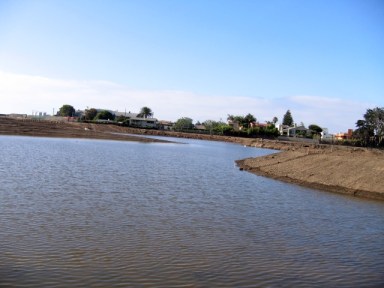
Looking south towards the beach, the channel edges are graded (L. Johnson 8/26/12)
to me; perhaps they’ll be graded further into gentler slopes. We couldn’t get to the vegetated area in the SW corner where a picnic area will be located, depressing our overall passerine sightings. Peering through holes in the fence netting into the channels area, we managed to spot: 8 Mallard, 1 Pied-billed Grebe, 1 Great Blue Heron, 3 Snowy Egret, 2 Coot, 2 Killdeer, 1 Spotted Sandpiper, 1 Pectoral Sandpiper, 2 Least Sandpiper, 1 Black Phoebe, 5 American Crow, 2 Rough-winged Swallow, 12 Barn Swallow, 1 Bewick’s Wren & 1 Song Sparrow (both in brush between the path & PCH), 3 Great-tailed Grackle; 16 species in all. The Pectoral Sandpiper is an early fall migrant, most pass through in September. All these birds are included in the trip list below.
As in July, very little was on the ocean except two kelp-walking Snowy Egret, 1 Common Loon, 3 Western Grebe, 2 Pelagic Cormorant and 1 Brandt’s Cormorant. Down the beach, the surfing competition had many tents and loudspeakers and little else. The ocean was unusually flat. If anything more than a foot high rolled in, I’d be surprised. The audience was nearly as non-existent as the waves.
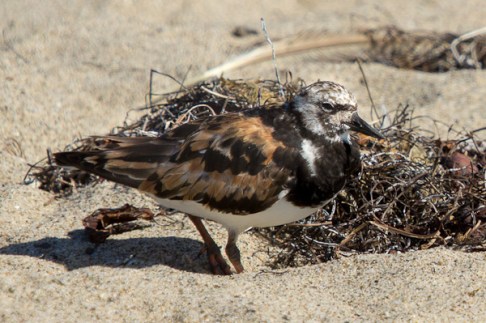
Still-colorful Ruddy Turnstone on the beach. Yes, they really do use their bill to turn over stones. (C. Bragg 8/26/12)
The Snowy Plovers were in their pre-high tide (scheduled for 11:36am) roost about 100 yds. east of the enclosure. Many people counted them many times, finally arriving at 45 birds, an all-time high for any August. Unfortunately, there are no banded birds. As usual, most other birds were on the sand islands near the lagoon’s south shore except for the gulls, mostly Western Gull, who were on the beach near the Snowies.
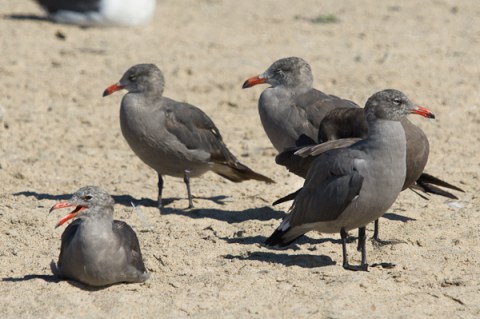
The boys are back in town. Post-breeding Heermann’s Gulls back from islands off the tip of Baja California. (C. Bragg 8/26/12)
We saw at least 5 dead Brown Pelicans on the beach, lagoon edge and sandy islands. I later found out that young Brown Pelicans have been appearing all up and down the West Coast for well over a month, starving, begging and dying. The problem seems to be that there aren’t enough right-sized fish in the ocean to feed all the pelicans. The young birds, less skilled than adults at finding and catching fish are suffering the consequences. The cause(s) for the dearth of fish is uncertain, but I can think of plenty of “usual suspects.”
Birds at Adamson House were mostly Allen’s Hummingbirds, busily poking around in the flowers, not one Anna’s among them. A young Bullock’s Oriole, some Song Sparrows and a California Towhee also appeared. Just before we did our final bird count we were treated to an Osprey soaring high over the lagoon. All were surprised to learn we had seen 53 species; guesses ranged from 25 to 45.
The morning began relatively cool (70°) and cloudy, but the clouds left and it was sufficiently warm by the time we left.
Our next three field trips: Lower Los Angeles River, 8 Sep., 7:30am; Malibu Lagoon, 23 Sep., 8:30am.; Bolsa Chica, 6 Oct. 8:30am.
Our next program: Tuesday, 2 October, 7:30 pm. Water Conservation and Sustainability – Kimberly O’Cain. The usual blog reminders will be emailed.
NOTE: Our 10 a.m. Parent’s & Kids Birdwalk remains canceled until the lagoon project is completed and the parking lot is again fully available.
Links: Unusual birds at Malibu Lagoon
Aerial photo of Malibu Lagoon from 9/23/02.
Prior checklists: July-Dec’11, Jan-June’11, July-Dec ’10, Jan-June ’10, Jul-Dec ‘09, and Jan-June ‘09.
Comments on Bird List Below
Total Birds: Total birds numbers for August were down the same 9% as in July, or 732 of the 6-year average of 807, which is not really significant. Low numbers of Mallard (32) and Brown Pelican (37) were the primary reason. However, the 10-year comparison chart on our Project Page shows August 2012 as 9% above average. Go figure! Notably, August 2012 was an all-time August high count of 45 Snowy Plovers.
Species Diversity: Of 103 total species appearing in August for 2007-12, no more than 68% of them appeared on any one count day, something to keep in mind if you wonder why what is there is much less than what could be there. Since we began these 6-year comparisons in May, this “maximum appearance rate” has fluctuated from 61% to 68%, intriguingly consistent, I think. It seems to indicate that – whenever you visit – what you see will be 1/2 – 2/3rds of what is possible to see there at that time of year. August 2012 with 53 species is slightly (6%) below average.
Summary of species diversity from the 6-year average so far: May +4%, June -10%, July +10%, August -6%. If anyone can draw significance from that fluctuation, let me know, because I can’t, other than thinking that the project is not having a significant adverse or beneficial effect on diversity.
[Chuck Almdale]
| Malibu Census | 2007 | 2008 | 2009 | 2010 | 2011 | 2012 | |
| August 2007 – 2012 | 8/26 | 8/24 | 8/23 | 8/22 | 8/28 | 8/26 | |
| Temperature | 65-75 | 68-75 | 72-81 | 70-78 | |||
| Tide Lo/Hi Height | H +4.4 | L +2.9 | H +5.7 | H +4.32 | H +5.03 | H +2.59 | Ave. |
| Tide Time | 0928 | 0819 | 1201 | 0933 | 0942 | 1136 | Birds |
| Brant | 5 | 0.8 | |||||
| Gadwall | 5 | 4 | 1.5 | ||||
| Mallard | 35 | 42 | 35 | 55 | 60 | 32 | 43.2 |
| Northern Shoveler | 4 | 0.7 | |||||
| Northern Pintail | 6 | 1.0 | |||||
| Green-winged Teal | 6 | 1.0 | |||||
| Surf Scoter | 4 | 0.7 | |||||
| Ruddy Duck | 3 | 5 | 5 | 2.2 | |||
| Common Loon | 1 | 0.2 | |||||
| Pied-billed Grebe | 10 | 3 | 7 | 9 | 15 | 10 | 9.0 |
| Western Grebe | 3 | 0.5 | |||||
| Brandt’s Cormorant | 3 | 1 | 0.7 | ||||
| Dble-crstd Cormorant | 22 | 18 | 12 | 30 | 48 | 34 | 27.3 |
| Pelagic Cormorant | 6 | 2 | 3 | 2 | 2.2 | ||
| Brown Pelican | 66 | 15 | 185 | 163 | 77 | 37 | 90.5 |
| Great Blue Heron | 9 | 8 | 7 | 6 | 3 | 5 | 6.3 |
| Great Egret | 14 | 5 | 5 | 4 | 2 | 1 | 5.2 |
| Snowy Egret | 31 | 23 | 17 | 19 | 15 | 14 | 19.8 |
| Cattle Egret | 1 | 0.2 | |||||
| Green Heron | 1 | 0.2 | |||||
| Blk-crwnd N-Heron | 15 | 2 | 3 | 7 | 4 | 5.2 | |
| Osprey | 1 | 1 | 1 | 0.5 | |||
| Cooper’s Hawk | 1 | 1 | 0.3 | ||||
| Red-tailed Hawk | 1 | 2 | 0.5 | ||||
| Sora | 1 | 0.2 | |||||
| American Coot | 25 | 15 | 28 | 75 | 33 | 29.3 | |
| Blk-bellied Plover | 52 | 45 | 71 | 55 | 46 | 64 | 55.5 |
| Snowy Plover | 26 | 41 | 36 | 44 | 36 | 45 | 38.0 |
| Semipalmated Plover | 8 | 2 | 10 | 4 | 2 | 4.3 | |
| Killdeer | 3 | 6 | 3 | 3 | 8 | 5 | 4.7 |
| Black Oystercatcher | 1 | 0.2 | |||||
| Black-necked Stilt | 2 | 0.3 | |||||
| Spotted Sandpiper | 8 | 2 | 2 | 1 | 2 | 4 | 3.2 |
| Wandering Tattler | 1 | 0.2 | |||||
| Greater Yellowlegs | 2 | 0.3 | |||||
| Willet | 24 | 18 | 16 | 10 | 4 | 2 | 12.3 |
| Lesser Yellowlegs | 1 | 0.2 | |||||
| Whimbrel | 10 | 12 | 29 | 8 | 41 | 52 | 25.3 |
| Marbled Godwit | 2 | 3 | 2 | 2 | 1.5 | ||
| Ruddy Turnstone | 18 | 4 | 11 | 3 | 4 | 9 | 8.2 |
| Black Turnstone | 1 | 1 | 0.3 | ||||
| Red Knot | 1 | 0.2 | |||||
| Sanderling | 17 | 20 | 105 | 30 | 15 | 1 | 31.3 |
| Western Sandpiper | 25 | 12 | 8 | 4 | 11 | 10.0 | |
| Least Sandpiper | 20 | 13 | 3 | 4 | 6 | 6 | 8.7 |
| Pectoral Sandpiper | 1 | 0.2 | |||||
| Short-billd Dowitcher | 1 | 3 | 3 | 1.2 | |||
| Red-necked Phalarope | 2 | 7 | 1.5 | ||||
| Boneparte’s Gull | 2 | 0.3 | |||||
| Heermann’s Gull | 45 | 8 | 21 | 62 | 24 | 17 | 29.5 |
| Mew Gull | 1 | 0.2 | |||||
| Ring-billed Gull | 4 | 2 | 4 | 1.7 | |||
| Western Gull | 204 | 108 | 132 | 66 | 146 | 134 | 131.7 |
| California Gull | 3 | 1 | 1 | 3 | 8 | 4 | 3.3 |
| Least Tern | 35 | 20 | 1 | 9.3 | |||
| Caspian Tern | 1 | 1 | 13 | 12 | 4.5 | ||
| Common Tern | 2 | 0.3 | |||||
| Forster’s Tern | 40 | 2 | 5 | 3 | 1 | 8.5 | |
| Royal Tern | 1 | 3 | 2 | 18 | 3 | 4.5 | |
| Elegant Tern | 20 | 4 | 1 | 45 | 36 | 69 | 29.2 |
| Black Skimmer | 103 | 1 | 17.3 | ||||
| Rock Pigeon | 6 | 3 | 6 | 4 | 5 | 12 | 6.0 |
| Mourning Dove | 4 | 3 | 2 | 2 | 1.8 | ||
| Anna’s Hummingbird | 5 | 1 | 2 | 4 | 2.0 | ||
| Allen’s Hummingbird | 4 | 2 | 2 | 4 | 7 | 3.2 | |
| Belted Kingfisher | 1 | 1 | 2 | 0.7 | |||
| Nuttall’s Woodpecker | 1 | 0.2 | |||||
| Downy Woodpecker | 1 | 0.2 | |||||
| Western Wood-Pewee | 1 | 0.2 | |||||
| Pac.Slope Flycatcher | 1 | 0.2 | |||||
| Black Phoebe | 8 | 3 | 6 | 5 | 10 | 8 | 6.7 |
| Ash-throated Flycatcher | 1 | 0.2 | |||||
| Cassin’s Kingbird | 1 | 1 | 0.3 | ||||
| Western Kingbird | 3 | 5 | 2 | 4 | 4 | 4 | 3.7 |
| Western Scrub-Jay | 2 | 0.3 | |||||
| American Crow | 6 | 5 | 3 | 4 | 3 | 5 | 4.3 |
| Rough-wingd Swallow | 4 | 1 | 3 | 3 | 22 | 2 | 5.8 |
| Tree Swallow | 1 | 0.2 | |||||
| Barn Swallow | 12 | 6 | 25 | 8 | 45 | 22 | 19.7 |
| Cliff Swallow | 15 | 2 | 2 | 1 | 3.3 | ||
| Oak Titmouse | 2 | 0.3 | |||||
| Bushtit | 15 | 17 | 6 | 14 | 8.7 | ||
| Bewick’s Wren | 1 | 2 | 0.5 | ||||
| House Wren | 1 | 0.2 | |||||
| Marsh Wren | 1 | 0.2 | |||||
| Northern Mockingbird | 5 | 1 | 2 | 5 | 3 | 4 | 3.3 |
| European Starling | 2 | 15 | 8 | 7 | 20 | 28 | 13.3 |
| Ornge-crwnd Warbler | 3 | 0.5 | |||||
| Yellow Warbler | 5 | 0.8 | |||||
| Yellow-rumpd Warbler | 2 | 0.3 | |||||
| Common Yellowthroat | 2 | 4 | 1 | 5 | 8 | 1 | 3.5 |
| Wilson’s Warbler | 1 | 1 | 0.3 | ||||
| California Towhee | 1 | 1 | 1 | 0.5 | |||
| Song Sparrow | 2 | 3 | 4 | 3 | 5 | 3 | 3.3 |
| Western Tanager | 1 | 0.2 | |||||
| Red-winged Blackbird | 2 | 1 | 2 | 32 | 6.2 | ||
| Brewer’s Blackbird | 3 | 0.5 | |||||
| Great-tailed Grackle | 5 | 7 | 2.0 | ||||
| Brwn-headed Cowbird | 1 | 1 | 0.3 | ||||
| Hooded Oriole | 1 | 1 | 0.3 | ||||
| Bullock’s Oriole | 1 | 0.2 | |||||
| House Finch | 4 | 4 | 5 | 4 | 8 | 4.2 | |
| Lesser Goldfinch | 1 | 3 | 4 | 1.3 | |||
| Totals by Type | 8/26 | 8/24 | 8/23 | 8/22 | 8/28 | 8/26 | Ave. |
| Waterfowl | 53 | 42 | 39 | 71 | 65 | 36 | 51 |
| Water Birds-Other | 129 | 53 | 204 | 231 | 221 | 121 | 160 |
| Herons, Egrets | 70 | 38 | 32 | 37 | 24 | 20 | 37 |
| Raptors | 2 | 1 | 1 | 0 | 3 | 1 | 1 |
| Shorebirds | 217 | 180 | 303 | 162 | 187 | 196 | 208 |
| Gulls & Terns | 356 | 145 | 162 | 299 | 248 | 232 | 240 |
| Doves | 6 | 3 | 10 | 7 | 7 | 14 | 8 |
| Other Non-Pass. | 10 | 2 | 3 | 8 | 7 | 7 | 6 |
| Passerines | 98 | 51 | 64 | 76 | 181 | 105 | 96 |
| Totals Birds | 941 | 515 | 818 | 891 | 943 | 732 | 807 |
| Total Species | 8/26 | 8/24 | 8/23 | 8/22 | 8/28 | 8/26 | Ave. |
| Waterfowl | 5 | 1 | 2 | 4 | 2 | 2 | 2.7 |
| Water Birds-Other | 5 | 5 | 3 | 5 | 6 | 8 | 5.3 |
| Herons, Egrets | 5 | 4 | 4 | 5 | 4 | 3 | 4.2 |
| Raptors | 2 | 1 | 1 | 0 | 2 | 1 | 1.2 |
| Shorebirds | 15 | 14 | 16 | 10 | 14 | 13 | 13.7 |
| Gulls & Terns | 11 | 7 | 8 | 8 | 8 | 7 | 8.2 |
| Doves | 1 | 1 | 2 | 2 | 2 | 2 | 1.7 |
| Other Non-Pass. | 3 | 1 | 2 | 4 | 3 | 1 | 2.3 |
| Passerines | 23 | 14 | 13 | 19 | 18 | 16 | 17.2 |
| Totals Species – 103 | 70 | 48 | 51 | 57 | 59 | 53 | 56.3 |