Free email delivery
Please sign up for email delivery in the subscription area to the right.
No salesman will call, at least not from us. Maybe from someone else.
Saying Good-Bye and Good Luck to Maja Block
After more than thirty years as a member of SMBAS, and most of that time also on the Board of Directors, Maja is leaving us to move to Hawaii to be nearer her son.
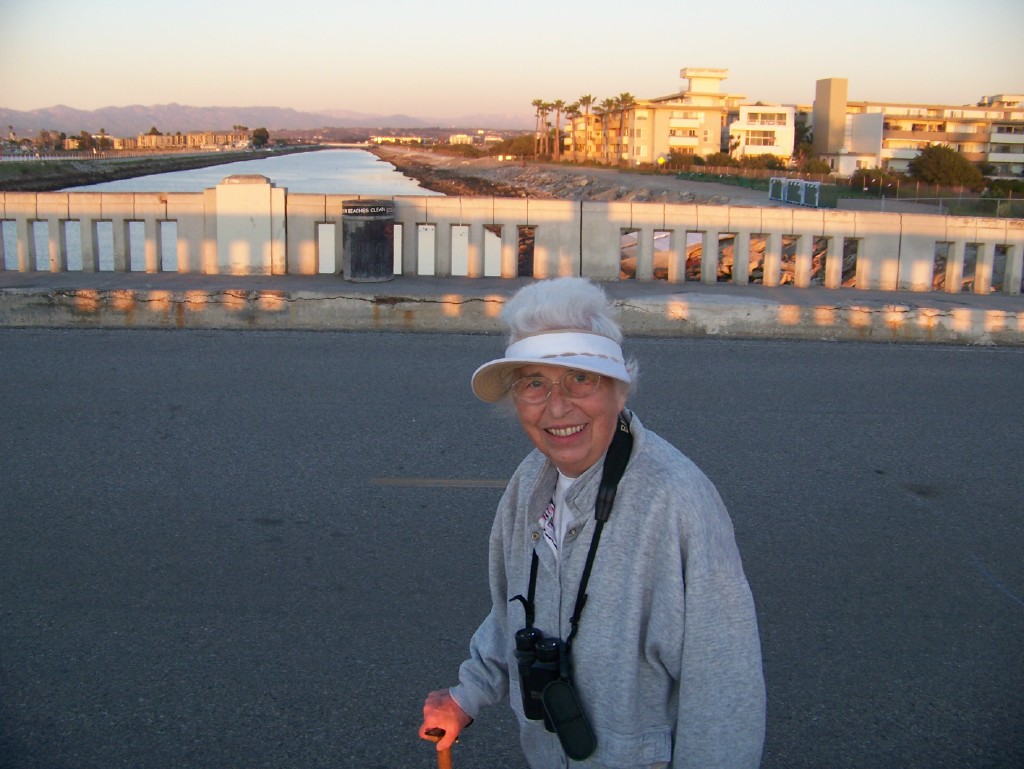
Maja on the Ballona Creek Bridge
She joined the board in 1982 as Field Trip Chair and served until 1988. In 1988, she was elected Chapter President, simultaneously served as Education Chair with responsibility for Audubon Adventures. After serving as President for three years and then Past President for three more years, she served us yummy refreshments at our general meetings as Hospitality Chair from 1994 to 2000. Since 2000, Maja has been responsible for organizing the superb programs we have seven times a year. She made sure we were not just entertained with programs about birding trips but also educated about the environment and the sciences surrounding us. She set a high bar as Program Chair, but we will try to follow her leads to have a schedule of interesting and varied programs.
During all this time, she raised two wonderful children, Michelle and Kevin, worked as a school nurse, and traveled the world. Her birding adventures took her as close by as Malibu Lagoon, Butterbredt Spring, Morongo Valley, and Arizona, and as far afield as Antarctica, New Zealand, Australia, and of course England and Germany.
Thank you Maja for all your years of service to Santa Monica Bay Audubon Society and the world of birds.
We will miss you and wish you all the best in Hawaii. Perhaps, sometime you will come back and drop in at one of our meetings. With email and the internet, you need never be far away.
Lillian Johnson Almdale
April, 2010
Naturalized Hummingbirds and the Native Plants they Love
Do two good deeds in one and have fun into the bargain by using native plants to draw hummingbirds to your garden. First, of course, you’ll enjoy the hummingbirds that feast on the nectar and the insects that love your native plants. Hundreds more insects, in fact, enjoy native plants than are attracted to cultivars. Second, native plants help return the environment to its original, pre-cultivar state, and this helps other plants and animals, including other birds.
What native plants are good for hummingbirds? Some that enjoy our climate and are relatively easy to grow are:
- paintbrush (castillija affinis ) – flowers in spring to summer
- red-flowered larkspur (delphinium cardinale) – flowers in summer to autumn
- California fuchsia (epilobium canum) – flowers in autumn
- island snapdragon (galvesia speciosa) – flowers in spring to autumn
- heart-leafed penstemon (keckelia cordifolia) – flowers in summer to autumn
- scarlet monkeyflower (mimulus cardimalis) – flowers in spring to autumn
- red monkeyflower (mimulus puniceus) – flowers in spring to summer
- chaparral currant (ribes malvaceum) – flowers in spring to summer
- fuchsia-flowered gooseberry (ribes speciosum) – flowers in spring to autumn
- hummingbird sage (salvia spathecea) – flowers in spring to summer
Notice that native plants don’t bloom in winter. One reason is because all hummingbirds used to migrate south in winter and the birds weren’t around for winter pollination.
There’s nothing wrong with feeding hummingbirds except that you encourage them to depend on an artificial (and often messy or even dirty) source of food.
You can rely on native plants to do all of the feeding, but then you eschew the pleasure of seeing the birds’ antics up close.
Help Monitor Least Terns at Venice Beach!
The California Least Tern is listed as endangered by both Federal and California state authorities, and Los Angeles Audubon Society is looking for dedicated volunteers to help monitor them at Venice Beach.
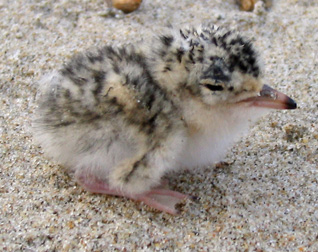
Least Tern chick
In Los Angeles County, this species has only two breeding colonies: Venice Beach and the Port of Los Angeles. L.A. Audubon works with project biologists and the California Department of Fish & Game studying the tern colony in Venice by coordinating a community-based science monitoring program during the nesting season. Volunteers receive training and then help monitor the colony for one hour each week from mid-April to mid-August. This is a great opportunity for families looking for a way to learn about nature together, for students looking to gain some field experience in environmental science, or anyone who’d like to know more about urban wildlife. Many Santa Monica Bay Audubon chapter members have volunteered in previous years.
If you’re interested, then they’d love to meet you at one of the following training sessions:
Monday, April 26th, 6:30 p.m. to 7:30 p.m.
Saturday, May 1st, 9:00 a.m. to 10:00 a.m.
Training Location: The sessions will take place at the Least Tern Colony enclosure on Venice Beach, located a few short blocks north of the Ballona Channel at the southern end of Venice Beach. There is metered parking along the channel where Pacific Ave. turns into Via Marina, and there’s a public pay lot at the intersection of Via Marina and Captain’s Row. There’s free parking along Pacific Ave. but the spots disappear quickly.
Volunteers need attend only one of these sessions, though you’re welcome to attend both. Binoculars are essential to monitoring, so please bring them with you if you own them. If you don’t own any, they can lend you a pair for the season. If neither of these dates work for you, please let them know and they’ll see if they can arrange an alternative training session.
Questions? Please contact the Volunteer Coordinator at (323) 481-4037 or email: tern@laaudubon.org.
From: Stacy Vigallon
Weeds and Springtime
WEEDS! The copious, welcome rain has invigorated trees and shrubs of the chaparral and brought forth a wealth of wildflowers. But they also have created a lush cover of weeds that smother and choke our lovely, treasured native plants and convert swathes of chaparral and coastal scrub into weed patches that turn into semi-desert in the fall and winter, ripe for invasion by other weeds or fire. We are witnessing a type conversion of native habitat into a fire-prone wasteland.
What to do? No one expects an average homeowner to take on the task of clearing all these weeds by her or himself. But each of us can make a contribution. Assuming you take care of an average homeowner’s piece of land, at the least, you should try to keep it weed-free. This means you should pull out or otherwise destroy non-native grasses. Almost any grass that “volunteers” in your yard is not native. You will also want to get rid of non-natives like oxalis (oxalis pes-caprae, or Bermuda buttercup), no matter how pretty they are.
Better yet, you may spend a few hours on a “weed war” with the California Native Plant Society, helping free habitat from nasty weeds. Call CNPS for information on how you can help.
I don’t think the temperature ever made it up to 70° and those of us (me) who assumed it would warm up significantly tended to be
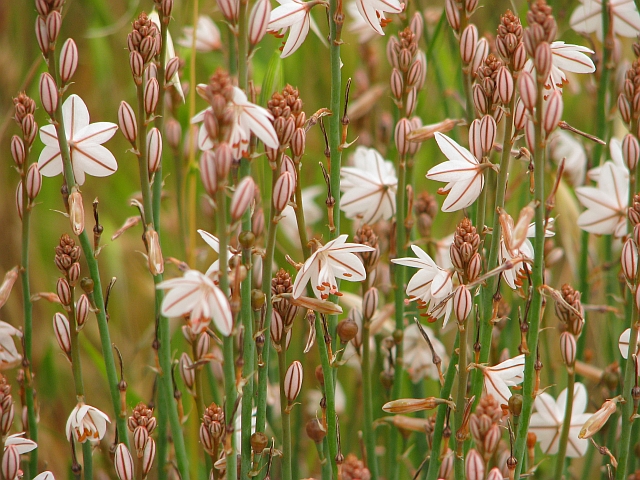
Garlic blooms (L.Johnson)
chilled for much of the hike. The flowers and birds, however, were certain it was spring. Many of the birds noted were never seen, only heard: of the House Wrens, for example, we probably didn’t see more than 4 of the 32 cited; the rest were gaily singing from hidden perches in nearly every tree we passed. We saw so many flowers that our four-mile hike stretched out to five hours long, as we continually asked Peggy Burhenn, our indefatigable leader, “Hey, what’s this flower?” (Repeat 1000 times.) What she didn’t immediately know, she diligently looked up in her large handbook of California flowering plants.
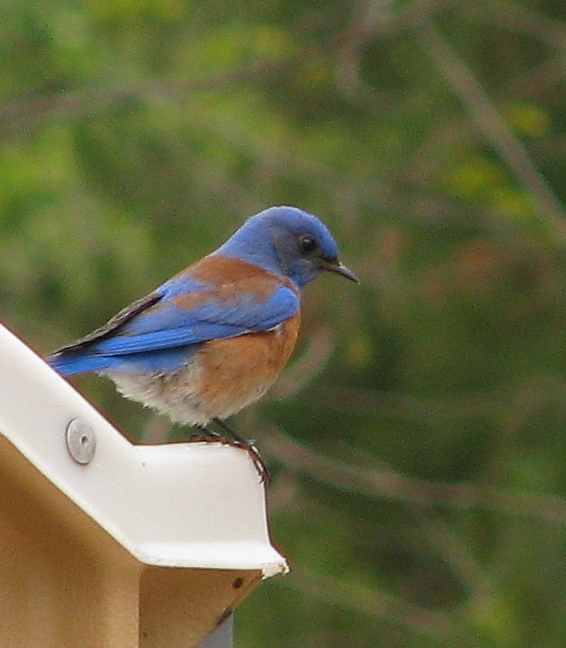
Western Bluebird male (L.Johnson)
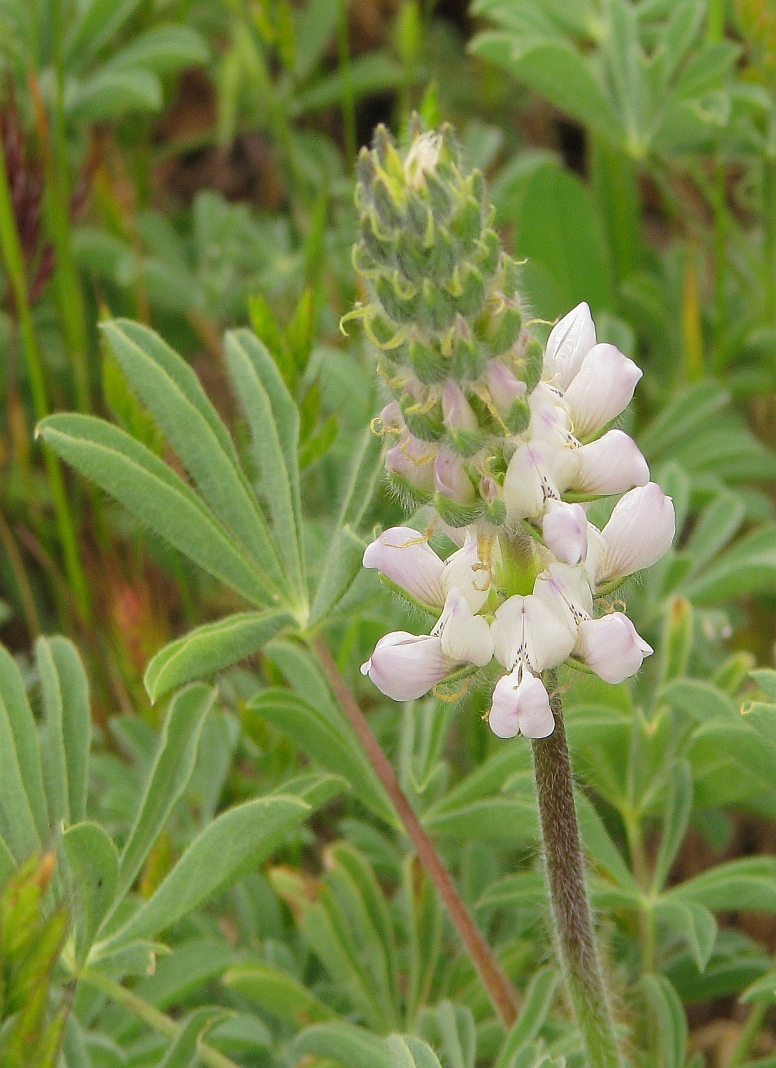
Valley Lupine (L.Johnson)
Western Bluebirds were in great evidence near all the buildings. At the Reagan Ranch we found both Cassin’s and Western Kingbirds bouncing over the flowers and grass. Four pairs of Orioles – both Hooded and Bullock’s – gurgled overhead in the roadside trees. At the Paramount Ranch western town a large flock of American Goldfinches contained several bright breeding plumage males among the numerous winter and molting plumage birds. Great Blue Herons stalked the fields looking for unwary ground squirrels, proving that they don’t have an exclusively aquatic menu. Overhead in several locations were flocks of swallows and swifts. We found most of the No. Rough-winged Swallows in a flock low over Malibu Creek flying through a gap in the reeds, feeding on a flock of insects close to the water.

Male Spotted Towhee in a Ceanothus
Many of the flowers were seen on our prior year’s trip but a few were new, perhaps because we were about 10 days further into Spring.
Among them were: Cliff Aster, Morning Glory, White Nightshade, Common Goldfields, Strigose Lotus, Western Wallflower, Chinese Houses, Prickly Phlox, Winter Vetch, California Bickelbush, and Fennel.
The weather, which looked like rain for a while, held, and we had a fine day. By the time we returned to Paramount Ranch, we were ready to eat.
Brian Cohee took a great selection of flower photos on this hike. You can find a nice slide show of them here.
There is also a website with hundreds, perhaps thousands of pictures of flowers of the Santa Monica Mountains National Recreation Area. If you can’t figure out what was that bloom you saw on a local hike, check this out.
| PARAMOUNT TO MALIBU CREEK 4/10/10 – TRIP LIST | ||
| PLANTS | BIRDS | Nos. |
| WHITE | Mallard | 10 |
| Big Pod Ceanothus | California Quail | H |
| Coyote Brush (not in bloom) | Great Blue Heron | 2 |
| Elderberry | Turkey Vulture | 2 |
| Mule Fat | Sharp-shinned Hawk | 1 |
| Poison Hemlock | Red-shouldered Hawk | 2 |
| Cliff Aster | Red-tailed Hawk | 5 |
| Horehound* | American Coot | 4 |
| Miner’s Lettuce | Mourning Dove | 12 |
| Morning Glory | Black-hooded Parakeet | 1 |
| Popcorn Flower | Vaux’s Swift | 20 |
| White Nightshade | White-throated Swift | 12 |
| White Sage | Blk-chinned Hummingbird | 1 |
| Wild Cucumber | Anna’s Hummingbird | 4 |
| Yucca | Allen’s Hummingbird | 1 |
| YELLOW | Belted Kingfisher | 1 |
| Johnny-Jump Up | Acorn Woodpecker | 11 |
| Common Fiddleneck | Nuttall’s Woodpecker | H |
| Common Goldfields | Pacific-slope Flycatcher | 2 |
| Deerweed | Black Phoebe | 8 |
| Golden Currant | Say’s Phoebe | 1 |
| Mountain Dandelion | Cassin’s Kingbird | 2 |
| Mustard* | Western Kingbird | 3 |
| Pineapple Weed* | Western Scrub-Jay | 14 |
| Strigose Lotus | American Crow | 6 |
| Western Wallflower | Common Raven | 5 |
| ORANGE | No. Rgh-winged Swallow | 24 |
| California Poppy | Tree Swallow | 4 |
| Sticky Monkey Flower | Violet-green Swallow | 12 |
| RED | Barn Swallow | 2 |
| Hummingbird Sage | Cliff Swallow | 20 |
| Indian Paintbrush | Oak Titmouse | 4 |
| PINK | Bushtit | 4 |
| Chinese Houses | White-breasted Nuthatch | 2 |
| Milk Thistle (not in bloom) | Canyon Wren | H |
| Prickly Phlox | Bewick’s Wren | 2 |
| Purple Owl’s Clover | House Wren | 32 |
| Purple Sage | Blue-gray Gnatcatcher | 1 |
| Red-stem Filaree* | Ruby-crowned Kinglet | 2 |
| Wild Radish* | Western Bluebird | 10 |
| Wild Rose (not in bloom) | American Robin | 1 |
| Wild Sweet Pea | Wrentit | H |
| PURPLE / BLUE | California Thrasher | H |
| Black Sage | European Starling | 12 |
| Blue Dicks | Orange-crowned Warbler | 6 |
| Bush Lupine | Yellow Warbler | H |
| Caterpillar Phacelia (2 types) | Yellow-rumped Warbler | 10 |
| Chia | Common Yellowthroat | 2 |
| Common Vervain | Spotted Towhee | 5 |
| Danny’s Skullcap | California Towhee | 6 |
| Fiesta Flower | Song Sparrow | 7 |
| Green Bark Ceanothus | Black-headed Grosbeak | 4 |
| Parry’s Phacelia | Red-winged Blackbird | 20 |
| Purple Nightshade | Brown-headed Cowbird | 1 |
| Valley Lupine | Hooded Oriole | 6 |
| Winter Vetch | Bullock’s Oriole | 6 |
| BROWN | Purple Finch | H |
| Curly Dock* | House Finch | 20 |
| Dodder | Lesser Goldfinch | 16 |
| Common Plantain | American Goldfinch | 30 |
| NOT IN BLOOM | Total Birds | 60 |
| Ashy-leafed Buckwheat | H – Heard only | |
| California Bickelbush | ||
| California Buckwheat | ||
| California Sagebrush | ||
| Chamise | ||
| Fennel | ||
| Laurel Sumac | ||
| Mistletoe | ||
| Mugwort | ||
| Poison Oak | ||
| Scrub Oak (with gall) | ||
| Toyon | ||
| TREES | ||
| California Bay Laurel | ||
| Coast Live Oak | ||
| Valley Oak | ||
| Western Sycamore | ||
| Willow | ||
| Total Plants — 70 | ||
| * – Introduced species | ||



 SANTA MONICA BAY AUDUBON SOCIETY BLOG