Free email delivery
Please sign up for email delivery in the subscription area to the right.
No salesman will call, at least not from us. Maybe from someone else.
Back Bay Newport: Sun. 15 December, 8:00 AM
The trip is going, reservations not needed.
Starting location is same as last year (see below)
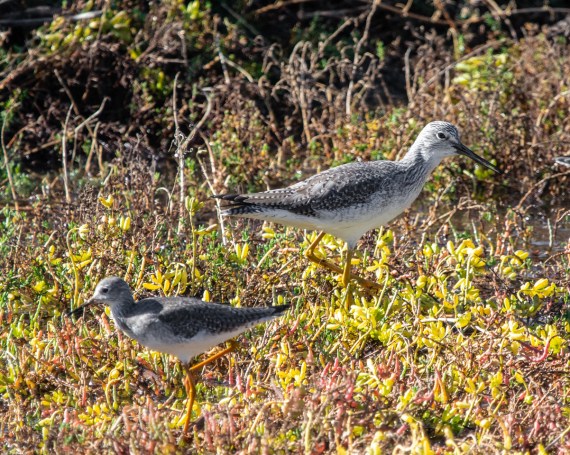
Lesser (L) & Greater (R) Yellowlegs on the pickleweed
(R. Juncosa, Upper Newport Bay 12-8-18)
Back Bay Newport (Upper Newport Bay) can provide great birding when the tides are right. It’s a bit of a drive for us (see below) and the difficulty of finding a weekend day with a super-high tide has occasionally kept us from going in the past. This year, on Sunday Dec. 15 the high tide will be 6.91 ft @ 0810 and low of -1.6 ft @ 1538. [For comparison, last year it was 5.55 ft. @ 0612, and low of 0.18 ft. @ 1318. Highest tide this season is +7.0 ft. on Nov. 16.] Water level will falling during our trip so don’t be late. This isn’t optimal for flushing rails from the reeds, but good for shorebirds and ducks. By the time we get to the upper end of the bay, the tide will have receded and shorebirds should be plentiful. [No promises!]
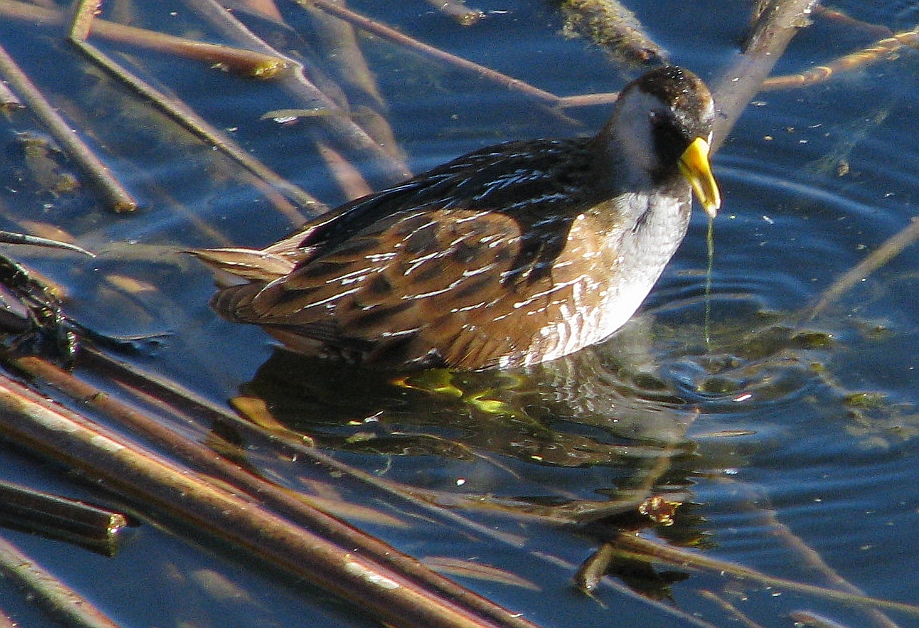
We will of course search for Sora, Virginia and Ridgway’s Rails, and during that process we will see waterbirds, shorebirds, bushbirds, treebirds, pondbirds, reedbirds, mudflatbirds, sandislandbirds, skybirds and the always-to-be-desired whatnots. [AKA ducks, grebes, waders, sandpipers, gulls, terns and skimmers on the bay and shore, raptors overhead and things in the brush, not necessarily in that order.] I saw my lifer Short-eared Owl here, decades ago, standing on a post among the reeds, and thereafter made the common newbee mistake of expecting to see it on the same post year after year. We had a Bald Eagle the last two years, albeat at a distance. You never know what will be around. We will also search for the endangered California Gnatcatcher at a particular location along the route.

We’ll have lunch (so bring one!) probably at nearby birdy San Joaquin freshwater marsh, and those who wish can do some more birding there. In 2017 we saw a Red-throated Pipit here, a Very Good Bird, and Virginia Rails show up, plus White Pelicans and more whatnots. However, energy remaining, we also make sure to look for anything around; they usually keep a nice stock of interesting birds on hand, scattered around the many birder-sized ponds. They keep a list of sightings outside the bookshop door, AND if you’re looking for a particular bird book (say…Field Guide to Galapagos Birds) they might have it. You could call them: 949-378-6501.
Family guide: We mostly stand around near our cars gawking at the birds, then drive to the next spot and gawk some more. We don’t walk a whole lot. Temps. should be 52-60°, wind 3-5 mph. At San Joaquin Marsh after lunch it’s all walking. Dress in layers.
For future reference: Link to tide chart
Link to December 2023 report.
Driving Time: 50-60 minutes – 48 miles. While there are gas stations in the area (primarily right where you get off the freeway) you could get hung up there while everyone else drives on to the next birding spot to find that über-rarity (or even a mega-tick) which then flies away before you arrive. Don’t let this happen to you! Gas up in advance.
Carpooling Drivers & Riders: If you’re willing to drive others or ride with others, include your contact info, approx. location and drive/ride preference in your reservation to me, and I’ll circulate it to any others similarly interested. If you’re riding, the polite thing is to get yourself to the driver’s starting location rather than try to get them to drive to your house to pick you up. They’re already in for a 2-4 hour drive time for the trip. And riders should inquire of drivers about their face-masking requirements, if any.
Meeting time: 8 am, Sunday 15 December, 2024. Get there early and find the rails and snipes!
Contact: Chuck, no later than Thursday 5 PM 12 December. email misclists [AT] verizon [DOT] net
Food: Bring munchies & liquids and/or lunch. No services next to the bay.
Directions: From the Santa Monica Fwy (I-10)Take San Diego Fwy (I-405) 43 miles south to CA-73. CA-73 south for 2.3 miles [Do not get onto I-55 Costa Mesa Fwy], take exit 15 for JAMBOREE RD and continue on SE BRISTOL ST. about 0.5 mile to JAMBOREE RD. and turn right. Continue south on JAMBOREE 3.1 miles to BACK BAY DR., turn right and continue on BACK BAY Dr. 0.4 miles to the start of MOUNTAINS TO SEA TRAIL HEAD ride/bike one-way road. Continue about 0.1 mile on the ride/bike road to first dirt parking area on left next to the bay. We’ll meet here. Write down these directions and look at the map linked to below!!! Don’t get lost. If you’re significantly late and we’re not at the meeting spot, continue on the ride/bike 15 MPH road. It’s one-way for miles and we’ll be somewhere along it.
Birding Note: Nelson’s Sparrow has been seen by me several times in the past along this first stretch on either side of the road in the reedy areas before the dirt parking area.
Coffee/Bathroom Needs: If you need either before the 8am start, exit CA-73 at Campus Dr./Irvine Ave, the last exit before Jamboree Rd. Continue from exit ramp onto SE Bristol Rd. which has fast food restaurants with bathrooms along the right side. Then continue on Bristol to Jamboree Rd. and to the meeting spot. There are porta-potties on the ride/bike road, but not right at the beginning.
If you get there early, there’s good birding!! right where you’re parked. It doesn’t hurt to get there early and find all the birds for the rest of us, not to mention the one’s that will disappear before we arrive.
Meet at 8:00 a.m. in the parking lot. Leader: Chuck Almdale.
Map to Meeting Place: Back Bay Newport – SE meeting area
Use + and – to zoom in or out, left click and mouse drag to reposition the map.
Directions to lunch @ San Joaquin Marsh
We’ll finish birding Back Bay near the corner of the Mountains-to-the-Sea Trail and EASTBLUFF DRIVE. East on EASTBLUFF DR. and cross JAMBOREE RD. where the road becomes UNIVERSITY DR. Continue under Fwy. #73 and about 1 mile more to CAMPUS DR. Turn left on Campus Dr. & across the creek to the first right, RIPARIAN DRIVE. Turn right & continue north about 1/2 mile to the entrance of SAN JOAQUIN Marsh (home of Sea & Sage Audubon). Turn left and down the little hill to the parking lot. You’ll pass the bookstore on your right and the picnic tables are just beyond the bathroom block. If the parking lot is full, go back up the little hill and park in the large dirt lot below you on the other side, then schlep your lunch over to the picnic tables.
[Chuck Almdale]

Zoom Recording: The Motus Wildlife Tracking System: Using technology to research grassland birds, with Senior Avian Ecologist Matt Webb.
The recording of this program from 3 December 2024 is now available online
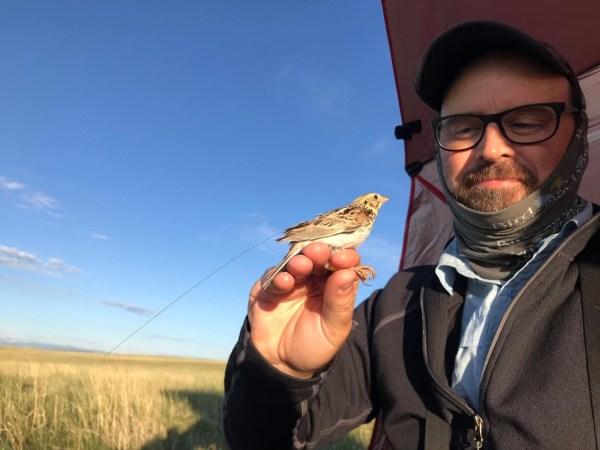
The Motus Wildlife Tracking System: Using technology to research grassland birds, with Senior Avian Ecologist Matt Webb.
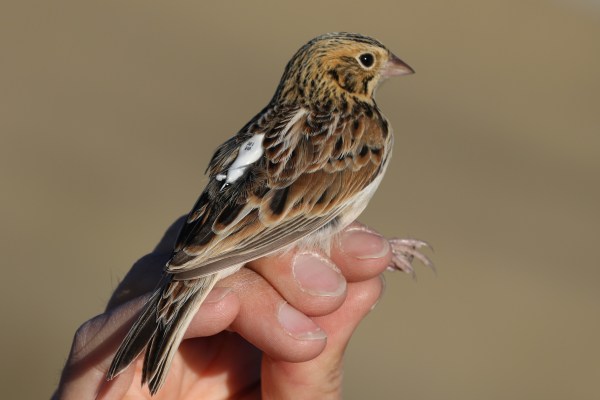
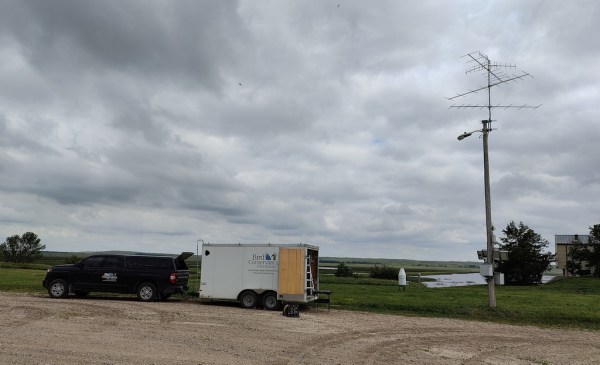
The Motus Wildlife Tracking System is a complex and sophisticated system designed to track migrations of birds and other wildlife, and currently has over 1,500 stations worldwide. The Motus (Latin for movement or motion) system uses a variety of transmitters – some as light as .05 grams – which are attached to a variety of migrating wildlife. Information from the receiver stations is fed into large databases which are at the core of a great deal of research on migrations. In this overview and to illustrate how the system actually works, Matt Webb will describe how the Motus system is being used for research on five different species of grassland birds at the Bird Conservancy of the Rockies.
|
Matt Webb is the Senior Avian Ecologist and Motus Wildlife Tracking System Coordinator at the Bird Conservatory of the Rockies in Fort Collins, CO. He was born and raised in Salida, CO. Around age 10, at odds with his preferences, his family moved to the ‘dull’ plains of Northern Colorado. To Matt’s surprise, he fell in love with the endless roll and incredible diversity of the shortgrass prairies. He later spent some time in Pittsburgh, PA, working at the Carnegie Museum of Natural History, the American Bird Conservancy, and the Smithsonian Migratory Bird Center. He holds a Bachelor’s Degree in Wildlife Biology and a Master’s in Conservation Leadership, both received from Colorado State University. When not building automated radio telemetry stations, Matt enjoys mothing, photographing beetles, riding and fixing bicycles, turning over stones, and dragging his family outside at night to watch the International Space Station go by.
Our entire catalog of Zoom recordings is here.
President’s Annual Appeal for 2024
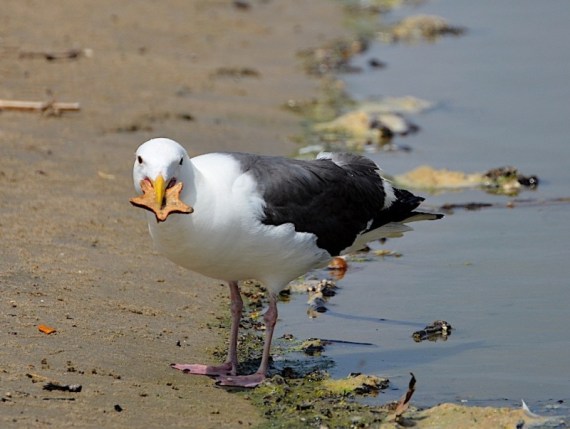
The Western Gulls have already chipped in. (Photo: Grace Murayama 7-23-17)
We are asking you to consider giving us your support this year. Remember, this is our only fund raising effort. We don’t pester you weekly, monthly, or throughout the year. Your help allows our all-volunteer group to accomplish our mission “to be a center for wildlife education, habitat protection, and conservation issues that involve birds.”
These efforts are of increasing importance in view of the past decreasing support for environmental issues coming from the Federal Administration.
You can DONATE four different ways:
- With the self-addressed envelope enclosed with the annual appeal letter (sent to those already on our membership rolls)
- Send a check to our mailing address: SMBAS, PO Box 35, Pacific Palisades, CA 90272
- With PayPal using the PayPal Widget located on the right side bar of the blog
- With a Credit Card using the same PayPal Widget located on the right side bar of the blog. You do not have to join PayPal to donate, just have your credit card “standing by.”
Please take a moment and make a donation today.
We continue our strong backing of all things birds, habitat, native plants, the environment and conservation through education, field trips, bird monitoring, speakers and grants to students and conservation groups.
Please take a minute to read the annual appeal letter below and see what we have been doing this year.
Thank you,
Jean Garrett
President
Link to print copy of our 2024-25 Calendar of Field Trips and Programs
Dear Friend of SMBAS, November 6, 2024
We ask for your help only once a year! Last year marked the end of our 12 year support for 10 buses for inner city students to attend the Ballona Wetlands education program. The field trip is for elementary schools to participate in a hands-on learning session about the environment around a beach. Teachers & students love the Ballona program because it is fun. Students use microscopes to see what is in the water; they learn to pull invasive weeds and not confuse them with native plants; they learn to identify coastal birds; and they see where the river finally reaches the ocean.
With your help, we can continue to fund more buses. Educational programs like the Ballona field trip have helped create the commitment the younger generations have to the environment.
Our focus is on:
Education
- Student Conservation Association. We financially support the association because it is on the job training for students. They repair trails and even put up barriers to prevent dirt bikes from straying off the trails.
- Nature Nexus Institute, the new formal name for the Ballona Wetlands program mentioned above. For some elementary students, it is the first time they have seen the ocean.
- We provided funding to support laminated training/education materials for the LA County’s Young Lifeguard program.
- Children’s walk. Every fourth Sunday of the month at 10 AM, we offer an educational program at the Malibu Lagoon State Beach. (Adults 8:30 a.m.)
Public Outreach
- Every first Tuesday (October-May, except January) we have a Zoom program starting at 7:30 PM with speakers on subjects that range from the parrot population in Los Angeles to conservation efforts on the ocean. Upcoming programs are announced on our BLOG, smbasblog.com (Facebook: http://www.facebook.com/SantaMonicaAudubon). Prior program recordings are available on the blog.
Habitat Conservation and Research
- We offer grants to local college students. Current projects include collecting DNA from Wilson’s & Yellow Warblers to determine timing of migration, the number breeding locally and identification of the bird’s origins as a means to establish migration patterns. Another student study collected data on the effects that various species of lice have on quail and the level of health of the quail as a result.
- We sponsor and staff the Malibu Lagoon location for the Coastal Cleanup project.
- We actively support the Dune Restoration Project undertaken by the City of Santa Monica and the Bay Foundation. We are helping to fund the new signage.
Bird Monitoring
- Not only have we kept a bird count at Malibu Lagoon for decades, we also monitor Western Snowy Plovers (WSP) and have helped pay for fencing for the WSP at Malibu Lagoon and Santa Monica Beach. Volunteers from our organization also monitor Brown Pelicans and Least Terns whose numbers are included in the data given to Federal, State and local agencies so that declining or increasing populations can be tracked.
We hope you will check our blog for fascinating articles by Chuck Almdale, look for the upcoming speakers, and check out our other monthly walks. Join us at Malibu Lagoon (on the 4th Sunday of every month). On the Lagoon walk, you can leave at any time so don’t think that it will take all morning if you don’t want to. We have good binoculars to lend to you for the walks, paid for by your donations.
Please remember all contributions are fully tax deductible and will be used exclusively in direct support of our programs.
Your continued financial assistance helps us to encourage other people to care about the environment!
Jean Garrett, President
post office box 35 pacific palisades california 90272
Please check the blog www.smbasblog.com for changes and updates.
[posted by Chuck Almdale]
Butterbredt Christmas Bird Count December 21st

The Christmas Bird Count (CBC) is held every year in the dead of winter. For those not familiar with this event, which is a Field Trip combined with Citizen Science, click here and here.
The kicker is that our count does not take place in Santa Monica Bay. It happens in the high Mojave Desert where snow is present, some years in little patches in the shade and other years where you need 4WD and skis to get around. We don’t know what the weather will be in 2 weeks from now but is typically in the 40s-50s and sunny – snow years are rare.
You do not need to be an expert bird identifier – there will be one in every group. We need about 4 groups to cover the territory and every eye counts.
If you’re up for an adventurous day of birding send me an email: <smbaudubon@gmail.com>. In addition to warm bodies we also need cars – unless it’s a snow year 4WD is not necessary but low-slung cars might be a problem. Leave the Jaguar at home.
You are all invited to the next ZOOM meeting
of Santa Monica Bay Audubon Society
The Motus Wildlife Tracking System: Using technology to research grassland birds, with Senior Avian Ecologist Matt Webb.
Zoom Evening Meeting, Tuesday, 3 December, 7:30 p.m.
Zoom waiting room opens 7:15 p.m.
The Motus Wildlife Tracking System is a complex and sophisticated system designed to track migrations of birds and other wildlife, and currently has over 1,500 stations worldwide. The Motus (Latin for movement or motion) system uses a variety of transmitters – some as light as .05 grams – which are attached to a variety of migrating wildlife. Information from the receiver stations is fed into large databases which are at the core of a great deal of research on migrations. In this overview and to illustrate how the system actually works, Matt Webb will describe how the Motus system is being used for research on five different species of grassland birds at the Bird Conservancy of the Rockies.
|
Matt Webb is the Senior Avian Ecologist and Motus Wildlife Tracking System Coordinator at the Bird Conservatory of the Rockies in Fort Collins, CO. He was born and raised in Salida, CO. Around age 10, at odds with his preferences, his family moved to the ‘dull’ plains of Northern Colorado. To Matt’s surprise, he fell in love with the endless roll and incredible diversity of the shortgrass prairies. He later spent some time in Pittsburgh, PA, working at the Carnegie Museum of Natural History, the American Bird Conservancy, and the Smithsonian Migratory Bird Center. He holds a Bachelor’s Degree in Wildlife Biology and a Master’s in Conservation Leadership, both received from Colorado State University. When not building automated radio telemetry stations, Matt enjoys mothing, photographing beetles, riding and fixing bicycles, turning over stones, and dragging his family outside at night to watch the International Space Station go by.
(If the button above doesn’t work for you, see detailed zoom invitation below.)
Meeting ID: 849 6116 7348
Passcode: 858689
One tap mobile
+16694449171,,84961167348#,,,,858689# US
+16699009128,,84961167348#,,,,858689# US (San Jose)
Dial by your location
+1 669 444 9171 US
+1 669 900 9128 US (San Jose)
+1 253 205 0468 US
+1 253 215 8782 US (Tacoma)
+1 346 248 7799 US (Houston)
+1 719 359 4580 US
+1 646 931 3860 US
+1 689 278 1000 US
+1 301 715 8592 US (Washington DC)
+1 305 224 1968 US
+1 309 205 3325 US
+1 312 626 6799 US (Chicago)
+1 360 209 5623 US
+1 386 347 5053 US
+1 507 473 4847 US
+1 564 217 2000 US
+1 646 558 8656 US (New York)
Meeting ID: 849 6116 7348
Passcode: 858689
Find your local number: https://us02web.zoom.us/u/kc7rV57nSq



 SANTA MONICA BAY AUDUBON SOCIETY BLOG