Free email delivery
Please sign up for email delivery in the subscription area to the right.
No salesman will call, at least not from us. Maybe from someone else.
Kingfisher under water | BBC Discover
[Posted by Chuck Almdale, submitted by Lillian Johnson]
7 astonishing underwater kingfisher photos that show the beautiful bird is just as at home below the surface as above it
These remarkable photographs show how a kingfisher dives and the ingenious way it is adapted for underwater
by Daise Bowie-Sell, 27 Feb 2026
Click the link to the article.
https://www.discoverwildlife.com/animal-facts/birds/kingfishers-underwater-photos
Lead Paragraph
The common kingfisher, or Alcedo atthis, is an iconic sight on the riverbanks and wetlands of the UK. Azure blue with an orange and white sheen, they offer a fast moving streak of colour among reeds and waterways. But despite their distinct look, they can be tricky to spot.
Condors lay egg (maybe) in NoCal | Smithsonian
[Posted by Chuck Almdale, submitted by Lillian Johnson]
These California Condors Might Be Tending to the Species’ First Egg in the State’s Northern Region in More Than a Century
Experts haven’t confirmed the existence of an egg, but the nesting birds’ behaviors suggest one was laid in early February.
By Sarah Kuta, 4 Mar 2026
Lead Paragraph:
Wildlife biologists in far Northern California are beaming with cautious pride, as a pair of California condors appears to be tending to the region’s first wild egg in more than a century. Scientists haven’t been able to confirm the egg, but the behavior of the bird couple suggests they’re taking turns with incubation duties—a welcome bright spot for the critrically endangered creatures.
Sepulveda Basin Field Trip: Saturday, 14 March, 8:00 AM
The day starts cool, then warms into the 70’s.
Paths & grass possibly damp from dew or sprinklers.
Wear appropriate footwear.

Unfortunately, we get there a bit later.
Reservation: Not necessary
Masking/Covid Requirements: None. Wear a mask if you wish, but trails are wide and uncrowded.
Weather: NWS predicts 59 > 78°F, wind 0mph, sky cover 14%. Dress in layers.
Link to: 2025 Sepulveda report
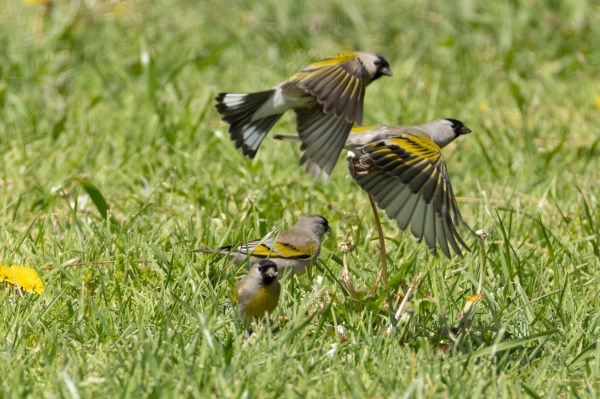
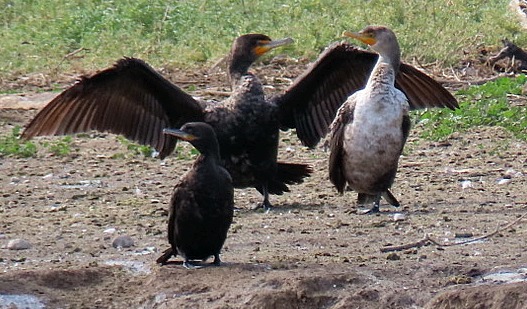
Located only 15 minutes from Santa Monica, Chuck Almdale will show us around one of San Fernando Valley’s best birding spots, where – unless it’s become a giant lake from any recent & unexpected rainfall – we’ll check the fields, pond, riparian areas and perhaps Los Angeles River for migrants and wintering birds. Neotropic Cormorants are frequently seen around the ponds and river. Time & conditions permitting, we might go to Lake Balboa for the Dusky-capped Flycatcher if it’s around.
Expect ducks, grebes, raptors, herons, cormorants, hummingbirds, doves, kingfishers, woodpeckers, thrushes, flycatchers, swallows, corvids, kinglets, warblers, sparrows, blackbirds, turtles, perhaps a coot or two and possibly cricketeers. The whole kit and the caboodle to boot!
Family Guide: 1-2 miles easy walking on level crushed granite path, sometimes clay or grass. Dress in layers, bring water & snack, wear footwear suitable for possibly damp paths.

Directions: SAN DIEGO FWY (I-405) north over the mighty range of Santa Monica Mountains (aka “the hill”) and past the #101 Fwy to first exit at BURBANK BLVD. Go west (left) to WOODLEY AVE. Turn north (right) on WOODLEY AVE. continue 1/2 mile to the south entrance on right) or another 1/10 mile to the middle entrance for the WILDLIFE RESERVE AREA. One or the other or both of these two entrances are always open. Drive east, continuing past the cricket pitches and the small traffic circle and meet at the very last parking lot on the left (blue marker by amphitheater on Google map above). Bathrooms nearby.
Arrive early and find the Parakeets, Western Bluebirds, Dark-eyed Juncos, Chipping Sparrows, Pine Siskins and the ever-elusive Delirious Whatnots for the rest of us! We then walk south into the wildlife reserve, just in case you arrive late.
Meet at 8 a.m. at the parking lot
Leader: Chuck Almdale email: misclists@verizon.net
The Kingbird’s Crown
[By Chuck Almdale, Photos by Armando Martinez]
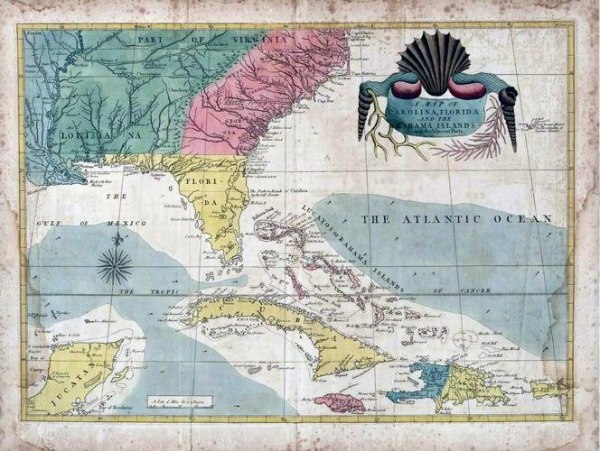
In the early 18th century, British naturalist Mark Catesby decided to tour the southeastern British Colonies and make observations of this land, new to Europe and largely uncharted as to its flora and fauna. Out of his endeavors came the collection of artwork and observations known as The Natural History of Carolina, Florida and the Bahama Islands, which appeared, twenty elephant-folio sized plates at a time in eleven installments, between 1729 and 1747. You can see where J.J. Audubon got his idea eighty years later. These days the plates are generally found bound into two volumes, 350 pages each, and one set sold at Christie’s in 2022 for a mere $138,600. Even better, you can browse the volumes for free in the Digital Collections Repository of University of South Carolina. Among the many birds Catesby illustrated was the Eastern Kingbird, whom he called ‘The Tyrant,’ and noted:
The courage of this little Bird is singular. He pursues and puts to flight all kinds of Birds that come near his station, from the smallest to the largest, none escaping his fury; nor did I ever see any that dar’d to oppose him while flying; for he does not offer to attack them when sitting. I have seen one of them fix on the back of an Eagle, and persecute him so, that he has turned on his back into various postures in the air, in order to get rid of him, and at last was forced to alight on the top of the next tree, from whence he dared not move, till the little Tyrant was tired, or thought fit to leave him.
–– Text from Royal Collection Trust. Link
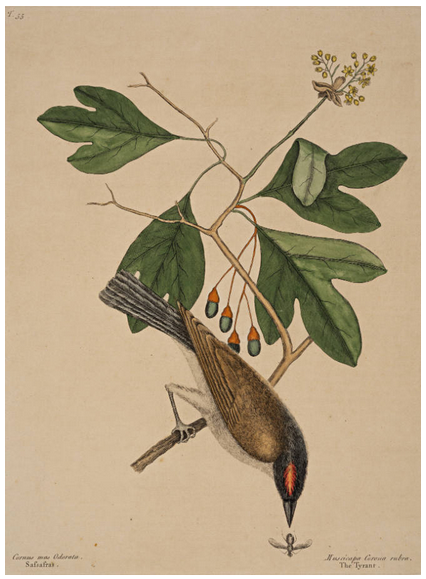
Frances Lehman Loeb Art Center – Vasser College
Carl Linnaeus greatly admired Catesby’s work and in recognition gave the bird the species name of tyrannus, based on Catesby’s description of the bird’s behavior. This name was carried on to the family name of Tyrannidae, and onward into the English name for the family, Tyrant Flycatchers. Today, of the world’s 250+ families of birds, the largest is Tyrannidae and at latest count has 451 members or about 4% of the world’s birds. The next largest family is the tanagers, currently with 384 species.
Look closely at the painting above and if you are familiar with the Eastern Kingbird, you might notice something that you won’t find illustrated or mentioned in the text of recent field guides.
During my research on the Birds of the World website I ran across this photo below. In case you haven’t yet figured out what ‘something’ I’m talking about, it’s the brightly colored reddish ‘crown.’ Excluding Google Images – filled as it is with photos swiped from across the world wide web – it’s pretty hard to find the crown in a photo or illustration, especially in a field guide. I know, I looked.
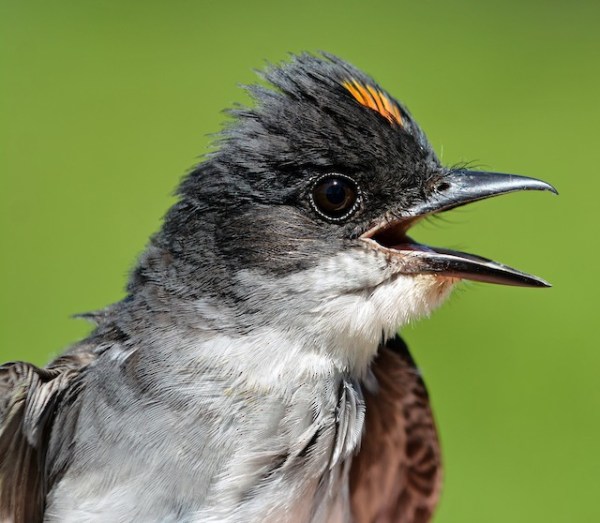
Checking the Field Guides
I checked all my field guides that were likely to include an Eastern Kingbird. While I was at it, I checked all thirteen species within genus Tyrannus, eleven of which are named ‘XYZ Kingbird,” plus the Scissor-tailed and Fork-tailed Flycatchers. All of them have a colored patch on their crowns; one reason, if not the only reason, why they’re in the same genus. Several Tyrannus species do not appear in the United States, and thus no field guide has all thirteen species. Here’s what I found (or didn’t find, the usual case).
Three field Guides neither mentioned nor illustrated a colored crown for any Tyrannus species.
NGS Field Guide to Birds of North America (FGBONA) 8th Ed, 2025: 9 species shown
NGS FGBONA 6th Ed, 2011: 9 species shown
Sibley FGBONA Western, 1st Ed., 2003: 6 species shown
Four field guides had some illustration or mention of the colored crown, commonly described as ‘seldom seen,’ ‘semi-concealed,’ or ‘usually concealed.’ Note: In my descriptions below, “faintly” means you need a magnifying glass to see it.
1. Golden FGBONA, 1st Ed., 1966: 7 species. No mention in brief text. Illustrated for Cassin’s K. – faintly red, Eastern K. – faintly red, Gray K. – orange/red, Thick-billed K. – yellow; Tropical K. orange/red. Not illustrated for: Western, Scissor-tailed Flycatcher.
2. NGS FGBONA 1st Ed., 1983: 10 species. Colored crown never illustrated. Mentioned in text for Cassin’s – red, Eastern – orange/red, Gray – red, Loggerhead – yellow, Thick-billed – yellow, Western – red. No mention for Couch’s, Tropical, Fork-tailed or Scissor-tailed Flycatchers.
3. Peterson’s FG Western Birds, 3rd Ed., 1990: 6 species.No mention in brief text except Eastern – red. Illustrated for Cassin’s – faintly red, Eastern – orange/red, Western – faintly orange/red. Not illustrated for Thick-billed, Tropical, or Scissor-tailed Flycatcher.
4. Peterson’s FG Eastern Birds, 5th Ed., 2002: 4 species. No mention in brief text except: Eastern – red. Illustrated for Eastern – orange/red, Gray – red, Western – orange/red, Scissor-tailed Flycatcher – red.
I got the distinct impression that as time went by, the authors and illustrators decided to skip such niggling, rarely-glimpsed details as the existence or color of kingbird crowns.
I finally found accurate and nearly complete information on all thirteen members of genus Tyrannus in the Handbook of the Birds of the World (HBW) (volume 9, pp. 418-425). The text gave all the crown colors; they were also illustrated, sometimes very faintly for all but the following species: Snowy-throated Kingbird, White-throated K., Thick-billed K., Western K., Gray K., Scissor-tailed Flycatcher.
The on-line version, updated (usually) annually, of HBW is Birds of the World (BotW), and it’s textual information was similar to HBW. All crown colors were described, essentially the same as in HBW, plus a lot more detail on general plumage such as feather length. Photographic illustrations were woefully lacking; the only crown shown was for our old friend the Eastern K. (red/orange/yellow) (see photo above).
Why are they called ‘king’-birds?
My trusty companion The Dictionary of American Bird Names, by Earnest A. Choate, revised edition, 1984, always within reach, has this to say:
Kingbird. From Anglo-Saxon (c.450-c.1200) cyning. Possibly for the little crown, usually invisible like that of the Ruby-crowned Kinglet, of reddish gold feathers on the top of the head, or more probably because of the aggressive, dominating nature of the bird.
The online replication of Webster’s Dictionary, 1828: https://webstersdictionary1828.com/Dictionary/kingbird was not much help:
KING’BIRD, noun A fowl of the genus Paradisea; also, a species of the genus Muscicapa, so called from its courage in attacking larger fowls.
Well…Musicapa is a genus within the large family of Musicapidae or Old World Flycatchers, small 5-6″ birds the size of our Empidonax genus of flycatchers. The King Bird-of-Paradise (Cicinnurus regius) in the family Paradisaeidae lives only in New Guinea. So neither of Webster’s references seem to have anything to do with our Kingbirds. However, it may well be that in 1828 the flycatchers of the Americas were considered to be in the same family as the flycatchers of the Old World. To summarize the name changes & additions:
- In the 1730s naturalist Mark Catesby described and illustrated the bird he called ‘the Tyrant,’ later to be called Eastern Kingbird.
- In 1758 Carl Linnaeus – thinking it was a shrike – formally named it Lanius tyrannus in his 10th edition of Systema Naturae.
- In 1799 French naturalist Bernard Germain de Lacépède introduced Tyrannus as the ‘type genus’ for the Eastern Kingbird, which then became Tyrannus tyrannus, the ‘type species’ for the new genus.
- In 1825, the bird family Tyrannidae was formally established and named by Irish zoologist Nicholas Vigors.
- In recent decades we have added higher-order taxa such as:
- Parvorder Tyrannida (families of Tyrant Flycatchers, Royal Flycatchers, Sharpbills, Tityras, Cotingas and Manakins)
- Infraorder Tyrannides (parvorders Tyrannida and Furnariida [Ovenbirds, Antbirds & Allies])
- Suborder Tyranni (infraorders Tyrannides & Eurylaimides [Pittas, Broadbills & allies])
So perhaps Noah Webster was not completely wrong in 1828 when thinking that Kingbirds were in the family of Musicapidae or Old World Flycatchers, as Tyrannidae or New World Flycatchers was only three years old at the time. News did not travel quickly in those days, even when it was critically important information on changes in the taxonomic classification of an 8.5″-long flycatcher.
The kingbirds, most particularly the Eastern Kingbird, Tyrannus tyrannus, type species, type genus and type family member, were quickly recognized as feisty little characters, quite willing to attack any bird of any size to drive it from it’s territory. Remember Catesby’s description of the Tyrant and the eagle from the top of this article? Certainly a tyrant and certainly a king – in the early 19th-century opinion of all right-thinking red-blooded Americans, all kings were unquestionably tyrants – and the flaming crown of yellow-orange-red worn by all members of the genus, kept hidden until duty called, serves to reinforce the name of tyrant-king. As with some other avian species, the crown is kept hidden until danger lurks or passion flares—when competitors or predators invade his air space, or when he strives to attract a mate.
Why are we talking about this?
I’ve been birding for about half-a-century, I’ve seen all thirteen members of genus Tyrannus, with many hundreds of sightings of one or another of the thirteen species, but I’ve never seen the colored crown on any of them, anywhere, ever. I knew that they had a colored crown, but beyond that I never much thought about it. There are lots of birds with hidden crowns or other startling displays of plumage or skin that you only see in the right place at the right time or if you’re just plain lucky. Orange-crowned Warbler and Ruby-crowned Kinglet are two local examples of such birds. All the male Birds-of-Paradise have really interesting and sometimes astounding displays that they reserve for attracting females. Bowerbirds build their bowers and perform dances for the females, but they don’t like humans watching them. Oropendolas hang upside-down by their feet, flap their wings, spread their tail and scream at the top of their lungs for their females, not for us. The world of birds is filled with all sorts of bizarre, beautiful and secretive behavior, so not seeing the crown on a kingbird is just one among many such missed treasures. But – as I said – I knew it was there; a known unknown.
When SMBAS board member and shutterbug Armando Martinez photographed these birds below, he did not see the colored crown until he inspected them at home and saw the ruby crown. He checked his field guides – including National Geographic’s and Sibley’s field guides. plus both Sibley’s and Audubon’s app, and found nothing—and then sent them to me. I immediately suspected what was going on, did a minor bit of research to confirm my belief, and let him know that his photos were indeed of a Cassin’s Kingbird, as he suspected, whatever the field guides might say or show or omit. They are in the same sequence as they were taken.
Take a look.
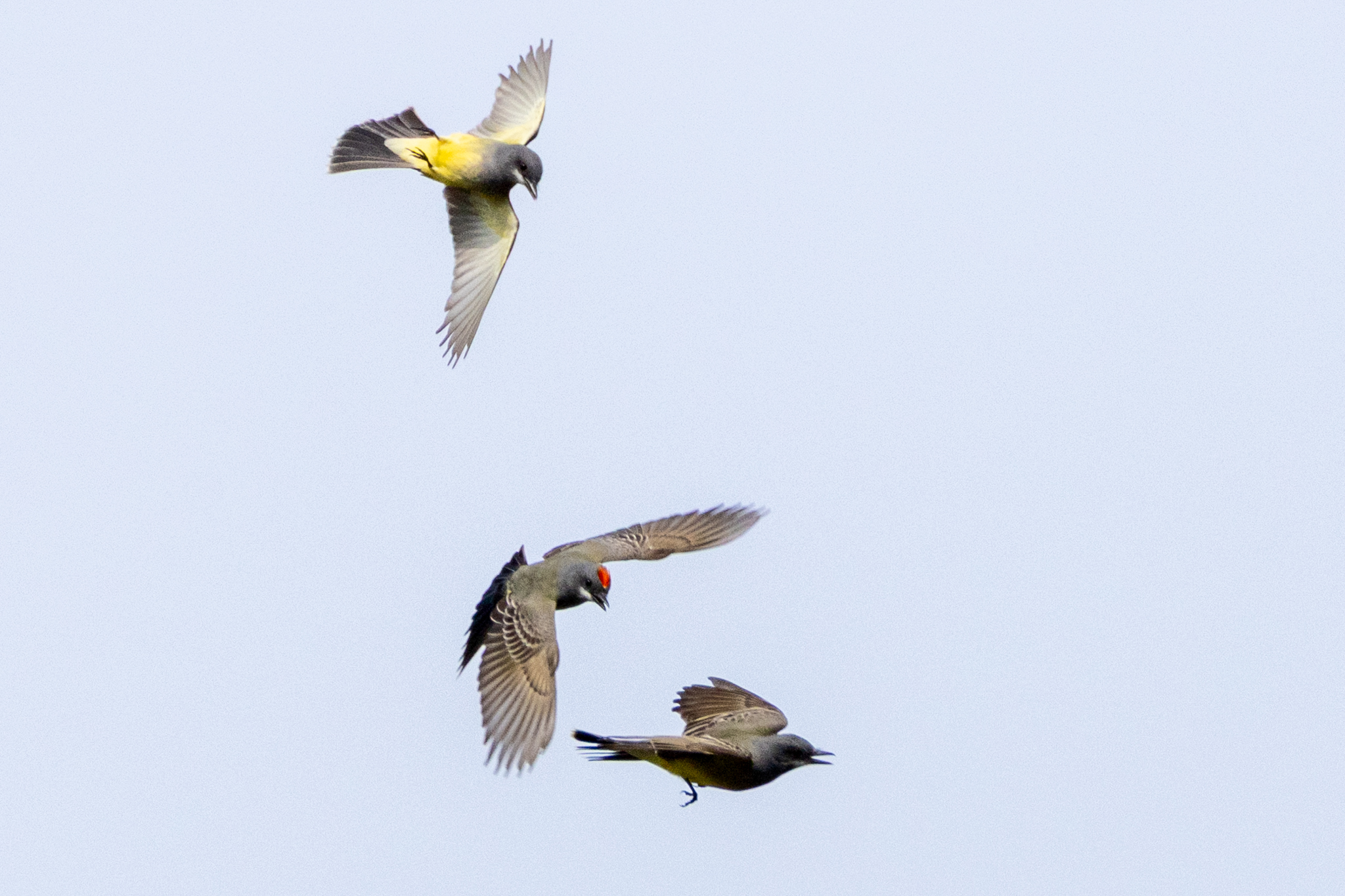
(Armando Martinez, San Joaquin marsh 2-12-26, 10:19:55)
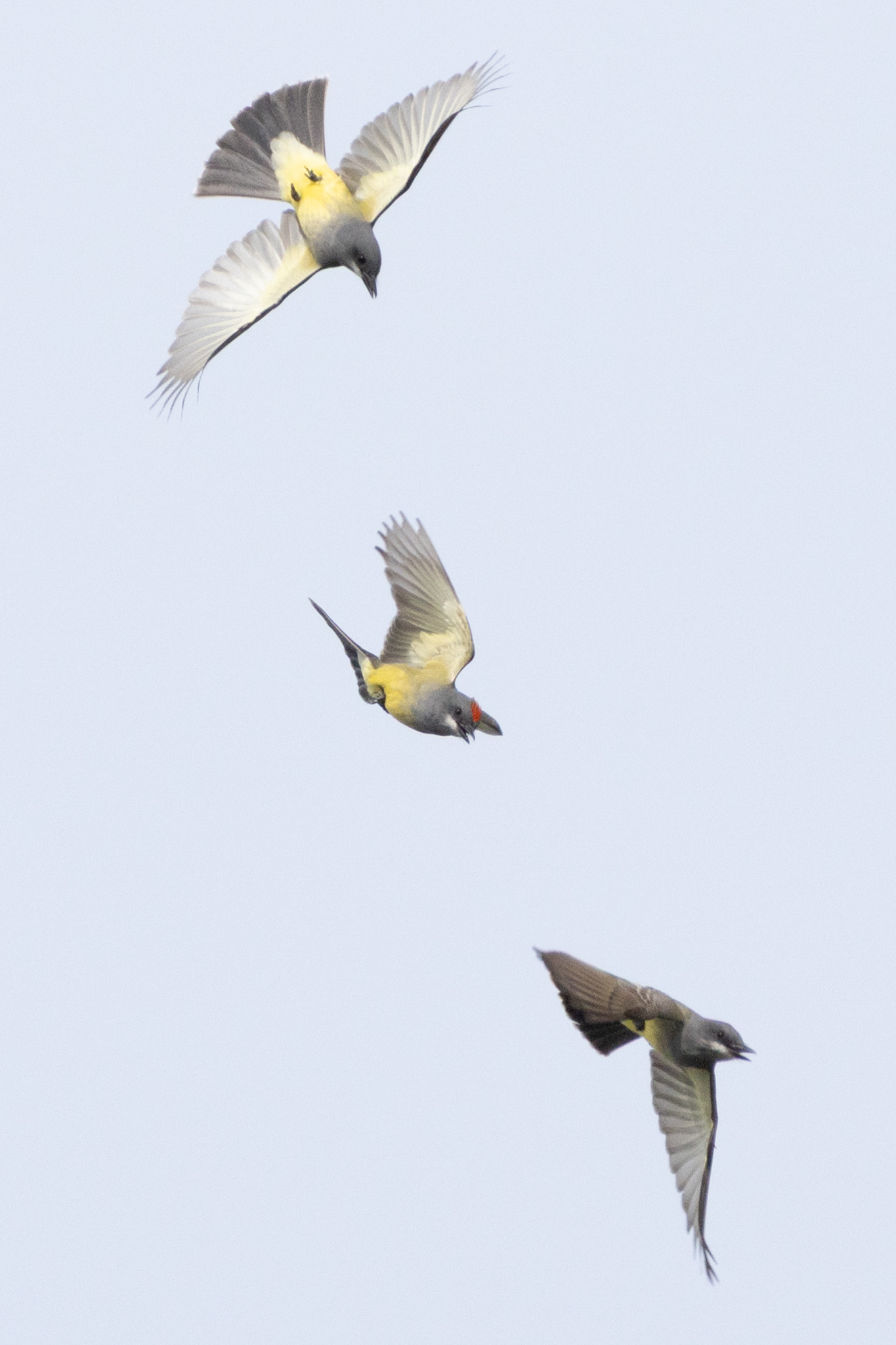
(Armando Martinez, San Joaquin marsh 2-09-26, 10:19:55)
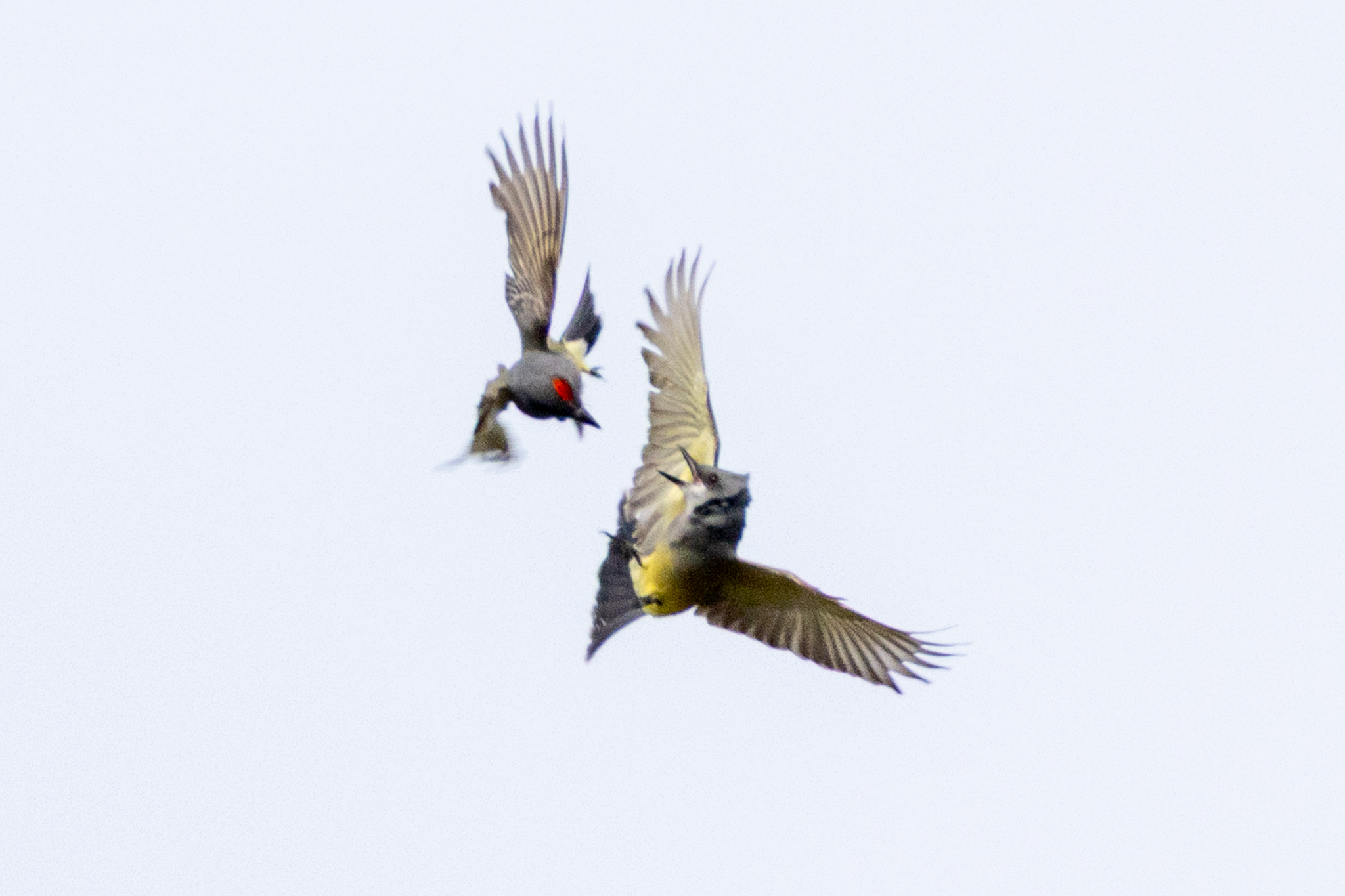
(Armando Martinez, San Joaquin marsh 2-09-26, 10:19:57)
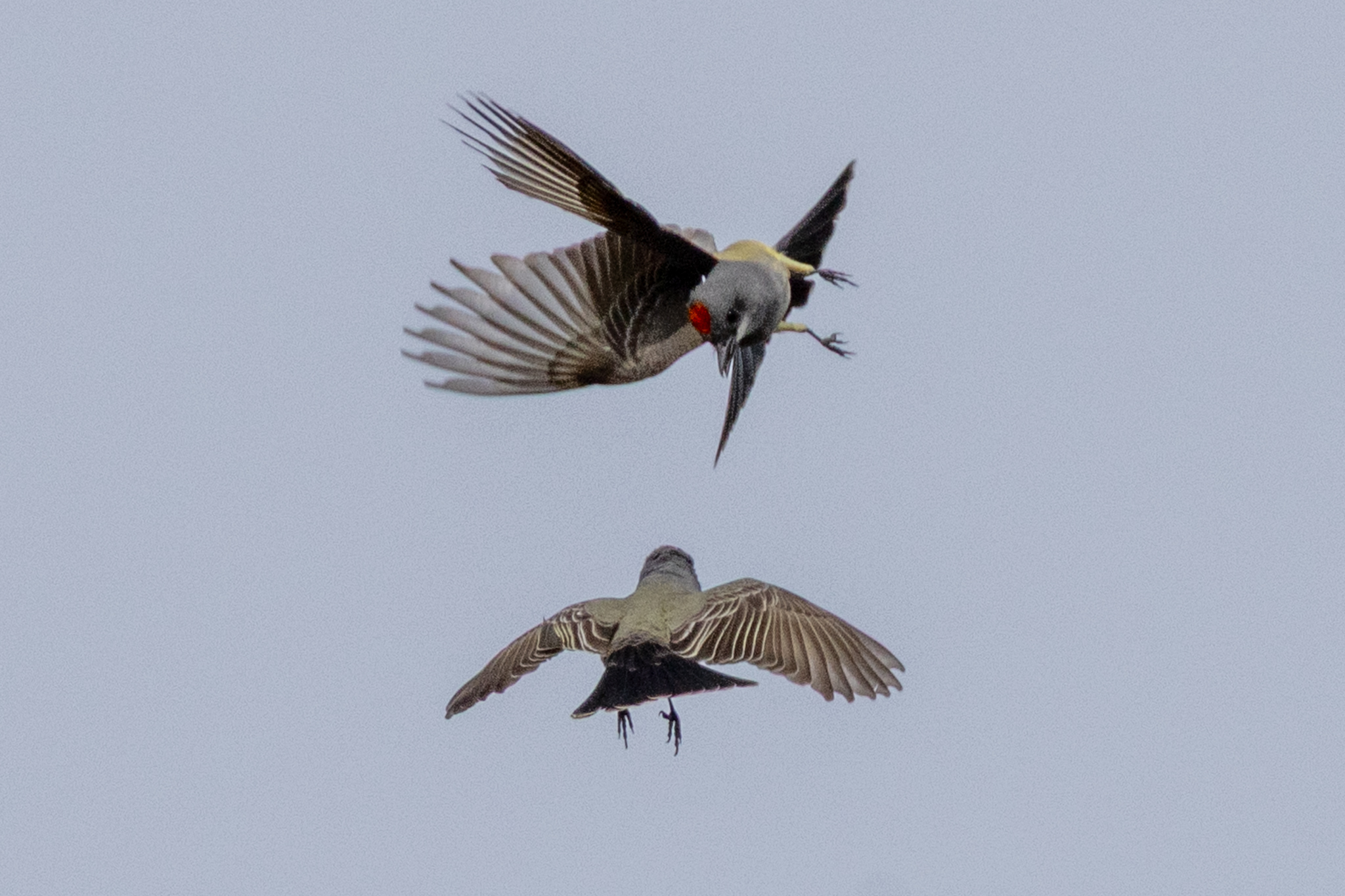
(Armando Martinez, San Joaquin marsh 2-09-26, 10:19:58)
Lucky dog. Great photo sequence.
Zoom Recording: Evolutionary History and Biogeography of Passerines, with Diego Blanco
The recording of this program from 3 March 2026
is now available online.
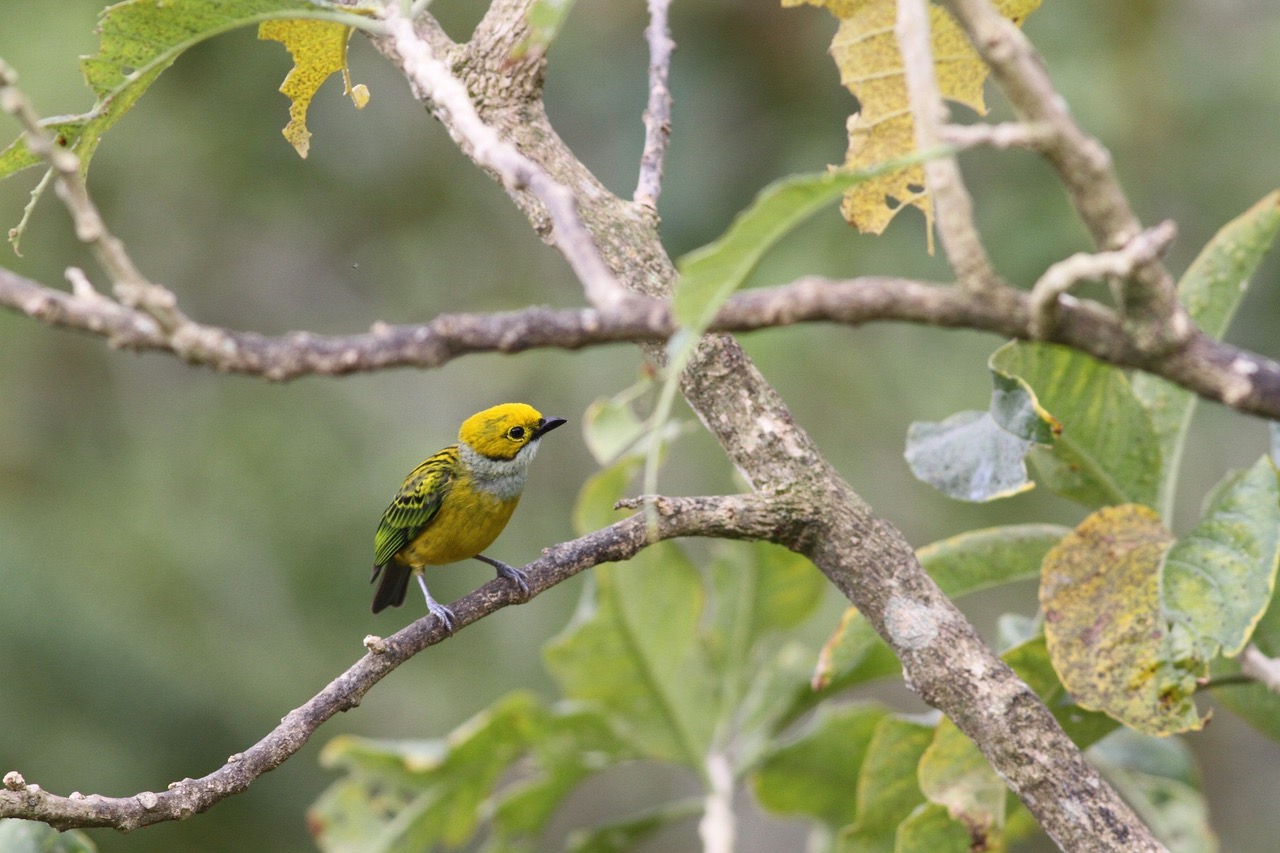
Evolutionary History and Biogeography of Passerines, with Diego Blanco.
Diego Blanco of the Moore Laboratory of Ornithology will present an Evolutionary History and Biogeography of Passerines. Topics will include song bird behavior, evolution, and conservation. Diego will describe the avian family tree and explain how songbirds have spread across the globe and how they’ve changed over time.
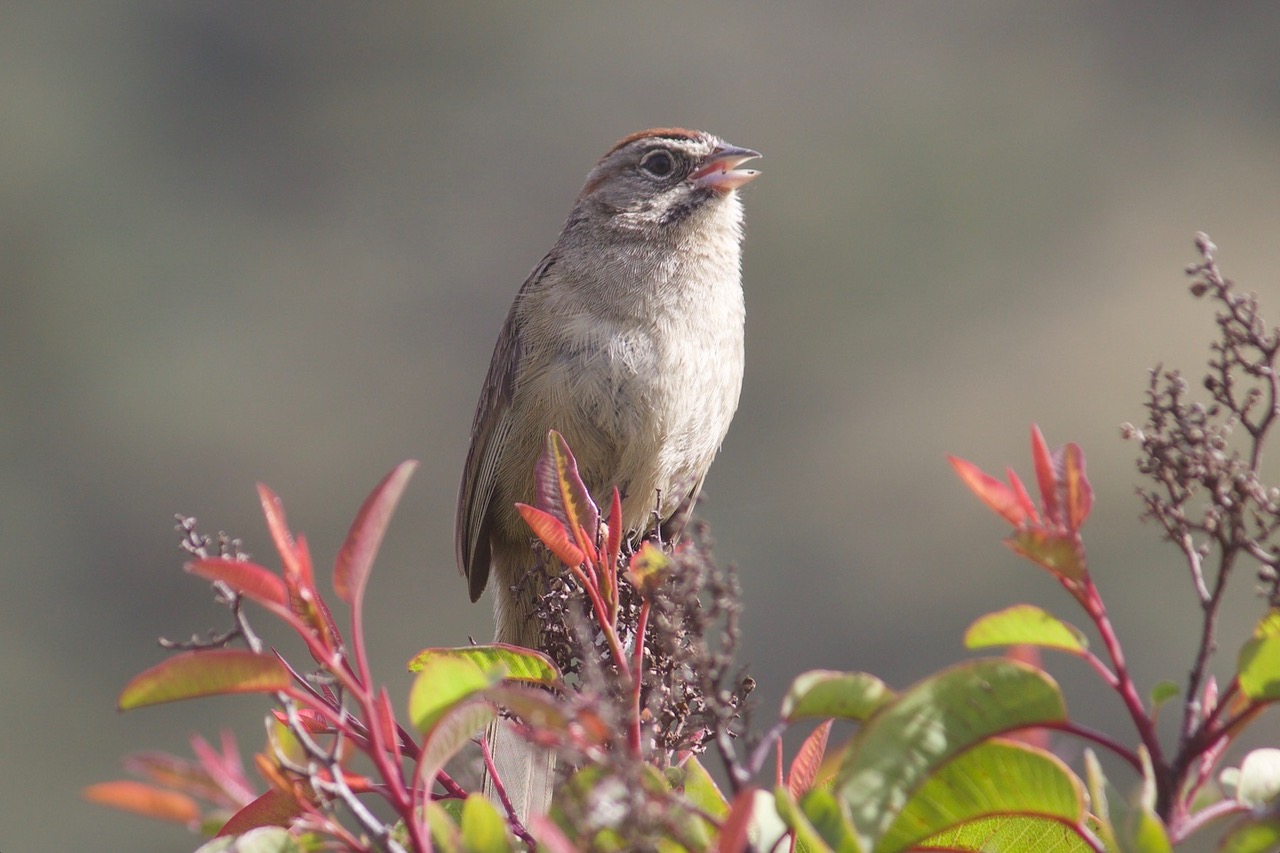
Before Diego Blanco became an Outreach and Research Assistant at the Moore Lab of Zoology at Occidental College, he was a Los Angeles area birder and naturalist. He enjoys hiking, camping, and documenting biodiversity through photography and illustration. Diego graduated from Cornell University in 2022 and has worked as an administrative assistant at the Theodore Payne Foundation for Wild Flowers and Native Plants where he taught field sketching and bird identification classes. He spent the summer 2024 season as a point count technician with the Klamath Bird Observatory conducting surveys on bird populations and plant communities in Whiskeytown National Recreation Area and Lassen Volcanic National Park in Northern California.




 SANTA MONICA BAY AUDUBON SOCIETY BLOG