Free email delivery
Please sign up for email delivery in the subscription area to the right.
No salesman will call, at least not from us. Maybe from someone else.
[Posted by Chuck Almdale]
Just to place some of our locally introduced parrots into a wider frame of space and time, we’ll begin with the major split in the evolution of birds that occurred a mere 55 million years ago. The evolutionary line which led to the enormous Songbird order of Passeriformes (6595 species in 143 families) split from the line which led to the Parrot order of Psittaciformes, making these two orders (of the 41 avian orders) each other’s closest relatives. Their next closest relatives are the Falconiformes (Falcons, 65 species in one family which does not include Hawks, Eagles and Osprey) and the little-known Cariamiformes (Seriemas, two long-legged species in one family) of southern South America. Over the period 32-22 million years ago the Psittacids (or Psittacines) slowly split into four families: Strigopidae (New Zealand Parrots, 4 species), Cacatuidae (Cockatoos, 22 species), Psittaculidae (Old World Parrots, 202 species), and Psittacidae (New World and African Parrots, 177 species).
Some useful avian diversification cladograms:
Origin and Diversification of birds: https://ars.els-cdn.com/content/image/1-s2.0-S0960982215009458-gr6_lrg.jpg
What are the Parrots and Where Did They Come From?: https://content.ucpress.edu/chapters/9930.ch01.pdf
Earth History and the Passerine Radiation: https://www.ncbi.nlm.nih.gov/pmc/articles/PMC6475423/figure/fig01/
Amazona Parrots
In the Psittacidae line, new genera and species continued to appear, eventually bringing us to the 37 genera and 177 species we know of today. The largest Psittacid genus is Amazona with 32 species. This genus is widespread throughout the new world, ranging from the Rio Grand Valley of Texas, throughout Central America, the Caribbean Islands and South America to Peru, southeast Bolivia and northern Argentina. It’s very difficult to find an area in this region where Amazona parrots don’t occur.
As this genus can be found from roughly 30°N to 30°S of the equator, which includes all of the New World tropical rainforest, for rapid identification purposes it’s very handy to know that they share a distinctive manner of flight, uncommon outside their genus: they fly with fast shallow wing beats, wings rising and falling about 45° or less from the horizontal. Any parrot flying like that in SoCal (and probably throughout their range) will be an Amazona. They also have blunt tails. Any Psittacid in SoCal with a long pointed tail is one of the species of parakeet (or rarely a much-larger Macaw). Most, if not all, Psittacid species are very social and call constantly to each other while they fly. They are far less vocal when resting or feeding in trees.
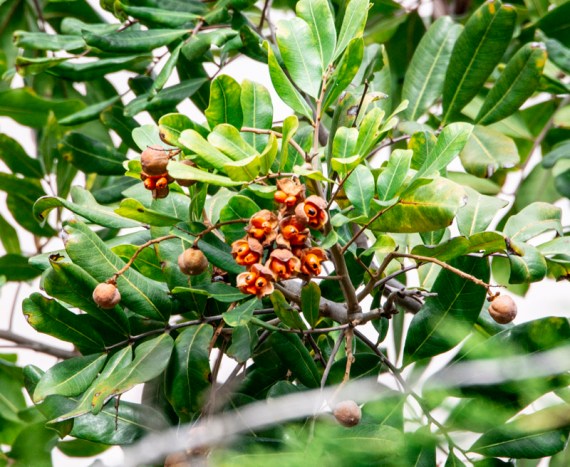
The photo below shows the sort of thing Amazona parrots (and perhaps parrots in general) like to eat in the SoCal area. The parrot photos at the bottom of this article were taken while the birds fed in this particular Cupianopsis (Carrotwood) tree.

In the northernmost portion of their natural range – central to Northern Mexico – there are four Amazona species. Lilac-crowned Parrot Amazona finschi ranges from Oaxaca and along the western coast to the mountains of southeastern Sonora to 200 miles south of the Arizona border. White-fronted Parrot Amazona albafrons overlaps the Lilac-crowned, ranging from southern Sonora 160 miles south of Arizona down to central Costa Rica. In eastern Mexico the Red-crowned Parrot Amazona viridigenalis ranges from coastal Veracruz north to Monterrey, only 60 miles south of the Texas border. It’s close relative the Red-lored Parrot Amazona autumnalis overlaps this range, and is found from the Rio Grand Valley of Texas south to northern Brazil and Ecuador.
From Birds of the World:
Molecular phylogenetic studies using DNA sequence data as well as genomic data from ultra-conserved elements (UCEs) have shown that the Lilac-crowned Parrot Amazona finschi and the Red-crowned Parrot Amazona viridigenalis form a sister relationship with strong support. Together, these two species appear to be sister to Red-lored Parrot Amazona autumnalis with this clade in turn sister to a small group of Amazona parrots from South America and the Lesser Antilles in the Caribbean. White-fronted Parrot Amazona albafrons is member of a clade found from Yucatan eastward through the Greater Antilles to Puerto Rico.
Giving an indication of just how closely these Amazona species are related, in SoCal the Red-crowned Amazon A. viridigenalis has hybridized with Lilac-crowned A. finschi, Yellow-headed A. oratrix, and Red-lored A. autumnalis. If these hybrids are themselves capable of reproducing and we were strictly following the biological definition of species, these species would all be considered subspecies of one wider-ranging as-yet-unnamed-and-undescribed species.
Parrots in SoCal
Here in Southern California the organization FLAPP (Free-flying Los Angeles Parrot Project) has recorded 37 species of Psittacids living wild in SoCal. Their information comes through iNaturalist and always includes a photo. According to the Zoom presentation by Brenda Ramirez, the most abundantly reported Psittacid is the Red-crowned Parrot (2864 observations) followed distantly by Mitered Parrot Psittacara mitratus (963 observations), Nanday Parakeet Aratinga nenday (766 observations), Lilac-crowned Parrot (583), all the way down to eight species – including several Macaws – each seen one time only.
According to the original Parrot Project website (see their chart), of the thirteen most common species of parrot in SoCal, six are in the Amazona genus: Red-crowned A. viridigenalis, Lilac-crowned A. finschi, Red-lored A. autumnalis, Blue(now Turquoise)-fronted A. aestiva, Yellow-headed A. oratrix and White-fronted Amazona albafrons. As they are all in the same genus they look much the same both while perched or in flight.
Link to Zoom Recording: Red and Lilac-crowned Parrots in SoCal, with Brenda Ramirez
Because the closely-related and hybridizing Red-crowned and Lilac-crowned Parrots are the first and fourth most commonly sighted parrots in SoCal, FLAPP prepared some identification cards specifically for them, and kindly gave me copies to include in this posting.


Additional information on the thirteen-most commonly seen Psittacids is available from the California Parrot Project: http://www.californiaparrotproject.org/id_guide.html
Following are some photos on which to hone your identification skills.
All photos below are by Ray Juncosa, June, 2019, Santa Monica Area.
Identification key at bottom.

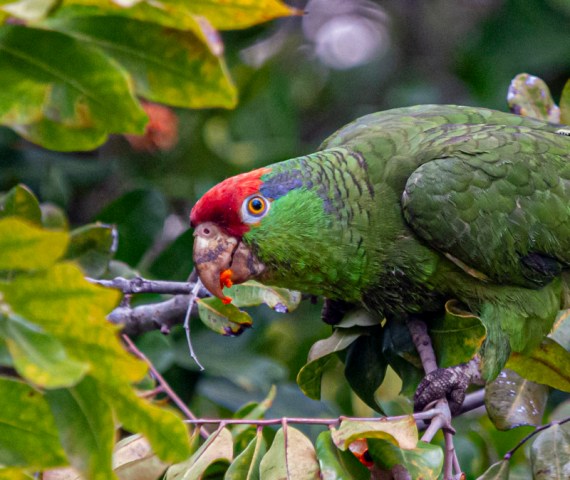


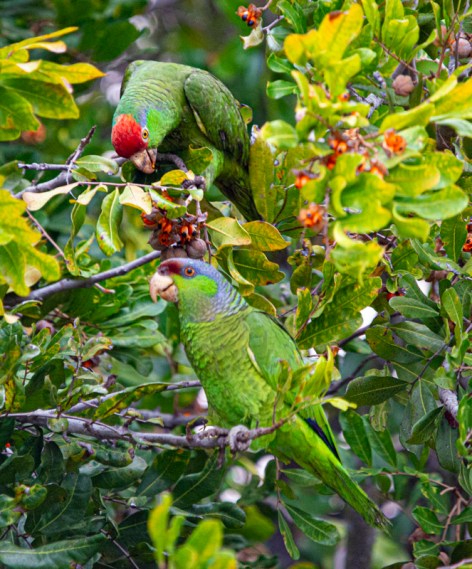

Photo Key:
Lilac-crowned Parrot: 1, 3, 5, 7
Red-crowned Parrot: 2
Both, Red-crowned above, Lilac-crowned below: 4, 6
Local bird problems: Loon and Brown Pelicans
[Posted by Chuck Almdale]
Pacific Loon 368
On Friday 26 April 2024 around 9am, local birder Ursula “H” of Venice reported on LACoBirds ListServe (which sends out emails to all its members) that she’d found a loon at Ballona Creek with a hook in its throat. With bird now in car, she wanted to know where to take it.
SMBAS maintains a bird and marine mammal rescue page on our blogsite. Many birders responded to Ursula with the following in one form or another:
1. International Bird Rescue (IBR) in San Pedro 310-514-2573, 3601 South Gaffey St., San Pedro, Ca. 90731. Website: http://www.bird-rescue.org/
2. California Wildlife Center, 310-458-9453. 26026 Piuma Rd, about one mile east of Malibu Canyon Road. Website: http://www.cawildlife.org/. The number 818-591-9453 is outdated but may still work.
3. Licensed wildlife rehabilitation facilities: There are dozens in California including several around Los Angeles:
https://wildlife.ca.gov/Conservation/Laboratories/Wildlife-Health/Rehab/Facilities
4. Los Angeles Audubon also has an On-line list with 50 rescue sites for all types of animals: https://www.laaudubon.org/wildlife-rehabilitation
Later that day (26 Apr) the intrepid Ursula wrote in with an update on the Loon:

I’m now back home and wanted to extend a warm thank you to all of you who jumped in and helped out with very useful info this morning. Here’s the story so far:
I spotted the loon just east of the Ballona Creek bike/ped bridge in Marina del Rey a little after 9 this morning, not far from a small group of surf scoters. Unlike the scoters, the loon seemed to be moving oddly, just paddling in place, sort of like a buoy. So I jogged across the bridge and climbed down to take a closer look, and saw that there was a fishing line running from the loon to the shore.
A very friendly and helpful passerby located a piece of broken glass that we could use to cut the line (the ubiquitous trash came in handy, for a change). But then I discovered to my dismay that the rest of the line ran into the loon’s bill. I picked it up, wrapped it in my vest and looked in its bill, but the line ran down its throat. So I rushed it to my car, put it in a box, and sent the emergency email, then left a voicemail with IBR. Thanks so much for the quick reference to IBR from people on this list – that was a lifesaver!!
I started heading east on Culver, saw several guys doing work at the Ballona Freshwater Marsh, and pulled over to see if they might have advice. They checked the bird, confirmed that the hook was deep down its gull, and a guy with the nametag Patrick said IBR would take it in (anyone know who that Patrick might be – I want to thank him?). Real luck that I’m not teaching today, so I drove down to San Pedro, and they took the loon in. Vet seemed hopeful that the hook could be removed with surgery, and also noted that one of the loon’s eyes looked a bit funny, which I hadn’t noticed. It’s now Pacific Loon 368 down there. I’ll call on Monday to see how he/she is doing.
The loon did seem pretty strong – it struggled to get out of my vest and arms in Playa del Rey and to get out of the box down in San Pedro, which I thought was a good sign: I hope that it wasn’t caught on that line the whole night.
I’m sending a generous donation to IBR this weekend – so glad they were there in this situation! And I can’t thank everyone on this list enough for the referral: I was about to take the loon to the Access Animal Hospital on Jefferson, where I take my pet birds, but was doubtful that they’d accept a wild bird. So your lightning-fast responses to my emergency email came in the nick of time!
I’ve posted a picture of the loon with this morning’s ebird list:
https://ebird.org/checklist/S170404169Thank you, everyone, and let’s hope this beautiful bird survives! I’ll send an update next week.
–Ursula–
This news elicited a response from Neysa at Friends of Ballona Wetlands:
Hi Ursula,
So glad to hear you were able to help the loon! Patrick is our Habitat Restoration Manager at Friends of Ballona Wetlands, we were out doing trail rehabilitation work at the Ballona Freshwater Marsh today. I will let him know that the loon arrived at IBR!We also have a drop down menu “Found an Injured Animal?” with a list of helpful animal rescue/injury numbers on our Contact Page: https://www.ballonafriends.org/contact-us
Thank you for going above and beyond for that bird!
Best wishes,
Neysa
Ursula posted an update on Loon 368 on 8 May:
Hello Birders:
I received sad news regarding Pacific Loon 368 today, the bird that I took to IBR in San Pedro on April 26. The fish hook was lodged so deeply in its throat that they were not able to extract it with surgery, and they euthanized the bird. Needless to say, I’m terribly sad – you get attached to these critters you find in distress, and this seemed a particularly unnecessary death, just from someone’s negligence in leaving fishing gear around.I was also told that the IBR is currently receiving a very large number of 2-3 year old pelicans on the brink of starvation. It wasn’t entirely clear to me what the cause is – not sure that they know, either. Not bird flu, they told me. Overfishing? If anyone has any information, I’d be curious to know.
Anyway, I’ll keep donating to them and – time allowing – will volunteer with IBR. Maybe we can an at least save some of these pelicans.
In sadness,
Ursula
Ursula is to be commended for unstinting concern and determination, as are also Habitat Restoration Manager Patrick and his workmates at Friends of Ballona Wetlands. Unfortunately, the bird was too damaged to be saved. Ages ago I used to catch fish, and I know how devilishly difficult it can be to extract a hook the fish (in my case) has swallowed.
Starving Brown Pelicans
Which brings us back to the starving Brown Pelicans mentioned by IBR. The following comment was posted yesterday (8 May) by Justyn Stahl of San Diego:
I got the following from California Department of Fish and Wildlife’s Wildlife Health Laboratory in response to a mortality report I had submitted a few days ago. This is presumably what’s behind the increase in inland records of Brown Pelicans recently.
“Thank you for submitting a mortality report. We have had an uptick in reports of brown pelicans along the central and southern coasts recently. Additionally, a number of wildlife rehabilitation centers have been admitting increased numbers of debilitated pelicans. Most of these pelicans appear to be younger birds that are emaciated, sometimes with secondary injuries. Unfortunately, we sometimes see increased mortality of seabirds due to food resource issues. Younger birds may have more difficulty adjusting to changes. Thankfully, we have not detected disease in these pelicans so far this season. We appreciate you reporting your observations. These reports help us monitor the numbers and locations of animals involved in the event.”
Justin adds:
I would encourage submission to CDFW any sick/weak/dead pelicans you may encounter:
https://wildlife.ca.gov/Conservation/Laboratories/Wildlife-Health/Monitoring/Mortality-Report
This issue is mentioned in LA Times and the Santa Barbara Independent:
https://www.latimes.com/california/story/2024-05-04/scores-of-starving-brown-pelicans-found-on-socal-beaches
A similar event occurred in 2022:
https://wildlife.ca.gov/News/Archive/cdfw-provides-update-on-california-brown-pelican-stranding-event
LAist also has a recent article on the Starving Brown Pelicans:
https://laist.com/news/climate-environment/mystery-surrounds-brown-pelican-starvation-socal

Malibu Pier and Used Fishing Line
All the above brought SMBAS Board Member and longtime Western Snowy Plover roosting site monitor for Santa Monica Beach, Lu Plauzoles, to contact our local California State Parks personnel about the “fishhook recycling” containers on Malibu Pier. A few years back Lu and other SMBAS members installed these containers on Malibu Pier to give the fishermen at this very popular pier fishing location a place to put the hooks and fishing line that must be discarded, rather than put it into the trash bins (where they may snag foraging people, birds or animals) or tossing them into the sea. The containers do fill up and need to be cleaned out from time to time. Both Lu and some local merchants have been cleaning them out, but one container seems to have jammed and can’t be opened. Lu thinks that more containers are needed, and that dropping the “recycling” aspect and promoting the “SAVE THE BIRDS” aspect with stickers and labels will be an improvement. I think he’s right.
The recording of this program from 7 May 2024 is now available online

|
Red-crowned and Lilac-crowned Parrots in SoCal, with Brenda Ramirez
Non-native parrots have become a very present and boisterous element of the urban ecosystems throughout Southern California. Ranging from cities to more natural areas, parrots can be found in a variety of habitats where they coexist with people. Through the Free-Flying Los Angeles Parrot Project (FLAPP) on iNaturalist, we created a dataset focused on two of the more prominent species in Southern California, the Red-crowned and Lilac-crowned Parrots. After being introduced through the illegal pet trade, these sister-species have established their populations and even created mixed-species flocks that would not be possible otherwise. Originally from opposite coasts of Mexico, these parrots are model organisms for answering questions on range shifts and hybridization because of the unique displacement that has led to their coexistence. Our research has focused on distinguishing the two species based on morphological features, comparing the environmental conditions between their respective native ranges and their introduced range, and we are now shifting to understanding how their genetic makeup has been affected. Join us to learn how you can help contribute to our research from your own neighborhoods!
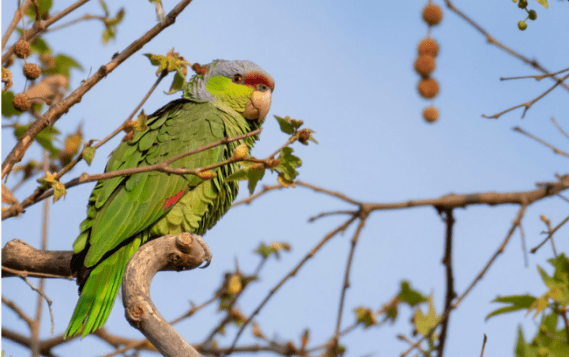
Brenda Ramirez has experience working with large citizen science datasets and incorporating them into spatial models to understand species distributions over thousands of years. Having recently graduated with her master’s degree from Cal Poly Pomona, Brenda is now working on Moore Lab’s Free-flying Los Angeles Parrot Project (FLAPP) to evaluate how the non-native Los Angeles parrot populations have changed genetically as they have adapted to their new urban habitats.

Note: Ms. Ramiriz’s very useful facial closeup ID charts on these two species are included in our posting Identifying Red-crowned and Lilac-crowned Parrots in Southern California.
Meanwhile, you can read about FLAPP – Free-Flying Los Angeles Parrot Project – on the iNaturalist website and the Moore Laboratory of Zoology website at Occidental College.
King Gillette FT Report, 4/20/2024
After two consecutive rainy or drizzly Saturdays we finally made it to King Gillette. Everything was green, including an acre of duckweed on the pond. However, only one kind of duck was present.

Female Mallard (Anas platyrhynchos) with one of her two remaining ducklings.
For a long time we heard House Wrens calling but it took a while to see one.
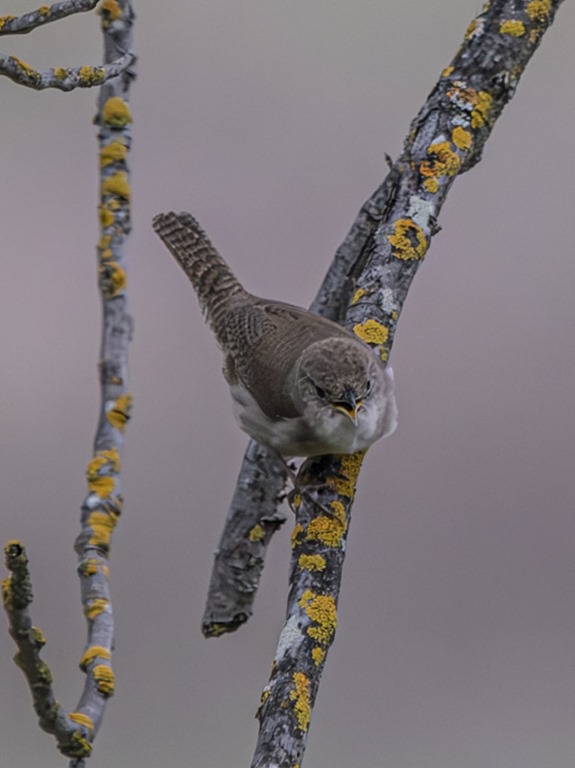
House Wren (Troglodytes aedon)
We walked up to the residence (for you bar-trivia enthusiasts, it’s one of the locations where they filmed the TV show “The Biggest Loser”). Standing among the maintenance vehicles was a larger than life-size plastic Gentoo Penguin and a Pneumatic Roof-Owl. More to our liking were several Hooded Orioles, possibly looking to make nests in the palm trees,
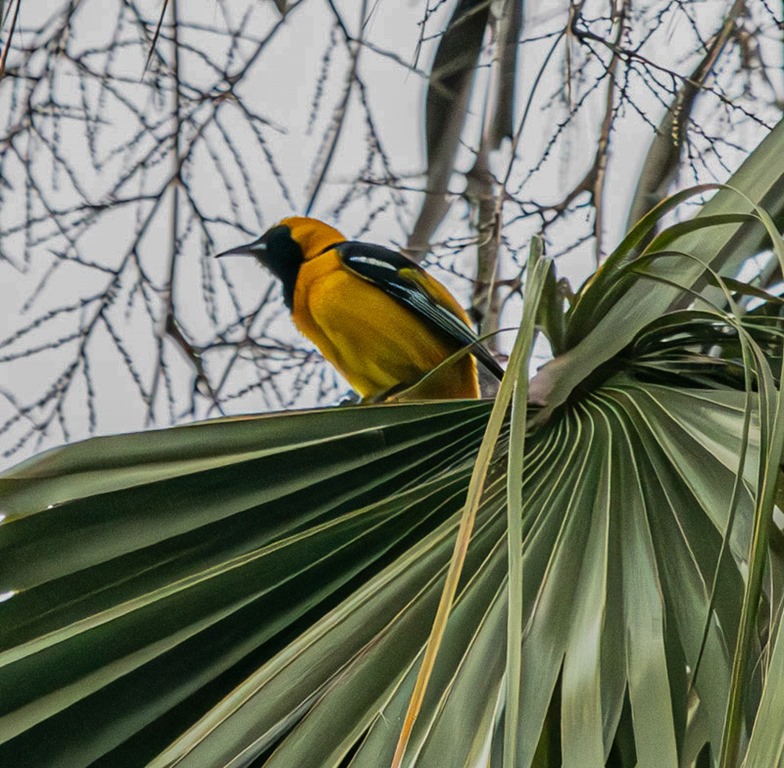
Hooded Oriole (Icterus cucullatus)
The raucous calls came from Acorn Woodpeckers and Nanday Parakeets. There were numerous trees that were serving as acorn storage – ACWO’s peck the holes, one for each acorn, for future food use. They also have the most interesting family lives and habits – you can read a brief description of them at https://www.allaboutbirds.org/guide/Acorn_Woodpecker/overview.
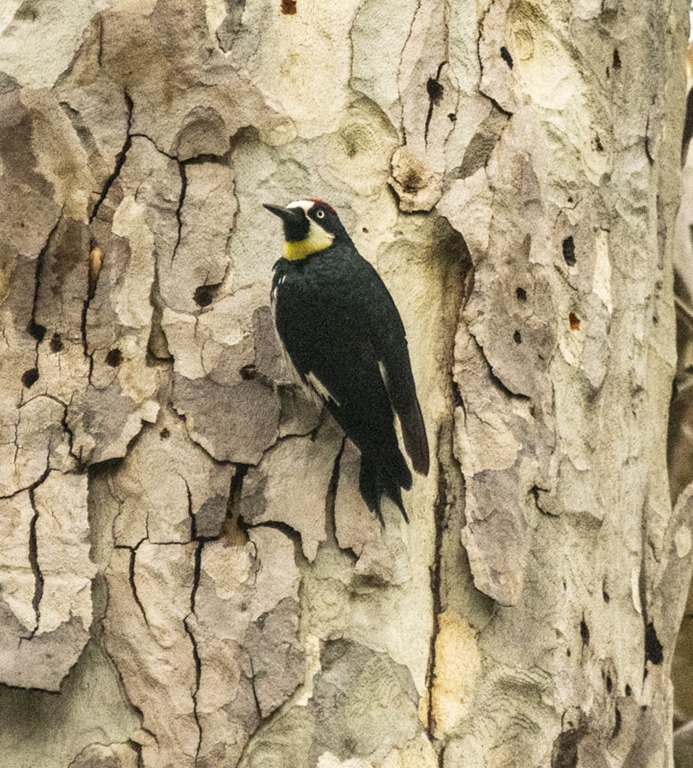
Acorn Woodpecker (Melanerpes formicivorus)
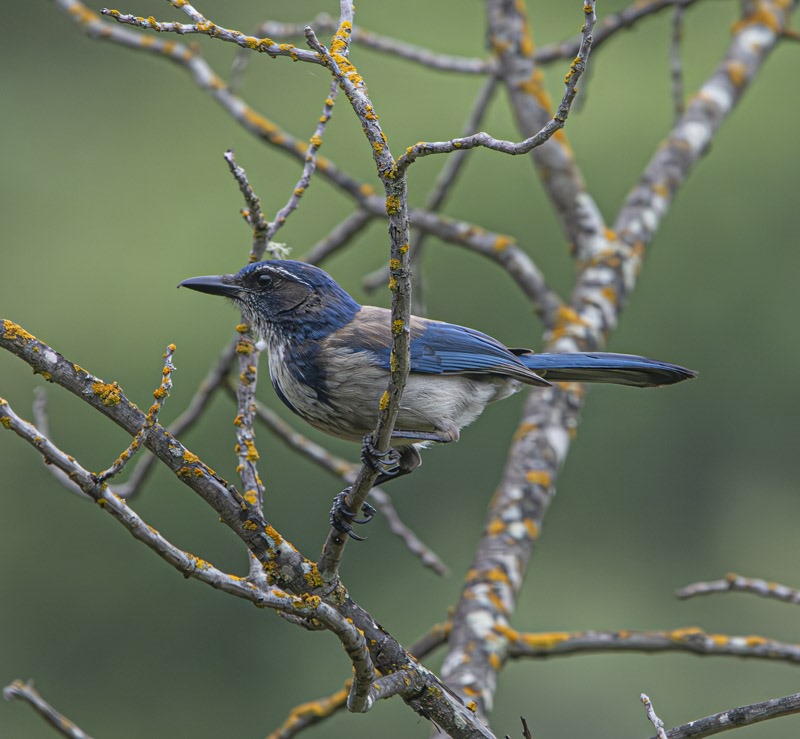
California Scrub-Jay (Aphelocoma californica). Basically limited to western coastal states and Baja.
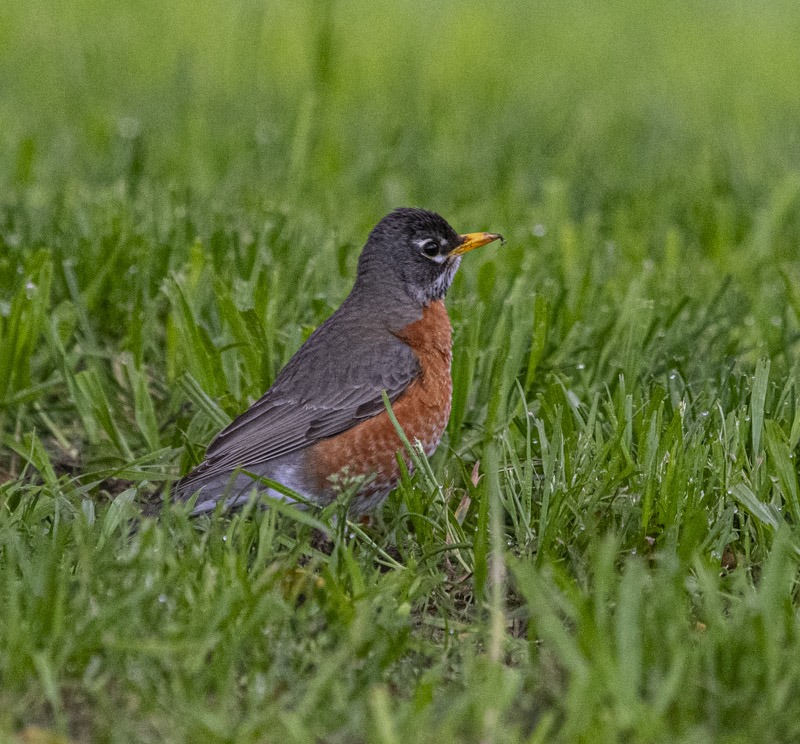
American Robin (Turdus migratorius). In spite of its name, we see it here year-round.
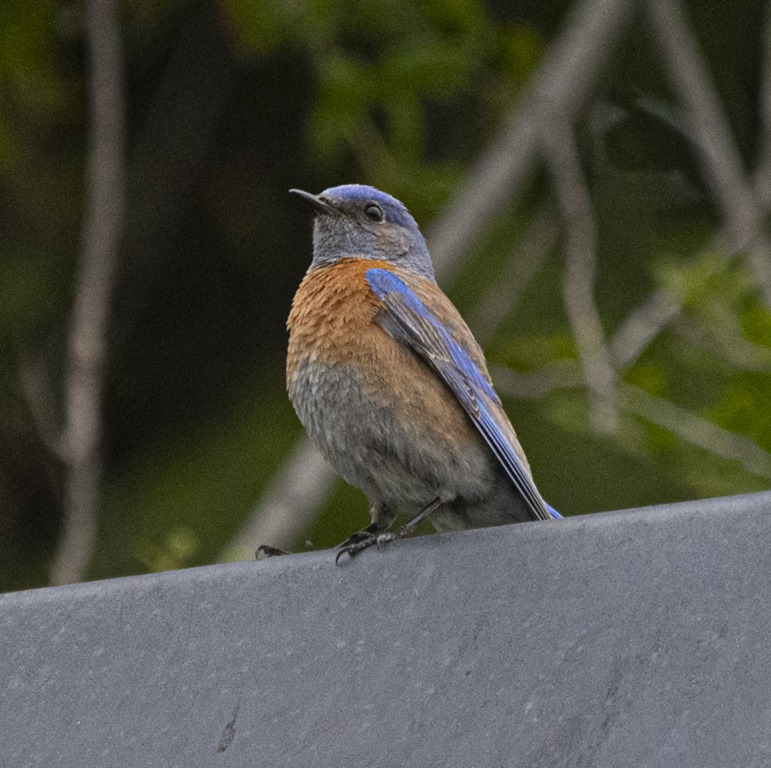
Western Bluebird (Sialia mexicana)
Perhaps the most unusual sighting was a Purple Martin. Chuck Almdale has recorded ‘them’ in LA County only once before, at Malibu Lagoon 19 years ago and, oddly, on April 15th that year. Perhaps we are all too busy doing our taxes to look up and see the Purple Martins.
We managed to see 40 species in this relatively small area – a good day. Many thanks to Ray Juncosa for his photos, and to Chuck Almdale for taking over when I had to leave early.
Canada Goose
Mallard
Band-tailed Pigeon
Eurasian Collared-Dove
Mourning Dove
White-throated Swift
Anna’s Hummingbird
Allen’s Hummingbird
Great Blue Heron
Turkey Vulture
Acorn Woodpecker
Nuttall’s Woodpecker
Northern Flicker
American Kestrel
Nanday Parakeet
Black Phoebe
Loggerhead Shrike
California Scrub-Jay
American Crow
Common Raven
Oak Titmouse
Purple Martin
Bushtit
Wrentit
House Wren
European Starling
Northern Mockingbird
Western Bluebird
American Robin
House Finch
Dark-eyed Junco
Song Sparrow
California Towhee
Spotted Towhee
Hooded Oriole
Bullock’s Oriole
Red-winged Blackbird
Yellow Warbler
Yellow-rumped Warbler
Wilson’s Warbler
Tropical Treats with Femi | Pajaros Y Comidas de Colombia
[Posted by Chuck Almdale]
Femi Faminu returns to Colombia, this time staying at Aracuana Lodge in the Cauca Valley, near Cali and southwest of the capital of Bogotá, an area stuffed to the gills with birds. Indeed, the first bird in the film is a hoot-honking (and perhaps duetting) Toucan Barbet, one of only two members in its family Semnornithidae, one of the seven families of Piciformes (Woodpeckers & their pals). Eventually the food appears, and I believe I saw one version of the ubiquitous South American dessert pass by, known to its aficionados as fluffy white stuff.
It’s good to know that Colombia is again safe enough to travel in. When bird field guides for Central and South America began to appear decades ago, permitting travel by birders who were not fully-employed professional ornithologists on collecting trips, one of the first books to appear was one for Colombia. By the time a second, improved guide was published, the various Colombian insurgent groups had appeared, and birders completely avoided Colombia, going instead to nearby Panama, Ecuador and Venezuela, as well as points south, and that field guide languished. Birders have been again visiting Colombia for the past decade or so, and there are several excellent in-country birding tour companies, plus many international birding tour companies visiting regularly.
According to WorldRainForests Colombia now has the highest bird species count in the world: 1,917 species (18.3% of world species), followed closely by Peru at 1,892, Brazil 1,864, Indonesia 1,791 and Ecuador 1,684. Brazil led for a long time, but in recent decades Peru consistently was first. Colombia, most likely, recently took the lead because – safety now restored – researchers (not to mention garden-variety birders like us) could again explore the mountains and rainforests and discover new species.
At the end of the video is her phylogenetically-sequenced trip lists which includes 241 species, 108 non-passerines and 133 passerines. Twenty-six hummers, twenty-six Tyrant Flycatchers, twenty-four Tanagers anyone? Her all-too-brief YouTube photo & video film is as enjoyable as always, despite the notable absence of one of my favorite birds, the startlingly-plumaged Oleaginous Pipromorpha.
If you go here https://www.youtube.com/@femif9792 you can see her other films.



 SANTA MONICA BAY AUDUBON SOCIETY BLOG