Free email delivery
Please sign up for email delivery in the subscription area to the right.
No salesman will call, at least not from us. Maybe from someone else.
What Bone is This?
[Text & photos by Chuck Almdale]
I don’t know much about bones and certainly not about sea mammal bones. If anyone out there can I.D. this bone and point me towards an on-line source that can illustrate it, I’d be very grateful and will certainly give you credit.

We found the bone in question on Malibu Surfrider beach yesterday. By “we” I mean one of our group of birders came up and handed it to me, asking if I knew what it was. I should mention that the beach was almost completely covered from end-to-end and from high tide line to lagoon with driftwood, seaweed and shells, flotsam and jetsam from the recent storms. I quickly and confidently analyzed the bone as “probably marine mammal…I suppose” thereby exhausting my limited knowledge/guesswork. We wondered if it might be a fossil as it felt so rock solid. But I doubt that. I don’t think a real fossilized-into-rock bone would look like this.
It’s a fragment missing one end. What’s left is 8″ long and weighs just under 9 oz. or 250 grams. It feels very heavy and solid. The surfaces and edges are very worn and smooth.
View 1 (above) and 2 (below) show what looks to me like a socket at the near end of the bone, at bottom, about 1.25 inch across, the same diameter as the hole down the center of the bone.

View 3 below shows the other side of the bone with what looks like a wide groove about 0.5″ across and 2″ long, eroded along the left edge and smoothed on the right edge.

Below: another view (#4) of the end & side with socket showing as in views 1 & 2.

Another view (#5 below) of the flip side like view #3 except that the wide groove is now at the right end.

Below, the “groove” side again. The widest part is 2.5″ from bottom of groove directly vertical (i.e. not along the groove but straight up).
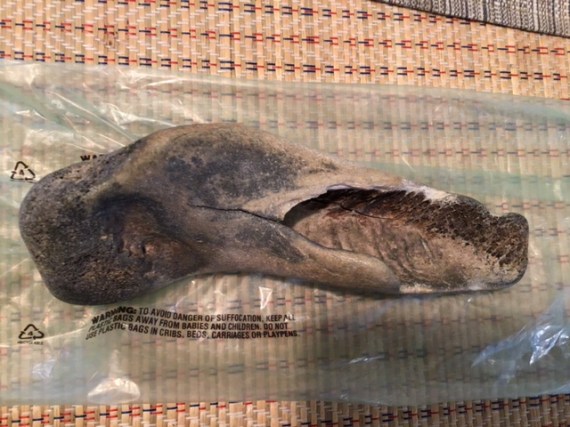
I googled around on-line and found an animated view of a harbor seal skeleton assembling itself. The whole film is interesting and very nicely produced, although the bones could be a little more accurately shaped, and not generic puffy bones. At time 3:35 you get to the left scapula (shoulder blade) and the left foreleg showing the humerus, radius and ulna. After watching the entire film, I returned to the left ulna as the most likely bone, although I wouldn’t call it a perfect match. Perhaps it’s a different species of seal or sea lion, although harbor seal is (I believe) the most common pinniped in the Malibu area.
The film then moves on to the right foreleg, then at time 4:50 moves on to the hips and rear legs including the femur, tibia and fibula. It’s possibly a tibia.
Below: Close up of the interior showing structural ridges.
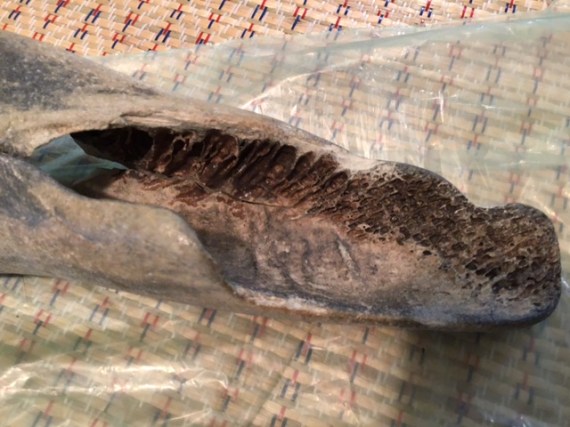
I tried to find another site showing pinniped or whale bones in detail, but believe it or not, found nothing useful. Nothing! Even those sites claiming “I.D. your bone here!!!!” Nil, nada, zippo.
Below, the groove end showing small pits from heavy wear/erosion?
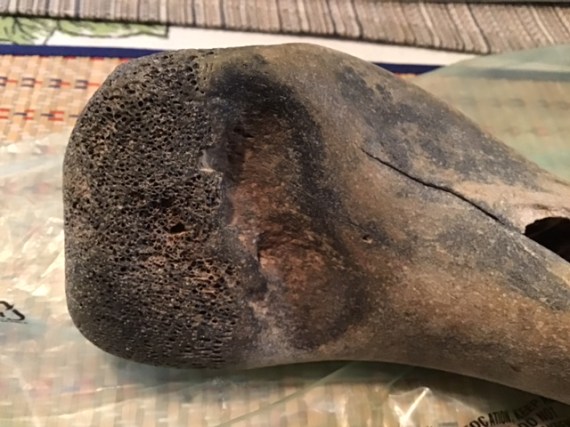
So…at least one of you osteologists out there, tell us what it is. Please.
Spring Bird Photos | Birds & Blooms
[Posted by Chuck Almdale]
‘Tis the season to see spring birds, fa la la la la….
Well…almost.
Birds & Blooms Magazine has a lot of bird pictures online. Here’s a link to some of their portfolios. Here’s another link to what you’ll see if you merely google Spectacular Pictures of Spring Birds Birds and Blooms.
The pictures below are from their portfolio The 51 Best Spring Bird Pictures Ever.
I recently mentioned partially leucistic birds in a blog, and that I’d once seen a leucistic American Robin. Here’s another, photo’d in Waukesha, WI. “When I saw an American robin with leucism (partial albinism) last fall, I was absolutely enchanted. Winter passed, and I wasn’t sure if I would see this special bird again. I was so happy when it reappeared in my yard once March arrived. This robin is a great photo subject and seems to enjoy posing for the camera!”

Here’s an example of a different coloration problem, photo’d at a feeder in Newport, NY. Believed to be “…an American goldfinch that has normal carotenoid pigments (producing the bright yellow) but is lacking melanins. That’s why it looks as if someone took a normal goldfinch and then deleted all the black from its wings and tail.”
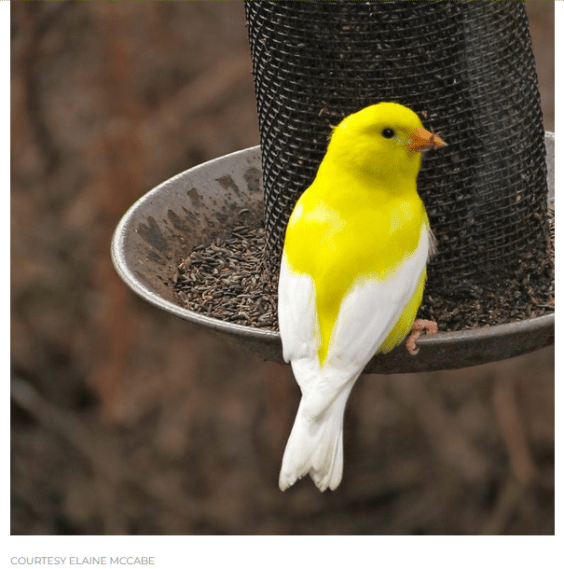
There are 49 more excellent photos in this album which are not devoted to odd plumages, despite appearances to the contrary. I just happened to pick out these two. Then there are loads of other albums with photos like this.

There’s a lot of very good nature photography going on out there. I ran across these photos because a reader sent me a link:
13 Spectacular Pictures of Spring Birds: Bird activity abounds as the season of renewal arrives
Read in Birds & Blooms: https://apple.news/A3jo9h2ChTviQ2uZ5SeD2IQ
But I don’t have an Apple so I couldn’t access the article. Maybe you can. The photos were really stunning.
Twisteddoodles on Birdwatching | New Scientist
[Posted by Chuck Almdale, submitted by Anon.]
More Twisteddoodles available here. Bonus at bottom.
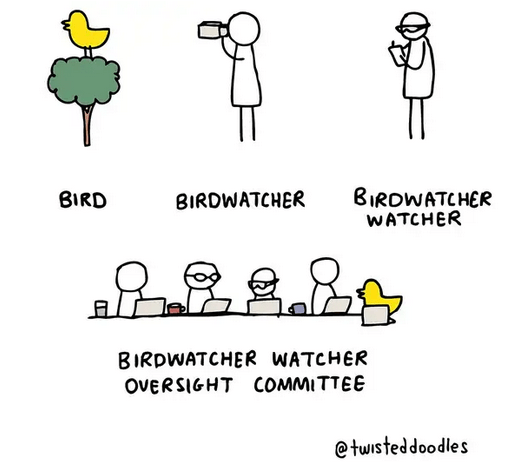
Not everything on X is intended to explode your brain.

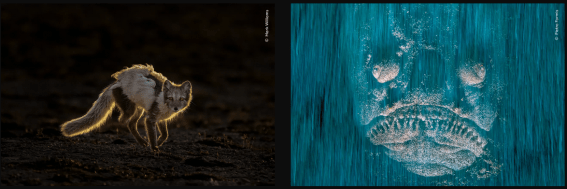
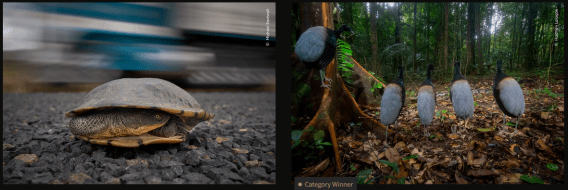
Wildlife Photographer of 2023 | London Natural History Museum
[Posted by Chuck Almdale]

There are thousands of photos one could look at on this site. I could mine it weekly for years. I’ll let you discover them for yourselves, just play around with the buttons and choices. Look especially for this thing:

It’s your key to the treasure chest.
Meanwhile: this link gets you to eighty-four or so (I lost count midway) of the best for 2023. Here’s a few. Then there’s 2022-2010 to look at. A gold star for knowing what are the white things at bottom right.
Whydah heck not? Madrona Marsh: 10 February 2024
[Text by Chuck Almdale, photos by Ray Juncosa, Chris Tosdevin & Karen Woo]

A large group of people waited at the entrance gate to Madrona Marsh at 8:30am, but they weren’t birders. Most were Eagle Scouts, there to build some sort of wooden structure. They were still at it when we left at 11:30, and I still couldn’t tell what it was. A lot of other people had shown up: trail-workers, weed-pullers, tree-fanciers, docents. Even the number of birders for our walk was sizable — seventeen.
The nine vernal pools were full of water, and there were plenty of waterfowl and Red-winged Blackbirds there to celebrate.

The male red-wings seemed eager to get on with breeding, as everywhere in and near the reed beds they were prominently displaying their red & yellow epaulets.

Once upon a time some meddling research scientists decided to see how important bright red epaulets were to the males. They captured a few, colored their epaulets black, and released them back into their marsh. They immediately lost their territories and the females ignored their courting maneuvers. No breeding for them! Upon hearing this woeful tale, one birder asked me if the scientists restored the red to the epaulets so the males could regain their territories and all would again be right with the world. Sorry to say, I don’t know for sure, but knowing how these things went decades ago, I suspect not.
One of the male Red-winged Blackbirds had a white head, what is frequently called partially leucistic (rather than albino). Leucism doesn’t seem to be an inherited trait and appears uncommonly in many different species. [I’ve seen leucistic robins and hummingbirds elsewhere.] Another bird had a light speckling of white (right photo below, look very closely).

Also in the reeds, and rather annoyingly well-hidden were the Scaly-breasted Munias, a very pretty little bird which I always enjoy seeing. They’re colorful and have a nice song, which is why they’ve been domesticated as cage birds for many decades – perhaps centuries – with the inevitable escaping from confinement and flight to the local wildlands. People who keep birds in cages or around their homes like to give their feathered companions names, and I suspect this species Lonchura punctulata has the most English names of any species I’ve ever heard of: Spice Finch, Spice Munia, Nutmeg Finch, Nutmeg Mannikin, Nutmeg Munia, Ricebird, Spotted Manikin, Spotted Munia, Checkered Munia, Scaled Munia, Scaly-breasted Mannikin, Scaly-breasted Munia. That’s twelve and I probably missed some. It also has names in at least 62 other languages, from Asturian to Esperanto to Ukrainian. [Esperanto! Imagine that.] Definitely a world-traveler.
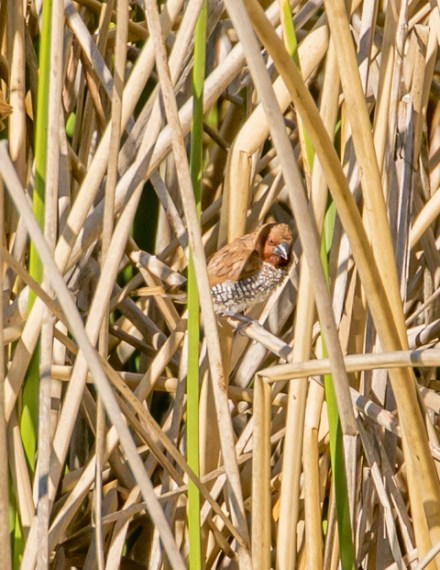
Scaly-breasted Munia (info link), by whatever name, naturally range from eastern Afghanistan to eastern China and south through Indonesia to east of the Wallace Line. With human help, they’re just about everywhere, and have been in SoCal since the 1980’s. We’ve seen them on trips to Huntington Beach Central Park for several decades.
We didn’t have many warbler species (two), but we had a lot of Yellow-rumped Warblers in every plumage variation you might expect (or fear). When I began birding, I remember Roger Tory Peterson making many useful comments in the introduction to his ground-breaking field guides: e.g. keep a life list, the first 300 species you see are “trash birds,” learn well your common local birds so when something unusual appears, you’ll know it’s unusual and will mutter to yourself, “My, my, that looks different! I’d better get a good look.” All sound advice.
And that’s why I tell birders that the Yellow-rumped Warbler is about as variable as any of the warblers you’ll ever see. You can see a group of ten and they could easily all like potentially different species. And in another month or 500 miles away, they’ll all look different from today and here. A good bird to learn. This one below had an unusual amount of black on the face. Photographer Chris Tosdevin thought it might be a “possible juvenile side molt.”


Chris thought the bird below to be a Yellow Warbler when he photographed it. They can look quite unlike their summer selves in the winter. It also seems to have an eye-ring, which is usually subdued in this species.
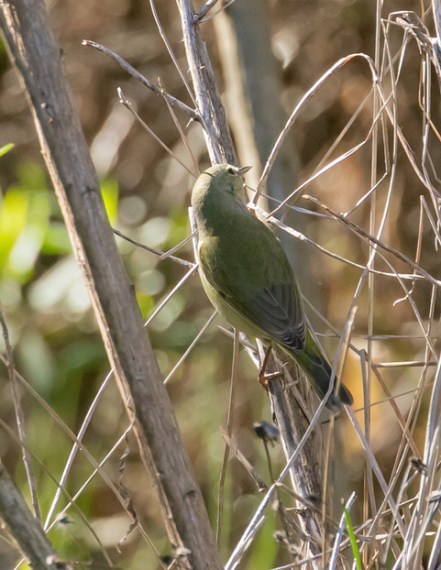
We couldn’t tell if there were twenty Cassin’s Kingbirds or only one who got around. A lot. I never saw more than one at a time. It certainly was everywhere, forcing everyone to keep re-identifying it over and over (and over) again. White chin, dark gray neck and breast, no white outer tail-feathers.

Blue-gray Gnatcatchers seem to love Madrona. We had at least eight, and I see that in 2016 we had thirteen, which seems a lot for an area completely surrounded by suburbia and no hilly chaparral in sight. This turned out to be a lifer for one of the birders.

I was looking forward to seeing the Pin-tailed Whydahs, another escaped cage bird that’s been expanding its SoCal range for at least the past few years, but which I had somehow missed. I’d seen them in Sub-Saharan Africa, where they range widely, but that was thirty years ago. All the ones we saw today – the best count was 18 – looked like the two pictured below with thick bright red bill, streaky head and back and mostly white chest & belly. They’re too recent an escapee to be in my NGS field guide (2011) 6th edition, but a few people found them on their phone app, once we figured out how to spell it (that extra “h”). We narrowed them down to male or female, non-breeding, which isn’t particularly narrow.

In breeding plumage the males have red bills and females usually have “blackish” bills. In non-breeding plumage the male bills are still red, but females can have red or blackish-red. All the birds I saw had bright solid-red bills, but they could be of either sex.
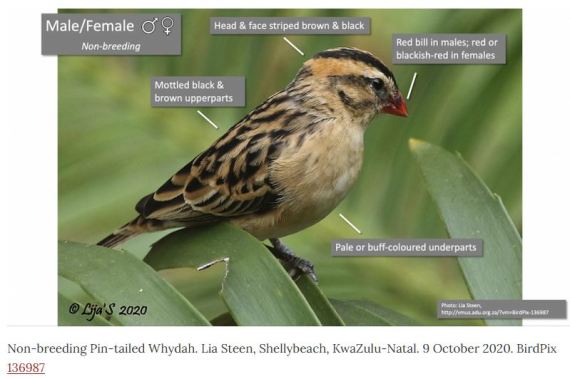
They hail from sub-Saharan Africa where, once the desert stops, they start, almost all the way to Cape Town. The site linked to below this photo has lots of info, plus song recordings.
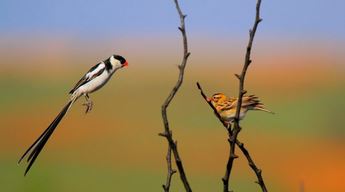
The link above has lots of photos, including ones from around SoCal.
We certainly did not see any males like the one above, who – in addition to his long pin-tail – appears to be standing in mid-air, which is a good trick, sure to impress any female watching.
But that was not the end of the oddities. There were Northern Flickers of two persuasions. Most were of the expected western Red-shafted subspecies, but at least one (quite possibly two) were of the eastern Yellow-shafted subspecies. Sometime you get only a hint, as in the photo below, where all you get indicating Yellow-shafted is the brownish face and the tiny tiny glimpse of red on the nape. There seems to be no black whisker-mark (aka moustachial stripe).

However, in the photo below, the yellow shouts at you, unmistakably.
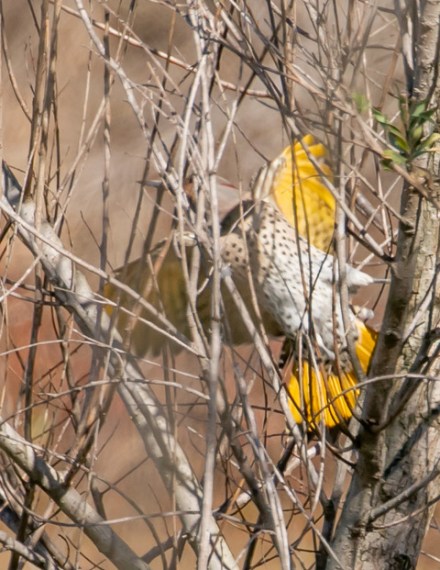
These two species were considered separate species until roughly 30 years ago when they were discovered interbreeding in (I believe) Nebraska. Apparently the two populations became widely separated at some point in geological time (perhaps during or following an ice-age) and their plumages diverged. When Europeans arrived, spread across the Great Plains and began planting trees around their homes, the eastern and western woodpeckers spread towards each other across the otherwise-treeless plain, eventually meeting each other mid-continent. Although they looked different, it wasn’t enough of a difference to inhibit their mating with one another. Following the widely-accepted “biological concept of speciation,” if two forms of an animal mate and bear fertile offspring, they’re the same species, whatever their appearance. Charles Darwin considered subspecies to indicate a species in the process of diverging into two but not quite there, and the only diagram in his book On the Origin of Species illustrates this. Given sufficient time and continued geographical separation, the Yellow-shafted and Red-shafted could well have each become “good species.”
Hummers of two species were scattered about the grounds, conveniently perching on bare twig-ends, easy to spot.

And sparrows of various persuasions were out and about. Near the vernal pools the chorus of Song Sparrows was nearly deafening at the start of our walk.

It may look like a saddle-without-a-horse, but the photo below is of a tree (or shelf) fungus. Note the fence lizard considerately situating itself for size comparison.

When we returned to our cars, we found a large lunch-tent in the middle of the parking lot serving plates of pizza. We assumed this was for the benefit of the work crews and boy scouts who were doing actual useful work in the marsh, and not for birders loafing their way around the grounds, so we restrained ourselves (so far as I know) from helping ourselves.
As always, many thanks to our photographers: Ray Juncosa, Chris Tosdevin and Karen Woo.
| Madrona Marsh Trip List | 12/10/16 | 2/11/23 | 2/10/24 |
| Canada Goose | X | 8 | |
| Cinnamon Teal | X | ||
| Northern Shoveler | X | 40 | |
| Gadwall | X | 2 | |
| American Wigeon | 6 | X | 2 |
| Mallard | 6 | X | 50 |
| Green-winged Teal | X | ||
| Ring-necked Duck | 1 | ||
| Hooded Merganser | X | ||
| Rock Pigeon | 8 | X | 8 |
| Eurasian Collared-Dove | X | ||
| Mourning Dove | 50 | X | 12 |
| Anna’s Hummingbird | 3 | X | 3 |
| Allen’s Hummingbird | 9 | X | 4 |
| American Coot | 5 | X | 2 |
| Killdeer | X | ||
| Greater Yellowlegs | X | ||
| Ring-billed Gull | 2 | ||
| Western Gull | 4 | ||
| California Gull | 2 | X | |
| Great Egret | 1 | ||
| Green Heron | X | ||
| Black-crowned Night-Heron | X | ||
| Sharp-shinned Hawk | 1 | ||
| Red-shouldered Hawk | 1 | ||
| Red-tailed Hawk | 2 | X | 2 |
| Downy Woodpecker | 1 | 1 | |
| Northern Flicker (Red-shafted) | 2 | X | 10 |
| No. Flicker (prob. Red x Yellow) | (1) | ||
| American Kestrel | 3 | X | 1 |
| Ash-throated Flycatcher | 1 | ||
| Cassin’s Kingbird | 6 | X | 2 |
| Black Phoebe | 6 | X | 5 |
| Say’s Phoebe | 1 | X | 1 |
| California Scrub Jay | 1 | ||
| American Crow | 4 | X | 12 |
| Common Raven | 2 | X | 2 |
| No. Rough-winged Swallow | 2 | ||
| Bushtit | 50 | X | 18 |
| Ruby-crowned Kinglet | 12 | ||
| Cedar Waxwing | 20 | X | |
| Blue-gray Gnatcatcher | 13 | X | 8 |
| House Wren | 1 Heard | ||
| Northern Mockingbird | 1 | ||
| European Starling | 8 | X | 5 |
| Hermit Thrush | 1 Heard | ||
| Scaly-breasted Munia | 45 | 20 | |
| Pin-tailed Whydah | 18 | ||
| House Finch | 20 | X | 5 |
| Lesser Goldfinch | 3 | X | |
| American Goldfinch | 45 | X | 8 |
| Chipping Sparrow | 6 | 4 | |
| Brewer’s Sparrow | 2 | ||
| Fox Sparrow | 1 | ||
| White-crowned Sparrow | 60 | X | 15 |
| Golden-crowned Sparrow | 2 | X | |
| Savannah Sparrow | 4 | X | |
| Song Sparrow | 2 | X | 8 |
| Lincoln’s Sparrow | 3 | X | 1 |
| California Towhee | 2 | X | 1 |
| Western Meadowlark | 10 | X | 1 |
| Red-winged Blackbird | 2 | X | 31 |
| Great-tailed Grackle | X | 1 | |
| Black-and-White Warbler | 1 | ||
| Orange-crowned Warbler | 6 | X | |
| Common Yellowthroat | 3 | 1 | |
| Yellow-rumped Warbler | 10 | X | 40 |
| Black-throated Gray Warbler | 1 | X | |
| Townsend’s Warbler | 1 | ||
| House Sparrow | 1 | ||
| Total Species – 69 (forms – 70) | 51 | 46 | 41 (42) |



 SANTA MONICA BAY AUDUBON SOCIETY BLOG