Free email delivery
Please sign up for email delivery in the subscription area to the right.
No salesman will call, at least not from us. Maybe from someone else.
Photoshopped Photo in the CBC Report
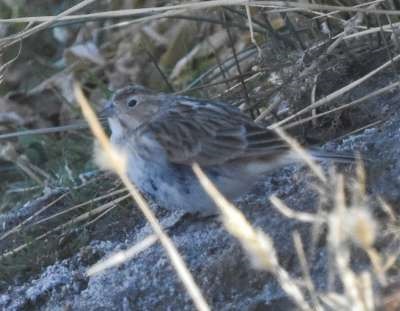
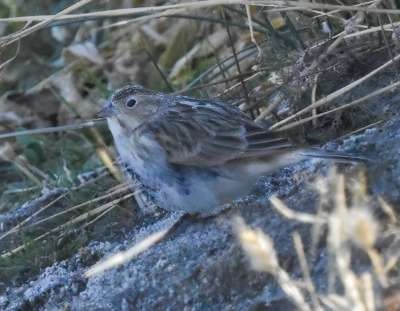
We had a comment from Tom Hinnebusch about the use of Photoshop and its potential effect on bird identification. The CBC report had a photo of the Chestnut-collared Longspur that had some vegetation removed to make it a more pleasing photo (one hopes). The current version of Photoshop has what they call “regenerative fill” (RF) and this is the issue. RF will erase what you tell it and then use artificial intelligence (AI) to replace the empty spots. The trick is that the replacement bits are generated out of thin air, using a library of similar photos in its memory. It also looks at the original photo to help it match up – perhaps the feathers next to the blank area will guide it. But, the important thing is the replacement bits are fakes, unreal, arbitrary. For purposes of bird i.d. one must be careful – if we get a question from The Committee the original must be used without alteration.
AI can do a really good job. Done carefully it might be impossible to tell there has been any alteration. Sharpening, denoising and other traditional editing is fine and need not be mentioned, but if a photo has been altered by replacing or removing original elements, that should be made clear. For anyone who is interested, here are the “before and after” photos. I think the field marks are OK in both, although the beginning of the black plumage on the chest in the altered photo seems to have been enlarged. I missed that.
A Most Unusual Christmas Count: Butterbredt 2023
To the details in a moment. First a big Thank You to the participants: Reed Tollefson and Steve Hylton from Audubon’s Kern River Preserve; Sasha Robinson and Annie Meyer from the Southern Sierra Research Station; Connie Day, Chris Lord and Alice Bragg from SMBAS. Thanks to them we saw 56 species – an average year is 42 species and the all time high is 62. We added 4 birds completely new to the list So, it was a great day.
For those who are unfamiliar with this count, the circle is about 30 miles north of Mojave. The habitat ranges from sandy scrub to grasslands to Joshua Tree ‘forests’ to mixed montane woodlands to several freshwater springs. In former days there was a lot of cattle ranching but nowadays not so much. Our chapter started this count in 1977 (it’s a long story). The temperature began at 38 degrees at 8:00 and got to 61 (!) by noon. It was sunny and there was virtually no wind. Usually the better the weather the fewer the birds – don’t know why. But today was different. There is one tree on the plain at the SE corner of the count circle and we found two Anna’s Hummingbirds feeding from the tiny flowers on the tree. Flowers? December? Was this a sign?
Maybe. As we worked west we got the first new species for the list – two Western Kingbirds. Excellent. But as we came to the open ground where we typically find the most raptors, we saw only a single Red-tailed Hawk. At the end of the day our raptor list was pretty small. Also, our group saw only one bunny. After all the rain last winter we expected to see more vegetarians in the field.
On the plus side there were four species seen by various groups where we saw as many on this day as had been seen in the entire 48 years of the count. Up in the Piute Mtns. I spotted a Lewis’ Woodpecker far far away. Victory! This is an unusual bird everywhere. But after an hour we had totaled 14 birds, doubling the total over that 48 years. Amazing.
A small digression. Lewis’ Woodpecker is named after Meriwether Lewis (Lewis and Clark). The Park Service cabin in the Meriwether Lewis State Park (Tennessee) has a little notebook display with a picture.
![0529-5_thumb[1]](https://smbasblog.com/wp-content/uploads/2023/12/0529-5_thumb1.jpg "0529-5_thumb[1]")
I pointed out to the staff person that this was an Acorn Woodpecker. She promised to look into it. This was in 2013 – anyone going that way who can check?
![ian routley_thumb[1]](https://smbasblog.com/wp-content/uploads/2023/12/ian-routley_thumb1.jpg "ian routley_thumb[1]")
Lewis’ Woodpecker (cr. Ian Routley, 8/9/2012, British Columbia)
Sasha and Annie found two of the four new birds. They found Green-tailed Towhees, one at Butterbredt and one at Tunnel Springs. Annie got photos!
![gtto-2_thumb[3]](https://smbasblog.com/wp-content/uploads/2023/12/gtto-2_thumb3.jpg "gtto-2_thumb[3]")

But the blockbuster bird of the day was a Chestnut-collared Longspur. I emailed them saying that the Great Sceptic in charge of the California counts would ask questions about this very rare sighting. But, Sasha and Annie have actually done field work on this bird in Montana, Texas and Mexico. They saw field marks when the bird flew. And, Annie got a photo.
![cclo-Edit-Edit-Edit-Edit_thumb[1]](https://smbasblog.com/wp-content/uploads/2023/12/cclo-edit-edit-edit-edit_thumb1.jpg "cclo-Edit-Edit-Edit-Edit_thumb[1]")
Chestnut-collared Longspur (Calcarius ornatus). Vegetation Photoshopped out to see the bird better.
Summer plumage is spectacular. Winter plumage is, well, whatever. I am certain that if I had seen this bird I would have put it in the Sparrow species category. But they heard the call and saw the triangular black tail pattern when it flew.
Further highlights:
- 60 Yellow-rumped Warblers. The previous 47 years totaled 75 birds.
- 845 White-crowned Sparrows. Always common, but this is the third highest total ever.
- 1 Orange-crowned Warbler. Common winter bird in your garden, but the first ever on this count.
- 1 European Starling. One? Whoever saw just one starling?
So that was the 2023 count. Join us next year and find your own unique first-time species?
| Green-winged Teal [American] | 3 | |
| Duck sp. | 1 | |
| California Quail | 83 | |
| Sharp-shinned Hawk | 1 | |
| Cooper’s Hawk | 2 | |
| Red-tailed Hawk | 2 | |
| Great Horned Owl | 2 | |
| Anna’s Hummingbird | 2 | |
| hummingbird sp. | 1 | |
| Acorn Woodpecker | 4 | |
| Red-breasted Sapsucker | 1 | |
| Lewis’s Woodpecker | 14 | |
| Ladder-backed Woodpecker | 8 | |
| Nuttall’s Woodpecker | 2 | |
| Hairy Woodpecker | 3 | |
| Northern Flicker | 1 | |
| Northern (Red-shafted) Flicker | 6 | |
| Black Phoebe | 3 | |
| Say’s Phoebe | 1 | |
| Western Kingbird | 2 | new |
| Loggerhead Shrike | 5 | |
| California Scrub Jay | 24 | |
| Common Raven | 26 | |
| Oak Titmouse | 2 | |
| Bushtit | 8 | |
| Rock Wren | 7 | |
| House Wren | 5 | |
| Marsh Wren | 1 | |
| Bewick’s Wren | 13 | |
| Cactus Wren | 1 | |
| Blue-gray Gnatcatcher | 1 | |
| Ruby-crowned Kinglet | 15 | |
| Western Bluebird | 16 | |
| Mountain Bluebird | 8 | |
| Hermit Thrush | 1 | |
| California Thrasher | 1 | |
| Northern Mockingbird | 2 | |
| European Starling | 1 | |
| American Pipit | 44 | |
| Phainopepla | 4 | |
| Orange-crowned Warbler | 1 | new |
| Yellow-rumped (Audubon’s) Warbler | 60 | |
| Chipping Sparrow | 3 | |
| Brewer’s Sparrow | 5 | |
| Black-throated Sparrow | 2 | |
| Dark-eyed (Oregon) Junco | 87 | |
| White-crowned Sparrow | 845 | |
| Golden-crowned Sparrow | 16 | |
| Bell’s Sparrow (belli) | 28 | |
| Savannah Sparrow | 5 | |
| Song Sparrow | 3 | |
| Lincoln’s Sparrow | 7 | |
| California Towhee | 5 | |
| Green-tailed Towhee | 2 | new |
| Spotted Towhee | 8 | |
| sparrow sp. | 49 | |
| Chestnut-collared Longspur | 1 | new |
| Western Meadowlark | 5 | |
| House Finch | 18 | |
| Lesser Goldfinch | 1 | |
| Birds Seen | 1478 | |
| Net Species Seen | 56 |
Lesser Black-backed Gull at Malibu Lagoon
[Posted by Chuck Almdale]
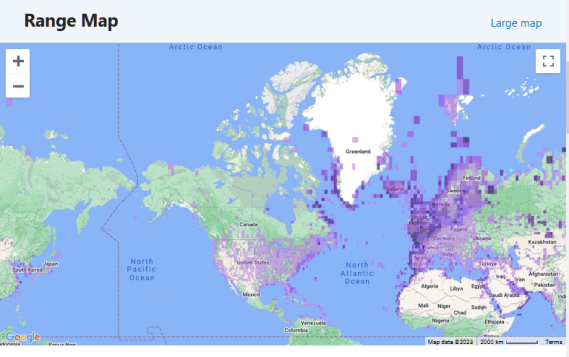
Link to eBird page: https://ebird.org/species/lbbgul
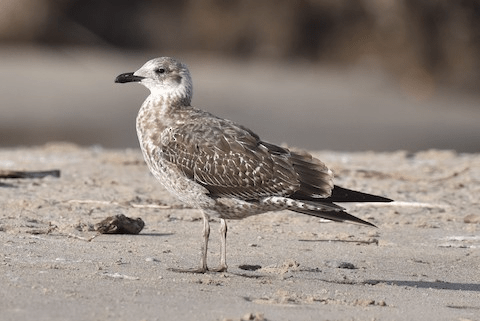
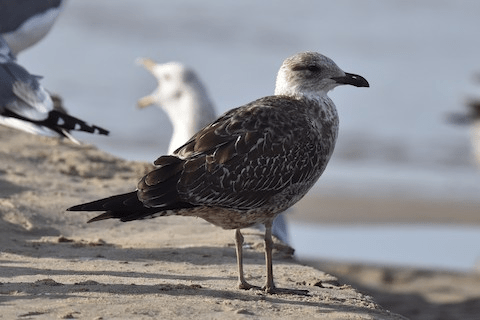
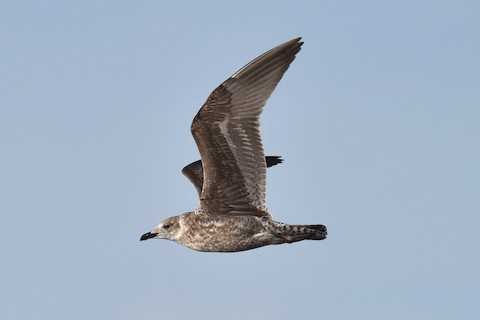
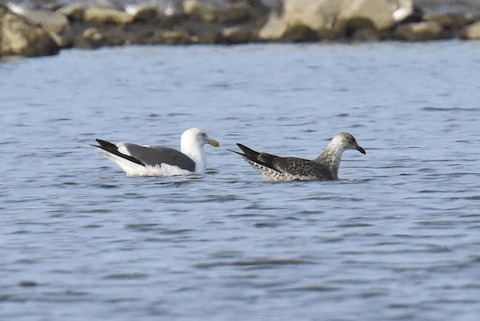
We don’t get a lot of Lesser Black-backed Gulls in SoCal let alone at Malibu Lagoon. It’s been there at least Dec. 17-20, 2023 and might stick around longer. It’s primarily a European & West Asian bird, so it appears more often on the U.S. east coast than the west coast. 21″ long, 1st-cycle bird (first winter).
There’s also a Laughing Gull at Cabrillo Beach.
I got the following from eBird.
Photos:
William Tyler 12/20/23
https://ebird.org/checklist/S156770710
Typical first cycle. Contrasting white head. All dark bill (parallel-sided). Long wings. (Kind help from Andy Birch).
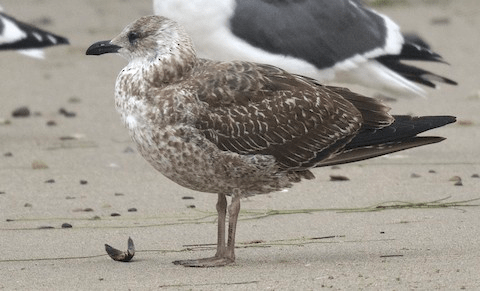
Naresh Satyan 12/17/23 Total of 8 photos on link below
https://ebird.org/checklist/S156568717?_gl=1*bj3cph*_ga*MTYwNzM3MDkwLjE3MDMxOTM3MTE.*_ga_QR4NVXZ8BM*MTcwMzE5MzcxMS4xLjAuMTcwMzE5MzcxMS42MC4wLjA.
First cycle. Fairly typical bird with white head with smudging around the eye, replaced scapulars dark gray with darker centers, juvenile coverts and tertials dark chocolate brown with thin white edges, elongated primaries dark black, upper and undertail coverts white based with thin brown markings, dark tail, narrow parallel-sided all-dark bill.
Link to eBird page: https://ebird.org/species/lbbgul
Slender, long-winged gull [21″], same size as California Gull, slightly smaller than Herring or Western Gulls [25″]. Adults show dark gray back and yellow legs; in winter note fairly heavy streaking on head and neck. Takes four or five years to reach adult plumage; immatures can be difficult to distinguish from other gulls, especially Herring. On first- or second-year birds, look for contrastingly whitish head with dark smudge around the eye, long wings, dark bill, whitish rump and tail base, and evenly dark wings in flight. Can be found around any body of water but prefers beaches and flats. Often with flocks of other large gulls. Common in Eurasia, wintering to Africa and Southeast Asia. Population in North America has increased dramatically in the last couple decades; now regular (even fairly common!) on the Atlantic coast, rarer inland and farther west.
Owls: What they know and what humans believe | Carl Safina on KCRW’s ‘Life Examined’ Podcast
[Posted by Chuck Almdale]
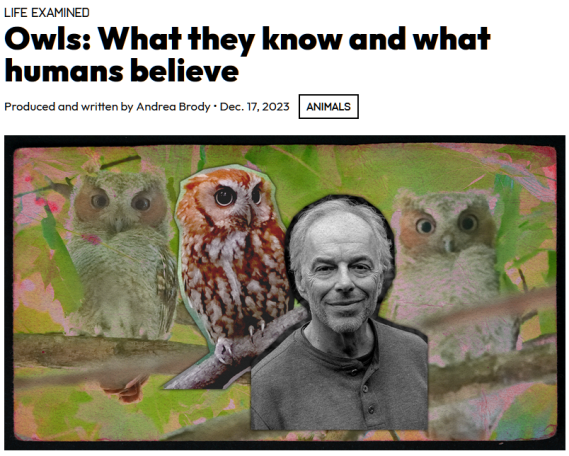
Owls: What they know and what humans believe: Podcast Page Link
From the Podcast Introductory Blurb:
Carl Safina, ecologist and founding president of The Safina Center at Stony Brook University in New York, shares his experience raising a small owl. Safina recounts what he learned and why this period of his life was so joyful in his latest book Alfie and Me: What Owls Know, What Humans Believe. Writer Jennifer Ackerman, who’s written several books on birds and is author of What an Owl Knows:The New Science of the World’s Most Enigmatic Birds, describes why the owl is the absolute apex predator.
[By Chuck Almdale]
The weather was fine and it was a great day for a Padelynge of Dookysse (the 1452 AD collective noun expression). In fact we had a great many swich padelynges, all down and up the upper bay, at San Joaquin Marsh as well.
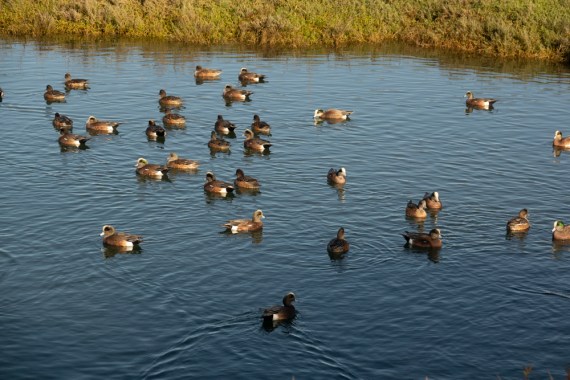
Our first paddling of ducks!
If you find anything other than American Wigeons above, give yourself an extra point. There’s always a group of ducks at the foot of San Joaquin Hills Rd. where it junctions with the one-way walk-run-bike-drive-bird road with the succinct name “Mountains to the Sea Trail and Bikeway.” It’s often a good spot for less common ducks such as Cinnamon Teal, Blue-winged Teal, Canvasback, Eurasian Teal. We didn’t find those species there this time, but we located some of them elsewhere.
As the tide dropped from a high of 5.55 ft. @ 0612, and low of 0.18 ft. @ 1318, birds kept dropping in and flying about as water receded and mud became exposed. Can you ID this species before it hits the water?
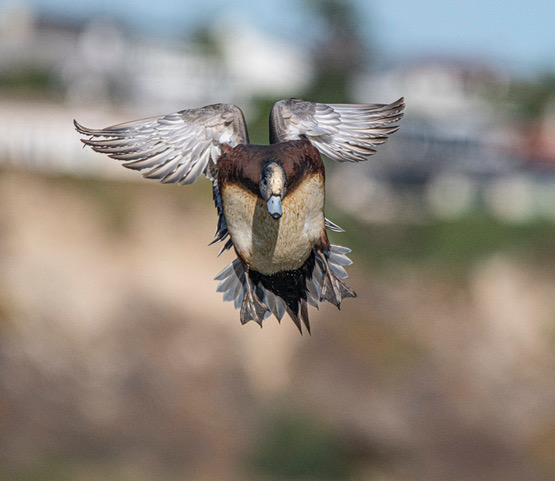
The ducks of the world are highly sexually dimorphic. Of the 128 species (here’s a list) called “duck” I can’t find any that are monomorphic (males & females look alike). On the other hand the 36 species of “geese & swans”)” are nearly all monomorphic (the Upland Goose isn’t, there may be others). Among the ducks it’s always the male that’s more colorful while the female is a mélange of brown & gray colors, occasionally spicing it up with some white or black. She sits on the eggs; he doesn’t. If you’re stuck sitting on a nest full of eggs on the ground for weeks on end, it helps to be cryptically plumaged. If you aren’t, predators notice you and eat you and/or your eggs. So it goes. If your male mate is brightly colored and out wandering around well away from the nest, his attractive bright colors may distract predators away from the cryptic females, nests and eggs. If anyone gets chased and eaten, it’ll be the male. So (again) it goes. At least his progeny are more likely to live on. Voilà! Natural selection in a nutshell.

What this means for birders is that it’s often hard to tell female ducks apart. The males are (generally) easy. You can narrow down the species for the females because 1) they’re the same shape and size as the males (whom you’ve already figured out, of course), and 2) they tend to stay near the males of their species. The wigeons above illustrate this very nicely by considerately positioning themselves at the same angle and distance to the camera. Their bills are also identical in color and pattern.
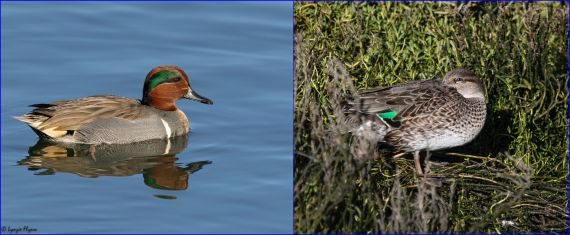
The Green-winged Teal weren’t as cooperative. At least you can see the green in the wing of this female attempting to snooze.
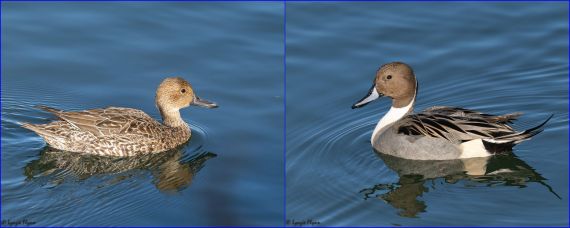
The tail of the male Pintail is very long and pointed, the female not so much. The bill is the same shape and length (the female above was a bit farther away), but the patterns differ. The female bill is all black; the male’s is baby blue bordered in black. Both sexes are sleek with slender necks and smallish heads. We spent some time trying to figure out these females who were out swimming around by themselves among the wigeons, and finally settled on the bill-neck-head shape and proportions as most useful.
Here’s two other swimmers: one is a duck, one isn’t. Which is which?
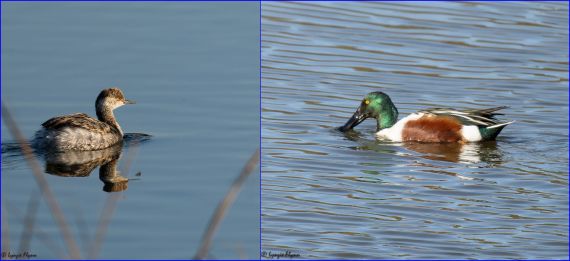
I hope that wasn’t too difficult. The one with the big duck bill is…the duck. The Northern Shoveler has about the biggest bill in the duck world. Guess what color the female plumage is? The left bird is an Eared Grebe in an order of birds distantly related to ducks. Grebes generally have pointed bills, often long, and their legs are far back on their body. If you think ducks walk poorly, you should see a grebe walk, except you’ll probably never see a grebe try to walk as they hate solid land. If they’re on land, they’re likely to be sick or wounded. They don’t even like to nest on land, preferring to build floating nests of reeds, cattails, aquatic grasses. There are several species of flightless grebes in the world living on lakes with lots of reeds. “Who needs to fly anymore!” their ancestors “decided.” Everything we need is right here.” As far as I know all grebe species (22, depending on whom you ask) are sexually monomorphic. Unlike the ducks, both male and female sit on the eggs and take care of the young, even carting them around on their backs, tucked between their wings.
The Greater and Lesser Scaups is a species pair where the males are hard to tell apart. Generally speaking the Lessers are more common in SoCal, but not always. Based on the bump on the head (more towards the front than the back), the slight whitish ear patch (absent in Lesser) and what might be a wider black nail at the end of the upper bill (narrow in the Lesser), the bird below seems to be a female Greater Scaup.
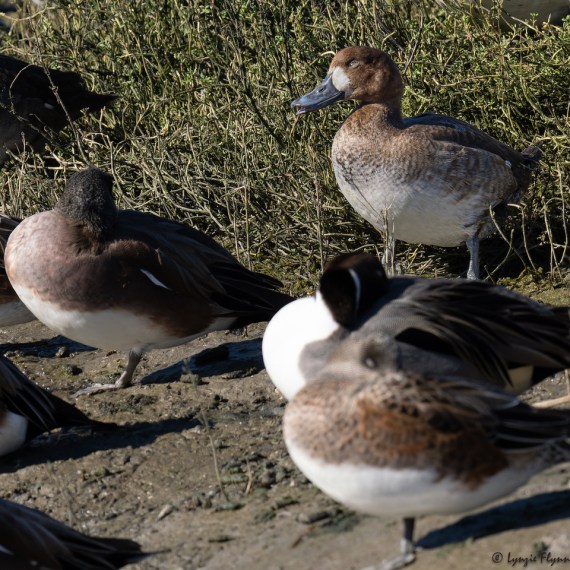
We saw a flotilla of scaup of both species near the Jamboree bridge at the north end of the bay, a goodly distance afar.
Our last pair of of floaters are the grebes below, Clark’s and Western Grebes. Which is which?
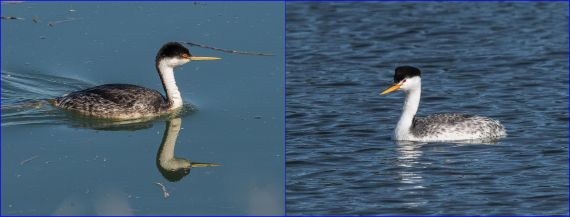
Western Grebes outnumber Clark’s about 99 to 1 in SoCal, so when in doubt, Western is the default. Their slightly offshore flocks can number well into the 1000’s in winter and if you’re looking for a Clark’s, you’ll have to comb through them bird by bird. Or go to Upper Newport Bay and San Joaquin Marsh: they’re fewer in number but closer. The Clark’s is the right grebe above: bill is orange, not dull yellow-green; the white cheek extends around the eye, often with a dark line connecting eye downward to bill gape, and paler flanks. Keep reading to the end of this posting and you’ll find a special treat.
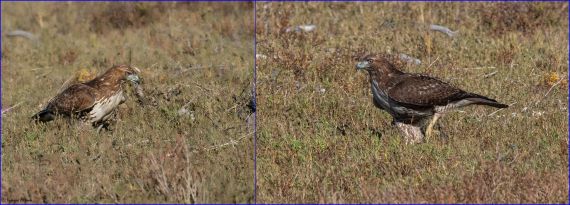
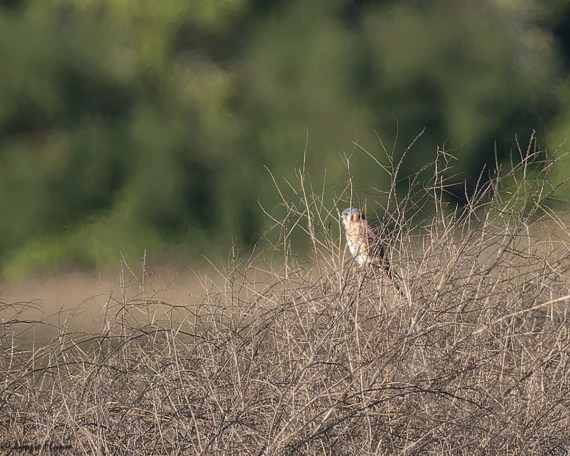
The hawk above was in a damp field with a small rodent (zoom in on left photo). Far far away, nearly all the way across the bay we spotted this American Kestrel which – judging by his blue-gray crown – is male.
The herons and egrets were scattered around the bay, with no significant concentrations. We had four species.

Are the two photos below the same species, perhaps the same bird?
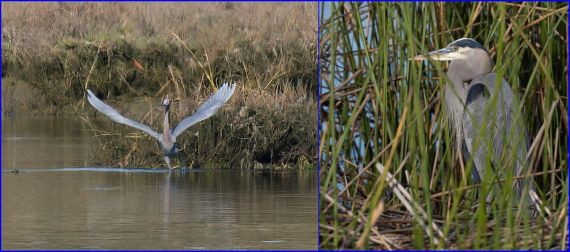
Nope. The left-hand bird, all the way across the bay, was noticeably smaller than a nearby Great Blue Heron, and had an odd reddish neck. Reddish Egrets are 30″ tall while GB Herons are 46″, a noticeable difference. This particular Great Blue Heron (above right) was seen later, tucked into the reeds at San Joaquin Marsh. Reddish Egrets are still uncommon in SoCal and it’s always a surprise and a treat to find one, but they seem to be slowly growing in numbers and locations every years.
We didn’t have a huge number of passerines. Most common around the bay were Black & Say’s Phoebes, Song and White-crowned Sparrows. San Joaquin Marsh had a lot of Blue-gray Gnatcatchers and Yellow-rumped Warblers.
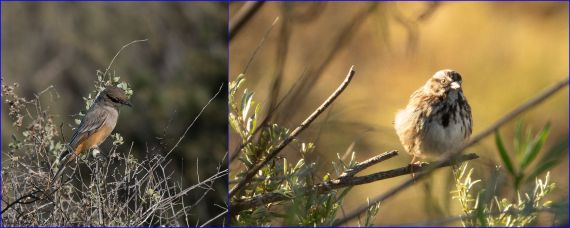
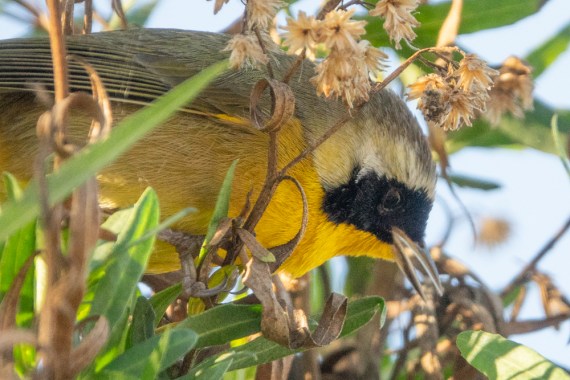
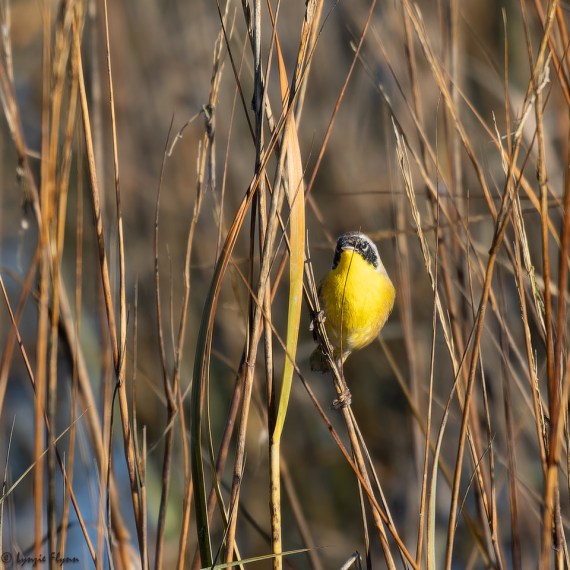
At one point we heard a huge rustling of leaves and snapping of twigs behind us. Turning around we discovered this enormous Common Yellowthroat plowing through the brush like a tank run amok.
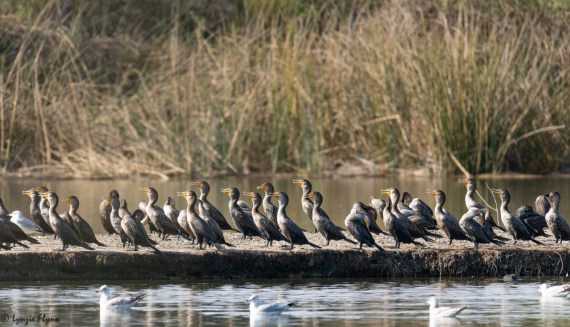
Double-crested Cormorants were present on the bay, but we didn’t see many until we came upon this group on a mud embankment at San Joaquin Marsh. It wasn’t particularly hot but they were practicing their gular fluttering, perhaps for when they really need it next summer.
As the water hadn’t receded much from high tide, we didn’t see many “peeps” until several hours had passed and mud began to become exposed. Photographer Flynn captured this nice comparison of Least and Western Sandpipers, the most common of the shorebirds, although Willets and Whimbrels were also in good numbers, with fair numbers of Marbled Godwit, and naught but a single Dunlin resting among the smaller peeps.
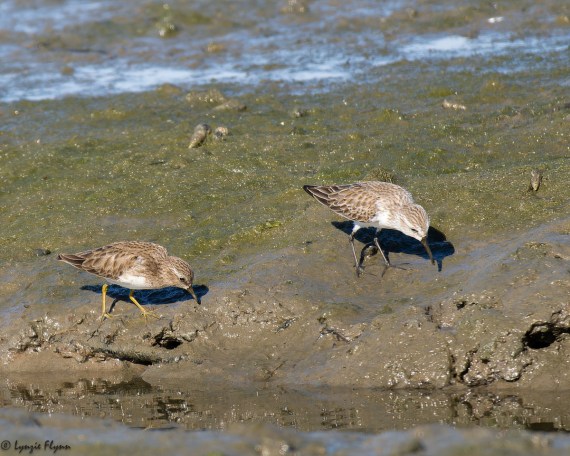
The field marks differentiating these two species are so blindingly obvious in the above photo that I won’t bother you with the tedious details.

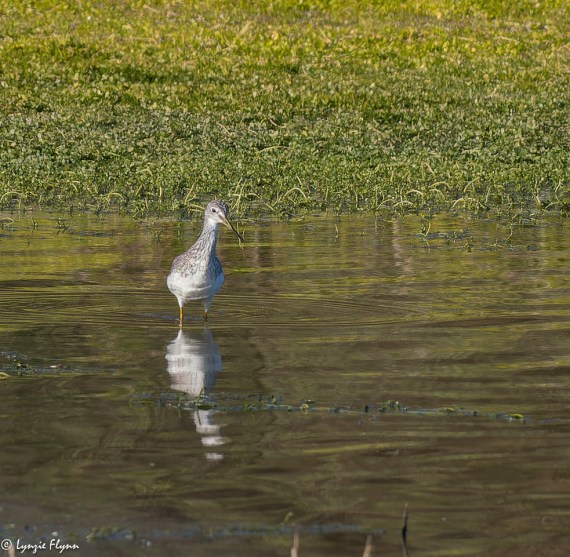
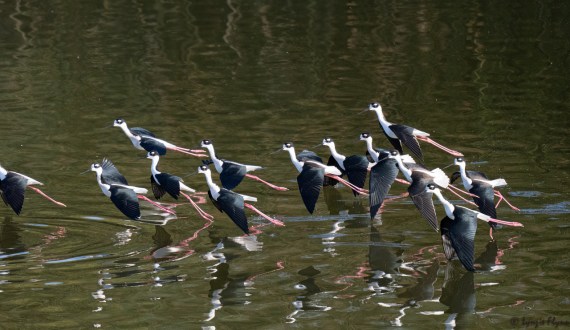
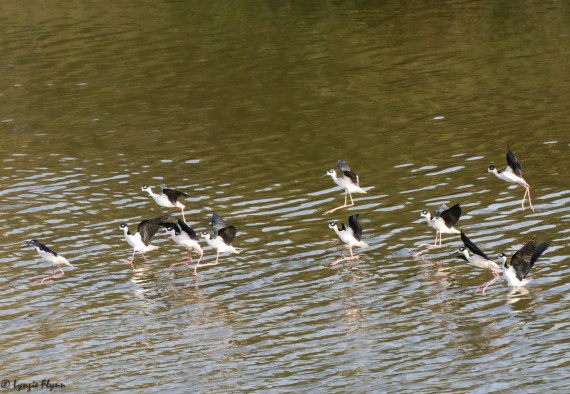
I don’t believe I’ve ever seen Black-necked Stilts in this lovely sway-backed posture before, moments before landing.
At San Joaquin Marsh we saw two smaller-but-perfect versions of a Clark’s Grebe following one (maybe two) of the adults around. December is normally really late to see young birds. They were probably still unable to fly as most birds are full- or nearly-full-sized by the time their flight feathers grow out and their muscles develop and they finally capable of taking flight. So this was a bit mystifying. Were they miniature grebes, or aberrant Red-necked Grebes? Afterwards I received the photo below from Lynzie.
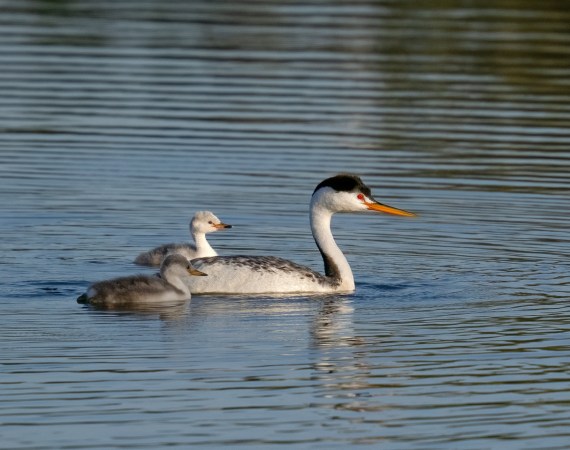
Clark’s Grebes obviously bred at San Joaquin Marsh, which I had not known. Lynzie says some think they might be hybridizing here with the Western Grebes.
The drive home was surprisingly good, not much longer than the morning drive despite (or perhaps because of) the numerous police cars on the freeways.
Many thanks to our photographers Chuck Bragg, Lynzie Flynn, Ray Juncosa
The trip list for San Joaquin Marsh is below the Back Bay Newport list. Our combined trip list for both locations was 65.
| Back Bay Newport | 12/9/23 | 12/10/22 | 12/14/19 | 12/8/18 | 11/4/17 |
| Canada Goose | X | X | X | X | X |
| Gadwall | X | X | X | ||
| American Wigeon | X | X | X | X | X |
| Mallard | X | X | X | X | X |
| Blue-winged Teal | X | X | X | ||
| Cinnamon Teal | X | X | X | ||
| Northern Shoveler | X | X | |||
| Northern Pintail | X | X | X | X | X |
| Green-winged Teal | X | X | X | X | X |
| Canvasback | X | X | |||
| Redhead | X | X | X | X | |
| Greater Scaup | X | X | |||
| Lesser Scaup | X | X | X | X | |
| Surf Scoter | X | X | |||
| Bufflehead | X | X | X | X | X |
| Hooded Merganser | X | ||||
| Red-Breasted Merganser | X | ||||
| Ruddy Duck | X | X | X | X | X |
| Pied-billed Grebe | X | X | X | X | X |
| Eared Grebe | X | X | X | ||
| Western Grebe | X | X | X | X | |
| Clark’s Grebe | X | X | |||
| Rock Pigeon | X | X | X | X | |
| Mourning Dove | X | X | X | X | X |
| Anna’s Hummingbird | X | X | X | X | |
| Allen’s Hummingbird | X | X | X | ||
| White-throated Swift | X | ||||
| Virginia’s Rail | 10 | ||||
| Ridgway’s Rail | 12 | 1 | 15 | ||
| Sora | 1 | X | |||
| American Coot | X | X | X | X | X |
| American Avocet | X | X | X | ||
| Black-bellied Plover | X | X | |||
| Killdeer | X | ||||
| Whimbrel | X | X | X | ||
| Long-billed Curlew | X | X | X | X | |
| Marbled Godwit | X | X | X | X | X |
| Sanderling | X | ||||
| Dunlin | X | ||||
| Least Sandpiper | X | X | X | X | |
| Western Sandpiper | X | X | |||
| Long-billed Dowitcher | X | X | |||
| Spotted Sandpiper | X | X | |||
| Lesser Yellowlegs | X | ||||
| Willet | X | X | X | X | X |
| Greater Yellowlegs | X | X | X | ||
| Ring-billed Gull | X | X | X | X | X |
| Western Gull | X | X | X | X | X |
| California Gull | X | X | X | ||
| Forster’s Tern | X | ||||
| Double-crested Cormorant | X | X | X | X | X |
| Am. White Pelican | X | ||||
| Brown Pelican | X | X | X | X | |
| Great Blue Heron | X | X | X | X | X |
| Great Egret | X | X | X | X | X |
| Snowy Egret | X | X | X | X | X |
| Little Blue Heron | X | ||||
| Tricolored Heron | X | ||||
| Reddish Egret | X | ||||
| Green Heron | X | ||||
| Turkey Vulture | X | X | X | X | X |
| Osprey | X | X | X | X | |
| Northern Harrier | X | X | X | X | |
| Cooper’s Hawk | X | X | X | ||
| Bald Eagle | X | X | |||
| Red-shouldered Hawk | X | ||||
| Red-tailed Hawk | X | X | X | X | X |
| Belted Kingfisher | X | X | X | X | |
| Northern Flicker | X | ||||
| American Kestrel | X | X | X | X | X |
| Peregrine Falcon | X | ||||
| Black Phoebe | X | X | X | X | X |
| Say’s Phoebe | X | X | X | X | X |
| Cassin’s Kingbird | X | X | X | ||
| California Scrub-Jay | X | ||||
| American Crow | X | X | X | X | X |
| Common Raven | X | ||||
| No. Rough-winged Swallow | X | ||||
| Bushtit | X | ||||
| House Wren | X | ||||
| Marsh Wren | X | H | X | X | |
| Bewick’s Wren | X | X | |||
| Blue-gray Gnatcatcher | X | X | X | ||
| California Gnatcatcher | H | X | |||
| Ruby-crowned Kinglet | X | ||||
| Wrentit | H | ||||
| California Thrasher | X | H | |||
| Northern Mockingbird | X | X | X | X | X |
| House Finch | X | X | X | X | X |
| California Towhee | X | X | X | ||
| Savannah Sparrow | X | X | X | X | |
| Song Sparrow | X | X | X | X | X |
| Lincoln’s Sparrow | X | ||||
| White-crowned Sparrow | X | X | X | X | X |
| Orange-crowned Warbler | X | ||||
| Common Yellowthroat | X | X | X | X | |
| Yellow-rumped Warbler | X | X | X | ||
| Western Meadowlark | X | ||||
| Lesser Goldfinch | X | X | |||
| Total Species – 99 | 54 | 68 | 59 | 65 | 52 |
| X – Seen | |||||
| H – Heard only | |||||
| 1, 15 – Number seen | |||||
| San Joaquin Marsh | 12/09/23 |
| Canada Goose | X |
| American Wigeon | X |
| Mallard | X |
| Northern Shoveler | X |
| Northern Pintail | X |
| Green-winged Teal | X |
| Surf Scoter | X |
| Bufflehead | X |
| Pied-billed Grebe | X |
| Eared Grebe | X |
| Western Grebe | X |
| Clark’s Grebe | X |
| Rock Pigeon | X |
| Mourning Dove | X |
| American Coot | X |
| Black-necked Stilt | X |
| Black-bellied Plover | X |
| Whimbrel | X |
| Marbled Godwit | X |
| Willet | X |
| Greater Yellowlegs | X |
| Ring-billed Gull | X |
| Western Gull | X |
| California Gull | X |
| Double-crested Cormorant | X |
| American White Pelican | X |
| Great Blue Heron | X |
| Great Egret | X |
| Snowy Egret | X |
| Turkey Vulture | X |
| Osprey | X |
| Red-tailed Hawk | X |
| Nuttall’s Woodpecker | X |
| Black Phoebe | X |
| Say’s Phoebe | X |
| Cassin’s Kingbird | X |
| California Scrub-Jay | X |
| American Crow | X |
| Tree Swallow | X |
| Bushtit | X |
| Marsh Wren | X |
| Northern Mockingbird | X |
| House Finch | X |
| Song Sparrow | X |
| White-crowned Sparrow | X |
| Common Yellowthroat | X |
| Yellow-rumped Warbler | X |
| Lesser Goldfinch | X |
| Total Species | 48 |
| Total Back Bay & Marsh | 65 |
| X – Seen | |
| 1, 15 – Number seen |



 SANTA MONICA BAY AUDUBON SOCIETY BLOG