Free email delivery
Please sign up for email delivery in the subscription area to the right.
No salesman will call, at least not from us. Maybe from someone else.
Back Bay Newport Trip: Sat. 10 December, 8:00 AM
THIS IS A SIGN-UP TRIP.
THE DRIVE IS ONE HOUR.
THE LEADER WANTS TO KNOW WHO IS COMING.
Despite what you may have read elsewhere, start time is 8 am.
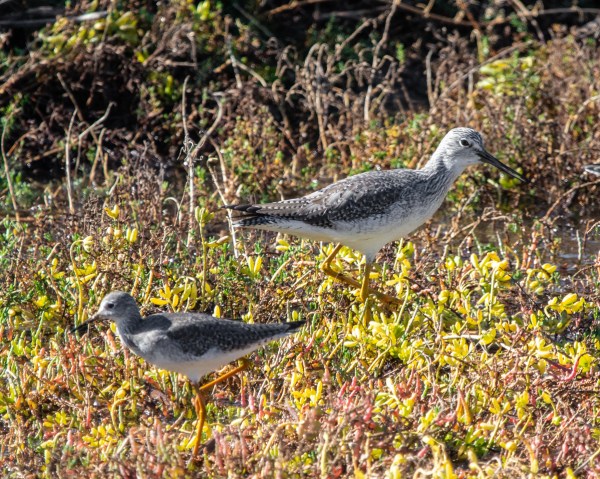
Lesser (L) & Greater (R) Yellowlegs on the pickleweed
(R. Juncosa, Upper Newport Bay 12-8-18)
Back Bay Newport (or Upper Newport Bay) can provide great birding when the tides are right. It’s a bit of a drive for us (see below) and the difficulty of finding a Saturday with a high tide often keeps us from going. This year, the full moon falls on Dec. 7, and the monthly high tide(s) are 6.6 ft. on both Dec. 6th & 7th. Our Saturday trip three days later gets a good high tide of +5.74 feet at 9:22 AM, giving us a good 90 minutes of rising tide. The rising tide will (we hope) bring shorebirds close to shore and flush the rails up out of the inundated reeds.
We hope to see Sora, Virginia Rail and Ridgway’s Rail, but we will of course keep our eyes open for Black Rail, which some of our chapter members swear on a stack of bibles (an as-yet-unverified claim) they have seen there. There should be plenty of ducks, grebes, waders, sandpipers, gulls, terns and skimmers on the bay and shore, raptors overhead and things in the brush. I saw my life Short-eared Owl here, decades ago, standing on a post among the reeds, so you never know what will be around. We will also search for the endangered California Gnatcatcher at one or two particular locations along the route.
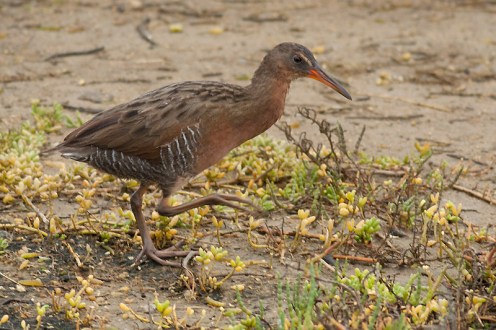
Ridgway’s Rail (Kirsten Wahlquist 10/11/14)
We’ll have lunch (so bring one!) probably at nearby & birdy San Joaquin freshwater marsh, and those who wish can do some more birding there. In 2017 we saw a Red-throated Pipit here, a Very Good Bird, and a Virginia Rail showed up recently. However, we will also make sure to look for anything around; they usually keep a nice stock of interesting birds on hand, scattered around the many birder-sized ponds. They keep a list of sightings outside the bookshop door, AND if you’re looking for a particular bird book (say…Field Guide to Galapagos Birds) they might have it. You could call them: 949-378-6501.
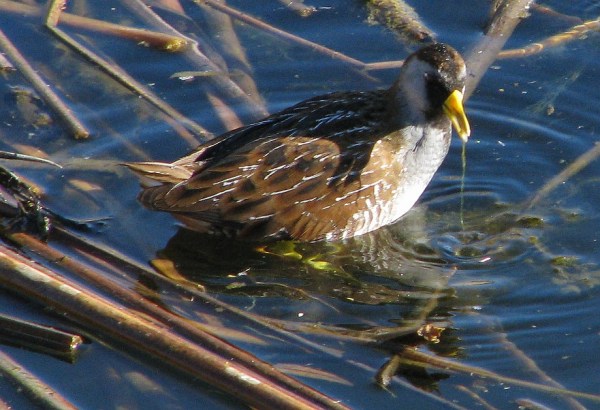
Sora (C. Almdale 11/09)
Family guide: We begin with a half-mile round-trip stroll on a bay-side bike path. After that we drive to a few more spots near Jamboree Rd., then to lunch. Morning temps. start cool. Dress in layers, weather may be cool.
For future reference: Link to tide chart.
Link to December 2019 report.
Driving Time: 50-60 minutes – 48 miles. While there are gas stations in the area (especially right where you get off the freeway) you could get hung up there while everyone else drives on the the next birding spot to find that uber-rariety. Don’t let this happen to you! Gas up in advance.
Carpooling Drivers & Riders: If you’re willing to drive others or ride with others, send me a reply including your contact info and approx. location and I’ll circulate it to any others similarly interested. If you’re riding, the polite thing is to get yourself to the driver’s starting location rather than try to get them to drive to your house to pick you up. They’re already in for a 2-4 hour drive time for the trip – don’t add to it. And riders should inquire of drivers about their masking requirements, if any.
Meeting time: 8 am, 10 December, 2022. Get there early and find California Gnatcatchers!
Sign-up Requested: No fee, but the leader wants to know who is coming. The drive is long: no signups, no trip.
Contact: Chuck, no later than Thursday 8 PM 8 December. email misclists [AT] verizon [DOT] net
Food: Bring munchies & liquids and/or lunch. No services next to the bay.
Directions: From the Santa Monica Fwy (I-10)Take San Diego Fwy (I-405) 46 miles south to CA-73. CA-73 south for 2.5 miles [Do not get onto I-55 Costa Mesa Fwy] and exit at CAMPUS DR / IRVINE AVE. Right on IRVINE AVE., drive southwest 1.1 miles, turn left onto not-terrifically-well-marked UNIVERSITY DRIVE (NOT Campus Drive or University Drive alongside the UC-Irvine campus, NOT, NOT!!!), and then turn right at the first driveway into the Upper Newport Bay Ecological Reserve parking lot. Write down these directions and look at the map linked to below!!! There are certain people who get themselves lost every year! You know who you are!
There’s good birding around the parking lot where you can walk around or use the bathroom in the nature center (accessible from outside on the bay side bottom floor). It doesn’t hurt to get there early.
Link to December 2019 report.
For coffee or snacks: There are several fast food places along one-way Bristol St. just past Irvine Ave. To get back to IRVINE AVE. go right on Birch or Cypress St, south to Orchard Dr., right on Orchard and back to Irvine Ave. where you turn left and drive about 1 mile southwest as described above Meet there. Allow at least 60 minutes travel time from Santa Monica.
Bathrooms in the interpretive Center open at 6am (entrance from outside, bayside, bottom floor).
Meet at 8:00 a.m. in the parking lot. Leaders: Chuck & Lillian Almdale.
Map to Meeting Place: Back Bay Newport – NW meeting area
Use + and – to zoom in or out, left click and mouse drag to reposition the map.
[Chuck Almdale]
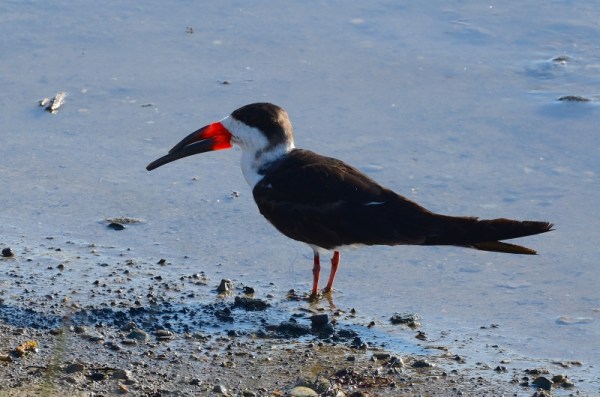
Black Skimmer with the giant schnozzola. (Grace Murayama)
Black-naped Pheasant-Pigeon Rediscovered after 140 years
[Posted by Chuck Almdale]
From American Bird Conservancy (ABC):
A team of scientists and conservationists has rediscovered the elusive Black-naped Pheasant-Pigeon, a large, ground-dwelling pigeon that only lives on Fergusson Island, a rugged island in the D’Entrecasteaux Archipelago off of eastern Papua New Guinea. Like other pheasant-pigeons, the Black-naped Pheasant-Pigeon has a broad and laterally compressed tail, which, along with its size, makes it closely resemble a pheasant. The bird has been observed several times over the years by local hunters, but the newly taken photographs and video are the first time the bird has been documented by scientists since 1882, when it was first described. Ornithologists know very little about the species, but believe that the population on Fergusson is very small and decreasing.
Voice: A loud. far-carrying “wu-huwoooooa” rising and falling in pitch before trailing off at the end.
Video from ABC
Link to ABC text report.
Link to IUCN Red List Edge of Extinction report on Black-naped Pheasant-Pigeon Otidiphaps insularis.
Link to Re:Wild Search for lost birds report on 10 missing species.
Other Text Reports
Audubon Society News
CNN Report
CBS News
BBC News
Nearshore flocks on Santa Monica Bay
[Posted by Chuck Almdale]
Winter is the season for nearshore flocks on Santa Monica Bay. By “nearshore” I mean 25-500 yards from the shore. While there are flocks of gulls, I’m primarily talking about sea ducks and grebes. There can be many flocks of either, numbering from a dozen to many thousands of birds. Many of these birds also occur in and near lagoons, channels, bays, harbors and rivers, where they’re usually closer and easier to see. A telescope is not absolutely essential for the (much) closer birds — only 98% essential. The information below is a very rough guide.
If you’ve never seen some of the birds listed below, the time to get out out and look for them begins now. The several western capes/points (e.g. Point Dume, Mugu Rock) can be good and whales occasionally pop up there, plus dolphins and seals. The several miles of beach around Dockweiler Beach often has the largest nearshore flocks, but parking is tricky. The beach directly in front of the Hyperion water treatment can have large beach flocks of many species, including Mew Gulls, which seem attracted to sewage facilities.
The impetus for this posting was the following comment from LACoBirds chatline, which linked to a couple of photos. Richard Barth is a very well-known and long-time LA area birder who frequently checks the nearshore flocks in season:
Thurs 17 Nov
This morning a Surf Scoter flock south of Grand Ave (El Segundo Beach) had a White-winged Scoter and two Black Scoters. Poor photos on my eBird post, I scrambled to get some grainy long shots. https://ebird.org/view/checklist/S122581435
Richard Barth, West Hollywood
Richard’s Photos below:
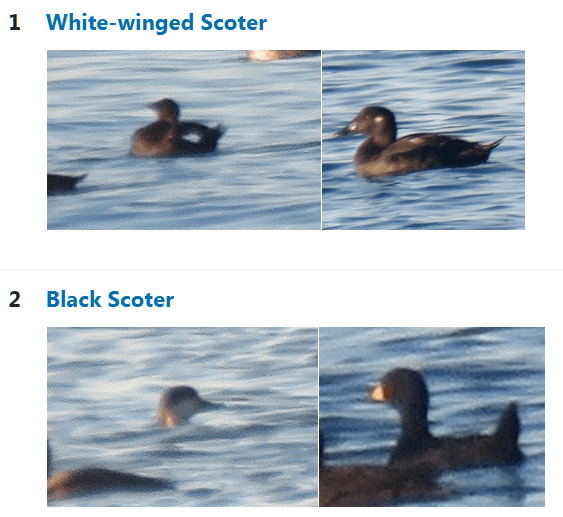
Scoter Ducks
As 99% of scoters will be Surf, what you’re really doing is scanning for those that aren’t. Learn their field marks ahead of time and/or carry a field guide.
Surf Scoter: The most common sea duck
Black Scoter: Roughly 0.1-3.0% of scoter flocks
White-winged Scoter: About the same as Black
Other Ducks
The few eiders & Long-tailed I’ve seen were in small “harbors”, such as Redondo Beach and Ventura.
Common Eider: Accidental on West Coast
King Eider: Accidental on West Coast
Long-tailed Duck: Rare
Harlequin Duck: Rare
Grebes
They can stay underwater for several minutes. Be prepared for them to suddenly pop up.
Western Grebe: Most common species by far in nearshore grebe flocks
Clark’s Grebe: About 1% of a Western Grebe flock will be Clark’s
Eared Grebe: On fresh & salt water; previously super-abundant on Salton Sea
Horned Grebe: Less common than Eared on fresh and salt water
Red-necked Grebe: Rare on SoCal coast, among westerns, likes bays, harbors, etc.
Pied-billed Grebe: Seen more often on brackish or salt water
Loons
Loons appear in small numbers nearshore. At Malibu they can be near the surf zone, very rarely in the lagoon. When feeding they dive a lot, can stay down several minutes, and may swim far underwater. Percentages below are for Surfrider Beach nearshore. They fly low to the water and constantly flap because they’re relatively heavy for their wing surface area.
Common Loon: 25%
Pacific: 60%
Red-throated Loon: 15%
Yellow-billed Loon: Rare; usually seen in bays or lakes.
Arctic Loon: Rare
Alcids
These tend to be farther offshore, where some flocks may be large, but they occasionally show up nearshore or in bays and harbors. All of them dive a lot and stay down for minutes, except when resting. You’re not likely to see any of them from the shore, but they are listed here in rough order of probability. They also fly low and constantly flap.
Common Murre
Pigeon Guillemot
Cassin’s Auklet
Rhinoceros Auklet
Marbled Murrelet
Scripp’s Murrelet
Guadalupe Murrelet
Shearwaters
All shearwaters “shear” the water, long glides between rows of waves, wingtips almost touching the water, rarely flapping; similarly-sized and shaped gulls flap a lot & fly higher.
Black-vented Shearwater: The most common close enough to shore to be at all visible; seasonal.
There are of course many other species out there flying around, diving and resting. This list is not intended to mention all possible birds.
[Posted by Chuck Almdale]

Great Egret captures a lizard (Ray Juncosa 2-28-16)
To all readers:
National Audubon Society has sent out another survey, this one for all Audubon members, and they give you until November 30 to fill it out, not just 9 days. They’re doing strategic planning and giving us all a opportunity to chime in on how we think the future ought to look.
The board of Santa Monica Bay Audubon Society thinks that the entire membership of Audubon chapters and National Audubon Society should have the opportunity—whatever their views—to take this survey and express their opinion.
Here is a link to the survey. There are 19 questions including name, email, chapter name and state. You get a chance to explain some of your responses with one-to-two sentence explanations.
The following is the email from NAS.
Dear Chapter Leaders,
When I had the opportunity to meet with many of you shortly after I started as CEO of the National Audubon Society, I heard that many local Chapters would like a deeper relationship with Audubon. I was heartened and inspired to hear this. I believe that birds, people, and the planet will benefit if we all rally around a shared vision.
Audubon has begun developing our next strategic plan, and I invite you and your Chapter to be part of its development. Our strategic plan will define the conservation impact Audubon aims to achieve, the main actions we will take, and the organizational culture we are building. I know the direction and decisions taken by Audubon can significantly impact the work of your Chapter, so I need to hear from you. I value your input.
From now through the end of the year, we are reaching out to all Chapters and Ambassadors online as well as holding virtual focus groups and interviews. I invite you to take 15 minutes to share your views here and to share this invitation with other members of your Chapter. This survey will remain open until November 30, 2022.
In the new year, we will invite your input again with a focus on the activities Audubon will undertake to implement the vision laid out in the strategic plan. Your feedback is very important. I hope you are able to take the survey and help us build a plan that positions Audubon to be an even stronger voice for birds, people, and the planet.
If you have any questions or suggestions about the strategic plan, please email the project team at sp2023@audubon.org.
Finally, thank you to those who recently shared your views regarding the Audubon name. We are now carefully considering the results of that feedback.
Warmly,
Elizabeth
—>
Elizabeth Gray, Ph.D.
Chief Executive Officer
Pronouns:Â she, her, hers
National Audubon Society
1200 18th St. NW, Suite 500
Washington, D.C. 20036
www.audubon.org
Zoom recording: Evolution of Feather Color in the Tanagers, with Dr. Allison Schultz
The recording of this program is now available.

|
Evolution of Feather Color in the Tanagers, with Dr. Allison Schultz.
Join Dr. Allison Schultz, Assistant Curator of Ornithology at the Natural History Museum of Los Angeles County, as she talks about the evolution of feather color in the largest family of birds – the tanagers. She will talk about why she is careful to use a bird’s visual perspective to study this important signaling trait, and how natural and sexual selection have shaped plumage color in males and females. She will end her talk by describing some of her current work on the mechanisms underlying the great diversity of colors in birds.

Be the first on your block to collect the entire set of White-cheeked Turacos.
Dr. Allison Shultz is Assistant Curator of the Ornithology Department at NHMLAC. With her research, she seeks to understand the evolution of bird diversity, focusing on two major areas: how birds are responding to human-caused environmental changes, and how and why bird colors evolve. Dr. Shultz is originally from Southern California, and was excited to get a job so close to home. She received her PhD from Harvard University, MS from San Diego State University, and BA from the University of California, Berkeley. In addition to her research, Dr. Shultz is passionate about increasing diversity, inclusion, access and equity in the sciences, and inspiring a love of nature in everyone. Dr. Schultz’s website.

Cherry-throated Tanager Nemosia rourei. Commonly found in one very small patch of forest in eastern Brazil . Source: Birds of the World



 SANTA MONICA BAY AUDUBON SOCIETY BLOG