Free email delivery
Please sign up for email delivery in the subscription area to the right.
No salesman will call, at least not from us. Maybe from someone else.
Ivory-billed Woodpecker still surviving in Louisiana? | Pre-print study plus film & additional comments
[Posted by Chuck Almdale]
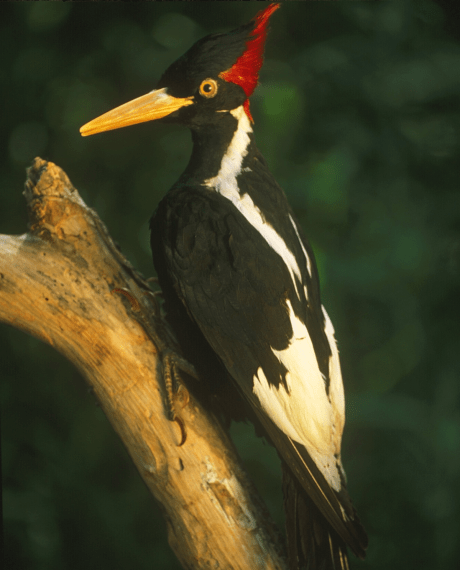
Below you will find a link to a not-yet-peer-reviewed pre-print of a study in Louisiana riverine swampland. The study by a consortium of agencies includes ten years of search effort. Hundreds of thousands of hours of trail camera photos, videos and drone photography were taken and examined. It makes for interesting reading, and includes photographs at the end, starting at page 26 (line 546). This link appeared on the nationwide chat line BirdChat.
Some comments and links from other birders posted to BirdChat over the following few days which are also of interest. They are at the bottom. Two articles and link to a video follow the quote from the study below.
From the paper, with permission from the lead author:
The phenotypically similar Pileated is one of the most unspecialized of the truly arboreal woodpeckers, while the Campephilus woodpeckers are characterized by pamprodactyly, a pedal morphology that enables the forward rotation of all four toes. The specialized modifications in the highly arboreal Ivory-billed Woodpecker are not so much in the structure of the toes as in the position of the legs. The feet are held outward from the body and are directed diagonally upward and sidewise, with both feet wide apart and more anterior relative to the body. Usually the angle between the tarsi and the horizontal plane is ≤45 ̊, and often seem to be pressed against the tree trunk. This is very different from the condition seen in most woodpeckers, as, for example, the Pileated Woodpecker, where the legs are held more or less beneath the pelvic girdle, the joints are fully flexed, and the tarsi are held well away from the tree trunk. This generally results also in a more obtuse angle of the intertarsal joint (where the leg bends between the tibiotarsus and the tarsometatarsus), and is evidence of the better scansorial adaptations of the Ivory-billed Woodpecker compared to the Pileated Woodpecker.
Multiple lines of evidence indicate survival of the Ivory-billed Woodpecker in Louisiana. Steven C. Latta, plus multiple authors and agencies.
This short article contains a 25-minute video that is well worth watching
Not Extinct After All: First ‘Widely Accepted Sighting’ of Ivory-Billed Woodpecker Since 1944
Eco-Watch | Cristen Hemingway Jaynes | 15 Apr 2022 | 2 Min read
Here’s a direct link to the 25-minute YouTube video mentioned above.
Another article on the recent paper.
Researchers claim to have sighted a bird not sighted since 1944
MIC.com | A.J. Dellinger | 13 Apr 2022 | 3 min read
Lead paragraph:
If you ask the U.S. Fish and Wildlife Service, the ivory-billed woodpecker is extinct. It’s been more than half a century since anyone has seen the iconic animal, which was last officially spotted in 1944. Extensive searches through the swamplands and forests of the southern U.S. that it was once known to occupy have come up empty, which led to the declaration that the bird was gone forever.
Not so fast.
Additional comments posted on BirdChat, in date/time order:
14 Apr 2022 07:25
The photos in the attached paper (from trail cameras) are hardly masterpieces but to my eye they are much more convincing than earlier purported evidence of surviving ivory-bills. If true (and let’s hope that it is) that means a small population survives near the Louisiana-Florida border. Note that this is a pre-print that has yet to be peer-reviewed.
https://www.biorxiv.org/content/10.1101/2022.04.06.487399v1.full.pdf
RO, Mississauga, ON, Canada
Thu, 14 Apr 2022 12:26
Very interesting. Agree the amount of white on folded wing is consistent with IBWO. Guess we need more and better evidence, but intriguing.
GM, Silver Spring, MD
14 Apr 2022 18:52
Much as I admire the continued search effort, the biorxiv preprint really only shows what seem to be blurry photos of Pileated Woodpecker, with the apparent white wing ‘saddle’ being attributable to incorrect interpretation of the position of the bird’s body in relation to the tree. There’s some images here https://twitter.com/docmartin2mc/status/1513873735488618506
A critique of the paper here
https://twitter.com/Alexander_Lees/status/1514555358919942146
and also a thoughtful thread about why the bird is inevitably extinct here
https://twitter.com/Alexander_Lees/status/1514290140365082631
JMC, Aberdeen, UK
17 Apr 2022
The authors are also relying on such things as leg position, so the white wing isn’t the only character they rely on. They also claim sight records and sound, so unless they are deliberately lying I would hope that their overall evidence is better than the photos in the paper. That said, I would agree that the evidence is inconclusive, though interesting.
RO, Mississauga, ON, Canada
[Posted by Chuck Almdale]
When a Giant Petrel attacks them, Emperor Penguin chicks stand together against it. Watch out for a cameo from a particularly feisty Adelie penguin! Preview from #SpyInTheSnow, out in the UK December 30th.
If no film or link appears in this email, go to the blog to view it by clicking on the blog title above. If the film stops & starts in an annoying manner, press pause (lower left double bars ||) to let it buffer and get ahead of you. [Chuck Almdale]
Ballona Freshwater Marsh | Safety Update #4 | LA Times
[Posted by Chuck Almdale]
But wait! There’s more! Unfortunately it doesn’t involve a super-spud-slicer. The three prior updates are: 7 Apr 2021, 11 Feb 2021 and 29 Jan 2021. Changes are afoot. Maybe.
If you recall from yesterday’s posting, there are hundreds [well…a lot, anyway] of RV’s in varying states of repair parked near the Ballona Freshwater Marsh, and it’s become unsafe and/or impossible to look at birds there, not to mention the accumulated trash and worse.
Due to the pandemic, people out-of-work, jobs and housing lost, the city stopped towing RV’s and/or telling their occupants to move. RV’s are all over town, not just in a few well-known areas of congregation. Here’s a guesstimate: In 90% of L.A. City you won’t have to drive more than ten minutes (maybe only five!) to find at least one such parked & occupied RV.

Los Angeles lifts moratorium on towing RVs, pledges to move problem campers
L.A. Times | Rachel Uranga & Ruben Vives | 7 Apr 2020 | 5 min read
From the article:
Hundreds of people living in recreational vehicles parked on Los Angeles streets have largely avoided towing thanks to a pandemic-era moratorium on impounding oversized vehicles used as homes.
But on Wednesday, the Los Angeles City Council voted to lift the moratorium amid growing complaints from residents who say some RV dwellers dump human waste on streets, use drugs and accumulate trash.
City officials say they will begin to enforce the regulation next month, prioritizing RVs and campers that are unregistered, inoperable or heavily damaged, as well as ones that interfere with construction, pose a safety hazard by blocking driveways or traffic or have had multiple responses from the Department of Sanitation. Officials will also resume towing cars that violate posted parking restrictions.
We’ll close with a not-uncommon denizen of the Ballona Freshwater Marsh, usually seen cruising low over the adjacent field.

Ballona Freshwater Marsh | Safety Update #3
[Posted by Chuck Almdale]
You can tell by the title that this is a continuing problem. The two prior updates are 11 Feb 2021 and 29 Jan 2021. Nothing good has happened since then.
There was a recent flurry of emails on our local county bird hot line LACoBirds. The pertinent ones are below, names changed to protect the annoyed.
Initial comment, Birder One, 4 Apr 2022, 3:22pm:
Those of you who visit (bird) Ballona Freshwater Marsh already know that the line of broken down RVs along Jefferson has gotten longer than ever. Today I drove by there and not only was there no parking anywhere for birders or casual (nonbirder) observers/tourists, but now tall plastic orange netting has been installed at the [gate] entrance [to the marsh] on Jefferson. I realize that birders aren’t supposed to enter that gate. I also realize that Loyola Marymount students and local residents routinely hike or jog [by passing through the gate] on the same dirt path where birders have gotten (trespassing) tickets.
At this point you cannot even bird the area while trying to do so legally (because you cannot park on Jefferson and stare in from the street), and if you parked somewhere else and walked over to the marsh you could encounter people who have mental health or substance abuse issues and aggressive dogs off leash (I have repeatedly experienced this).
Also, the unhoused citizens who live there on Jefferson spill a lot of solid and liquid waste onto the dirt walkway and yes, you can see trash inside the preserve from them. This is an environmental issue with plastics and organic liquids including radiator fluid entering the water and soil of a nature preserve.
There are no porta-potties anywhere. Where are the 200 to 300 people here going to the bathroom? I seriously doubt that the toilets in their RVs work. The City and County and the State have all neglected their obligations.
What are local Audubon chapters doing about this???
Birder two, 4 Apr 2022, 5:08pm:
This issue is very important to me. I am willing and able to help. We need to do something. This was my patch and quite frankly I have been intimidated away.

Birder three, 4 Apr 2022, 7:24pm:
I’ll take a crack at responding, and maybe others can chime in.
When I was first hired as a subcontractor to monitor the Ballona Freshwater Marsh (“BFM”) 20 years ago, it was obviously well prior to the explosion in outdoor encampments and RV camps across California. There was a brief debate as to who would manage BFM, and I felt at the time it was be a really bad idea to have Playa Vista manage the site, with the State of CA managing a contiguous Ecological Reserve over a split-rail fence. Why not just put it all under the State, managed as a whole, for nature? I was clearly outvoted (not that I actually ever had a say).
To sort out who can do anything about it, one needs to unpack what’s actually going on, if it’s actually illegal, who is responsible for enforcement, etc. Sure, local Audubon chapters can write op-eds or contact their local officials (as can you, or I), but ultimately, enforcement of encampments appears to be mediated by the city council district in which an encampment has formed. You may have read that Mike Bonin, who controls the area, came up with zero encampments recommended for remediation, even as other council members submitted hundreds of sites in their own districts. (No need to hash out that issue on this forum, just search it up.) But it explains why there’s no enforcement of the parking/living situation, the logic being that the RV residents are “home”, and that city can’t “evict” “residents” from “homes”.
As for the management of the site, I believe the BFM itself is managed by Playa Vista’s Ballona Wetlands Conservancy (set up years ago to manage BFM), but they really have no control over who parks their RV where – all they can do is constantly repair fences, clean up feces and needles, etc., which they have for years, as the problem gets worse and worse.
I recently wrote the director of local conservation group at Ballona urging them to pen an editorial in the L.A. Times about how the situation was truly intolerable, how precious wetland function and nature habitats were just getting degraded day after day, etc. I received what can only be described as a brush-off, told that help was coming. This was last fall, soon after four homeless men were shot there. Haven’t gotten around to writing it, but should.
[Birder One], I don’t know what the solution is at this point, I wish I did. Bonin isn’t running for re-election, so perhaps the new council member for the district will value nature. The pandemic restrictions are clearing. The L.A. Co. Sheriff recently announced more clean-ups of encampments where the city hasn’t been interested.
I’ll add that it is not safe to bird (my opinion), particularly to bird alone, and parking is best done across the street on Playa Vista property. I do think, however, that with community will and commitment by the city, it can recover – look at Harbor Park now vs. 20 years ago. BFM is truly a gem of a birding/bird site in the region, one of the best freshwater marsh habitats along the coast, home to many rare and declining species, and an unparalleled location to get people into birding. Though others have apparently done so, I won’t give up on it.
Birder One, 4 Apr 2022, 10:19pm:
We need to generate a list of an ad hoc committee of people (including me) who are angry about this.
I’m going to answer everybody else’s emails tomorrow after I get 8 hours of sleep.
I am heartened by [Birder Three]’s optimism and his example of the restoration of Harbor Park.
Birder Four, 6 Apr 2022, 3:16pm:
Obviously the situation at the Freshwater Marsh is far from ideal for the health of the ecological reserve, for accessibility by nature watchers, and for the RV residents themselves. I agree with [Birder Three]’s comments that things will get better as pandemic policies are slowly eased back. I also agree that it was unwise to leave the Freshwater Marsh out of the ecological reserve and will note that that policy could still be revised.
While I don’t want to disregard anyone’s perceptions about this situation, I do want to say that I ride my bike past the RVs quite often and just this morning stopped to photograph various water fowl in the seasonal wetland areas just south of Jefferson. I have also walked the portion of the FWM path that runs parallel to Lincoln and not had any issues. Each person will have their own comfort level at this area.
Finally, and perhaps most importantly, is that the bird watching community has been largely uninvolved in discussing the current and long-term management policies for the complex and very important greater Ballona Wetlands ecosystem. There are unused parking lots in the reserve that should not be there, extensive weeds that could be managed with basic stewardship, expensive habitat projects with no success criteria that aren’t yielding expected results, plans to bury one of the most iconic views of the wetlands (that is also existing nesting habitat for Belding’s Savannah Sparrow) under a new berm, plans to surround the salt pan with another engineered berm that would only extend the life of that critical habitat by a mere 10 years, little league baseball fields in the ecological reserve where elementary students are not allowed entry for ecological study or stewardship, etc. I would respectfully suggest that we have an obligation as a nature-focused community to worry more about long term impacts to wildlife habitats than on impacts to our personal bird watching experiences. I am happy to discuss the Ballona Wetlands with anyone who is interested off-line.

A Cornucopia of Collective Nouns of the Venery
[Posted by Chuck Almdale]
Collective nouns of the venery (“the hunt”) were created over many centuries, beginning in the 15th and continuing into the 21st century. These often used nouns are useful and fun to know. What birder hasn’t heard of “an exaltation of larks,” “a murder of crows” or “a parliament of owls.” They are obviously fun to invent as well, and “reams of paper” and “pots of ink” have been devoted to recording and keeping track of them.
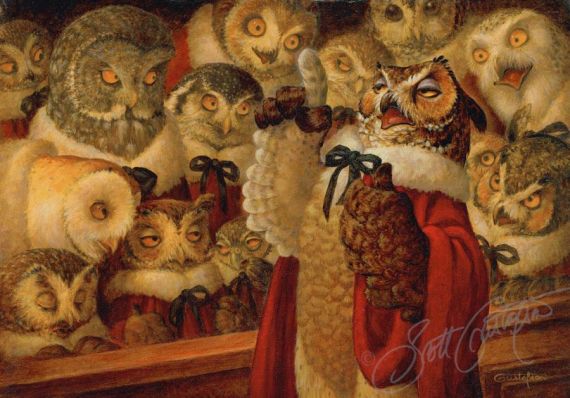
The forty collective nouns listed below are for the express delectation of our birding friends. These are the ones you will most enjoy knowing and the one you are most likely to use. Have fun! Sprinkle them into your next birding conversation and watch the faces of your companions light up with delight!
They were selected from a longer list of 934 collective nouns pertaining only to birds, which itself is a portion of a longer list of 7,305 collective nouns in categories ranging from Abstract Nouns to Viruses.

Should you be so inclined to peruse this largest compendium, you will find it here:
https://sites.miamioh.edu/meyersde/the-collective-noun-catalog/
However, if you wish only for the collective nouns pertaining to birds, we extracted them at great labour from the longer list. There are two lists, both arranged as is the list below, and downloadable copies in Adobe PDF are available for both.

List 1: 288 collective nouns of the venery for the period 1400-1614 CE; a double list, alphabetical by bird and by noun, sources given at end.
List 2: 934 collective nouns of the venery for the period 1400-2018 CE, a double list, alphabetical by bird and by noun, sources given at end.
Following are two tables of our forty selections, the first arranged in alphabetical sequence by bird name, the second arranged alphabetically by the collective noun. Following these tables are the written sources from whence they came.
| Alphabetical | First Use | |
| Sequence by Bird | Date | Source |
| A cegee of betterys | 1400s | 30 |
| A dyssymylacyon of bryddys | 1452 | 27 |
| A pype of chekynnysse | 1452 | 27 |
| A courerete of cootys | 1452 | 27 |
| A fflyȝt of coṝmeravnttys | 1400s | 30 |
| A mursher of crowys | 1452 | 27 |
| A badelynge of dokys | 1496 | 03 |
| A padelynge of dookysse | 1452 | 27 |
| A fflẏth of dowẏs | 1400s | 31 |
| A jye of ffesauntȝ | 1400s | 26 |
| A tremynge of goldefynchis | 1400s | 29 |
| A chermyng of goldfȳchys | 1400s | 28 |
| A fflyȝt of goshavkys | 1400s | 30 |
| A gagulle of gyse | 1400s | 30 |
| A brode of hennys | 1496 | 03 |
| A doppyng of herles | 1400s | 29 |
| A sege of heyrōnys | 1400s | 28 |
| An exsalttynge of larkys | 1400s | 30 |
| A desyte of lepewẏkes | 1400s | 31 |
| A fflusche of mallardys | 1452 | 27 |
| A waycche of nyghtynggalys | 1452 | 27 |
| A monstyr of pecockys | 1452 | 27 |
| A couy of pertrikkys | 1400s | 28 |
| A congregacon of plouerys | 1400s | 30 |
| A tygenes of pyes | 1586 | 14 |
| A bevee of quaylys | 1400s | 28 |
| A vnkyndenesse of rauons | 1400s | 29 |
| An onkyndenes of ravynnys | 1400s | 28 |
| A byldynge of rookys | 1400s | 30 |
| A walke of snyttys | 1400s | 30 |
| A hoste of sparowẏs | 1400s | 31 |
| An oste of sparrowys | 1452 | 27 |
| A mormeracyoii of staris | 1400s | 30 |
| A chaterẏng of starẏs | 1400s | 31 |
| A fflẏth of swaleus | 1400s | 31 |
| A turbe of teles | 1420 | 15 |
| A mutacyon of threstyllys | 1400s | 30 |
| A duell of turtylles | 1496 | 03 |
| A ffalle of woodeclckys | 1452 | 27 |
| A heerde of wrennys | 1400s | 29 |
| Alphabetical Sequence | First Use | |
| By Collective Noun | Date | Source |
| A badelynge of dokys | 1496 | 03 |
| A bevee of quaylys | 1400s | 28 |
| A brode of hennys | 1496 | 03 |
| A byldynge of rookys | 1400s | 30 |
| A cegee of betterys | 1400s | 30 |
| A chaterẏng of starẏs | 1400s | 31 |
| A chermyng of goldfȳchys | 1400s | 28 |
| A congregacon of plouerys | 1400s | 30 |
| A courerete of cootys | 1452 | 27 |
| A couy of pertrikkys | 1400s | 28 |
| A desyte of lepewẏkes | 1400s | 31 |
| A doppyng of herles | 1400s | 29 |
| A duell of turtylles | 1496 | 03 |
| A dyssymylacyon of bryddys | 1452 | 27 |
| An exsalttynge of larkys | 1400s | 30 |
| A ffalle of woodeclckys | 1452 | 27 |
| A fflusche of mallardys | 1452 | 27 |
| A fflyȝt of goshavkys | 1400s | 30 |
| A fflyȝt of coṝmeravnttys | 1400s | 30 |
| A fflẏth of dowẏs | 1400s | 31 |
| A fflẏth of swaleus | 1400s | 31 |
| A gagulle of gyse | 1400s | 30 |
| A heerde of wrennys | 1400s | 29 |
| A hoste of sparowẏs | 1400s | 31 |
| A jye of ffesauntȝ | 1400s | 26 |
| A monstyr of pecockys | 1452 | 27 |
| A mormeracyoii of staris | 1400s | 30 |
| A mursher of crowys | 1452 | 27 |
| A mutacyon of threstyllys | 1400s | 30 |
| An onkyndenes of ravynnys | 1400s | 28 |
| An oste of sparrowys | 1452 | 27 |
| A padelynge of dookysse | 1452 | 27 |
| A pype of chekynnysse | 1452 | 27 |
| A sege of heyrōnys | 1400s | 28 |
| A tremynge of goldefynchis | 1400s | 29 |
| A turbe of teles | 1420 | 15 |
| A tygenes of pyes | 1586 | 14 |
| A vnkyndenesse of rauons | 1400s | 29 |
| A walke of snyttys | 1400s | 30 |
| A waycche of nyghtynggalys | 1452 | 27 |
| Sources |
| 3. “The manere of hawkynge & huntynge: and also of diuysynge of Cote armours.” The Boke of Saint Albans. Wynkyn de Worde, 1496. Reproduced in Facsimile. 50-52. |
| 14. Berners, Dame Juliana (attrib). Hawking, Hunting, and Fishing, with the True Measures of Blowing. Newly Corrected and Amended. 1586. Printed by Edward Allde. |
| 15. Cambridge, Trinity College Library. Femina Manuscript. 1420. No. B.14. 40. Folio 88-89b. |
| 26. London, British Museum. Addl. Manuscript 33,994. 15th Century. Folio 26b. |
| 27. London, British Museum. Egerton Manuscript 1995. Circa 1452. Begins on folio 555. |
| 28. London, British Museum. Harley Manuscript 2340. 15th Century. Begins on folio 51a. |
| 29. London, British Museum. Harley Manuscript 541. 15th Century. Begins on folio 225a. |
| 30. London, British Museum. Porkington Manuscript 10. Begins on Folio 184a. |
| 31. London, British Museum. Robert of Gloucester Manuscript, College of Arms. 15th century. |



 SANTA MONICA BAY AUDUBON SOCIETY BLOG