Free email delivery
Please sign up for email delivery in the subscription area to the right.
No salesman will call, at least not from us. Maybe from someone else.
Native Plant Landscaping & urban wildlife | Noriko Smallwood study presentation on Zoom
[Posted by Chuck Almdale]
Doing this study during the middle of the Covid-19 pandemic was not easy for Noriko Smallwood, but determination and energy got her through. I know this first hand, as our yard was one of her many study sites. Occasionally we’d peek out our window and spot her skulking around, counting birds and insects, especially our enormous numbers of harmless hover flies and delightful small native bees.

The Influence of native plant landscaping on urban wildlife in Southern California residential yards
Noriko Smallwood and Dr. Eric Wood | LASMMCNPS website | 12 Oct 2021
Noriko begins her program about 7 minutes in, and Q&A follows at the end.
From her introduction to the Zoom presentation on the website of the Los Angeles/Santa Monica Mountains chapter of the California Native Plant Society:
For my master’s research, I quantified the importance of native yards to wildlife throughout L.A. by comparing birds and insects in 22 native and 22 paired non-native yards. Additionally, I investigated the drivers behind these patterns and identified particular plants that were used by birds in greater proportion than their availability, indicating preference. In this presentation, I will share the results of my study and will provide recommendations for wildlife-friendly landscaping.

Website of the Los Angeles/Santa Monica Mountains chapter of the California Native Plant Society
Now clean, oiled birds released | LA Times
[Posted by Chuck Almdale]
Following up on last week’s blog about oiled Western Snowy Plovers, Los Angeles Times reporter Robin Estrin describes more of the process and the final release back into the wild of an Eared Grebe and a Ruddy Duck.
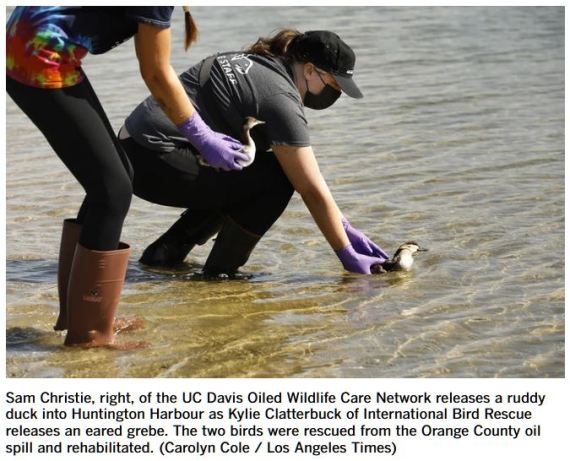
Cleansed of oil, birds harmed by Orange County spill take flight in Huntington Beach
Los Angeles Times | Robin Estrin | 14 Oct 2021 | 5 minute read
Excerpted from the article:
On Oct. 3, the first winged victim of the Orange County oil spill washed ashore in Newport Beach. Its white and light-brown feathers were caked with black crude. Cold, oily water had seeped through its down and onto its skin.
Ten days later, Sam Christie, a wildlife care specialist from the UC Davis Oiled Wildlife Care Network, lifted the bird — a ruddy duck — from a soft, blue box and placed it at the edge of Huntington Harbour. Healthy and cleaned of oil, it did as ducks do; it glided across the surface of the water, paddling its feet and bobbing its head. More…
Both Eared Grebes and Ruddy Ducks are regular wintering birds at Malibu Lagoon and elsewhere along the coast, freely associating with each other as they dive for fish in the deeper sections of the lagoon, especially near the Pacific Coast Highway bridge.
We have recorded Eared Grebes in every month except June, but 82% of the sighting are in Oct – Feb, when they are in their basic (plain) non-breeding plumage. The brightly colored adults in alternate plumage are mostly black and bronze, with bright golden bronze “ear” plumes, absent in winter. Unfortunately, they are mostly gone from the lagoon before this plumage appears, as are the Ruddy Ducks.
Ruddy Ducks are recorded in all months. However 98.2% of sightings are Nov-Apr, and 1.8% are May – Oct. We have no photos of either species in their brighter, breeding alternate plumage. In breeding the colorful males have bright blue bills. Both sexes have short, almost upright tails, and for this have long been known to hunters as “Stifftails.”

(Ray Juncosa 12/28/14)
The Arbornaut | Book Recommendation
[Posted by Chuck Almdale]
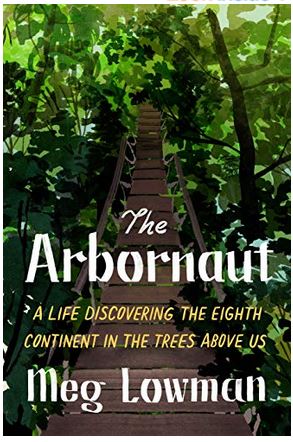
The Arbornaut, an adventurous autobiography by biologist Meg Lowman, is exactly what her subtitle suggests: A Life Discovering the Eighth Continent in the Trees Above Us. The short version of this recommendation is that everyone will find something to love in the book.
Inquisitive—but a little lonely—child. Plucky young woman. Budding scientist. A woman alone among domineering male scholars and the beer-drinking fellow students. The first person to study forestry who didn’t think in terms of board-feet or harvestable timber per acre, but did think about what might be going on in a tree higher than six feet above the ground. How to get safely into the canopy and move around. What was eating those leaves, and what does it do to the tree? Why are leaves in different parts of the canopy very different from one another. The enormous number of unknown insect species living in the forest canopy. Canopy walks, deforestation, sacred trees, fungal and insect pests, bio-blitzes, fire, tree thirst, global warming. She did it all, and much of it—using rock-climbing (or cave-descending) equipment to get into and around the forest canopy, and the creation of canopy trails—she invented and designed.
An interesting quote about coastal redwoods, one of her favorite trees:
And one last factoid discovered by arbornauts relates to the complex crowns of redwoods: the trees sprout new leaders (shoots at the branch tips) in the upper canopy after wind or storms have damaged the existing trunks. Such response to repeated weather conditions results in complicated masses of separate leaders, both living and dead, and massive amounts of detritus in the tree crotches where entire mini communities establish. One individual tree called Ilúvatar, named after a character from J.R.R. Tolkein’s The Hobbit and The Lord of the Rings, contains 220 different trunks branching in the crown, representing regrowth from fire or wind and comprising over 37,000 cubic yards of wood. Measured by Steve Sillett and colleagues, this tree is considered the most complex living organism on the planet, but only by climbing into its upper reaches were such structural wonders discovered.
The Arbornaut: A Life Discovering the Eighth Continent in the Trees Above Us
Meg, Lowman. Farrar, Straus & Giroux, New York, 2021. 337 pages
The publisher’s blurb:
“An eye-opening and enchanting book by one of our major scientist-explorers.” —Diane Ackerman, author of The Zookeeper’s Wife
Nicknamed the “Real-Life Lorax” by National Geographic, the biologist, botanist, and conservationist Meg Lowman—aka “CanopyMeg”—takes us on an adventure into the “eighth continent” of the world’s treetops, along her journey as a tree scientist, and into climate action
Welcome to the eighth continent!
As a graduate student exploring the rain forests of Australia, Meg Lowman realized that she couldn’t monitor her beloved leaves using any of the usual methods. So she put together a climbing kit: she sewed a harness from an old seat belt, gathered hundreds of feet of rope, and found a tool belt for her pencils and rulers. Up she went, into the trees.
Forty years later, Lowman remains one of the world’s foremost arbornauts, known as the “real-life Lorax.” She planned one of the first treetop walkways and helps create more of these bridges through the eighth continent all over the world.
With a voice as infectious in its enthusiasm as it is practical in its optimism, The Arbornaut chronicles Lowman’s irresistible story. From climbing solo hundreds of feet into the air in Australia’s rainforests to measuring tree growth in the northeastern United States, from searching the redwoods of the Pacific coast for new life to studying leaf eaters in Scotland’s Highlands, from conducting a BioBlitz in Malaysia to conservation planning in India and collaborating with priests to save Ethiopia’s last forests, Lowman launches us into the life and work of a field scientist, ecologist, and conservationist. She offers hope, specific plans, and recommendations for action; despite devastation across the world, through trees, we can still make an immediate and lasting impact against climate change.
A blend of memoir and fieldwork account, The Arbornaut gives us the chance to live among scientists and travel the world—even in a hot-air balloon! It is the engrossing, uplifting story of a nerdy tree climber—the only girl at the science fair—who becomes a giant inspiration, a groundbreaking, ground-defying field biologist, and a hero for trees everywhere.
Snowy Plovers cleaning up | LA Times
[Posted by Chuck Almdale]
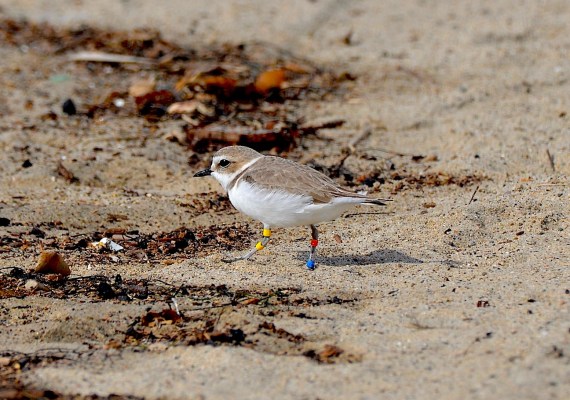
No, they didn’t make a killing in Vegas, they got oiled in the Orange County oil slick and friendly humans came to help. Los Angeles Times reporter Robin Estrin gives a very nice description of the process, as well as of other pertinent events. If you’ve never helped in this sort of rescue operation, or you are not yourself small and feathered and spend all your days and nights on the seashore, feeding and sleeping and running about, it’s interesting to know what is involved.
A Comeback disrupted
Snowy Plovers’ numbers have gone up, but spill is a new threat
Los Angeles Times | Robin Estrin | 9 Oct 2021 | 5 minute read
Excerpted from the article:
Once the plovers are stabilized, a trained professional will douse them in a special cleaning solution designed to break down the oil matting their feathers.
“Dawn, the dish detergent that we would typically use, is not quite enough to get this product off the animals,” said Sam Christie, a strike team leader with the Oiled Wildlife Care Network.
From there, the birds will be placed in a tub filled with warm water and a low concentration of dishwashing detergent. Agitating the solution allows it to penetrate the space beneath and through the bird’s feathers. Next, a Water Pik device is used to clean the bird’s sensitive areas — near the eyes, nose and mouth.
“As the tubs of water get oiled, we’ll move to the next tub,” Ziccardi said in an interview Monday. “Heavily, heavily oiled birds can take 15 to 20 tubs of this soapy water.”
After that, the soapy birds will be thoroughly rinsed with specialized nozzles using water pressure anywhere from 20 to 50 pounds per square inch.
The plovers will eventually be placed under a drier, where they can preen and align their feathers. Experts will then open their beaks and massage a soft rubber tube down their esophagus for a feeding. Once stabilized, they’ll move to outdoor pools where they will remain until they are healthy enough to return to a natural, oil-free environment.
The Oiled Wildlife Care Network has a 50% to 75% success rate in returning oiled animals back into a clean environment, Ziccardi said….
In case you have not heard of the Oiled Wildlife Care Network, here’s a few links.
Their blog, headquartered at University of California at Davis.
https://owcn.vetmed.ucdavis.edu/
OWCN Contact Page
https://owcn.vetmed.ucdavis.edu/about/contact
Pipeline P00547 Incident Wildlife Report | How You Can Help
If local residents to the spill site see oiled wildlife, please call 1-877-UCD-OWCN (823-6926) and report immediately. DO NOT PICK UP OILED WILDLIFE.
OWCN Blog: https://owcnblog.wordpress.com/
Their blog posting from 9 Oct 2021
Pipeline P00517 Incident: Reflections from the ICP
A short excerpt from an informative article:
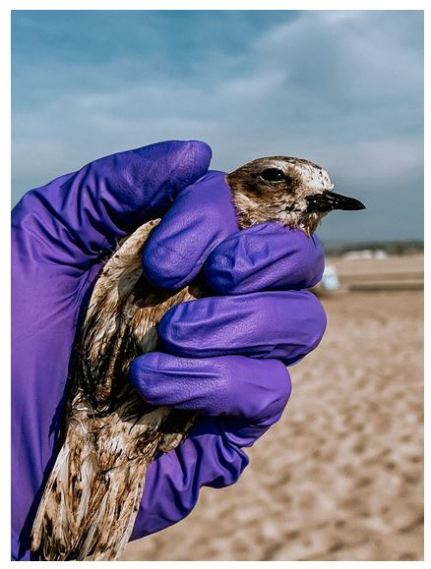
The wildlife response for the Pipeline P00547 Incident (name just flows off the tongue, doesn’t it?) is going very well to date. We currently have more than 50 responders on site – doing extensive recovery (from Long Beach Harbor down to Oceanside), field stabilization at the Wetlands and Wildlife Care Center in Huntington Beach, and primary care at the Los Angeles Oiled Bird Care and Education Center (home to International Bird Rescue). Overall, as of yesterday, we have had more than 80 overall responders from 14 of our 44 Member Organizations involved in the effort. Absolutely amazing, and makes me so proud of all we have collectively developed to respond quickly and in a coordinated fashion anywhere oil may be oiled!
As of yesterday, we have collected 26 live birds and 17 dead – a much lower number than we feared based on the initial volume estimates. There are a number of possible reasons for this: time of year resulting in fewer animals at risk, lower actual released oil than was initially thought, etc. What is ABSOLUTELY certain, however, is that it isn’t due to a lack of search effort! More…
Migratory songbirds flying high
[Posted by Chuck Almdale]
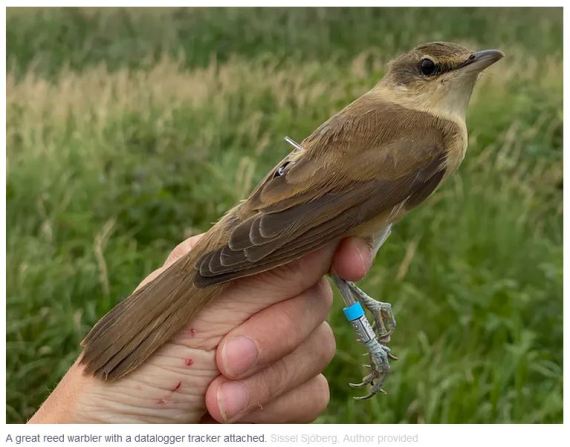
Most birders have read that migrating Bar-headed Geese fly over the Himalayas on their migratory way from India to Siberia, and then again on the return flight. They’ve even been seen from the top of Mt. Everest, overhead, presumably honking away as geese tend to do while in migratory flight. But they’re not the only high-flyers. Follow the links below to learn about others.
Migratory songbirds climb to extreme altitudes during daytime
Lund University | ScienceDaily | 7 May 2021 | 5 min read
From the article:
Great reed warblers normally migrate by night during its month-long migration from northern Europe to Sub-Saharan Africa. However, researchers have now discovered that during the few occasions when it continues to fly during daytime, it flies at extremely high altitudes (up to 6300 meters). One possible explanation for this unexpected and consistent behaviour could be that the birds want to avoid overheating. The study is published in Science.
Migratory birds found to be flying much higher than expected – new research
The Conversation | Sissel Sjöberg | 13 Sep 2021 | 8 minute read
From the article:
During crossings of the Mediterranean Sea and the Sahara Desert, the great reed warblers sometimes prolong their night flights either for a few hours into the following day, or for the full day and next night, lasting up to 35 hours.
Great snipes, meanwhile, are waders weighing about 200g and breed in the mountains of northern Sweden. An international team of researchers led by Åke Lindström at Lund have been tracking these birds for the last decade. Studies have revealed that great snipes have developed a migratory strategy where most of the 6,000km journey to their wintering ranges in sub-Saharan Africa is performed in one long non-stop flight, lasting 60-90 hours.



 SANTA MONICA BAY AUDUBON SOCIETY BLOG