Free email delivery
Please sign up for email delivery in the subscription area to the right.
No salesman will call, at least not from us. Maybe from someone else.
MassAudubon Photo Contests | 10 years
[Posted by Chuck Almdale]
Massachusetts Audubon Society, founded in 1896, steward of 38,000 acres, 20 wildlife centers and 35 sanctuaries, independent of National Audubon Society since inception, has run photo contests since 2011. They’ve received untold numbers of submissions, and you can view the best ones here.
Photographers of all ages and levels of skill! Know what you’re up against!
This year’s contest for photos taken within Massachusetts, closes 30 Sep, 2021.
This page also has photography tips and resources:
- How to take a winning photo
- The subtle art of image composition
Contest winners for 2020
Contest winners for 2011-2019

What is a “Stint”?
[Posted by Chuck Almdale]
After we found the Red-necked Stint last month and posted about it, a few readers asked why some sandpipers are called “stints” and others in the same genus of Calidris are not. Good question, for which I had no certain answer.
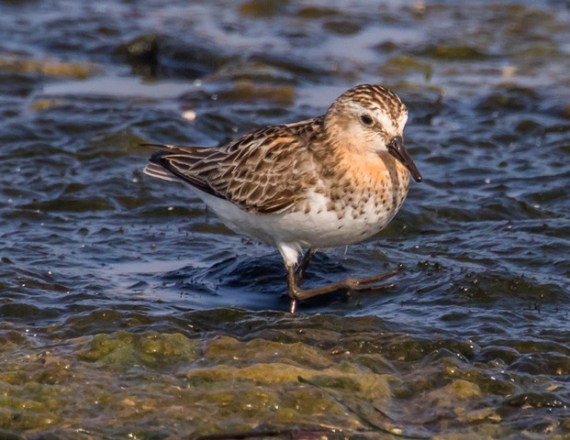
It seemed likely to be because all four species of “stints”—Little, Long-toed, Temminck’s and Red-necked—at 6.0-6.25” long, are among the very smallest of sandpipers. “Stint” probably shares etymological roots with “stinting,” “stunted,” “stingy,” all of which relate to being short, small, scant, limited, confined, underdeveloped, frugal or penny-pinchingly miserly.
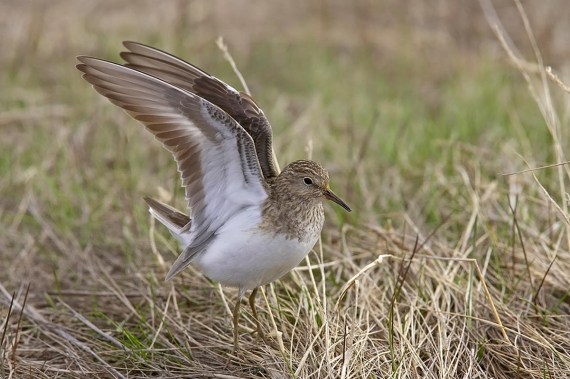
Our Least Sandpiper, Calidris minutilla, at 13-15 cm. long, and 17-33 grams, is supposedly the smallest of the sandpipers, hence the name “Least.” But the Little Stint Calidris minuta, at 12-14 cm. long, is overlappingly shorter, although they weigh 17-44 grams, ranging slightly bulkier. It’s almost a toss-up whether the Least or the Little is the least of the lot.
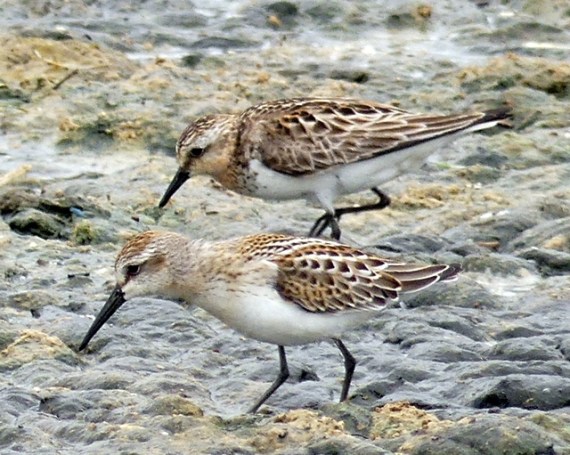
So why isn’t the “Least Sandpiper” the “Least Stint?” A few of the other calidrids could also qualify as stints, the 6.25″ Semipalmated Sandpiper for certain and possibly the 6.5″ Western Sandpiper. But they’re called sandpipers, not stints. Why?
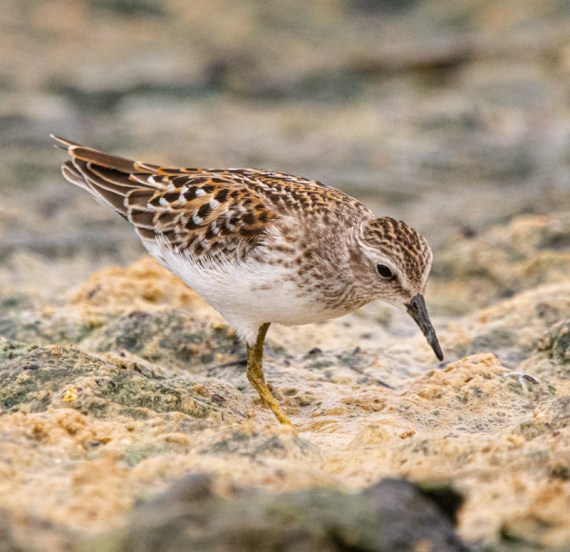
It’s due to range, really. The four stints are all Eurasian birds. Only the Red-necked Stint regularly breeds in North America, in far far far northwestern Alaska, on the Seward Peninsula and at Pt. Barrow. No one knew about that little detail centuries ago when these names were being concocted.
The Least, Semipalmated and Western Sandpipers are all New World birds, very rarely seen anywhere in Eurasia. Presumably, by the time explorers and biologists got around to naming New World birds, the then-centuries-old British name “stint” seemed inappropriate, old-fashioned, perhaps archaic, perhaps too “generic,” so they stuck with sandpiper as the generic name. They’re all sandpipers, including the stints.
The Red-necked Stints breeding in Alaska occasionally get their geomagnetic wires crossed and fly southeast for the winter, passing through California and—once, at least—Malibu Lagoon. Normally they fly southwest and spend the winter in Australasia, alongside a million other stints.
In case you’re wondering, besides the seven stint/sandpipers I’ve named so far, there are eleven more species in the genus Calidris: Great Knot C. tenuirostris, Red Knot C. canutus, Sanderling C. alba, White-rumped Sandpiper C. fuscicollis, Baird’s Sanpiper C. bairdii, Pectoral Sandpiper C. melanotos, Sharp-tailed Sandpiper C. acuminata, Curlew Sandpiper, C. Ferruginea, Purple Sandpiper C. maritima, Rock Sandpiper C. ptilocnemis, Dunlin C. alpina.
I discovered there is an Oxford Dictionary of British Bird Names, written by W.B. Lockwood, first published in 1984, and ordered a copy. My paperback version arrived ending at page 174 at the entry for Yowlring, with the following four pages ripped out. They may have been blank. Or not.
Request to all: If anyone has this book, are there additional entries following Yowlring? If so, could you send me a copy of them? Or if anyone knows any British birders, will you ask them about it? I’d greatly appreciate it.

I’ll end with the fascinating entry for Stint, fresh from my new book.
A rather widespread term for the Dunlin, also for the Sanderling and, indiscriminately, for any Sandpiper. It occurs along the east coast from Northumberland to Suffolk, as well as in Sussex, making its debut in 1472 ‘Styntis’, the present spelling first in 1622. A corruption is seen in STENT, recorded in 1579, and apparently also in the peculiar form SNENT quoted as a name used in Berwicks. Etymologically, stint is allied to stunt, giving a basic sense of small or stunted creature.
The name STINT has passed into the standard nomenclature in the term LITTLE STINT.
Reference to cognates in related languages helps us to understand more clearly the semantic evolution of this name. In Danish and Swedish dialects, stint is a term loosely applied to various species of small fish. In (originally Low) German Stint this general sense has been narrowed to a point whee it has come to denote one small species only, namely the Smelt. In English, this very old word evidently developed in such a way that it became associated with birds, to be later restricted to small waders and sometimes to an individual species, as Dunlin or Sanderling.
The birds in question with their long, strong bills bear a close resemblance to the Snipes, hence such local Dunlin names as SEA SNIPE, common in the north and in Scotland, or LITTLE SNIPE, heard in Yorkshire (Swaledale), further Gloucestershire SAND SNIPE, with which compare the [Common] Sandpiper named SUMMER SNIPE.
So “stint” was a generic term for the really small sandpipers. For everyday use for everyone except the most persnickety proto-biologist, all those little sandpipers were interchangeable and of little use to anyone. “Stint” was sufficient, much like LBJ (Little Brown Job) is sufficient today—even for birders who are supposed to care about these matters—for any unidentified small brown bird ducking into a bush.
Note: Handbook of the Birds of the World, Vol. 3 came in handy for the above information pertaining to size, weight, etc.
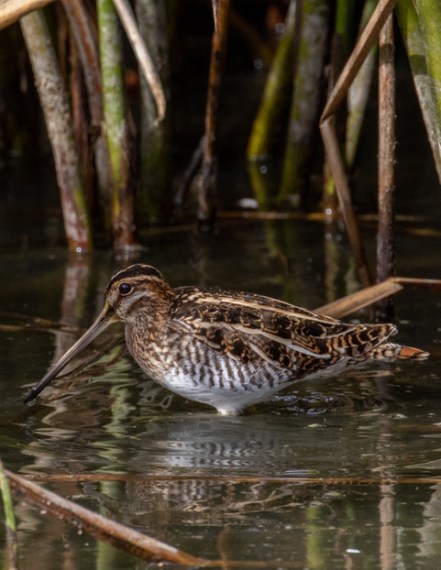
Definitely not a stint, although technically a sandpiper
Coastal Cleanup Day & Month
[Posted by Chuck Almdale]
Due to the pandemic, SMBAS is not sponsoring a cleanup day at Malibu Lagoon, as we have done for the past twenty years (or thereabouts).
Coastal Cleanup is still happening in a somewhat different form than usual, as there is still a particular day—Saturday, 18 Sep 2021—that is officially the day, but it’s also going on all September, in a do-it-yourself fashion.
For the Sat. 18 Sep 2021 info go to Heal The Bay:
https://www.eventbrite.com/e/coastal-cleanup-day-2021-tickets-168157582857
For the September all-month info, also go to Heal The Bay:
https://healthebay.org/coastalcleanupmonth/

California Native Plant Society meeting & news | Monday. Act Now.
[Posted by Chuck Almdale, submitted by Grace Murayama]
The South Coast Chapter of the California Native Plant Society has a meeting & program tomorrow, Monday 13 Sep 2021.
PROGRAM: PLANT FOR BIRDS: USING NATIVE CALIFORNIA PLANTS TO CREATE HABITAT AT HOME
Speaker: Scot Pipkin
For many of us, gardens are more than places to grow food or pretty flowers. If we want to create rich, diverse, and resilient habitats in our yards and communities, we have to start with the appropriate native plants. They provide an opportunity to attract a variety of local wildlife and cultivate healthy natural systems. One of the best indicators of a successful habitat garden is the bird life it attracts. In this talk, we will look at the important role native plants play in providing our local birds with the food, shelter, and nesting materials necessary for survival. We will also examine how the use of native plants and fundamental design principles can contribute to a sense of sanctuary and well-being for the people in our garden spaces. Taking a deep dive into the major food groups birds need (fruits, seeds, insects, and nectar), Scot will talk about native California species that are readily available and will be sure to enhance the habitat quality of your garden.
MEETING LOCATION
This meeting is via Zoom
Join Zoom Meeting by following this link:
https://cnps-org.zoom.us/j/92487485027?pwd=dnZtaUNrSktPbVQxRW5wTWVFSHNJQT09
Or use the meeting ID and password below at https://zoom.us/
Meeting ID: 924 8748 5027
Passcode: 955573
One tap mobile
+16699009128,,92487485027#,,,,*955573# US (San Jose)
+13462487799,,92487485027#,,,,*955573# US (Houston)
One tap mobile +16699009128,,92487485027# US (San Jose)
The meeting starts at 7:30, but gathering at 7:20 or so is recommended.
Link to sccnps: https://sccnps.org/
Giant plant sale of ordinary-sized plants!
They are having a plant sale Sept 14-26. Order online and schedule your pickup day & time. Read the details, including a frighteningly long list of available plants, on the SCCNPS website.
Go to: https://sccnps.org/
A Birder’s Eye View | Art at the Getty
[Posted by Chuck Almdale]
Cindy Hardin is one of SMBAS’s long-term members. She’s very active in nature education for schoolchildren and has managed the Environmental Education Program at Ballona for over a decade. She writes for various blogs, such as “What if we had a field trip and nobody could attend?,” a problem all active birders now worry about. Her 2013 article on The Tongva, co-written with Jane Beseda, is perennially one of the top five postings on our SMBAS blog and seems to be the schoolchildren’s Google go-to article on our local First Americans.
Recently she was interviewed by Erin Migdol for the Getty Museum blog.
A Birdwatcher’s Eye View
Seeing the feathered members of our collection through an expert’s eyes
The Getty Museum | Erin Migdol | 9 Sep 2021 | 4 min read

From the article:
As artistic styles and attitudes towards nature have evolved, so have works of art that depict birds—from medieval manuscripts featuring imaginary winged creatures to photographs that take a scientist’s eye to a variety of avian species.
But how would a birdwatcher—someone who observes birds in the wild and is intimately familiar with their true personalities and habitats—react to artists’ representations of birds?



 SANTA MONICA BAY AUDUBON SOCIETY BLOG