Identifying Red-crowned & Lilac-crowned Parrots in Southern California
[Posted by Chuck Almdale]
Just to place some of our locally introduced parrots into a wider frame of space and time, we’ll begin with the major split in the evolution of birds that occurred a mere 55 million years ago. The evolutionary line which led to the enormous Songbird order of Passeriformes (6595 species in 143 families) split from the line which led to the Parrot order of Psittaciformes, making these two orders (of the 41 avian orders) each other’s closest relatives. Their next closest relatives are the Falconiformes (Falcons, 65 species in one family which does not include Hawks, Eagles and Osprey) and the little-known Cariamiformes (Seriemas, two long-legged species in one family) of southern South America. Over the period 32-22 million years ago the Psittacids (or Psittacines) slowly split into four families: Strigopidae (New Zealand Parrots, 4 species), Cacatuidae (Cockatoos, 22 species), Psittaculidae (Old World Parrots, 202 species), and Psittacidae (New World and African Parrots, 177 species).
Some useful avian diversification cladograms:
Origin and Diversification of birds: https://ars.els-cdn.com/content/image/1-s2.0-S0960982215009458-gr6_lrg.jpg
What are the Parrots and Where Did They Come From?: https://content.ucpress.edu/chapters/9930.ch01.pdf
Earth History and the Passerine Radiation: https://www.ncbi.nlm.nih.gov/pmc/articles/PMC6475423/figure/fig01/
Amazona Parrots
In the Psittacidae line, new genera and species continued to appear, eventually bringing us to the 37 genera and 177 species we know of today. The largest Psittacid genus is Amazona with 32 species. This genus is widespread throughout the new world, ranging from the Rio Grand Valley of Texas, throughout Central America, the Caribbean Islands and South America to Peru, southeast Bolivia and northern Argentina. It’s very difficult to find an area in this region where Amazona parrots don’t occur.
As this genus can be found from roughly 30°N to 30°S of the equator, which includes all of the New World tropical rainforest, for rapid identification purposes it’s very handy to know that they share a distinctive manner of flight, uncommon outside their genus: they fly with fast shallow wing beats, wings rising and falling about 45° or less from the horizontal. Any parrot flying like that in SoCal (and probably throughout their range) will be an Amazona. They also have blunt tails. Any Psittacid in SoCal with a long pointed tail is one of the species of parakeet (or rarely a much-larger Macaw). Most, if not all, Psittacid species are very social and call constantly to each other while they fly. They are far less vocal when resting or feeding in trees.
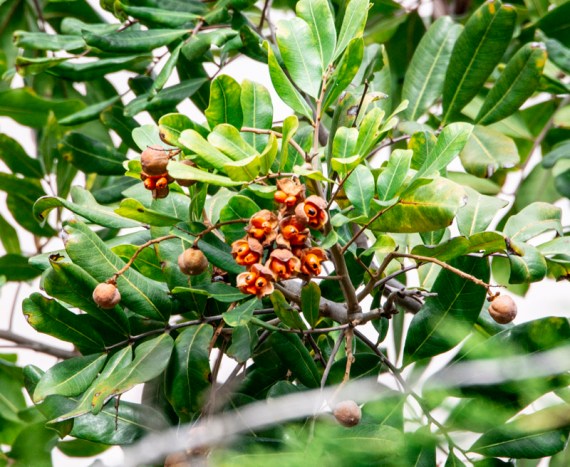
The photo below shows the sort of thing Amazona parrots (and perhaps parrots in general) like to eat in the SoCal area. The parrot photos at the bottom of this article were taken while the birds fed in this particular Cupianopsis (Carrotwood) tree.

In the northernmost portion of their natural range – central to Northern Mexico – there are four Amazona species. Lilac-crowned Parrot Amazona finschi ranges from Oaxaca and along the western coast to the mountains of southeastern Sonora to 200 miles south of the Arizona border. White-fronted Parrot Amazona albafrons overlaps the Lilac-crowned, ranging from southern Sonora 160 miles south of Arizona down to central Costa Rica. In eastern Mexico the Red-crowned Parrot Amazona viridigenalis ranges from coastal Veracruz north to Monterrey, only 60 miles south of the Texas border. It’s close relative the Red-lored Parrot Amazona autumnalis overlaps this range, and is found from the Rio Grand Valley of Texas south to northern Brazil and Ecuador.
From Birds of the World:
Molecular phylogenetic studies using DNA sequence data as well as genomic data from ultra-conserved elements (UCEs) have shown that the Lilac-crowned Parrot Amazona finschi and the Red-crowned Parrot Amazona viridigenalis form a sister relationship with strong support. Together, these two species appear to be sister to Red-lored Parrot Amazona autumnalis with this clade in turn sister to a small group of Amazona parrots from South America and the Lesser Antilles in the Caribbean. White-fronted Parrot Amazona albafrons is member of a clade found from Yucatan eastward through the Greater Antilles to Puerto Rico.
Giving an indication of just how closely these Amazona species are related, in SoCal the Red-crowned Amazon A. viridigenalis has hybridized with Lilac-crowned A. finschi, Yellow-headed A. oratrix, and Red-lored A. autumnalis. If these hybrids are themselves capable of reproducing and we were strictly following the biological definition of species, these species would all be considered subspecies of one wider-ranging as-yet-unnamed-and-undescribed species.
Parrots in SoCal
Here in Southern California the organization FLAPP (Free-flying Los Angeles Parrot Project) has recorded 37 species of Psittacids living wild in SoCal. Their information comes through iNaturalist and always includes a photo. According to the Zoom presentation by Brenda Ramirez, the most abundantly reported Psittacid is the Red-crowned Parrot (2864 observations) followed distantly by Mitered Parrot Psittacara mitratus (963 observations), Nanday Parakeet Aratinga nenday (766 observations), Lilac-crowned Parrot (583), all the way down to eight species – including several Macaws – each seen one time only.
According to the original Parrot Project website (see their chart), of the thirteen most common species of parrot in SoCal, six are in the Amazona genus: Red-crowned A. viridigenalis, Lilac-crowned A. finschi, Red-lored A. autumnalis, Blue(now Turquoise)-fronted A. aestiva, Yellow-headed A. oratrix and White-fronted Amazona albafrons. As they are all in the same genus they look much the same both while perched or in flight.
Link to Zoom Recording: Red and Lilac-crowned Parrots in SoCal, with Brenda Ramirez
Because the closely-related and hybridizing Red-crowned and Lilac-crowned Parrots are the first and fourth most commonly sighted parrots in SoCal, FLAPP prepared some identification cards specifically for them, and kindly gave me copies to include in this posting.


Additional information on the thirteen-most commonly seen Psittacids is available from the California Parrot Project: http://www.californiaparrotproject.org/id_guide.html
Following are some photos on which to hone your identification skills.
All photos below are by Ray Juncosa, June, 2019, Santa Monica Area.
Identification key at bottom.

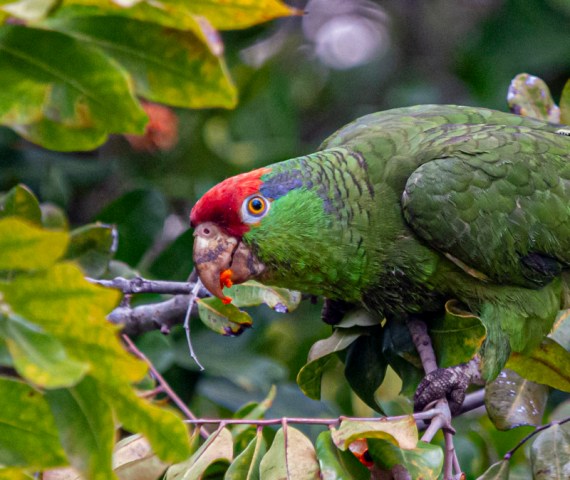


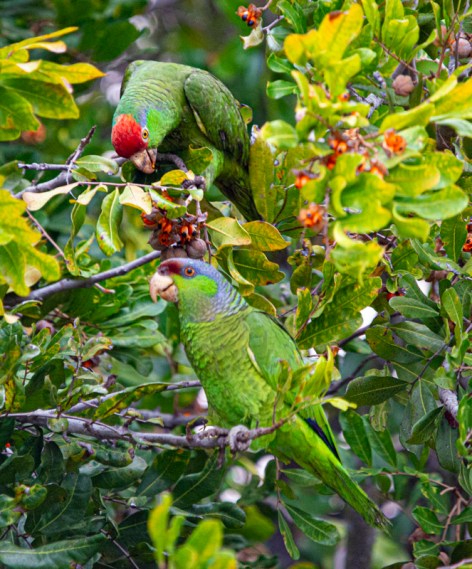

Photo Key:
Lilac-crowned Parrot: 1, 3, 5, 7
Red-crowned Parrot: 2
Both, Red-crowned above, Lilac-crowned below: 4, 6
Discover more from SANTA MONICA BAY AUDUBON SOCIETY BLOG
Subscribe to get the latest posts sent to your email.



 SANTA MONICA BAY AUDUBON SOCIETY BLOG
This is utterly fantastic! Thank you Chuck ! I must save it and read it a few more times. And …by the way, which one is the parrot in San Francisco. From the short film “the parrots of Telegraph Hill. I should know of course. it looks most like the red crowned parrot.
LikeLike
Emily:
According to Wikipedia: “The flock is composed primarily of cherry-headed conures, but there is one lonely blue-crowned conure.”
I’ll add: AKA Red-headed Conure or Red-masked Parakeet (Psittacara erythrogenys) native to Ecuador & Peru. Their pointy tails give them away as parakeets.
CVA
LikeLike