The Controversy over Changing Eponymous Bird Names — Documents
[Posted by Chuck Almdale]
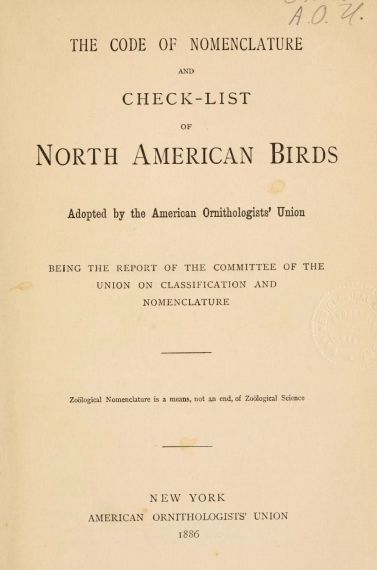
We might as well start at the beginning.
Document 1. The following citation is from The Code of Nomenclature and Check-List of North American Birds, Adopted by the American Ornithologist’s Union, Being The Report Of The Committee Of The Union On Classification and Nomenclature, published 1886; pages 20-21; Chapter II, Principles, Canons and Recommendations; Section A, General Principles; Principle V (Link).
In my opinion, it argues for conservatism combined with the “law of priority” when it comes to the changing of names, due to the desirability of “fixity of names in Zoology.” The function of the name is to label, not define or describe.
PRINCIPLE V. A name is only a name, having no meaning until invested with one by being used as the handle of a fact; and the meaning of a name so used, in zoological nomenclature, does not depend upon its signification in any other connection.
REMARKS. The bearing of this principle upon the much desired fixity of names in Zoology, and its tendency to check those confusing changes which are too often made upon philological grounds, or for reasons of ease, elegance, or what not, may be best illustrated by the following quotation: – “It being admitted on all hands that words are only the conventional signs of ideas, it is evident that language can only attain its end effectually by being permanently established and generally recognized. This consideration ought, it would seem, to have checked those who are continually attempting to subvert the established language of zoology by substituting terms of their own coinage. But, forgetting the true nature of language, they persist in confounding the name of a species or [other] group with its definition; and because the former often falls short of the fulness of expression found in the latter, they cancel it without hesitation, and introduce some new term which appears to them more characteristic, but which is utterly unknown to the science, and is therefore devoid of any authority.1 If these persons were to object to such names of men as Long, Little, Armstrong, Golightly, etc., in cases where they fail to apply to the individuals who bear them, or should complain of the names Gough, Lawrence, or Harvey, that they were devoid of meaning, and should hence propose to change them for more characteristic appellations, they would not act more unphilosophically or inconsiderately than they do in the case before us ; for, in truth, it matters not in the least by what conventional sound we agree to designate an individual object, provided the sign to be employed be stamped with such an authority as will suffice to make it pass current.” (B. A. Code, 1842.)
These words, which in the original lead up to the consideration of the ‘law of priority,’ seem equally sound and pertinent in connection with the above principle of wider scope.1 “Linnaeus says on this subject: ‘Abstinendum ab hac innovatione quae nunquam cessaret, quin indies aptiora detegerentur ad infinitum.'” [Google Translation: ‘We must refrain from this innovation, which would never cease, unless more suitable ones were discovered to infinity.'”]
That was a long, but necessary quotation. The founders of the AOU did not want Zoological names changed willy-nilly, in accordance with the latest fashion, lest – as Linnaeus wrote – “more suitable ones were discovered to infinity.” They were talking about scientific names in Latin (or Modern Latin), but in recent years, the accepted English names have been far more stable than Latin scientific names (reference Van Remsen #27 page 13, below) due to the onslaught of DNA research-based discoveries. The use, and usefulness, of English bird names by the lay public who are not professional ornithologists, has vastly surpassed the usage of scientific names.
Fast forward 138 years.
The following documents and their links will be accompanied by comments and/or quotes of varying lengths, as appropriate, to give you the flavor of the contents. The quotes are not intended to replace the originals and all interested parties should read all the documents. They are, however, not all equally importance nor of equal interest.
List of twenty-eight additional documents.
Scroll farther down for notes, quotes and a few comments
on these documents
Document 2. 18 Sep 2018: AOS Classification Committee – North and Middle America.
Document 3. 16 Nov 2018: Blogsite – Birding New Jersey, by Rick Wright: The Official English Names of North American Birds.
Document 4. 23 Jun 2019: Blogsite – 10,000 Birds: Rename All Birds Named After White People.
Document 5. October 2019: AOS – NACC: Guidelines for English Bird Names.
Document 6. 2 Jun 2020: AOS: Message From AOS President and The Diversity & Inclusion Committee.
Document 7. 22 Jun 2020: Website – Bird Names For Birds (BN4B): “Nomenclatural changes for a more welcoming ornithology” letter/petition to AOS to change eponymous English bird names.
Document 8. 8 Jul 2020: AOS: What’s in a name? More than you might think…
Document 9. 4 Aug 2020: Washington Post – Opinion: The stench of colonialism mars these bird names. They must be changed, by Gabriel Foley & Jordan Rutter.
Document 10. 8 Aug 2020: Website – Why Evolution is True: “First they came for the bird names. . .” Woke craziness creeps into bird taxonomy.
Document 11. 17 Aug 2020: Website – Bird Names for Birds: The Close of the Bird Names for Birds Petition and End of NAOC 2020.
Document 12. No Date: Website – Bird Names for Birds: Frequently Asked Questions (FAQ’s). What about Latin scientific names? Are you proposing to change those too?
Document 13. 1 Apr 2021: AOS: Introducing the AOS English Bird Names Blog.
Document 14. 16 Apr 2021: AOS – YouTube Video: Community Congress on English Bird Names.
Document 15. 8 Jun 2021: AOS: What’s next for English bird names?
List of AOS Presidents & President-elects 2015-2024 & Election Protocol
Document 16. 23 Sep 2021: AOS: English Bird Names: Working to Get It Right.
Document 17. 3 Oct 2023: AOS: American Ornithological Society Council Statement on English Bird Names.
Document 18. 1 Nov 2023: AOS PDF file: Ad Hoc English Bird Names Committee Recommendations for Council of the American Ornithological Society.
Document 19. 1 Nov 2023: AOS web-friendly version: Ad Hoc English Bird Names Committee Recommendations for Council of the American Ornithological Society.
Document 20. 1 Nov 2023: AOS: American Ornithological Society Will Change the English Names of Bird Species Named After People.
Document 21. 1 Nov 2023: South American Classification Committee (SACC), website based at Louisiana State University (LSU): SACC disaffiliates with AOS.
Document 22. 28 Nov 2023: R.K. Hopper petition thru Change.Org: Petition to AOS Leadership on the Recent Decision to Change all Eponymous Bird Names.
Document 23. December 2023: J.V. Remsen, Jr., LSU, SACC founder and leader: Comments to AOS Council from J. V. Remsen (Chair and founder, South American Classification Committee, and member since 1984 of North American Classification Committee).
Document 24. 6 Feb 2024: R.K. Hopper petition thru Change.Org: An Open Letter to AOS Leadership.
Document 25. 1 Mar 2024: R.K. Hopper petition thru Change.Org: The Petition Has Been Submitted.
Document 26. 4 April 2024: 231 AOS Fellows to AOS leadership: Resolution for a Moratorium on Changing Nonharmful Eponymous English Bird Names.
Document 27. 24 Apr 2024: J.V. Remsen, Jr., LSU, SACC founder and member, 26 page expansion of his Dec. 2023 critique:: Critique of the Ad Hoc English Bird Names Committee Recommendations for Council of the American Ornithological Society.
Document 28. 13 May 2024: AOS website confirms that SACC disaffiliated with AOS and affiliated with International Ornithological Union (#1 above): AOS Pilot Project to Change Harmful English Common Bird Names.
Document 29. 15 May 2024: R.K. Hopper’s petition thru Change.org: Response to the Petition from the American Ornithological Society, Colleen M. Handel, President. Reply to Hopper’s petition from the AOS.
Some useful acronyms:
AOU – American Ornithological Union; merged with Cooper Ornithological Society in 2016 to become the AOS.
AOS – American Ornithological Society; successor to AOU; research, nomenclature, taxonomy, meetings; you can join for $90/year or less.
BN4B – Bird Names for Birds; a group favoring Decolonialism and elimination of eponymous bird names.
IOU – International Ornithologist’s Union; promoting ornithology and updating a world checklist.
LSU – Louisiana State University; heavily involved in Central/South American ornithology for many decades
NACC – North America Classification Committee; taxonomy & nomenclature
SACC – South America Classification Committee; taxonomy & nomenclature
WGAC – Working Groups Avian Checklists; groups affiliated with IOU
Document 2. 18 Sep 2018: AOS Classification Committee – North and Middle America. This is a PDF document of 17 taxonomy and/or nomenclature proposals. It contained no comments, just the proposals themselves. Pg 25, Change the English name of McCown’s Longspur Rhynchophanes mccownii, proposal written 23 May 2018, submitted by Robert Driver (link to Driver & Bond’s July 2021 paper “Towards redressing inaccurate, offensive and inappropriate common bird names.”) This proposal is biased and inaccurately depicts events.
“John P. McCown did not intentionally collect the longspur, nor was he an ornithologist.” Inaccurate. McCown was an amateur ornithologist (professional ornithologists did not yet exist as degrees in ornithology nowhere existed), and was intentionally seeking interesting specimens. Collection could be done only by “firing at” birds. McCown recognized the bird as interesting (which takes experience and knowledge), potentially new to science, and sent it to George Lawrence [Lawrence’s Goldfinch] who identified it as new and named it after McCown.
“John P. McCown, previously of the U.S. Army, joined the Confederacy and fought for the right of states to preserve slavery.” Inaccurate and biased and tarring with a wide brush, making me wonder who’s perpetuating the Civil War more, the North or the South. McCown, his family and his entire region in Tennessee did not hold slaves. Most soldiers of both sides fought in our “War Between the States” because their state joined in. Most fought in units created by and named for their states. The loyalty of most Americans was to their state where their family and friends lived. Significant loyalty to the nation whose capital was weeks away in Washington, was uncommon. Thus the Southern quandary: you cannot be simultaneously loyal to your state and to the nation; loyalty to one was treason to the other and you must choose. Tennessee joined the Confederacy and McCown followed. One of the forces he led was within the “Army of Tennessee.” It was the “War Between the States” until the early 20th century, then changed to “Civil War” by act of Congress. After war’s end individual loyalty to the nation slowly evolved, encouraged by immigrants who came to America, not to a particular state. Even today, should secessions reoccur, many Americans might fret over their divided loyalties.
“All races and ethnicities should be able to conduct future research on any bird without feeling excluded, uncomfortable, or shame when they hear or say the name of the bird.” The existence of Americans who might feel “excluded” is postulated, not supported by evidence. There may well be no such people, in which case changing names to mollify them is a performance lacking a purpose.
Document 3. 16 Nov 2018: Blogsite – Birding New Jersey, by Rick Wright: The Official English Names of North American Birds.
“Giving the birds their official labels, applying the official names to the things in front of us, is quite simply what birding is in post-Griscom American culture.”
“Zoölogical nomenclature is a means, not and end, to Zoölogical Science [citing the1886 AOU principles]
“The past several years have seen more and more formal proposals submitted to the committee urging the alteration of English names…proposals supported with arguments ranging from the more or less cogent to the downright silly….[they] all take time and attention away from the real work of the committee, the assessment of evolutionary relationships and the alignment of scientific nomenclature to reflect those relationships.”
“…while all can agree that there is nothing essentially McCownian about the longspur…this proposal may finally be what breaks the seventy-year hold of the AOS on the English names of North American birds, freeing field guide authors, birders, even normal seagull watchers to make wise and informed decisions about what they want to call their birds.”
Document 4. 23 Jun 2019: Blogsite – 10,000 Birds: Rename All Birds Named After White People; written by an unnamed guest in favor of changing all eponymous bird names. A few examples of the pertinent and sometimes hilarious reader’s comments:
1. “One question to ask is: Who gave the AOS the authority to name our birds?”
2. “This seems to me something that has to be assessed on a case-by-case basis and written up into a proposal such as that for the McCown’s Longspur.”
3. “We should take our lead from sports stadiums – go out for sponsorship deals and raise big bucks for conservation. The Burger Kinglet. The Taco Bell’s Vireo. The Citibank Swallow.”
4. “Renaming hundreds if not thousands of birds is a great idea, and it’s nice to know that the present political climate of social and environmental tolerance has given us the leisure time to sit back, relax, and spend all this energy writing about the need to gratuitously change English bird names rather than engage in more pressing issues.”
5. “It gets worse. With the recent sordid news about MLK, King Eider and King Rail have to go. King Penguin too, if our jurisdiction extends that far. Also, who will be in charge of purging Latin names?”
6. “The biggest load of claptrap I ever read.”
7. “America is not the only country to colonize with violence. History back to ancient times is full of war and slavery. Conquerers [sic] from Europe, the Middle East. Slaves built the Egyptian Pyramids. Should those be torn down?”
8. “There are actually birds named for dead Japanese aristocrats and imperialists, too… One notable example is the Mikado Pheasant (Syrmaticus mikado) from Taiwan, named in 1905 after Emperor Mutsuhito, the emperor of Japan.”
Document 5. October 2019: AOS – NACC: Guidelines for English Bird Names: The AOS reiterates their naming guidelines, and very soon thereafter begins ignoring them.
English names for species are developed and maintained in keeping with the following guidelines, which are used when forming English names for new or recently split species and when considering proposals to change established names for previously known species.
Stability of English names. The NACC recognizes that there are substantial benefits to nomenclatural stability and that long-established English names should only be changed after careful deliberation and for good cause. As detailed in AOU (1983), NACC policy is to “retain well established names for well-known and widely distributed species, even if the group name or a modifier is not precisely accurate, universally appropriate, or descriptively the best possible.” The NACC has long interpreted this policy as a caution against the ever-present temptation to ‘improve’ well-established English names and this remains an important principle. In practice, this means that proposals to the NACC advocating a change to a long-established English name must present a strongly compelling, well-researched, and balanced rationale.
Name change procedures. The NACC process of considering an English name change is the same as for other nomenclatural topics. NACC deliberations are proposal-based, and the committee welcomes proposals from interested members of the professional and non-professional ornithological communities.
Special Considerations
1. Eponyms. At present, 142 English names of NACC bird species are eponyms. The NACC recognizes that some eponyms refer to individuals or cultures who held beliefs or engaged in actions that would be considered offensive or unethical by present-day standards. These situations create a need for criteria to evaluate whether a long-established eponym is sufficiently harmful by association to warrant its change. After substantial deliberation and consultation, the NACC has adopted the following guidelines:
1.1 The NACC will change well-established eponyms only in unusual circumstances, but these situations may occur. The NACC recognizes that many individuals for whom birds are named were products of their times and cultures, and that this creates a gradient of disconnection between their actions and beliefs and our present-day mores. By itself, affiliation with a now-discredited historical movement or group is likely not sufficient for the NACC to change a long-established eponym.
“Sufficiently harmful” as in “#1 Eponyms” above became a very quickly moving target thereafter, as this doctrine took hold: “We can never say or write anything now that anyone anywhere thinks might annoy anyone, anywhere at anytime in the unlimited future.” Comments were apparently not allowed and none appear.
Document 6. 2 Jun 2020: AOS: Message From AOS President and The Diversity & Inclusion Committee. AOS president Kathy Martin and the D&I Committee of the AOS plunge fully into the Social Justice pool. Will this move help fulfill their stated mission of “Advancing scientific knowledge and conservation of birds?”
As a professional Society, we must embrace the path forward: through self-education about implicit bias; by adhering proactively to our policies on diversity and inclusion; by continually enforcing a culture of inclusion and awareness; and by being vigilant within and beyond our Society for acts of discrimination, bias, and aggression.
Here are some resources and actions you can take today [two of the eight listed]:
“How to Be an Antiracist,” a book by Ibram X. Kendi
“Decolonize your Mind”, another great reading list
The first book suggestion is a controversial, widely-cited and widely-condemned polemic. The second introduces the concept of Decolonization to the AOS membership. Politicization and polarization sets in. Comments were permitted but none were posted.
Document 7. 22 Jun 2020: Website – Bird Names For Birds (BN4B): “Nomenclatural changes for a more welcoming ornithology“. A letter/petition to AOS to change eponymous English bird names. Far less vituperative than their later Washington Post opinion piece (document #9 below). Cites DEI initiatives, removal of statues, banning the Confederate flag, free AOS memberships to Black ornithologists, changing name of Oldsquaw to Long-tailed Duck, McCown’s Longspur. In reference to the AOS not-yet-approval of changing McCown’s Longspur name, they write:
Last year, a proposal to remove the eponymous “McCown”, a Confederate officer, from McCown’s Longspur was rejected. In its place, Special Considerations were created to guide the NACC’s future decision-making regarding eponymous, derogatory, or offensive names. Quite frankly, these considerations are inadequate if the AOS intends on participating in reducing the impacts of colonialism, white privilege, and racism.
Exactly how changing the name of a 6″ bird, an obscure resident of our central plains, will result in “reducing the impacts of colonialism, white privilege, and racism,” is never explained by anyone, anywhere. There may have been AOS member comments, but none appear.
Document 8. 8 Jul 2020: AOS: What’s in a name? More than you might think… The AOS continues to dive deeper into EDI & Decolonialism, sounding more like a political party than a scientific organization charged with taxonomy, nomenclature, research and “Advancing scientific knowledge and conservation of birds.”
“AOS leaders, including the NACC and Diversity and Inclusion Committees are working together to develop Society-level policies in our nomenclature, and to be intentional in all our activities to ensure all individuals feel welcome in our Society. We will discuss these issues at our 2020 meetings of Council and make a statement at the end of the NAOC VII meeting. We hope you will join us in our journey”. – Kathy Martin, President, AOS
“The American Ornithological Society (AOS) is committed to anti-racism and addressing systemic racism. In recent weeks, we’ve been both thrilled and overwhelmed by the attention building around avian nomenclature. The outpouring of sentiment around how science, and in particular ornithology, has historically constructed its nomenclature (including a public petition asking AOS to address the issue of English bird names that are considered derogatory, offensive, or harmful) has highlighted the need to address potential relics of systemic oppression.“
“…but the collective mission remains the same: AOS is committed to advancing the scientific knowledge and conservation of birds. In support of our mission, we want to think carefully about what the future of ornithology looks like, and act on those thoughts with sincere intention. It’s up to us—all of us—to create this future. To this end, the NACC and AOS Diversity and Inclusion Committee are working together to develop policies that will establish criteria when relevant to social reform, and promote engagement between the NACC and members of the AOS community at large. We at the AOS strive to mirror the diversity and inclusivity we observe in the natural world, and to which we all belong, in our policies, actions, and initiatives at all levels of our Society.”
AOS member comments were permitted, three were posted:
1. “Delighted to see this response, and genuinely proud to be a member of the AOS today. Let’s move forward, together!”
2. “This is politically correct nonsense of the highest order. This self-righteousness alienates a lot of people and is a complete waste of time….Don’t the committees have more serious things to do like habitat preservation and fighting the attack on conservation laws by the current administration?
3. “Although your goal to get rid of offensive names is honorable, trying to be politically correct is an impossible task. Political views change over time. Please leave the names as they were originally described. Our birds and their names have a history which we should try to maintain. Please do not undo the history….The political correctness can go on for ever. But the historical names should remain stable. Include all the diverse groups and cultures who want to join us and contribute to our cause but leave history alone.”
Document 9. 4 Aug 2020: Washington Post – Opinion: The stench of colonialism mars these bird names. They must be changed, by Gabriel Foley & Jordan Rutter. The title alone of this first attack on avian eponyms published by a newspaper (to my knowledge) shows that Decolonialism is the real topic, not science or bird names. The text is more of the same, with added venom. [Note: the linked URL above doesn’t always get you past the WaPo paywall.] Don’t miss the 727 reader’s comments; here are portions of the first five:
1.”This is what happens when people are in Covid lockdown for too long.”
2. “This opinion editorial is shallow and silly. Foley/Rutter are doing a disservice to natural science and the rules of taxonomic nomenclature.”
3. “You are out of your mind. This is a ridiculous article…”
4. “The Baltimore Oriole name should immediately be changed to Lewis Oriole, after John Lewis, civil rights icon.”
5. “Possibly the most absurd article I’ve read in the last 5 years. Unless, possibly, it was intended as a joke.”
Document 10. 8 Aug 2020: Website – Why Evolution is True: “First they came for the bird names. . .” Woke craziness creeps into bird taxonomy. Website of Jerry Coyne, with over 30,000 readers; evolutionary biologist, professor emeritus at University of Chicago, author of “Why Evolution Is True” (2009) and Fellow of the Committee for Skeptical Inquiry. It was this article that alerted me to the name-changing movement. His first three paragraphs:
The latest gambit of Woke politics is to trawl back through everyone’s history, and, if you find something unsavory, that person must be canceled. Now sometimes this is okay, as when statues are taken down that honored Confederates, particularly postbellum statues meant to solidify the established system of segregation. (I’d prefer, however, that those statues be left in place with a prominent caveat.)
But when you do that with scientific names, it causes a problem. Sometimes a “problematic” person is part of a species’ name, either the common name like Audubon’s shearwater (Puffinus lherminieri), or both the common name and the Latin binomial, like these birds: Audubon’s warbler (Setophaga auduboni), Townsend’s warbler (Setophaga townsendi), Hammond’s flycatcher (Empidonax hammondii) , and McCown’s longspur (Rhynchophanes mccownii). These names confer instant communication between birders and other biologists, and the Latin binomials are entrenched in the literature and can’t be changed without a taxonomic revision that shows why the name is somehow taxonomically incorrect (the species might, for example, have been previously described under another name).I used these names because, in a new op-ed in the Washington Post, two birders have proposed canceling at least the common names of the species given above (and of course why not the Latin names?), for they’re named after people who did bad things in the past. (The authors are described as “ornithologists and birders who created the website Bird Names for Birds.”)
This posting alerted tens of thousands – roughly ten times the membership of AOS – of science-oriented readers from end to end of the political spectrum. It was the first of many posts by Coyne on this and related subjects.
Document 11. No Date: Website – Bird Names for Birds: Frequently Asked Questions (FAQ’s).
“What about Latin scientific names? Are you proposing to change those too?
BN4B is currently focused on English common bird names.”
This made some of their readers believe that scientific names are next on the BN4B “To Do” list.
The Bird Names for Birds websites heavily implies that changing the scientific names is their ultimate goal. This will actually cause far less disruption of literature and communication issue if it ever happens.
— Forum.Inaturalist – Nov 2023 Link to comment
Finally, I expect that they will come for the Latin eponyms. From the FAQ, emphasis mine: “BN4B is currently focused on English common bird names.” Yet the calls to upend all biological taxonomy over this hysteria are already out there (see, for example, this link), and will only grow more strident, now that there is blood in the water. I certainly hope I am wrong, but I don’t think I am.
— Website – Legally Blind Birding link to comment
The above blog received 45 reader’s comments, many worth reading. The blogger actually gives thoughtful replies to many of the comments, something almost unheard-of in the blogosphere.
One of the big advantages of English names is that they do not change as frequently as scientific names. From the 7th edition of AOU Checklist (1998) to 2023, either the genus or species name changed for 143 (18%) of the 782 species, i.e., 5 times more frequently than the rate of change of English names, so in that sense it is the English names that serve as anchors, not the scientific names. This was documented and pointed out to the AOS Council in July 2023, but was not mentioned in the final EBNCR.
— Van Remsen. 24 Apr 2024, comment 2.16 from Document #27 below
Remsen supports the claim greater stability of English over scientific names in recent years with numbers.
Document 12. 17 Aug 2020: Website – Bird Names for Birds: The Close of the Bird Names for Birds Petition and End of NAOC 2020. The AOS took longer to decide on the BN4B petition to get rid of all the eponymous bird names that they’d originally thought they would take, although it doesn’t appear to have been a “deadline,” just an expectation.
“The Bird Names for Birds (BNFB) letter-turned-petion officially timed out per the deadline of the end of the North American Ornithological Conference (NAOC)….AOS publicly committed to making a future announcement about this issue by the end of NAOC (August 15, 2020). Despite passing this deadline, no announcement has been made.”
“…says Alex Holt of Bird Names for Birds…“At an absolute minimum, we would have hoped to have begun an open and frank discussion around the deeply troubling history that these eponyms bind the field of study to. Until ornithology is willing to confront and deal with the (often very literal) skeletons in its closet, it will be off putting and unwelcoming to talented people from underrepresented backgrounds who would greatly enhance the study and understanding of birds.”
“It seems obvious that the NACC should be restructured in a way that separates the taxonomy from the nomenclature.”
“I’m very happy that we have one less eponym (McCown’s Longspur) on the North American checklist. However, I am concerned that AOS and others see this as an endpoint, rather than a first step…Why is the most important feature of a bird, the one we choose to use to define the bird itself, that some person once saw it? Eponyms are problematic on multiple levels, and I am disappointed that AOS hasn’t made a statement specifically addressing the issues we are raising.”
“Eponyms are problematic on multiple levels…” The overuse of the typically unsupported epithet “problematic” is itself problematic. Through such usage it has become little more than the informal cognitive fallacy of appeal to emotion used as an insult and of pejorative value only.
Document 13. 1 Apr 2021: AOS: Introducing the AOS English Bird Names Blog. I have been a member of the “broader ornithological and birding communities” for over 40 years, and as a blog editor I read more on birding matters than the average birder, but I never heard of any of the AOS opinion-outreach activities they describe in this blog. Here’s some selected quotes:
“Eponymous English bird names have been front and center in our minds these past months….the AOS is unequivocally committed to finding collaborative solutions that promote inclusivity in ornithology and birding.”
“Our process has centered on working with the broader ornithological and birding communities to discuss the next steps forward. This strategy, with a universal and inclusive design in mind, requires an initial understanding of how diverse stakeholders within the ornithological and birding communities feel about the call to change eponymous names.”
“In these sessions, the D&I Committee asked for stakeholders’ thoughts on the philosophy of names, the issues to be considered when changing them, and the effects of bird-name changes on key issues including research, recreation, management, and the publication of field guides.”
“We’ll use this blog to update our members and the broader community about the work of our nomenclature committees and ongoing progress by the Society regarding English bird names.”
This blog permitted AOS member comments; there were five, shortened below:
1. “I detest eponyms and honorifics. Please give descriptive names to birds. Don’t name them after people! Thanks.”
2. Why only descriptive names [as replacements]? What about birds named for often inappropriate places (Nashville, Cape May, Carolina, Philadelphia….Purely descriptive names are boring and often misleading (e. g. Gray-tailed Tattler when BOTH tattlers have gray tails)….Wandering Tattler tells you nothing of help in recognizing the bird when you see it, but it’s a marvelous name nevertheless. I happen to like some eponyms…(Lewis’s Woodpecker, Clark’s Nutcracker) because they teach us history and context. Gray-collared Woodpecker and Gray Nutcracker just don’t do it for me….why not rename all those states…cities, towns, and counties named for people? Wouldn’t THAT be helpful?
3. Will ridding North America of eponymous common bird names actually cause any great uptake in birding by people….I question whether there really are many people who would like to go birding but don’t because of eponyms…..given that there is no intention to change scientific names, then eponyms will still be there…in every bird book that everyone opens. So surely, the folks that feel offended by eponyms will continue to be so, making the whole exercise a bit pointless?
4. I don’t know why the AOS has a committee on Diversity and Inclusion in the first place. Its statement “that continuing to use harmful English names in ornithology unfairly demands tolerance from already marginalized people, creating an unnecessary barrier to the field of ornithology with clear downstream effects felt at multiple levels of our ornithological community” could be a parody of earnest sophomores in the Political Science Department.
5. Renaming all birds named after people is a lot of chasing rainbows for no real practical purpose, in my view. Also, there is no end to this. Where would you stop, as he so aptly points out?….Even some…descriptive names…such as red-bellied woodpecker…red-naped woodpecker and common yellowthroat…[do not] really help anyone ID the bird. Would it not be better to just leave common names alone rather than totally upsetting the apple cart and make all the bird guides obsolete and have everyone learn new names for a hundred-plus birds? It seems there are a lot more important issues to face, including things that would really make birding more open to all persons.
Document 14. 16 Apr 2021: AOS – YouTube Video: Community Congress on English Bird Names, 2,939 views Apr 22, 2021, 2:02 length. From the blog YouTube blurb: “…The (AOS’s Diversity & Inclusion (D&I) Committee hosted a virtual AOS Community Congress on English Bird Names to open this discussion on the complex issues around eponymous English bird names to the wider ornithological and birding communities to promote an even greater awareness of the complexities of name changes for constructive dialogue moving forward.” Comments permitted, none made.
Document 15. 8 Jun 2021: AOS: What’s next for English bird names? A few quotes; emphasis within the document is theirs:
After hearing from the many perspectives shared during the Community Congress on English Bird Names hosted by the AOS Diversity and Inclusion (D&I) subcommittee in mid-April, the AOS Council is in the process of forming an ad hoc committee charged with developing recommendations for guidelines and procedures used to identify and change harmful English bird names. This new committee will not have the responsibility of changing English bird names, but rather will make recommendations on a process to do so that includes the perspectives from many stakeholders in the broader ornithological and birding communities.…Our goal in building this committee is to represent the broad demographic and geographic diversity of stakeholders interested in the determination and use of English bird names, experts in nomenclature, users of English bird names, and society leadership….Scientific and English bird names are the entry point to accessing all of the information that has been gathered over many decades of research on bird species—information that is key to the broader understanding, enjoyment, and conservation of those species by the ornithological and birding communities….AOS is committed to anti-racism and unequivocally supports increasing diversity and inclusion in ornithology, including efforts to change problematic bird names that are harmful or otherwise act as barriers to participation in ornithology and the enjoyment of birds….Although the AOS has responsibility only for English names of birds of the Americas, the AOS can lead by example in changing harmful English names for species within our geographical region.
This blog permitted AOS member comments; there were two, shortened below:
1. No English bird name has prevented anyone from seeing that bird, if they want to….the birds themselves don’t care a whit about it….These “problematic” eponyms aren’t the issue. It is our own prejudices and bias and thin skin that lead to problems. The name of a long dead whoever does not cause anything. Instead of rising above it all we are succumbing to our own unresolved neuroses and trying to drag everyone else along for the ride….no one is perfect and to be judge someone a century later by others who never met the person is a bit pretentious on our part. In a hundred years all our wokeness will be seen by people who never met us and they will shake their heads chuckle at our narcissism.
2. Derivation of motivation may well be narcissistic – as if the words we choose could clean our slate of bias guilt. But that would only be a surface scrape of the real story here. This speaks to quality assurance of our life processes. If we discover that something as simple as a name can send a message of racism we did not intend, what’s wrong with correcting that mistake?
Changing a name may take only a few keystrokes, but the repercussions are enormous; to do so at the whim of this generation is foolish.
List of AOS Presidents & President-elects 2015-2024
While in the process of finding, sequencing and quoting these documents, I noticed that the AOS presidency seemed to change hands frequently, so I checked their annual IRS Form 990 filings as to what the changes were. Propublica had a complete set 2015-2022 (2023 not yet filed). Based on the AOS By-Laws Article IV Section 3, everything was fine. Their system is [briefly stated]: A President-elect is elected every two years at their “Stated Meeting.” Following that two-year term, they automatically become President for two years and a new President-elect is elected. Stated Meetings seem to occur at no permanently fixed date in the latter half of the year, most recently August. Since I’d already done the research, I’ve recorded these names for the past few years in case anyone else is curious about this.
Presidents & President-elects per form 990
2015 [as AOU] — Scott Lanyon — Steve Beissinger
2016 [as AOS & hereafter] — Steve Beissinger — Kathy Martin
2017 — Steve Beissinger — Kathy Martin
2018 — Kathy Martin — Thomas Sherry
2019 — Kathy Martin — Thomas Sherry
2020 — Michael Webster — Colleen Handel
2021 — Michael Webster — Colleen Handel
2022 — Colleen Handel — Sara Morris
2023 — Colleen Handel — Sara Morris
2024 [so far] — Colleen Handel — Sara Morris
At the 2024 Stated Meeting they will elect a new President-elect and Sara Morris becomes President.
Document 16. 23 Sep 2021: AOS: English Bird Names: Working to Get It Right. From the “AOS Leadership.” A few quotes; emphasis within the document is theirs:
As many of you know, the American Ornithological Society (AOS) has been working to determine the best process for proactively changing harmful and exclusionary English bird names for species within our geographic realm of responsibility….our Diversity and Inclusion (D&I) Committee highlighted the need to take a step back and redirect our efforts toward soliciting broader input and representation to improve our charge and our process….The general charge of this new committee is to develop a process that will allow the American Ornithological Society to change harmful and exclusionary English bird names in a thoughtful and proactive way for species within AOS’s purview.
This blog permitted AOS member comments; there were 25, many very long; eleven are shortened below:
1. I hope to see bird renaming that completely abandons the practice of assigning human names to birds, not just abandoning those names derived from humans that currently are being judged as not deserving to be honored.
2. What you suggest is perilously close to just throwing out all current English names and starting over. Once you add “inappropriate” and “inaccurate” to the list of disqualifiers, it will be chaos. Among New World Warblers ([some] actually do warble) I find Connecticut, Nashville, Cape May, Tennessee, Prairie, Worm-eating, Hermit, Myrtle, and Palm that are inaccurate or impart no useful biological or ID information, and at least two often overlooked eponyms (Blackburnian and Magnolia) to add to the other 15 obvious ones….Among the warblers with “bird names” I find such “helpful” and “informative” names as White-striped (actually eyebrows; how many other warblers have white eyebrows?), Flavescent (means “yellowish”; aren’t most of them? [yellowish]), White-rimmed ([as is] MacGillivray), Two-banded (no bands at all, just head stripes), Golden-bellied (…over a dozen others with golden bellies), Black-eared ([as are] Townsend and Blackburn), White-bellied, and Gray-headed (sorry again MacG. and CT. I note that [comment #1 above] asserts that eponyms are “never helpful” and “can be hurtful” (not that they ARE hurtful, but that they might be). I would reply that these names were VERY helpful to me as a budding young ornithologist and birder because they caused me to look them up and learn something, far more than I would ever learn from Black-backed Oriole…
3. The idea of doing away with eponyms altogether is a VERY bad one. We might manage it (poorly) in the AOS area, but worldwide it would be a nomenclatural disaster. Just take a look at the English names for storm petrels. They are predominantly eponyms that commemorate persons associated with the various species…none are offensive or harmful. Now, take a look at the birds themselves. Not many differences that would be useful for unique descriptive names are apparent, with just three basic colors to work with (black, gray, and white).
4. There is real value in naming a species for its own characteristics, not the least of which is making it easier for new birders or scientists to learn to identify species. We have many other ways to honor and commemorate ornithologists whose work we admire.
5. It’s a good thing white-headed gulls have variously-colored feet or breed in different areas, but what good information does the modifier “herring,” or Iceland for that matter, give you when you are looking at the bird in the field? Do “glaucous” and “glaucous-winged” really set those species apart in a useful way?
6. I agree completely with [comment #3 above]. Much ornithological history will otherwise be lost,
7. I watched the Community Congress meeting [Document #12 above] back in April, and almost everyone on that panel was in favor of removing aaalll Honorific Bird Names, regardless of whether or not those men (mainly white) had questionable pasts. I’am also in favor of removing all Honorific Bird Names, no matter the backstory. The possibilities are endless, and I can’t wait to give birds more descriptive/creative names that highlight their beauty, rather than celebrating the “discoverer.”
8. The old saying assures us that if something isn’t broke don’t try to fix it. As someone who has spent far too much time reconciling common (and even scientific) names among various publications I ,for one, don’ need to waste more lifespan due to someone’s new hobby horse.
9. Just a quick comment on the panel you mention in [comment #7 above]. That panel was obviously selected to include only persons who were likely to agree with the premise that we should eliminate honorific names. It did not include a single professional taxonomist (rather like having a medical discussion without any physicians) though plenty were available of at least two genders and multiple ethnicities. So much for “inclusivity”.
10. “…as I looked at the recent blogs on AOS on “Getting English Bird Names Right” within the AOS’s “geographic realm,” I felt a huge feeling of déjà vu in relation to the social “churn” we are all experiencing in the last few years as the people in our country become more and more polarized and in certain ways even more extreme as we push strongly held, opinion-driven views too often unsupported by verified and verifiable factual information….I am afraid this ad hoc effort by well-intended non-taxonomists in the AOS will end up identifying so many English names they regard as “exclusionary” (sacrificing all eponyms is a ridiculous goal; I suspect few additional English names regarded as socially harmful to humans will be found) that misplaced regional pressure within AOS to upend international gains in stability of such names among English-speaking bird people will result….so far as the AOS is concerned, members of NACC and SACC make the final decisions on English names of New World birds. Their choices will not depend on how many people support name changes based on expressed opinion and personal advocacy coming from “AOS Staff” or birders more broadly.
11. I enjoy reading biographies, have a strong interest in history, and therefore like the use of eponyms as English names for birds….learning about the people behind these names can enrich the experience of being an ornithologist or birder. Additionally, discarding all English name eponyms would be extremely disruptive…
Author’s comment on #4 above: “…making it easier for new birders or scientists to learn to identify species“. This not how human beings learn to identify species, which we learn just as we learn everything else that involves name-labels. We learn the appearance of an object, we read or hear the name, we associate the two. Most names for everything have no descriptive value. The word “red” has no descriptive value until we see the paint color or wavelength of light and learn that it is called “red.” “John,” “Susan,” “apple,” “car,” “bird” or “wren” have no inherent descriptive value. They gain value only through association with the object, person, etc. they refer to, which we must experience before the name gains descriptive value. One could learn the names of 900 North American Birds, but until you see them or their pictures, then see the names and associate the name with the object, the names are meaningless. Once we recognize the appearance, one can learn to associate the name “yellow,” “oriole,” “Townsend’s,” “petrel,” “green-throated,” “mallard” or “John Smith” equally easily. Our hominin evolutionary line spent six million years evolving this “object-name-association” ability and we do it very well.
Document 17. 3 Oct 2023: AOS: American Ornithological Society Council Statement on English Bird Names, beginning with 70-80 birds named after people; approved by the AOS Governing Council, the web-friendly version. Their commitments now include changing all eponymous names.
The governing Council of the American Ornithological Society (AOS) announces three important commitments related to English common names of birds:
- The AOS commits to changing all English-language names of birds within its geographic jurisdiction that are named directly after people (eponyms), along with other names deemed offensive and exclusionary, focusing first on those species that occur primarily within the U.S. or Canada.
- The AOS commits to establishing a new committee to oversee the assignment of all English common names for species within the AOS’s jurisdiction; this committee will broaden participation by including a diverse representation of individuals with expertise in the social sciences, communications, ornithology, and taxonomy.
- The AOS commits to actively involving the public in the process of selecting new English bird names.
These momentous decisions have been made after careful consideration of recommendations by the AOS ad hoc English Bird Names Committee, which was tasked in 2022 with developing a process that would guide the AOS to change harmful and exclusionary English bird names in a thoughtful and proactive way for species within the society’s purview.
No comments were permitted.
Document 18. 1 Nov 2023: AOS: Ad Hoc English Bird Names Committee Recommendations for Council of the American Ornithological Society. From the AOS Ad Hoc Committee. The PDF version. Expands upon document #17.
[Page 3] In 2022 AOS created the Ad Hoc English Bird Names Committee (hereafter “the committee”). From 2022-2023, the committee reviewed and discussed, as its charge, “to develop a process that will allow the [AOS] to change harmful and exclusionary English bird names in a thoughtful and proactive way for species within AOS’s purview.” These include species that have historically occurred in the areas covered by the North American Classification Committee (NACC) and South American Classification Committee (SACC). To consider the multiple impacts of name changes, the committee was deliberately composed of members with relevant but varied perspectives across the broader ornithological and birding communities.
After nine months of bi-weekly deliberations, the committee recommended three actions that would form the basis of this process and be consistent with the AOS’s DEIBJ statement and its mission to advance the scientific understanding of birds, to enrich ornithology as a profession, and to promote a rigorous scientific basis for the conservation of birds.Recommendations [Page 10]
The committee has three primary and interconnecting recommendations for the AOS leadership. These recommendations cover which English bird names should change, as well as the creation of a process that can be used now and in the future. The recommendations are:1. Change all English names of birds that have been named directly after people and three additional names.
2. Establish a separate standing committee that will be responsible for common name changes now and in the future.
3. Involve the public in the process leading to the selection of new names.
Comments could not be made on this document.
Document 19. 1 Nov 2023: AOS: Ad Hoc English Bird Names Committee Recommendations for Council of the American Ornithological Society. From the AOS Ad Hoc Committee. A web-friendly version of Document #18 above.
Document 20. 1 Nov 2023: AOS: American Ornithological Society Will Change the English Names of Bird Species Named After People. From the AOS Leadership. Looks like a press release which reiterates the three Commitments (see Documents #17-19 above], mentions that “North America has lost nearly 3 billion birds since 1970,” and may be the first use of President Colleen Handel’s apparent motto, “There is power in a name, and some English bird names have associations with the past that continue to be exclusionary and harmful today.” Briefly, the Three Commitments are: Change all English language eponyms, start new committee on English common names, solicit public involvement.
Member comments were permitted; there were eight. One seemed like a BN4B member, two were positive, two were critical, two intended to amuse, and one was satirical.
Document 21. 1 Nov 2023: South American Classification Committee (SACC), website based at Louisiana State University (LSU): SACC disaffiliates with AOS:
“SACC became affiliated with the American Ornithological Society in August 2002, but is no longer affiliated with the AOS, as of 1 November 2023, when the AOS leadership decided that all eponymous names were to be purged and that the South American Classification Committee would no longer be in charge of English names. SACC is now affiliated with the International Ornithologists’ Union as a regional committee working with the IOU’s Working Group Avian Checklists (WGAC), whose goal is to produce a global classification of birds.“
Reader comments were not possible on this document.
Document 22. 28 Nov 2023: R.K. Hopper petition thru Change.Org: Petition to AOS Leadership on the Recent Decision to Change all Eponymous Bird Names. Over 6,300 signatures received; included comments from many very-well-known birding community members.
“We the undersigned strongly support diversity and inclusion in the birding community but disagree with this decision for the following reasons: The destabilization of 150 English bird names is unprecedented….The attempt by AOS leadership to appear more diverse and inclusive has created an unprecedented and unnecessary division within the birding community unseen in our lifetimes….We challenge the AOS to produce evidence that bird names are having a negative impact on the stated goals of the organization or birding in general….Rather than a total purge of eponyms, we suggest that the previous case-by-case method be resumed to remove offensive names rather than dishonoring the many people who founded ornithology in the Americas…This methodology was also endorsed by the entire North American Checklist Committee (NACC) and all but one member of the South American Checklist Committee (SACC) although the committees recommendations were ignored by the AOS.“
Reader comments were permitted. I stopped counting them at 200. The comment below captures name-change problems mentioned by few, if any, other commenters.
No thought was given to the overwhelming amount of work that will be required by people who track birds on spreadsheets and databases, create various checklists or bird lists, have websites or blogs that will have to be revised. It will take days for me to change these names in my various items. And then we do it all again next year. For what? I suspect that this woke movement would have had a short shelf life had the AOS decided to ponder this for a while and to gauge the opinions of regular people. This move has all the earmarks of a rush to action before changing of eponyms loses its 15 minutes of fame and is dropped for the next woke fad.
Document 23. December 2023: J.V. Remsen, Jr., LSU, SACC founder and leader: Comments to AOS Council from J. V. Remsen (Chair and founder, South American Classification Committee, and member since 1984 of North American Classification Committee). Van Remsen’s initial and shorter critique of the AOS decision.
“The English Bird Names Committee report is antithetical to the AOS mission with respect to diversity and inclusion….censoring all eponyms smacks of an attempt to erase the cultural heritage and scientific accomplishment of “Western” culture in the Western Hemisphere….Because AOS names are used by federal agencies, the cost to taxpayers of those name changes needs assessment. USFWS, USDA, NPS, etc. all use standardized AOS names….A typical reaction to the controversy from the general public and scientists [paraphrase] ‘…of all the problems in need of solutions, the AOS is focusing on THIS!’”….If AOS adopts the proposal, it will be seen as a heavy-handed edict from the Global North without consideration of negative impacts….There is no direct evidence for any tangible, positive effect, other than to appease the BN4B [Bird Names for Birds] people….All but one SACC members are in favor of a case-by-case analysis to remove eponymous English for which continued use of that eponym is harmful to people or bird conservation…The ENBC report takes it as a given that its new names will help people learn bird identification. I regard this a classic False Premise….here we are, tearing each other apart over English bird names.“
Reader comments cannot be added to this document.
Document 24. 6 Feb 2024: R.K. Hopper petition thru Change.Org: An Open Letter to AOS Leadership. “As the author of this petition, I have recently been attacked on a state listserv, being called a “trumper” and a “racist” with “vile ideology”. I have also been attacked on Facebook with the same racism allegations. Most of you do not know me, but you can be assured that these allegations could not be further from the truth.”
Reader comments cannot be added to this document.
Document 25. 1 Mar 2024: R.K. Hopper petition thru Change.Org: The Petition Has Been Submitted. “The petition with 5,788 signatures was submitted to the AOS this morning. I will be leaving this petition active until we hear back from the AOS.” Total now over 6,300 as signatures continue to be added. Reader comments cannot be added to this document.
Document 26. 4 April 2024: 231 AOS Fellows to AOS leadership: Resolution for a Moratorium on Changing Nonharmful Eponymous English Bird Names; PDF file, Signed by 231 AOS/AOU/COS Past Presidents, Past Officers, Past Journal Editors and Associate Editors; Winners of any of these Awards: Brewster, Coues, Miller, Schreiber; Winners of Jenkinson/Stettenheim/Cooper Honorary Awards; Honorary Fellows and Fellows; includes name list and FAQs.
“This Resolution grew out of widespread member discord with the decision to eliminate all eponymous English bird names and the process that led to it. The lack of transparency and opportunities for participation in a decision as subjective and broadly impactful as the use of eponymous English bird names is not how many of our members want this professional society to operate. Right now, a substantial number of AOS members feel disenfranchised and ignored.“
Reader comments cannot be added to this document.
Document 27. 24 Apr 2024: J.V. Remsen, Jr., LSU, SACC founder and member, 26 page expansion of his Dec. 2023 critique:: Critique of the Ad Hoc English Bird Names Committee Recommendations for Council of the American Ornithological Society. It is devastating.
“[As AOS council voted to] replace all 257 eponymous bird names in the Western Hemisphere with new descriptive names….The final report itself was not made available to AOS membership for comment….A June 2023 draft of the report was made available to the members of the AOS’s NACC and SACC, on condition of secrecy. Committee members were given two weeks to respond….Collectively, NACC and SACC members voted 21-1 to reject the EBNC report and also provided extensive criticism, which was largely ignored in the final draft of the EBNC report other than correction of factual errors pointed out by committee members….[Remsen now gives them his 26-page critique].”
Reader comments cannot be added to this document.
Document 28. 13 May 2024: AOS: AOS Pilot Project to Change Harmful English Common Bird Names, Colleen Handel, AOS President, et. al. This covers a lot of ground, ending up (roughly) at the following upcoming step:
In an effort to address past wrongs and engage more people in the enjoyment, conservation, and study of birds, the Council of the American Ornithological Society (AOS) announced a decision in November 2023 to change all English common bird names within its geographic purview that are currently named directly after people (eponymous names), as well as other names deemed offensive and exclusionary….Since we publicly announced the decision last November, the AOS has received a wide range of supportive and critical feedback both in the news media and in direct correspondence….The AOS is moving forward with a pilot project to determine new English common names for an initial set of six species of North American birds.
The AOS decided to move ahead – despite the ballooning criticism and disaffiliation of critically important personnel – with changing six bird names, displayed below.

Comments were permitted; six were made, all brief and approving.
Document 28. 13 May 2024: AOS website confirms that SACC disaffiliated with AOS and affiliated with International Ornithological Union (#1 above): AOS Pilot Project to Change Harmful English Common Bird Names. The disaffiliation from AOS of the SACC is mentioned in passing near the end of this lengthy posting.
“Our decision to change all eponymous English names of birds within our geographic purview triggered a marked response from the AOS’s South American Classification Committee (SACC), which has maintained the globally recognized checklist of South American birds since 1998. The SACC had been formally affiliated with the AOS since 2002, but after the AOS announced its decision to change all eponymous names, almost all members of the SACC joined the International Ornithologists’ Union (IOU) as a regional committee within the IOU’s Working Group on Avian Checklists, whose goal is to produce and maintain a global checklist of birds. This change in affiliation has resulted in an additional complexity relative to our decision, namely, the need to discuss and decide with other checklist committees and ornithological societies what is truly within the AOS’s geographic purview for naming (and renaming) birds.“
Document 28. 13 May 2024: AOS Pilot Project to Change Harmful English Common Bird Names, Colleen Handel, AOS President, et. al. The final paragraph of this lengthy posting mentions that they are soliciting opinions from AOS members and other interested parties. As far as I can tell, this is the only mention of such solicitation to the millions of birders in America, and the solicitation is open for only two weeks, leaving one with the impression that they don’t really want to hear from anyone.
Please submit your ideas and comments to us [AOS) through this online form by Friday, 31 May 2024.
Document 29. 15 May 2024: R.K. Hopper’s petition thru Change.org: Response to the Petition from the American Ornithological Society, Colleen M. Handel, President. Reply to Hopper from the AOS.
We ask for your continued patience as we move forward with the pilot project, which will be changing the English common names of six species of birds that occur primarily within the U.S. and Canada, including four eponymous names honoring individuals who engaged in what we think most people today would agree was reprehensible behavior plus two other non-eponymous names recommended to be changed by both the AOS ad hoc English Bird Names Committee and the AOS North American Classification Committee.
Reader’s comments to Hopper’s petition posting are not possible.
End of list of documents.
There were hundreds more blog postings in various places that had worthwhile things to say on this topic, but I had to draw the line somewhere.
Discover more from SANTA MONICA BAY AUDUBON SOCIETY BLOG
Subscribe to get the latest posts sent to your email.



 SANTA MONICA BAY AUDUBON SOCIETY BLOG
Loved this!
Yahoo Mail: Search, Organize, Conquer
LikeLike
Care to write a review on it? Ho ho.
LikeLike
Good grief. That’s some list of documents to slog through.
Thanks for sending…. I think…🧐🤨!
🙂
Enid
LikeLike
Imagine not just slogging thru but finding, linking, organizing, quoting, etc. blah blah.
But I felt it needed to be done.
LikeLike