Goldfinches Galore, Madrona Marsh: 8 February 2025
[Text by Chuck Almdale, photos by Ray Juncosa & Chris Tosdevin]
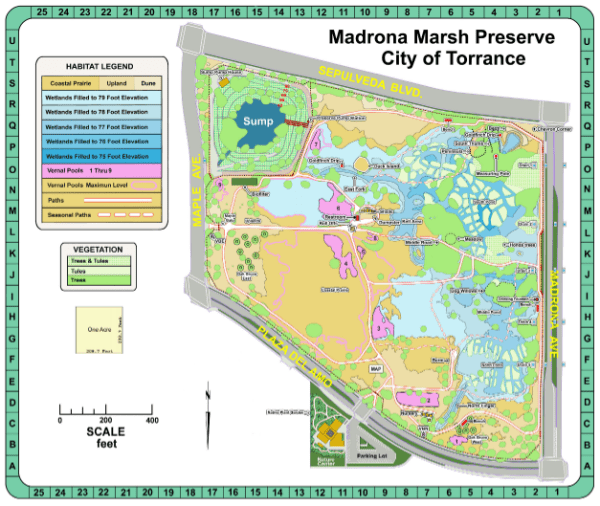
In the upside down map below, north is at the bottom, so no…you haven’t lost your mind.
We almost had the preserve to ourselves as we encountered few volunteers mucking about and a few birders looking for the annually reoccurring Black-and-white Warbler. Our leader Jean Garrett was a little under the weather so I led the trip.
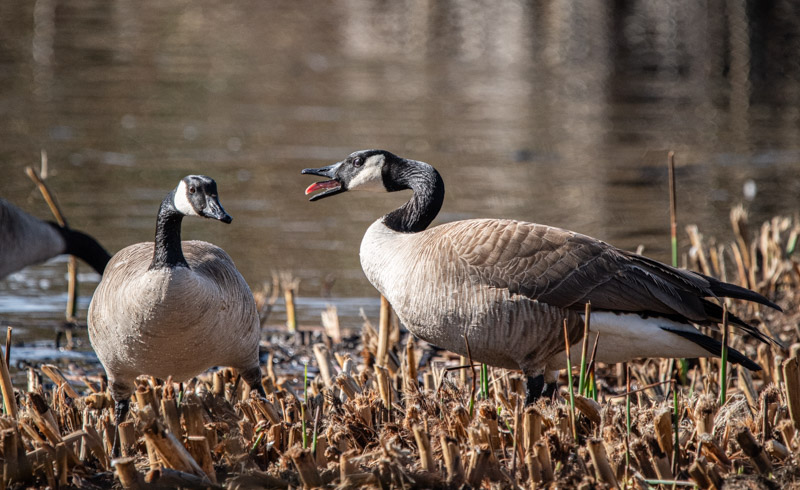
There was far, far less water than last year, not at all surprising considering the rain we have not received. I’d estimate that vernal pool surface was 75% less, seeing as several large previous-pools were – at best – perhaps slightly soft, perhaps. Oddly enough this had virtually no effect upon the number of waterfowl species or individuals — they just occupied a smaller area. This led to occasional bickering, nothing new for commonly quarrelsome ducks and geese.
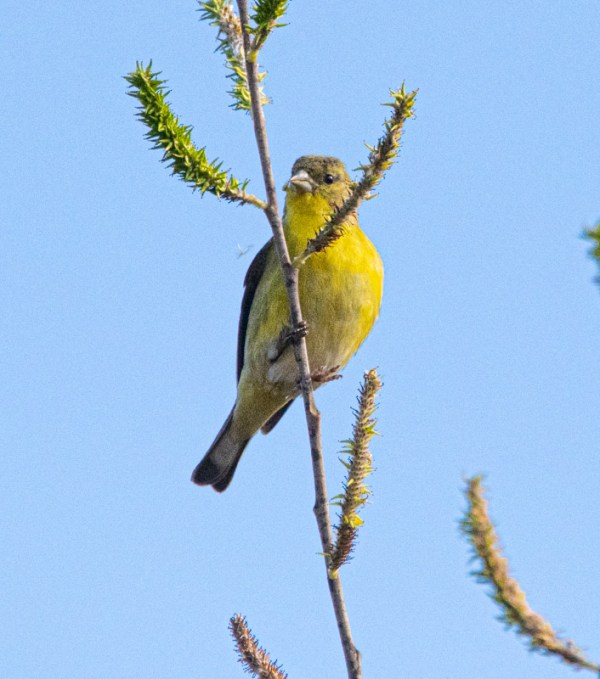
Perhaps most noteworthy were the numerous goldfinches – both Lesser and American. We couldn’t find any Lawrence’s or the once-upon-a-time European Goldfinch that lived here. Goldfinches were in the trees, the brush, the grass, on the bare ground.


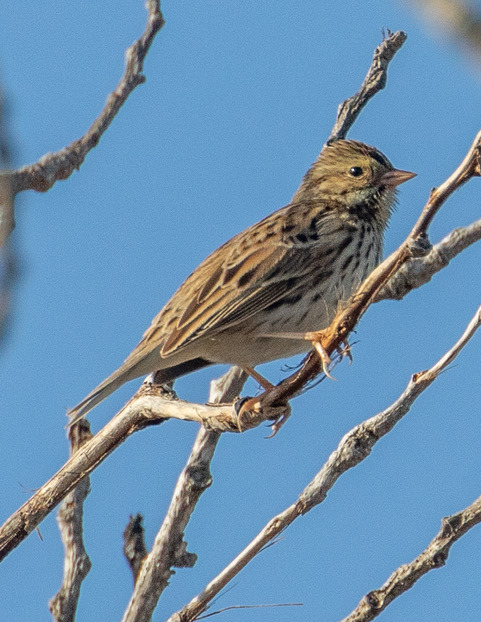
Mixed in with the goldfinches were various sparrows, mostly White-crowned, but also Savannah, Lark, Golden-crowned and California Townees, plus House Finches.
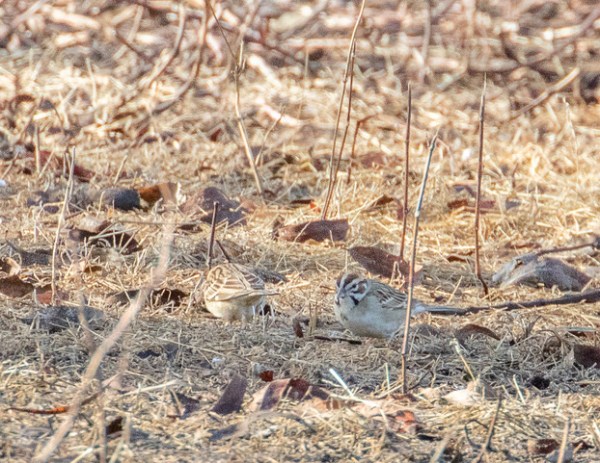
Here’s two sparrow names not currently used, available to those addicted to changing bird names for no discernible reason: Variable Sparrow, In-between Sparrow. You’re welcome.
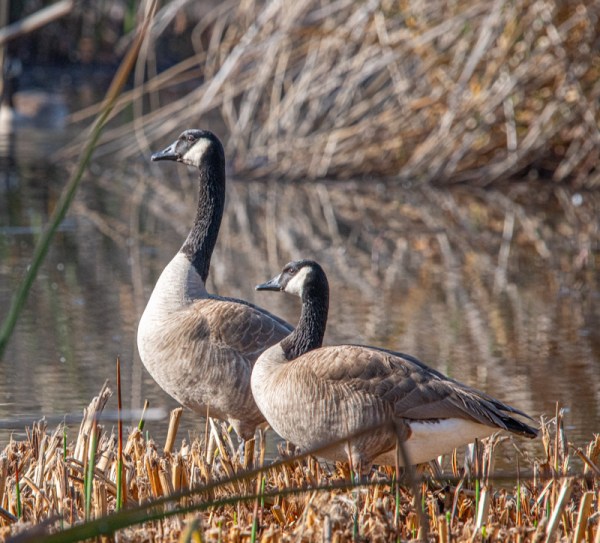
One of these two Canada Geese is obviously a lot larger than the other. Could the right-hand bird be the look-alike by relatively diminutive Cackling Goose, formerly considered as subspecies of the Canada?
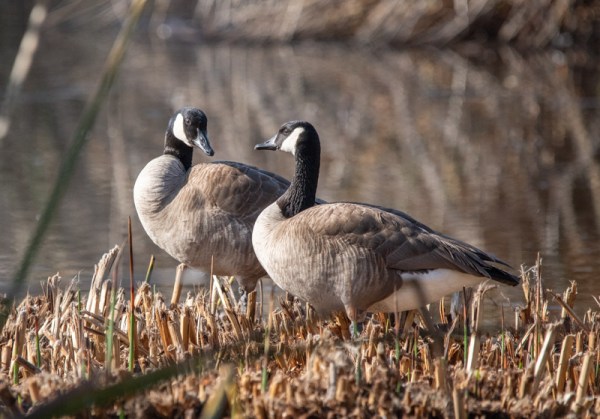
Hmmm…not so different after all; apparently an optical postural illusion. If you’re not certain these are the same two individuals in the same location in both pictures, check the surrounding grass stalks.
Green-winged Teal were the least common, as well as the smallest, waterfowl on the vernal pools. Last year there were none at all despite all the water.

Even less common were the Hooded Mergansers, of whom we found only these two females in the sump at the southeast corner of the preserve. They like deep water, and I’ve never seen them in the vernal pools, only in the sump. We couldn’t find a male, but as we were peering through the chain link fence over the edge of the sump-hole, we couldn’t see the entire pool. I suspect that the wooden raft was intentionally placed there to give these birds a safe place to rest out of the water.

Lots of birds were in the trees and bushes. Sometimes they seemed to be the same individuals moving around, making our total count for several species a bit uncertain.
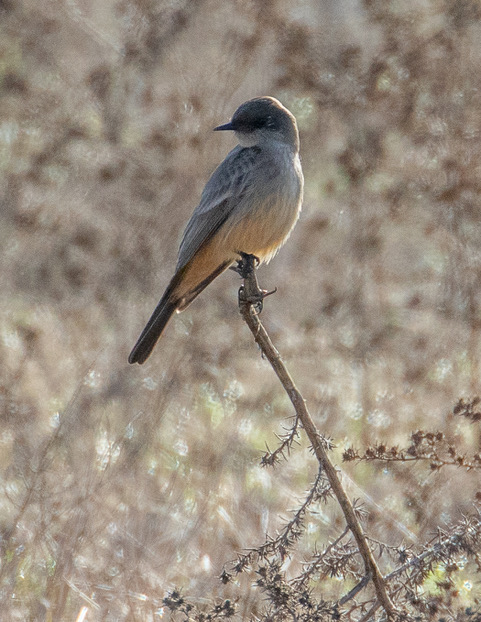
We had the same problem with Cassin’s Kingbird as we did last year: were there twenty of them or just two moving around a lot? We conservatively counted two.
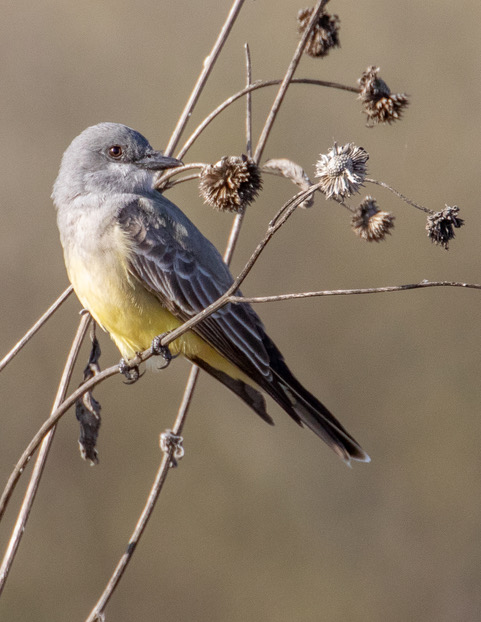
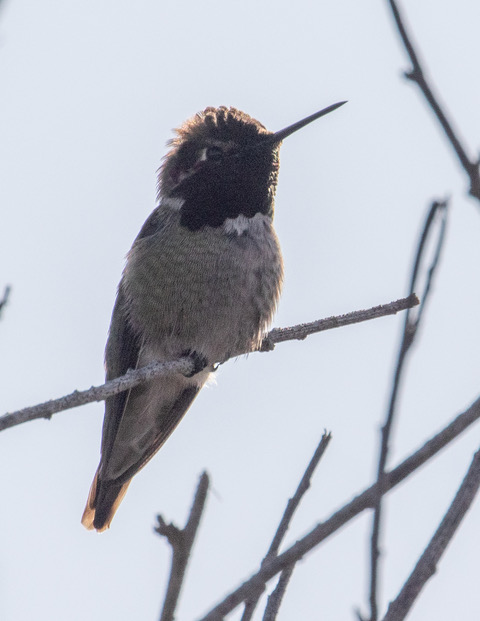
There seemed to be a Ruby-crowned Kinglet in every bush and leafy tree.

Our group became separated while walking west on the “central road.” Four people – Cynthia, Ellena, Emily and Ray – continued ahead while the rest of us went back to look for Cedar Waxwings at the northeast corner where we failed to find them. Meanwhile the Gang of Four came upon a mixed feeding flock which included the sought-for Black-and-white Warbler, a species that breeds east of the Rocky Mtns. and usually flies south for the winter, but a few come west and winter with us. One has frequently wintered at the marsh since at least 2016. As usual, this one was busily gleaning invertebrates from the trunk and branches of the trees. Later the four – now dwindled to three – led the rest of the group back to the sighting spot but the birds had moved on. So it goes.
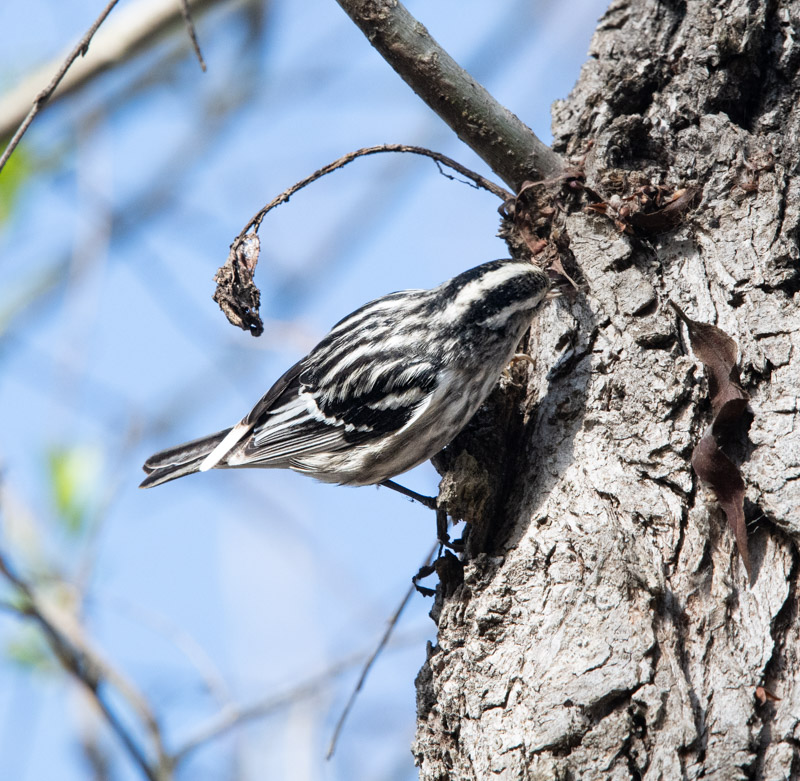
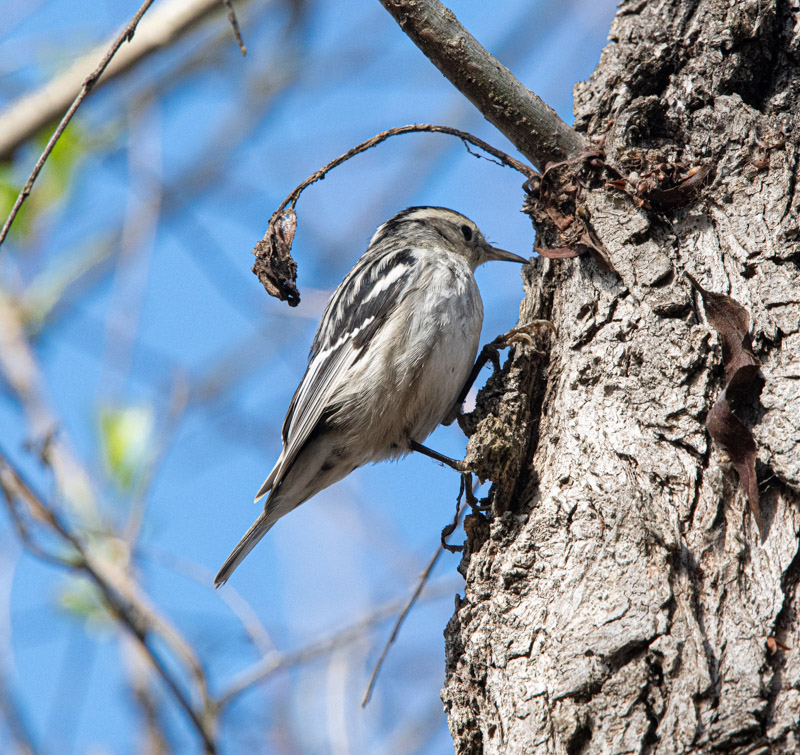
Black-and-white Warbler, gleaning from the bark, their typical behavior. (Ray Juncosa 2/8/25)
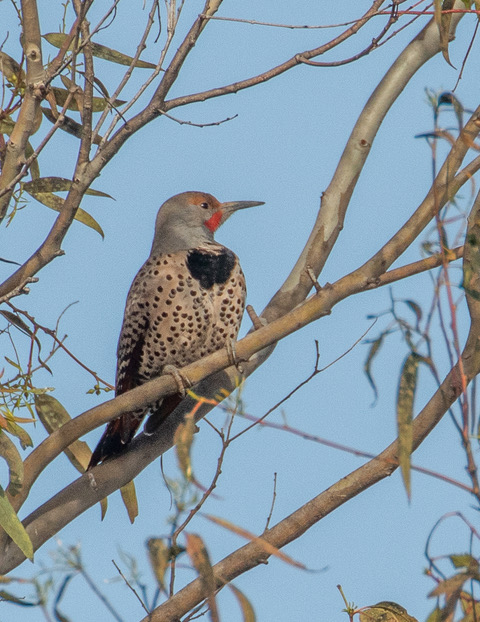
As with last year we found a Northern (Red-shafted) Flicker in one of the trees. This western form has the red whiskers and a brown nape. Last year we had both the Red-shafted and an intergrade form.
We had four species of raptors: the Red-tailed Hawk was high overhead and far away, the Merlin was far away and seen only through a lattice of branches, but the American Kestrel was cooperative as were a pair of Cooper’s Hawks.
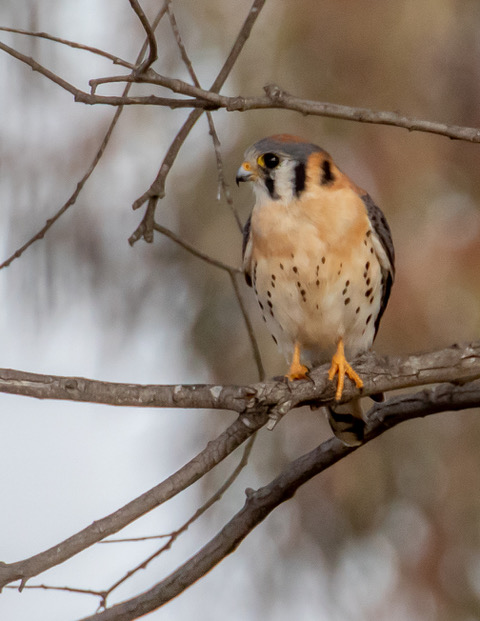
I suspect that this bird below was a bit chilled as it was extremely fluffy.

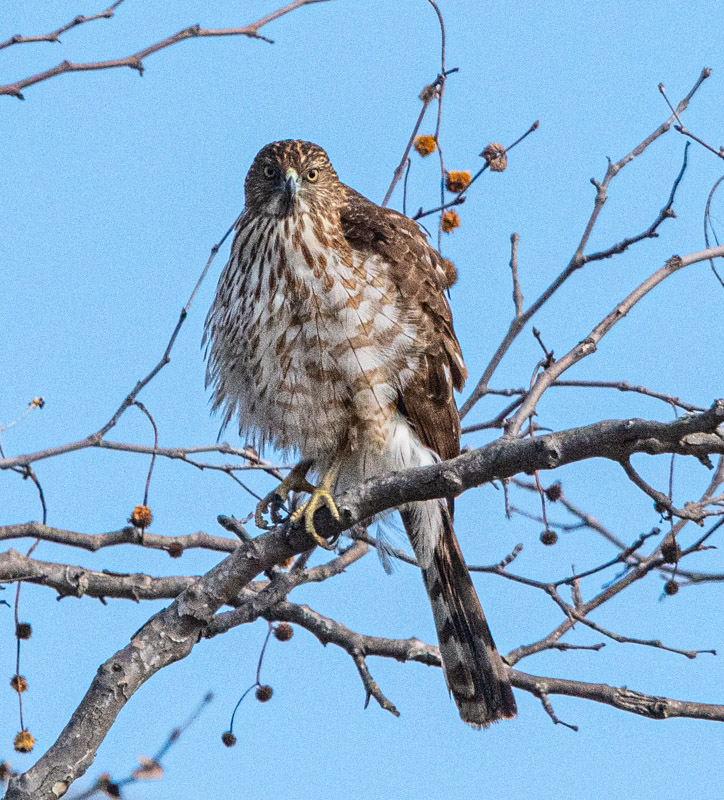
Cooper’s Hawk 2/8/25. Left: Chris Tosdevin, Right: Ray Juncosa.
A few birds, especially an Orange-crowned Warbler, had black on their face, mostly on their chin but some above the bill or above the eyes, which threw us for a bit of a loop. Back home I mentioned this to Lillian who recalled that Kimball Garrett, birder extraordinaire, had once told us that some birds get this from feeding on the eucalyptus flowers which can be a bit sticky. Here’s a photo from last year.

Google AI commented on this:
AI Overview
When a bird has black residue on its face after feeding on a eucalyptus tree, it’s usually due to a sticky, gummy substance called “eucalyptus oil” present in the flowers and leaves, which can accumulate on their beaks and faces while they forage for nectar or insects, appearing as a dark stain.
This led me to the interesting paper Birds and Eucalyptus on the Central California Coast: A Love – Hate Relationship by David L. Suddjian, dated June 3. 2004. [Link]
Eucalyptus stands may offer several special features. Large specimens growing at lower densities develop large and complex limb structures that may provide key nest sites for raptors and colonial waterbirds. With age, the large specimens may also develop snag features, such as dead limbs, and over time older stands include standing dead trees. However, snag resources and tree cavities are generally much less available in eucalyptus stands than in oak or riparian woodland. The loose bark of blue gum eucalyptus, and crevices and cracks in the bark provide foraging substrate and nest sites for some species. The flowers of blue gum, red gum, and other species provide a bounty for many different birds during the winter and spring. Birds visit the flowers for the copious nectar, and to eat insects that are attracted to the flowers. This nectar resource may not be without its downside, however…
As the birds spend time feeding amid the flowers, the feathers on their faces become matted with a black pitch-like residue (or gum) from the nectar. This affects their ability to maintain those feathers, and in some cases the gum may plug their nostrils or bills, and prevent breathing or feeding. Australian birds that regularly feed at Eucalyptus flowers in native settings have longer bills than North American species that feed at eucalyptus flowers, apparently permitting them to feed there without being affected by the gum.
Articles published in the Point Reyes Bird Observatory newsletter (Stallcup 1997) and in Audubon magazine (Williams 2001) have suggested that the effects of this black pitch cause substantial mortality among the North American species that feed at eucalyptus flowers. It seems to be a reasonable conclusion, and Stallcup (1997) cites some instances of mortality. But in my experience, and the experience of a number of other long time field ornithologists, we have seen very little evidence of such mortality. It has been argued that the bird carcasses do not last long on the ground before they are scavenged. However, when observers spend hundreds of hours under these trees over many years but find hardly any evidence of such mortality, then it seems fair to question whether the incidence of mortality is as high as has been suggested. Not all bird carcasses are scavenged rapidly, and large amounts of time under the trees should produces observations of dead birds, if such mortality were a frequent event. I’m not making a judgment either way, but I just think more evidence is needed. Pgs: 2-3, 5
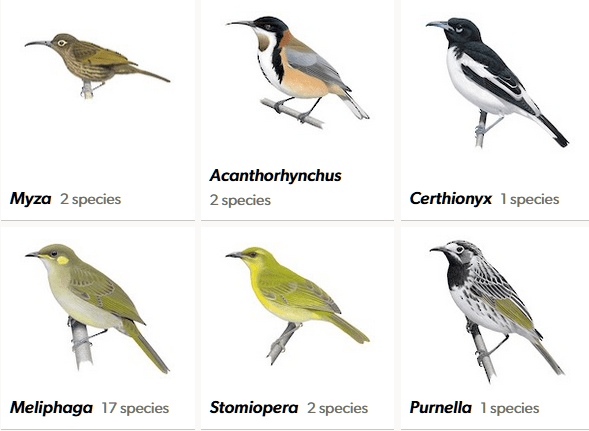
Among the many Australian birds that co-evolved with eucalyptus over tens of millions of years are the Honeyeaters, family Meliphagidae. They generally have long slender slightly decurved bills which aid while digging into the depths of eucalyptus blossoms as well as keeping the gum from getting onto their facial plumage.
Tasmanian Blue Gum, Eucalyptus globulus, is the eucalyptus tree most common introduced into the United States and has lovely, sticky flowers. Photo below from Trees of Stanford University.

As always, many thanks to our photographers: Ray Juncosa & Chris Tosdevin
| Madrona Marsh Trip List | 12/10/16 | 2/11/23 | 2/10/24 | 2/8/25 |
| Canada Goose | X | 8 | 32 | |
| Cinnamon Teal | X | |||
| Northern Shoveler | X | 40 | ||
| Gadwall | X | 2 | ||
| American Wigeon | 6 | X | 2 | 35 |
| Mallard | 6 | X | 50 | 15 |
| Green-winged Teal | X | 5 | ||
| Ring-necked Duck | 1 | |||
| Hooded Merganser | X | 2 | ||
| Rock Pigeon | 8 | X | 8 | 6 |
| Eurasian Collared-Dove | X | |||
| Mourning Dove | 50 | X | 12 | 6 |
| White-throated Swift | 12 | |||
| Anna’s Hummingbird | 3 | X | 3 | 2 |
| Allen’s Hummingbird | 9 | X | 4 | 3 |
| American Coot | 5 | X | 2 | |
| Killdeer | X | 1 | ||
| Greater Yellowlegs | X | |||
| Ring-billed Gull | 2 | |||
| Western Gull | 4 | |||
| California Gull | 2 | X | ||
| Gull sp. | (2) | |||
| Great Egret | 1 | |||
| Green Heron | X | |||
| Black-crowned Night-Heron | X | |||
| Sharp-shinned Hawk | 1 | |||
| Cooper’s Hawk | 2 | |||
| Red-shouldered Hawk | 1 | 1 | ||
| Red-tailed Hawk | 2 | X | 2 | 1 |
| Downy Woodpecker | 1 | 1 | ||
| Northern Flicker (Red-shaft) | 2 | X | 10 | 1 |
| No. Flicker (prob. Red x Yellow) | (1) | |||
| American Kestrel | 3 | X | 1 | 1 |
| Merlin | 1 | |||
| Ash-throated Flycatcher | 1 | |||
| Cassin’s Kingbird | 6 | X | 2 | 4 |
| Black Phoebe | 6 | X | 5 | 3 |
| Say’s Phoebe | 1 | X | 1 | 2 |
| California Scrub Jay | 1 | |||
| American Crow | 4 | X | 12 | 6 |
| Common Raven | 2 | X | 2 | 2 |
| No. Rough-winged Swallow | 2 | |||
| Bushtit | 50 | X | 18 | 8 |
| Ruby-crowned Kinglet | 12 | 8 | ||
| Cedar Waxwing | 20 | X | ||
| Blue-gray Gnatcatcher | 13 | X | 8 | 6 |
| House Wren | 1 Heard | |||
| Northern Mockingbird | 1 | |||
| European Starling | 8 | X | 5 | 30 |
| Hermit Thrush | 1 Heard | |||
| Scaly-breasted Munia | 45 | 20 | 20 | |
| Pin-tailed Whydah | 18 | |||
| House Finch | 20 | X | 5 | 20 |
| Lesser Goldfinch | 3 | X | 50 | |
| American Goldfinch | 45 | X | 8 | 60 |
| Lark Sparrow | 2 | |||
| Chipping Sparrow | 6 | 4 | ||
| Brewer’s Sparrow | 2 | |||
| Fox Sparrow | 1 | |||
| White-crowned Sparrow | 60 | X | 15 | 30 |
| Golden-crowned Sparrow | 2 | X | 2 | |
| Savannah Sparrow | 4 | X | 4 | |
| Song Sparrow | 2 | X | 8 | |
| Lincoln’s Sparrow | 3 | X | 1 | |
| California Towhee | 2 | X | 1 | 4 |
| Western Meadowlark | 10 | X | 1 | |
| Red-winged Blackbird | 2 | X | 31 | 40 |
| Brewer’s Blackbird | 5 | |||
| Great-tailed Grackle | X | 1 | 3 | |
| Black-and-White Warbler | 1 | 1 | ||
| Orange-crowned Warbler | 6 | X | 2 | |
| Common Yellowthroat | 3 | 1 | ||
| Yellow-rumped Warbler | 10 | X | 40 | 8 |
| Black-throated Gray Warbler | 1 | X | 1 | |
| Townsend’s Warbler | 1 | |||
| House Sparrow | 1 | 6 | ||
| Total Species – 74 (forms-76) | 51 | 46 | 41 (42) | 43 (44) |
Discover more from SANTA MONICA BAY AUDUBON SOCIETY BLOG
Subscribe to get the latest posts sent to your email.



 SANTA MONICA BAY AUDUBON SOCIETY BLOG