Extreme weather is now a key predictor of bird presence | Yale News
[Posted by Chuck Almdale, submitted by Edna Alvarez]
Extreme weather now a key predictor of where bird species occur in North America, study finds
By Jim Shelton | 11 August 2026 | Yale News
A Yale-led study links severe weather to bird ranges and biodiversity for hundreds of North American birds. Accounting for extreme weather, the authors say, is critical to understanding and predicting where species are found in the environment.
By Jim Shelton, 11 August 2026
Using hundreds of millions of citizen science bird observations in the eBird database, researchers found that using data on the variability and extremes of climate were a better predictor than mean temperatures of when and where over 500 North American species were present. “The habitat ranges in [Means only] models without extreme weather events were, on average, 10% too large for winter months and 6% too large for summer months.”
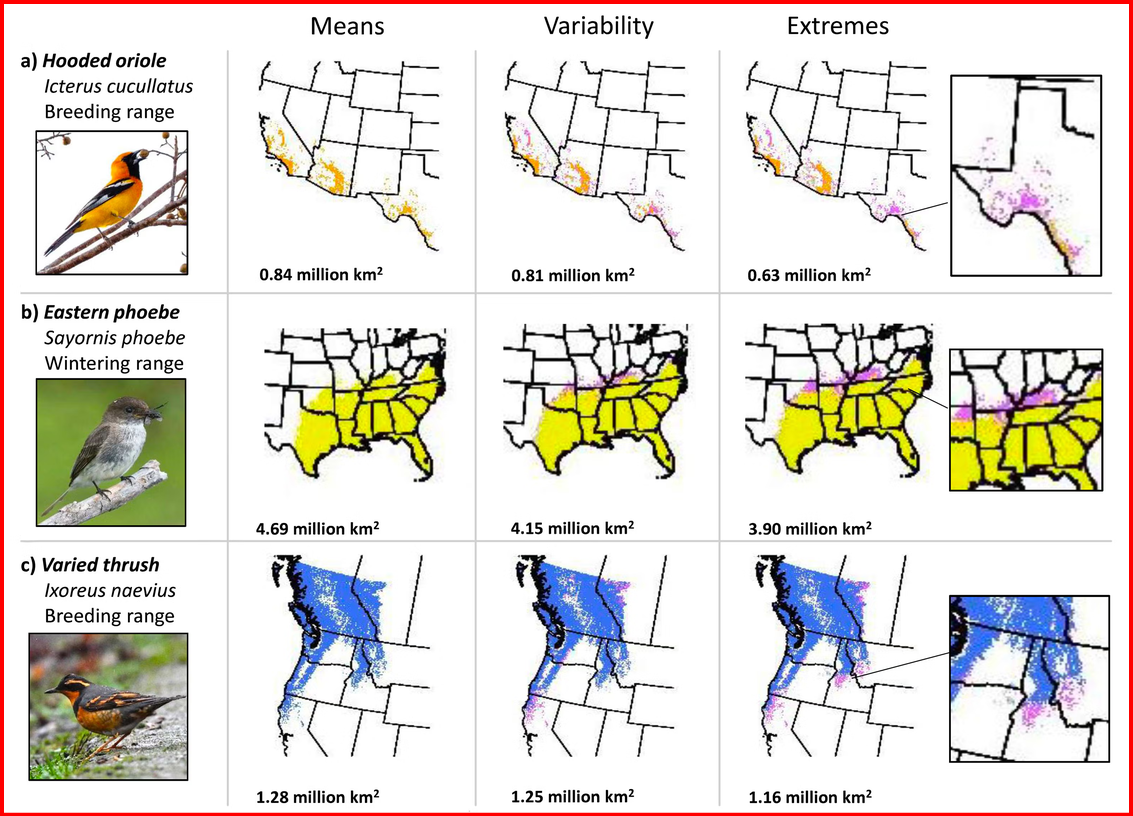
Predicted breeding range of (a) Hooded Oriole (Icterus cucullatus), (b) wintering range of Eastern Phoebe (Sayornis phoebe), and (c) breeding range of Varied Thrush (Ixoreus naevius) across models including only climate means, climate variability, and extreme weather risk (left to right).
For variability and extremes, colored areas represent predicted suitable areas in all models, pink areas are suitable in Means but not Variability or Extremes models, and gray areas are suitable in Variability or Extremes but not Means models. Insets highlight regions with large differences between model predictions.
This article is based on research published 8 August 2026 in the journal Global Change Biology.
Continental-Scale Biodiversity Predictions Are Influenced by Climatic Variability and Extreme Weather
Jeremy M. Cohen, Diego Ellis-Soto, Shubhi Sharma, Frank A. La Sorte, Walter Jetz
First published: 08 August 2026 https://doi.org/10.1111/gcb.71028
Abstract:
Increasingly variable and extreme weather can push organisms beyond their physiological thermal or hydric tolerances and limit where they can persist, affecting their geographic distributions and biodiversity patterns. For example, organisms often live near their physiological limits at range edges and may be unable to persist in these regions under variable and extreme conditions. However, it remains unclear how climatic variability and extreme weather define continental-scale species distributions and biodiversity patterns. Here we link hundreds of millions of citizen science bird observations from 2004 to 2024 to high-resolution maps of within-year climatic variability and extreme weather risk, exploring how these factors define both summer and winter distributions and biodiversity patterns for 535 North American species across 2901 individual models. We find that species distribution models accounting for climatic variability or extreme weather risk performed better than others at predicting richness and individual species presences across 220 well-surveyed sites. Such models predicted narrower geographic distributions than models relying on only climatic means, especially at the range edges, resulting in species’ ranges that were truncated on average by 6% in summer and 10% in winter when climatic variability and extreme weather variables were included. These effects were observed in both seasons but were particularly strong in winter, a time with greater short-term weather variability than summer. Richness estimates were substantially lower when climatic variability or extreme weather were accounted for, especially in the US southwest and central plains (up to 35 fewer species), regions highly prone to extreme heat, cold, and drought. Our results suggest that more mechanistically informed biodiversity predictions that account for climatic variability and extreme weather are critical for reliably predicting distributional and biodiversity patterns.
Discover more from SANTA MONICA BAY AUDUBON SOCIETY BLOG
Subscribe to get the latest posts sent to your email.



