Cormorants, terns and bands, Malibu Lagoon: 23 August 2026
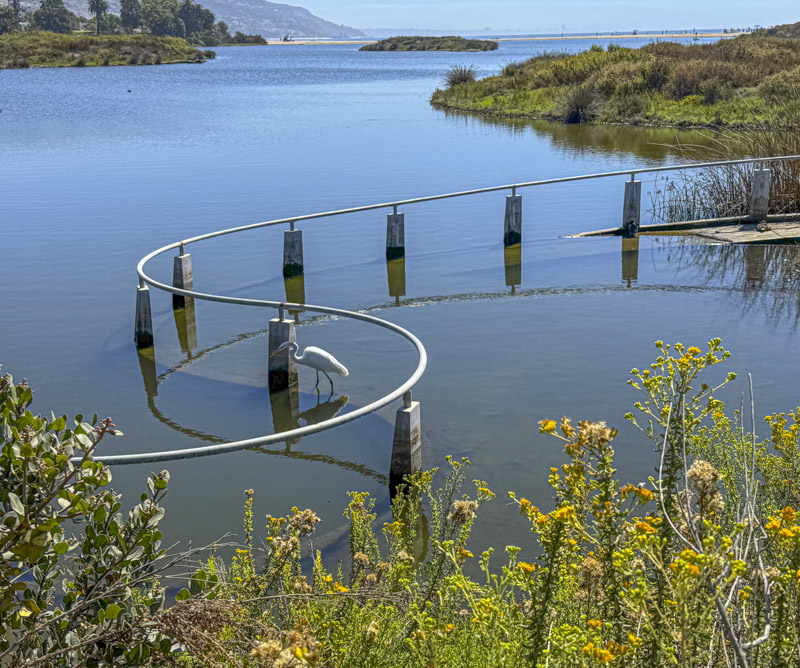
(Ray Juncosa 8/23/26)
[By Chuck Almdale; photos by Ray Juncosa, Trish Oster & Chris Tosdevin]
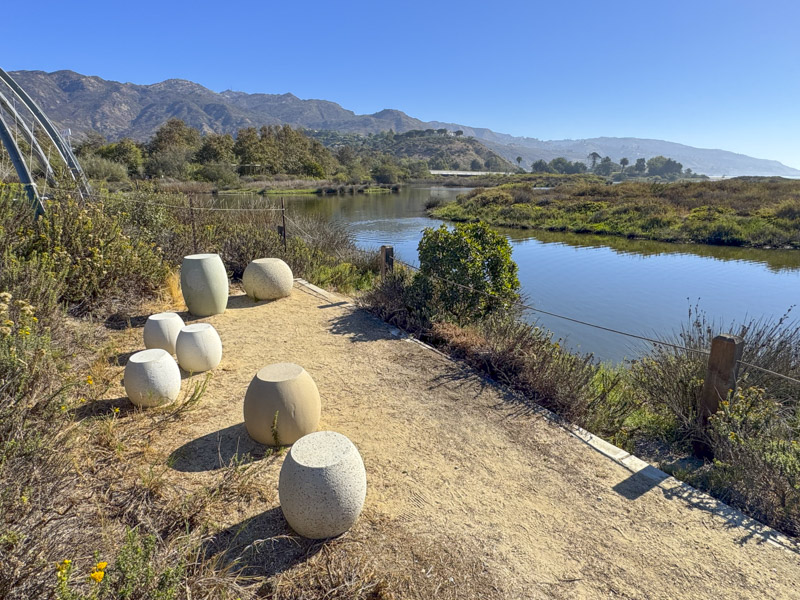
It may look like high tide, but it’s not. The lagoon is closed to the sea. It happens every summer, for most of the summer. Water keeps coming down the creek, gradually filling the lagoon. Occasionally it gets so high, perhaps 9-10 ft. above sea level that it begins to spill over whatever is the low spot in the beach, possibly creating a “permanent” channel which may last until the next spring. But usually it’s the first significant rain (1/2 inch or more) in November or December that is brings sufficient water down Malibu Creek to blow through the beach. When this happens, all the water runs out at the next low tide until the end of the next low tide, along with a lot of the fish, and the lagoon remains open to the sea for the next six months. Or thereabouts.
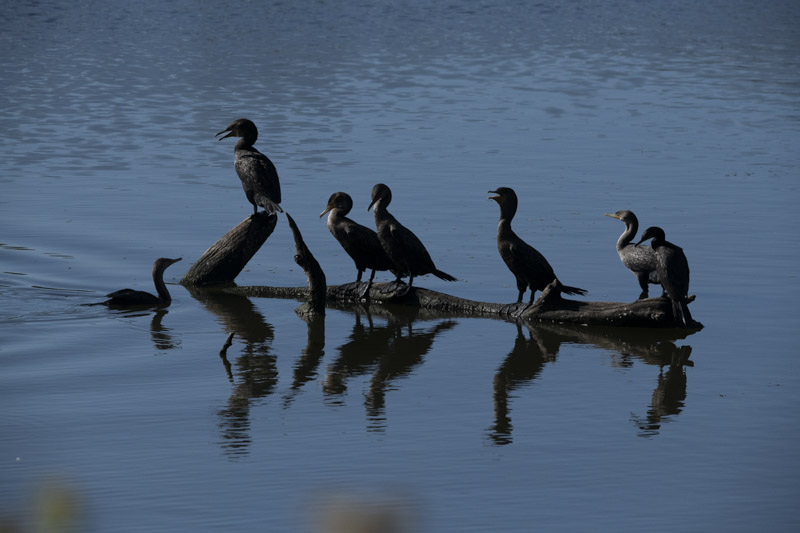
The Double-crested Cormorants, unafraid of fresh or brackish water, frequently rest on this log near our gathering point, giving us something close-at-hand to look at.
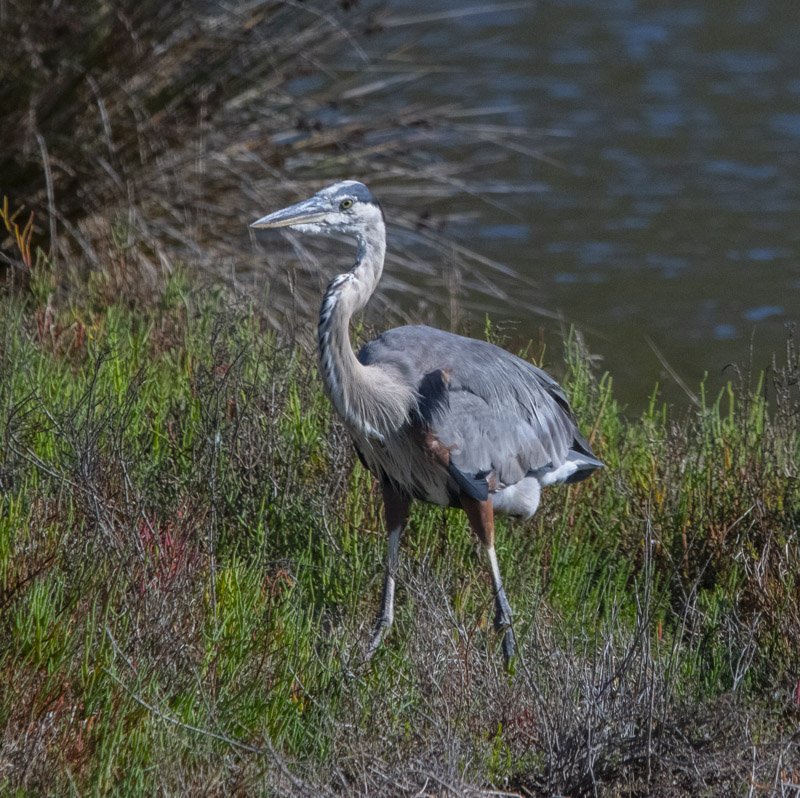
(Ray Juncosa 8/23/26)
The NGS field guide describes the color of “trousers” as burgundy. Looks more rusty, rufous or cinnamon to me.
To our great surprise the Surf Scoter (or more accurately “a” Surf Scoter) was resting on the ground on the east end of the western sand & brush island in exactly the same spot as one rested a month ago. Seeing one on land is so uncommon – I can’t recall a single other instance – that we (or maybe only I) assumed it was sick or damaged. Seeing it there still, or again, reinforced that belief.
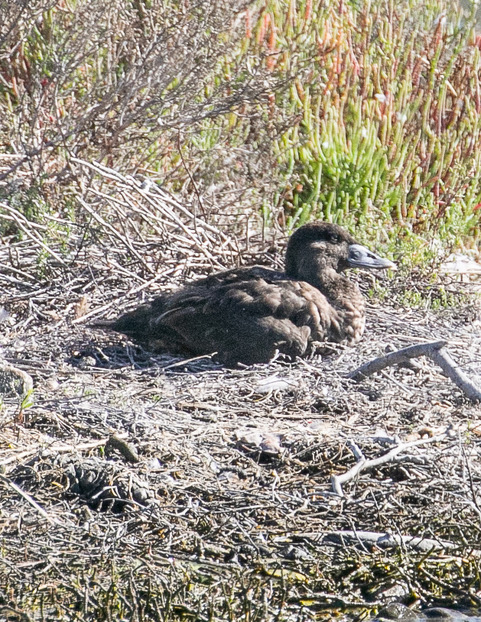
(Chris Tosdevin 8/23/26)
Of course, later on our way back from the beach, the bird was nowhere to be seen, blowing all assumptions about the state of its health out of the water.
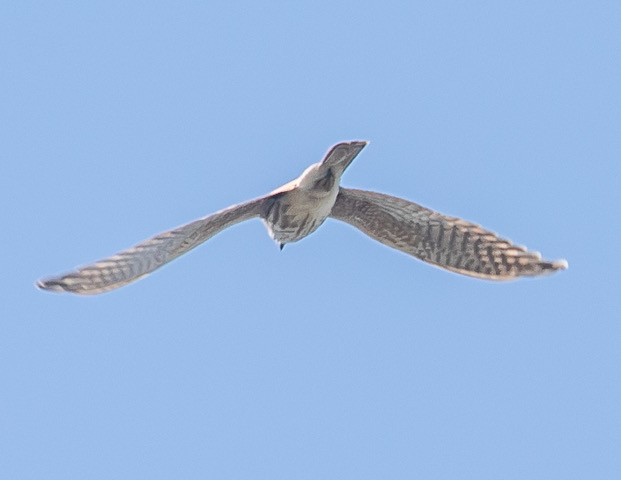
The go-away bird below is an American Kestrel according to those who actually saw it. I didn’t, but I’d guess from the breast-streaks that it’s a female. (In southern Africa there is a whole family of real go-away birds, also called turacos. The vocalizations of some species sound like they’re pleading with you to “go away.”)
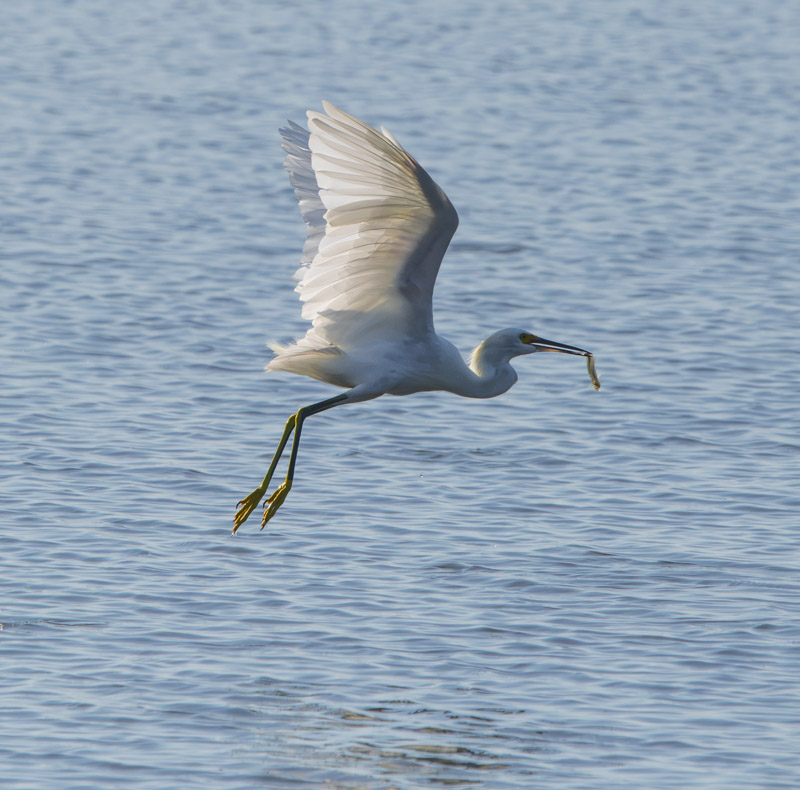
I don’t know exactly what this Snowy Egret has here, but evidently it’s a keeper.
I thought the numbers (346 birds) and diversity (48 species) was pretty low for August, but a quick check revealed that August 16, 1980 had only 282 birds and 22 species. On the other hand August 25, 2013 had 1154 birds and 61 species. So you never know.
We had (at least) seven Pygmy Blue Butterflies today. Possibly a record.
Here’s a collection of left-looking birds.
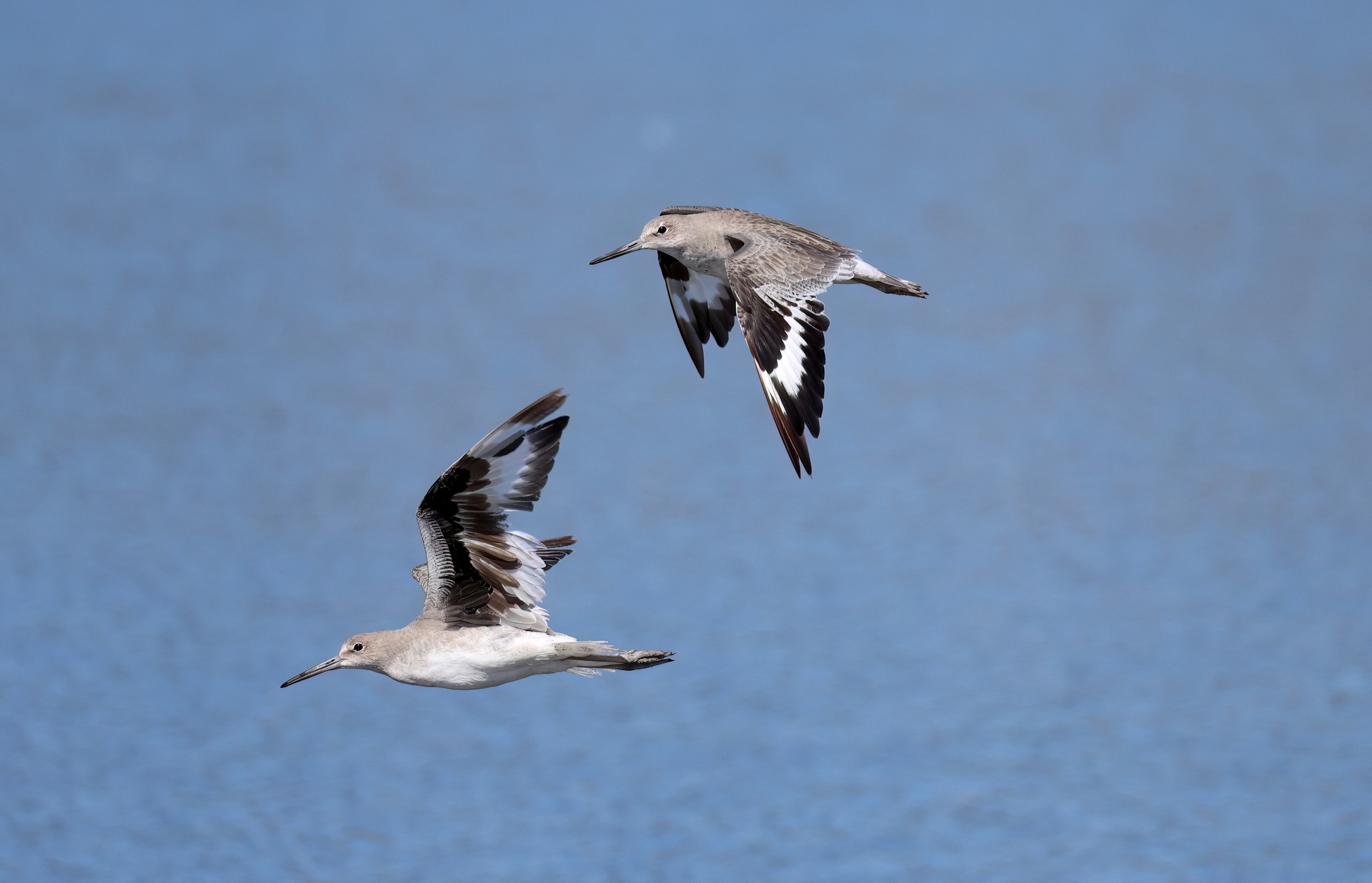
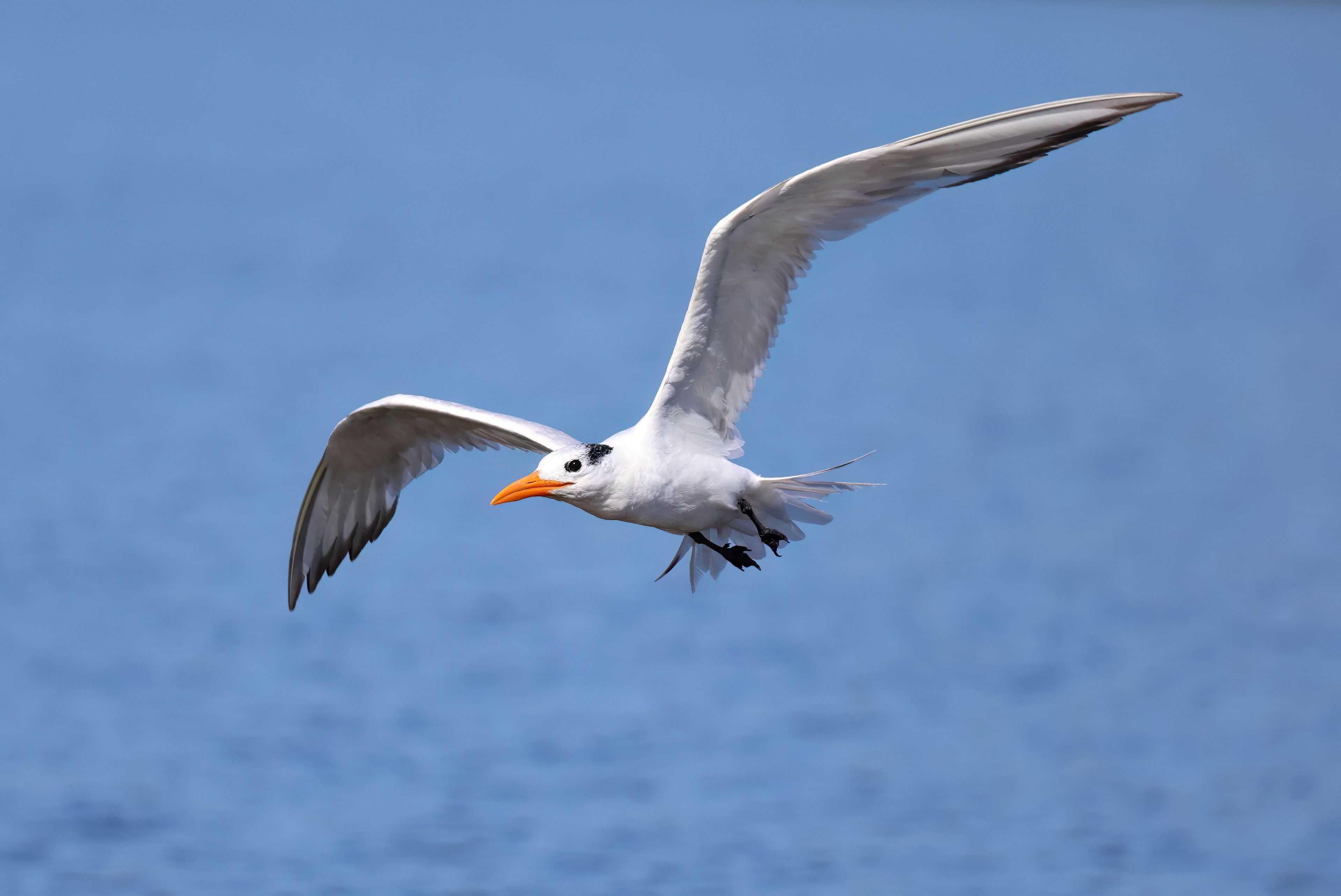
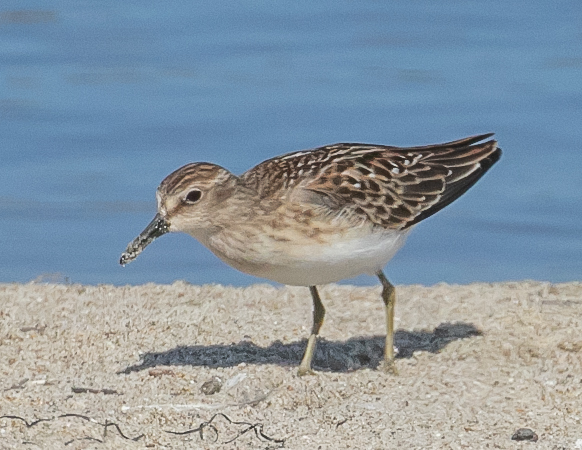
(Chris Tosdevin 8/23/26)
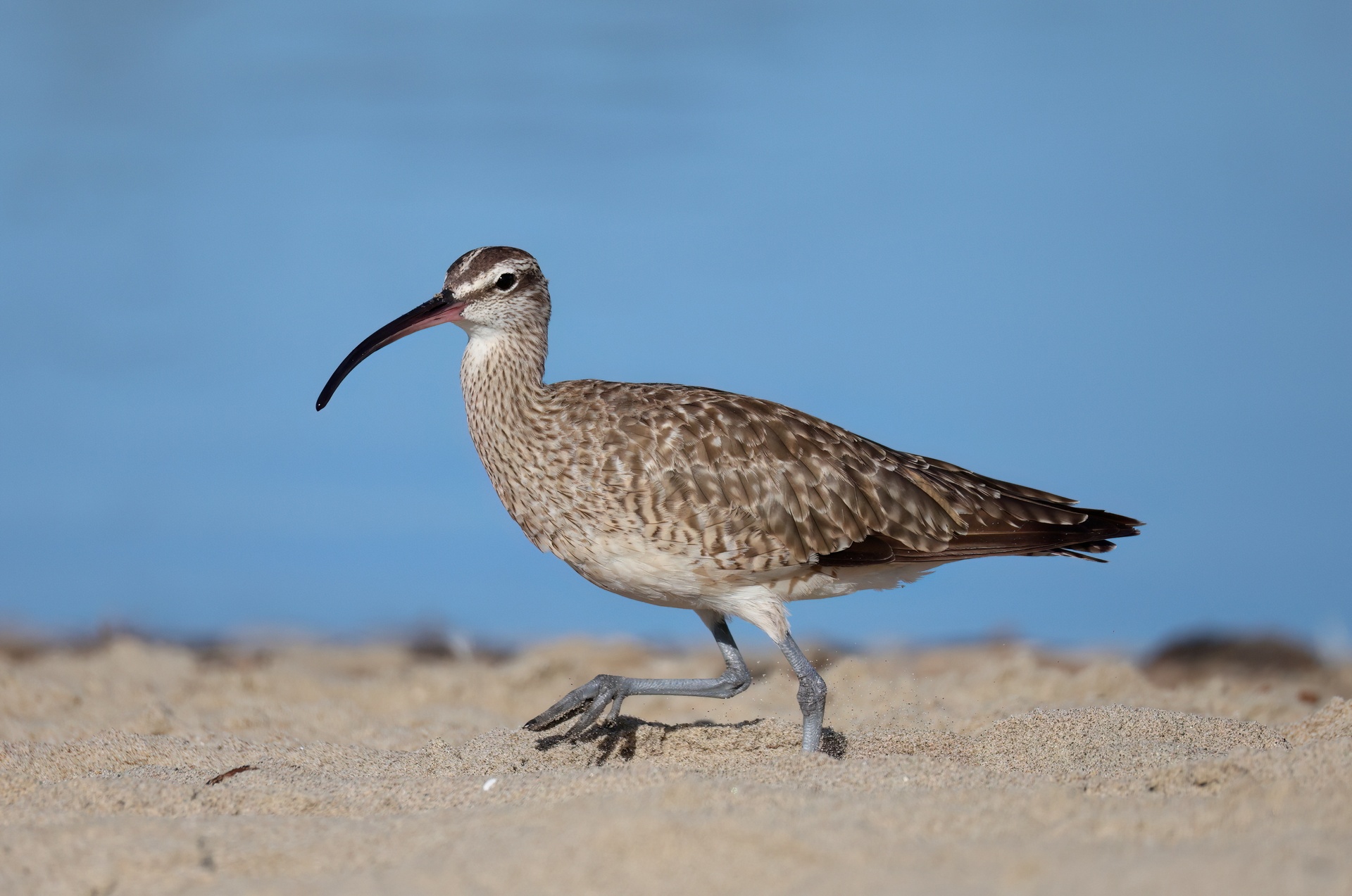
In case the name “Hudsonian” Whimbrel sounds new to you, you’re right, as in 2025 the Whimbrel Numenius phaeopus was officially split into two species. In the Americas we have Hudsonian Whimbrel Numenius hudsonicus and Eurasian Whimbrel Numenius phaeopus everywhere else.
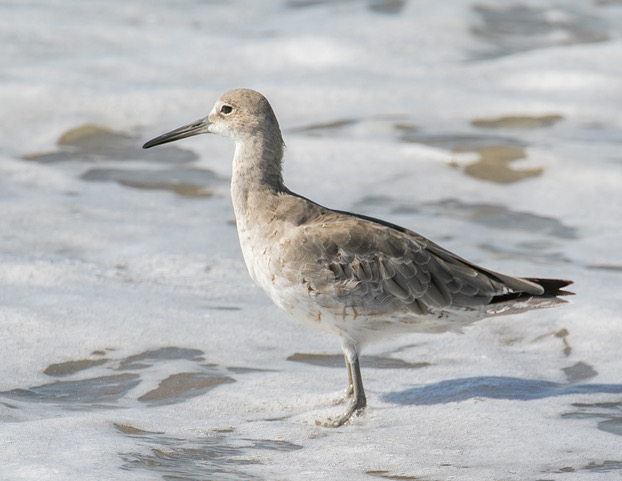
Our Black-bellied Plover Pluvialis squatorola is known as the Grey Plover in Europe. They are of course both Gray and Black-bellied. Most of the year they have gray bellies, and the rest of the bird is always gray-ish, but for the few months in which they breed they have black bellies. Of course the Golden Plovers also have black bellies in breeding plumage and they too are largely gray, not terrifically golden as a rule, certainly not oriole or warbler or finch-like golden. [If you think bird names are supposed to be accurately descriptive or helpful when trying to identify a bird, you’d best forget that right now. Their names are frequently misleading and rarely useful, primarily because it’s very difficult for one-to-four words to both adequately and exclusively cover both sexes, all plumages and all ages of a species. But with over 11,000 species of birds to look at, there are of course exceptions to this generalization, although none come to mind. Ostrich, perhaps?]
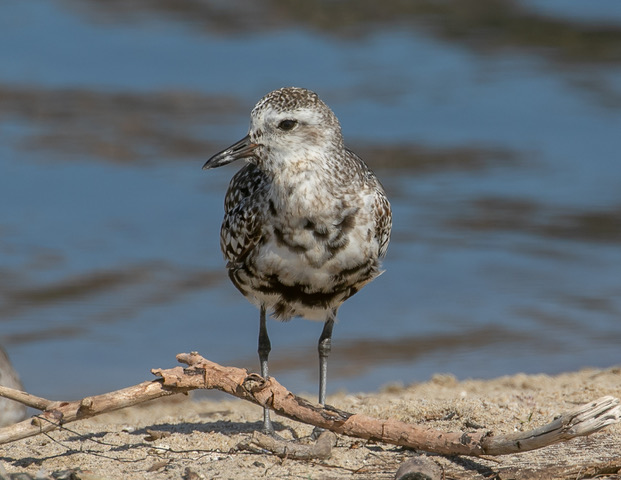
(Chris Tosdevin 8/23/86)
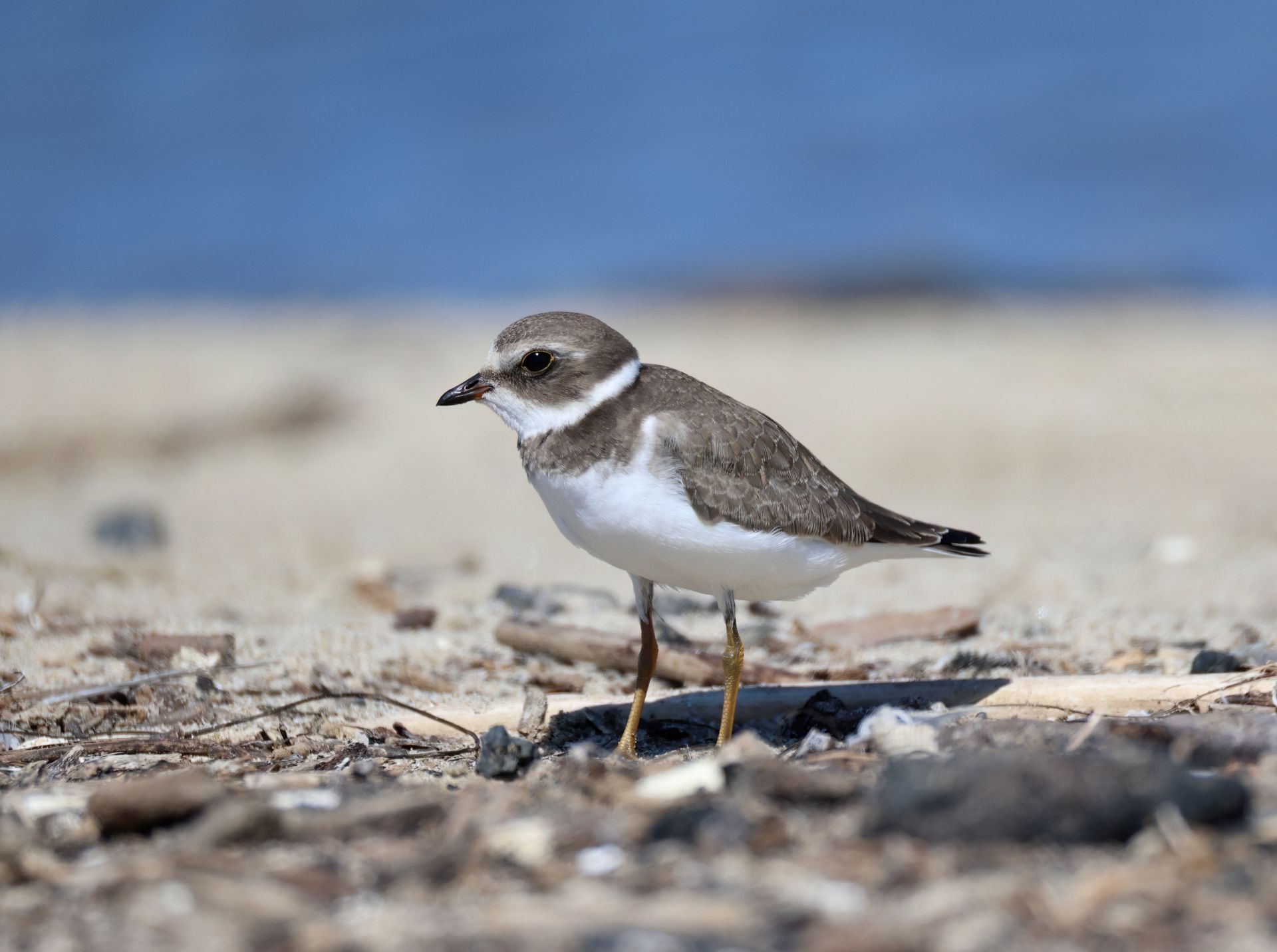
Semipalmated Plovers (can you see the obvious semi-palmation, so useful for identification purposes?) are regular spring and fall visitors to the lagoon. April and August-September are their peak months, whereas in May-June and October-February they are very few and far between.
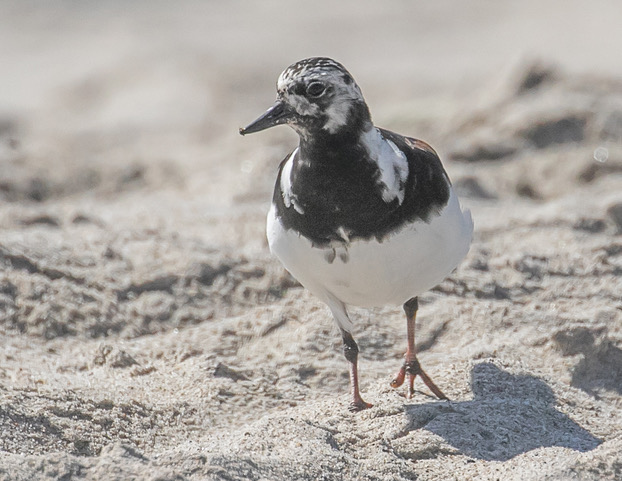
Can you guess why this Ruddy Turnstone below is called a “turnstone?” Usually their bills show a very slight up-turn towards the end of their upper mandible and a slight thickening in the lower mandible just below. This bird has a hint of the thickening in the lower bill, but no noticeable up-turn. These add structural strength which aids in the turning of stones, as you guessed. There are often tiny edible invertebrates hiding under small stones.
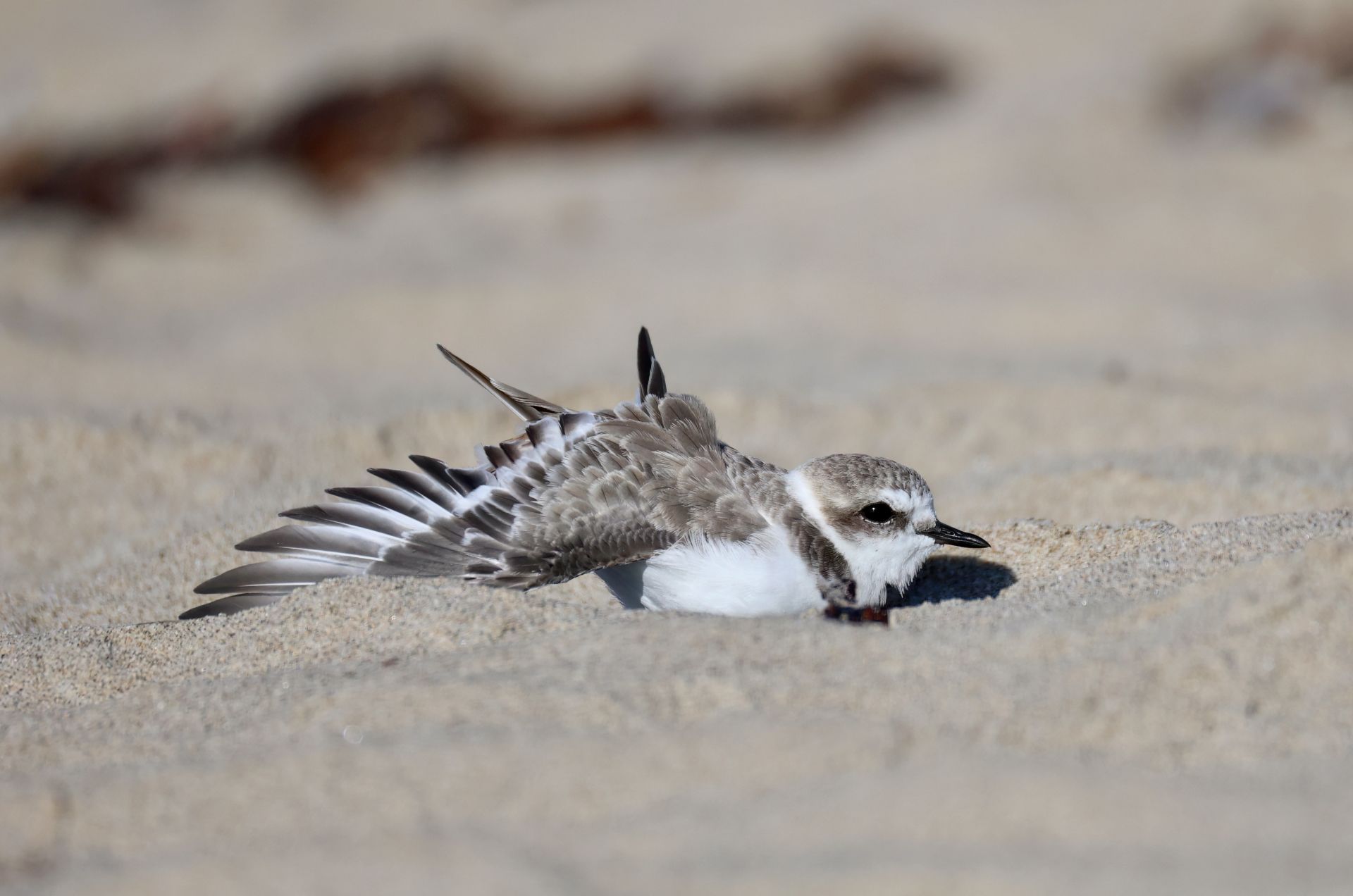
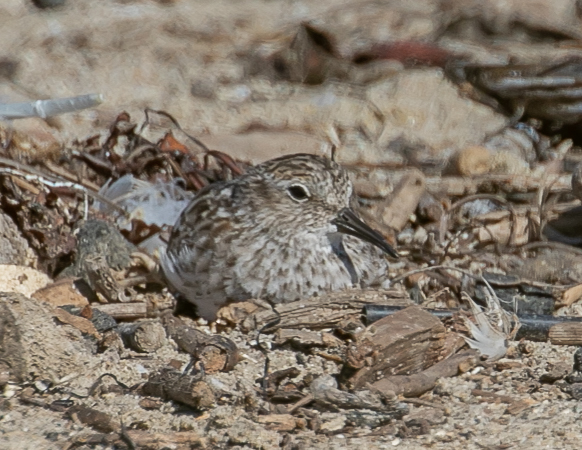
This Western Snowy Plover flubbed his photo op.
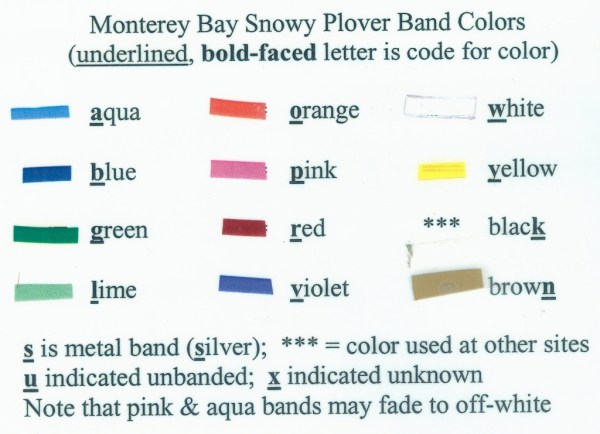
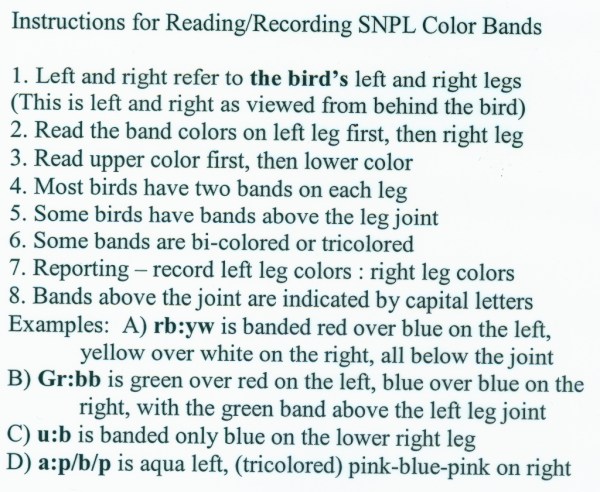
We had two banded Western Snowy Plovers on this trip, and discussion ensued as to the color of their bands. Most west coast Snowy Plovers have four bands (rings) on their legs, two on each leg. Alternatively, some have a single ring on the leg above the heel (or backwards knee or leg joint if you prefer). I concluded that they were (reading left leg above, then below, right leg above then below) orange : aqua+blue (o:ab) and violet+green : orange+white (vg:ow). But some thought the single left orange band on the first bird was rust or corrosion (bands are colored plastic applied to a metal ring); it was hard to differentiate between violet and blue; the white at first looked to me like a very light brown, but I then decided it was merely body shadow altering the color.
Here’s the official color chart for Western Snowy Plovers. Learn it and become a pro.
Three of our photographers in action. Now you know where some of those great close-up photos come from. I personally think that having good equipment, rock-steady hands, great framing ability and wise choice in capturing interesting behavior should all be considered some sort of cheating. I refuse to cheat, which is why I rarely include my own cruddy photography in these postings.

(Chris Tosdevin 8/23/26)
We had great fun discussing and sorting out the Royal and Elegant Terns, although there were only 35 of them. No one was hurt during these discussions.
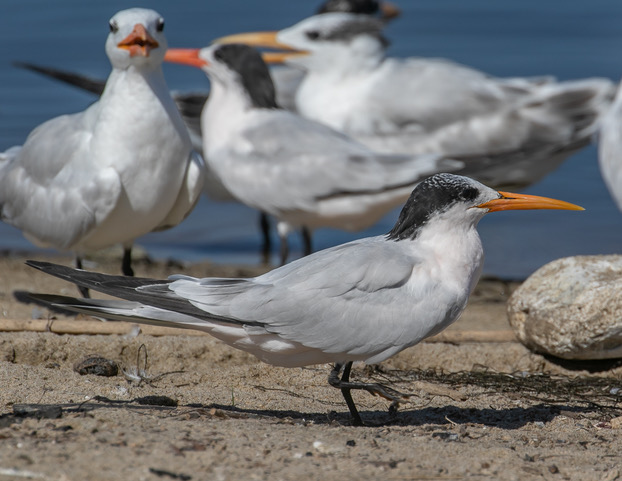
Sometimes it’s hard to unwind after a long flight.
A view of the west channel, PCH bridge and Santa Monica Mountains in the distance.
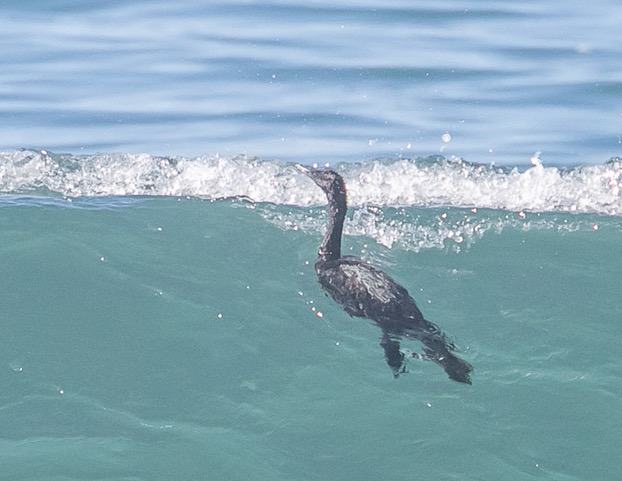
The surf was very good today. Very little wind so the waves weren’t all blown out but were very nicely shaped. The highway shoulders were packed with surfer’s cars, the waves packed with surfers, and the beach packed with sunbathers under their portable shades. Even the birds joined in, with cormorants in the waves and several loons out past the surf zone.
Malibu Lagoon on eBird as of 8-24-26: 9595 lists, 3143 eBirders, 323 species
Most recent new species seen: Canyon Wren, 06/11/26 by Judith Olsen (no photo).
Birds new for the season: Semipalmated Plover, Red-throated Loon, Osprey, Red-shouldered Hawk, American Kestrel, Northern House Wren, Marsh Wren, Common Yellowthroat. “New for the season” means it has been three or more months since last recorded on our trips.
Many, many thanks to photographers Ray Juncosa, Trish Oster & Chris Tosdevin
Upcoming SMBAS scheduled field trips; no reservations or Covid card necessary unless specifically mentioned:
- Lower L.A. River, Sat. Aug. 29, 7 am
- Lower Sycamore Canyon, Mugu Rock & Marsh, Sat. Sep 12
- Malibu Lagoon, Sun. Sep 27, 8:30 am (adults) & 10 am (parents & kids)
- Huntington Beach Central Park, Sat. Oct 10, 8 am
- Malibu Lagoon, Sun. Oct 25, 8:30 am (adults) & 10 am (parents & kids)
- These and any other trips we announce for the foreseeable future will depend upon expected status of the Covid/flu/etc. pandemic, not to mention landslides, fires, local flooding and atmospheric rivers at trip time. Any trip announced may be canceled shortly before trip date if it seems necessary. By now any other comments should be superfluous.
- Link to Programs & Field Trip schedule.
The next SMBAS Zoom program: Tuesday, October 6, 7:30pm; TBA
The SMBAS 10 a.m. Parent’s & Kids Birdwalk has again resumed. Reservations not necessary for families, but for groups (scouts, etc.), please call Jean (213-522-0062).
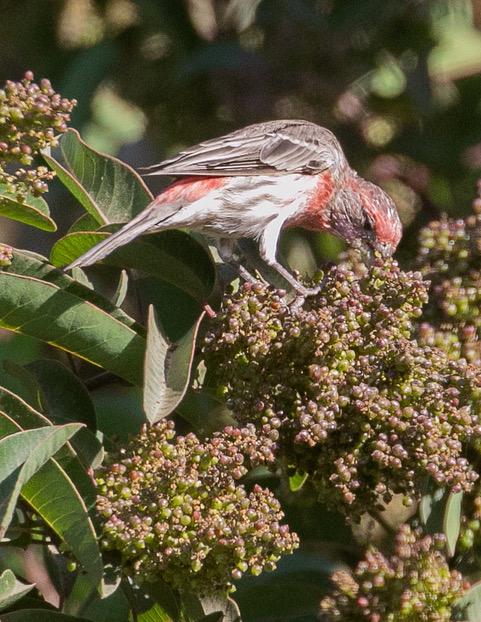
(Chris Tosdevin 8/23/26)
Links: Unusual birds at Malibu Lagoon
9/23/02 Aerial photo of Malibu Lagoon
Aerial ‘film’ flying north over lagoon
More recent aerial photo
Prior checklists:
2025: Jan-June, July-Dec 2026: Jan-June
2023: Jan-June, July-Dec 2024: Jan-June, July-Dec
2021: Jan-July, July-Dec 2022: Jan-June, July-Dec
2020: Jan-July, July-Dec 2019: Jan-June, July-Dec
2018: Jan-June, July-Dec 2017: Jan-June, July-Dec
2016: Jan-June, July-Dec 2015: Jan-May, July-Dec
2014: Jan-July, July-Dec 2013: Jan-June, July-Dec
2012: Jan-June, July-Dec 2011: Jan-June, July-Dec
2010: Jan-June, July-Dec 2009: Jan-June, July-Dec
The 10-year comparison summaries created during the 2012-13 Lagoon Reconfiguration Project period, remain available—despite numerous complaints—on our Lagoon Project Bird Census Page. Very briefly summarized, the results unexpectedly indicate that avian species diversification and numbers improved slightly during the restoration period June’12-June’14. We also have a newly-refurbished slide show of the reconfiguration from just before it started until the recent 13-year celebration.
Many thanks to Marie Barnidge-McIntyre, Femi Faminu, Chris Lord, Emily Roth, Chris Tosdevin and others for contributions made to this month’s census counts.
The species list below was re-sequenced as of 12/31/25 to agree with the eBird sequence. If part of the right side of the chart below is hidden, there’s a slider button inconveniently located at the bottom end of the list. The numbers 1-9 left of the species names are keyed to the nine categories of birds at the bottom. Updated lagoon bird check lists can be downloaded here.
[Chuck Almdale]
| Malibu Census 2026 | 3/22 | 4/26 | 5/24 | 6/28 | 7/26 | 8/23 | |
| Temperature | 65-76 | 55-64 | 60-63 | 61-66 | 72-76 | 67-81 | |
| Tide Lo/Hi Height | L-0.31 | H+4.32 | L+0.42 | H+3.35 | H+3.49 | H+3.64 | |
| Tide Time | 0640 | 0624 | 1126 | 1034 | 0949 | 0858 | |
| 1 | Brant (Black) | 1 | 1 | 2 | |||
| 1 | Cackling Goose | 1 | |||||
| 1 | Canada Goose | 5 | 4 | ||||
| 1 | Northern Shoveler | 2 | |||||
| 1 | Gadwall | 15 | 25 | 18 | 10 | 11 | 15 |
| 1 | American Wigeon | 6 | |||||
| 1 | Mallard | 14 | 8 | 12 | 15 | 35 | 6 |
| 1 | Northern Pintail | 1 | 1 | ||||
| 1 | Surf Scoter | 1 | 1 | 1 | |||
| 1 | Red-breasted Merganser | 4 | 3 | 1 | |||
| 2 | Feral Pigeon | 2 | 8 | 10 | 2 | ||
| 2 | Mourning Dove | 3 | 1 | 3 | 2 | 3 | |
| 2 | Black-chinned Hummingbird | 1 | |||||
| 2 | Anna’s Hummingbird | 1 | 2 | 1 | 3 | ||
| 2 | Allen’s Hummingbird | 5 | 2 | 6 | 3 | 6 | 4 |
| 3 | American Coot | 4 | 3 | 2 | 4 | ||
| 4 | Black-bellied Plover | 6 | 3 | 3 | 2 | 35 | 50 |
| 4 | Killdeer | 5 | 6 | 3 | 3 | 2 | 8 |
| 4 | Semipalmated Plover | 6 | 1 | ||||
| 4 | Snowy Plover | 1 | 17 | 20 | |||
| 4 | Hudsonian Whimbrel | 6 | 6 | 7 | 11 | 2 | |
| 4 | Long-billed Curlew | 1 | |||||
| 4 | Marbled Godwit | 1 | |||||
| 4 | Long-billed Dowitcher | 1 | |||||
| 4 | Spotted Sandpiper | 1 | 1 | ||||
| 4 | Willet | 4 | 9 | 1 | 6 | ||
| 4 | Ruddy Turnstone | 1 | 2 | ||||
| 4 | Least Sandpiper | 8 | 3 | 2 | 7 | ||
| 4 | Western Sandpiper | 13 | 29 | ||||
| 5 | Bonaparte’s Gull | 3 | 1 | ||||
| 5 | Heermann’s Gull | 22 | 75 | 2 | 18 | 9 | 1 |
| 5 | Ring-billed Gull | 3 | |||||
| 5 | Western Gull | 61 | 40 | 22 | 29 | 68 | 51 |
| 5 | American Herring Gull | 1 | 1 | ||||
| 5 | California Gull | 95 | 110 | 6 | 1 | 2 | |
| 5 | Glaucous-winged Gull | 1 | |||||
| 5 | Caspian Tern | 3 | 11 | 3 | 5 | 1 | 1 |
| 5 | Elegant Tern | 24 | 750 | 185 | 3 | 12 | 4 |
| 5 | Royal Tern | 34 | 18 | 3 | 3 | 9 | 31 |
| 6 | Pied-billed Grebe | 3 | 1 | 6 | 3 | 4 | 7 |
| 6 | Western Grebe | 24 | 4 | 35 | 1 | ||
| 6 | Red-throated Loon | 1 | |||||
| 6 | Pacific Loon | 45 | 1 | ||||
| 6 | Common Loon | 1 | 1 | ||||
| 6 | Brandt’s Cormorant | 3 | 4 | 2 | 1 | ||
| 6 | Pelagic Cormorant | 3 | 2 | 1 | 2 | 1 | 1 |
| 6 | Double-crested Cormorant | 18 | 26 | 25 | 10 | 30 | 21 |
| 6 | Black-crowned Night-Heron | 3 | |||||
| 6 | Snowy Egret | 1 | 2 | 3 | 2 | 8 | 7 |
| 6 | Green Heron | 2 | 1 | 1 | |||
| 6 | Great Egret | 2 | 2 | 1 | 2 | 2 | |
| 6 | Great Blue Heron | 3 | 3 | 1 | 3 | 2 | 2 |
| 6 | Brown Pelican | 30 | 395 | 28 | 64 | 15 | 2 |
| 7 | Turkey Vulture | 3 | 4 | 10 | 2 | 2 | |
| 7 | Osprey | 1 | 1 | ||||
| 7 | Red-shouldered Hawk | 1 | |||||
| 7 | Red-tailed Hawk | 1 | 1 | 1 | |||
| 8 | Belted Kingfisher | 1 | |||||
| 8 | Nuttall’s Woodpecker | 1 | |||||
| 7 | American Kestrel | 1 | |||||
| 7 | Peregrine Falcon | 1 | 1 | ||||
| 9 | Western Flycatcher | 1 | |||||
| 9 | Black Phoebe | 2 | 2 | 4 | 2 | 1 | 3 |
| 9 | Cassin’s Kingbird | 3 | 1 | ||||
| 9 | Hutton’s Vireo | 1 | |||||
| 9 | California Scrub-Jay | 2 | 1 | 1 | 1 | ||
| 9 | American Crow | 6 | 2 | 8 | 8 | 4 | 5 |
| 9 | Common Raven | 2 | 1 | 1 | 1 | ||
| 9 | Oak Titmouse | 1 | 1 | 1 | 3 | 2 | |
| 9 | Tree Swallow | 3 | |||||
| 9 | Violet-green Swallow | 2 | |||||
| 9 | No. Rough-winged Swallow | 25 | 5 | 3 | 2 | 10 | |
| 9 | Barn Swallow | 8 | 12 | 15 | 35 | 15 | |
| 9 | Cliff Swallow | 25 | 20 | 3 | 5 | 2 | |
| 9 | Bushtit | 8 | 1 | 10 | 25 | 8 | 15 |
| 9 | Wrentit | 1 | 1 | 2 | 2 | ||
| 9 | Swinhoe’s White-eye | 2 | |||||
| 9 | Blue-gray Gnatcatcher | 1 | |||||
| 9 | Northern House Wren | 1 | 1 | ||||
| 9 | Marsh Wren | 1 | |||||
| 9 | Bewick’s Wren | 1 | |||||
| 9 | European Starling | 13 | 2 | 6 | 5 | 12 | |
| 9 | Western Bluebird | 3 | |||||
| 9 | American Robin | 1 | 1 | ||||
| 9 | House Finch | 12 | 10 | 9 | 7 | 22 | 6 |
| 9 | Lesser Goldfinch | 6 | 2 | ||||
| 9 | Dark-eyed Junco | 2 | 1 | ||||
| 9 | White-crowned Sparrow | 10 | |||||
| 9 | Song Sparrow | 6 | 6 | 4 | 4 | 3 | 4 |
| 9 | California Towhee | 3 | 1 | 2 | 2 | 1 | 1 |
| 9 | Spotted Towhee | 1 | |||||
| 9 | Hooded Oriole | 2 | 4 | 1 | |||
| 9 | Red-winged Blackbird | 2 | 5 | ||||
| 9 | Great-tailed Grackle | 5 | 4 | 8 | 1 | ||
| 9 | Orange-crowned Warbler | 1 | 1 | 1 | 1 | ||
| 9 | Common Yellowthroat | 1 | 4 | ||||
| 9 | Yellow-rumped Warbler | 4 | |||||
| 9 | Black-headed Grosbeak | 1 | |||||
| Totals Birds by Type | Mar | Apr | May | Jun | Jul | Aug | |
| 1 | Waterfowl & Quail | 48 | 42 | 35 | 25 | 47 | 22 |
| 2 | Doves, Swifts & Hummers | 11 | 11 | 21 | 6 | 15 | 4 |
| 3 | Rails & Coots | 4 | 0 | 0 | 3 | 2 | 4 |
| 4 | Shorebirds | 44 | 54 | 6 | 22 | 70 | 97 |
| 5 | Gulls & Terns | 247 | 1005 | 221 | 60 | 99 | 90 |
| 6 | Grebe, Loon, Heron, Pelican | 134 | 435 | 105 | 91 | 63 | 46 |
| 7 | Hawks & Falcons | 4 | 6 | 11 | 3 | 3 | 3 |
| 8 | Kingfish, Peckers & Parrots | 0 | 2 | 0 | 0 | 0 | 0 |
| 9 | Passerines | 116 | 70 | 92 | 96 | 100 | 81 |
| Totals Birds | 608 | 1625 | 491 | 306 | 399 | 347 | |
| Total Species by Group | Mar | Apr | May | Jun | Jul | Aug | |
| 1 | Waterfowl & Quail | 8 | 6 | 6 | 2 | 3 | 3 |
| 2 | Doves, Swifts & Hummers | 4 | 3 | 4 | 3 | 5 | 1 |
| 3 | Rails & Coots | 1 | 0 | 0 | 1 | 1 | 1 |
| 4 | Shorebirds | 8 | 7 | 2 | 5 | 8 | 9 |
| 5 | Gulls & Terns | 10 | 7 | 6 | 7 | 5 | 6 |
| 6 | Grebe, Loon, Heron, Pelican | 11 | 8 | 10 | 10 | 8 | 11 |
| 7 | Hawks & Falcons | 2 | 3 | 2 | 2 | 2 | 3 |
| 8 | Kingfish, Peckers & Parrots | 0 | 2 | 0 | 0 | 0 | 0 |
| 9 | Passerines | 23 | 16 | 21 | 19 | 17 | 15 |
| Totals Species – 98 | 67 | 52 | 51 | 49 | 49 | 49 |
Discover more from SANTA MONICA BAY AUDUBON SOCIETY BLOG
Subscribe to get the latest posts sent to your email.



