Free email delivery
Please sign up for email delivery in the subscription area to the right.
No salesman will call, at least not from us. Maybe from someone else.
A magnetic field reversal 42,000 years ago may have contributed to mass extinctions | Science News
[Posted by Chuck Almdale]
The topic of reversals of the Earth’s magnetic field has interested me for over 50 years. In the 1920’s it was discovered that some volcanic rocks were magnetized with polarity opposite to the local magnetic field. In the 1950’s, when research vessels were taking core samples of the floor of the Atlantic Ocean, they discovered that magnetic polarity of the sediments ran in north-south bands, and occasionally the polarity reversed.
This led to the theory that the sea floor is spreading out in opposite directions from the Mid-Atlantic Ridge, that “new rock” emerges at the ridge, that the earth’s crust is made of large continent-sized plates which “float” on underlying mantle rock, emerging in some places and diving under other plates in other places. The ensuing science of Plate Tectonics leapt to the forefront of geology, while the phenomenon of magnetic field reversals stayed in the background, useful for measuring crustal movements, but not much else.
When the Earth’s magnetic poles reverse, the field strength dwindles (at an unknown rate) to the zero point, then builds back up but with the north pole now at the south and vice-versa. What we currently call the “north magnetic pole” is actually the Earth’s magnetic south pole, and vice-versa for the “south magnetic pole.” Check the diagram below. I presume, but feel free to check elsewhere, that when our magnetic poles next flip, our compass needles will all point south.
For me, it’s this dwindling and zero-point of field strength which is of interest.
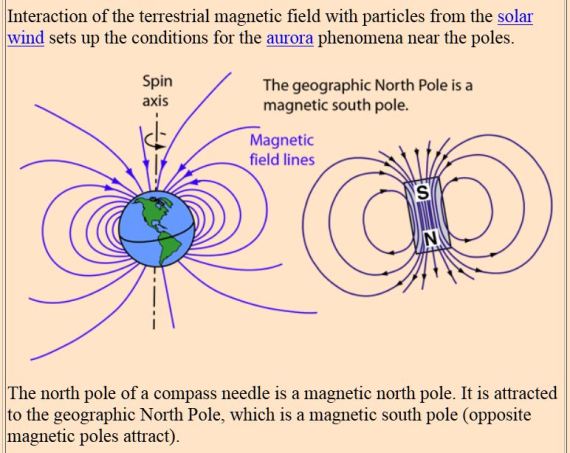
From Magnetic Field of the Earth
Our magnetic field protects us from incoming charged particles — cosmic rays — by deflecting them magnetically. Decrease the field and more cosmic rays come down to the surface. At the zero point of field strength, there’s only atmospheric gas molecules to stop them. In the 1960’s I learned that such charged particles are important causes of genetic changes, i.e. mutations. These protons, etc. come whizzing in from outer space, bang into our DNA molecules, knock a base pair or two around, and if it happens inside a spermatozoa or ova, the animal or plant born with that change is a mutant.
Many such mutations have no physiological affect whatsoever, causing only “genetic drift.” Many others are detrimental — with complex creatures, it’s easier for things to get worse rather than better. A few mutations bring an improvement: possibly the offspring will be stronger, faster, smarter, on any of a million other ways to “improve.” This is where natural selection comes in; the environment weeds out faulty genes and their owners, and — on average — good genes enable their owners to have more offspring. Evolution happens.
In the 1990’s, after his talk at a meeting I asked a geologist: “If huge numbers of incoming cosmic rays during these zero-point magnetic field events cause mutation rates to explode, wouldn’t a lot of animals die — from cancer, say — and greater numbers than usual of beneficial genes appear? Perhaps this has something to do with Gould and Eldredge’s theory of punctuated equilibrium? Nothing much changes for hundreds of thousands of years, then a magnetic pole reversal occurs, and suddenly new species appear and others disappear.”
“Interesting idea,” he said. “Possibly true, but I don’t know how anyone is ever going to be able to test it, or prove it, or disprove it.”
Time moves on, discoveries are made. Apparently we’re getting closer to testing and proving this idea.
ScienceNews.org | Carolyn Gramling | 18 February 2021
A flip-flop of Earth’s magnetic poles between 42,000 and 41,000 years ago briefly but dramatically shrank the magnetic field’s strength — and may have triggered a cascade of environmental crises on Earth, a new study suggests.
With the help of new, precise carbon dating obtained from ancient tree fossils, the researchers correlated shifts in climate patterns, large mammal extinctions and even changes in human behavior just before and during the Laschamps excursion, a brief reversal of the magnetic poles that lasted less than a thousand years. It’s the first study to directly link a magnetic pole reversal to large-scale environmental changes, the team reports in the Feb. 19 Science.
During a reversal, Earth’s protective magnetic field, which shields the planet from a barrage of charged particles streaming from the sun, can lose strength (SN: 1/28/19). So some researchers have suggested that these flip-flops may be linked to extinction events (SN: 11/19/20).

Kauri trees (one shown) have grown in New Zealand for thousands of years. By analyzing tree rings of preserved trees in the Ngawha swampland, scientists identified evidence to suggest a magnetic pole flip around 41,000 years ago.Mark Meredith/Moment/Getty Images
Link to the original article in Science, 19 Feb 2021.
Los Angeles Bird & Garden News
[Posted by Chuck Almdale]
The following is extracted from The Los Angeles Times, Saturday section, 20 February 2021.
The California Native Plant Society has a free and easy online tool to help you plan a native plant garden based on you ZIP Code, sun availability and goals for your yard. Answer a few questions and you’ll get a long list of suggested plants, along with their requirements for water, shade and types of pollinators they attract. https://www.calscape.org/
The camellias are blooming at Descanso Gardens. Now through the end of February is prime bloom time. Descanso has America’s largest collection of camellias, so put your ogling shoes on. Tickets are $15 for non-members, $11 seniors & students, $5 children 5-12, members free. Open 9-5 daily, 1418 Descanso Drive, La Canada Flintridge. https://www.descansogardens.org/
Bird Month at California Botanic Garden includes a chance for visitors to try to identify the many birds who thrive in the state’s largest botanic garden of California native plants (88 acres) at 1500 N. College Ave., Claremont. The contest has prizes to the people who document the most bird species at the garden. Also a scavenger hunt. Open 8-5 Tues-Sunday. Non-members must buy tickets ahead of time online: $10 admission, $6 seniors 65+ & students, $4 children 3-12. All visitors over 2 must wear a face covering. https://www.calbg.org/
February 27, online Zoom class Habitat Gardening for Birds and other Pollinators, led by California Botanic Garden horticulturist Chip Grubbs. This one-hour class focuses on how to turn your garden into habitat attractive to birds, bees and other pollinators, the types of plants to grow and how to care for them. Starts at 11am. $25 fee, $20 for members. https://www.calbg.org/
King tide recap Winter 2020-2021
[Posted by Chuck Almdale, all photos by Larry Loeher except where otherwise noted]
It seems like a good time to recap our winter king tides.
Not much dry beach during the 16 November 2020 king tide

Even less during the 15 December 2020 king tide

Still shrinking as of 13 January 2021 king tide

Some beach still showing as of 11 February 2021 high tide (demoted from king tide),
in addition to the ever-so-slightly higher sand island
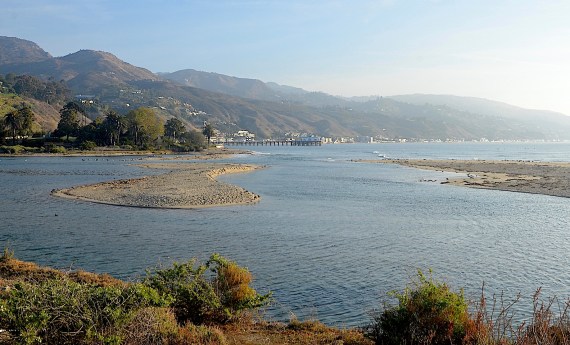
This 11 February 2021 photo shows almost crater-like curvature of opposing shores.
Riffling in the water suggests eddying of the current is taking place.

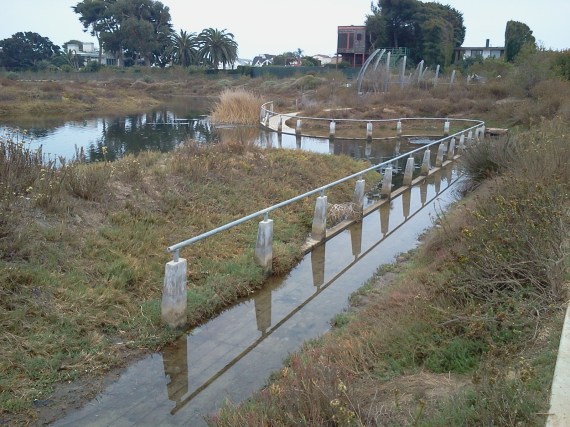
An inundated tidal clock sidewalk measured 6′ 9.6″ lagoon water
level a week after the king tide. (L. Johnson 11-23-20)
A pair of Redheads visited during the November king tide (Grace Murayama 11-16-20)

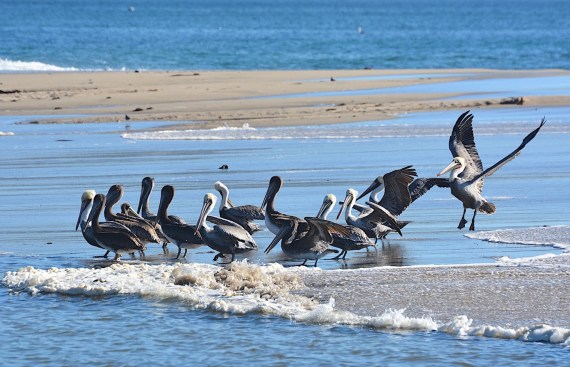
These Brown Pelicans “were bothered at each little wash-up of washover-surf”
according to photographer Larry Loeher during the 11-16-20 king tide.
You never know what might show up. Here’s a beautiful male Hooded Merganser
during the December king tide (Grace Murayama 12-15-20)

This nicely-plumaged male American Wigeon (aka Baldpate)
graced the lagoon during the 1-13-21 king tide.

As did this wing-drying or sun-warming Double-crested Cormorant.

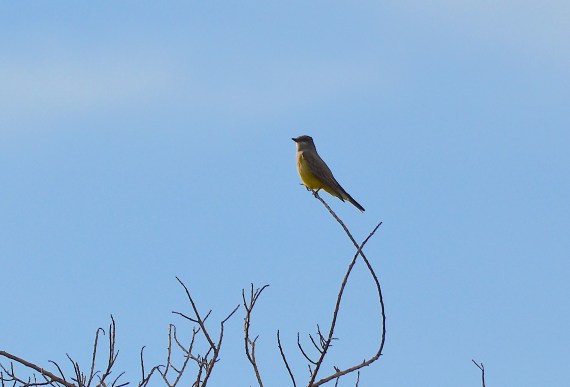
While this distant Cassin’s Kingbird (distinct white chin) waited for a flying fly to fly by.
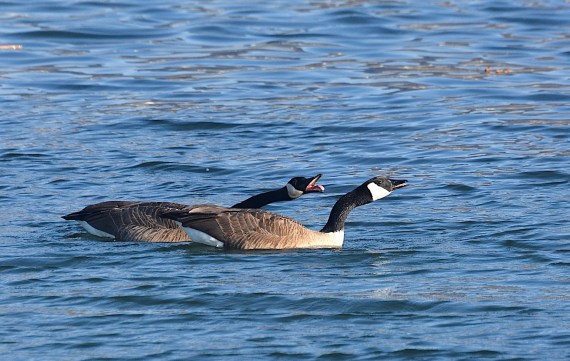
Two Canada Geese a-honking (Grace Murayama 2-11-21)
Two first-winter Heermann’s Gulls during February high tide (Grace Murayama 2-11-21)

The next really high tides will be May 25-27 with the high of 6.67 ft. @ 9:24pm, May 26.
Why were there different king tide dates for northern and southern California?
Southern California experienced King Tides in November and December. There was an additional January King Tide in northern California, north of Point Conception/Vandenberg AFB, due to a combination of astronomical influences such as the relative tilt of the Earth’s rotation with respect to the Sun and seasonal influences on water level such as temperature and wind that differ in southern California as compared to northern California over the course of the year.
An Osprey at Malibu Lagoon
[Posted by Chuck Almdale, photos by Chris Tosdevin]

Osprey has recently replaced the Red-tailed Hawk as the most common raptor at Malibu Lagoon.
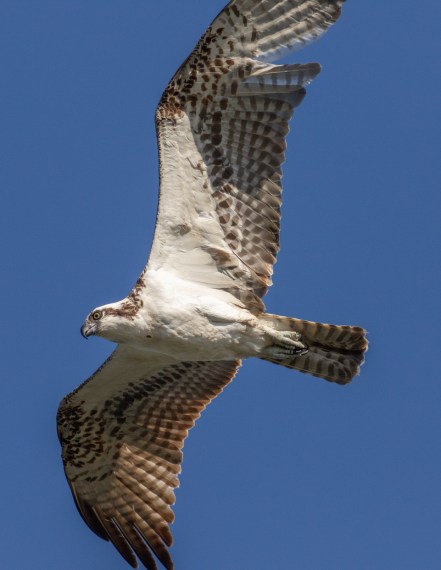
Since I began censusing the lagoon in October 1979 (there are gaps) and through January 2021, I’ve recorded 130 Red-tailed Hawks on 101 occasions, and 84 Osprey on 76 occasions. Red-tailed Hawks appeared one-third more often than Osprey.

But in more recent years, The Osprey has appeared more frequently. Check this chart.
| Osprey | Red-tailed Hawk | |||
| Period | Birds | Appearances | Birds | Appearances |
| 2020 | 5 | 5 | 4 | 2 |
| 2016-20 | 32 | 26 | 19 | 16 |
| 2011-20 | 59 | 52 | 56 | 41 |
| 1979-2020 | 84 | 76 | 130 | 101 |

Other than pure happenstance, the most likely explanation has to do with the greater abundance and reliability of lagoon fish, especially the “Jumping Mullet.” These are big fish relative to the Tidewater Gobies, which are hardly worth bothering with, if you’re an Osprey.

The 2012-2013 reconfiguration of the lagoon which eliminated the three narrow, shallow, nearly-anaerobic channels and greatly increasing the water surface area and depth, made the lagoon much friendlier to Mullet. You can often see them jumping from the water several feet into the air.

Osprey have long been classified into their own family of Padionidae of which they are the only member. There are four subspecies. Discussion occasionally arises concerning splitting Osprey into two or more “good” species, but it doesn’t seem to go very far, partially because the subspecies are very difficult to tell apart.

Osprey eat fish and little else. After they catch them in their talons, they grip them with both feet, one foot in front of the other, and carry the fish head first to reduce wind resistance. They return to a perch or to the ground to eat it, holding it in one or both sets of talons and tear at it with their sharply-pointed, hooked bill.

There has been a lot of recent discussion concerning the changing of birds’ English names to make some people happier. The Osprey’s English name goes a long way back, possibly to the 1300’s when many Latin and Old French words came into English, and has never been accurate. It was previously known as the “Ossifrage,” a term found in some English translations of the Bible. This came from Latin os “bone” + frangere “to break,” to make “bone-breaker.”

The problem with this is that Osprey don’t eat bones; they eat fish. From Choate’s Dictionary of American Bird Names:
The bird the old Romans called ossifragus is not the fish hawk [Osprey]. The ossifragus mentioned by Pliny was the Lammergeier, a German name, which means literally “lamb vulture.” It received its Latin name from its habit of dropping bones and even tortoises from a height in order to fragment their ossified body parts.
The Lammergeier is also known as the Bearded Vulture and is found from Eastern Asia to Southern Africa.

The scientific name is Pandion haliaetus (Linnaeus). According to Jobling’s Dictionary of Scientific Bird Names:
“Pandion comes from Pandion, the King of Attica, whose tragic daughters, Philomela and Procne, were metamorphosed into a nightingale and a swallow respectively.”
Choate gives an extensive description of the Greek myth, which I won’t trouble you with, and ends with Pandion possibly deriving from Greek pan “all” + dio(n) “god.” They both agree on haliaetus: Greek hals (halos) “the sea” + aetos “eagle.”
By any name, the bird loves fish. People often confuse it with that other fish-loving raptor, the Bald Eagle, primarily because they’re both large, have white heads (partially white in the case of the Osprey), are usually found near water and…eat fish!
A bird’s eye view of quantum entanglement | Nova
[Posted by Chuck Almdale]

Chryptochrome or Cry4, mentioned in the linked articles below, has been known and studied for some time as possibly involved in the ability of birds to navigate by the earth’s magnetic field. That quantum entanglement, which Albert Einstein characterized as “spooky action at a distance,” may be involved seems to be a new development. I think more evidence is needed. But read the articles and form your own opinion.
A bird’s eye view of quantum entanglement
Scientists have long wondered how birds “read” Earth’s magnetic field to navigate. Some think entangled particles in birds’ eyes play a role.
NOVA – PBS.org | Katherine J. Wu | 6 Feb 2019
In a bare, windowless room, a lone robin stretches her wings. The chamber is silent and dark, illuminated only by a dim artificial light source. But even with no apparent connection to the outside world, the small bird repeatedly flutters in the same direction, guided by an invisible force. It’s a scene scientists have watched play out again and again.
That force, it turns out, is Earth’s magnetic field, which arises from the electric currents in our planet’s molten, metallic core. Scientists have long known that birds are equipped with a mysterious ability to tune in to these orienting forces, but exactly how this works hasn’t been clear. But some researchers say they have a good working theory—and it shows that avian evolution has tapped into quantum mechanics.
Earth’s magnetic field is perhaps the most reliable navigational guide in nature, constant even when neither sunlight nor starlight is available, or landmarks fail to guide the way.
This article goes into the Cry4 protein in greater depth, discussing its involvement in circadian rhythms and the ability to sense magnetic fields.
Protein in Birds’ Eyes Helps Them ‘See’ Earth’s Magnetic Field
Called Cry4, the protein belongs to a group known to regulate circadian rhythms, or biological sleep cycles.
NOVA – PBS.org | Yasmeen Fakhro | 10 Apr 2018
Researchers have discovered a protein in birds’ eyes that allows them to see magnetic fields.
The protein, called Cry4, belongs to a group of proteins known to regulate circadian rhythms, or biological sleep cycles. It turns out that Cry4 serves a previously unknown function, interacting with light to help birds sense magnetic fields.
Here’s an early research paper on cryptochromes.
Retinal cryptochrome in a migratory passerine bird: a possible transducer for the avian magnetic compass
ResearchGate.net | Moller, Sagasser, Wiltschko, Schierwater | January 2015
Abstract –
The currently discussed model of magnetoreception in birds proposes that the direction of the magnetic field is perceived by radical-pair processes in specialized photoreceptors, with cryptochromes suggested as potential candidate molecules mediating magnetic compass information. Behavioral studies have shown that magnetic compass orientation takes place in the eye and requires light from the blue-green part of the spectrum. Cryptochromes are known to absorb in the same spectral range. Because of this we searched for cryptochrome (CRY) in the retina of European robins, Erithacus rubecula, passerine birds that migrate at night. Here, we report three individually expressed cryptochromes, eCRY1a, eCRY1b, and eCRY2. While eCRY1a and eCRY2 are similar to the cryptochromes found in the retina of the domestic chicken, eCRY1b has a unique carboxy (C)-terminal. In light of the ‘radical-pair’ model, our findings support a potential role of cryptochromes as transducers for the perception of magnetic compass information in birds.



 SANTA MONICA BAY AUDUBON SOCIETY BLOG