Free email delivery
Please sign up for email delivery in the subscription area to the right.
No salesman will call, at least not from us. Maybe from someone else.
Ballona Freshwater Marsh | Safety Update #2
[Posted by Chuck Almdale]
An update just arrived (Thurs. Feb. 11, 2021). Older messages on this are further below.
Hello Everyone,
I hope you are safe and well. The latest update is that CDFW Wardens will be patrolling the Freshwater Marsh soon (they may have started already, I am not sure). They will be mainly patrolling the Jefferson parking area in an attempt to increase safety and deter bad behavior, however, they may also patrol the inside gate which has restricted access. If you visit the marsh, please stick to the public trail if you do not an authorization letter to utilize the non-public areas, ie. the back maintenance road. If you need to access the back maintenance road you need to request an access letter, please let me know if you require this. If you do not have your ID and letter on you when stopped by a warden on the maintenance road, you will likely be fined. We still discourage you from going to the marsh, as conditions have not improved and the attackers have not been found.
Stay safe,
Neysa Frechette
Manager of Scientific Programs
Friends of Ballona
P.O. Box 5159 | Playa del Rey | CA | 90296
Ph: 310-306-5994
neysaf@ballonafriends.org
Hello Birders,
Some of you may be aware that parking, habitat, and safety conditions at the Ballona Freshwater Marsh have deteriorated significantly over the last 8 months or so. I have just been informed that on Tuesday [26 Jan. 2021] a woman who lives in Playa Vista was attacked at the Ballona Freshwater Marsh by three men with knives. She was able to escape and is okay but we don’t know any other details at this time and the men have not been found. The Ballona Wetlands Conservancy is working on measures to increase safety at the marsh. The marsh has not been very safe for some time now, but this confirmed attack pushes us to ask you to not visit the marsh for the time being. Your safety is very important to us. Please spread the word to any other birders that visit the marsh and are not on this email list. If they want to be added to this list for updates, please send me their email address. I will let you know of any new information I receive.
Best wishes during these troubled times,
Neysa Frechette
Manager of Scientific Programs
Friends of Ballona
Lisa Fimiani, long-term board member of Friends of Ballona and maven of all things Ballona, gave me some clarification, which I pass along to you with her consent.
“We have a very serious problem at the Ballona Freshwater Marsh with people who have taken up residence in their RV’s, cars, buses along Jefferson Boulevard; and some of them are not very nice people. The situation has escalated with more and more people crowding into the few parking spots left, so if you go there to bird you basically cannot find a parking spot on Jefferson. We’ve been battling this for over a year, long before the COVID-19 pandemic hit. The City has been absolutely useless in this situation – claiming they cannot force people to move due to COVID-19 restrictions. We’ve tried getting the City to put up NO OVERNIGHT PARKING signs, but the City won’t enforce them. Meanwhile, some of these “service resistant” folks have been cutting bushes and trees down for firewood, snagging wildlife with fishing lines, [going to the bathroom] everywhere, dumping unbelievable amounts of garbage, and basically running roughshod over our beloved Freshwater Marsh. I’m so angry I can barely speak about this, and the Marsh Manager, Edith Read, is beside herself (she’s copied). Her crew has had to deal with this mess, as well as the Ballona Wetlands Conservancy, who have been forced to hire HAZMAT crews and now security to patrol the area.
If you know anyone high up in government who can help, please reach out.”
There you have it. Be careful out there. And if you have any pull, push or twist with local government, feel free to use it.
Owls of the Eastern Ice | Jonathan Slaght | Book recommendation
[Posted by Chuck Almdale]
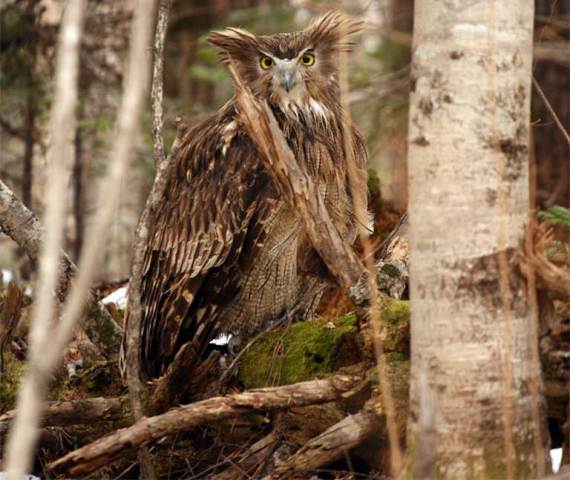
Among the world’s 237 species of owls – 18 Barn-Owls in Tytonidae and 219 Typical Owls in Strigidae – there are many beautiful, odd, scary, tiny, giant and mysterious owls. High on the list of owls I find mysterious and want to know more about are the Fish- and Fishing-Owls. How the devil does an owl catch fish at night? Do they see them? Hear them swimming or surfacing? Pure dumb luck? Missing a supposedly-staked-out Pel’s Fishing Owl Scotopelia peli in South Africa was a great disappointment, but seeing five Buffy Fish-Owls Ketupa Ketupui in Borneo, spotlighted at night on the Tenegang River, dropping from a perch into the water and coming up with fish in their talons, more than made up for it.
Author Jonathan C. Slaght is another for whom these charismatic owls remain an attraction and a mystery. So he decided to combine his desire to know more about these owls – specifically the Blakiston’s Fish-Owl Ketupa blakistoni – with his love of the Primorye area of far eastern Siberia, north of Vladivostok, where he’d happened to photograph the bird, and his need for a research project for his Ph.D. thesis. This book records the fun, adventure, culture, people, forest, miserable conditions and the grueling hard work he had while carrying out that project. Slaght is a wonderful teller of tales, and from here on, I’ll let his words draw you into his story.
Links to Slaight’s website and some factoids about fish-owls follow the excerpts below.
Owls of the Eastern Ice: A quest to find and save the World’s Largest Owl
Jonathan C. Slaght | Farrar, Straus and Giroux, New York | 2020 | 314 pages & notes & index
By joining this expedition, I would help protect fish owls of the Samarga and also gain important experience in the art of search for them. These were skills I would apply to the second phase of the project: identifying a study population of fish owls. Surmach and Avdeyuk had compiled a list of sites in the more accessible forests of Primorye where they had heard fish owls calling, and they even knew the locations of a few nest trees. This meant we had a place to focus our preliminary searches….Avdeyuk and I would spend a few months visiting these sites and more within a twenty-thousand-square-kilometer area along much of Primorye’s coast. After we’d found some fish owls, we would return the following year and begin the third, final, and longest stage of the project: captures. By outfitting as many owls as possible with discreet backpack-like transmitters, over a period of four years we could monitor their movements and record where they went. Such data would tell us exactly what parts of the landscape were most important to fish owls’ survival, which we could use to develop a conservation plan to protect them.
How hard could it be?

Primorye is where far eastern Russia borders China, North Korea and the Sea of Japan
After a kilometer or two without incident, I heard a sudden, sharp crack reverberate behind us. I looked back. A broad sheet of ice in between our snowmobile and Tolya’s had separated from the rest of the river ice, darkening as water spread across it. Tolya slowed his machine and stood for a better view.
“You need to move now!” screamed Sergey, catalyzing Tolya into action. He pushed the engine and streaked across the wet surface as the displaced ice continued to shift. The floating sheet pressed down under him but held his fleeting weight, and he pulled up alongside us, panting and swearing. From that point on, each meander in the river brought with it a dread of what the far side might bring. We continued on, besting naleds [slushy mixture of water and frazil ice], enduring slush waves, skirting holes that had once been trail, and watching the river devour ice in our wake.
We…had just started off again when suddenly the water before us flowed free in the main current, hugging the left bank and then crossing the entire riverbed to continue flowing down the right band and out of sight around a bend. The snowmobile trail drove into the water, then picked up on the far side of a thick ice shelf. This was no naled to fumble through. We were trapped.
“Good a place as any for lunch,” said Sergey, lighting a cigarette and staring pensively downriver.
“Do you know why Tolya doesn’t drink?” John asked quietly, peering at me inquisitively over the mouth of his half-liter bottle of beer. I replied that I did not. John nodded and continued.
“He told me he was in the Altai Mountains some years back, visiting some family, and he drank too much wine on a picnic. He was reclining on the grass, looking at the blue sky above, when something inside made him wish for rain. To his amazement, the drops started falling. Tolya realized then that he had power over the weather, and decided to quit drinking because he needed to shepherd this dangerous responsibility.”
I stared at John, unsure of how to respond.
“Just when you think someone’s right in the head,” said John, drawing on his beer, “they go and say something like that.”
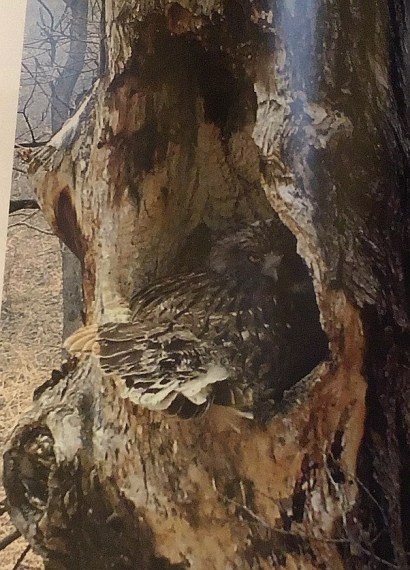
My movements were deliberately slow and noiseless. I was terrified of spooking the female, who was on the nest and certainly saw me approach. As the screen focused I could see she was in place, and to my relief she sat still with an air of calm. Toward dusk she perked up, catching sight of something and I heard a noise in the tree above — probably the male landing nearby. This suspicion was validated when the female ambled out of the nest and walked along a branch out of view. Then the duet began, deep and resonant and loud, just overhead.
I sat mesmerized as I listened to the owls above, hushing the sound of my heart pounding in my ears, reluctant to swallow or twitch for fear the owls would hear me and break off this captivating ritual. Even at close distance the sounds seemed muffled, as though the birds were hooting into pillows. The juvenile fish owl, clearly visible on the monitor, was a small gray sack of potatoes that waddled to and fro in the wide and flat nest cavity, shrieking. He knew food was soon, coming and unlike me, he had no patience for all this hooting.

I smiled when I thought of how the next field season would go: we’d sit in the relative warmth of an insulated blind, tucked into lofty down mummy bags with hands gripping mugs of hot tea, watching our trap sites in real time on a flickering, monochrome screen. When an owl flew in to inspect our bait, we’d know immediately and be ready. No more guessing about the nature of strange sounds in the dark and no more questions about how much cold my extremities could take before I needed to start worrying about frostbite. I had no idea how inconvenient these conveniences would turn out to be.
Apparently Anatoliy had worked as an informant for the KGB for a period in the early 1970’s as a sailor in the Soviet merchant marines. It was not uncommon for Soviet citizens to be asked to inform on their peers, especially those traveling abroad. In fact, one estimate suggested that by the Soviet Union’s collapse in 1991, up to five million people could be considered informants.
Katkov recounted the first time he had ever seen a fish owl. “I formed a mental image of a majestic creature living in only the most immaculate of environments: roosting in a snow-covered pine, then dropping into the clear water of a mountain stream to grip an enormous salmon.” He paused and laughed. “Want to know the first time I saw one? I was driving with Sergey to Amgu last spring to recapture the Kudya female. It was almost midnight, and it was absolutely pouring rain. As the road took that last big turn at the base of the Amgu Pass, the headlights illuminated a fish owl. It was sitting on the side of the road on a discarded truck tire, its feathers flat from the pouring rain, and it was choking down a frog! Not what I was expecting, I can tell you that. Not very regal!”
International Women’s Day was always on March 8 and had been a major national holiday of prime importance in Russia since 1917. It was international in the sense that it was observed globally, but with the greatest vigor in Russia, former Soviet states, and communist countries such as Cuba. Men spend this holiday, often just called “the Eighth of March” in Russia, heaping flowers, chocolates, and opulent praise upon the women in their lives. Declarations of appreciation can be so hyperbolic that they don’t translate well culturally, as evidenced by a recent exchange at the University of Wisconsin. There, Russian students visiting on International Women’s Day wished their female American counterparts success in childbirth and thanked them for their patience with the sterner sex. The women, deeply offended and unsure of how to respond, nearly reported the Russians for sexual harassment.
As I approached the river, three carrion crows cawed excitedly from the forest edge. Two of them flew over to me, circled, then returned from where they had come. I followed their flight with my eyes and caught motion among the pines below: a wild boar. Had the crows purposely alerted me to its presence, hoping to feast on the offal a hunter typically leaves behind? I watched the wild boar amble along and out of sight, unaware that he had been betrayed.
Link to website Of Johathan C. Slaight.
In addition to the usual biography, contact information, book blurbs and upcoming events, it has the following films:
Book Trailer for Owls of the Eastern Ice
How big is a Fish Owl?
How wild is Primorye?
Plus it has songs and calls of Blakiston’s Fish-Owl:
Duetting pair
Young fish owl, begging parents for food
Fish Owl Courtship
Fish- & Fishing-Owl factoids
If the data seems a bit skimpy, it is. More research is on this unusual group of owls is needed.
Information from Handbook of Birds of the World.
Blakiston’s Fish-Owl Ketupa blakistoni. Length 60-72cm, Wingspan 180-190cm, Weight 3500-4300 gm. Nocturnal, fishes from perch, log or bank; fish large and small, crabs, crayfish, frogs, birds up to grouse-size, occasionally bats in flight.
Four subspecies:
K.b. piscivora – Western Manchuria
K.b. doerriesi – Southeast Siberia, extreme Northeast China & North Korea
K.b. karafutonis – Sakhalin Island
K.b. blakistoni – N Japan (southern Kuril Islands and Hokkaido)
Brown Fish-Owl Ketupa zeylonensis. Two subspecies. Range: Turkey – Sri Lhanka – Southeast China- IndoChina. Length 50-57cm, Weight 1105gm. Nocturnal, fishes from perch or wading; also frogs, crabs, crayfish, snakes, lizards, rodents, birds and large insects.
Tawny Fish-Owl Ketupa flavipes. Range: Himalayas – Taiwan – Indochina. Length 48-55cm. Nocturnal, fishes from perch; also crayfish, crabs, rodents, lizards, large beetles, and large birds.
Buffy Fish-Owl Ketupa ketupui. Four subspecies. Range: East India – Indochina – Indonesia – Borneo. Length 38-44cm. Smallest fish-owl. Nocturnal, fishes from perch; also frogs, crustaceans, reptiles, large aquatic insects, small mammals and birds, carrion.
Pel’s Fishing-Owl Scotopelia peli. Range: Sub-Sahara Africa. Length 55-63cm, Wingspan 150cm, Weight 2055-2325gm. Nocturnal, fishes from perch 1-2m high; also frogs, crabs, mussels, large insects. Prey probably detected from surface ripples, acoustical cues probably not used.
Rufous Fishing-Owl Scotopelia ussheri. Range: Sierra Leone – Ghana. Length 46-51cm, Wingspan 150cm, Weight (1 male) 743gm. Nocturnal, fishes from perch, sometimes wades from bank.
Vermiculated Fishing-Owl Scotopelia bouvieri. Range: Cameroon – Angola. Length 46-51cm. Nocturnal, fishes from perch 1-2m high; also frogs, crustaceans, small birds and mammals.
And, for comparison, what used to be considered the largest owl in the world, until Jonathan Slaght captured and measured a particular female Blakiston’s Fish-Owl:
Eurasian Eagle-Owl – Bubo bubo. Length 60-75cm, Wingspan 160-188cm, Weight one male 1500-2800gm, female 1750-4200gm.
Followup: Jess Morton’s Panama show & Adopta
[Posted by Chuck Almdale]
For those who enjoyed Jess Morton’s program on Panama and would like to help the in-Panama environmental charity he talked about, here’s the information.

The following is an article originally published in Hummin’, the newsletter of the Palos Verdes / South Bay Audubon Society.
A Chucantí Update
By Paul Blieden
In late 2019, Guido Berguido, gave a highly entertaining program for Audubon. He told his story: how a young birder became a passionate conservationist. All he had wanted to do was see all the birds of his native Panama. Then, fifteen years ago, he began taking birders to a remote mountain top in which he had been finding birds never before reported from that part of the country. Each time he went, there was less and less forest to explore. Guido realized that unless something was done, the cloud forest of that sky island, Cerro Chucantí, would disappear—and that it would be up to him to save it.
Chucantí became his life’s work. With no money, but youthful energy and passion, and the will to succeed, Guido has managed to bring funders and conservation-minded people to his side, including Rainforest Trust and our Audubon chapter. Through Adopta, the Panamanian non-profit he created for Chucantí, he acquired the first 1500 acres of what he hopes will become a 50,000-acre national park. He has built a research field station at the edge of his preserve and brought scientists of many disciplines to study the flora and fauna. To date, more than 40 new species [50 as of January 2021] have been found, among them snakes and coffee plants. Many await the funds to describe them formally. And because of the constant threat of illegal logging and burning, Guido has hired rangers to protect the preserve.
Two years ago, Guido led a group of birders on an adventure in Panama that was organized by our treasurer and long term board member Jess Morton. A highlight of the trip was an unforgettable visit to the field station on Chucantí. As a result, our chapter became a strong supporter of Guido’s efforts.
Recently Guido brought us up to date via Zoom from his home, in Gamboa, Panama. He said that to thank us for our critically needed financial help, we would have the honor of naming one of the many new species discovered on Chucantí, a calla lily in the genus Dieffenbachia. The lucky person to name it was drawn by Guido from among the donors to Adopta through PV Audubon. In the drawing, held via Zoom on Saturday, October 3rd, he picked Evi Meyer, a long-time chapter member.
When asked about winning the drawing, Evi said, “Sure. I was happy to hear that I was the winner, but really, the person who is the winner is Jess Morton. Without him we never would have gone to Panama to meet and bird with Guido. Jess was also instrumental in setting up Guido’s visit to Southern California and several of its Audubon chapters to report and inform on Chucanti and Adopta. For all those reasons it was a no-brainer for me to have the flower named after Jess and not myself. It represents a big thank you to Jess for all he does for conservation and our natural environment.”
Publication of this new species will establish its scientific name, a highly important designation. Its known range is limited to the Chucantí Preserve. Thus it is extremely vulnerable, but once named, it will be eligible for the “Critically Endangered” status Guido will be seeking for it. The naming could save a species from extinction!
Wombat poop, cubed | Science News
[Posted by Chuck Almdale]
Just when you thought it was safe to into (out to?) the outback again, the wombats are cubing their poop. What’s next? Making igloos out of them? Skyscrapers? Rabbit-proof fences?
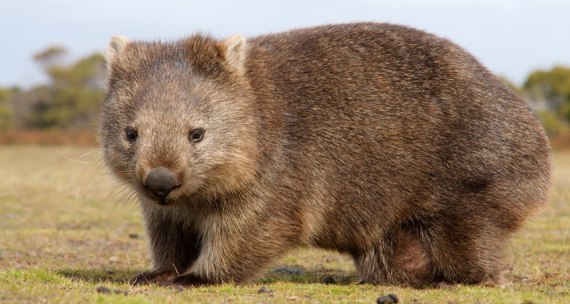
Wombats are the only animals whose poop is a cube. Here’s how they do it.
The elasticity of wombats’ intestines helps to shape their distinctive poops
Science News | Laurel Hamers | Nov 18 2018
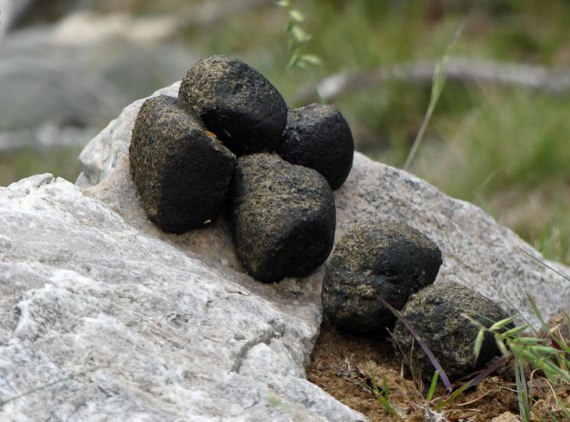
The varied elasticity of the wombat’s intestines helps the marsupials to sculpt their scat into cubelike nuggets, instead of the round pellets, messy piles or tubular coils made by other mammals, researchers reported November 18 at the American Physical Society Division of Fluid Dynamics meeting in Atlanta. More…
Minnesota Bird Songs
[Posted by Chuck Almdale | Suggested by Jane Beseda]
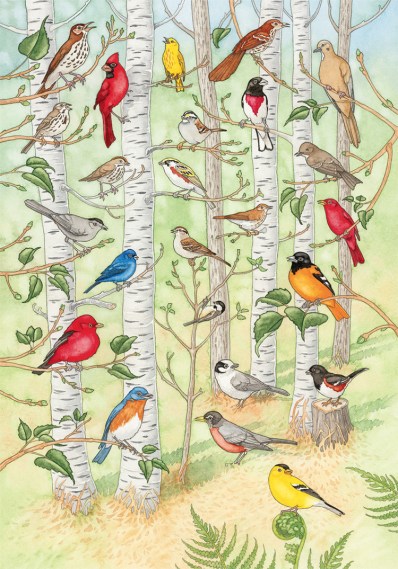
There’s a very cool interactive graphic on this site just like the non-interactive picture to the right, kindly supplied to me by William Stone. Click on a bird and it sings for you. Go and look.
If anyone knows of any other such interactive artwork, send me a link and I’ll post it. I’d especially like to have one for California. The American West always seems to get the short end of the stick when it comes to work like this.



 SANTA MONICA BAY AUDUBON SOCIETY BLOG